
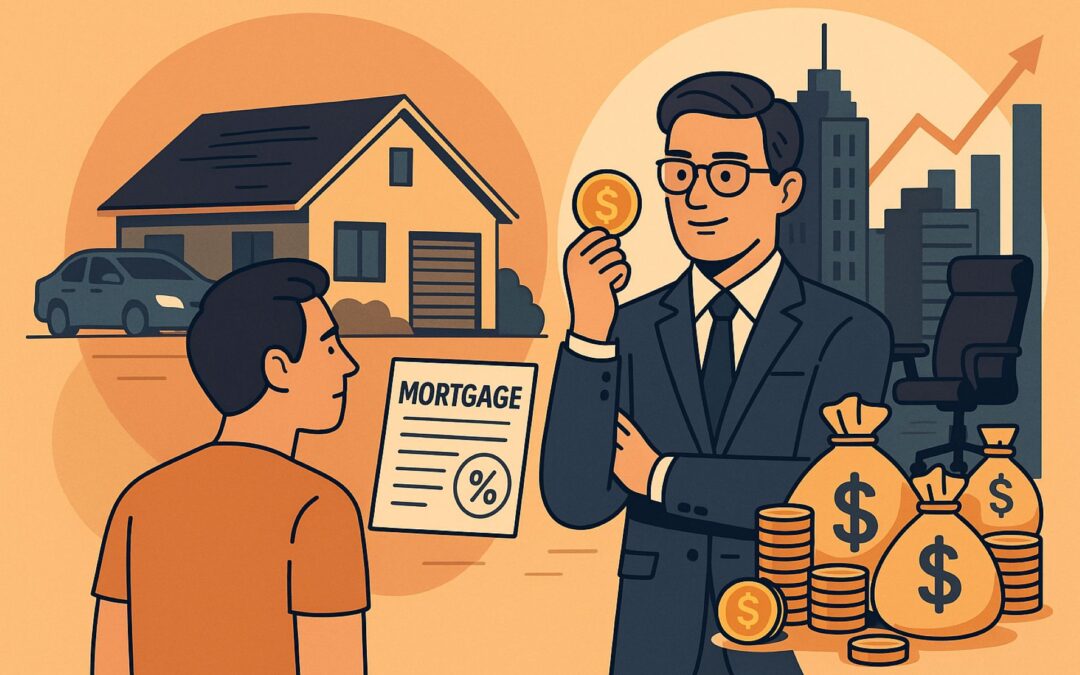
You can tell how wealthy someone is without ever seeing their bank balance — just look at what they own. A person’s portfolio is a mirror of their mindset. It reveals not just how much money they’ve earned, but how intelligently they’ve positioned it. Most people believe owning a home or clearing debt means they’ve “made it,” but true wealth follows a very different architecture. The rich don’t merely collect assets — they build systems. They don’t chase income — they create engines that produce it.
Wealth, as it turns out, grows in stages. From the illusion of homeownership to the quiet power of ownership itself, each stage demands a shift in how you think, spend, and structure your life. And while most people never make it past the second stage, understanding what separates the rich from everyone else could change how you approach your own financial journey forever.
Stage 1: The Mortgage Prison
The first stage of wealth isn’t about luxury or freedom — it’s about survival dressed up as progress. This is where most people spend their entire financial lives without realizing they’re trapped. They’ve done everything society told them to do: go to school, get a job, buy a home. On paper, they’re “building equity.” In reality, they’re servicing debt.
The illusion is powerful. Homeownership feels like a milestone — a mark of stability, maturity, and success. But the truth hides in the fine print: most homeowners don’t own their homes. The bank does. The deed may bear their name, but until that last payment clears, they’re merely renting from the lender with slightly better terms.
According to data from the Federal Reserve, the bottom 50% of American households have over half of their total net worth tied up in their primary residence. That means one house — one physical, immovable object — represents their entire financial world. They’ve placed all their chips on a single square: their home’s value.
That’s what makes this stage so fragile. If real estate prices fall, their “wealth” evaporates. If they lose their job, the bank still expects its payment. If the roof leaks or the furnace breaks, they can’t delay the expense. Their supposed “asset” constantly drains them — property taxes, maintenance, insurance, and the never-ending mortgage. What they call security is, in fact, dependency.
And even worse, their so-called equity earns them nothing. It just sits there — illiquid, idle, and inert. Unlike investments that pay dividends or businesses that generate income, a house produces no return unless you sell it or borrow against it. It’s wealth in name only — a financial mirage that offers comfort while quietly caging the owner.
The Debt Loop
Every month, a large portion of their income disappears into the mortgage — a ritual that never seems to end. Thousands of dollars flow to the lender, not toward creating wealth, but toward repaying the past. This is the cycle of the lower class: working endlessly to maintain a lifestyle that keeps them from moving forward.
The Richmond Fed calls it what it is — a debt-servicing economy. Mortgages remain the largest liability for 90% of households in America. Instead of being a launchpad, homeownership becomes an anchor. Families pour their effort into keeping the house rather than leveraging it.
Outside of the home, the picture doesn’t improve much. They might have a car — another depreciating liability that loses value the second it leaves the dealership. They may keep a few thousand dollars in savings, but inflation eats away at it faster than interest can replenish it. A modest retirement account sits in the background, underfunded and underperforming. It’s a fragile ecosystem built on instability.
The Illusion of Safety
At this stage, security is psychological, not financial. The house feels safe because it’s tangible — something you can touch, see, and live in. But tangibility isn’t the same as liquidity. You can’t sell a bedroom to pay a medical bill. You can’t cash in your kitchen to survive a layoff.
The illusion deepens because everyone around is living the same way. The neighborhood looks stable. The conversations sound reassuring. But most of these families are one emergency away from financial collapse. A job loss, a health crisis, or even a market correction could erase years of perceived progress.
And yet, they cling to the home — not because it’s profitable, but because it’s familiar. Society equates homeownership with success. Banks reinforce this by lending freely, creating the illusion that debt equals opportunity. In truth, it’s the opposite. The more of your net worth is trapped in illiquid assets, the less freedom you have.
The Path to Escape
The escape from this stage isn’t glamorous — it’s disciplined. You don’t climb out through luck or sudden windfalls. You climb out by killing the mortgage. Every extra payment, every refinance at a lower rate, every attempt to accelerate payoff is a strike against the prison bars.
Once that debt is gone, the transformation is profound. Cash flow — the lifeblood of financial freedom — returns. If $1,200 a month no longer vanishes into the bank’s pocket, that’s $14,400 a year of liberated capital. It can now be redirected toward real assets: investments, index funds, or even entrepreneurial ventures. For the first time, money starts working for you instead of being absorbed by obligation.
This shift from servicing debt to creating cash flow is the true graduation moment. It marks the transition from financial stagnation to mobility. The numbers may not look huge at first — a few hundred dollars here, a few thousand there — but over time, this reallocation compounds.
The Anatomy of a Typical Household
Let’s break it down. The average family at this stage might show a net worth of $150,000, but here’s the reality behind the numbers:
- $100,000 in home equity (still tied to the mortgage)
- $10,000 in a car that’s losing value every year
- $5,000 in a savings account barely keeping up with inflation
- $5,000 in a small retirement account or 401(k)
- The rest? Credit card debt, personal loans, or monthly expenses
It looks respectable on paper, but it’s dangerously concentrated. Nearly 70% of their wealth is locked in an illiquid form, and the rest is either shrinking or static. If they needed $10,000 tomorrow, they’d have to borrow it — often against the very house they think they own.
The Realization
This is the uncomfortable truth: the lower class doesn’t lack income — it lacks leverage. Every dollar earned is spent to maintain a structure that doesn’t generate returns. Their time and effort are consumed by stability, not growth.
To graduate from this stage, one must embrace a radical redefinition of wealth. It’s not about having things; it’s about having things that move. The goal isn’t merely to live in a house — it’s to reach a point where your house lives for you, not the other way around.
Only when the mortgage is gone, the equity unlocked, and the cash flow freed can you step into the next stage — where safety stops being an illusion and begins to evolve into strategy.
Stage 2: The Plateau of Security
Stage two is the great resting place of modern society — the land of comfort, predictability, and quiet stagnation. Most people who escape the mortgage prison settle here and never leave. They’ve worked for years, cleared their debts, and now own their homes outright. For the first time, they feel untethered. But what feels like freedom is often just stillness disguised as safety.
They’ve eliminated the chains, but not the ceiling. The cash that once disappeared into monthly mortgage payments now sits in savings accounts, retirement funds, and low-yield investments. The fear of loss lingers, so they cling to preservation instead of progress.
The Anatomy of Stability
At this level, the balance sheet looks impressive — on paper. A fully paid-off home, a decent retirement account, some cash in the bank, and maybe a car or two that’s fully owned. The numbers convey stability, but the composition reveals the truth: the majority of their wealth remains concentrated in slow-moving or stagnant assets.
According to the Federal Reserve’s Distributional Financial Accounts, households in the 50th to 90th percentile — the broad “middle class” — still hold 40–60% of their wealth in their homes. That’s a smaller concentration than the lower class, but it’s still dangerously high. The home may be debt-free, but it’s not producing income. It’s just sitting there, absorbing maintenance costs, property taxes, and insurance.
The rest of their wealth tends to live in retirement vehicles — 401(k)s, IRAs, and pensions — which make up roughly 20–30% of their portfolio. These accounts provide psychological safety but little flexibility. The money is locked away for decades, growing modestly but inaccessible without penalties or taxes.
The remaining 10–20% usually sits in cash, bonds, or certificates of deposit. These instruments are intentionally conservative. They offer peace of mind but lose ground to inflation every single year. In total, this portfolio structure is not designed for growth — it’s designed for comfort. And comfort is the greatest enemy of wealth creation.
The Growth Gap
The middle-class approach is built on a dangerous misunderstanding of time and compounding. They believe they’re safe because their assets grow slowly but steadily. But over a 30-year span, small differences in growth rates compound into enormous differences in outcomes.
Consider this: a home appreciating at 3% per year doubles in roughly 24 years. A conservative portfolio earning 5% doubles in about 14 years. But equities — compounding at 8% — double in just nine. Now stretch those numbers across a lifetime. That’s the difference between ending with a few hundred thousand dollars and crossing into multi-millionaire territory.
This is why the middle class rarely escapes its bracket, even when debt-free. They eliminate volatility, but also velocity. Their portfolios are designed to protect what they have, not to expand it. They value stability over opportunity, and in doing so, they quietly trade potential for peace.
The Psychology of Arrival
Perhaps the most insidious trap at this level isn’t financial — it’s psychological. The middle-class individual genuinely believes they’ve arrived. The markers of success are all there: a paid-off house, a car in the driveway, and enough savings to weather a storm. They compare themselves to those still paying off debt and feel victorious.
That feeling is addictive. It breeds complacency. The mindset shifts from “How can I grow?” to “How can I protect what I have?” This subtle change turns ambition into maintenance. People begin spending on comfort — home renovations, vacations, a new SUV — instead of re-investing in assets that grow. They feel they’ve earned the right to enjoy stability, and in a way, they have. But the price of that comfort is opportunity foregone.
It’s not that the middle class can’t become wealthy — it’s that they stop trying. They mistake the absence of debt for the presence of freedom. They stop taking calculated risks. They no longer stretch, explore, or learn. They’ve completed the financial checklist society gave them, so they close the book instead of writing the next chapter.
The Hidden Weakness in “Safe” Wealth
What most people at this stage don’t realize is that their “safe” portfolio is still vulnerable — not to collapse, but to erosion. Inflation quietly eats away at purchasing power. The cost of living rises faster than their returns. Retirement accounts tied to conservative funds underperform against the broader market. Even their home, the symbol of their success, underperforms compared to other asset classes.
A $500,000 home might appreciate to $1 million in 25 years, which feels like a win — until you factor in inflation, taxes, and maintenance. Adjusted for real value, the gain is far smaller. Meanwhile, someone who directed their surplus cash flow into equities or business ventures during that same period could easily see 3–4x that growth.
This difference compounds not just in numbers but in options. The middle class spends their later years managing expenses; the wealthy spend theirs managing investments. One lives off finite savings; the other off infinite yield.
Breaking the Middle-Class Ceiling
Graduation from this stage doesn’t require abandoning security — it requires reinterpreting it. True security comes not from what you own, but from what you control. A house is shelter. A portfolio is protection. But ownership of productive assets — businesses, equity, or scalable investments — is freedom.
To rise beyond the plateau, one must redirect the newly liberated cash flow from mortgage payments into assets that work. The $1,000–$1,500 per month that once went to the bank must now be deployed intentionally — into index funds, dividend stocks, rental properties, or entrepreneurial ventures. Every dollar should have a job. Idle cash is comfort. Active cash is leverage.
This transition requires courage because it feels like stepping backward into risk. After decades of chasing safety, embracing volatility again seems counterintuitive. But it’s the only path forward. The wealthy aren’t reckless — they’re strategic. They diversify risk instead of avoiding it. They understand that money sitting still is money slowly dying.
A Subtle Shift of Identity
The middle class sees wealth as the absence of debt. The wealthy see wealth as the presence of growth. One is defensive; the other offensive. To graduate, you must shift from the mindset of a protector to that of a builder.
Stop treating your home as your masterpiece and start viewing it as an asset among many. Stop idolizing liquidity as safety and start valuing cash flow as security. Stop waiting for your portfolio to grow passively and start feeding it actively.
Because while the middle class sleeps comfortably in their paid-off homes, the wealthy stay awake — not out of worry, but out of curiosity. They ask questions that lead to opportunity. They reinvest, recalibrate, and reposition constantly.
At Stage 2, you’ve built the fortress. But if you stay inside its walls too long, it becomes a cage. The next evolution of wealth demands you step outside — not to risk everything, but to make what you’ve earned truly work for you.
Stage 3: The Compounding Class
Stage three is where money begins to breathe — where wealth starts generating its own momentum independent of the owner’s labor. This is the inflection point between working for money and money working for you. Those who reach it no longer measure their progress in salaries or possessions, but in the velocity of their capital.
They’ve mastered the basics — debt is gone, savings are robust, and cash flow is positive. But more importantly, they’ve moved beyond comfort. They’ve stopped hoarding safety and started pursuing scalability. Their wealth isn’t stored in one or two large, immovable assets like a home — it’s diversified across systems that grow while they sleep.
The Architecture of the Upper-Class Portfolio
At this level, the portfolio has evolved in structure and behavior. The house still exists, but it’s no longer the centerpiece. It now represents 25–30% of total net worth — an asset of utility rather than strategy. The rest of the wealth is distributed across instruments that compound — equities, retirement accounts, business stakes, and income-generating real estate.
A typical upper-class household, worth around $1 million, might have:
- $300,000 in home equity — steady but slow growth
- $350,000 in equities and mutual funds — compounding through dividends and appreciation
- $250,000 in retirement accounts — tax-deferred growth for long-term stability
- $100,000 in cash and liquid assets — a buffer for opportunity or downturns
What defines this stage isn’t the balance sheet’s total, but its composition. This is the point where financial assets finally outweigh physical ones. Wealth begins to behave differently — it accelerates.
The Mathematics of Acceleration
Compounding is the quiet miracle of wealth creation. A home might appreciate 3% annually — slow, steady, predictable. But equities historically return 7–10% per year. The gap seems small — until time magnifies it.
Let’s put that into perspective:
- $300,000 invested in a home at 3% for 25 years becomes roughly $628,000.
- The same $300,000 in equities at 8% becomes $2 million.
That’s not a marginal difference — that’s an entirely different financial destiny. The same principal, but a radically different philosophy.
And that’s why the upper class views wealth not as ownership of things, but of growth vehicles. They want their money exposed to compounding environments — markets, funds, businesses, and scalable assets. The focus shifts from stability to acceleration.
Passive Income: The Silent Engine
By this stage, the wealthy have detached their survival from their income. They don’t live paycheck to paycheck. They live portfolio to portfolio.
Their assets produce yield even while they rest. Dividends arrive quarterly. Interest accumulates. Capital gains compound invisibly through reinvestment. They’ve engineered a system where money performs labor.
This is why, even when upper-class individuals stop actively earning, their wealth continues expanding. The mechanisms they’ve built — stocks, mutual funds, business ownership — generate returns autonomously. It’s not about working harder anymore; it’s about owning smarter.
From Worker to Investor
This stage requires a profound shift in identity. Up until now, money was earned through personal effort — a direct exchange of time for pay. But here, money becomes detached from hours. The game transforms from income generation to asset allocation.
Every financial decision now revolves around one question: Where does this dollar work best?
They stop chasing promotions and start chasing yield. They stop accumulating possessions and start accumulating equity. The home, the car, the lifestyle — all remain, but they’re now symbols of success, not strategies for it. The real engine hums quietly behind the scenes in brokerage accounts, private investments, and business equity.
The New Trap: Overconfidence
But every level of wealth comes with a unique temptation. For the compounding class, that danger is overconfidence. Success in markets or investments can create the illusion of infallibility. People begin believing they can’t lose. They start chasing “hot” opportunities — high-risk startups, speculative crypto plays, over-leveraged real estate — without a clear system to protect themselves.
It’s how once-successful investors lose half their fortunes in a single downturn. Their strength — the willingness to take risk — becomes their undoing when not tempered with discipline.
The wealthy who endure understand this balance. They diversify intelligently. They build safety nets without sacrificing growth. They let compounding do its quiet work instead of trying to outsmart it.
The Compounding Mindset
The mindset at this level is calm, strategic, and patient. True upper-class wealth builders are not gamblers — they are gardeners. They plant capital and give it time to bloom. They understand that time in the market beats timing the market.
They treat every dollar as a seed. Some are allocated to growth, some to protection, and some to liquidity for new opportunities. They think in terms of decades, not months. While the lower classes measure success in income and possessions, and the middle class measures it in debt freedom, the compounding class measures success in growth rate.
If their net worth grows faster than their spending, they’re moving forward. If it grows faster than inflation, they’re protecting purchasing power. If it grows while they sleep, they’re winning.
The Inflection Point: Investor vs. Owner
At the tail end of this stage lies a critical choice. The upper class must decide whether to remain investors in other people’s systems or evolve into owners of their own.
An investor participates in growth. An owner controls it.
That’s the distinction between someone who holds stocks in a company and someone who builds a company. The former shares in the upside; the latter dictates it.
Reaching Stage 3 gives you the capital and stability to choose. But to graduate beyond it — to enter the realm of the ultra-wealthy — requires a transformation in philosophy. You must stop asking, “What can I invest in?” and start asking, “What can I create?”
Because the truth is, every great fortune was built not by owning shares of someone else’s dream, but by owning the dream itself.
The Transition to Ownership
The transition from investor to owner is subtle but profound. It’s not about abandoning the markets — it’s about building alongside them. It could mean starting a business, acquiring equity in a private company, or creating intellectual property that scales. It’s about designing systems that generate income without your constant supervision.
At this level, money is no longer the destination — it’s the tool. You stop asking how much something costs and start asking what it produces. You stop working for stability and start building engines of autonomy.
Stage three is not the end of the journey — it’s the beginning of exponential possibility. Those who linger here will live comfortably, even luxuriously. But those who graduate to the next level — the ownership class — will cross the invisible threshold between wealth and power.
They’ll stop riding the compounding curve and start designing it.
Stage 4: The Ownership Class
Stage four is not simply the top of the financial hierarchy — it’s an entirely different ecosystem. Here, wealth doesn’t resemble savings, income, or even investments. It resembles infrastructure. At this level, money is not earned or saved — it’s engineered.
This is the realm of the 1% — individuals and families whose wealth composition has completely transformed. The home that once defined their financial worth now occupies a sliver of the balance sheet. Ownership has shifted from physical possessions to productive systems — companies, equity stakes, funds, and networks of cash-generating entities that thrive even in their absence.
This is the ultimate graduation. And it’s not just about money — it’s about control.
The Anatomy of True Wealth
In this stage, the financial structure of the ultra-wealthy looks radically different from every level below it.
Their primary residence, once the crown jewel of the middle class, now makes up less than 10% of total net worth. It’s a lifestyle choice, not a financial cornerstone. They could sell it tomorrow without altering their long-term wealth trajectory.
The rest of their portfolio is a masterclass in leverage, scalability, and compounding through ownership.
A typical $10 million household might look like this:
- $1 million — primary residence (a fraction of their total wealth)
- $3.5 million — public equities, diversified across industries and markets
- $3.5 million — private business holdings, ownership stakes, and ventures
- $2 million — distributed among hedge funds, bonds, alternative investments, and cash reserves for strategic opportunities
This composition reveals something critical: the rich don’t think in terms of possessions; they think in terms of systems.
Every dollar is deployed inside a structure designed to multiply it — a company, a fund, a trust, or a venture that scales through labor, technology, or capital.
They don’t rely on a paycheck. Their assets create paychecks.
The Power of Ownership
The defining characteristic of the ownership class is control. They don’t merely participate in markets — they influence them.
According to the Federal Reserve, the top 1% of Americans hold nearly half of all corporate and mutual fund wealth, and over 80% of private business equity. That means a tiny fraction of the population owns most of the productive capacity of the economy.
They don’t wait for returns — they create them.
Think of it this way: while the middle class owns homes and the upper class owns stocks, the 1% owns the companies behind those stocks. They own the factories, the algorithms, the patents, the real estate portfolios, and the intellectual property that generate wealth at scale.
They’ve stopped working within the system and started owning the system itself.
The Psychological Shift
What separates this stage from all others isn’t intelligence or luck — it’s a fundamental shift in mindset.
The poor think in terms of income.
The middle class thinks in terms of possessions.
The upper class thinks in terms of investments.
The rich think in terms of ownership and systems.
Ownership creates asymmetry. When you own something that scales — whether it’s a business, software, or intellectual property — your upside becomes infinite while your effort remains finite. You can step away, and the machine keeps running.
It’s not about working harder; it’s about designing something that keeps working without you.
That’s why, for the 1%, time is no longer the bottleneck. Their wealth grows whether they’re asleep, traveling, or completely disengaged. Their financial engine has achieved self-sufficiency.
The Invisible Machinery of Wealth
At this level, wealth behaves like an organism. It evolves, reinvests, and regenerates on its own. But what makes this possible is structure.
The ultra-wealthy protect and compound their fortunes through a network of financial architectures that most people never see:
- Holding Companies that consolidate multiple revenue streams under one umbrella.
- Trusts and Foundations that preserve wealth across generations while minimizing taxation.
- Private Equity Funds and Venture Investments that provide exposure to exponential growth.
- Family Offices staffed with professionals who manage, analyze, and allocate capital strategically.
Their personal effort is no longer the multiplier — their systems are. They’ve built a fortress of mechanisms that turn capital into perpetual motion.
Risk, Leverage, and the Art of Balance
Stage four is not without peril. When you play at this level, every gain is amplified — and so is every mistake.
Ownership magnifies both reward and risk. A misstep in business strategy, a poorly timed acquisition, or an over-leveraged bet can vaporize millions overnight. That’s why the ultra-rich are often obsessed not with growth, but with protection.
They diversify relentlessly. They own businesses across sectors, hedge exposure across markets, and maintain liquidity to seize opportunities during downturns. They operate like chess masters — every move calculated, every risk hedged, every asset interconnected.
This is why economic recessions, which devastate the lower classes, often enrich the ultra-wealthy. They have cash when everyone else has fear. They buy when others sell. They own the downturn and ride the recovery.
Their secret isn’t luck — it’s preparedness.
From Income to Infrastructure
By this point, money has transformed from something they earn to something they engineer. Their financial lives resemble a living ecosystem — with businesses as roots, investments as branches, and cash flow as fruit.
The difference between Stage 3 and Stage 4 is like the difference between a farmer and an architect.
- The Stage 3 investor plants and harvests.
- The Stage 4 owner designs the irrigation system.
Their role is no longer to participate in growth but to create the environment where growth happens automatically.
They build teams, delegate operations, automate income streams, and protect wealth through complex but elegant structures. Their capital no longer moves reactively — it operates on a schedule, through pre-programmed vehicles, with professional oversight.
At this level, money is no longer personal. It’s institutional.
The Philosophy of the 1%
The rich understand something simple yet profound:
You can never get wealthy by working harder — only by owning smarter.
They know that time, energy, and skill all have limits — but ownership has none. The person who owns the system, not the one who runs it, reaps the compounding returns.
A millionaire investor might earn a few hundred thousand a year through market growth.
A billionaire owner earns that every week — because they built the system that pays everyone else.
That’s why the rich don’t just accumulate assets; they accumulate autonomy. Their wealth buys time, choice, and influence. They don’t have to ask permission, clock in, or wait for opportunities. They create them.
The Intergenerational Horizon
At this stage, wealth stops being about one lifetime. The ultra-rich think in terms of dynasties. They design systems that endure for generations — trusts that outlive them, businesses that operate beyond their leadership, and investments structured to preserve and compound long after they’re gone.
For them, money isn’t the destination. It’s the medium for continuity. The purpose isn’t just to live well — it’s to ensure their descendants never start from zero again.
That’s why while 90% of people think in decades, the 1% thinks in centuries.
They’re not playing the game of earning. They’re playing the game of ownership transfer.
The True Divide
The real gap between the wealthy and everyone else isn’t just numerical — it’s structural.
- The bottom class owns liabilities that depreciate.
- The middle class owns homes that stagnate.
- The upper class owns investments that compound.
- The top 1% owns systems that multiply — infinitely.
Their wealth compounds across time, generations, and markets, while others remain trapped in cycles of labor and consumption.
They’ve graduated from being players in the economy to being its architects.
Stage four isn’t about luck or genius — it’s about composition, patience, and control.
The ultimate measure of wealth is no longer what you earn, or even what you own — it’s what continues to grow long after you’ve stopped touching it.
Conclusion
Wealth is not a finish line — it’s a graduation system. Each stage reveals a new way of thinking about money: from earning it, to saving it, to compounding it, and finally, to controlling it. The poor work for stability. The middle class works for comfort. The upper class invests for growth. But the rich? They build the systems that everyone else depends on.
That’s the great secret — wealth isn’t about what you buy, it’s about what you build. Your home, your savings, your portfolio — they’re all steps on a ladder. But the top of that ladder doesn’t belong to those who work the hardest. It belongs to those who own the work itself. So the question isn’t just how much money you make — it’s this: what part of the system do you own?