
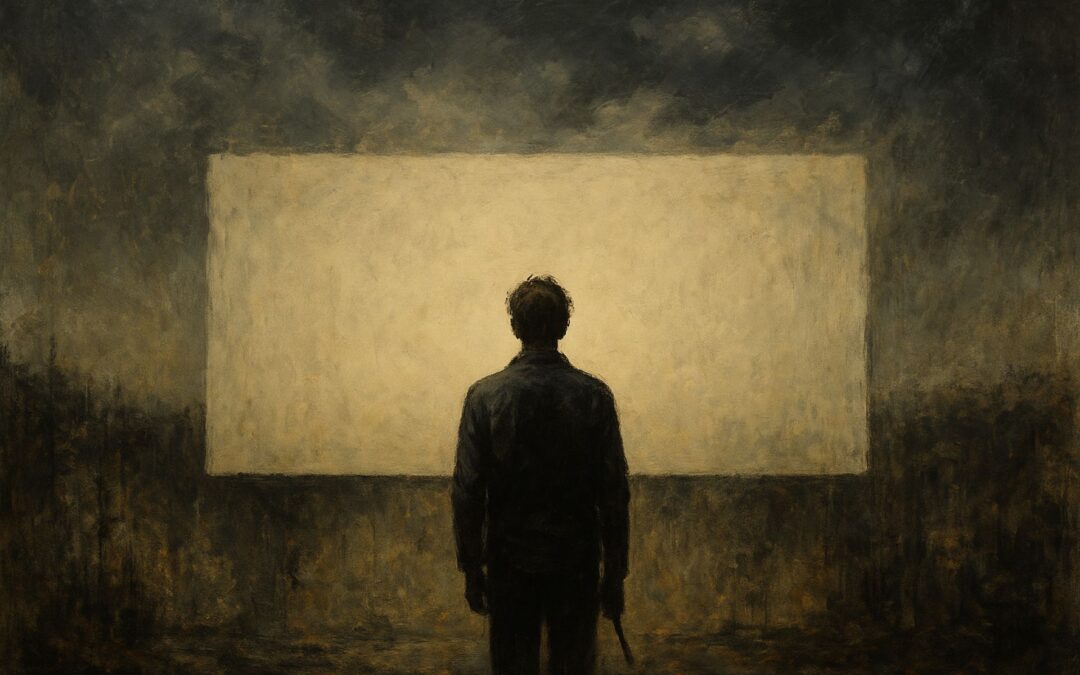
What if life has no meaning?
The very question sounds bleak — maybe even offensive to our sense of purpose. We spend our lives searching for meaning as though it were oxygen: in careers, relationships, religion, and ambition. We chase it through self-help books, spiritual retreats, and philosophical rabbit holes. Yet the more desperately we pursue it, the more it slips through our grasp.
But what if that’s the point? What if life’s meaninglessness isn’t a void to be filled, but a canvas to be painted — not a tragedy, but an opportunity? From Nietzsche to Sartre to Camus, the great thinkers of existentialism all arrived at the same radical idea: the absence of inherent meaning doesn’t make life futile; it makes it free. It’s not the end of purpose — it’s the beginning of authorship.
Because when you realize life has no prewritten script, you finally understand — you are the one holding the pen.
The Modern Obsession with Meaning
The word meaning has become a kind of modern prayer — whispered in podcasts, written in self-help books, searched millions of times on Google every month. Everyone’s looking for it, everyone’s talking about it, yet few can articulate what it actually means. We live in an age obsessed with purpose — every career must be a calling, every hobby a passion project, every relationship a source of personal growth. To simply exist without justification feels almost shameful.
Our ancestors didn’t face this dilemma. Their days were anchored in necessity. To live was to hunt, gather, protect, survive. Purpose was embedded in action; it wasn’t something to be found, it was something to be done. But when survival became easy — when fire was replaced by electricity and tribes by cities — that natural sense of purpose evaporated. We no longer needed to struggle to live, so we began struggling to feel alive.
Today’s culture amplifies that struggle. Every scroll through social media confronts us with people who appear to have found their calling: the minimalist traveler who “escaped the 9-to-5,” the artist who “turned pain into purpose,” the CEO who “built his dream life.” The message is subtle but relentless — if your life isn’t brimming with passion and meaning, you’re somehow doing it wrong. This creates a new form of anxiety: existential comparison.
But here’s the irony. The harder we chase meaning, the further it drifts. Because meaning isn’t something you acquire like a possession. It isn’t a job title, a spiritual awakening, or a perfect relationship. It’s a living process — something that emerges through experience, not something handed to us prepackaged. And yet, the modern world convinces us otherwise. We consume meaning like content — expecting to find it in ten-minute YouTube videos, meditation retreats, or someone else’s philosophy.
The problem is not that life lacks meaning; it’s that we’ve outsourced the search for it. We expect the world to define it for us, forgetting that meaning was never something to find. It’s something to make.
And that realization — that responsibility — terrifies us.
The Paradox of a Comfortable Civilization
We are living in the safest, wealthiest, and most technologically advanced era in human history. Diseases that once wiped out cities are now prevented by a simple injection. Food is delivered to our doorstep, information to our screens, comfort to every corner of life. Yet despite all this progress, a quiet emptiness lingers. Rates of depression, anxiety, and loneliness are rising. People feel lost, adrift, and unfulfilled. How can it be that the most comfortable civilization in history is also the most restless?
The paradox lies in the very structure of comfort itself. When survival becomes effortless, the human psyche loses its compass. Struggle once gave direction to existence — it focused the mind, sharpened the will, and forced meaning upon even the smallest act. The farmer planting seeds in the cold dawn didn’t wonder about his “life purpose.” The act of survival was its own answer. But when the struggle ends, the question begins: now what?
Modern civilization has eliminated necessity and replaced it with abundance. But abundance breeds distraction. Instead of working to live, we now live to consume — to fill the void with stimulation. Our time, once spent on essential tasks, is now scattered across screens, notifications, and micropleasures. Every dopamine hit — every “like,” every purchase, every binge — promises satisfaction but delivers only a temporary numbness.
In theory, a life with infinite choices should be exhilarating. In practice, it’s paralyzing. We are overwhelmed by possibility, trapped in perpetual indecision. The psychologist Barry Schwartz called it “the paradox of choice” — when confronted with too many options, people become anxious, hesitant, and dissatisfied. And meaning suffers the same fate. With endless paths to follow, none feels urgent or inevitable.
So we chase comfort as a substitute for meaning. We upgrade our gadgets, perfect our routines, optimize our diets — all in pursuit of control. But the more we control, the less we feel. Comfort, taken to excess, becomes a sedative. It dulls the very hunger that gives life its flavor.
This is the modern condition: we have everything to live with and nothing to live for.
Nietzsche’s Warning: The Death of God and the Rise of Nihilism
Friedrich Nietzsche looked at the modern world and saw a storm brewing beneath its progress. His declaration — “God is dead” — wasn’t a celebration of atheism; it was a diagnosis of cultural collapse. What he meant was that the old foundations of meaning — religion, morality, tradition — were disintegrating. The divine scaffolding that once supported human life had been dismantled by science, reason, and modernity. And now, humanity was suspended in midair, with nothing solid beneath its feet.
For centuries, religion answered life’s biggest questions: Why are we here? What is good? What is evil? What is the point of suffering? It gave us a cosmic story that made chaos feel orderly. When that story vanished, Nietzsche feared, something far more dangerous would take its place: nihilism — the belief that life is meaningless, that values are illusions, that nothing truly matters.
To Nietzsche, this was not just a philosophical problem; it was an existential emergency. Without a higher framework, people would drift into moral confusion, lose their sense of direction, and fill the void with empty pleasures. He described this emerging archetype as the Last Man — the ultimate product of a civilization that had traded transcendence for comfort.
The Last Man does not suffer, but he also does not strive. He avoids risk, avoids pain, avoids greatness. He prefers entertainment over challenge, security over freedom, comfort over growth. His happiness is shallow — a mechanical routine of consumption and comfort. He believes he is civilized, but he has merely been domesticated.
Nietzsche’s portrait of the Last Man feels eerily prophetic today. Look around — a society obsessed with convenience, flooded with distraction, terrified of discomfort. People anesthetize themselves with busyness, entertainment, and digital validation. Their calendars are full, their souls are empty.
But Nietzsche didn’t despair completely. He offered a radical alternative — the Übermensch, or Overman — a being who creates his own values in the void left by God’s death. Instead of succumbing to nihilism, the Overman becomes a self-creator, shaping meaning out of chaos. He doesn’t ask, “What is the meaning of life?” He declares, “This is my meaning.”
It is a philosophy of artistic existence — to treat life as a blank canvas, and yourself as both artist and artwork. It’s a call to courage, to reject passive comfort and actively sculpt your own destiny. Nietzsche believed that once humanity could face the emptiness of existence without flinching — without retreating into false beliefs or cheap pleasures — a new kind of strength would emerge.
The death of God, in his view, was not the end of meaning. It was the beginning of our responsibility to create it.
Freedom and the Existentialists
If Nietzsche revealed the void left behind by the death of God, the existentialists—Sartre, Beauvoir, Camus—showed us how to live within it. They accepted the unsettling truth that there is no cosmic plan, no predestined purpose, no divine script. But instead of collapsing into despair, they saw liberation. For if nothing is fixed, then everything is open.
Jean-Paul Sartre, perhaps the most famous among them, distilled this idea into a single, revolutionary phrase: existence precedes essence. We are not born with a predefined role or purpose; we come into existence first, and only afterward do we define who we are through our actions. We are not actors playing parts written by gods or society; we are playwrights, penning the script as we go.
This freedom sounds intoxicating—but it’s also terrifying. Because it means there are no excuses left. Every choice we make, and even the refusal to choose, becomes an act of self-definition. You are what you do, not what you say you’ll do. If you dream of being a writer but never write, then you are not a writer. If you wish to be courageous but constantly retreat from challenge, then you are, by your actions, a coward. Life, Sartre insisted, is the sum of our choices.
But here’s the catch: freedom isn’t just possibility—it’s responsibility. You cannot blame God, fate, or circumstance for the life you live. To be human is to be condemned to freedom, as Sartre famously put it. We are free, even when we don’t want to be. We can quit the job, leave the relationship, move to another country, or reinvent ourselves at any moment. Yet most people don’t—because freedom, in its raw form, is too heavy a burden to bear.
So we run from it. We build systems, routines, and identities that give the illusion of stability. We convince ourselves that we “have no choice,” that we are “stuck,” that we “must” do certain things. Sartre called this bad faith—the act of lying to oneself in order to escape the anxiety of freedom. We pretend that the waiter must act like a waiter, the employee must obey, the citizen must conform. But these roles are self-imposed prisons.
To live authentically is to tear off these masks. It’s to face the chaos of possibility and still choose deliberately, consciously, courageously. Freedom, Sartre believed, is not about doing whatever you want—it’s about taking ownership of who you become.
And meaning, therefore, is not something hidden in the world—it’s something we create every time we choose.
Simone de Beauvoir and the Ethics of Freedom
Simone de Beauvoir took Sartre’s radical notion of freedom and made it human. Where Sartre’s philosophy could sometimes feel coldly individualistic, Beauvoir infused it with empathy, ethics, and relational depth. Her central question was this: if we are all free to create our own meanings, how do our choices affect one another?
In The Ethics of Ambiguity, she acknowledged that life is full of paradoxes. We are both free and bound, both creators and prisoners of circumstance. She called this tension ambiguity—the condition of being human. You can’t escape it, but you can learn to live gracefully within it.
To ignore one side of this ambiguity—either by denying your freedom or denying your limits—is to live dishonestly. And that dishonesty manifests in what Beauvoir called the sub-man: the person who refuses to choose, who drifts through life passively, letting others decide for him. The sub-man blames society, destiny, or bad luck for his situation. He is alive, but not truly living.
Beauvoir saw this not as a moral failure but as a tragedy—a waste of potential. To reject one’s freedom is to reject the very thing that makes us human. Yet she didn’t believe freedom existed in isolation. For her, the highest expression of freedom is not to dominate, but to liberate. “To will oneself free,” she wrote, “is also to will others free.”
This means that the pursuit of meaning isn’t a solitary climb up a mountain—it’s a shared ascent. Every project we undertake, every choice we make, interferes with or enhances the freedom of others. Therefore, our meaning becomes more authentic when it uplifts rather than restricts those around us.
To live meaningfully, then, is to act in ways that affirm both your freedom and the world’s. If you build, build something that frees. If you lead, lead in a way that empowers. If you love, love in a way that expands the other’s horizon, not encloses it.
Beauvoir’s insight is both ethical and existential: meaning created at the expense of others is hollow. Meaning that contributes to the flourishing of life—yours and others’—is real.
Camus and the Absurd: Living Without Meaning
While Sartre and Beauvoir tried to construct meaning through freedom, Albert Camus stared straight into the void and found beauty in its emptiness. For him, the fundamental problem of philosophy was simple: if life has no meaning, should we go on living? His answer was defiant—yes, we should.
Camus saw the human condition as inherently absurd. We long for clarity, order, and purpose in a universe that offers none. We demand answers from a cosmos that remains silent. This clash between our yearning for meaning and the world’s indifference creates what he called the Absurd.
Most people, faced with this confrontation, seek escape. Some retreat into religion, clinging to divine order. Others bury themselves in distraction—work, entertainment, pleasure—anything to avoid the discomfort of meaninglessness. But Camus argued that to deny the Absurd is to deny life itself. The only honest response is rebellion—not through violence, but through awareness. To see the Absurd clearly, accept it fully, and live joyfully anyway.
In his essay The Myth of Sisyphus, he used the image of a man condemned to push a boulder up a hill, only for it to roll down each time. It’s a metaphor for human existence: endless labor, no final victory, no lasting meaning. But Camus’s twist is profound—he imagines Sisyphus happy. Because once Sisyphus accepts his fate, once he stops expecting the universe to reward him, he becomes free. His defiance, his persistence, his laughter in the face of futility—that’s his triumph.
Camus invites us to live in the same spirit. To stop asking “What’s the point?” and start saying “Why not?” Why not dance, love, write, travel, rebel, create—even knowing it all ends? Meaninglessness doesn’t diminish life; it amplifies it. When nothing is guaranteed, every moment becomes precious.
The Absurd doesn’t demand despair—it demands intensity. To live, fully and fiercely, because it’s fleeting. To savor existence without needing it to mean something cosmic.
Camus didn’t want us to conquer the Absurd; he wanted us to fall in love with it. Because once you accept that life has no ultimate meaning, you’re finally free to live as though it does—and to mean it with all your heart.
Creating Your Own Meaning
If the universe offers no inherent meaning, then meaning becomes a creative act — an invention, not a discovery. We are not archaeologists digging for truth buried in the sands of destiny; we are artists standing before a blank canvas, brush in hand. The beauty and terror of this realization is that the canvas is ours alone — and so is the responsibility to fill it.
Meaning does not arrive as an epiphany. It is crafted, piece by piece, through the choices we make, the projects we commit to, and the people we love. Jean-Paul Sartre once said that “man is nothing else but what he makes of himself,” and that statement holds more weight than most are comfortable admitting. Because if your life feels meaningless, that is not fate — it is inertia.
Creating meaning requires engagement, not revelation. It means throwing yourself into pursuits that matter to you, even when the world doesn’t applaud. It’s about cultivating something that resonates with your soul — writing, building, teaching, nurturing, inventing — and investing time and energy into it, knowing full well it might fail, fade, or be forgotten. The act of doing is what imbues life with substance.
But meaning is also transient. What feels significant today might feel hollow tomorrow. The purpose that once defined you — a career, a relationship, a dream — might lose its vitality as you evolve. This is not a crisis; it is the natural rhythm of growth. Meaning is not a monument to be erected once and worshipped forever; it’s a flame that must be rekindled again and again.
That’s why clinging to a fixed definition of purpose can be dangerous. When people attach their identity to one pursuit — “I am my work,” “I am my art,” “I am my success” — they risk crumbling when that pursuit collapses. True meaning lies not in the permanence of what you do but in the consciousness you bring to it. The awareness that your life, however fleeting, is your canvas — and every brushstroke, every decision, adds to its texture.
Meaning, then, is not something to be found at the end of the road. It’s something created with each step along the way.
The Middle Path: Purpose and Practicality
The idea of “creating your own meaning” can sound lofty, but there’s a pragmatic dimension to it that can’t be ignored. You can’t ponder philosophy on an empty stomach. You can’t write novels if you’re worried about rent. Money may not buy meaning, but it buys the conditions that allow meaning to flourish — stability, safety, time.
The challenge is to avoid letting money become the meaning. It’s a delicate balance, one that modern society constantly distorts. We are conditioned to believe that financial success automatically equates to purpose. That if our bank accounts grow, our lives will feel fuller. But wealth without direction breeds its own kind of emptiness — a gilded cage lined with anxiety, comparison, and fear of loss.
The middle path lies between idealism and materialism. It’s understanding that while money can sustain life, it cannot define it. Work, therefore, should serve both ends — the practical and the profound. Even if your day job doesn’t fulfill you, it can still hold value if it enables the things that do: art, travel, learning, time with family, solitude, or contribution to others.
Some find purpose directly in their labor — building, creating, mentoring, designing. For others, work is simply a means to support the areas where meaning blooms. Both are valid. What matters is consciousness — being intentional about the role work plays in your life. You can despise your job and still use it wisely, or you can love your work and still guard yourself from becoming enslaved to it.
Camus wrote that rebellion against meaninglessness is not about grand gestures but small affirmations of life — savoring a morning coffee, listening to the sound of rain, laughing with a friend. The same applies to work and money. You don’t have to reject them outright, nor worship them blindly. The goal is to integrate them into a life that feels coherent, where your financial reality supports your inner one.
Purpose without practicality is unsustainable. Practicality without purpose is unbearable. The art of living lies in balancing the two — earning enough to live, but never selling your soul to survive.
When Meaning Disappears
There are moments when even the most purpose-driven among us feel the weight of emptiness. When the projects that once inspired us lose their glow, when the things that once felt profound suddenly feel mechanical. In these moments, it’s easy to panic — to assume that something is broken within us. But perhaps meaning’s disappearance is not a crisis, but an invitation.
Meaning, like emotion, is cyclical. It waxes and wanes. There are seasons of creation and seasons of stillness; times when life feels electric with purpose and times when it feels muted and ordinary. When meaning disappears, it’s often a sign that we’ve outgrown an old narrative — that the purpose we once clung to has served its role and is now asking to be released.
Fighting this phase only deepens the void. The more we demand meaning to appear, the further it retreats. But if we stop chasing — if we allow ourselves to simply be — something curious happens. The smallest moments regain their weight: sunlight filtering through curtains, the sound of boiling water, a brief conversation with a stranger. Life’s texture returns, not because we’ve found meaning again, but because we’ve stopped insisting it must exist.
This is where Camus’ insight becomes luminous. To live without meaning isn’t nihilism — it’s clarity. It’s the realization that meaning is not a prerequisite for joy. When you drop the need for life to “add up,” you begin to experience it directly. You stop looking for the story and start living the scene.
Think of the times you felt most alive — laughing uncontrollably, lost in music, holding someone you love. In those moments, you weren’t analyzing life; you were immersed in it. There was no thought of “purpose.” There was only presence.
Perhaps this is the final freedom — to no longer demand meaning from life, but to let life mean whatever it will. To stop narrating and start noticing. To stop constructing and start experiencing. Because when you no longer need life to mean something grand, even the smallest details — a breath, a touch, a sound — become enough.
And maybe, that’s where true peace begins — not in finding meaning, but in finally realizing you don’t need one to live beautifully.
Conclusion
Meaning, it turns out, is not something the universe hides from us — it’s something we continuously create, destroy, and recreate through the way we live. The mistake is believing it must be fixed, absolute, eternal. But meaning, like life itself, is fluid — it shifts as we grow, disappears when clung to, and reemerges when least expected.
Perhaps the highest form of wisdom isn’t to find meaning at all, but to live so vividly that you stop needing it. To see existence not as a riddle to be solved, but as a song to be sung — imperfect, fleeting, yet full of beauty in every note.
When we let go of the need for life to make sense, we free ourselves to actually live it. That’s when meaning — quiet, subtle, and self-made — begins to appear on its own. Because maybe, the moment we stop asking, “What does life mean?” is the moment life finally begins to answer.