
Every value you hold—honesty, loyalty, freedom, kindness—has a lineage. It wasn’t invented by you, nor is it random. Values are heirlooms of civilization, passed down through centuries of trial, imitation, and adaptation. They are the moral technologies that kept tribes alive, societies coherent, and individuals tethered to purpose. Yet we rarely pause to ask: Where did these values actually come from—and why do we hold them so tightly?
The Ancestry of Morals
Before philosophy, before religion, before the written word—there was survival. And survival, not scripture, gave birth to morality. The first values did not emerge from temples or councils; they emerged from the soil of necessity. Imagine small bands of early humans, huddled around fires, bound by hunger, fear, and the faint beginnings of language. They weren’t pondering good and evil—they were negotiating coexistence. If someone hoarded food, the group weakened. If someone shared, the tribe thrived. Over time, that simple exchange—give and take—became a moral truth: sharing is good, greed is bad.
From that spark, morality took root. Fairness, cooperation, loyalty—these weren’t abstract virtues but evolutionary adaptations. They maximized group survival in an unpredictable world. A tribe that valued cooperation outlived a tribe that didn’t. The genes and customs favoring empathy, trust, and justice spread, not because they were noble, but because they worked. In this way, natural selection sculpted the earliest moral instincts. Our conscience, far from divine, began as a compass for group survival.
But something remarkable happened as humans evolved the capacity for imagination and language. These instincts—once practical—became symbolic. People began telling stories to explain why cooperation mattered, why betrayal hurt, why fairness was sacred. Myths gave moral behavior emotional weight. The gods rewarded honesty, punished deceit, and sanctified the tribe’s way of life. What started as a survival tool became the foundation for meaning.
Here lies the first great transformation in human history: the shift from “what helps us live” to “what makes life worth living.” Morality, once mechanical, became mythological. It no longer just kept the tribe alive—it gave the tribe an identity. Rituals reinforced belonging; taboos protected boundaries. “Don’t steal” became not just a rule, but a reflection of who we are. Every culture, from the plains of Africa to the mountains of Mesopotamia, began engraving its own version of virtue into story, song, and law.
Anthropologists have long observed that even the most isolated tribes exhibit moral codes—rules governing fairness, kinship, reciprocity, and harm. These universals suggest that morality isn’t imposed from above but encoded within us. It’s the architecture of coexistence. When a hunter risks his life for another, when a mother sacrifices comfort for her child, when strangers form alliances against danger—those moments reveal morality’s primal logic: the group must survive.
Yet morality didn’t remain static. As societies grew more complex, so did their values. Hunter-gatherers prized sharing; agrarian societies, stability; industrial ones, productivity. Each new mode of survival brought its own moral narrative. The commandment “Thou shalt not steal” meant one thing in a small band where resources were shared and another in a market economy built on private property. The content of morality changed, but its function—to regulate relationships and sustain cohesion—remained constant.
This evolutionary inheritance still whispers in our modern ethics. Our outrage at injustice, our empathy for the vulnerable, our instinct to protect fairness—these are ancient reflexes dressed in modern language. Every time we stand up for what’s right, we’re echoing the logic of our ancestors: cooperation sustains life. We may no longer fight predators in the dark, but our moral impulses remain tuned to the same primal frequency.
So when we ask where values come from, the answer begins here—not in philosophy but in biology, not in creed but in community. Morality was humanity’s first social technology, the invisible contract that allowed us to build villages, cities, and civilizations. Long before laws were written or gods named, humans had already made the most important discovery of all: survival requires solidarity. And solidarity—refined, ritualized, and remembered—is what we now call values.
Cultural Relativism — Margaret Mead’s Radical Insight
When Margaret Mead set foot on the islands of Samoa in the 1920s, she wasn’t merely crossing oceans—she was crossing into an entirely different moral universe. The Western world she came from was steeped in Victorian morality, where sexuality was restrained, individual freedom constrained, and adolescence defined by conflict and repression. But in Samoa, she found something extraordinary: a culture that seemed to flow rather than fracture. Teenagers moved easily from childhood to adulthood. Romantic relationships carried no stigma. Authority was gentle, not punitive. Life, it seemed, was lived without guilt.
Mead’s observations, later published in Coming of Age in Samoa, shattered Western assumptions about human nature. The turbulence of adolescence, she argued, wasn’t universal—it was cultural. The anxiety, shame, and rebellion that American youths experienced were not products of biology, but of social conditioning. In Samoa, where community norms encouraged openness and cooperation, the same developmental stage unfolded with ease. Her conclusion was both simple and revolutionary: morality is not innate or absolute. It is a construct—molded by geography, tradition, economy, and collective imagination.
This idea, known as cultural relativism, marked a profound turning point in anthropology and moral philosophy. Before Mead, Western societies assumed that their moral systems represented the pinnacle of civilization—objective truths that all others should emulate. Missionaries, colonizers, and reformers carried this conviction like a torch, convinced they were spreading enlightenment. Mead dimmed that torch. She showed that moral judgment depends entirely on the context in which it arises. What one society condemns as immoral—premarital intimacy, for instance—another accepts as natural and harmonious. What one calls “virtue,” another might see as oppression.
Mead’s insight was not an attack on morality but an invitation to humility. She revealed that the moral landscape of humanity is a mosaic, not a monolith. Each culture, shaped by its environment and history, constructs a moral order suited to its survival. A society living on scarce resources may value restraint and hierarchy. One blessed with abundance might celebrate generosity and leisure. To declare one inherently superior is to misunderstand the function of values themselves—they are adaptive tools, not eternal commandments.
The implications of her work rippled far beyond academia. Mead forced the West to confront its ethnocentrism—the belief that one’s own moral framework is the universal measure of right and wrong. Her studies arrived at a time when colonial powers still sought to “civilize” the rest of the world. By demonstrating that moral norms are culture-bound, she undermined the moral justification for imperialism and missionary zeal. If every society defines its own good, who are we to impose ours upon others?
Of course, cultural relativism did not come without controversy. Critics accused Mead of moral complacency, arguing that her approach made it impossible to condemn practices like slavery, oppression, or violence. If all moral codes are equally valid, they asked, what happens to justice? Mead never suggested that all behaviors were defensible. Her point was subtler: understanding must precede judgment. To change or challenge another culture’s moral code, we must first comprehend the context that sustains it. Moral reform without understanding, she believed, is arrogance disguised as virtue.
Mead’s fieldwork also carried a deeper philosophical weight. It suggested that morality itself evolves alongside human culture. Just as language adapts to describe a people’s world, values adapt to regulate it. A society’s moral code is its emotional grammar—its way of coordinating behavior, expressing identity, and resolving tension. To understand morality, one must read it in its native syntax.
In doing so, Mead humanized moral difference. She made it possible to see foreign customs not as barbaric or backward, but as coherent expressions of human adaptation. Her work whispered a radical truth still relevant today: morality is not about who is right, but about what helps a society remain whole.
Even now, in our hyperconnected world, Mead’s insight remains a compass. The debates that polarize us—about gender, family, technology, freedom—often mirror the same ethnocentrism she challenged a century ago. We mistake difference for danger, diversity for decay. Yet if we adopt her lens, we begin to see moral disagreement as data, not threat. Each society, each subculture, even each generation, is experimenting with its own version of “the good.”
Through Mead, we learn that to understand values, we must first unlearn the assumption that ours are universal. Morality, she taught, is a mirror—showing us not what is right for everyone, but what is necessary for us.
Mary Douglas and the Grid-Group Map of Morality
If Margaret Mead revealed that morality varies across cultures, Mary Douglas showed why. Where Mead illuminated the diversity of moral worlds, Douglas sought to understand their architecture—the structural logic that underpins every society’s sense of order, purity, and taboo. Her work answered one of anthropology’s most enduring questions: why do people, regardless of time or geography, draw invisible boundaries between what’s “clean” and what’s “unclean,” “sacred” and “profane,” “permitted” and “forbidden”?
Douglas’s seminal book, Purity and Danger (1966), proposed that these boundaries are not irrational superstitions but symbolic systems that protect the integrity of social order. Dirt, she wrote, is not an objective thing—it is “matter out of place.” What a society calls “dirty” or “impure” reflects its need to maintain structure and coherence. When a rule is broken, when a custom is defied, when a role is confused, society experiences moral contamination. The ritual act of purification—whether through washing, exclusion, or punishment—restores the moral order.
This insight reframed morality as a system of classification. Every society, consciously or not, sorts the world into categories of acceptable and unacceptable, order and chaos. Those categories, Douglas realized, are less about hygiene or holiness and more about control. They tell people where they belong, what roles they play, and what threatens their identity. In this way, morality becomes a social immune system—defending a group’s boundaries from the infection of ambiguity.
Douglas later formalized this idea into her Grid-Group Theory, a framework that maps societies along two dimensions:
- Grid — the extent to which individual behavior is regulated by rules, hierarchy, and structure.
- Group — the degree to which people identify with and depend on their community.
The combination of these axes creates four moral archetypes—four distinct ways of seeing and organizing the world.
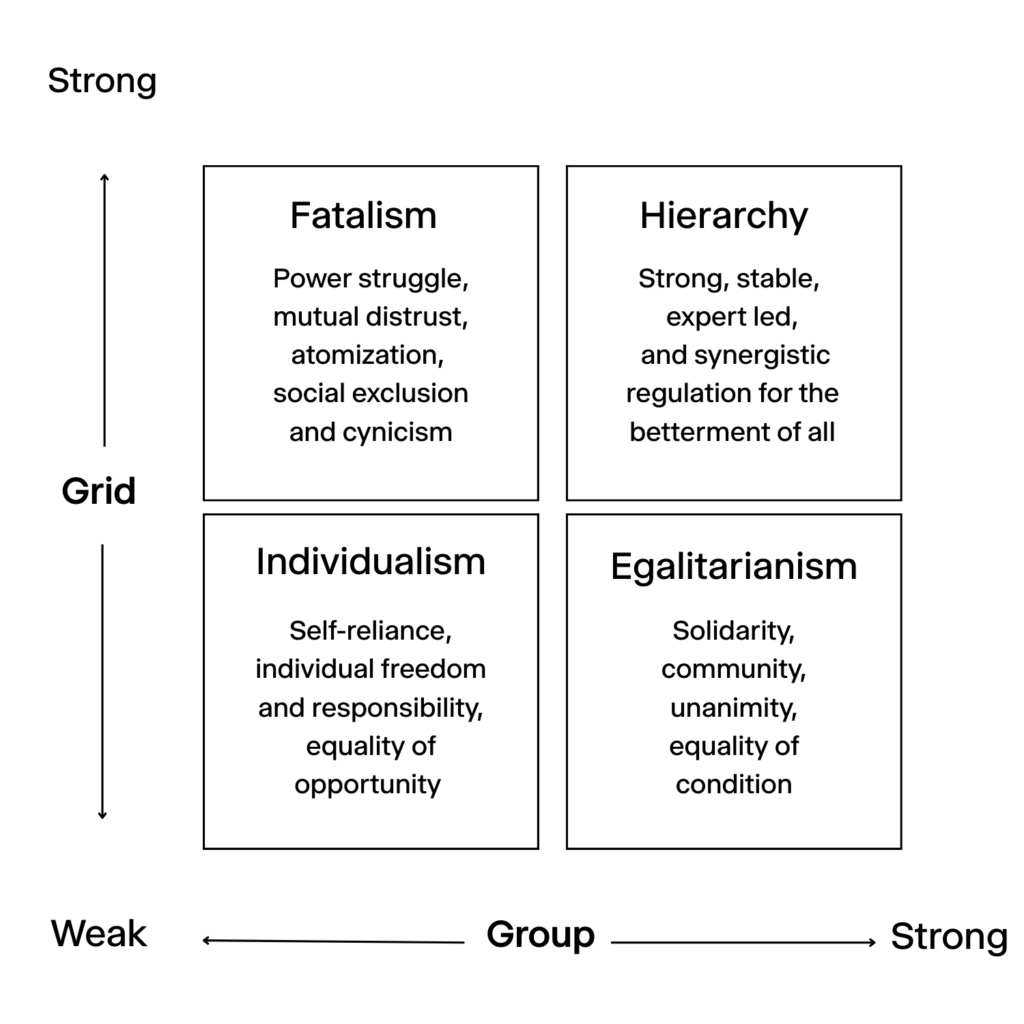
1. Hierarchists (High Grid, High Group)
Hierarchist societies value stability, tradition, and authority. Their moral systems emphasize duty, purity, and obedience to social roles. Ancient monarchies, religious orders, and even bureaucratic states fit this mold. In such worlds, morality flows downward—from elders, priests, or rulers—and deviation is seen as pollution. Order is sacred because it keeps chaos at bay.
2. Egalitarians (Low Grid, High Group)
In contrast, egalitarian cultures distrust authority and hierarchy. They value equality, community, and shared responsibility. Their moral focus lies in fairness and solidarity, not obedience. Moral violations here often involve betrayal or selfishness—the sins that fracture unity. Many tribal societies, cooperatives, and modern activist movements express this ethos.
3. Individualists (Low Grid, Low Group)
These societies celebrate autonomy and self-expression. Rules are minimal, and individuals are free to pursue personal gain or creativity. Their moral ideal is liberty; their sin is conformity. Markets, democracies, and entrepreneurial cultures tend to embody this outlook. Success is moralized as virtue—proof of initiative and resilience.
4. Fatalists (High Grid, Low Group)
Finally, fatalist environments are those where individuals feel bound by rigid structures yet disconnected from belonging. Think of oppressed castes or authoritarian regimes. Morality here turns cynical; rules feel arbitrary, and virtue becomes survival. People obey not out of faith in order, but out of fear of punishment.
Together, these four quadrants form a moral map of humanity. Each quadrant explains not only what people value, but why they disagree. When one person says “society needs more discipline,” and another replies “society needs more freedom,” they’re not just arguing politics—they’re expressing different positions on Douglas’s moral grid.
Douglas’s framework also illuminates modern polarization. Hierarchists and individualists clash over authority; egalitarians and hierarchists clash over inclusion; fatalists distrust them all. Beneath every cultural conflict—between traditionalists and progressives, nationalists and globalists—lies a structural disagreement about how tightly society should bind individuals and how strictly it should enforce rules. These are not merely ethical preferences; they are psychological habitats.
Her insight is particularly relevant in an age where institutions are eroding and communities fragmenting. As the “group” dimension weakens, and individuals become increasingly detached from shared identity, societies drift toward the individualist and fatalist corners. The result is moral dissonance—an explosion of personal freedom accompanied by a collapse in shared meaning. What once held people together—rituals, norms, collective purpose—feels arbitrary or outdated. But without them, people feel unmoored. The pendulum swings between chaos and control, liberty and order.
Douglas’s genius lay in revealing that these tensions are not new—they are eternal. Human beings are constantly balancing the need for belonging against the desire for autonomy. Every moral system, from tribal taboos to modern laws, is a negotiation between those forces. The stricter the rules, the safer the order—but the smaller the self. The freer the individual, the greater the creativity—but the weaker the cohesion.
She offered no utopia, no moral formula. Instead, Douglas gave us a lens—one that invites compassion for difference. When people clash over values, they are often defending the invisible architecture that keeps their world intact. Understanding that doesn’t make us agree—but it helps us see. And perhaps that, in a fractured moral landscape, is the beginning of wisdom.
Jonathan Haidt — Morality as an Evolutionary Toolkit
If Margaret Mead showed that morality is shaped by culture, and Mary Douglas revealed that it is structured by society, Jonathan Haidt brought the discussion full circle—back to biology. His work bridges the moral, the cultural, and the cognitive, showing that our sense of right and wrong is not purely learned nor entirely rational. It is evolved. Morality, Haidt argues, is not something humanity invented to civilize itself; it is something nature built into us to make civilization possible in the first place.
Haidt’s fascination with moral psychology began with a simple question: Why do good people disagree so profoundly about what is good? Why does fairness mean one thing to a libertarian, another to a socialist, and something entirely different to a devout believer? To answer that, he and his colleagues conducted years of cross-cultural studies, from the streets of Philadelphia to the villages of India, examining how people across societies justify moral judgment. What emerged was a startling insight: people don’t arrive at moral beliefs through reasoning—they start with intuition.
We feel our way into morality long before we think our way into it. Haidt famously described the process through a metaphor: the emotional elephant and the rational rider. The elephant—our moral intuition—moves instinctively, driven by gut reactions shaped by evolution. The rider—our conscious reasoning—follows behind, crafting arguments to justify the elephant’s direction. We like to imagine that our values come from careful deliberation, but most of our moral positions are post-rationalizations of ancient instincts. As Haidt put it, “The emotional tail wags the rational dog.”
These instincts evolved not for the sake of abstract truth, but for group cohesion. Our ancestors didn’t need objective ethics—they needed teamwork. Over time, natural selection favored individuals whose moral sentiments helped bind tribes together. Altruism, empathy, loyalty, and outrage at cheaters were not accidents of culture; they were survival advantages. Communities that punished freeloaders, revered elders, and cooperated in hunting or defense outlasted those that didn’t. Morality became an invisible coordination mechanism—a set of internalized rules that allowed groups of unrelated individuals to act like extended families.
To explain this universal pattern, Haidt proposed the Moral Foundations Theory, identifying six core moral “taste buds” embedded in every human brain:
- Care/Harm – The instinct to nurture and protect others from suffering.
- Fairness/Cheating – The drive to reward cooperation and punish exploitation.
- Loyalty/Betrayal – The pull to stand with one’s group, kin, or tribe.
- Authority/Subversion – The respect for hierarchy, order, and tradition.
- Sanctity/Degradation – The sense of purity, disgust, and moral cleanliness.
- Liberty/Oppression – The resistance to domination and the defense of freedom.
Every society, religion, and ideology builds its moral framework using a combination of these foundations—just as chefs create cuisine from shared ingredients. But while the ingredients are universal, the recipes differ. Cultures and individuals “activate” certain foundations more strongly depending on their history, geography, and worldview. This is where moral diversity—and conflict—comes from.
For example, Haidt’s research revealed that liberals tend to emphasize care and fairness, focusing on protecting individuals and reducing harm. Conservatives, by contrast, distribute moral weight more evenly across all six foundations, valuing not just compassion and justice but also loyalty, authority, and sanctity. This difference explains why debates over religion, family, or freedom feel intractable: both sides are defending moral visions that feel instinctively right. Neither is immoral; they’re simply drawing from different sections of humanity’s moral repertoire.
What’s revolutionary about Haidt’s model is that it redefines morality not as a ladder—with higher and lower forms—but as a spectrum of adaptive tools. Every foundation evolved for a reason. Care fosters compassion, fairness sustains cooperation, loyalty strengthens unity, authority maintains stability, sanctity preserves identity, and liberty prevents tyranny. Societies that overvalue one and suppress others become unbalanced. Too much authority breeds oppression; too much liberty dissolves cohesion. The healthiest moral ecosystems, Haidt suggests, are those that balance competing virtues instead of erasing them.
This biological lens also illuminates why moral reasoning is so emotionally charged. When someone attacks our values, we don’t experience it as an intellectual challenge—we feel it as a physical threat to our social survival. That’s why online debates spiral into hostility, and political dialogue collapses into tribal shouting. Our moral mind evolved in small groups of trust, not digital battlegrounds of strangers. Modern society has expanded faster than evolution could adapt, leaving ancient instincts to navigate modern complexities.
But Haidt’s work is not pessimistic. His research also points toward empathy—not the soft, sentimental kind, but an intellectual empathy grounded in biology. If we understand that others operate from different moral foundations, disagreement no longer feels like moral failure. It becomes a form of biodiversity. Just as ecosystems thrive through variation, so too does moral civilization. Liberal and conservative, religious and secular, collectivist and individualist—all represent adaptive experiments in the great evolutionary lab of humanity.
In his later work, Haidt urged societies to recover moral humility—to see righteousness as a potential vice. The danger, he warned, lies not in moral conviction but in moral certainty. When people believe their moral foundation is the only legitimate one, they cease to cooperate, empathize, or listen. They stop seeking truth and start defending their tribe. Moral diversity, like genetic diversity, is not a weakness—it is the condition for resilience.
Haidt’s insight reframes centuries of philosophical debate with evolutionary clarity: morality is not a discovery; it is a design. We did not stumble upon ethics in the wilderness; we were born wired for it. Every argument, every act of compassion, every cultural taboo—each is part of the same grand pattern: humanity’s ongoing attempt to turn survival into meaning.
The Allegory of the Taco Truck
After tracing morality through evolution, culture, and social structure, Values Solved ends with a deceptively simple image: a taco truck. At first glance, it seems playful, even trivial—a street-side metaphor dropped into a conversation about anthropology and moral psychology. But the allegory carries an elegant weight. It distills the entire argument of the chapter into one vivid scene: moral diversity is not a problem to be solved but a feast to be understood.
Imagine a bustling street lined with food vendors. Each one serves their own version of the perfect taco. Some are traditional—simple tortillas, spiced meat, a squeeze of lime. Others are experimental—fusion flavors, vegan fillings, gourmet garnishes. Each cook believes their recipe captures the “true essence” of the taco. Customers cluster around their favorites, praising the balance of flavors or complaining about the spice. From a distance, the scene looks chaotic: shouting, sizzling, laughter, disagreement. But step closer, and you see something else—a shared rhythm. Every stall, every recipe, every taste exists in dialogue with the others. The diversity is the harmony.
The taco truck becomes a metaphor for human morality. Each vendor represents a moral system—Christian, Buddhist, liberal, conservative, collectivist, capitalist, secular, spiritual. Each claims to possess the “right flavor” of virtue. Each is convinced its combination of ingredients—compassion, discipline, faith, reason, tradition, freedom—is the most balanced, the most nourishing. Yet no single stall can satisfy everyone. What’s too spicy for one is too bland for another. And that, the allegory suggests, is the point. There is no universal recipe for the good life—only evolving tastes shaped by culture, experience, and need.
To understand this allegory, think of the theories introduced earlier. Margaret Mead showed that morality adapts to cultural context—different islands, different ingredients. Mary Douglas explained how social structures define what’s “pure” and what’s “polluted”—what belongs in the recipe and what doesn’t. Jonathan Haidt revealed that we all share the same basic moral palate, but each culture adjusts the seasoning differently. The taco truck unites them all. It says: morality is a culinary art, not a chemical formula. Its beauty lies in variation.
The danger arises when one stall decides that its recipe should dominate the street. In moral terms, this is absolutism—the belief that one’s moral code is universally correct and must be imposed on others. History is filled with such moral monopolies: empires that conquered in the name of righteousness, ideologies that sought to erase dissent, religions that claimed exclusive access to truth. The result is always the same—uniformity at the cost of richness, silence at the cost of harmony. A street with one taco stand is no longer a market; it’s a monotony.
The opposite danger, however, is nihilism—the idea that since everyone’s taste is subjective, nothing matters at all. That too empties the street, not by force but by apathy. The goal, then, is not uniformity or indifference—it’s coexistence. The wisdom of the taco truck is that diversity, when respected, produces vitality. Each stand competes and collaborates simultaneously. They borrow spices from each other, learn from rival recipes, and collectively keep the crowd alive with curiosity. The variety doesn’t weaken the street—it sustains it.
Translated back into moral terms, this means that disagreement is not evidence of decline; it’s evidence of growth. A society where everyone agrees on everything is either stagnant or oppressive. Moral evolution requires tension—the push and pull between order and freedom, tradition and innovation, care and authority. The friction of opposing values, when managed with humility, generates moral progress. Just as chefs refine their recipes through experimentation, civilizations refine their ethics through debate.
The allegory also carries a subtler psychological message. When we encounter values that clash with our own, our instinct is to recoil, to defend our recipe. But what if, instead, we approached moral difference as a tasting opportunity? What if encountering another person’s worldview was less a threat and more an invitation—to sample a new flavor, to see why it satisfies them, to understand its balance even if we wouldn’t cook it ourselves? This doesn’t mean abandoning one’s moral convictions. It means realizing that one’s convictions are one recipe among many in humanity’s ongoing moral cuisine.
From this perspective, tolerance becomes less about politeness and more about participation. Just as no single dish can feed an entire city, no single moral framework can meet every human need. A healthy society, like a thriving food market, depends on plurality. The libertarian, the traditionalist, the reformer, the mystic—they all feed the collective palate in different ways. The tension between them keeps the menu evolving.
The taco truck also illuminates why moral certainty feels comforting but can become dangerous. When people stop exploring other recipes, they forget that their flavor was once an experiment too—born from context, struggle, and change. Every moral system began as a creative adaptation to human need. Over time, it fossilized into doctrine. The challenge of modernity is to remember that morality, like cuisine, is alive. It must adapt, borrow, and reinvent—or it spoils.
And so, the taco truck metaphor isn’t just an intellectual flourish—it’s a call to moral maturity. It reminds us that wisdom lies not in eliminating moral difference, but in managing it gracefully. It invites us to move through the moral marketplace with curiosity instead of contempt, humility instead of superiority. To realize that behind every recipe lies the same primal hunger—for connection, meaning, belonging, and survival.
In the end, moral diversity is not a sign that humanity is lost. It’s proof that we are still learning, still tasting, still creating. Just as a world of identical meals would starve the soul, a world of identical morals would starve the mind. The goal is not to find the one perfect taco, but to keep the street alive with flavor—to let the aromas of different lives remind us that morality, at its heart, is a celebration of our shared appetite for the good.
The Roots Beneath Our Beliefs
When we trace our values to their origins, certainty gives way to humility. Morality is not a single truth descending from the heavens but a tapestry woven from biology, culture, and choice. From Mead’s relativism to Haidt’s moral instincts, one message rings clear: our sense of “right” is a story we keep rewriting to suit our time.
The more we understand where our values come from, the less we cling to them as weapons—and the more we hold them as wisdom. Because in the end, the roots of our beliefs are not about division, but about shared human effort: the endless, imperfect attempt to make life meaningful together.