
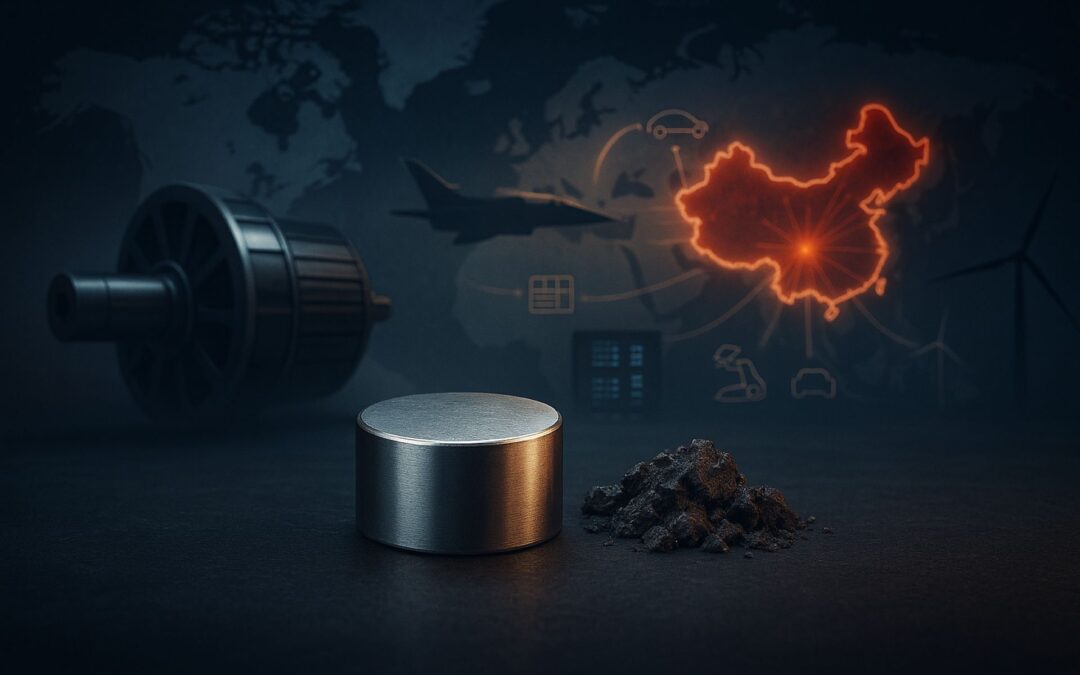
If you want to understand the future, don’t look at billion-dollar factories or global trade routes. Look at the 1.1 pounds of metal hidden inside a Tesla motor. Because that tiny cluster of rare earth magnets—barely the size of your palm—is quietly deciding who leads the next century. What seems trivial is actually tectonic.
China understood this decades ago. The West didn’t. And today, those microscopic minerals have become the leverage point for EVs, AI, robotics, defense systems, and every industry that will define the modern world.
This article unpacks how China built that dominance, how the U.S. lost it, and why the smallest ingredient in your technology determines the biggest shifts in global power.
The Tiny Ingredient That Changed Global Power
Walk into any Tesla showroom and you’ll see a masterpiece of modern engineering—sleek panels, high-density batteries, advanced software, and aerodynamic precision. What you won’t see is the real foundation of the EV revolution: a small cluster of magnets buried deep inside the rear drive unit. This drive unit weighs roughly 194 pounds. Inside it, the rotor houses a tiny assembly of neodymium-iron-boron magnets weighing just 1.1 pounds. That’s less than a water bottle. Yet this negligible fraction of the vehicle—0.02% of the total weight—determines almost everything that makes an EV competitive: acceleration, torque delivery, range, power efficiency, thermal performance, even the size and cost of the battery pack.
Magnets are the hidden engines of the electric age. Without them, EV motors would need bulkier induction systems or rare, complex alternatives that sacrifice performance. They would waste more energy as heat, drain batteries faster, cost more to manufacture, and ultimately slow down global adoption. That one pound of rare earth magnets is the difference between EVs being a premium niche product and becoming mainstream transportation.
This is why their origin matters. Seventy percent of the world’s rare earth mining and ninety-plus percent of refining happens in one country: China. The U.S., despite being the world’s largest EV market, produces a fraction of what it needs and processes almost nothing. This asymmetry means that every modern EV rolling off an American assembly line quietly depends on China’s minerals, China’s refineries, and China’s magnet factories. A tiny component becomes a geopolitical hinge—one that dictates who controls the future of transportation.
How Rare Earths Became the World’s Most Strategic Resource
Rare earths sit in the bottom rows of the periodic table—unfamiliar names like neodymium, praseodymium, dysprosium, terbium, europium, and yttrium. They don’t sparkle like gold or trade like oil. But their importance dwarfs most natural resources in the 21st century. Each element has a unique electronic structure that makes it incredibly good at tasks no other material can perform. Neodymium and praseodymium create the strongest permanent magnets known to mankind. Dysprosium enhances heat resistance in high-performance motors. Europium and terbium power advanced LEDs and screen displays. Yttrium enables laser systems and missile guidance technology.
What makes rare earths strategic isn’t scarcity—it’s irreplaceability. There are substitutes, but all are inferior: heavier, weaker, costlier, or less energy-efficient. Removing rare earths from a fighter jet, a wind turbine, an EV motor, or a missile system doesn’t just reduce performance. It cripples the technology.
And yet the process of turning raw ore into something usable is extraordinarily complex. Rare earths are chemically similar to one another, making separation difficult. The purification demands intense heat, acids, solvents, and dozens of delicate steps. The process generates toxic waste, radioactive byproducts, and enormous water pollution. Western nations consider these costs prohibitive. China, however, embraced the challenge.
The result? Rare earths became the backbone of global technological progress—and China built itself into the spine. The world’s EV ambitions, AI data center efficiency, renewable energy expansion, autonomous robotics, and military capabilities all sit on top of a supply chain concentrated in a single geopolitical rival. In a world racing toward electrification and automation, rare earths are the closest thing we have to a “control chip” for the future.
Yet the world didn’t fully realize this until it was too late.
From Leader to Dependent: How the U.S. Lost Its Dominance
In the late 20th century, the United States wasn’t simply a participant in the rare earth industry—it owned it. Mountain Pass in California was the world’s premier rare earth mine, supplying the majority of global demand. The U.S. possessed not just the ore, but the refining capability, the engineering expertise, the technological innovation, and the corporate ecosystem to turn these obscure metals into high-value industrial products. American companies produced advanced magnets, alloys, phosphors, and materials used in defense, telecommunications, computing, and early hybrid vehicles.
But the decline began quietly.
Environmental regulations grew stricter, particularly concerning radioactive thorium and toxic wastewater that naturally occur during the refining process. Mountain Pass struggled to comply while remaining profitable. In 1998, a major wastewater leak triggered a shutdown of operations. Investors lost interest; policymakers saw rare earths as a niche industry; companies shifted focus to higher-margin technologies; and by the early 2000s, the entire American rare earth infrastructure—mines, refineries, and magnet factories—began to wither.
Meanwhile, global demand skyrocketed due to smartphones, wind turbines, robotics, and emerging hybrid vehicles. The U.S. had no response. Every refinery closure, every missed investment, and every policy oversight handed China another step up the ladder.
By the time the Pentagon realized rare earths were critical for precision-guided missiles, radar systems, drones, jet engines, and night-vision equipment, the supply chain had already migrated. American manufacturers were now importing processed materials and magnets from the very geopolitical competitor they were trying to defend against.
The transition from leader to dependent didn’t happen in a single moment. It happened through a thousand small decisions. A leak in California. A closed refinery. A sale of a magnet division. A lack of industrial strategy. The culmination of these choices meant that the U.S.—once the global hub of rare earth innovation—had become dependent on imported magnets for its fighter jets and missiles. A superpower, reliant on foreign ore to power its own defense.
China’s Long Game: Decades of Planning, Investment, and Intent
China’s rise in the rare earth industry wasn’t luck. It was deliberate, methodical, and rooted in long-term strategy. In the mid-1970s, Chinese leaders recognized something the rest of the world dismissed: rare earths would become foundational to the next century’s technologies. They saw what the U.S. did not see—that rare earths were the invisible infrastructure of future dominance.
So they began planning.
China funded rare earth research institutes, sent scientists abroad for training, and encouraged universities to specialize in metallurgy, geochemistry, and materials engineering. It mapped out domestic reserves, particularly at the massive Bayan Obo deposit in Inner Mongolia, which would later become the world’s largest source of rare earths. Throughout the 1980s and 1990s, China aggressively scaled its refining capacity. It didn’t just want to mine ores—it wanted to master every step of processing and production.
China didn’t care that the industry was messy, toxic, and expensive to regulate. It embraced the pollution as the cost of building a future where it controlled the critical materials for global technology. While the West focused on consumer electronics and software, China focused on the metals that made those technologies possible.
China Studies the West
One of China’s most decisive strategic moves came in the form of scientific exchanges. Chinese delegations visited Mountain Pass—the crown jewel of American rare earth production. They were welcomed warmly, given full tours, shown equipment, processes, and methodologies, photographed facilities, and allowed to analyze ore samples. At the time, the U.S. believed sharing this knowledge would accelerate China’s transition into a democratic, market-friendly nation.
Instead, China brought home a blueprint.
Chinese geologists used this knowledge to identify similar mineralization patterns in China. Engineers adapted U.S. processing techniques. Factories replicated American equipment. What began as “research cooperation” quietly became industrial augmentation. By the late 1990s, China wasn’t just catching up—it was surpassing.
The Magnequench Mistake
Perhaps the most consequential misstep by the U.S. was the sale of Magnequench, General Motors’ advanced magnet division. This wasn’t just a company—it was the heart of America’s rare earth magnet technology. When a consortium of Chinese companies purchased Magnequench in 1995, it set in motion one of the most significant industrial transfers in modern history.
Initially, Chinese leaders promised to keep production in America. For a few years, they honored that promise. But one machine moved to China. Then another. Then a production line. Then entire facilities. Within a decade, America no longer had a meaningful rare earth magnet industry.
The sale shifted:
- Decades of intellectual property
- Advanced manufacturing capability
- Specialized engineering talent
- Production infrastructure
- Innovation pipelines
—all to China.
This wasn’t simply a business acquisition. It was the quiet relocation of an entire industrial ecosystem. And it allowed China to establish itself as the global epicenter of rare earth magnet manufacturing.
China didn’t win rare earths because of cheap labor or abundant ore. It won because it had a plan—one that spanned decades, aligned with national strategy, and leveraged the West’s shortsighted decision-making.
This was China’s advantage: patience. Ambition. Vision. The understanding that tomorrow’s power belongs to the country that controls the tiny things everyone else overlooks.
When Chaos Became Strategy: The Wild West of Chinese Mining
China’s rise to rare earth dominance is often portrayed as a flawlessly orchestrated long-term plan. But the truth is messier—and far more revealing. In the 1990s and early 2000s, China’s rare earth sector resembled a lawless frontier more than a strategic industry. Thousands of small-scale miners, informal operators, and privately run processing outfits competed in a brutal race to the bottom. They extracted ore using crude tools, dangerous chemicals, and makeshift techniques, often working without any environmental oversight or safety protocols.
This chaos produced devastating environmental consequences. Toxic acids leaked into rivers. Radioactive tailings piled up in open fields. Entire villages saw their water sources contaminated. But the mining frenzy also produced something else: ultra-cheap rare earths. Costs were so low that global prices collapsed, and Western producers simply couldn’t compete. Chinese miners weren’t trying to outsmart global competitors through strategy—they were trying to survive the margins of competition. And in doing so, they inadvertently wiped out the global industry.
What looked like reckless disorder from the outside was, in effect, a strategic advantage. The lack of regulation allowed China to scale production rapidly while driving everyone else out of the market. By the time the Chinese government stepped in to clean things up, most of China’s foreign competition was already dead.
China didn’t inherit the rare earth market. It flooded it—until it became the only viable supplier.
The Great Consolidation: How China Built the Big Six
After years of unregulated extraction, China realized that rare earths weren’t just a messy domestic industry—they were a geopolitical asset. And that asset needed control. Starting in 2011, Beijing unleashed an aggressive nationwide campaign to bring order to the chaos. The government sent in inspectors, conducted unannounced audits, shut down illegal mines, seized equipment, and dismantled smuggling networks that had been funneling rare earths out of the country.
This crackdown wasn’t symbolic. It was transformative.
Within four years, the fragmented and disorderly mining landscape—once dominated by countless small players—was consolidated into six massive, state-backed conglomerates. These “Big Six” firms became vertically integrated giants that controlled nearly every step of the rare earth supply chain:
- Mining
- Refining
- Processing
- Magnet production
- Export management
The effect was immediate and profound.
First, smuggling plummeted from about 30% of total production to negligible levels, giving China full visibility into supply and pricing. Second, environmental devastation decreased as illegal operations were eliminated and remaining firms were required to meet higher standards. But the most important consequence was pricing power. With the Big Six controlling extraction and refining, China could set global rare earth prices with near-total authority.
This shift created a monopoly-like structure far more powerful than that of oil markets. OPEC controls about 40% of global oil production. China controls 90% of refined rare earths—a market where no easy substitutes exist.
The Big Six didn’t just protect China’s rare earths. They turned them into one of the world’s most effective industrial weapons. By organizing and centralizing the supply chain, China ensured that no other country could scale production, invest competitively, or create a parallel ecosystem. It was consolidation not for profit, but for leverage.
And today, that leverage stretches across every EV motor, missile system, robot arm, and AI data center on the planet.
How the West Helped China Win (Without Realizing It)
China’s dominance wasn’t built on strategy alone—it was built on the West’s mistakes. For years, Western governments, companies, and policymakers underestimated rare earths, treating them as a commodity instead of the backbone of modern technology. This blindness created an environment where China didn’t need to outmaneuver anyone—the competition effectively dismantled itself.
Western leaders wanted cheap materials, stable supply, and environmental cleanliness. What they didn’t want was the industrial messiness that comes with mining and refining rare earths. As manufacturing shifted to Asia in the 1990s and 2000s, rare earths were quietly bundled into that exodus. Companies outsourced magnet production, wafer-thin components, and specialty alloys. Defense contractors and auto manufacturers prioritized cost efficiency over supply chain security. Academic researchers lost funding. Few policymakers even knew what rare earths were.
As China scaled production, Western firms became increasingly reliant on low-cost imports, slowly allowing strategic capability to drift overseas. By the time national security agencies sounded the alarm, the industrial ecosystem was already gone. The West didn’t just lose control of the mines—it lost the engineers, the metallurgists, the chemists, the factories, the IP, and the supply chains that made rare earth materials usable in the first place.
Instead of protecting its rare earth sector, the West unintentionally created the perfect conditions for China to rise uncontested.
The WTO Backfire
The most shocking example of Western self-sabotage came with the 2012 WTO case. China had restricted rare earth exports to stabilize prices and prevent illegal mining. Whether intentional or not, those restrictions raised global prices, giving Western miners like Molycorp a lifeline. Investors saw opportunity. Mountain Pass restarted. Domestic refining was being rebuilt.
But the U.S., Japan, and the EU misunderstood the long-term game. They assumed China was manipulating markets for unfair advantage. So they sued. They won. And in 2014, the WTO forced China to remove export quotas.
The result was catastrophic—for the West.
Once China lifted its restrictions, global supply surged. Prices crashed. And the newly revived American rare earth industry collapsed again. Molycorp went bankrupt. Mountain Pass shut down. Billions in investment evaporated. And the only country capable of producing rare earths at scale remained the same as before: China.
The West didn’t protect its supply chain—it destroyed it. In trying to punish China, policymakers accidentally eliminated the last functioning rare earth mine in North America.
The EV Blind Spot
While the U.S. and Europe focused on defense applications, China was thinking bigger. Beijing recognized early that rare earths were not just for missiles and radar—they were the heart of the coming electric vehicle boom. This insight changed everything.
China:
- Poured money into battery R&D
- Launched EV pilot programs in major cities
- Subsidized electric buses, taxis, and fleets
- Supported domestic automakers
- Invested in gigafactories
- Built magnet and motor plants alongside refineries
Meanwhile, the West treated rare earths as a supply chain inconvenience rather than a foundational technology. Western automakers underestimated EVs. Governments delayed support. Investors were skeptical. Regulations focused more on emissions than on securing critical materials.
By the time anyone realized that EVs, robotics, drones, and AI hardware were impossible to scale without rare earth magnets, China had already spent a decade building the world’s largest EV ecosystem.
China didn’t just win rare earths. It aligned them with the defining industries of the 21st century. The West missed the moment—and entered the EV race already 20 years behind.
Everything the Future Needs Depends on Rare Earths
Rare earths aren’t valuable because they’re shiny, exotic, or scarce. They’re valuable because they unlock performance levels that no other materials can match. As the world transitions to electrification, automation, and high-precision systems, rare earths become more important—not less.
In electric vehicles, rare earth magnets provide unmatched power density. A smaller, lighter motor means a smaller battery. A smaller battery means lower cost. Lower cost means mass adoption. Without rare earth magnets, EVs become heavier, more expensive, and less efficient. It’s not an exaggeration to say rare earths are the reason EVs are viable today.
In defense, rare earths are even more critical. They enable:
- High-power radar systems
- Stealth aircraft control surfaces
- Precision-guided missiles
- Drone stabilization
- Satellite communication arrays
- Laser targeting
A jet like the F-35 contains hundreds of kilograms of rare earth elements. Take them away, and the plane is blind.
In AI and robotics, rare earths fuel high-speed actuators, server cooling systems, robotic joints, medical imaging, and advanced sensors. Without them, the physical world of AI would stall.
In renewables, rare earth magnets power high-efficiency wind turbines that produce more energy per rotation than any alternative. They are essential for countries trying to meet clean energy targets.
Everything that defines the next industrial revolution—electricity, autonomy, intelligence, and precision—runs on rare earths. They are the invisible architecture of the future.
And China controls almost all of it.
The Illusion of Alternatives: Why the West Still Can’t Escape
Every few months, headlines announce a new discovery or breakthrough: a promising rare earth deposit in Africa, a new refinery in Australia, a cutting-edge recycling process in Europe, or a pilot mine in the U.S. On paper, these developments sound like the beginning of independence. In reality, they highlight how difficult it is to break China’s grip.
Mining rare earth ore is the easy part. Processing it into usable, high-purity material is the impossible step. Rare earths occur in mixed, chemically similar forms. Separating them requires dozens of stages of solvent extraction, high-temperature cracking, repeated acid baths, waste neutralization, and precision chemical engineering. Each step demands deep expertise—and creates toxic byproducts. Western countries are unwilling to accept the radioactive tailings, groundwater contamination, and environmental risk that China absorbs without hesitation.
This environmental divide is one of China’s biggest advantages. Where Western nations see regulatory burdens and lawsuits, China sees strategic opportunity and industrial control.
Even Malaysia, often touted as the West’s alternative, only handles parts of the refining process. Most of the high-value downstream work—magnet production, alloying, sintering—still happens in China. Even if Malaysia or Australia increase refining output, the magnets will almost certainly be finished in China because the expertise, factory clusters, and supply networks exist only there.
New technologies like ionic clay leaching or solvent-recycling sound promising, but they are two to four times more expensive than Chinese methods. And even if they mature, China already dominates these technologies too, having spent years researching cheaper and cleaner methods.
The West isn’t stuck because it lacks minerals. It’s stuck because it lacks:
- Processing capacity
- Skilled metallurgists
- Established supplier networks
- Magnet factories
- Environmental tolerance
- Decades of accumulated know-how
China doesn’t just control the raw material. It controls the capability to turn that raw material into power.
In rare earths, control isn’t about having the ore—it’s about having the system.
The Future: What Happens When One Country Controls Tomorrow
The world is in the middle of the biggest industrial transition since the invention of electricity. Electric vehicles, AI acceleration, robotics, autonomous drones, smart weapons, renewable energy, and next-generation computing all depend on rare-earth magnets and materials. As these industries grow, demand for rare earths is projected to jump from 91,000 tons today to 150,000 tons by 2040.
China’s dominance may drop from 90% refining share to around 78%. But that reduction is cosmetic. In commodities, you don’t need total control to dictate terms. You need strategic control. Enough influence to shape prices, guide supply chains, pressure competitors, and set global standards. China will still hold:
- The largest mines
- The most refining capacity
- The deepest industrial clusters
- The most magnet factories
- The most engineers
- The cheapest production costs
- The highest quality output
- The willingness to bear environmental risk
And most importantly: the leverage.
If a single country controls the core ingredients of global technology, then every other nation must negotiate from weakness. Tariffs lose their punch. Sanctions lose their teeth. Military procurement becomes vulnerable. EV adoption becomes contingent. AI scaling slows down. Renewable energy becomes costlier. Robotics becomes bottlenecked.
China doesn’t need to “weaponize” rare earths to benefit from them. Simply maintaining dominance is enough. Every shortage, every price spike, every export approval or rejection ripples through global supply chains. The West can innovate, invest, and legislate—but it cannot rewrite the physics, chemistry, and industrial timing that China locked in decades ago.
This is the new geopolitical reality:
the future belongs to the country that controls the invisible components of progress.
And for now, that country is China.
Conclusion: The Silent Leverage That Shapes the Modern World
The story of rare earths is the story of a world that runs on invisible ingredients. While the West slept, China built an empire from the bottom of the periodic table. Not by chance, but by design. Not overnight, but over decades.
A few grams of metal in a Tesla motor reveal a deeper truth: the future belongs to the nations that understand the strategic value of small things. And right now, China understands that better than anyone.