
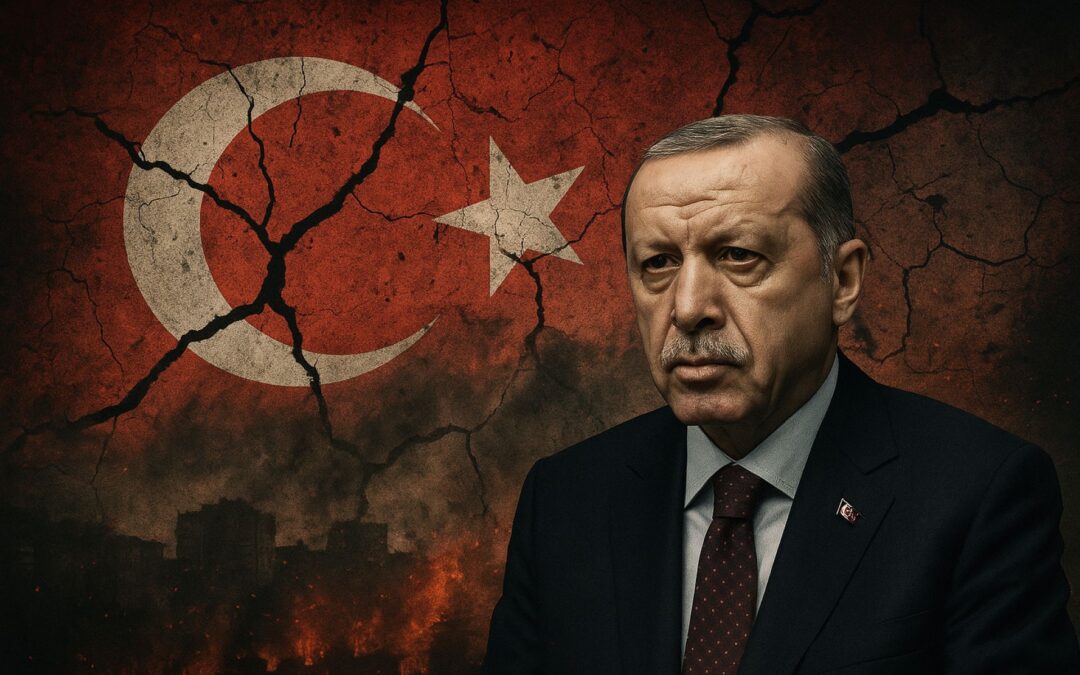
Turkey’s modern history has always been defined by sharp turns—moments when the nation seemed to pivot suddenly between democracy and dictatorship, prosperity and crisis, secularism and faith. Few leaders have embodied these contradictions more fully than Recep Tayyip Erdogan. Once hailed as the man who lifted millions out of poverty and gave a voice to the conservative working class, he now stands accused of eroding the very foundations of the republic he promised to strengthen.
His story is not simply one of political endurance but of transformation—from reformer to autocrat, from populist savior to polarizing ruler. To understand why Erdogan is breaking Turkey, one must trace his journey from a street vendor’s son to the country’s most dominant leader since Ataturk, and then examine the institutions, economy, and society left in his wake.
The Coup That Defined a Generation
The summer of 2016 was not just another turbulent chapter in Turkey’s political story—it was a night that altered the country’s trajectory. On July 15, as citizens prepared for what seemed like an ordinary evening, chaos erupted. Tanks thundered onto the streets of Istanbul, blocking bridges that connect Europe and Asia. Fighter jets screamed across the skies, firing on government buildings in Ankara. Soldiers seized television stations and declared that the military was taking control to “restore democracy.”
For a country with a long history of military coups, the move seemed eerily familiar. Since the founding of the republic in 1923, the armed forces had seen themselves as the custodians of Mustafa Kemal Ataturk’s secular vision. They had toppled governments in 1960, 1971, and 1980, always justifying their interventions as necessary corrections against creeping authoritarianism or religious influence. Many thought 2016 would be a repeat performance.
But this coup was different. Erdogan was not a passive target. He was on vacation at a seaside resort when the uprising began, yet he used modern technology to outmaneuver his opponents. Appearing on a live FaceTime call broadcasted by CNN Türk, he called upon citizens to defend their democracy. His words struck a chord: “There is no power higher than the power of the people.” It was a bold gamble—urging unarmed civilians to confront tanks and soldiers—but one that paid off.
Within hours, Istanbul’s streets were choked with crowds waving Turkish flags, chanting Erdogan’s name, and blocking military convoys. Videos circulated of citizens lying in front of tanks, clambering onto armored vehicles, and overpowering bewildered soldiers. By dawn, the coup had collapsed. Erdogan flew back into Istanbul as the triumphant defender of democracy, hailed by his supporters as the man who saved the republic.
Yet that night was more than a victory. It was also a turning point. Erdogan interpreted the failed coup not simply as an attack by rogue officers but as proof that enemies were everywhere—within the military, the judiciary, the media, even among former allies. The purges that followed would reshape the nation, centralizing power around his presidency and redefining Turkish democracy in his own image. Ironically, the man who rallied the people against a military takeover would soon use that same legitimacy to consolidate unprecedented control.
Fast forward to the present, and the symbolism is haunting. Once again, tens of thousands fill the streets, not to defend Erdogan but to oppose him. The arrest of Istanbul’s mayor, Ekrem Imamoglu, on charges widely seen as politically motivated, has turned public squares into arenas of defiance. Where Erdogan once stood as the embodiment of resistance to an unpopular order, many now see him as the very embodiment of that order.
From Working-Class Boy to Political Powerhouse
Erdogan’s rise is a story steeped in paradox—at once deeply ordinary and extraordinary. Born in 1954 in Kasimpasa, a tough, working-class neighborhood of Istanbul, he was the son of a coastguard officer. His upbringing was modest, defined by discipline and conservative values. He sold sesame buns and lemonade on the streets as a boy, a detail he has frequently highlighted to reinforce his image as a man of the people.
Unlike the secular elite who traditionally dominated Turkey’s politics, Erdogan was educated in a religious high school. This background made him an outsider in a political system shaped by Ataturk’s rigid secularism. Yet it also tethered him to the underrepresented masses who felt alienated by the urban, Western-oriented elites. For millions, Erdogan’s life mirrored their own struggles, creating a bond that would later translate into unwavering political loyalty.
His first brush with politics came through Islamist movements, which were often sidelined by the state. But he proved relentless, climbing through party ranks until his breakthrough in 1994, when he stunned the establishment by winning the mayoralty of Istanbul. The city, plagued by pollution, traffic chaos, and water shortages, became his proving ground.
As mayor, Erdogan was pragmatic rather than ideological. He improved garbage collection, expanded green spaces, and tackled chronic water shortages by investing in infrastructure. He built credibility not through fiery rhetoric but through visible results. Even some of his critics conceded that Istanbul was better run under his tenure.
Then came the turning point in 1999. At a political rally two years earlier, Erdogan had recited a poem deemed to incite religious hatred: “The mosques are our barracks, the domes our helmets, the minarets our bayonets, and the faithful our soldiers.” For this, he was sentenced to prison—a punishment that transformed him from politician to symbol. To conservatives, he was not just punished but persecuted for his faith. His few months in jail elevated him to martyrdom status.
He capitalized on that momentum. In 2001, he co-founded the Justice and Development Party (AKP). Unlike earlier Islamist movements, the AKP was carefully calibrated. It projected moderation, economic competence, and a commitment to democratic reform, appealing to both conservatives and centrists. The strategy worked: in 2002, the AKP swept national elections, breaking the stranglehold of Turkey’s political elite.
What followed was a steady climb. As prime minister from 2003 to 2014, Erdogan oversaw economic growth that transformed Turkey into one of the world’s fastest-growing economies. Poverty fell sharply, the middle class expanded, and Turkey seemed to be entering a golden age. By 2014, Erdogan had reinvented himself once more—this time as Turkey’s first directly elected president.
His journey from a boy selling snacks on the streets to the highest office in the land was more than political success. It was a narrative—a living parable of the underdog who defied elites, survived imprisonment, and came to embody the aspirations of millions of ordinary Turks.
Power Consolidated, Institutions Dismantled
The coup attempt in 2016 was more than a failed uprising—it was the catalyst that allowed Erdogan to transform Turkey’s political architecture. In the days that followed, he declared a state of emergency that lasted two full years. During this period, the government detained over 100,000 people and dismissed more than 150,000 public officials, teachers, judges, and military officers from their posts. The justification was always the same: rooting out alleged followers of Fethullah Gülen, the exiled cleric accused of masterminding the coup from Pennsylvania.
But the purges extended far beyond Gülen’s network. Critical journalists were imprisoned, newspapers were shuttered, and media outlets were placed under government control. Courts were stacked with loyalists, ensuring verdicts that aligned with the ruling party’s interests. Universities lost some of their most respected scholars, replaced by politically compliant figures. What began as a security response evolved into a systematic dismantling of dissent.
The 2017 constitutional referendum marked the point of no return. Erdogan pushed for—and narrowly won—a transformation of Turkey’s parliamentary democracy into a presidential system. The prime minister’s office was abolished. The president gained sweeping powers: the ability to issue decrees with the force of law, appoint judges, dissolve parliament, and dominate the judiciary. Checks and balances, once fragile but present, were effectively erased.
Turkey’s democracy became increasingly performative. Elections continued, but they were no longer fair contests. Opposition candidates faced harassment, media coverage skewed heavily in Erdogan’s favor, and state resources were mobilized to support the ruling party. The 2019 Istanbul mayoral race exposed the limits of this system. When opposition candidate Ekrem Imamoglu won, the government annulled the result. A re-run was ordered—yet Imamoglu triumphed again, this time with an even greater margin. The episode demonstrated that, despite Erdogan’s control, Turkish democracy retained sparks of resilience.
Yet overall, the trajectory was clear. Institutions that once mediated political life—an independent press, an impartial judiciary, a parliament with genuine authority—were gutted or subordinated. Erdogan became the fulcrum of the state. Critics described the shift as a transition from democracy to electoral autocracy—a system where ballots still exist but the playing field is so tilted that outcomes are all but predetermined.
For Erdogan’s supporters, this concentration of power was a shield against instability. For his critics, it was the death of the republic Ataturk envisioned. Either way, Erdogan had fundamentally rewritten the rules of Turkish politics.
The Economy in Freefall
For much of his rule, Erdogan’s greatest political asset was economic performance. Between 2003 and 2013, Turkey averaged nearly 6% annual growth, outpacing most European peers. New highways, gleaming airports, and sprawling housing complexes symbolized a country on the rise. Millions of Turks saw their incomes rise, while poverty rates fell dramatically. Erdogan’s message—that he was the leader who delivered prosperity—was backed by numbers.
But beneath the surface, the model was brittle. Turkey consumed far more than it produced. It relied on imports for essentials like oil, gas, and gold, leaving it with a perpetual current account deficit. To finance this, banks borrowed heavily in foreign currencies and lent domestically in lira, fueling a credit-driven boom. The construction sector, in particular, became the engine of growth, with megaprojects like Istanbul’s new airport touted as symbols of national pride.
The system unraveled in 2018. As inflation rose and external debt ballooned, foreign investors began to question whether Turkey could sustain its borrowing spree. Confidence evaporated, triggering a sharp depreciation of the lira. In a single year, the currency lost 40% of its value against the dollar. Inflation spiked above 25%, and economic growth stalled.
Conventional economic wisdom dictated raising interest rates to stabilize the currency and rein in inflation. Erdogan, however, clung to an idiosyncratic belief: that high interest rates caused inflation rather than curbed it. He intervened repeatedly in central bank policy, dismissing governors who defied him. Four were sacked between 2019 and 2023 alone. As a result, the central bank lost credibility at home and abroad, and investors fled.
By 2022, inflation had surged to over 70%, one of the highest rates in the world. The lira, once trading at three to the dollar, collapsed to more than forty. Ordinary Turks bore the brunt: savings evaporated, rents soared, and basic goods became unaffordable. Middle-class families slipped back toward poverty, erasing much of the progress of Erdogan’s earlier years.
Even after reluctantly allowing interest rates to rise in 2023, the recovery was sluggish. Foreign borrowing slowed, but investor confidence remained shaky. The International Monetary Fund projected Turkey’s growth at 2.7%, well below the global average for developing economies. The damage was not just economic but institutional. By undermining the central bank and rule of law, Erdogan had hollowed out the very structures that could have guided Turkey back to stability.
The irony was cruel. Erdogan had built his reputation as the leader who delivered economic prosperity to ordinary Turks. Two decades later, his policies had left the lira in ruins, inflation rampant, and families struggling to make ends meet. For many, it was proof that the man who once lifted Turkey’s economy was now the one breaking it.
A Religious Agenda in a Secular Republic
When Mustafa Kemal Ataturk founded modern Turkey in 1923, he envisioned a state liberated from the grip of religion. Secularism was not just a principle but a pillar: the military, judiciary, and education system were designed to keep mosque and state apart. For decades, Turkey stood as a rare Muslim-majority nation where religious authority held little sway over public policy.
Erdogan has spent much of his political career reversing this legacy. From his earliest speeches, he cast himself as the authentic voice of Turkey’s devout majority, long sidelined by urban secular elites. He tapped into resentment among rural and working-class conservatives who felt excluded from the republic’s promise. Religion was not merely personal belief—it became a political tool, a symbol of identity, and a wedge to distinguish his movement from the so-called out-of-touch elite.
The transformation was gradual but deliberate. In 2013, his government lifted the ban on headscarves in public institutions, including schools, courts, and the military. What Ataturk had once outlawed as a threat to secularism, Erdogan reinstated as a matter of freedom and dignity for conservative women. Alcohol, another marker of secular modernity, came under tighter regulation. Sales were restricted during certain hours, advertising banned, and taxes raised sharply. During the pandemic, alcohol sales were outright banned for weeks, further igniting debates about creeping theocracy.
Perhaps the most striking shift has been in education. Erdogan’s government expanded Imam Hatip schools at an unprecedented rate. These institutions, once intended to train imams, began to serve as an alternative education pathway with a heavy emphasis on Islamic instruction alongside mathematics, science, and literature. By 2023, the number of Imam Hatip schools had quadrupled since the AKP came to power, and enrollment had risen sixfold. Government spending funneled disproportionately into these schools—23% of high school funding for only 11% of students, according to reports. Critics argued that Erdogan was siphoning resources away from secular schools to nurture a generation aligned with his ideological vision.
He was explicit about his intent: to raise a “pious generation.” The goal was not simply academic instruction but cultural reengineering. Erdogan wanted a society where religion re-entered public life, where Turkish identity was rooted in Islam rather than secular nationalism. Even his economic rhetoric carried religious undertones. His insistence that high interest rates were “un-Islamic” was not just an eccentric economic view but a theological claim used to legitimize policy.
Yet here lies the paradox. While Erdogan pushed religion further into public institutions, Turkish society itself was evolving in the opposite direction. Polls revealed a steady decline in religiosity, especially among the youth. In 2008, 55% of Turks described themselves as religious; by 2025, that number had fallen to 46%. Urbanization, global connectivity, and generational change were eroding the very base Erdogan sought to expand. Rather than forging a new national consensus, his policies deepened the cultural divide between conservative strongholds and liberal cities like Istanbul, Ankara, and Izmir.
In trying to resurrect the Ottoman spirit of faith in governance, Erdogan may have overlooked a simple truth: Turkey’s younger generations are less interested in piety than in prosperity, freedom, and opportunity. His religious agenda has satisfied a loyal conservative base but alienated a growing portion of the population, turning secularism into not just a historical principle but a rallying cry for resistance.
Playing a Larger Game Abroad
If Erdogan’s domestic policies were divisive, his foreign policy was audacious. Few leaders in modern Turkish history have wielded international influence with such boldness. Anchored between Europe, Asia, and the Middle East, Turkey has always been a geopolitical crossroads. Under Erdogan, it became a player determined not just to sit at the table but to reshape it.
The Syrian civil war became the crucible of Erdogan’s foreign policy. From the early days of the conflict, he supported rebel factions, providing financing, weapons, and sanctuary. Turkish forces crossed into Syria multiple times, aiming both to weaken Assad and to carve out a buffer against Kurdish separatists. For years, Ankara clashed with NATO allies uneasy about Turkey’s unilateral interventions. Yet when Assad finally fell in 2024, Erdogan’s gamble paid off. Turkey emerged as one of the primary powerbrokers in Syria, securing defense pacts and wielding influence over Damascus’s reconstruction. The new Syrian leadership’s repeated visits to Ankara underscored Turkey’s newfound dominance in the region.
Erdogan also weaponized migration. As millions of Syrians fled the conflict, Turkey became the main gateway to Europe. At its peak, Turkey hosted over 3.8 million Syrian refugees—by far the largest refugee population in the world. Domestically, this was a burden, straining schools, hospitals, and housing markets. But internationally, it gave Erdogan leverage. The European Union, terrified of another refugee wave, had no choice but to negotiate. He secured billions of euros in aid, visa concessions for Turkish citizens, and political clout as the man who could either unleash or contain the refugee tide.
At the same time, Erdogan escalated his decades-long war against Kurdish separatism. The Kurdistan Workers’ Party (PKK), labeled a terrorist organization by Turkey, the U.S., and the EU, had fought for autonomy since the 1980s. Erdogan’s government launched relentless airstrikes on PKK strongholds in northern Iraq and Syria, claiming to have neutralized tens of thousands of fighters. In 2025, after secret negotiations, the PKK announced its disbandment—a symbolic victory Erdogan quickly seized upon as proof of his strength.
Beyond the Middle East, Erdogan recalibrated Turkey’s alliances. Though a NATO member, he cultivated warm ties with Russia, buying advanced missile systems from Moscow despite U.S. objections. He criticized Western powers for hypocrisy, blaming them for Turkey’s economic woes and democratic criticisms, even as he courted European investment when convenient. His balancing act—antagonizing the West while maintaining NATO membership—made Turkey both a disruptive ally and an indispensable one.
This foreign policy approach was often described as “neo-Ottomanism”—a revival of Turkey’s regional assertiveness reminiscent of its imperial past. Whether in Syria, Libya, or the Eastern Mediterranean, Erdogan projected Turkey as a decisive force, unwilling to defer to great powers. For some, it was a bold reclamation of sovereignty. For others, it was reckless adventurism that risked isolation.
Yet one thing was undeniable: Erdogan ensured Turkey could no longer be ignored. By leveraging geography, migration, and military power, he turned the country into a regional heavyweight. Even critics who despised his domestic repression recognized his international success. For Erdogan, who thrives on defiance, foreign policy became both a shield against internal criticism and a stage where he could claim victories no domestic opponent could easily dispute.
The Populist Survivor
Erdogan’s greatest talent has never been technocratic expertise or institutional craftsmanship—it is survival. Time and again, he has weathered storms that would have destroyed most leaders: imprisonment, attempted coups, economic collapse, electoral setbacks, and mass protests. Through all of it, he has managed to reinvent himself, recasting his image as the tireless defender of the people against shadowy enemies.
His strategy is rooted in populism. Erdogan frames politics as a struggle between a virtuous majority—conservative, working-class, religious—and a corrupt elite, often portrayed as secular, Westernized, and detached from the realities of ordinary life. This narrative allows him to shift blame for failures. If the economy collapses, it is because of foreign conspiracies or domestic traitors. If democracy falters, it is because elites conspire against the will of the people. In Erdogan’s lexicon, he is not a ruler but a vessel for the popular will, uniquely chosen to articulate its demands.
This framing has served him well at the ballot box. Erdogan has won more than a dozen nationwide elections and referendums since 2002—an unparalleled record in Turkish history. Even as inflation devastated household savings and the lira crumbled, his loyal base continued to turn out for him, believing his narrative of resistance against enemies both foreign and domestic. His charisma, his common touch, and his relentless campaigning style reinforced the perception that he was one of them, not above them.
Yet the survival instinct has its costs. To preserve his dominance, Erdogan has increasingly resorted to authoritarian tactics: jailing opponents, silencing journalists, and manipulating institutions. The arrest of Ekrem Imamoglu in 2025 is emblematic of this shift. Imamoglu, the popular mayor of Istanbul, embodies much of what Erdogan once represented—an outsider challenging the establishment, charismatic, and rooted in municipal success. By imprisoning him, Erdogan may have neutralized a rival, but he also recreated the very narrative that propelled him to power: the jailed politician standing against an unpopular order.
The paradox is striking. Erdogan rose as the persecuted underdog, rallying conservatives who felt excluded from Turkey’s elite-dominated politics. Today, he risks being remembered as the persecutor, wielding the same machinery of repression he once decried. His ability to survive is undeniable. But survival alone is not success, and history often judges leaders not by their longevity but by what they leave behind.
Breaking Turkey’s Future
Two decades of Erdogan’s rule have reshaped Turkey beyond recognition. His legacy is written in bold strokes: gleaming infrastructure projects, a once-thriving economy, a reasserted regional presence, and a political system bent to his will. He has ensured that Turkey is a country the world cannot ignore. Yet beneath the surface, the costs of his rule are staggering.
Economically, the story is one of squandered opportunity. Erdogan inherited a fragile but reforming economy and, for a time, delivered growth that transformed lives. But instead of building resilience, he pursued short-term populist booms funded by foreign debt. The result is a currency in tatters, inflation that has gutted savings, and an economy increasingly unattractive to investors. The promise of prosperity has been replaced by the reality of decline, leaving millions struggling with soaring prices and diminished hope.
Institutionally, the damage is profound. The central bank, once a guardian of monetary stability, has been stripped of independence. The judiciary, once an imperfect but real check on power, now functions as an extension of the executive. Independent media have been muzzled, dissent criminalized, and civil society weakened. Erdogan’s Turkey retains the outward form of democracy—elections, parliaments, parties—but the substance has been hollowed out.
Socially, Erdogan has deepened divisions rather than healed them. His effort to insert religion into public life has pleased his conservative base but alienated much of the urban, educated youth. Secular Turks see themselves not merely as political opponents but as cultural outsiders in their own country. The widening gulf between rural and urban, conservative and secular, has left Turkey more polarized than at any point in its modern history.
Internationally, Erdogan has positioned Turkey as a formidable player, extracting concessions from Europe, striking deals with Russia, and shaping outcomes in Syria. But the cost has been a reputation for unpredictability. Allies mistrust him, adversaries exploit him, and Turkey’s aspirations for European Union membership have effectively collapsed. What remains is a country influential abroad but increasingly unstable at home.
Perhaps the greatest irony lies in Erdogan’s personal narrative. As a young mayor of Istanbul, jailed for reciting a poem, he embodied defiance against an oppressive order. Today, he uses the power of the state to jail his rivals, most notably Imamoglu, another popular Istanbul mayor challenging a government accused of corruption and repression. The cycle has come full circle.
Polls suggest that two-thirds of Turks now yearn for an end to the Erdogan era. Yet he remains firmly in power, ruling until at least 2028. His survival is assured for now. But what kind of Turkey will he leave behind? A nation once seen as a model of Muslim democracy now faces a future of weakened institutions, broken economic promises, and deep social fractures.
Erdogan once embodied hope for millions of Turks. Today, he embodies the contradictions of a leader who built a new Turkey but, in doing so, may also have broken it.
Conclusion
Recep Tayyip Erdogan has proven himself a master of survival. He has outlasted coups, crises, and countless rivals, all while consolidating power and recasting Turkey’s place in the world. Yet the cost of his longevity is written across the nation’s institutions and economy: a weakened currency, an embattled judiciary, a silenced press, and a society more divided than ever.
The irony of his legacy is profound. Erdogan once rose as a jailed outsider challenging an unpopular elite; today, he jails his own rivals in an effort to silence opposition. He once embodied the aspirations of millions seeking prosperity and dignity; now he presides over a country where hope is waning and discontent is rising.
Turkey remains resilient, its people fiercely proud and politically engaged. However, whether the country can recover from the fractures Erdogan has left behind will determine not only his place in history, but also the future of the republic itself.