
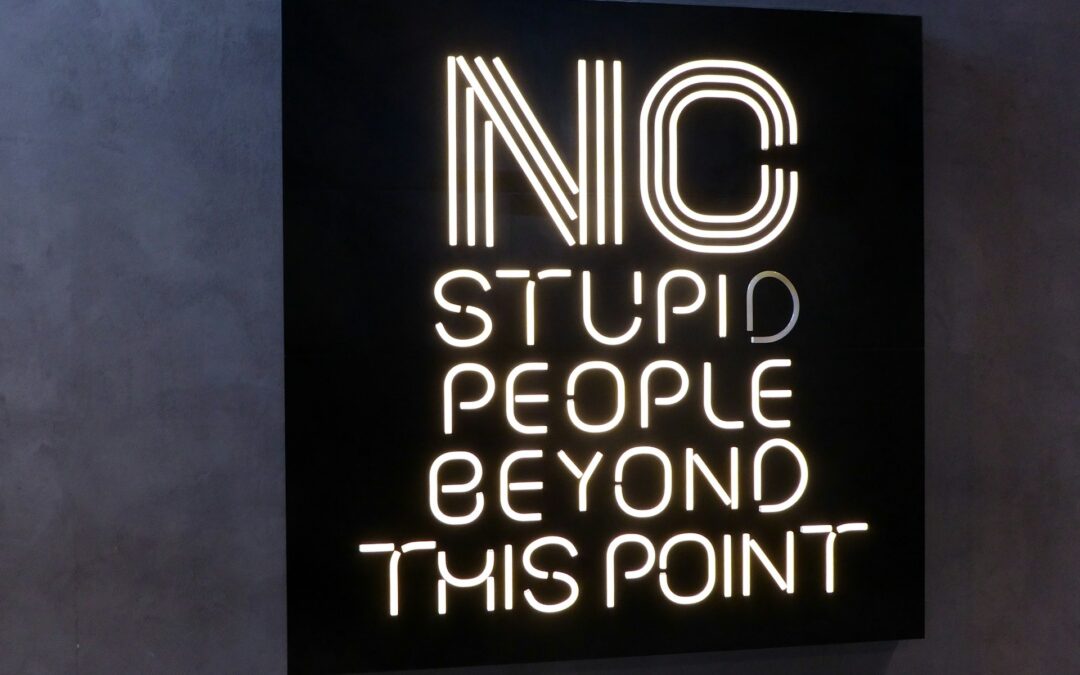
In a world where intelligence is often celebrated and stupidity ridiculed, the concept of “being stupid” can seem counterintuitive to most. We strive to present ourselves as competent, knowledgeable, and capable, fearing that any sign of stupidity might be seen as a fatal flaw. But what if being perceived as “stupid” could actually be a hidden asset? This article explores the surprisingly powerful benefits of embracing stupidity—why appearing less intelligent than you are might offer strategic advantages, simpler solutions, and even the freedom to avoid unnecessary burdens. It’s time to reconsider what “stupidity” truly means and how it can propel us forward in ways intelligence sometimes can’t.
1. People Don’t Expect Much of You
“Appear weak when you are strong,” is a timeless adage from Sun Tzu’s The Art of War that transcends military strategy and penetrates the depths of human behavior. The concept of appearing less capable than you are, as counterintuitive as it may sound, has profound implications for personal interactions, career dynamics, and social navigation. When others perceive you as “weaker” or less competent, they lower their expectations of you. This allows you to maneuver with far more freedom than those who are constantly under the scrutiny of high expectations.
In the context of everyday life, this principle plays out in various subtle ways. For example, in the workplace, people who are perceived as highly competent are often burdened with additional responsibilities, projects, and challenges. They are expected to consistently deliver at a high level and are constantly watched by colleagues and superiors alike. On the other hand, those who are underestimated or seen as “less capable” tend to be overlooked, which, surprisingly, can be a strategic advantage. The pressure to perform is significantly reduced, allowing the “weak” individual to navigate their work with more flexibility, creativity, and the freedom to take calculated risks without the fear of failure looming over them.
Moreover, appearing less competent or “stupid” can create a cloak of invisibility. People who think you’re not a threat are less likely to see you as competition. They may dismiss your capabilities, inadvertently providing you with the opportunity to operate without their interference. This can be particularly advantageous in social settings or situations where you need to gather information without drawing attention to yourself. The “fool” persona allows you to blend into the background, while others unwittingly reveal their intentions or secrets, assuming that you’re too oblivious to understand the situation.
Take the example of Yoda from Star Wars. When Luke Skywalker first meets the Jedi Master, Yoda plays the part of a seemingly eccentric, ancient fool. He acts as though he’s nothing more than a curious, primitive hermit, which allows him to gauge Luke’s character without the young Jedi suspecting anything. Yoda’s apparent foolishness hides his deep wisdom, and by feigning ignorance, he is able to learn much more about Luke than a direct approach would have allowed. This manipulation of perception gives Yoda the chance to understand Luke’s strengths and weaknesses without raising his guard. In the same way, when people perceive us as “stupid,” they let their guard down, revealing more than they might have if they had seen us as a threat.
This perception of stupidity also often results in a lack of expectation. Mistakes made by those perceived as less intelligent are often more easily forgiven, since they are presumed to be unintentional. People may be more lenient and understanding, as they don’t hold you to the same high standards that others are held to. In contrast, those who are seen as “smart” are expected to avoid mistakes altogether, and when they slip up, the repercussions can be far harsher. The “stupid” persona, then, offers a shield against the usual scrutiny and criticism that accompanies high expectations. As a result, you have the freedom to fail, learn, and grow without facing the severe consequences that might befall someone who is perceived as more competent.
Thus, while most people strive to appear intelligent and capable in the eyes of others, there are undeniable advantages to presenting oneself as less so. By strategically downplaying your abilities, you allow others to underestimate you, creating opportunities for growth, learning, and success that might otherwise be out of reach. It’s the subtle art of being underestimated that gives you the space to thrive without the pressure of perfection.
2. A Different Perspective
One of the most significant drawbacks of expertise and experience is that they often limit our ability to see the world from fresh perspectives. As we accumulate knowledge, we develop frameworks and filters that shape the way we interpret situations, problems, and challenges. While this is generally beneficial in helping us make informed decisions, it can also lead to a narrow view—one that can overlook simpler, more effective solutions that a beginner or someone with less experience might easily spot.
In his article for Psychology Today, Gary Klein, a senior scientist, discusses how “being stupid” can actually help prevent mistakes. Klein recounts a case in a petrochemical plant where an experienced employee, who had spent years mastering the technical aspects of the job, failed to foresee the types of errors that novices might make—errors that could lead to dangerous situations and costly shutdowns. The employee’s extensive experience in the field made it difficult for him to understand the perspective of someone with far less knowledge. This created a gap in the training process, as the expert couldn’t imagine what mistakes beginners might make, and thus was ill-equipped to prevent them.
Klein’s insight into this “stupidity” paradigm reveals a profound truth: sometimes, it is beneficial to remove ourselves from the expertise and knowledge that we possess in order to see the world through the eyes of someone less experienced. This fresh perspective is particularly valuable when trying to solve problems or develop solutions that are more accessible to those who are not specialists. The “stupid” viewpoint allows us to strip away preconceived notions, biases, and complexities, offering a more straightforward approach that can be incredibly effective in a variety of situations.
This concept is not limited to technical fields or industries. Consider the process of designing technology for people who are not tech-savvy. To design a smartphone interface that is user-friendly for elderly individuals, for example, designers need to “unlearn” their own advanced understanding of technology and approach the task from the perspective of someone who may not be familiar with the terminology or functionality of modern devices. They need to forget the shortcuts, the multi-tasking capabilities, and the streamlined functions that tech experts take for granted, and instead create something simple, intuitive, and easy to navigate for someone who might be encountering a smartphone for the first time. By “playing dumb,” designers can make technology more accessible to the less tech-savvy, bridging the gap between complex innovations and everyday usability.
Furthermore, the “stupid” mindset encourages a simpler approach to problem-solving. In our complex, fast-paced world, it’s easy to fall into the trap of overcomplicating things. We often assume that the more intricate a solution is, the more effective it must be. This is known as the “complexity bias,” the tendency to prefer complicated explanations or solutions, even when simpler alternatives exist. Embracing stupidity allows us to strip away the non-essential, focusing only on what truly matters. By adopting a childlike curiosity and questioning things from a more basic standpoint, we can identify the simplest, most effective solution to a problem.
For example, when faced with a complex organizational challenge or a seemingly unsolvable dilemma, the ability to think simply and without the constraints of prior knowledge can lead to insights that others might overlook. By approaching the situation as if you were seeing it for the first time, with fresh eyes and an open mind, you’re more likely to find creative, unconventional solutions that may be missed by someone who is deeply entrenched in the issue at hand.
In essence, “being stupid” can lead to breakthroughs precisely because it forces us to relinquish our assumptions and biases. This ability to return to a more fundamental, beginner’s mindset is a skill that can unlock innovative ideas and solutions that would otherwise remain hidden behind layers of expertise. By temporarily shedding our intelligence, we can gain a clearer, more holistic view of the world, one that’s not constrained by what we already think we know.
3. Being Considered Useless
In a world where usefulness is often equated with worth, being perceived as “useless” can initially feel like a major disadvantage. We are constantly reminded that to succeed, we must contribute, be productive, and offer something of value to others. Yet, when viewed from a different lens, being seen as “useless” can offer significant freedom and protection from the expectations and burdens that are imposed on those who are deemed valuable or capable.
The concept of “uselessness” offers a paradoxical benefit—those who are overlooked or dismissed by society are often spared the weight of responsibility. When people perceive you as of little value, they are less likely to rely on you for important tasks or ask you to carry out high-pressure duties. In an office setting, for instance, the “useless” employee may avoid being assigned to stressful projects or taken for granted as a constant performer. In many ways, being seen as “useless” liberates you from the constant pressure to deliver. It allows you to exist on the periphery, away from the scrutiny and demands that can drain your energy and creativity.
While society often values individuals for their contributions and tangible outputs, the “useless” person is free from this continuous burden. There is a certain peace in being unimportant to others, as it allows one to focus on personal pursuits, hobbies, and interests without the constant interference of expectations. Schopenhauer’s reflection on the insignificance of other people’s opinions speaks directly to this idea: when you are considered “useless,” their judgments lose power over you. You are less likely to be used as a tool in someone else’s agenda, and as a result, you preserve your mental and emotional well-being.
The Taoist story of the crooked tree offers a brilliant illustration of how being seen as “useless” can be a hidden blessing. The crooked tree, unlike its straight counterparts, was ignored by woodcutters because it couldn’t be used for timber. The straight trees, valued for their practicality, were eventually cut down. The crooked tree, however, lived on, untouched and free from the fate that befell the “useful” trees. Its perceived uselessness preserved its life and allowed it to grow strong and resilient over time. In the same way, when we are deemed “useless,” we are often spared from the societal pressures that might otherwise consume us. This freedom from obligation allows us to live without the stress of constantly proving ourselves or fulfilling the needs of others.
Moreover, the perceived “uselessness” can also be a form of personal liberation. When people don’t see you as a valuable resource, they are less likely to exploit your talents or push you into roles that do not align with your desires. It’s a form of protection, a way to escape the often exploitative nature of society, which values individuals based on their productivity. As Zhuangzi’s fable shows, sometimes being seen as useless can preserve your peace, safeguard your time, and protect you from being consumed by the demands of others.
4. The Foundation of Civilization
At first glance, stupidity may seem like an obstacle to progress, a roadblock to the rational and intelligent decisions that drive human development. However, Dutch historian Matthijs van Boxsel suggests that stupidity is, in fact, a foundational element of human civilization. According to van Boxsel, human intelligence is a direct result of our efforts to understand, mitigate, and combat our own stupidity. Stupidity, paradoxically, is a catalyst for the very intelligence that has allowed humanity to build advanced societies, develop technology, and tackle existential threats.
Human stupidity has long been a source of frustration, but it also serves as a stark reminder of our limitations. Without the constant threat of our own foolishness, humanity would have little motivation to improve. Our ancestors’ failure to recognize the dangers of irrational behavior, whether through reckless wars, irrational ideologies, or blind allegiance to harmful beliefs, led to some of the darkest chapters of history. However, these same failures prompted us to develop systems of governance, scientific inquiry, and education to prevent further catastrophic outcomes. In essence, human stupidity has been a driving force in the creation of the systems that now guide us.
Van Boxsel’s claim that “intelligence is nothing but the result of our vain efforts to understand our own stupidity” encapsulates this relationship between intelligence and stupidity. In confronting the absurdities of our actions and beliefs, humanity has developed the capacity for self-awareness, critical thinking, and innovation. These intellectual advances are not born out of pure logic alone but are, in large part, responses to the dangers posed by our own irrationality. For example, the development of modern scientific methods, laws, and technologies has been a direct response to human folly. The need to better understand and control our environment emerged from a history marked by disastrous mistakes, from the destruction caused by warfare to the global impact of climate change.
Take, for example, the threat of nuclear warfare. The idea of using nuclear weapons, which could annihilate entire populations and ecosystems, is an incredibly foolish one. Yet, the existence of nuclear weapons has forced humanity to reckon with its own recklessness. The devastating potential of these weapons led to the development of arms control agreements, non-proliferation treaties, and global organizations aimed at preventing further escalation. In this way, the very threat posed by human stupidity—the potential for global self-destruction—has led to intelligent solutions aimed at safeguarding the future of humanity. The presence of stupidity in the form of irrational actions, like the desire for power through the destruction of others, compels societies to find intelligent, rational ways to preserve peace.
Van Boxsel’s exploration of stupidity as the “missing link” between our ape ancestors and modern humans highlights how our cognitive evolution is shaped by our need to overcome our own foolishness. The development of intelligence was driven not by our desire to become more rational, but by our need to survive the consequences of our own irrational actions. The mistakes of our ancestors, from miscalculating risks to blindly pursuing dangerous ideologies, spurred the development of critical thinking, problem-solving, and ethical frameworks that have allowed us to avoid the same pitfalls.
While we may wish for a world without stupidity, it’s this very stupidity that has propelled us forward. In recognizing the limitations of our own knowledge and intelligence, we are forced to adapt, innovate, and grow. Stupidity, therefore, is not simply a flaw—it is a driving force behind human progress. It compels us to think more deeply, question our assumptions, and develop solutions to the problems we create through our ignorance. By embracing stupidity, we are reminded of our humanity and the ever-present need to improve in the face of our own shortcomings.
Conclusion
The concept of stupidity is often misunderstood and dismissed as a weakness, yet it holds immense potential when viewed from a different perspective. From reducing the expectations others place on us to simplifying complex problems, the benefits of being perceived as “stupid” are surprisingly numerous. Stupidity forces us to adopt new ways of thinking, fosters innovation, and even shields us from unnecessary burdens. Rather than shying away from being seen as less than we are, perhaps we should embrace the power of being a fool—an unassuming, underestimated force that quietly works its way toward victory. In the end, the strategic use of stupidity may just be one of the greatest advantages in navigating the complexities of modern life.