
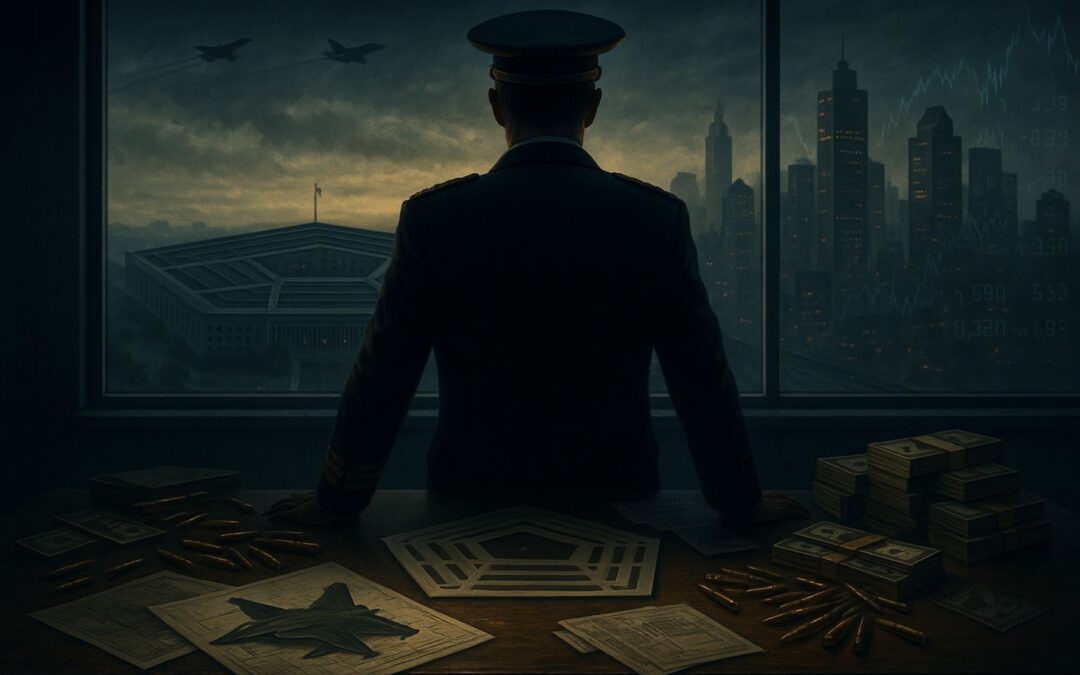
The Promise That Died Before It Began
January 2009 was supposed to mark a turning point — a moment when integrity would return to Washington. Barack Obama had campaigned not just on hope, but on cleansing the machinery of power. He spoke often about the “revolving door” — that quiet corridor between government and industry where influence never retires, it merely changes uniforms.
The idea was simple: no more lobbyists writing laws they once fought to weaken. No more bureaucrats cashing in on the systems they designed. No more defense executives slipping into the Pentagon only to emerge richer and more powerful than before. Obama’s ethics rules would draw a clear line between service and self-interest.
But that promise unraveled before it began. Even before he took the oath of office, Obama made an exception that told the world how Washington really works. His choice was William J. Lynn III, a man whose résumé read like a case study in everything the new president had vowed to stop.
Lynn had served as undersecretary of defense under Bill Clinton — the man responsible for managing the defense budget and overseeing the very contracts he would later profit from. When he left government, he joined Raytheon, one of America’s largest weapons manufacturers, earning over a million dollars a year lobbying for the same department he once ran. When Obama brought him back into the Pentagon as deputy defense secretary, he justified it as a matter of “experience.”
Experience, indeed — in how the game is played.
Within a few years, Lynn would once again leave “public service,” this time to become CEO of DRS Technologies — a defense firm that paid him tens of millions. It was the perfect demonstration of the cycle: policy to profit, profit to policy, repeat.
And Lynn was no anomaly. Between 2016 and 2021, 1,700 senior government officials took jobs in the defense sector after leaving office. Eighty percent of retired four-star generals and admirals now work for military contractors or serve on their boards. The very people who decide where the bombs fall and which weapons get built often end up cashing in from those same decisions.
The revolving door isn’t just a metaphor anymore. It’s an economic model — one that rewards loyalty to the system, not the public.
Each new administration promises reform. Each inherits the same architecture of influence. And each discovers, sooner or later, that the war machine doesn’t answer to presidents. It answers to profit.
The Birth of a Permanent War Machine
Before the Second World War, the United States had no standing military industry. When conflict arose, factories converted temporarily — Detroit’s automakers built tanks, typewriter companies made rifles, and washing machine manufacturers stamped out parts for bombers. When peace returned, so did civilian production. War was seen as an interruption, not an industry.
That changed with the scale and scope of World War II. Facing enemies across two oceans, the United States realized it couldn’t rely on improvised supply chains. President Franklin D. Roosevelt established the War Production Board — a centralized command to coordinate factories, materials, and manpower. It worked spectacularly. In four years, America built 300,000 aircraft, 100,000 tanks, and 70,000 ships. Private industry had never moved so efficiently.
But victory brought an unintended consequence: a realization that permanent mobilization was profitable.
When the war ended, the U.S. faced a choice — return to peace or preserve the war economy as a hedge against future threats. Then came the Soviet Union. The Cold War offered the perfect justification to maintain the machinery of conflict.
Factories that once made bombers for Berlin now made jets for Korea. The same contractors that supplied D-Day now supplied Vietnam. Corporations like Boeing, Lockheed, and General Dynamics transformed from versatile manufacturers into specialized defense giants. What began as a patriotic duty evolved into a dependable business model.
By the 1950s, a new pattern had emerged: military budgets no longer fluctuated with war and peace. They grew steadily year after year, ensuring stability for an entire ecosystem of engineers, lobbyists, and investors. Even peacetime became profitable.
In 1941, no American company derived most of its revenue from defense. By the 1960s, that had completely reversed. Lockheed derived nearly 80% of its income from military contracts. General Dynamics built submarines, missiles, and tanks — all funded by taxpayers. Northrop became synonymous with stealth technology. The modern defense contractor was born — not as a wartime savior, but as a permanent arm of government policy.
America had crossed an invisible line. War was no longer an emergency. It was an economy.
And once an economy takes shape, it demands growth. It seeks new markets, new justifications, new enemies. Thus began the age of the permanent war machine — an era where defense was not a response to threat, but a precondition for prosperity.
By the time Eisenhower left office in 1961, he could see the full outline of the beast he had helped build. It would take generations before the rest of America realized it was no longer defending freedom — it was funding dependence.
Eisenhower’s Warning — and America’s Deaf Ear
Dwight D. Eisenhower was a man forged in war. He led the Allied armies across Europe, witnessed the industrial mobilization that won the Second World War, and understood better than anyone how nations turn steel, fuel, and willpower into victory. Yet as he prepared to leave the presidency in 1961, the general who had once commanded millions of troops felt compelled to deliver a warning that would echo through history.
In his farewell address, Eisenhower coined a new phrase — the military-industrial complex. It wasn’t a speech meant to inspire pride, but one meant to stir unease. He had seen something dangerous growing in the shadow of America’s triumph: a vast network of corporations, bureaucrats, and politicians whose interests were aligning in ways that threatened the very democracy they claimed to protect.
“Guard against the acquisition of unwarranted influence,” he said, “whether sought or unsought.” Those words were meant as both prophecy and plea. Eisenhower had seen firsthand how the defense industry had transformed from a temporary necessity into a permanent political and economic force. Weapons manufacturers no longer waited for wars; they lobbied for them. Generals no longer advised on military needs; they advocated for larger budgets. Congress no longer debated strategy; it approved spending bills so massive they defied comprehension.
Eisenhower knew what few in power wanted to admit: war had become profitable, and profit had become patriotic. The Cold War, with its perpetual sense of danger, made this arrangement easy to justify. The Soviet threat provided the perfect rationale for endless expansion. Each new missile system, each new bomber, each new base was presented as a safeguard of freedom — but underneath, it was also a safeguard of revenue.
Throughout the 1950s and ’60s, the defense budget ballooned into a fixture of the American economy. The industries of peace were gradually eclipsed by the industries of power. Corporations like Lockheed and Boeing became so entwined with the state that their interests were indistinguishable from national policy. And the people — taxpayers footing the bill — were told this was the price of safety.
Eisenhower’s warning fell on deaf ears because it was inconvenient. It threatened the comfortable narrative of American greatness. To heed it would have required sacrifice, transparency, and restraint — qualities that rarely coexist with ambition and profit. So the nation looked away, and the machinery of war kept humming.
By the time his words were studied seriously, decades later, the system he feared was no longer a possibility. It was a reality — vast, untouchable, and indispensable to the American way of life.
After the Cold War: The Empire Consolidates
When the Soviet Union collapsed in 1991, it seemed the world had entered a new age of peace. The great ideological contest that had defined the twentieth century was over. With no rival superpower, the United States stood unchallenged — the sole global hegemon. Many believed this would finally mean the downsizing of the military apparatus that had dominated the national budget for nearly half a century.
For a brief moment, that appeared to happen. Defense spending fell from 6% of GDP in the 1980s to just over 3% by the late 1990s. Factories slowed. Contracts shrank. There was talk of a “peace dividend” — the idea that money once spent on missiles could now be invested in schools, healthcare, and infrastructure. But inside the Pentagon and on Wall Street, a different conversation was unfolding.
An entire economy had been built around war, and peace threatened to ruin it. Defense contractors were running out of enemies, not ingenuity. The Pentagon saw the danger too: too many contractors, not enough contracts. So, in 1993, Defense Secretary Les Aspin gathered the heads of the major defense firms for what would later be remembered as The Last Supper.
It was not a warning, but an invitation — to merge, consolidate, and survive. The Pentagon essentially told the industry: there will be fewer contracts in the future, so you’ll need to become bigger and more efficient to compete. The result was historic. Within a few years, Lockheed merged with Martin Marietta, Boeing absorbed McDonnell Douglas, Northrop joined with Grumman, and Raytheon swallowed Hughes Aircraft.
By the turn of the century, what had once been an ecosystem of dozens of competing firms had shrunk into an oligopoly of five: Lockheed Martin, Boeing, Northrop Grumman, General Dynamics, and Raytheon. Together, they controlled over half of all Pentagon contracts.
In theory, this was supposed to make the system leaner and more efficient. In practice, it made it unassailable. With so few players, competition disappeared. There were no real market pressures to innovate, lower costs, or deliver better results. These companies didn’t need to fight for contracts — they were guaranteed them.
The concentration of power had another, more subtle effect. It blurred the boundary between private industry and national defense. CEOs of defense firms moved easily into advisory roles within the Pentagon. Generals retired and joined corporate boards. Lobbyists became policymakers. The same people who designed the weapons were now helping decide when and where they would be used.
From that point onward, the idea of “national defense” became inseparable from corporate interest. Every new conflict — from Iraq to Afghanistan to Ukraine — offered not just geopolitical influence but economic opportunity. Stock prices rose with every new deployment. Defense spending became as predictable as gravity.
The empire had consolidated. And in doing so, it ensured that even in times of peace, the machinery of war would never be idle again.
The Economics of Endless Conflict
In most industries, efficiency is rewarded. Companies are expected to innovate, reduce costs, and deliver better products faster and cheaper than their competitors. In defense, the logic runs backward. Waste isn’t punished — it’s incentivized. Failure isn’t a setback — it’s a business model.
The reason lies in a single phrase buried deep in Pentagon contracts: cost-plus. Under this arrangement, contractors are reimbursed for all expenses and then guaranteed a fixed percentage in profit. It sounds fair in theory — ensuring companies don’t lose money when costs rise. But in practice, it’s an open invitation to overspend. The higher the costs, the higher the profit.
If a jet engine part costs $10 million instead of $5 million, the contractor earns more, not less. If the project runs five years late and billions over budget, there are no consequences — only larger invoices. The incentives are inverted: inefficiency becomes lucrative, accountability vanishes, and the taxpayer foots the bill.
Consider the F-35 fighter jet, the most expensive weapons system ever built. Initially projected at $200 billion, its lifetime cost has since soared to $1.7 trillion. Trillion — with a T. That number exceeds the GDP of most nations. The jet has been plagued by technical problems, software bugs, and maintenance nightmares. Yet despite its flaws, the program has never been threatened. Why would it be? It generates jobs across nearly every U.S. state and sustains entire industries.
Another case: the VH-71 presidential helicopter. Its original budget was $6 billion. Costs ballooned to $13 billion before the project was scrapped — and the contractor still made money. Each “failure” was quietly absorbed by the government as part of the process, a polite euphemism for legalized waste.
This isn’t corruption in the cinematic sense — no envelopes under tables or secret meetings in smoke-filled rooms. It’s systemic. The design itself ensures that inefficiency pays. The Pentagon, bound by bureaucratic inertia and political pressure, becomes the ideal client: endlessly forgiving, eternally funded, and incapable of walking away.
Meanwhile, Wall Street loves it. Defense stocks are among the safest bets in the market. Since 2000, companies like Lockheed Martin and Northrop Grumman have outperformed the S&P 500 in every five-year window. Their risk-adjusted returns rival those of Big Tech, but with one crucial difference — they don’t depend on consumers, trends, or innovation. They depend on fear.
The industry’s investors aren’t betting on victory or peace; they’re betting on perpetual tension. Whether it’s terrorism, cyberwarfare, or a great power rivalry, the form doesn’t matter — only that the threat persists. The longer it does, the steadier the profits.
Every other sector strives to make life better, cheaper, easier. Defense thrives by ensuring it never gets too safe.
When war becomes a marketplace, the line between security and exploitation disappears. What’s left is a self-sustaining economy of conflict — one that sees every rising tension not as tragedy, but as opportunity.
Pork, Politics, and the Price of Influence
If inefficiency keeps the industry profitable, politics keeps it untouchable. The defense sector doesn’t just manufacture weapons; it manufactures consent. It has mastered the art of making itself indispensable to every corner of the American political map.
Take the F-35 program again. It employs over 125,000 people across 46 states. On paper, that looks like strategic distribution — in reality, it’s political insurance. When a weapons program spreads jobs across nearly every congressional district, it becomes impossible to kill. Any representative who dares to question its cost risks not only defense dollars but local employment — and, by extension, reelection.
This isn’t inefficiency; it’s design. Every subcontract, every plant, every supplier is placed with purpose — not where it’s most efficient, but where it’s most politically useful. This is called pork-barrel spending, and it’s the most effective shield an industry can build.
The result is staggering bipartisan unity in a country otherwise defined by division. Year after year, Democrats and Republicans feud over healthcare, education, and taxes. But when the National Defense Authorization Act (NDAA) comes up for a vote, the harmony is near perfect. Over the last five years, more than 80% of votes in both the House and Senate have supported increases in the defense budget — regardless of who holds power.
The reason isn’t ideology; it’s economics. In 2024, the U.S. spent nearly $1 trillion on defense — up from $640 billion just a decade earlier. That money touches every state, every district, every lobbyist. It funds campaigns, underwrites contracts, and ensures that no one has an incentive to pull the plug.
Campaign contributions seal the deal. Members of the House and Senate Armed Services Committees — those with direct influence over defense budgets — receive roughly four times more donations from defense companies than their colleagues who vote against spending hikes. Lawmakers who approve budget increases see millions flow into their campaign coffers during election cycles.
In the cold arithmetic of Washington, it’s a spectacular return on investment. For every dollar spent on lobbying or donations, the defense industry earns thousands — sometimes millions — in future contracts. Economists have estimated the ROI at nearly 450,000%. In any other context, that would be called corruption. In Washington, it’s called policy.
But perhaps the most striking success of the industry’s influence is how invisible it has become. Ask the average citizen what the government spends most on, and few will say defense. Ask how many wars America is currently fighting, and fewer still will have an answer. That’s the brilliance of the modern war economy — it doesn’t require active conflict to thrive. It only needs the possibility of one.
And so, the wheel turns. The politicians secure funding. The contractors secure contracts. The workers keep their jobs. The voters, grateful for stability, keep electing the same faces. Everyone wins — except the principle that government exists to serve people, not corporations.
This is how an empire sustains itself without admitting it’s one. The flag waves, the factories hum, and the balance sheets rise — not because war is necessary, but because peace is unprofitable.
The Revolving Door Never Stops Turning
If pork and politics keep the money flowing, the revolving door ensures the right people are always standing beneath the faucet. It’s not a door anymore, really — it’s a conveyor belt, moving seamlessly between the Pentagon, Capitol Hill, and corporate boardrooms. Everyone knows the rhythm: serve, retire, cash in.
For the men and women who climb to the top of America’s military hierarchy, the rewards waiting on the other side of retirement are extraordinary. Nearly 80% of four-star generals and admirals now go on to work for defense contractors or related investment firms. The expertise they built in uniform — knowledge of systems, budgets, and procurement — becomes a high-priced commodity.
When a general approves a weapons program during their tenure, they’re not just shaping defense strategy; they may also be shaping their own future. That contract can become a corporate seat, an advisory role, or a consulting gig worth millions. The same people who once demanded accountability from contractors now sign their paychecks.
Consider David Petraeus, once celebrated as the brilliant commander who led U.S. forces in Iraq and Afghanistan. After leaving the military — and later, the CIA — Petraeus joined the global investment firm KKR, helping direct billions into defense and security ventures. Or Lloyd Austin, who served as a four-star general and later joined Raytheon’s board before becoming Secretary of Defense under President Biden.
The overlap is no coincidence. Austin’s old firm, Pine Island Capital Partners, focuses specifically on investments in the defense sector — leveraging Washington connections to identify opportunities before the rest of the market can. The game isn’t subtle anymore; it’s simply part of the playbook.
And it’s not just generals. Former defense secretaries, undersecretaries, Pentagon lawyers, congressional staffers — all of them find lucrative landing spots in the private sector. According to a 2024 report, about 63% of the 950 lobbyists hired by the arms industry were former government employees. They know the process, the people, and the loopholes. They don’t need to bribe anyone; they just need to call their old colleagues.
This revolving ecosystem has created what some analysts call a “shadow government of continuity” — a permanent class of insiders whose loyalty lies not with any administration, but with the system itself. Presidents change. Parties alternate. Policies shift. But the people making money from war remain the same.
It’s a form of soft corruption — the kind that hides behind respectability. The retired general doesn’t think of himself as compromised; he tells himself he’s still serving his country. The former senator turned lobbyist believes he’s ensuring “national security.” The CEO insists that profit and patriotism are one and the same. And that’s what makes the system so durable: everyone involved can tell themselves they’re the good guy.
But beneath the euphemisms — “strategic advisory,” “national resilience,” “defense readiness” — lies the same moral rot Eisenhower warned about. Public service has become a pipeline to private enrichment. Every decision made in Washington is haunted by an unspoken question: Who profits next?
The revolving door doesn’t just blur ethics; it rewires them. When every exit leads to a payday, moral boundaries fade. The language of patriotism becomes indistinguishable from the language of profit. The nation’s security apparatus, once meant to defend democracy, now defends its own perpetuity.
The Moral Reckoning: Profit vs. Patriotism
Once, war was the failure of politics. Now, it’s the foundation of an economy. The modern defense industry doesn’t just respond to conflict — it requires it. Peace has become a pause, not a goal. The longer the tension lasts, the better the quarterly results.
The transformation is almost complete. Politicians justify bloated defense budgets as “investments in security.” Corporations wrap their contracts in the flag. Generals call for “strategic deterrence,” investors call it “growth.” Everyone’s vocabulary has adapted to disguise what’s really happening: the fusion of capitalism and militarism into one seamless enterprise.
It’s not that America is addicted to war in a moral sense — it’s addicted in a financial one. When your GDP, your employment, your pension funds, and your political campaigns are all tied to defense spending, peace becomes destabilizing. Ending a war isn’t good economics. Starting one is.
And so, the country drifts — not toward victory, but toward maintenance. Conflicts are managed, not resolved. Enemies are contained, not defeated. The wheel keeps turning because no one has the incentive to stop it.
This isn’t just a question of money. It’s a question of meaning. When profit masquerades as patriotism, when the men who sell the bombs also salute them, a society loses its moral compass. The symbols of honor and sacrifice become tools of marketing. The rhetoric of freedom becomes a sales pitch.
Eisenhower saw it coming, and so did Truman. Both men, soldiers and statesmen, understood that unchecked power doesn’t announce itself with tyranny — it seeps quietly into normality. “The military-industrial complex,” Eisenhower warned, “possesses the potential for the disastrous rise of misplaced power.” His words read today like a mirror, not a prophecy.
The defense industry has become too profitable to question, too integrated to reform, and too politically sacred to shrink. Its influence reaches from Wall Street to the White House, shaping foreign policy, campaign finance, and even national identity. It’s no longer an external system — it’s part of the bloodstream.
But here lies the deeper tragedy: in confusing profit with protection, the nation endangers both. An empire that cannot distinguish between security and greed eventually loses the very freedom it claims to defend.
And so, Eisenhower’s final plea remains the only antidote: an alert and knowledgeable citizenry. A public willing to ask who benefits from every bomb built, every base expanded, every budget raised. Because the moment we stop asking, democracy becomes just another line item on a defense contractor’s balance sheet.
If war is business, peace will always be bad for the bottom line.