
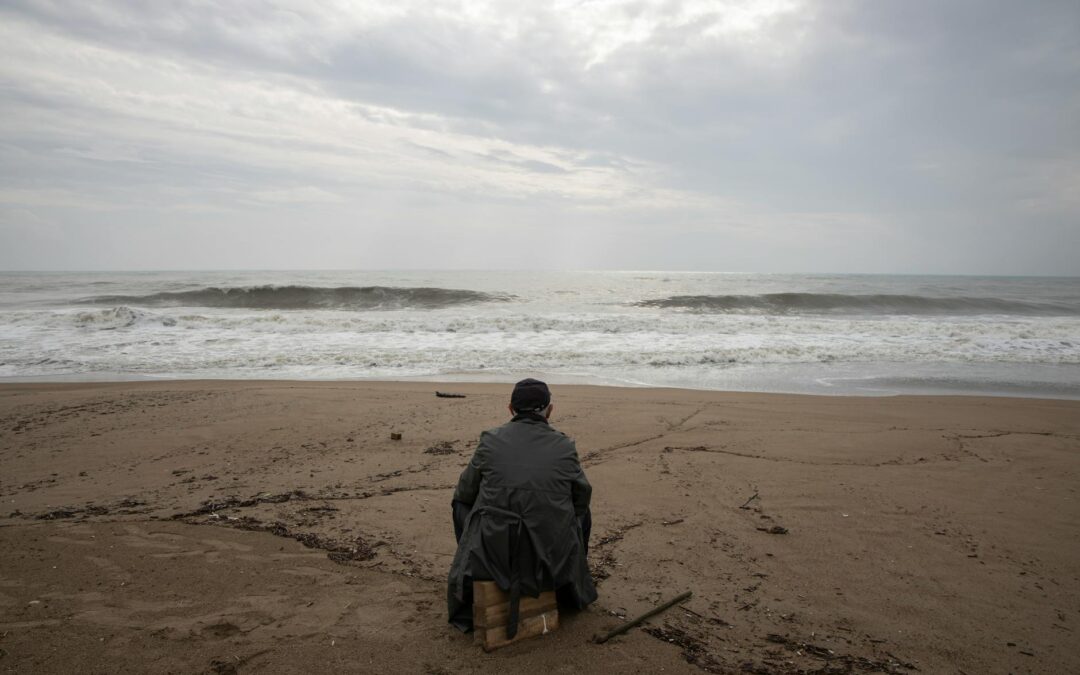
At some point, everyone feels it—the sense of drifting, of standing in a life that no longer fits. You wake up and the old routines feel hollow, the achievements you once chased seem empty, and the future feels like a fog without landmarks. It’s tempting to believe that this lostness means something is wrong with you, that you’ve failed or veered off course. But history suggests otherwise.
From presidents to explorers, scientists to astronauts, some of the greatest figures the world has ever known have faced moments when they were broken, disoriented, or undone by the weight of their own lives. Their stories remind us that feeling lost is not weakness—it’s part of the human process of growth and transformation.
Lincoln and the Void of Despair
The year was 1862, and Abraham Lincoln was unraveling. The war he had sworn to resolve had plunged into bloodshed, his young son Willie had just died in the White House, and his marriage to Mary Todd Lincoln was buckling under the crushing grief. The newspapers called him incompetent. Politicians whispered of his resignation. Generals refused his orders. To the public, he was a weak leader. To himself, he was a man crumbling under the weight of a nation’s collapse.
His depression was not the fleeting sadness of a bad season. It was a suffocating paralysis. He lay in bed for days, barely eating, his family afraid to leave him alone with a knife. To imagine the president of the United States—commander of armies, guardian of a fractured republic—treated like a patient on suicide watch is to glimpse the fragility beneath the myth of greatness.
And yet, Lincoln did not simply snap out of it. There was no lightning bolt of divine clarity, no rousing speech that restored his spirit. His recovery was slow, uneven, and agonizing. Some days, he forced himself upright by sheer discipline, burying himself in work. Other days, he relied on humor—his notorious storytelling, his self-deprecating wit—as a fragile shield against despair.
The turning point was not a miraculous cure but the stubborn insistence on continuing. Lincoln’s greatness was not that he avoided darkness, but that he kept walking through it. In the years ahead, as the war intensified and the body count mounted, he returned to that same grim resilience: life demanded endurance, not escape. His presidency, remembered today as one of history’s most consequential, was forged not in triumph but in the furnace of personal despair.
The lesson is uncomfortable yet liberating: sometimes, survival is the achievement. In seasons when you cannot see light, it is enough to keep rising, to keep speaking, to keep breathing through the void. For Lincoln, endurance became the soil from which vision eventually grew. For anyone lost in grief or failure, his example whispers: persistence itself is victory.
Jung and the Death of Old Meaning
Carl Jung’s early career was a storybook ascent. He fought his way through medical school, earned renown as Zurich’s leading psychoanalyst, and became Sigmund Freud’s chosen successor. Their bond was so intimate that Freud sometimes called him a son. To Jung, Freud was more than a mentor—he was a surrogate father, a figure of certainty and authority. For a time, the meaning of Jung’s life was clear: he was heir to a new science of the mind.
But meaning built on borrowed foundations rarely lasts. Jung could not ignore his growing doubts about Freud’s dogma—particularly Freud’s obsession with sexual repression as the root of every psychic wound. Jung valued ambiguity, myth, spirituality; Freud wanted certainty, reduction, power. When Jung published a book that contradicted Freud’s core theories in 1913, the rupture was volcanic. Freud did not merely disagree—he excommunicated him. Jung was denounced, isolated from the psychoanalytic community he had helped build, and stripped of the very identity he had constructed.
For Jung, the fallout was catastrophic. The world he had inhabited—the friendships, the intellectual community, the sense of destiny—collapsed overnight. Cut off from his role as Freud’s successor, he lost the narrative of his life. It was not just a career setback; it was an annihilation of self. In response, Jung spiraled into what he later described as a confrontation with the unconscious.
He withdrew from society, recording strange visions in his “Red Book”—an illuminated manuscript filled with dreamlike images, dialogues with archetypal figures, and passages that read more like scripture than science. He wandered along the shores of Lake Zurich, building tiny stone castles as if symbolically reconstructing the fragments of his psyche. He held conversations with phantoms in the forest, scribbled endless notes about dreams and symbols, and teetered on the edge of madness.
Yet out of this descent came transformation. By facing the death of his old meaning and refusing to patch it over with distraction, Jung birthed ideas that would revolutionize psychology: archetypes, the collective unconscious, the individuation process. His collapse was not the end but the threshold. He allowed the void to teach him, to strip away illusions and reveal the deeper strata of the psyche.
Jung’s journey demonstrates a hard truth: feeling lost is not the absence of meaning but the death of an old one. When your story no longer fits, you must allow it to break. The void is not a failure to escape—it is an invitation to remake yourself. Growth begins with destruction. Transformation demands burial before rebirth.
Roosevelt and the Comparison Trap
Theodore Roosevelt lived his life as a force of nature. By middle age he had been a rancher on the Dakota frontier, a police reformer in New York, the hero of San Juan Hill, governor, and then the youngest president in American history. His pace was relentless, his appetite for challenge insatiable. Roosevelt’s identity was inseparable from action—and from the public adoration that action inspired.
But in 1912, after two terms in office, he attempted a comeback. Believing himself still the indispensable man, he launched a third-party bid under the banner of the Progressive “Bull Moose” Party. He had survived bullets, wars, and political enemies—surely, he believed, he could survive this. Yet the voters rejected him. Instead of triumph, he found humiliation. His once thunderous voice in American life fell silent. Overnight, he became a political relic.
This was more than a political loss. For a man who had measured worth by victories, applause, and comparison with rivals, irrelevance was unbearable. Roosevelt’s sleepless nights reflected not just disappointment but a collapse of self. Without the echo of approval, he no longer recognized himself.
His solution was desperate: if he could not be remembered through politics, he would etch his name into history another way. He volunteered for an expedition to map an uncharted tributary of the Amazon—an undertaking so dangerous that local tribes called it the “River of Doubt.” It was less exploration than self-annihilation disguised as adventure.
The expedition nearly killed him. Wracked with malaria, weakened by infected wounds, and delirious with fever, Roosevelt begged to be left behind, preferring a “heroic” death to the humiliation of irrelevance. His son refused, dragging him through the jungle, step by agonizing step, until they returned to civilization.
The episode reveals the cruelty of the comparison trap. As long as life is measured against others—rivals, peers, strangers—our worth remains fragile. When applause stops, or when rivals surpass us, despair follows. Roosevelt’s collapse in the Amazon was not just about losing an election; it was about losing the external validation upon which he had built his very identity. His story warns against outsourcing self-worth to the fickle applause of the crowd.
Aldrin and the Impossible Aftermath
Buzz Aldrin’s step onto the lunar surface in 1969 was humanity’s triumph. Alongside Neil Armstrong, he achieved what millennia of dreamers had only imagined: leaving Earth behind and touching another world. In those moments, he was immortal. The parades, the medals, the cheers of millions cemented his place in history.
But when the dust of the moonwalk settled, a silence followed. Aldrin discovered the cruel paradox of ultimate accomplishment: once you’ve scaled the highest peak imaginable, every other mountain seems small. There was no “next mission.” No higher summit. Nothing in life could compare to walking on the moon. The glory of the moment curdled into despair.
He spiraled downward. Depression tightened around him like a vice. Alcohol became his anesthetic. His marriages fell apart. His finances crumbled. The astronaut who once piloted a spacecraft across the heavens now found himself selling Cadillacs in Beverly Hills, trying to convince strangers to buy cars. The juxtaposition was cruel: from the infinity of space to the banality of a dealership floor.
Aldrin’s downfall speaks to a universal human truth. Athletes encounter it when retirement arrives. Soldiers feel it when the war ends. Artists feel it when inspiration dries up. After the summit—the championship, the mission, the masterpiece—life can feel unbearably flat. We are wired to chase, not to rest. When the chase ends, drift begins.
The tragedy of Aldrin is not weakness but wiring. We mistake peak experiences for permanent fulfillment, when in truth they are fleeting. The higher the high, the sharper the descent when it ends. The lesson is not to avoid great accomplishments, but to remember they are moments, not lifetimes. Meaning must be continually renewed, not enshrined in a single triumph.
For Aldrin, the moon was not the end of the story but the beginning of a lifelong struggle to reorient meaning back on Earth. His collapse warns us: do not build your identity on one peak, however glorious. The summit is only a view, not a home.
Darwin and the Paradox of Choice
Charles Darwin was no stranger to questions of staggering magnitude. He had sailed around the world on the Beagle, studied the endless variety of life, and dared to suggest that all species—including humans—were shaped by natural selection. Yet when it came to one of life’s most ordinary questions—whether or not to marry—Darwin nearly unraveled.
He did not simply wonder. He made lists. On one side of the page, under “Marry,” he wrote: “children, if it please God,” “a constant companion,” “better than a dog anyhow.” On the other side, under “Not Marry,” he recorded: “freedom to go where I like,” “conversation of clever men at clubs,” and “not forced to visit relatives.” The handwriting of a man who had peered into the mysteries of creation suddenly looked like that of a nervous schoolboy.
Darwin’s torment illustrates a distinctly modern ailment: the paradox of choice. When faced with two equally good paths, the abundance of possibility paralyzes. Each choice is less about what we gain and more about what we sacrifice. The decision to marry meant giving up independence. The decision not to marry meant surrendering intimacy. Whichever way he turned, Darwin felt he was betraying the other version of himself.
This phenomenon is magnified in our age of abundance. Careers, partners, places to live—all gleam with potential. The more options we possess, the less satisfied we feel, not because the options are bad, but because choosing one requires closing the door on countless others. We mourn the lives unlived, even as we step into the one we’ve chosen.
Darwin resolved the dilemma by marrying Emma Wedgwood, his cousin. It was not a grand romantic gesture, but a decision rooted in practicality and quiet conviction. That stability became the anchor for his life’s greatest work. From the home he shared with Emma, he produced On the Origin of Species, a book that reshaped human self-understanding for centuries.
The lesson is subtle but profound: clarity comes not from infinite possibility, but from limitation. Meaning is forged not in freedom without end, but in commitment to a single path. Darwin discovered that to live fully is to choose, to shut doors, and to accept that the pain of lost options is the price of depth.
The Compass in the Fog
When life’s narrative collapses, we mistake the sensation for failure. Yet the stories of Lincoln, Jung, Roosevelt, Aldrin, and Darwin show something else: feeling lost is not the end—it is the threshold. Each man’s crisis reveals a different face of disorientation: despair, broken meaning, comparison, collapse after triumph, paralysis of choice. Together, they form a map of the human condition.
Lincoln teaches us the necessity of endurance—the quiet heroism of rising each day when nothing feels worth rising for. Jung shows that new meaning requires the death of old meaning, that transformation demands we sit with the void instead of fleeing from it. Roosevelt warns of the poison of comparison, how applause can enslave, and how silence can destroy those who live by it. Aldrin’s descent illustrates the danger of mistaking one moment of glory for a lifetime of fulfillment, reminding us that the summit is fleeting. Darwin reminds us that abundance itself can paralyze, and that freedom without commitment leads only to emptiness.
What, then, is the compass when the fog closes in? It is not a neat formula but a set of practices: endure the darkness, explore the void, resist comparison, release the past, and commit to the path before you. The fog is not your enemy. It is the crucible in which your next story is written.
To feel lost is not to fail—it is to be human. The question is not whether the map disappears, but how you walk when it does.
Conclusion
Lostness is not a detour from life’s path—it is the path itself. Lincoln, Jung, Roosevelt, Aldrin, and Darwin each walked through the wilderness of despair, confusion, or collapse, and in doing so, revealed that disorientation is not the end but a beginning.
When your story stops making sense, when applause fades, when choices overwhelm or triumphs leave you hollow, remember this: the fog is not emptiness. It is an invitation. An invitation to endure, to rediscover, to commit, to redefine. To feel lost is to stand at the edge of a new narrative waiting to be written. And the courage to step forward—uncertain, unsteady, but still moving—is what transforms the void into meaning.