
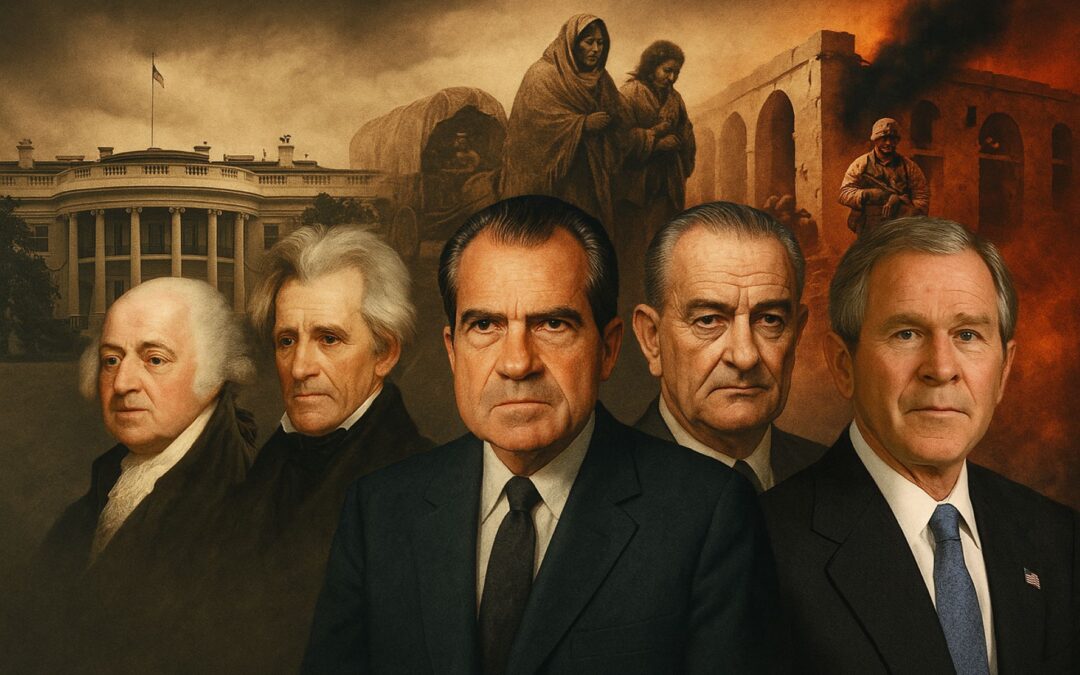
The American presidency is often cloaked in grandeur—portraits in marble, speeches etched in memory, moments that define eras. Yet alongside triumphs sit failures so grave they reshaped the nation itself. From signing laws that muzzled free speech to ignoring the threat of secession, from uprooting entire peoples to waging wars on false premises, presidents have sometimes driven the country into crises of their own making. These were not minor slip-ups or policy disagreements. They were decisions that derailed lives, weakened freedoms, and altered the course of history. To understand America’s journey, one must reckon not only with its victories, but also with its most catastrophic missteps.
John Adams and the Alien and Sedition Acts
John Adams inherited a fragile young republic balanced precariously between European titans. Britain and France were locked in perpetual conflict, and both expected America to take sides. The Jay Treaty with Britain angered the French, who felt betrayed after supporting America’s independence. Soon, French privateers were seizing American merchant ships, and whispers spread that French agents lurked within U.S. borders to destabilize the government. The press, often partisan and venomous, fanned the flames of fear.
Adams, already a cautious and insecure leader, faced immense pressure from his Federalist allies to act decisively. What emerged was the Alien and Sedition Acts of 1798—four laws that represented the first great test of constitutional liberty under fire. The Naturalization Act raised the residency requirement for citizenship from five to fourteen years, a thinly veiled attempt to weaken the political influence of immigrant communities that tended to support Jeffersonian Republicans. The Alien Friends and Alien Enemies Acts gave the president sweeping authority to detain or deport non-citizens deemed “dangerous” or hostile, often without trial. Most infamous was the Sedition Act, which criminalized “false, scandalous, and malicious writing” against the government.
Federalist prosecutors eagerly targeted critics. Newspaper editors, pamphleteers, even a congressman were hauled into court for daring to oppose the administration. Political dissent was equated with treason. For a nation born in rebellion against tyranny, the spectacle was shocking. Opposition exploded, especially in the South and West, where Jefferson and Madison secretly drafted the Virginia and Kentucky Resolutions, declaring that states could resist unconstitutional federal laws. Though their theory of “nullification” proved controversial, it was born directly out of Adams’s overreach.
The Alien and Sedition Acts backfired spectacularly. Instead of securing unity, they deepened division. The laws expired or were repealed within a few years, but the damage lingered. Adams lost re-election in 1800, and the Federalist Party began its slow decline. More importantly, he created a precedent that presidents could justify curbing civil liberties in times of fear—a pattern repeated during the Civil War, World Wars, and even in the War on Terror. Adams, the man who had helped draft the architecture of American liberty, was also the first to compromise it.
Thomas Jefferson’s Embargo Disaster
Thomas Jefferson approached the presidency with an almost philosophical devotion to peace and republican virtue. He loathed standing armies and feared entangling alliances. Yet in 1807, his lofty ideals collided with geopolitical reality. Britain and France, locked in the Napoleonic Wars, viewed American neutrality as weakness. Both powers seized U.S. merchant ships, and Britain enraged Americans by impressing sailors into service for the Royal Navy. Jefferson’s cherished vision of America as a “peaceful commercial republic” was mocked on the high seas.
Unwilling to wage war and desperate to assert independence, Jefferson turned to economic coercion. The Embargo Act prohibited all American exports and effectively shut down trade with foreign nations. His reasoning was simple but naïve: European nations relied on American raw materials and agricultural goods; by cutting them off, they would be forced to respect U.S. neutrality. Jefferson believed economic pressure could succeed where diplomacy and warfare failed.
The results were disastrous. American ports, once teeming with ships and sailors, became desolate. Warehouses overflowed with unsold goods. Farmers in the South and West, who depended on exporting tobacco, cotton, and grain, saw their incomes collapse. Shipbuilders and dockworkers in New England were thrown into poverty. In total, exports plummeted by over 75% within a year. The very lifeblood of the American economy had been severed by its own leader.
Smuggling flourished. Merchants evaded the embargo through Canada and the Caribbean, and Jefferson, once a champion of limited government, was forced to deploy federal agents to police his own citizens. The irony was painful: the man who had denounced Adams for trampling liberty under the Alien and Sedition Acts now authorized invasive enforcement measures to uphold his embargo.
Politically, the embargo eroded Jefferson’s popularity. Critics accused him of sacrificing the nation’s prosperity for an untested theory. By the time Congress repealed the act in 1809, the damage was severe. The economy lay battered, relations with Britain were worse than ever, and the nation was sliding toward open conflict. The Embargo Act, intended as a peaceful alternative to war, instead became a stepping stone to the War of 1812.
Jefferson had sought to demonstrate the power of economic leverage over military might, but his miscalculation underscored a brutal truth: in a world of empires, a fledgling republic could not bend global powers through trade alone. His grand experiment in “peaceful coercion” remains one of the most infamous examples of presidential overconfidence meeting harsh reality.
Andrew Jackson and the Trail of Tears
Andrew Jackson, the “hero of New Orleans,” embodied the image of rugged democracy and populist defiance. But behind the façade of the people’s champion lay a deep hostility toward Native Americans. He regarded Indigenous nations not as sovereign peoples but as obstacles to white settlement and economic expansion. His political base—frontier settlers and southern planters—clamored for access to fertile lands in Georgia, Alabama, and Mississippi. To Jackson, their demands aligned with his vision of a rising agrarian republic fueled by cotton and slavery.
In 1830, he pushed through the Indian Removal Act, cloaked in the language of “voluntary exchange” but enforced with federal might. The law authorized the president to negotiate land swaps, relocating tribes from the Southeast to territories west of the Mississippi. In reality, these negotiations were coercive. Tribal leaders were pressured, bribed, or outright deceived into signing removal treaties. The Cherokee, in particular, resisted fiercely, adopting written constitutions, farming methods, and even Christianity to demonstrate their “civilized” compatibility with American society.
Their resistance culminated in Worcester v. Georgia (1832), where the Supreme Court declared the Cherokee Nation a distinct community with the right to remain on its land. It should have been a triumph of law over force. Instead, Jackson dismissed the ruling. Whether or not he uttered the infamous line, “John Marshall has made his decision; now let him enforce it,” his actions made clear his contempt for judicial authority. The executive branch simply ignored the Court, shattering the balance of powers.
The result was a campaign of forced removals that reached its most tragic expression in the Trail of Tears (1838–1839). Under military escort, thousands of Cherokee were marched westward in brutal conditions. Families trudged through snow and mud, lacking proper supplies. Disease spread in makeshift camps, starvation hollowed entire communities, and exposure to the elements claimed lives daily. By the end, roughly 4,000 Cherokee—about one-quarter of the population—had perished. The Choctaw, Creek, Chickasaw, and Seminole endured similar ordeals.
The human cost was staggering, but Jackson’s policy also transformed the American South. Vast tracts of seized land became the foundation of the cotton kingdom, enriching white planters and entrenching slavery deeper into the region. The removal of Native peoples was not simply displacement; it was the opening act of an economic system that would drive America toward the Civil War. Jackson’s defiance of law, contempt for Native rights, and unleashing of human suffering ensured his legacy would forever be marred by one of the darkest stains on the nation’s conscience.
James Buchanan’s Paralysis Before Secession
James Buchanan, the fifteenth president, entered office at one of the most perilous moments in American history. By the late 1850s, sectional tensions had reached a fever pitch. The Dred Scott decision in 1857, endorsed by Buchanan himself, declared that African Americans could never be citizens and that Congress lacked authority to ban slavery in the territories. Instead of quelling the conflict, the ruling poured gasoline on an already raging fire.
When Abraham Lincoln won the presidency in November 1860, the South erupted. His platform of halting slavery’s expansion was perceived as an existential threat. Within weeks, South Carolina voted to secede. Mississippi, Florida, Alabama, Georgia, Louisiana, and Texas soon followed. Confederate leaders seized federal arsenals and forts, declaring themselves a sovereign nation. The Union—the grand experiment of the Founders—was disintegrating in real time.
Buchanan’s response was paralysis cloaked in legalism. In his December 1860 State of the Union address, he declared that secession was unconstitutional. Yet, in the same breath, he argued that the federal government lacked power to coerce states back into the Union. It was an astonishing contradiction: secession was illegal, but also unstoppable. In effect, Buchanan washed his hands of the crisis.
This abdication had dire consequences. As southern militias seized federal property, Buchanan hesitated to send reinforcements. Forts were left vulnerable, weapons stockpiled by secessionists, and the Confederacy gained strength and legitimacy. By the time Buchanan left office in March 1861, seven states had seceded, a Confederate government was in place, and war was all but inevitable.
Historians often rank Buchanan among the worst presidents, and with good reason. His inaction at the nation’s most critical hour allowed secession to harden into rebellion. His loyalty to Southern sympathizers in his cabinet, his obsession with constitutional theory over practical governance, and his failure to project even a semblance of leadership left the country leaderless in its darkest hour. When Lincoln finally took the oath of office, he inherited not just a divided nation but a government hollowed by indecision.
Buchanan’s legacy is a grim reminder that the absence of action can be as destructive as reckless action. His paralysis paved the road to the Civil War, a conflict that would claim more than 600,000 lives and scar the nation for generations.
Andrew Johnson’s Betrayal of Reconstruction
The assassination of Abraham Lincoln in April 1865 created a vacuum at the most delicate juncture in American history. Lincoln had envisioned a Reconstruction built on reconciliation and equality: binding the wounds of war while guaranteeing freedom and rights to the four million newly emancipated. His death transferred the presidency to Andrew Johnson, a Tennessee Democrat chosen as Lincoln’s running mate to symbolize unity between North and South. Yet Johnson’s worldview was antithetical to Lincoln’s vision.
Johnson despised the Southern planter elite but was equally hostile to Black equality. He believed the war had preserved the Union, not transformed it. His version of Reconstruction aimed to restore the South quickly, with minimal federal intervention and without reshaping its social order. He issued blanket pardons to thousands of ex-Confederates, returning them their lands and political power. Within months, Southern legislatures were controlled once again by the very men who had led secession.
These legislatures wasted no time in passing “Black Codes”—laws that restricted African Americans’ freedom, confining them to agricultural labor, denying them property rights, limiting mobility, and criminalizing unemployment. These codes were slavery in all but name, enforced by violence and intimidation. Johnson, instead of resisting, defended the Southern governments as legitimate.
Congress, particularly the Radical Republicans, recoiled at his betrayal. Determined to secure civil rights, they passed the Civil Rights Act of 1866 and later the Reconstruction Acts, granting citizenship and political protections to freedmen. Johnson vetoed these measures again and again, forcing Congress into unprecedented confrontation. His repeated vetoes were overridden—an extraordinary rebuke that underscored his isolation.
The battle escalated to impeachment. In 1868, the House of Representatives charged Johnson with violating the Tenure of Office Act after he tried to remove Secretary of War Edwin Stanton, a staunch defender of Reconstruction. The Senate trial left Johnson hanging by a thread; he survived removal by a single vote. Yet even though he finished his term, his presidency was effectively neutered.
The damage, however, was irreversible. His obstruction delayed meaningful reforms, undermined federal authority in the South, and left freedmen vulnerable. By the 1870s, as Reconstruction fatigue set in, federal willpower collapsed. What could have been a transformative era of racial equality gave way to Jim Crow segregation, disenfranchisement, and nearly a century of systemic oppression. Johnson’s betrayal of Lincoln’s vision ensured that America’s “new birth of freedom” was strangled in its infancy.
Woodrow Wilson and the League of Nations
Woodrow Wilson entered the Paris Peace Conference of 1919 with unparalleled prestige. The U.S. had played a decisive role in winning World War I, and Wilson sought to shape the postwar world with his “Fourteen Points”—a blueprint for self-determination, open diplomacy, and above all, the League of Nations. For Wilson, the League was not just a treaty provision but a moral mission: a global covenant to prevent future wars.
But at home, the Senate bristled. Many senators, especially the “irreconcilables,” feared the League would compromise U.S. sovereignty. Article 10 of the covenant, requiring members to defend one another against aggression, seemed to hand Congress’s constitutional war power to an international body. Henry Cabot Lodge, the powerful Republican Senate leader, did not oppose the League outright but demanded reservations to protect American independence.
Wilson refused. He viewed compromise as betrayal, believing the League must be accepted whole. Instead of negotiating, he embarked on a grueling cross-country speaking tour to rally public support. Exhausted and already weakened by influenza, Wilson collapsed in Pueblo, Colorado. Soon after, he suffered a massive stroke that left him incapacitated for the remainder of his presidency. His stubbornness had not only cost him political leverage but also left the nation leaderless at a critical moment.
When the treaty came before the Senate, it was rejected—twice. The United States never joined the League. Without American power and resources, the League of Nations was fatally weakened from birth. It proved unable to stop Japanese aggression in Manchuria, Italian conquest of Ethiopia, or German rearmament under Hitler.
Wilson’s inflexibility transformed what might have been his crowning achievement into a hollow failure. His dream of collective security dissolved into the nightmares of the 1930s, when fascist powers tested the League’s will and found only empty speeches and symbolic sanctions. By refusing to bend, Wilson broke his own creation, and the world paid the price in World War II.
His mistake was not in imagining a global order but in refusing to temper idealism with pragmatism. A few concessions might have secured U.S. participation, altering the balance of international power. Instead, Wilson’s unyielding stance left America isolated, the League crippled, and the world on a path to another cataclysm.
Herbert Hoover and the Great Depression
When the stock market crashed in October 1929, President Herbert Hoover faced an unprecedented economic collapse. Banks shuttered, industrial production plummeted, and millions of Americans lost jobs almost overnight. Yet Hoover, a man celebrated for his humanitarian work during World War I and his reputation as an “engineer president,” clung to a rigid philosophy of self-reliance and limited government. He believed that temporary hardships could be overcome through voluntary cooperation between businesses, charities, and local governments—without federal intervention.
His signature policy response was the Smoot-Hawley Tariff Act of 1930, one of the highest protective tariffs in U.S. history. Hoover intended it to shield American farmers and manufacturers from foreign competition, but the move sparked global retaliation. Nations raised tariffs against American exports, stifling international trade. U.S. exports fell by more than half, crippling industries dependent on global markets. What began as an economic downturn deepened into a worldwide depression.
As unemployment soared past 25%, Hoover still resisted direct relief to individuals, fearing it would erode self-reliance and create dependency. He instead funneled aid to banks and railroads through programs like the Reconstruction Finance Corporation, hoping benefits would “trickle down” to ordinary citizens. But the average American saw little immediate relief. Families lost homes, farmers watched crops rot in the fields, and urban centers filled with shantytowns derisively called “Hoovervilles.” Hunger and despair became the new normal.
When veterans of World War I marched on Washington in 1932 to demand early payment of their promised bonuses, Hoover’s response sealed his fate. He ordered the U.S. Army, led by General Douglas MacArthur, to disperse the “Bonus Army.” Troops used bayonets and tear gas, and tents were burned. The violent crackdown horrified the public, casting Hoover as heartless and disconnected from his people’s suffering.
Hoover’s mistakes transformed the expectations of the presidency. Never again would Americans accept passivity in the face of national crisis. His failure paved the way for Franklin D. Roosevelt’s New Deal, a sweeping expansion of federal responsibility. Hoover’s legacy is a cautionary tale of how rigid ideology can blind a leader to human suffering, turning a recession into a catastrophe and a presidency into a synonym for failure.
Franklin D. Roosevelt and Japanese Internment
Franklin D. Roosevelt’s leadership during the Great Depression and World War II reshaped America, but even his storied presidency bears a profound stain: the internment of Japanese Americans. After Japan’s surprise attack on Pearl Harbor in December 1941, panic and prejudice swept the West Coast. Politicians, military leaders, and newspapers stoked fears of espionage and sabotage, despite a lack of credible evidence.
In February 1942, Roosevelt signed Executive Order 9066, authorizing the forced removal of anyone deemed a security risk from designated military areas. In practice, this meant uprooting over 120,000 people of Japanese descent, two-thirds of whom were American citizens. Families were given days—sometimes hours—to sell property, abandon businesses, and pack what they could carry. They were herded onto trains and buses, guarded by armed soldiers, and transported to remote camps in deserts and swamps.
The camps, surrounded by barbed wire and watchtowers, subjected internees to harsh conditions. Dust storms swept through barracks with no insulation, summers were blistering, and winters bitterly cold. Privacy was nonexistent, and the psychological toll immense. Many internees lost homes and livelihoods permanently, their properties sold for pennies in their absence. Communities that had taken generations to build were shattered in months.
Roosevelt justified the decision as a wartime necessity, yet no evidence of mass espionage or sabotage by Japanese Americans ever surfaced. In fact, many young internees volunteered for military service, joining the 442nd Regimental Combat Team—a unit that would become the most decorated in U.S. military history. Their loyalty contrasted starkly with the betrayal they endured from their government.
The Supreme Court upheld the internment in cases like Korematsu v. United States (1944), cementing its legality at the time. But history’s verdict was damning. Decades later, the U.S. government issued a formal apology and reparations through the Civil Liberties Act of 1988, acknowledging the internment as a grave injustice rooted in fear and racism.
Roosevelt’s decision revealed the fragility of civil liberties during crises. The same president who declared “the only thing we have to fear is fear itself” succumbed to fear when it came to his own citizens. The internment remains one of the darkest chapters in American history, a reminder that even revered leaders can perpetrate profound injustices when prejudice and panic override principle.
John F. Kennedy and the Bay of Pigs
When John F. Kennedy assumed the presidency in 1961, he was young, charismatic, and determined to prove his mettle on the global stage. Almost immediately, he inherited a covert plan devised during the Eisenhower administration: a CIA-backed invasion of Cuba using anti-Castro exiles. The mission promised to overthrow Fidel Castro’s communist regime and deliver a quick victory against the spread of communism in the Western Hemisphere.
The CIA painted the operation as low-risk and high-reward. Cuban exiles would land on the southern coast, spark an uprising, and topple Castro with minimal U.S. involvement. Kennedy, wary of overt military action that could expose American fingerprints, scaled back planned air strikes to preserve “plausible deniability.” It was a fatal compromise.
On April 17, 1961, approximately 1,400 Cuban exiles landed at the Bay of Pigs. The plan unraveled almost instantly. Without sufficient air support, the invaders were outgunned, outnumbered, and quickly surrounded. Within three days, over 100 were dead and more than 1,000 captured. Instead of weakening Castro, the invasion solidified his power. Ordinary Cubans, far from rising in revolt, rallied against what they saw as a blatant foreign attack.
Internationally, the fiasco was humiliating. America’s covert hand was obvious, and Kennedy’s credibility took a beating. Castro turned firmly toward Moscow, inviting Soviet military aid and aligning himself more deeply with the communist bloc. The blunder set the stage for the Cuban Missile Crisis just a year later, when the world teetered on the edge of nuclear war.
Domestically, Kennedy took responsibility for the failure, but privately, he seethed at the CIA’s assurances and vowed never again to be blindsided by military advisers. The Bay of Pigs transformed Kennedy’s leadership style. He grew skeptical of generals and spymasters, relying instead on small, trusted circles of advisers and his own judgment. This shift proved crucial in 1962, when his measured resolve during the Cuban Missile Crisis helped avert nuclear catastrophe.
The Bay of Pigs remains a textbook example of flawed intelligence, overconfidence, and political miscalculation. It underscored the danger of half-measures: too visible to remain secret, too weak to succeed. For Kennedy, it was a painful baptism into the brutal realities of Cold War power politics.
Lyndon B. Johnson and Vietnam
Lyndon B. Johnson entered the White House determined to leave a legacy of domestic progress. His “Great Society” programs promised to eradicate poverty, expand education, and enforce civil rights. But abroad, a small conflict in Southeast Asia consumed his presidency and left America deeply scarred.
Vietnam had simmered for years, with the U.S. gradually supporting South Vietnam against the communist North, backed by China and the Soviet Union. Johnson inherited the situation after Kennedy’s assassination, but he escalated it dramatically. The turning point came in August 1964 with the Gulf of Tonkin incident, when U.S. naval vessels reported being attacked by North Vietnamese patrol boats. Though evidence was murky—and later shown to be exaggerated—Johnson seized the moment.
He urged Congress to pass the Gulf of Tonkin Resolution, granting him sweeping authority to use military force without a formal declaration of war. With bipartisan support, Johnson gained what amounted to a blank check. He cashed it fully. By 1968, more than 500,000 U.S. troops were fighting in Vietnam. Bombing campaigns such as Operation Rolling Thunder devastated the North, while ground troops slogged through jungles in brutal guerrilla warfare.
The war proved unwinnable. The North Vietnamese and Viet Cong were relentless, fighting not for territory but for national survival. American firepower destroyed villages and alienated civilians, fueling anti-U.S. sentiment. At home, images of napalm-scorched children and flag-draped coffins filled nightly news broadcasts, searing into public consciousness. Casualties mounted—58,000 Americans killed, millions of Vietnamese dead—and victory seemed ever more elusive.
The war fractured America. Protest movements surged, led by students, clergy, and civil rights activists. Demonstrations grew massive, sometimes violent. The chant “Hey, hey, LBJ, how many kids did you kill today?” echoed across campuses. Johnson, once hailed for his domestic achievements, became a symbol of war and deception. His credibility collapsed after the Tet Offensive in 1968, when communist forces launched a massive surprise attack that contradicted official claims of progress.
Facing a nation in turmoil, Johnson shocked the world by announcing he would not seek re-election. His dream of the Great Society was overshadowed by the quagmire of Vietnam. The war eroded public trust in government, poisoned faith in the presidency, and left scars that defined a generation.
Johnson’s mistake was not simply escalation—it was his failure to recognize that military might could not resolve a fundamentally political and ideological conflict. Vietnam remains one of the most tragic lessons in the limits of American power, a war that consumed lives, treasure, and the very legitimacy of leadership.
Richard Nixon and Watergate
Richard Nixon’s downfall did not begin with the burglary at the Watergate complex—it began with a mindset. Paranoid, secretive, and obsessed with enemies both real and imagined, Nixon cultivated an atmosphere where loyalty was prized above legality. In June 1972, five men tied to his reelection campaign, the Committee to Re-Elect the President (mockingly dubbed “CREEP”), were caught breaking into Democratic National Committee offices to bug phones and steal documents.
At first glance, it looked like petty political espionage. But Nixon’s reaction transformed a scandal into a constitutional crisis. Rather than distance himself from the crime, he orchestrated a cover-up. Hush money was funneled to the burglars, and he instructed the CIA to pressure the FBI into halting the investigation. The president of the United States was using the machinery of government to obstruct justice.
For months, Nixon denied knowledge of the cover-up, projecting confidence in public while privately scheming. The press, led by Washington Post reporters Bob Woodward and Carl Bernstein, chipped away at the administration’s story. Senate hearings followed, revealing the breadth of corruption—illegal wiretaps, political sabotage, and secret slush funds. The most damning revelation came when it was discovered that Nixon had secretly recorded conversations in the Oval Office.
When the tapes were finally subpoenaed, the truth was undeniable. In August 1974, the “smoking gun” tape was released, capturing Nixon ordering aides to use the CIA to block the FBI investigation. His complicity was irrefutable. Facing certain impeachment and conviction, Nixon became the first American president to resign, declaring in a televised address that he had always acted “in the interest of the nation.” Few believed him.
The consequences of Watergate went beyond Nixon’s resignation. It shattered public trust in government, fueling a wave of cynicism that still lingers. The suffix “-gate” became synonymous with scandal, a linguistic scar on political culture. Congress, wary of unchecked executive power, passed reforms to rein in presidential authority, including the War Powers Act and stronger campaign finance laws. Yet the deeper wound was psychological: the realization that a president could subvert the Constitution not in service of national security, but for his own political survival. Nixon’s paranoia brought him to power, but it also destroyed him, leaving behind a cautionary tale about how fear can corrode democracy from the inside out.
George W. Bush and the Iraq War
In the aftermath of September 11, 2001, George W. Bush faced a grieving, enraged nation. His swift invasion of Afghanistan to dismantle al-Qaeda drew broad support. But within his administration, attention soon turned to Iraq. Saddam Hussein, long a thorn in America’s side, was accused of harboring weapons of mass destruction (WMDs). Senior officials, including Vice President Dick Cheney and Secretary of Defense Donald Rumsfeld, pressed the case that Iraq posed an imminent threat.
In early 2003, despite weak and disputed intelligence, Bush announced that Iraq possessed stockpiles of chemical and biological weapons and was seeking nuclear capability. He framed the invasion as both a preemptive strike against a tyrant and a crusade to spread democracy in the Middle East. The U.S. launched “shock and awe” bombing in March 2003. Baghdad fell within weeks, Hussein’s regime crumbled, and Bush, standing under a “Mission Accomplished” banner aboard an aircraft carrier, declared major combat operations over.
But victory was a mirage. No WMDs were ever found, undermining the war’s central justification. Instead, the invasion unleashed chaos. The dismantling of the Iraqi army and bureaucracy left a power vacuum that fueled sectarian violence. Insurgencies spread, roadside bombs and ambushes took a steady toll on U.S. troops, and civilians bore the brunt of the violence. Torture scandals at Abu Ghraib prison further tarnished America’s image.
The war’s long-term consequences were even more destabilizing. Out of the rubble of post-Saddam Iraq arose jihadist groups that coalesced into ISIS, unleashing terror across the Middle East and beyond. America found itself mired in a costly occupation with no clear endgame. The war consumed trillions of dollars, claimed the lives of more than 4,000 American soldiers, and killed hundreds of thousands of Iraqis. At home, the sense of betrayal was profound. Many Americans felt misled by their leaders, and trust in government institutions eroded further.
The Iraq War also altered global perceptions of the United States. Once seen as a beacon of moral authority, America was now viewed by many as an aggressor. Allies distanced themselves, adversaries seized opportunities, and U.S. credibility suffered a blow from which it has not fully recovered.
Bush defended his decision by arguing that the world was better off without Saddam Hussein. Yet history’s verdict is harsher: the war destabilized an entire region, empowered America’s enemies, and deepened domestic divisions. In its scope and consequences, it stands as one of the most consequential foreign policy mistakes in modern presidential history—a war begun in certainty but sustained in error.
Conclusion
Presidential mistakes are never confined to the men who make them. Their ripples spread through generations—scarring communities, reshaping institutions, and rewriting the nation’s trajectory. Adams showed how fear can silence liberty. Jefferson proved that lofty ideals can collapse under poor judgment. Jackson’s cruelty left a permanent wound. Buchanan’s paralysis helped ignite civil war. Johnson’s betrayal condemned millions to second-class citizenship. Wilson’s stubbornness opened the door to global catastrophe. Hoover’s blindness deepened despair. Roosevelt’s fear imprisoned the innocent. Kennedy’s miscalculation nearly fractured the Cold War balance. Johnson’s escalation bled a nation dry. Nixon’s paranoia shattered trust. Bush’s war destabilized the world.
The lesson is stark: the Oval Office magnifies not only wisdom but also error. Great power brings the capacity for great harm, and history remembers misjudgments as sharply as it does triumphs. To study these failures is not merely to recount past blunders—it is to remind ourselves that vigilance, accountability, and humility are the only safeguards against repeating them. America’s destiny has always hung on the choices of its leaders, and it always will.