
Reading Time: 42 Minutes
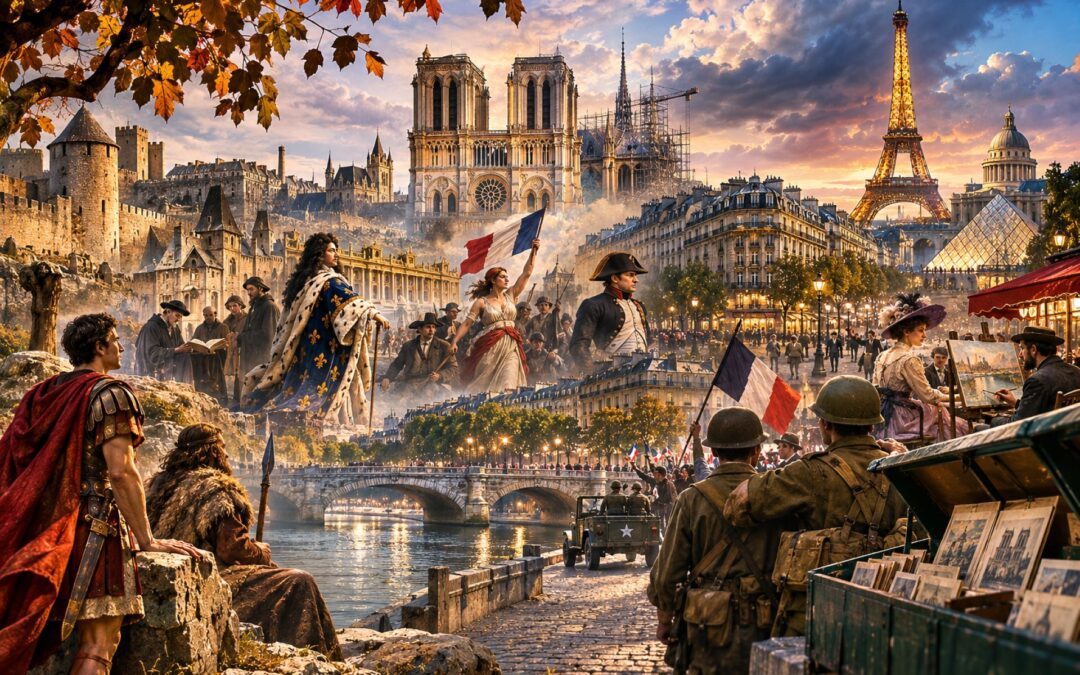
Stand on a bridge over the Seine and the history of Paris seems to arrange itself along the river. Notre-Dame rises from the Île de la Cité; the Louvre stretches across the Right Bank; farther downstream, the Eiffel Tower announces a very different age. Between them are places where kings displayed their authority, revolutionaries challenged it, and generations of workers kept an expanding city alive.
None of this was inevitable. Paris began neither as a royal capital nor as Europe’s artistic center, but as a settlement in a river landscape that made travel, trade, and defense possible. Its inhabitants repeatedly turned those geographical advantages into new institutions, markets, monuments, and political claims. They also endured epidemics, occupations, civil conflicts, displacement, and disasters that threatened what earlier generations had built.
The most revealing way to follow Paris is therefore not simply from one monument to another. It is to examine how its people used the Seine, how rulers tried to control the city, how ordinary life sustained its ambitions, and how successive Parisians adapted an inherited urban landscape to demands that their predecessors could scarcely have imagined.
From the Parisii to Roman Lutetia
Human occupation of the Paris region long predates written history. Archaeological finds include prehistoric tools, settlement traces, and ancient wooden boats, evidence that the Seine supplied food and provided routes for people and goods. River valleys were attractive not only because they offered water but because they connected communities that otherwise had to cross difficult terrain. A settlement near a useful crossing could profit from movement along both the river and the roads approaching it.
By the third century BCE, the Parisii, a Celtic-speaking people of Gaul, occupied this region. Their distinctive gold coins suggest developed exchange networks, while the strategic position of their territory linked river traffic with inland routes. Their name would outlast the Roman conquest and eventually replace the name by which Roman writers knew the town: Lutetia. Yet locating the Parisii’s principal settlement is more difficult than looking for the oldest streets of modern Paris.
The traditional identification puts Gallic Lutetia on the Île de la Cité, the island at the city’s historic center. Excavations at Nanterre west of Paris have complicated this view by revealing an important late Iron Age settlement there. In 2026, archaeologists working beneath the Hôtel-Dieu hospital on the Île de la Cité uncovered a substantial stone-and-timber structure interpreted as a possible Gallic defensive wall. The French Ministry of Culture’s account of the discovery points to evidence that may reshape this debate, but the structure’s identification and implications still require careful verification. One of Europe’s most excavated cities has not settled the question of its own beginnings.
Julius Caesar’s campaigns, beginning in 58 BCE, brought the region into Rome’s struggle to conquer Gaul. In 52 BCE, Roman forces under Titus Labienus fought Gallic defenders associated with the Parisii near Lutetia. Caesar’s account describes the defenders burning their settlement and destroying bridges to obstruct the Roman advance. The Romans prevailed, although reconstructing the precise battlefield and location of the destroyed town remains difficult. Under imperial rule, the settlement entered a system of roads, taxes, civic institutions, and markets extending far beyond the Seine valley.
Roman Lutetia developed especially on the Left Bank. Its principal streets followed an organized layout, and the high ground above the river accommodated a forum and other public structures. Baths, an aqueduct, religious buildings, and an arena announced the amenities of a Roman provincial town. Remains of the Arènes de Lutèce still sit among later houses, while parts of the Roman baths survive within the Musée de Cluny. These ruins show a substantial urban community, although Lutetia remained smaller and less prominent than Lugdunum, modern Lyon.
Its importance was not expressed through monuments alone. Merchants and boatmen connected the town to surrounding producers and consumers, while local religious practices mingled with those associated with Rome. The Pillar of the Boatmen, dedicated during the reign of Emperor Tiberius, bears imagery of Roman and Gallic deities. It offers a rare glimpse of a community adapting to imperial institutions without completely abandoning an older cultural world. The same river that brought goods and newcomers would also expose the town to danger as Roman power weakened. Romanization was never a single event that erased every previous identity. A local notable might employ Latin in public affairs while honoring a deity known before the conquest; traders might use Roman roads while relying on relationships along older waterways. The visible ruins of baths and arenas emphasize the empire’s monumental presence, but objects associated with work and worship reveal the negotiations by which people made imperial institutions part of everyday life.
From a Fortified Island to a Frankish Royal City
From the later third century CE, political instability and raids threatened settlements across Roman Gaul. Exposed parts of Lutetia’s Left Bank declined in importance, while the defensible Île de la Cité became a stronger focus of occupation. Builders reused stone from older monuments in fortifications, converting the material remains of imperial prosperity into walls against new threats. The town’s changing physical form reflected a wider shift from the relative security of the Roman world to a period of more localized power.
Christianity was becoming another organizing force. Early Parisian tradition remembered Saint Denis as a missionary and martyr, associating his death with Montmartre and his burial with the site north of the city that later became the Basilica of Saint-Denis. Its eventual role as the burial church of French kings gave the site political as well as religious importance. The fifth-century Saint Geneviève was likewise remembered as a protector of Paris, particularly through accounts of her encouragement of the population during the Hunnic threat of 451. These traditions require care when separated from later devotional narratives, but their lasting influence on the city’s identity is unmistakable.
As Roman authority in the West disintegrated, the Franks consolidated their position in northern Gaul. Clovis I combined military victories, alliances, and support from the Gallo-Roman Church to establish a powerful kingdom. Paris became an important royal residence in the early sixth century, and Clovis was buried there after his death in 511. It would be misleading, however, to imagine a centralized national capital already functioning like modern Paris. Frankish kings traveled between residences, divided their territories among heirs, and governed through networks of nobles and religious institutions.
Churches and monasteries possessed property, patronage, and learning, helping sustain authority when dynastic politics shifted. Paris’s prominence varied under subsequent rulers, and during the Carolingian era other centers of government often mattered more. Nevertheless, its bridges, river trade, religious institutions, and population gave it significance beyond the presence or absence of a king. Those advantages made it a tempting target as Scandinavian raiders pushed inland through the rivers of western Europe.
In 845, a Viking force reached Paris and departed after the payment of a substantial ransom. Further raids showed how easily the Seine could carry ships toward the heart of the Frankish realm. The great siege of 885–886 brought a more formidable challenge. Defenders led by Count Odo and Bishop Gozlin resisted attempts to seize the crossings and overcome the city’s fortifications. The prolonged defense raised Odo’s prestige even though the wider political settlement involved negotiation and a payment to the attackers.
The episode belongs to the larger Viking expansion across Europe, but its consequences for Paris were distinct. Military leadership in defense of the city became a source of political legitimacy. Odo himself gained the kingship in 888, and the family networks associated with the region subsequently helped give rise to a new ruling dynasty. In 987, Hugh Capet became king. The early Capetians held a relatively modest royal domain centered on places including Paris and Orléans, yet over generations they strengthened royal authority and made Paris increasingly important to administration, commerce, and court life.
The city’s rise was gradual rather than predetermined. Royal officials needed records, supplies, and lodging; churches and abbeys attracted gifts and visitors; merchants supplied growing populations; craftsmen found customers in the expanding court and religious establishments. Each activity reinforced the others. A place that had survived by defending a crossing was becoming a center from which kings could govern a larger kingdom. Its political geography developed from practical concentration rather than one founding decree. A royal residence attracted officials; officials brought documents and legal business; that business encouraged scribes, landlords, merchants, and service workers to remain nearby. Those networks made it easier for subsequent kings to return, strengthen institutions, and treat Paris as a permanent point of reference even when royal government still required travel across the realm.
Medieval Paris: Kings, Merchants, Scholars and Cathedrals
By the twelfth century, Paris’s political, commercial, and religious functions had produced a distinctive urban geography. The Île de la Cité contained royal and ecclesiastical buildings. On the Right Bank, landing places, warehouses, markets, and workshops made the riverside a center of commerce. Across the water, schools and colleges attracted scholars to the Left Bank. The three areas interacted constantly, but each developed an identity still recognizable in the city’s layout.
The royal household and its officials consumed food, fuel, cloth, building materials, and countless services. Goods arrived along the Seine and by roads connecting the city to farms, forests, quarries, vineyards, and other towns. Timber had to be floated or transported to construction sites, stone hauled and cut, wine delivered to taverns, and grain transformed into bread. Paris depended on an enormous supporting landscape; it could not feed or build itself simply from the resources within its walls.
The river merchants who organized this traffic acquired privileges and a voice in municipal life. Their commercial power helped produce civic institutions, but privileged access to the capital’s customers could also exclude competitors. Guilds similarly regulated training and workmanship, supporting skilled occupations while protecting established members. Economic growth did not abolish hierarchy; it created new ways for influential groups to defend their positions.
The Capetian monarchy strengthened the city’s defenses and physical organization. Philip II Augustus ordered new walls around expanding neighborhoods and commissioned a fortress at the western edge of the Right Bank. Beneath the modern Louvre, remains of that fortress still show the museum’s origin as a defensive work. Its eventual evolution from stronghold to royal palace and national museum mirrors centuries of change in the meaning of political authority.
Religious architecture expressed equally formidable ambitions. Construction of Notre-Dame began in 1163 under Bishop Maurice de Sully, replacing earlier sacred buildings on the Île de la Cité. The cathedral’s high vaults, pointed arches, flying buttresses, and sculpted façades demonstrated the possibilities of Gothic engineering, but they were also the outcome of generations of coordinated work. Quarrymen extracted stone, boatmen and carters moved it, masons shaped it, and craftsmen supplied glass, metal, timber, and decorative sculpture. A cathedral was both a statement of faith and an immense urban undertaking.
During the reign of Louis IX, work on Sainte-Chapelle produced another masterpiece of Gothic art. Built within the royal palace complex to house revered relics associated with Christ’s Passion, the chapel used soaring stained-glass windows to surround visitors with biblical imagery. It linked devotion to the prestige of the monarchy, much as Notre-Dame connected the city’s religious life with its growing economic and technical capabilities.
The Left Bank’s schools provided another route to international influence. Cathedral and monastic teaching gradually developed into the University of Paris, whose corporate independence and privileges took shape through royal and papal recognition in the early thirteenth century. Its intellectual life placed theology at the center while also encompassing philosophy and the arts. Latin allowed students and masters arriving from different European regions to participate in a shared scholarly culture, giving the Latin Quarter its enduring association with learning.
Robert de Sorbon established a college in the thirteenth century to support theological study. The Sorbonne began as one institution within a much larger university, although its name eventually came to represent Parisian scholarship more generally. Students needed lodging, meals, writing materials, and books. Manuscript production and circulation created livelihoods for scribes, booksellers, parchment workers, and others beyond the lecture rooms. Intellectual reputation depended on an ordinary service economy as much as on renowned teachers.
For most Parisians, life centered on households, parish communities, shops, and workplaces rather than palaces or academic disputes. Bakers supplied daily bread; porters unloaded boats; laundresses worked with water and cloth; servants maintained better-off homes; and laborers cleaned, built, hauled, and repaired. Apprentices shared workshops with masters and their families, while poorer residents faced unstable employment and tightly packed housing. Streets carried animals, waste, carts, pedestrians, trade stalls, and competing claims to space.
By the early fourteenth century, Paris had become one of Europe’s largest cities, with some estimates placing its population around 200,000, though medieval numbers remain uncertain. Such growth created extraordinary opportunities for merchants and rulers, but it multiplied the demands of food distribution and sanitation. When harvests failed, transport routes were disrupted, or grain prices rose, the consequences entered households immediately. The splendor of medieval Paris rested on logistics as fragile as the livelihoods of the people who performed them. Prices were not abstract numbers for residents buying bread with irregular earnings. A poor household might have to reduce meals when grain became dearer, while a prosperous merchant could store supplies or benefit from a favorable trading position. The city depended on regulation and negotiation over markets precisely because food security connected personal survival to public order. Medieval urban life also included parish charity, religious festivals, and local solidarity, but such ties could not remove the sharp inequalities of wealth and status.
Plague, War and the Struggle for Medieval Paris
The dense medieval city was vulnerable even in prosperous years. Drinking-water quality varied, waste disposal was uneven, and crowded neighborhoods provided opportunities for disease to spread. A large population depended on regular supplies of food from surrounding districts; shortages could rapidly turn an economic difficulty into a political emergency. These pressures sharpened as the fourteenth century brought epidemic disease and prolonged warfare.
The Black Death reached Paris in 1348, causing widespread mortality and disrupting households, religious institutions, workshops, and markets. Precise estimates of the dead are uncertain, and outbreaks recurred in later decades rather than disappearing after one catastrophic season. Surviving families faced grief and changes in labor availability, while communities struggled to reconcile enormous suffering with familiar religious explanations of the world. The epidemic exposed how deeply the city’s work, worship, and survival depended on densely interwoven relationships.
The Hundred Years’ War added another layer of instability. Beginning in 1337, the conflict arose from disputed claims to the French crown and territorial rivalry between the English and French monarchies. The French defeats at Crécy in 1346 and Poitiers in 1356 weakened confidence in royal leadership. War damaged the countryside that supplied Paris, disrupted roads and trade, and placed additional demands for taxes and soldiers upon an already strained population.
Paris was never merely an obedient spectator to decisions made by kings. In 1358, the merchant leader Étienne Marcel became central to a challenge against royal authority during the captivity of King John II. As provost of the merchants, Marcel represented a civic power whose economic foundations lay in the urban community. His confrontation with the dauphin, the future Charles V, revealed the tensions between demands for political oversight, the interests of powerful urban groups, and the monarchy’s attempts to preserve control. Marcel was killed in 1358, and the movement failed to establish lasting municipal authority, but the episode demonstrated that the capital’s inhabitants could become political actors in their own right.
Successive rulers strengthened defenses in response to insecurity. Under Charles V, fortifications expanded, and work began on the Bastille as a stronghold guarding an eastern approach. Its original function was defensive, even though later generations would remember it principally as a prison and symbol of royal arbitrariness. Parisian buildings repeatedly acquired meanings far removed from the circumstances of their construction.
A new crisis unfolded in the early fifteenth century as struggles among French factions intersected with English intervention. The Burgundian party controlled Paris at crucial moments and allied with the English. Following the Treaty of Troyes in 1420, the city formed part of an Anglo-Burgundian political order, and Henry VI of England was crowned king of France at Notre-Dame in 1431. These events remind us that a city later celebrated as the unquestioned heart of France experienced divided loyalties and competing definitions of legitimate rule.
Joan of Arc’s assault on Paris in September 1429 failed; its defenders were not uniformly eager to welcome her and the forces of Charles VII. In 1436, troops loyal to Charles VII recovered the city, but political recovery did not instantly reverse decades of disruption. Rebuilding homes, restoring trade, reestablishing confidence, and strengthening royal institutions took time. By the opening of the sixteenth century, Paris had recovered much of its position, yet its experiences of plague and factional war remained a warning against treating medieval growth as a steady rise. Control of the capital gave rival claimants more than prestigious buildings. It offered access to officials, commercial resources, religious legitimacy, and an immense population capable of supplying or resisting a regime. That is why competing factions invested so much in Paris and why residents’ loyalties mattered. Its value as a political prize and its vulnerability to political coercion were closely connected.
Renaissance Paris and the Wars of Religion
The Renaissance reached Paris through royal patronage, international warfare, scholarship, commerce, and the circulation of new ideas. French campaigns in Italy brought the monarchy into contact with artistic and architectural traditions that influenced royal building at home. Under Francis I, who ruled from 1515 to 1547, classical forms and ambitious palace projects increasingly appeared alongside the Gothic city. The Louvre began a long transformation from medieval fortress toward a more elaborate royal residence.
Printing changed the scale and speed of intellectual exchange. Printers and booksellers circulated religious texts, classical scholarship, literature, and political arguments to audiences extending beyond university circles. Francis I also encouraged advanced study of languages and subjects not fully accommodated by the university’s traditional curriculum, contributing to institutions that eventually developed into the Collège de France. A more connected culture of learning could broaden debate, but it could also spread hostility and expose disagreements that authorities struggled to contain.
Religious division became especially dangerous as Protestant reform challenged the position of the Catholic Church. Disputes over doctrine were inseparable from noble factional rivalries, court politics, and arguments about who should exercise authority over the kingdom. Paris remained a strongly Catholic city, and periods of escalating tension made life perilous for Protestants living there or visiting on political business.
In August 1572, prominent Protestants assembled in Paris for the marriage of Henry of Navarre and Margaret of Valois. The wedding was intended to help reconcile hostile factions, but a failed assassination attempt against the Protestant leader Admiral Gaspard de Coligny deepened the crisis. Targeted killings escalated into the St. Bartholomew’s Day Massacre, beginning in Paris around 24 August. Violence spread through neighborhoods and then to other French towns, leaving thousands dead. Estimates of the overall toll vary, but the central fact is beyond dispute: an event framed as reconciliation became an episode of religious slaughter.
Henry of Navarre survived and eventually inherited the crown as Henry IV in 1589. His claim remained contested, and he converted to Catholicism before entering Paris in 1594. The Edict of Nantes in 1598 granted French Protestants limited rights and protections, creating an uneasy settlement rather than complete religious equality. The wars left towns damaged, political trust weakened, and communities divided by memories of violence. The massacre is especially important because it cannot be explained as spontaneous violence with no political context. An attempted assassination, decisions made within the royal entourage, factional fear, and killings carried out in the streets interacted in ways historians continue to debate. The precise distribution of responsibility and casualties remains contested. What followed in Paris, however, shows how quickly local hostility could become lethal when state authority and popular mobilization reinforced each other rather than restraining violence.
Henry IV sought recovery through construction and the restoration of urban order. Pont Neuf, completed during his reign, differed from many older bridges because it did not carry rows of houses. Pedestrians could cross with open views of the river, while planned projects such as Place Dauphine and the Place Royale, later Place des Vosges, introduced more regular public spaces into the city. These interventions were not merely decorative: they altered circulation, commerce, royal representation, and the ways people gathered.
The king’s assassination in 1610 showed that political peace remained fragile. Nevertheless, the rebuilding associated with his reign helped prepare a city in which architecture and public space increasingly expressed centralized royal ambition. Paris continued to acquire the physical language of a capital even as its rulers would soon move their daily court life away from it.
Royal Grandeur, Versailles and the Enlightenment
Seventeenth-century Paris grew through royal administration, aristocratic wealth, institutional patronage, and the activities of a much larger urban population. Marie de Médicis commissioned the Luxembourg Palace in 1615, drawing inspiration from Italian models. Richelieu and the monarchy encouraged institutions such as the Académie française, established in 1635, to cultivate literary prestige and regulate the French language. New residences, gardens, and squares advertised status, while crowded working districts continued to supply the city with labor and essential goods.
The relationship between crown and capital was not always comfortable. During the Fronde, a series of rebellions beginning in 1648, conflicts involving courts, aristocratic factions, and popular unrest threatened royal authority. The young Louis XIV experienced the insecurity of political turmoil and was forced to leave Paris at moments during the crisis. These experiences contributed to the monarchy’s later determination to manage powerful elites and reduce exposure to unrest in the capital, although Versailles also developed from broader courtly and political ambitions.
On 6 May 1682, Louis XIV established his court and government at Versailles. The palace became a carefully organized setting for ceremony, patronage, and competition for the king’s attention. Paris remained the kingdom’s capital and an indispensable administrative, financial, and cultural center, but the king’s everyday presence moved elsewhere. This geographical separation sharpened the contrast between the highly regulated spectacle of court life and the needs of households struggling with rents, prices, and employment in Paris.
The city’s physical appearance nevertheless continued to change. Fortifications that had once marked its edge yielded in places to broad promenades and boulevards. The Tuileries gardens and the avenue that became the Champs-Élysées established formal axes and landscaped spaces different from the irregular streets of the medieval core. Such improvements reflected changing ideas about grandeur, circulation, leisure, and the role of the city as a stage for public life.
During the eighteenth century, Paris also became a center of intellectual conversation. Cafés, salons, academies, printing houses, and private correspondence connected writers, scientists, patrons, and readers. Voltaire and Jean-Jacques Rousseau challenged accepted assumptions about religious tolerance, education, political authority, and social obligations. Denis Diderot and Jean le Rond d’Alembert helped organize the Encyclopédie, which sought to gather, question, and classify knowledge. That ambition could be intellectual, practical, and politically unsettling at the same time.
Women who hosted salons helped shape these networks, even though formal institutions often excluded them. Madame Geoffrin, for example, brought together writers, artists, scholars, and visitors from the aristocratic world. Letters extended conversation across borders, allowing ideas developed in a Parisian room to circulate through European networks. The city’s reputation as a capital of thought depended partly on these personal relationships, printers, intermediaries, and patrons rather than on isolated geniuses.
The reach of Enlightenment arguments was much wider than the privileged circles that initially discussed them. Yet their existence did not eliminate censorship, inherited status, or gender exclusion. Most residents experienced the monarchy less through philosophical debate than through taxes, policing, wages, market prices, and parish obligations. Bread remained central to survival, and rising costs could undermine family security within days.
By the late 1780s, royal debt, resistance to reform, political privilege, and uneven harvests created a combustible situation. A city famous for salons and grand architecture was also a place where people could see the discrepancy between wealth and hardship at close range. The institutions and streets shaped by kings would soon become the setting for the most consequential challenge to their authority. Scientific societies, book trade networks, academies, and salon gatherings contributed to Paris’s growing reach, but they did not form a unified opposition to monarchy. Some thinkers sought reform within existing institutions; others developed far more radical criticisms. The variety of positions matters because the revolution did not emerge from a single Enlightenment blueprint. Ideas moved through unequal social networks and met immediate pressures from finances, food, and the credibility of the crown.
Revolution, Napoleon and the Return of the Barricades
France entered 1789 with an enormous financial crisis and a political system increasingly unable to agree on who should bear the costs of government. The Estates-General, called by Louis XVI, opened a struggle over representation and sovereignty. In Paris, shortages and rising bread prices gave constitutional disputes a daily urgency. Rumors about troop movements and the dismissal of the popular finance minister Jacques Necker intensified fears that the monarchy might suppress reform by force.
On 14 July, crowds stormed the Bastille looking for gunpowder and weapons. The fortress held few prisoners, but it represented royal coercion and the power to imprison without ordinary judicial safeguards. Its capture became a defining moment of the French Revolution. As the building was dismantled, fragments were carried away and displayed as material evidence of a new political order. Parisians had not simply seized an object of authority; they had helped change what it meant.
The revolutionary capital became a laboratory of political participation and conflict. Newspapers and pamphlets flourished; clubs and neighborhood assemblies gave activists new platforms; demonstrations brought crowds into debates over law and sovereignty. In October 1789, women from Paris marched to Versailles, demanding action over the price and availability of bread. The royal family returned with them to the Tuileries Palace, followed by the National Assembly. The monarchy was now physically much closer to the people who protested its decisions.
The revolution raised questions that could not be resolved by opposing aristocratic privilege alone. Who counted as a citizen? Would equality include women, poor men, enslaved people in the colonies, or religious minorities? How far could the state intervene in property, prices, and worship? The Declaration of the Rights of Man and of the Citizen proclaimed far-reaching principles, yet political and social exclusions persisted. Demands for liberty, social security, and popular power were not always compatible, even among people who all considered themselves revolutionaries.
The attempted flight of the royal family in 1791 undermined trust, while war with European monarchies intensified fears of conspiracy and counterrevolution. On 10 August 1792, insurgents attacked the Tuileries, bringing down the monarchy. Louis XVI was tried and executed on 21 January 1793 at the square now called Place de la Concorde. The new republic faced external invasion, internal rebellion, desperate financial pressures, and factional struggles in which Parisian crowds and political clubs remained powerful actors.
During the Reign of Terror, emergency institutions pursued suspected enemies of the revolution through arrests, tribunals, and executions. Maximilien Robespierre became a leading figure of this phase, although power was never held by one individual alone. His overthrow in July 1794 ended his ascendancy without ending the country’s political divisions. The revolution had expanded the imaginable boundaries of citizenship and government while also revealing how violently competing definitions of public safety could collide.
The transformation extended beyond politics. In 1793, the Louvre opened as a public museum, placing works from royal collections in a different civic setting. Across Paris, religious buildings, monuments, symbols, and public spaces were destroyed, renamed, appropriated, or preserved. These decisions raised a problem that outlived the revolutionary decade: if kings no longer possessed the country’s heritage, who had the right to define and display it?
Napoleon Bonaparte seized power in November 1799, promising stability after years of uncertainty. His regime strengthened administration and concentrated power, while carrying forward some legal and institutional consequences of the revolution. In 1804 he crowned himself Emperor of the French in Notre-Dame, making an old royal and religious space the setting for a new imperial claim. His building program linked the city to military achievement through projects such as the Arc de Triomphe, commissioned in 1806, and the Vendôme Column.
The ambitions of Napoleon’s European wars extended far beyond Paris, but the capital displayed their results in stone, ceremonial routes, and urban planning. Victory celebrations, military processions, and administrative buildings helped communicate the empire’s power. Many monuments survived the regime that commissioned them, and some were finished only after Napoleon’s fall. The landscape became a record of governments that succeeded one another without completely erasing what came before.
Coalition forces captured Paris in 1814, and Napoleon abdicated. He briefly returned to power in 1815, only to be defeated at Waterloo, after which the restored Bourbon monarchy resumed control. Louis XVIII sought to govern through a constitutional settlement, but disputes about press freedom, representation, and the authority of the crown did not disappear. Under Charles X, restrictions on political rights and the press provoked a new Parisian uprising in July 1830.
The July Revolution, remembered as the Three Glorious Days, forced Charles X to abdicate and brought Louis-Philippe to the throne. Barricades again turned familiar streets into military obstacles and political statements. The July Column at the Place de la Bastille commemorates the victims of this later revolution, linking the square’s memory of 1789 to another attempt to remake the relationship between rulers and citizens.
Louis-Philippe’s July Monarchy disappointed those who expected deeper democracy or social change. Economic inequality and political exclusion persisted, and the June Rebellion of 1832—later made famous through Victor Hugo’s Les Misérables—showed the endurance of radical opposition. In February 1848, renewed unrest over political restrictions and hardship drove Louis-Philippe from power and established the Second Republic. Hopes for social as well as political reform were intense, particularly among workers looking for employment security.
The government’s closure of the National Workshops, a public employment program, helped provoke the June Days uprising in 1848. Army repression of the workers exposed the gulf between republican declarations of solidarity and the interests of competing classes. Later that year, voters elected Louis-Napoleon Bonaparte president. He staged a coup in December 1851 and became Emperor Napoleon III in 1852. Paris had endured recurring upheavals under monarchy, republic, and empire; the new ruler would seek to impose a different kind of order through a physical transformation of the city itself.
Haussmann’s Paris: Modernization and Displacement
By the middle of the nineteenth century, Paris had outgrown much of its inherited infrastructure. The Industrial Revolution and expanding railway network brought people, raw materials, and manufactured goods into the capital at unprecedented rates. Narrow streets and irregular crossings slowed traffic, while crowded housing and unreliable sanitation exposed residents to disease. Railway stations were being built around a city whose older streets had not been designed to connect them efficiently. Reformers saw modernization as a practical necessity, but the means of achieving it would transform the distribution of wealth and power within Paris.
Napoleon III appointed Georges-Eugène Haussmann prefect of the Seine in 1853 and gave him extensive authority to implement an ambitious program of reconstruction. Haussmann did not act alone. Engineers, architects, municipal officials, investors, builders, and thousands of laborers were essential to the undertaking, while the emperor supplied political backing. Their collective project cut broad avenues through old neighborhoods, developed new public squares, improved access to railway stations, and reorganized traffic across the capital.
The new boulevards made it easier to move people, goods, and carriages between districts. They also opened long vistas toward monuments and important public buildings, giving the city a sense of visual coordination that older streets rarely possessed. Demolition was extensive: houses, small businesses, familiar lanes, and neighborhood networks were removed to create new routes. For visitors, the resulting boulevards could embody order and modernity. For people who lost their homes or customers, they could represent the destruction of an entire local world.
Architectural regulations helped create the recognizable Haussmannian streetscape. Buildings followed rules affecting height, alignment, roofs, and façades; repeated balconies, pale limestone, and consistent proportions produced a visual rhythm across stretches of the city. Shops occupied many ground floors, with apartments stacked above. Yet this apparent uniformity often concealed social differentiation within individual buildings, where more desirable floors and larger rooms commanded higher rents than attic accommodation or service quarters.
The infrastructure below ground was as consequential as the façades above. Engineer Eugène Belgrand developed new aqueducts to bring spring water from outside the city and expanded the distribution network. Different supplies served household needs and functions such as street washing or watering public spaces. Sewers were enlarged and reorganized, requiring sustained inspection, maintenance, and cleaning. These works did not solve every public-health problem, but they made a rapidly expanding metropolis more manageable and helped reduce dependence on older, inadequate systems.
Parks were another part of the program. The Bois de Boulogne and Bois de Vincennes offered major green spaces at opposite sides of the city, while Parc Monceau and the dramatically landscaped Buttes-Chaumont provided different kinds of urban recreation. Public gardens reflected changing ideas about health, fresh air, leisure, and the responsibilities of government toward crowded populations. Gas lighting, improved roads, markets, and new forms of transportation reinforced the sense of a city organized for circulation and consumption.
In 1860, annexation brought neighboring communities into Paris and replaced its earlier twelve arrondissements with twenty. The enlarged boundary created much of the administrative geography familiar today, but it could not contain the metropolitan region’s continued growth. Housing, industry, employment, and commuting increasingly connected central Paris to surrounding suburbs. The boundary of the municipality would never perfectly describe the lived city.
Reconstruction was expensive, and its benefits were not distributed equally. Large borrowing, land transactions, speculation, and the intervention of private investors linked public works to changing property values. Many poorer households and small businesses were displaced by demolition or priced out of redeveloped areas. Some moved toward less costly outer districts, intensifying class differences across the expanding city. Critics challenged both the financing of the works and the concentration of administrative power in Haussmann’s hands.
The political implications were unmistakable, but should not become a single-cause explanation. Wide boulevards could help troops move and make the construction of barricades more difficult. At the same time, transportation, water, sanitation, urban image, and commercial interests were genuine motives with their own histories. Haussmann’s dismissal in 1870 reflected growing opposition to the program’s costs and management, yet the works continued to shape Paris long afterward. The city’s famous appearance arose from a mixture of public benefit, authoritarian planning, private profit, and social displacement.
The Palais Garnier opera house, begun under Napoleon III and inaugurated in 1875, captured another aspect of these ambitions: modern Paris as a capital of spectacle and prestige. Its grand spaces stood alongside department stores, railway infrastructure, and new commercial buildings that transformed urban consumption. Above ground, the boulevards became the public face of the Second Empire’s idea of progress. Beneath them, systems maintained by largely unseen workers allowed that progress to function from day to day.
The Siege, Paris Commune and Belle Époque
The Second Empire collapsed not because of urban opposition alone but through military defeat. In the Franco-Prussian War of 1870, Napoleon III was captured at Sedan, and a republic was proclaimed in Paris. German forces then encircled the capital, beginning a siege that lasted through a bitter winter. Food and fuel became scarce; bombardment brought danger to residents; and desperation eventually led to the consumption of animals normally kept for other purposes. The city that had just celebrated modern infrastructure found itself cut off from the supplies on which its population depended.
Paris capitulated in January 1871, leaving anger at defeat and distrust of the national government. Many Republicans and National Guardsmen believed the authorities at Versailles had betrayed their sacrifices. Rent arrears, employment insecurity, and questions about control of the National Guard sharpened the political crisis. On 18 March, an attempt by government troops to seize cannon from the city triggered resistance. What followed was not simply another street protest but a claim that Parisians should govern their own municipality.
The Paris Commune was formally proclaimed on 28 March 1871. Its supporters included people with different republican, socialist, and revolutionary commitments, united more by opposition to Versailles than by a fully shared political program. They attempted reforms involving secular education, the relationship between Church and state, working conditions, and municipal democracy. Women organized relief, participated in political debate, supported defense, and asserted demands of their own even though formal political representation remained limited.
The Commune faced immense obstacles, including internal disagreement, wartime conditions, and the superior resources of the national government. During May, government troops forced their way into Paris. The final fighting, remembered as the Bloody Week, involved street battles, executions, the killing of hostages, and destructive fires. The Tuileries Palace and Hôtel de Ville burned. Thousands died, though historians disagree over the precise toll; survivors faced imprisonment, exile, and deportation. For some later movements, the Commune became an example of radical municipal democracy; for others, a warning about revolutionary violence and civil conflict.
The memory of 1871 complicated the republic that followed. A capital celebrated for elegant avenues also contained neighborhoods where families remembered repression, bereavement, and defeat. Yet in the later nineteenth century Paris grew as an international center of entertainment, consumer culture, and artistic experiment. The period later called the Belle Époque was not uniformly beautiful, but its technologies and images would shape the city’s worldwide reputation.
Department stores such as Le Bon Marché developed new approaches to fixed prices, displays, advertising, and the experience of shopping. Their bright interiors and elaborate merchandise presented consumption as an urban attraction rather than a simple transaction. Newspapers, posters, illustrated magazines, cafés, theaters, and music halls circulated shared images of Parisian life. Railways carried visitors and goods to the city, creating audiences for new cultural forms while helping industries and retailers grow.
Artists challenged official institutions and conventional representations. In 1874, Claude Monet, Edgar Degas, Berthe Morisot, and other artists participated in an independent exhibition that helped establish Impressionism as a recognizable movement. Their interest in changing light, movement, city crowds, labor, and leisure offered new ways of seeing a society in rapid transformation. Later artists including Henri de Toulouse-Lautrec and Henri Matisse developed different visual languages, while artistic networks increasingly crossed national boundaries.
International exhibitions presented engineering and industry on a spectacular scale. The 1889 World’s Fair, held during the centenary of the French Revolution, brought the Eiffel Tower into being. Designed as a dramatic demonstration of iron construction, the structure provoked criticism from people who considered it an intrusion into the historic skyline. Its usefulness for scientific and later communications purposes, together with its public popularity, helped ensure its survival. What began as a striking temporary feature became the city’s best-known emblem.
The 1900 exposition coincided with another technological milestone: the first line of the Paris Métro. Underground rail allowed increasingly large numbers of people to move beneath congested streets, extending the logic of an infrastructural city. The prosperity and spectacle associated with the Belle Époque nevertheless coexisted with insecure employment, political conflict, crowded accommodation, and major differences in wealth. The extraordinary public image of Paris was sustained by people whose experience of the period might have been very different from the images printed on its postcards. Nor did modern consumer culture spread evenly. An affluent shopper encountered illuminated displays and new fashions, while an exhausted worker might see the same store from the street after a long shift. The contrast was not accidental: the systems of transport, distribution, retail, and entertainment that made Paris fashionable were themselves workplaces, shaped by hierarchies of pay and status. Modernity was both an experience to be purchased and a process of labor undertaken by the people who made it available.
World War I, the Artistic Capital and Colonial Paris
In January 1910, the Seine flooded Paris on an exceptional scale, spreading water through streets, cellars, transport tunnels, and buildings. The flood disrupted work and movement, while rescue and adaptation required ingenuity from residents and public services. It was a reminder that the river which had made the city prosperous could also interrupt its most sophisticated routines. Even modern engineering could not completely remove the vulnerabilities of an urban landscape built around water.
The First World War brought a different threat. When Germany advanced through Belgium and northern France in 1914, the French government temporarily left Paris for Bordeaux as armies struggled to stop the invasion. In September, French and British forces fought the First Battle of the Marne, preventing a rapid German victory. Parisian taxis famously carried some troops toward the front, a vivid symbol of civilian involvement in the crisis, although their contribution was not militarily decisive in itself.
During the prolonged war, Paris remained an administrative, medical, industrial, and logistical center. Hospitals treated casualties; factories and workshops produced supplies; families dealt with shortages, separation, and bereavement. Air raids threatened inhabitants, and in 1918 the long-range Paris Gun fired shells from far beyond the city. Paris avoided the continuous destruction of the Western Front’s battle zones, but the war was never confined to distant trenches. It entered the capital through work, fear, mourning, and the enormous demands of an industrial conflict.
The armistice of November 1918 brought relief without ending economic or political strains. Diplomats gathered in and around Paris to negotiate the postwar settlement, while returning veterans and bereaved families faced the difficult process of reconstruction. Inflation, shortages, and uncertainty did not disappear. Yet the following decade also made Paris an extraordinarily attractive meeting place for artists, writers, performers, and people escaping more restrictive environments elsewhere.
Montmartre had already attracted artists and entertainers, and Montparnasse became an equally important center of studios, cafés, and artistic exchange. Pablo Picasso and Georges Braque developed Cubism through experiments that challenged single-point perspective and familiar ways of representing objects. Their work belonged to networks of dealers, patrons, fellow artists, and visitors rather than to an isolated Parisian tradition. People arriving from other countries helped make the city’s artistic reputation precisely because they brought experiences and ambitions formed elsewhere.
Writers including Ernest Hemingway, James Joyce, and Gertrude Stein participated in an international literary culture supported by publishers, bookshops, salons, and cafés. Jazz gained audiences in clubs and theaters, while Josephine Baker’s performances challenged conventions of entertainment and celebrity. Black musicians and intellectuals contributed to transatlantic cultural exchanges, although France’s racial attitudes and colonial relationships complicated any simple claim that Paris offered universal freedom.
Fashion became another medium through which the city projected influence. Designers such as Gabrielle Chanel and Madeleine Vionnet experimented with garments and silhouettes that departed from some earlier conventions. Photography associated with figures such as Man Ray connected commercial fashion imagery to modernist artistic techniques. Magazines carried carefully constructed images of Paris to readers who might never travel there. The capital’s reputation increasingly depended on its ability to circulate pictures and ideas beyond its physical boundaries.
This cultural openness existed beside a powerful imperial politics. In 1931, the Colonial Exposition in Paris presented France’s overseas territories as evidence of national prestige and imperial achievement. Exhibits and official displays were shaped by colonial hierarchies and often represented subject peoples through the assumptions of the colonial state. The Colonial Exposition of 1931 attracted large audiences but also criticism from opponents of imperial domination. The Palais de la Porte Dorée, built for the occasion, later acquired a very different role as the home of the National Museum of Immigration History.
The building’s changing purpose illustrates how Paris has revisited its relationship with peoples whose lives were shaped by French expansion. Empire was not only something displayed in museums or argued about in ministries; it influenced migration, employment, identity, and daily life within the capital itself. Workers, students, artists, and political activists from overseas encountered opportunity and exclusion in the same streets.
The Depression and political conflicts of the 1930s sharpened insecurity. Fascist and nationalist movements, communist and socialist organizations, and defenders of republican institutions struggled over France’s future. Antisemitism and xenophobia threatened residents who had come to Paris for safety or work. In a city celebrated as cosmopolitan, welcome was uneven and sometimes fragile. By September 1939, another European war had begun, and the cultural capital once again faced a test of survival. The contrast between celebrated cosmopolitanism and political exclusion was especially stark for refugees. Paris could contain communities offering work, solidarity, and artistic collaboration, while exposing the same people to suspicion, restrictive policies, or organized hostility. Its reputation for openness was an aspiration and an achievement in some settings, not a guarantee enjoyed equally by every newcomer.
Occupation, Persecution and the Liberation of Paris
When German forces invaded western Europe in May 1940, France’s military position collapsed with extraordinary speed. The advance sent civilians fleeing south and created a sense of chaos in Paris. French authorities declared the capital an open city to reduce the risk of devastating street fighting and bombardment. On 14 June 1940, German troops entered Paris, beginning an occupation that would transform daily life, expose deep political divisions, and leave enduring questions about responsibility and remembrance.
The German occupiers took over important buildings, requisitioned hotels and offices, and displayed their power in places already loaded with French historical meaning. The French state based at Vichy collaborated with Nazi Germany and pursued policies of its own that denied rights and protections to targeted groups. Paris was not simply governed by one visible occupying army. Police forces, administrators, employers, and civilian institutions also shaped how occupation worked in practice.
Food rationing, shortages, surveillance, and restrictions entered ordinary routines. Families searched for adequate supplies and made difficult choices about work, travel, and household security. The black market provided some goods to people who could afford them, further exposing differences in income and access. Curfews and identity checks made movement more uncertain, while censorship narrowed the public information available about the war. A city built around encounters, markets, and the movement of people had to operate within limits imposed by military and political control.
Parisians responded in varied ways. Some collaborated because of ideology, advantage, or an effort to preserve their position; others adjusted to occupation without openly supporting it. Resistance emerged through networks that published clandestine newspapers, gathered intelligence, forged documents, sabotaged operations, and helped threatened people find refuge or escape routes. Participation carried risks not only for individuals but often for their families and associates. Resistance was important without being the experience of every Parisian, and the difficult history of occupation cannot be reduced to a simple contrast between heroes and traitors.
For Jewish residents, occupation and the policies of French and German authorities brought systematic persecution. Anti-Jewish laws and administrative measures excluded people from professions and institutions, registered them, marked them for discrimination, and facilitated the seizure of property. Arrests and deportations tore apart families, including families whose children had spent their lives in France. These actions depended upon bureaucratic cooperation as well as overt force.
The Vel d’Hiv roundup on 16–17 July 1942 revealed the devastating consequences of that collaboration. French police arrested 13,152 Jews in Paris and the surrounding area during the operation. Thousands, including families with children, were confined under appalling conditions at the Vélodrome d’Hiver or held elsewhere before being transferred to internment camps. Most of those eventually deported were murdered, many at Auschwitz. The Mémorial de la Shoah’s account of the roundup documents the participation of French authorities and the human catastrophe inflicted upon the city’s Jewish population.
That responsibility has been central to later debates over memory. For decades, some public narratives emphasized national resistance while giving inadequate attention to collaboration and state involvement in persecution. A fuller history must hold both experiences together: the courage of those who resisted and the active role of French institutions in policies that endangered and destroyed lives. Neither dimension cancels the other.
The military balance began shifting as Allied forces advanced, particularly after the Normandy landings in June 1944. Underground groups prepared for possible action, and in August resistance forces in Paris rose against German control. Strikes, barricades, armed clashes, and attempts to seize strategic buildings made the capital a battlefield once more. Local insurgents faced difficult decisions about timing and their ability to withstand reprisals while Allied troops approached.
On 24 August, an advance detachment of the French 2nd Armored Division reached central Paris. Soldiers of La Nueve, a company with many Spanish Republican veterans, were among those who arrived at the Hôtel de Ville. Their participation is a reminder that the liberation of France included people who had fought dictatorship elsewhere and then continued the struggle against Nazi rule. On 25 August, elements of General Philippe Leclerc’s division and American forces fought through the city as the German commander surrendered. The liberation combined a local uprising with the strength of the wider Allied campaign.
Charles de Gaulle entered a capital whose political symbolism mattered far beyond its streets. On 26 August he processed through Paris, helping present the restoration of French sovereignty and republican legitimacy. The crowds celebrating liberation witnessed a rare and powerful reversal: after four years of occupation, the city again displayed national authority in its own public spaces. Yet enthusiasm did not erase wartime losses, political reprisals, or the difficulties of recovering ordinary life.
Much of Paris’s built heritage survived the war, unlike cities subjected to prolonged destruction. The survival of its monuments should not obscure what occupation had done to communities, institutions, and trust. Families returned to damaged circumstances, others never returned at all, and arguments over who had resisted, collaborated, suffered, or remained silent would continue for decades. Liberation ended military occupation; it did not instantly settle the moral and social history of the years before it.
Postwar Paris: Immigration, Algeria and May 1968
The decades after 1945 brought reconstruction, demographic change, and the widening of metropolitan Paris. France’s expanding economy needed workers, while families hoped for homes offering facilities that overcrowded older buildings often lacked. Large housing projects were built in and beyond the suburbs, with modern plumbing, electricity, and transport connections. Such developments could transform everyday comfort, but their social outcomes varied according to design, services, employment opportunities, and the treatment of residents.
Not everyone benefited equally. Some working-class families continued to endure overcrowding or inadequate housing, and shantytowns developed around parts of the metropolitan area. Transport networks did not always keep pace with new residential districts. The physical expansion of the city produced a basic question that remains relevant: what use is an affordable home if jobs, schools, hospitals, and cultural opportunities are difficult to reach?
Migration was central to the transformation. People arrived from rural France, neighboring European countries, North Africa, and other places tied to France through empire and decolonization. Immigrants helped staff factories, building sites, transport systems, services, and businesses that supported the growing region. Families established shops, associations, places of worship, and cultural institutions, adding new languages and traditions to the metropolitan landscape.
The experience was far from uniformly welcoming. Legal status, racial prejudice, employment discrimination, and unequal access to housing shaped opportunities. Some migrants were recruited as workers without being treated as full participants in the civic life of the country they helped build. Their presence exposed a contradiction between the capital’s image as a center of universal rights and the unequal treatment experienced by people connected to France’s colonial history.
The Algerian War, fought between 1954 and 1962, reached into Paris itself. Algerian nationalists and their opponents organized in metropolitan France, while the police monitored and repressed political activity. In October 1961, authorities imposed a discriminatory curfew specifically affecting Algerian Muslims in the Paris region. The National Liberation Front called for a peaceful demonstration against the restriction, bringing large numbers of Algerians into the city’s streets on 17 October.
The police response was violent. Demonstrators were beaten, arrested in large numbers, and killed; accounts and investigations have documented deaths in custody and bodies recovered from the Seine. The exact number of those killed remains disputed, partly because official records and public acknowledgment were long inadequate. The history of 17 October 1961 is not an isolated episode of disorder but a direct consequence of colonial war, discriminatory policing, and the struggle over who could safely occupy public space in the French capital.
For years, the event was marginalized in national narratives. Families, activists, researchers, and witnesses pressed for recognition and the preservation of evidence. Remembering it changes the picture of postwar Paris: the same city that celebrated its liberation from German occupation could experience state violence against residents protesting unequal treatment. The history of the capital’s streets includes those whose demands for dignity were met with repression.
A different, though equally transformative, challenge emerged in 1968. Student movements criticized university authority, crowded educational institutions, conventional social expectations, and the limits of political participation. Demonstrations and clashes with police escalated in the Latin Quarter during May. Barricades appeared once again in streets familiar from earlier revolutionary conflicts, but the grievances of this generation could not be reduced to repeating 1789 or 1848.
Strikes spread across France as millions of workers joined a crisis that extended far beyond university campuses. Factories were occupied, transport and services disrupted, and negotiations involved wages, working conditions, power in the workplace, and the legitimacy of government. Students and workers did not always agree on methods or objectives. The movement contained revolutionary ambitions, demands for reforms, cultural criticism, and competing visions of freedom rather than one unified program.
The government survived, and many participants were disappointed by the immediate political results. Yet the events reshaped public debate about education, sexuality, women’s roles, family authority, workplace hierarchy, and personal autonomy. Their cultural significance was not the same as a complete legislative or political victory. Paris remained a place where local confrontations could help ignite national questions about how society should be organized.
Urban and cultural development continued through the following decades. The RER rail system linked central Paris more closely to suburbs, reflecting the growing importance of journeys that crossed municipal boundaries. La Défense developed into a modern business district of towers and major offices, creating a skyline unlike the historic center. The Centre Pompidou, inaugurated in 1977, made its exposed structural and mechanical systems a visible architectural statement about contemporary culture. By the 1980s, the city was increasingly metropolitan and multicultural, not simply the old center surrounded by newer housing.
These changes made Paris richer in forms of cultural expression while leaving unresolved problems of inequality, commuting, and political representation. The modern capital could no longer be understood only through the landmarks inside its twenty arrondissements. Its workers, students, families, and public services operated across a much larger region whose residents did not share equal access to opportunities.
Modern Paris: Heritage, Crisis and an Unfinished City
In the late twentieth century, French governments continued the long Parisian practice of using architecture to express political and cultural ambition. Under President François Mitterrand, major public projects sought to make modern institutions visible within a city dominated by earlier periods of royal, imperial, and republican construction. One of the most striking was I. M. Pei’s glass pyramid at the Louvre, inaugurated in 1989. Its modern geometry initially provoked criticism, but it also solved problems of access and circulation for a museum housed within a vast historic palace.
The Louvre itself condenses many stages of Parisian history. It began as a medieval fortress built for defense, became a royal residence, opened to the public as a museum during the revolution, and acquired a contemporary entrance designed for enormous visitor numbers. The pyramid did not erase the older building’s meaning; it placed another layer upon it. Such adaptations can generate controversy precisely because people disagree over how much a city should preserve unchanged and how much it must transform to remain useful.
Paris’s prominence makes it a place of celebration and vulnerability. In January 2015, gunmen attacked the offices of Charlie Hebdo, and an antisemitic attack targeted customers at the Hyper Cacher supermarket. In November of the same year, coordinated terrorist attacks killed people at the Bataclan concert venue, cafés and restaurants, and near the Stade de France in the metropolitan region. The attacks targeted places associated with journalism, Jewish community life, music, leisure, and ordinary social encounters.
Public gatherings and improvised memorials expressed grief, solidarity, and arguments about security and civic freedom. Flowers, notes, photographs, and candles accumulated in public spaces, and the Archives de Paris preserved memorials after the November attacks. The city’s response showed how streets and squares can become temporary spaces of collective remembrance. It also raised difficult questions about protecting residents without surrendering the openness that makes urban life meaningful.
Heritage itself was suddenly endangered on 15 April 2019, when fire engulfed Notre-Dame. The roof and nineteenth-century spire were destroyed, while firefighters and emergency workers struggled to save the main structure, its towers, and much of what it contained. The catastrophe revealed the vulnerabilities of a monument that had survived wars, political upheaval, and centuries of alteration. Restoration required structural analysis, historical research, material expertise, skilled craftsmanship, and prolonged decisions about how faithfully to reconstruct damaged elements.
Notre-Dame reopened in December 2024. The occasion was not simply the recovery of a building for visitors and worshippers but a reminder that conservation is an ongoing form of work. Medieval builders had depended on extensive networks of craft and labor; their modern counterparts likewise relied on specialists whose names were less celebrated than the monument they restored. The cathedral’s renewed use demonstrated that historical buildings remain part of living institutions rather than being inert objects preserved outside society.
Before that reopening, the COVID-19 pandemic had exposed another dimension of the city’s vulnerability. In 2020, lockdowns and public-health restrictions emptied familiar streets, disrupted businesses, curtailed travel, and limited gatherings. Students struggled with isolation and changes to education; restaurants and shops faced closures or severely reduced activity; employees and service workers experienced very different capacities to work safely or remotely. Neighborhood stores, delivery systems, public services, and mutual support became especially important as residents tried to maintain everyday life under unfamiliar constraints.
For a city whose economic and cultural identity depends on encounters, the interruption was particularly visible. Cafés, museums, public squares, and transport networks often symbolize Paris as a place of perpetual movement. The pandemic revealed how much of that apparent spontaneity depends on labor, health systems, household stability, and the ability of people with different incomes to navigate restrictions. The experience reinforced older lessons: grand buildings offer little protection from crises that move through networks of ordinary human contact.
The city nonetheless returned to the world stage in 2024 when the Summer Olympics transformed the Seine into the setting for the opening ceremony. Rather than confining the parade of athletes to a stadium, organizers used boats and the river corridor, putting familiar monuments and bridges before an immense international audience. The event drew upon a feature that had shaped Paris’s fortunes since antiquity. The Seine was again a means of movement, but now also a stage on which the city narrated itself to the world.
Spectacle does not resolve the pressures of daily living. Rising housing costs affect who can remain in central neighborhoods and who must travel from farther away. Differences between wealthy districts and disadvantaged suburbs shape access to schooling, employment, parks, and public facilities. Tourism contributes income and international visibility while increasing pressure on some public spaces and residential markets. Decisions about transport links and development therefore influence not only how the city looks but whose opportunities it supports.
Climate and environmental challenges are becoming more urgent. Extreme heat places particular burdens on older people, low-income households, and residents of buildings poorly adapted to rising temperatures. Tree cover, shade, insulation, air circulation, water management, and access to public green space can make a substantial difference. The flood of 1910 remains a historical reminder that Paris must continue planning around the Seine’s capacity to disrupt transport and neighborhoods, even as the river is celebrated as a source of beauty and identity.
Parts of the Seine’s banks formerly dominated by motor traffic have been reclaimed for walking and recreation. Such changes allow residents and visitors to experience the river at a different pace, but they also provoke debates over congestion, access, environmental priorities, and who benefits from redesigned public space. These are contemporary versions of questions familiar throughout Parisian history: which interests determine how streets are used, who pays for improvement, and who has the authority to reshape the city?
Paris also faces the question of how to recognize histories that once remained outside its official commemorations. Colonialism, migration, wartime collaboration, gender, class, and uneven policing have all influenced who appears in public memory. Museums, archives, historical research, and local campaigns continue to bring those experiences into view. A city can preserve old buildings faithfully while still changing the stories it tells about the people who inhabited them.
The present-day metropolis is not finished simply because its monuments are famous. It continues to absorb migration, changing forms of work, demographic pressures, new cultural ambitions, and disputes about collective memory. Historians and archaeologists still uncover evidence beneath its streets, while residents negotiate the meaning of heritage above them. The city’s historical identity remains strong precisely because it is continually interpreted rather than left untouched.
Return to the bridge over the Seine. Notre-Dame, the Louvre, and the Eiffel Tower still make an arresting skyline, but none can tell the city’s story alone. Beneath their prominence lies the labor of boatmen, stonecutters, printers, students, nurses, market workers, migrants, and commuters whose lives connected one age of Paris to another.
Kings built fortresses and palaces to command the capital; revolutionaries turned its streets into claims for liberty and power; artists and intellectuals used its crowded networks to challenge established ideas. Epidemics, wars, fire, and flood repeatedly exposed how fragile urban achievement could be. What endured was not an unchanging city, but a capacity to rebuild, dispute, preserve, and adapt a place around a river crossing. The history of Paris continues wherever its inhabitants decide what that inherited city should become.
Last Updated on November 23, 2026 by Aseem Gupta