
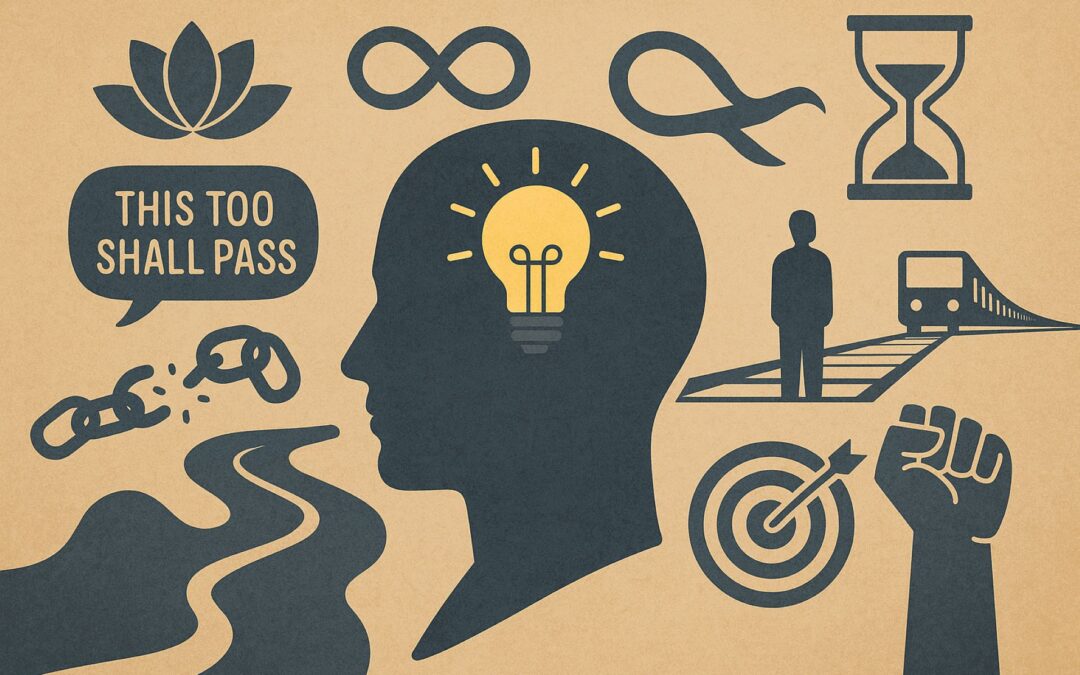
Life is full of moments that challenge our beliefs, test our limits, and push us to grow. Philosophies, often thought of as abstract ideas or ancient wisdom, have the power to reshape the way we live, helping us navigate both triumphs and struggles with clarity and purpose.
Some of the most impactful philosophies are simple yet profound, capable of shifting our perspectives and inspiring transformative change. Whether it’s through a reminder that “this too shall pass” or the encouragement to pursue freedom through personal rebellion, these philosophies invite us to live more intentionally.
In this article, we’ll explore 15 powerful philosophies that, when fully embraced, can change your life. From building resilience to understanding the importance of personal growth, each idea offers timeless wisdom for overcoming obstacles and living a more meaningful, fulfilling existence.
1. “This Too Shall Pass”
This simple yet profoundly powerful philosophy offers both solace and wisdom, reminding us that life is a constant ebb and flow. When you’re caught in the throes of adversity, it can often feel like your struggles will last forever. Whether you’re enduring financial hardship, emotional turmoil, or an overwhelming work project, the weight of the moment can make it seem endless. But the essence of “This too shall pass” lies in its reminder that nothing, whether good or bad, is permanent.
In moments of crisis, it’s easy to get trapped in the narrative of suffering, believing that the difficulties you face are insurmountable. However, when you internalize the idea that “this too shall pass,” it allows you to gain perspective. Even the most unbearable pain or grief eventually subsides, leaving you with newfound resilience and wisdom. On the flip side, the moments of joy or success that we experience can also be fleeting, so it’s essential to savor them while they last.
The key takeaway from this philosophy is not to become complacent in hardship or to take success for granted. By recognizing the impermanence of both pleasure and pain, you can navigate life with greater equanimity. If you are struggling, you will come to know that the struggle is temporary. If you are enjoying a high, you’ll remind yourself to remain humble and grounded, knowing that challenges are just around the corner. It teaches you to embrace the present moment and carry on, because everything changes.
2. “It Doesn’t Get Easier, You Get Better”
At its core, this philosophy challenges the illusion that life will eventually become easy. We often think that as we improve or gain experience, tasks will naturally get easier, but the reality is far more complex. As you improve in any area of life—whether in your career, relationships, or personal growth—the challenges will evolve with you. While you may get better at handling adversity, the adversity itself doesn’t necessarily lessen.
Consider the analogy of learning to play a musical instrument. In the beginning, every note feels like a struggle. As you progress, the difficulty of playing may seem to diminish, but the music itself may become more complex. Rather than the task getting easier, your capacity to tackle the challenges grows. As you improve, you will also raise your own standards, and what was once a monumental challenge will become part of your comfort zone, prompting you to push your limits further.
This philosophy serves as a reminder that growth is a continuous journey. You may not always feel that things are getting easier, and at times it can be frustrating to struggle despite your efforts. But as long as you’re improving, you’re moving forward. Every failure, every setback, is an opportunity to refine your skills and build the resilience you need to face even greater challenges. The trick is to focus not on how much easier life becomes, but on how much more capable you become in dealing with what’s in front of you. This mindset empowers you to persevere through obstacles, knowing that you are growing stronger with each experience.
3. “You’re Never Going to Feel Like Doing It”
One of the biggest barriers to productivity is waiting for the “right” feeling to take action. The truth is, motivation rarely comes to us on cue. We often procrastinate, waiting for the right moment or the perfect amount of energy to tackle the tasks at hand. Whether it’s the laundry, a difficult conversation, or launching a new project, waiting for motivation can paralyze us into inaction.
The reality is that you will rarely feel like doing something you know you should do. But the key to overcoming procrastination is recognizing that action breeds motivation, not the other way around. If you wait for motivation to strike before you act, you could be waiting indefinitely. The trick is to do it anyway. Start with a small step, even if it’s imperfect, and the momentum will follow. Once you begin, the task often feels less overwhelming, and you’ll find the energy to keep going.
This philosophy emphasizes the importance of discipline and consistency over inspiration. No one ever feels like doing the hard work consistently, but it’s this consistency that leads to long-term success. The fear or laziness you feel in the moment is often more paralyzing than the actual task itself. By pushing through those initial feelings, you’ll find that the work gets easier over time, and the results will follow. Don’t wait for motivation—create it by taking the first step.
4. “Everyone is Drunk on Something”
This philosophy sheds light on the underlying obsessions that shape our behavior. We all have something we are fixated on—something that consumes our thoughts, shapes our actions, and influences our decisions. This could be work, money, love, revenge, or even addiction. These obsessions can be powerful forces in our lives, sometimes without us even recognizing their influence.
Being “drunk” on something means that we are so immersed in it that it clouds our judgment and affects our choices. The problem arises when we allow these obsessions to take over and rule our lives, leaving us feeling disconnected from our true selves. Recognizing that everyone has an obsession allows us to understand human behavior more deeply. It also provides an opportunity to connect with others based on what drives them.
If you understand someone’s obsession, you can communicate with them more effectively and find common ground. For example, a colleague obsessed with success might be open to discussions about career advancement, while a friend consumed with the idea of love may be more receptive to emotional conversations. Knowing what “drives” someone allows you to engage with them on a deeper level. The philosophy encourages you to not only be mindful of your own obsessions but to also understand the things that dominate others’ lives. This understanding allows you to navigate relationships with empathy and insight.
At its core, this philosophy suggests that you should be aware of your own “drunkenness” and the extent to which it controls you. Are you making decisions based on what truly matters, or are you being driven by an obsession that distorts your judgment? If you’re able to recognize and address this, you can regain control over your life and direct your energy toward more productive, fulfilling endeavors.
5. “Never Half-Ass Two Things. Whole-Ass One Thing”
This piece of advice may sound simple, but it carries a profound truth. In a world that often glorifies multitasking, this philosophy encourages a shift toward complete focus and commitment to a single task. When you “half-ass” something, you’re giving it only partial attention and effort, resulting in mediocre outcomes. Multitasking, in particular, often leads to divided focus and diminished quality of work.
Instead of juggling multiple things at once, commit to one task and give it your undivided attention. By “whole-assing” something, you invest all your energy into doing it well. This doesn’t mean working yourself into the ground or burning out; it simply means focusing your attention and resources on one task until it’s completed to the best of your ability. The concept of “whole-ass” suggests that you can achieve excellence in whatever you put your mind to, but you must first focus on it entirely.
This philosophy isn’t just about quality; it’s also about efficiency. When you focus fully on one thing, you accomplish it faster and with greater accuracy. There’s no room for half-hearted efforts when you’re striving for excellence. As you practice this principle, you’ll likely find that your work quality improves, your stress levels decrease, and your sense of accomplishment grows. It’s a lesson in discipline, efficiency, and the power of singular focus. By dedicating your attention to one task at a time, you not only enhance your productivity but also your sense of pride in your work.
6. “Become the Kind of Person Who Doesn’t Need Second Chances”
This philosophy calls for the cultivation of personal integrity and accountability in such a way that you don’t rely on the notion of “second chances” to mend your mistakes. We all make errors in judgment, whether in personal relationships, professional environments, or with our own goals. However, the line between a mistake and a poor decision often lies in whether it was avoidable. Mistakes are part of being human, but repeatedly making poor decisions is something different.
“Becoming the kind of person who doesn’t need second chances” isn’t about perfection; it’s about taking responsibility for your actions and ensuring that your decisions reflect your values, priorities, and awareness. When you live with self-discipline and foresight, you create situations where your actions align with your intentions, and mistakes are less frequent. This doesn’t mean you’ll never slip up, but it does mean you’re mindful of your decisions and take measures to ensure they are in line with your best self.
Imagine a relationship where you constantly hurt the other person, or a work environment where you continually fail to meet expectations. Instead of expecting forgiveness each time, aim to evolve so that you don’t repeat the same behaviors. Reflect on your actions and take the necessary steps to change, whether that’s learning better communication, time management, or emotional regulation. People in your life will respect you more when you consistently make thoughtful, intentional decisions that minimize harm to others and yourself. By becoming the kind of person who doesn’t need second chances, you essentially eliminate the cycle of regret and make choices with greater awareness.
7. “Life Will Go On Whether You Board the Train or Stay on the Platform”
This philosophy speaks to the moments of indecision and fear of the unknown. Often, we stand at metaphorical crossroads in life, unsure whether to take the leap into something new. Whether it’s a career change, a relationship, or moving to a new place, the fear of uncertainty can freeze us in place. But here’s the reality: life does not wait for us to get comfortable with making decisions. Time continues to march forward, and whether you take that step or not, life will go on.
The imagery of standing at the platform while the train of opportunity moves ahead suggests that indecision has its consequences. The train will leave, regardless of whether you get on it. This metaphor highlights the necessity of taking action, even when you’re unsure about the outcome. Waiting until you’re certain or until you “feel ready” can prevent you from seizing opportunities that may come only once. The moment you hesitate can slip by, leaving you with regret.
The key takeaway here is that if you stay on the platform, you will miss out on what could be an extraordinary journey. By boarding the train, even with all its uncertainties, you step into the unknown with the possibility of great rewards. This philosophy encourages you to stop overthinking and take the leap, because staying stationary out of fear only perpetuates stagnation. Whatever path you choose, it will lead to experiences that shape you and provide lessons that will only become clear as you continue forward.
8. “Man is Condemned to Be Free” (Jean-Paul Sartre)
Jean-Paul Sartre’s existential philosophy centers on the paradox of freedom. While freedom is often viewed as a privilege—a desirable goal that many seek—Sartre argues that it is, in fact, a burden. He believes that human beings are “condemned” to freedom because, while we have the ability to choose, we cannot escape the responsibility that comes with our choices.
Sartre’s philosophy challenges us to confront the heavy responsibility of defining ourselves through our actions. There is no external force that dictates our decisions, and therefore, we are solely accountable for the choices we make and their consequences. The freedom to make choices sounds liberating, but it’s fraught with anxiety because every decision is a reflection of who we are and what we value. There is no predetermined path, and we cannot blame destiny, societal expectations, or external forces for the choices we make. The burden of responsibility is inescapable.
This philosophy urges you to embrace the freedom that comes with responsibility. Rather than seeing freedom as a source of stress, embrace it as a tool for self-empowerment. When you make a choice, you are shaping your own identity. However, this process also means that you can never excuse yourself from the consequences of your actions. Sartre’s philosophy calls us to live authentically, to make choices that reflect our true selves, and to fully own the responsibility that comes with the freedom to act. In doing so, we find meaning and purpose in our lives, not by deferring to external pressures but by asserting our own will and direction.
9. “He Who Has a ‘Why’ to Live Can Bear Almost Any ‘How’” (Viktor Frankl)
Viktor Frankl, a psychiatrist and Holocaust survivor, writes about the importance of having a deep sense of purpose in life, especially when facing extreme suffering. Frankl’s personal experiences during the Holocaust led him to conclude that people who survived the unimaginable horrors of the concentration camps were often those who had a compelling reason to live—a “why.” This “why” could be a love for family, a sense of duty, or a personal mission. It was this sense of meaning that gave them the strength to endure the brutal conditions they faced.
Frankl’s work in Man’s Search for Meaning underscores the concept that human beings are motivated not just by the pursuit of happiness or pleasure, but by the search for meaning. In the face of suffering, it is this “why” that provides the resilience to withstand the “how”—the physical, emotional, or mental pain. Whether you are facing grief, loss, or an existential crisis, knowing your purpose can help you endure the hardships of life.
This philosophy emphasizes the importance of cultivating a sense of meaning in everything you do. When you have a purpose, whether it’s in your work, relationships, or personal endeavors, the challenges you face become more bearable. Purpose gives you the stamina to push through life’s most difficult moments. In times of crisis, your “why” becomes your anchor, helping you stay grounded and focused on what truly matters. Frankl’s insights challenge you to find meaning in your own life, not just as a means of survival, but as a path to thriving, no matter the obstacles.
10. “You Can’t Step Into the Same River Twice” (Heraclitus)
Heraclitus, the ancient Greek philosopher, is famous for his assertion that “everything flows,” or that life is in constant flux. The river metaphor is a vivid reminder that nothing in life stays the same. Just as the water in a river is constantly moving and changing, so too is everything in life—your circumstances, your thoughts, your relationships, and even your own sense of identity.
The essence of this philosophy is about accepting and embracing change. Many people fear change, clinging to the past or trying to maintain a sense of control over their environment. However, Heraclitus teaches that resistance to change is futile. Change is a fundamental part of existence, and the more you accept it, the more gracefully you can navigate the shifts in your life.
This philosophy is also a reminder that no experience is ever repeated in exactly the same way. The river you step into today is different from the one you stepped into yesterday. Every moment, every relationship, and every action is unique, and the people and situations that come into your life will never be the same again. Instead of yearning for stability or permanence, Heraclitus encourages you to find beauty in the constant flow of life. By embracing the present moment and letting go of the past, you allow yourself to be fully immersed in the now, where growth and transformation occur.
The core lesson here is that life is a continuous process of change, and by accepting this reality, you can move forward with greater resilience, curiosity, and adaptability.
11. “If I Am Not for Myself, Who Will Be for Me? And If I Am Only for Myself, What Am I?”
Hillel the Elder’s profound reflection on self-care, communal responsibility, and action addresses the delicate balance between caring for oneself and caring for others. The first part of this statement is a powerful reminder that self-advocacy and self-respect are essential. If you do not stand up for yourself and your needs, who will? Life often requires us to navigate through challenges and protect our interests, whether they relate to career aspirations, personal well-being, or boundaries. To rely solely on others to advocate for your needs or desires is a form of disempowerment. You must first take ownership of your life, your choices, and your well-being. This does not mean selfishness, but a recognition of the necessity of self-respect and the importance of taking care of your own mental, physical, and emotional health.
The second part of Hillel’s statement underscores the need for empathy and compassion. While it’s essential to care for yourself, it’s equally important to recognize your responsibility to others. If you are solely focused on yourself, you lose the essence of what it means to be human. Our humanity is rooted in relationships and shared experiences. True fulfillment comes not only from personal success but from contributing to and caring for those around you. You must find the balance between advocating for your own needs while also being an active, compassionate participant in the lives of others. It reminds us that living in a vacuum, where we are entirely focused on our own desires, diminishes our humanity. Therefore, while you must advocate for your own needs, you must also be willing to give, share, and be present for others.
The final line, “And if not now, when?” calls us to action. This is a call to seize the present moment, to stop postponing the things that matter—whether personal goals or acting with kindness toward others. Time waits for no one, and delays can cost you opportunities and relationships. This philosophy is a rallying cry to stop procrastinating and to make the necessary changes or take the necessary actions now.
12. “The Only Way to Deal with an Unfree World is to Become So Absolutely Free That Your Very Existence Is an Act of Rebellion” (Albert Camus)
Albert Camus’s statement addresses the concept of freedom not as a political or social condition, but as an existential stance. In a world full of societal expectations, pressures, and norms, freedom often seems like an illusion. Many aspects of our lives—our careers, our relationships, and even our values—are influenced by external factors. Yet Camus proposes that the ultimate form of freedom is not found in external circumstances but in the internal choices we make and the way we live our lives.
Camus’s philosophy suggests that in order to truly experience freedom, you must rebel against the expectations that others impose upon you. This rebellion is not about defiance for its own sake, but about choosing autonomy over conformity. It’s about refusing to live a life dictated by others or by societal pressures. When you live according to your personal values and beliefs, you assert your independence, and that, in itself, becomes an act of rebellion.
The rebellion here is not violent or outwardly confrontational; it’s about living authentically, choosing to follow your own path regardless of what others think or expect. This means rejecting the societal standards that try to define success, beauty, and worth. It means being comfortable with your uniqueness and unapologetically pursuing a life that aligns with who you truly are. By making choices that align with your values, you embrace the ultimate freedom—freedom from the external systems that try to constrain you. Camus’s philosophy asks you to redefine what freedom means and to fight for it within yourself, because only then can you truly be free.
13. “To Have Doubted One’s Own First Principles is the Mark of a Civilized Man”
Intellectual humility is the cornerstone of this philosophy. Our first principles are the basic beliefs and values that form the foundation of how we see the world. These principles are often ingrained in us from an early age by our upbringing, culture, and environment. However, what happens when we begin to question these deeply held beliefs? Does it signal a crisis of identity, or does it mark the beginning of intellectual growth?
To doubt your own first principles is to demonstrate intellectual maturity. It shows that you are willing to question assumptions and be open to new ideas. This willingness to challenge your foundational beliefs is not a sign of weakness, but a reflection of wisdom. It’s easy to become entrenched in our views, especially when those views have been with us for so long, but real progress comes from the ability to reconsider and re-evaluate them.
In the pursuit of truth, you must recognize that no belief is beyond questioning. Doubting the things you take as self-evident forces you to seek deeper understanding. It’s a practice of refining your worldview, discarding beliefs that no longer serve you, and embracing those that stand the test of reason. Socrates, the father of Western philosophy, famously said, “The unexamined life is not worth living.” To truly live an examined life is to consistently question your assumptions, examine your motivations, and be willing to grow and adapt in response to new information. Intellectual maturity is reflected in this willingness to doubt and refine your principles, and it is this trait that enables true philosophical progress.
14. “The Master’s Tools Will Never Dismantle the Master’s House” (Audre Lorde)
Audre Lorde’s powerful statement calls for a complete overhaul of the systems that maintain oppression and inequality. The “master’s tools” refer to the methods, ideologies, and structures of power that perpetuate injustice. If the goal is to dismantle oppressive systems, using the very same tools that maintain them is futile. You cannot create meaningful change by simply tweaking the existing system; instead, Lorde argues, you need to approach the problem from an entirely new perspective.
This philosophy speaks to the limitations of conventional approaches to fighting systemic issues such as racism, sexism, and economic inequality. When we use the same methods and ideologies that created these systems, we only reinforce them. Lorde’s call is for radical rethinking—new, transformative methods of change that don’t just challenge the system but seek to completely dismantle it. She advocates for innovation and creativity in fighting oppression, and for those who are marginalized to reclaim their power in ways that are not defined by the dominant system.
The broader implication of this philosophy is that true transformation requires not just resistance but reimagining the entire framework. This is true not only for large-scale societal change but also for personal growth and evolution. If you want to break free from old patterns, whether in relationships, career, or personal habits, you must rethink your methods and approaches. The tools you used to create certain results in the past may no longer serve you as you strive for growth. This is a call for radical action and new ways of thinking that go beyond the established norms.
15. “What You Get By Achieving Your Goals Is Not As Important As Who You Become By Achieving Your Goals”
This philosophy redefines success by shifting the focus from the end result to the personal growth that happens along the journey. In our achievement-oriented society, we often measure success solely by the tangible outcomes—whether it’s wealth, status, or recognition. However, this perspective can be limiting and even damaging, as it overlooks the deeper transformation that occurs in the process of striving toward a goal.
The true value of achieving a goal lies in the person you become during the pursuit. The obstacles you face, the lessons you learn, and the discipline you cultivate are what shape your character. Success, then, is not just about reaching the destination; it’s about how you evolve as a result of the pursuit. Consider an athlete training for a competition. While winning the competition might be the ultimate goal, the athlete’s growth—both physically and mentally—is what truly defines their journey. Through hard work, sacrifice, and perseverance, they become someone who embodies resilience and strength, regardless of the outcome.
This philosophy encourages you to focus on personal development, not just external accomplishments. The skills, virtues, and insights you gain along the way are often far more valuable than the prize at the end. It’s a reminder that the process of achieving your goals is just as important as the goal itself, and that the journey will shape you into a better, stronger person. By shifting your focus to becoming the person capable of achieving great things, you ensure that the journey itself is fulfilling, regardless of the outcome.
Conclusion
The philosophies shared here are not just intellectual exercises—they are tools for living a more engaged, authentic life. They encourage us to question our assumptions, take responsibility for our choices, and embrace the inevitable changes that come our way. Whether you’re in a phase of struggle or triumph, these ideas can help you find balance, meaning, and direction.
As you reflect on these teachings and incorporate them into your life, remember that true transformation happens when you move beyond understanding these ideas intellectually and begin to embody them in your everyday actions. These philosophies hold the potential to reshape your path, challenge your perspective, and ultimately guide you toward a life of greater freedom, purpose, and fulfillment.