
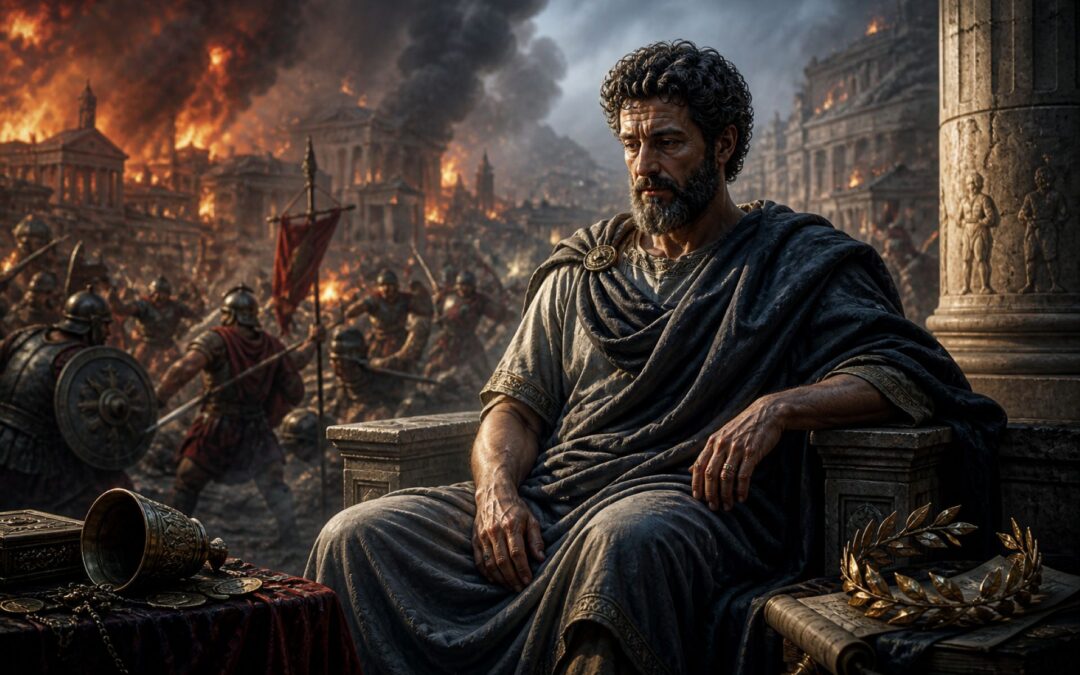
Power, in its purest form, is almost impossible to imagine.
To command armies feared across continents. To hold the fate of nations in your hands. To wake up each day knowing that whatever desire crosses your mind—pleasure, wealth, indulgence—can be satisfied without resistance. Most people never come close to this kind of power. And yet, even in smaller doses, power has a predictable effect: it corrupts.
History is filled with examples of individuals who, once given authority, became slaves to their impulses. They indulged endlessly. They surrendered to excess. They lost themselves.
And then there was Marcus Aurelius.
As the emperor of Rome, he stood at the peak of human power. He could have spent his life in constant pleasure—surrounded by luxury, drowning in wine, chasing every desire without consequence. The world would not have stopped him. In fact, it would have encouraged him. This was, after all, the norm among the Roman elite.
His own son, Commodus, would later embody exactly this path—descending into indulgence, cruelty, and spectacle, treating power as a tool for personal gratification rather than responsibility.
Marcus Aurelius chose differently.
Instead of surrendering to pleasure, he turned inward. Instead of chasing excess, he practiced restraint. Instead of losing himself in power, he used power as a test of character.
In the quiet moments between battles and political decisions, he wrote reflections to himself—private notes never meant for an audience. These writings, later known as Meditations, reveal not a man intoxicated by authority, but one in constant dialogue with his own mind. A man struggling, questioning, correcting himself.
What makes this remarkable is not that Marcus Aurelius was immune to temptation. It’s that he was aware of it.
He understood something that many powerful people fail to grasp: that the real danger of power is not what it allows you to do to others—but what it quietly does to you.
This is where Stoicism begins.
Not as an abstract philosophy, but as a response to a very real problem: how does a human being remain grounded, rational, and virtuous in a world full of chaos, temptation, and things beyond their control?
Marcus Aurelius did not try to control the world. He tried to control himself.
And in doing so, he arrived at a simple but transformative realization—one that sits at the heart of Stoic philosophy and remains just as relevant today:
There are things you can control, and there are things you cannot.
Understanding the difference is where real power begins.
The Temptation of Absolute Power
It’s easy to admire restraint when you’ve never been truly tested.
Most people like to believe they would act with discipline if given power. That they would remain grounded, rational, and morally upright. But history tells a different story. Power doesn’t just reveal character—it distorts it. It amplifies desire, removes consequences, and slowly erodes the boundaries that once kept a person in check.
When nothing stops you, nothing corrects you.
For the majority of rulers, elites, and influential figures throughout history, this has led to a predictable decline. What begins as authority often turns into entitlement. What begins as responsibility devolves into indulgence. Surrounded by yes-men and insulated from criticism, many begin to believe they are above the rules that govern everyone else.
Pleasure becomes constant. Excess becomes normal. And eventually, control is lost—not over others, but over oneself.
This is what makes Marcus Aurelius such a striking exception.
He was not blind to what his position offered him. He understood, perhaps more clearly than most, that momentary pleasure was available to him without limits. There were no real barriers between desire and fulfillment. And that’s precisely why it was dangerous.
Where others saw opportunity, he saw temptation.
His son, Commodus, would later illustrate the more familiar path. Raised in the same position of power, Commodus embraced indulgence fully—immersing himself in spectacle, cruelty, and personal gratification. The arena became his stage, excess his identity. Power, in his hands, became something to consume rather than something to steward.
The contrast is not just historical—it’s psychological.
Two individuals, given the same level of power, walked in completely opposite directions. One became a symbol of discipline and reflection. The other, a symbol of decay.
What separates them is not circumstance. It’s perspective.
Marcus Aurelius understood that power magnifies whatever already exists within a person. If you are ruled by impulse, power will make you more impulsive. If you lack discipline, power will expose it. If you chase pleasure, power will drown you in it.
So instead of trusting himself blindly, he did something unusual.
He questioned himself constantly.
His writings are filled with reminders—not to indulge, not to be distracted, not to fall into vanity or anger. These weren’t abstract ideas. They were active struggles. He wasn’t above temptation; he was actively resisting it.
This is the first layer of Stoic insight.
Before you can control anything external, you have to confront what’s happening internally. Because the greatest threat is not the world around you—it’s your own unchecked mind when given the freedom to act without limits.
And that’s where Stoicism draws its first line.
Not between good and bad. Not between success and failure.
But between what is within your control—and what is not.
The Stoic Divide: What We Control and What We Don’t
At the core of Stoicism lies a distinction so simple that it’s easy to overlook—and yet so powerful that it can reshape the way you experience life entirely.
According to the Stoic philosopher Epictetus, everything in existence falls into one of two categories: things that are up to us, and things that are not.
Most of life belongs to the second category.
Other people’s actions, opinions, and emotions are not up to you. The economy is not up to you. Your reputation, the way others perceive you, the success of your efforts, even the eventual decline of your body—none of these are fully within your control.
You can influence them, yes. You can make decisions, take action, try your best. But influence is not control.
Even if you do everything right, things can still go wrong.
A relationship can fall apart despite your effort. A career can collapse due to forces you never saw coming. Your health can deteriorate without warning. You can lose what you’ve built, not because you were careless, but because life is unpredictable by nature.
This is the uncomfortable truth Stoicism asks you to confront.
Not everything bends to your will.
At first glance, this sounds bleak—almost fatalistic. It can feel like a surrender, like giving up on the idea that your actions matter. But the Stoics weren’t pessimists. They were precise.
Because while most things are not under your control, a small but crucial domain remains entirely yours.
Your judgments.
Your reactions.
Your choices.
This is where the shift happens.
When you stop trying to control what is fundamentally uncontrollable, you free up energy—mental, emotional, and practical—that was previously wasted in resistance. You stop arguing with reality. You stop expecting certainty where none exists.
And instead, you begin to focus on the only place where your power is real.
The Stoics didn’t deny that external events matter. They simply refused to tie their inner state to them.
If something good happens, it’s welcomed—but not clung to. If something bad happens, it’s acknowledged—but not allowed to define the self.
This creates a kind of stability that doesn’t depend on circumstances.
You are no longer at the mercy of every change in the outside world. Your peace doesn’t rise and fall with outcomes. It becomes anchored somewhere deeper—within the way you interpret and respond to whatever happens.
This is why Marcus Aurelius, despite being surrounded by war, political tension, and constant pressure, could still write calmly about discipline, reason, and perspective.
He wasn’t trying to control everything around him.
He was trying to understand where his control actually ended.
And once you see that boundary clearly, something unexpected happens.
Life doesn’t feel smaller.
It feels lighter.
The Only True Domain: Your Mind and Your Actions
Once the Stoic divide becomes clear, a deeper question naturally follows:
If so much of life is outside our control, what exactly remains?
The Stoics give a precise answer: your judgments, your intentions, and your actions.
Everything else is uncertain. This is not.
This shift is subtle, but it changes everything.
Most people live as if their inner state is dictated by external events. Something happens—and they react. A setback leads to frustration. Criticism leads to anger. Loss leads to despair. It feels automatic, almost mechanical, as if the world presses a button and the mind responds.
But Stoicism challenges this assumption.
It argues that between the event and the reaction, there is a space—a moment where interpretation happens. And it is in this space that your freedom exists.
Two people can face the same situation and experience it completely differently. One sees failure and collapses inward. The other sees difficulty and adapts. The event is identical. The meaning is not.
This is why Stoics place such emphasis on judgment.
It’s not the situation itself that disturbs you, but the way you define it.
A delayed plan becomes “a disaster” only if you label it that way. Criticism becomes “an attack” only if you interpret it as such. Even pain, while undeniably real, is experienced through the lens of how the mind frames it.
This doesn’t mean denying reality or pretending that everything is good. It means recognizing that your response is not fixed—it is chosen.
And with that choice comes responsibility.
If your peace depends on how you interpret events, then you can no longer blame the world entirely for your suffering. You have to examine your own reactions. You have to ask whether your judgments are accurate, useful, or even necessary.
This is where Stoicism becomes demanding.
It removes the comfort of victimhood.
But in doing so, it offers something far more valuable: agency.
You may not control what happens, but you control how you meet it.
You control whether you act with patience or frustration, clarity or confusion, discipline or impulse. You control whether you escalate situations or dissolve them. Whether you carry resentment or let it pass.
And over time, these small internal decisions shape the quality of your life far more than external circumstances ever could.
Marcus Aurelius understood this deeply.
Surrounded by pressures that could justify anger, indulgence, or despair, he continually brought his attention back to one question: what is the right way to respond?
Not what is easiest. Not what feels good in the moment. But what aligns with reason, integrity, and self-mastery.
Because in the end, that is the only domain that truly belongs to you.
Your mind.
And what you choose to do with it.
Emotion, Reason, and the Stoic Balance
One of the most common misunderstandings about Stoicism is that it demands emotional suppression—that to be Stoic is to feel nothing, to become cold, detached, almost mechanical.
But that’s not what the Stoics taught.
They didn’t reject emotion. They questioned its authority.
Emotions, for the Stoics, are natural. They arise without permission. Fear, anger, joy, sadness—these are part of the human experience. Trying to eliminate them entirely would be both unrealistic and unnecessary.
The problem is not that emotions exist.
The problem is what happens when they take control.
Most people don’t just experience emotions—they become them. Anger doesn’t just appear; it dictates behavior. Anxiety doesn’t just pass through; it defines perception. A single emotional state can color the entire world, distorting judgment and narrowing awareness.
In that state, reason disappears.
And without reason, decisions become reactive rather than intentional.
The Stoic approach is different.
Instead of suppressing emotions or surrendering to them, Stoics observe them. They create a distance—a gap between feeling and action. This distance is where clarity lives.
An emotion becomes something you notice, not something you obey.
Imagine standing at the edge of the ocean, watching waves rise and fall. Some are small, barely noticeable. Others crash with force. But no matter how powerful a wave is, it doesn’t define the ocean itself. It passes.
The Stoics saw emotions in the same way.
Temporary movements within a larger, more stable awareness.
This shift changes your relationship with what you feel.
Anger can arise, but you don’t have to act on it. Fear can surface, but you don’t have to retreat blindly. Sadness can be present, but it doesn’t have to consume your entire perspective.
Reason steps in—not to eliminate emotion, but to guide your response to it.
This is where balance emerges.
You don’t deny what you feel, but you also don’t let it decide everything for you. You acknowledge the emotion, examine it, and then choose your response deliberately.
Over time, this practice becomes deeply therapeutic.
Because instead of being overwhelmed by emotional swings, you begin to see patterns. You notice how quickly feelings change. You realize that what felt permanent was never stable to begin with.
And with that realization comes a kind of quiet confidence.
You stop fearing your own emotions.
You stop reacting to every internal shift as if it demands action.
You begin to trust that no matter what arises within you, you have the ability to meet it with awareness and reason.
For Marcus Aurelius, this wasn’t theory.
It was survival.
In a world full of conflict, betrayal, and constant pressure, losing control emotionally would have had real consequences—not just for him, but for an entire empire.
So he trained himself to remain steady.
Not emotionless, but grounded.
Not detached, but deliberate.
Because in the end, the goal of Stoicism is not to remove emotion from life.
It’s to ensure that emotion never removes you from yourself.
Living in Accordance With Nature
For the Stoics, self-mastery was not just about control—it was about alignment.
They believed that a good life is one lived “in accordance with nature.” At first, this can sound vague, even abstract. But for the Stoics, nature had a very specific meaning. It referred not only to the physical world, but to the deeper order of things—the structure of reality and the role human beings are meant to play within it.
To live according to nature is to stop resisting what is.
It is to recognize that life unfolds according to forces far greater than individual will. Events happen. People act as they do. Time moves forward. Nothing remains fixed. Trying to fight this reality—to demand that things should be different—is what creates unnecessary suffering.
Acceptance, in this sense, is not weakness. It’s clarity.
It means seeing the world as it is, rather than as you wish it to be.
But Stoicism doesn’t stop at passive acceptance. Living in accordance with nature also involves action—specifically, acting in line with what is natural to us as human beings.
And what is natural to us?
Reason.
The Stoics saw human beings as rational creatures, capable of reflection, judgment, and deliberate action. This capacity for reason is what distinguishes us, and it comes with responsibility. To live well is to use this capacity fully—to act with wisdom, fairness, discipline, and integrity.
In other words, your role is not just to exist within the world, but to contribute to it.
Marcus Aurelius often reminded himself that he was part of something larger—a community, a society, a shared human experience. His actions, no matter how small, were connected to the whole. Acting selfishly, impulsively, or destructively wasn’t just a personal failure—it was a disruption of that greater order.
This perspective shifts the focus away from individual gain and toward collective harmony.
You begin to ask different questions.
Not “What do I want right now?” but “What is the right thing to do?”
Not “How do I avoid discomfort?” but “How do I respond in a way that aligns with reason and responsibility?”
At the same time, living in accordance with nature also means accepting your own nature—including your limitations.
You are not invincible. You are not permanent. Your body will age, your circumstances will change, and eventually, your life will end. Resisting these truths doesn’t prevent them—it only creates friction.
Acceptance, again, becomes a form of strength.
You stop expecting life to be something it’s not. You stop demanding certainty in an uncertain world. And in that absence of resistance, your actions become clearer, more grounded, more intentional.
This is the deeper aim of Stoicism.
Not just to control your reactions, but to bring your entire way of living into alignment—with reality, with reason, and with the role you play in the larger whole.
Because when your actions are aligned with nature, there is no internal conflict.
And without conflict, there is peace.
Training the Mind: Stoic Practices for Inner Stability
Stoicism is not just a way of thinking—it’s a way of training.
Understanding ideas like control, acceptance, and reason is important, but insight alone isn’t enough. In moments of stress, conflict, or temptation, theory tends to collapse unless it has been practiced repeatedly.
The Stoics knew this.
That’s why they developed exercises—not abstract rituals, but mental tools designed to prepare the mind for reality as it is, not as we wish it to be.
One of the most powerful of these is premeditatio malorum, or negative visualization.
At first glance, it seems counterintuitive. Why would you deliberately think about things going wrong?
But the purpose is not pessimism—it’s preparation.
Marcus Aurelius, before facing the day, would remind himself that he would encounter difficult people. Not just inconvenience, but interference, ingratitude, arrogance, selfishness. He didn’t expect the world to cooperate with him.
He expected resistance.
By doing this, he removed the element of surprise. When difficulties arose, they didn’t feel like personal attacks or unexpected disruptions. They were simply part of the structure of life—something already accounted for.
This changes your reaction completely.
Instead of frustration, there is recognition. Instead of emotional escalation, there is composure.
Another practice is memento mori—the reminder that you will die.
This is not meant to be morbid. It’s meant to be clarifying.
When you remember that your time is limited, trivial concerns begin to lose their weight. Petty conflicts, unnecessary worries, endless distractions—they start to feel less important. You become more selective with your attention.
You ask: is this really worth my time?
And more often than not, the answer is no.
This awareness doesn’t make life smaller. It makes it sharper. More intentional.
Then there is the view from above.
In this exercise, you imagine yourself rising above your immediate situation—higher and higher—until you can see your life from a distance. Then your city. Then your country. Eventually, the entire world.
From this perspective, your problems begin to shift in scale.
What felt overwhelming becomes small. What felt central becomes temporary. You see yourself not as the center of everything, but as a small part of a much larger whole.
And strangely, this reduction brings relief.
Because the pressure to control everything disappears.
You no longer carry the weight of the world on your shoulders. You begin to see that life continues—with or without your constant interference.
These practices are simple, but they are not easy.
They require repetition. They require honesty. They require a willingness to confront discomfort instead of avoiding it.
But over time, they build something that cannot be taken away easily.
A stable mind.
A mind that does not panic when things go wrong. A mind that does not get lost in every emotional shift. A mind that sees clearly, acts deliberately, and remains grounded even in uncertainty.
This is what Marcus Aurelius was cultivating—not just through his words, but through daily effort.
Because in the end, inner stability is not something you find.
It’s something you train.
The Strength of Indifference in a Distracted World
To the modern ear, the word indifference sounds negative.
It suggests apathy. Disengagement. A lack of care.
But for the Stoics, indifference meant something very different.
It meant freedom.
Not freedom from responsibility, but freedom from unnecessary attachment. A Stoic doesn’t stop caring about life—they simply become selective about what deserves their care.
Because not everything does.
Most of what fills our attention today is trivial. Endless notifications, opinions from strangers, the pressure to respond, to react, to keep up. We are constantly pulled in different directions, reacting to things that, in the grand scheme of life, have no real importance.
And yet, we treat them as if they do.
A comment online can ruin your mood. A delayed message can create anxiety. A small inconvenience can feel like a disruption of your entire day. The mind becomes overstimulated, scattered, and reactive.
This is the opposite of Stoic clarity.
The Stoics understood that attention is a limited resource. If you give it to everything, you dilute it. You lose the ability to focus on what truly matters.
So they practiced indifference—not toward everything, but toward the unnecessary.
They deliberately withdrew emotional investment from things outside their control or things that held no real value. Not because those things didn’t exist, but because engaging with them served no purpose.
This is a form of discipline.
It requires you to constantly ask: does this matter?
Not in the moment, not emotionally—but in the broader context of your life.
Will this still matter tomorrow? Next week? At the end of your life?
If the answer is no, then holding onto it is a choice—and often, an unnecessary one.
This doesn’t make you passive. It makes you precise.
Your energy is no longer scattered across dozens of small, irrelevant concerns. It becomes concentrated. Directed. Intentional.
You begin to care deeply about fewer things—but those things receive your full attention.
Your actions become clearer. Your priorities sharper.
And with that clarity comes a kind of quiet strength.
You are no longer easily disturbed. Not because nothing happens, but because most things no longer qualify as worth disturbing you.
In a world designed to capture and fragment your attention, this kind of indifference is not weakness.
It’s power.
It allows you to move through life without being pulled into every distraction, every provocation, every fleeting impulse. It gives you the ability to step back, to choose, to remain steady.
And perhaps most importantly, it creates space.
Space to think. Space to act. Space to live deliberately.
Because when you stop reacting to everything, you finally gain the ability to respond to what actually matters.
Why Stoicism Matters More Than Ever Today
It’s tempting to see Stoicism as something distant—an ancient philosophy shaped by a world that no longer exists.
But in many ways, the problems it addresses have only intensified.
We live in an age of constant exposure. Information never stops. Opinions are everywhere. The pace of life has accelerated, and with it, the pressure to react—to stay updated, to stay relevant, to stay in control of things that are fundamentally uncontrollable.
Anxiety thrives in this environment.
Not because life has become harder in every sense, but because the illusion of control has become stronger. We are made to feel as if we should be able to manage everything—our careers, relationships, health, reputation, and even how others perceive us.
And when reality refuses to cooperate, frustration follows.
This is exactly where Stoicism becomes relevant.
It cuts through the noise with a simple clarity: most of what you are trying to control was never yours to control in the first place.
Other people will think what they think. Events will unfold in ways you didn’t anticipate. Plans will fail. Circumstances will shift.
No amount of worry will prevent this.
But what Stoicism offers is not helplessness—it’s direction.
Instead of scattering your attention across everything that might go wrong, it asks you to bring it back to what you can actually influence. Your actions. Your decisions. Your response to whatever happens.
This shift alone reduces a tremendous amount of mental friction.
You stop fighting battles that cannot be won. You stop exhausting yourself trying to predict or prevent every possible outcome. You accept uncertainty—not as a flaw in life, but as a fundamental part of it.
And from that acceptance, a different kind of strength emerges.
A calm that is not dependent on things going your way.
A clarity that is not disrupted by every external change.
A resilience that doesn’t break the moment life becomes difficult.
Marcus Aurelius faced plagues, wars, political instability, and constant pressure. His world was not calm, controlled, or predictable. And yet, he continually returned to the same principle: focus on what is yours, and let go of what is not.
That principle hasn’t lost its relevance.
If anything, it has become more necessary.
Because today, the danger is not just external chaos—it’s internal overload. Too much information, too many distractions, too many things competing for your attention.
Without a framework to filter all of this, the mind becomes overwhelmed.
Stoicism provides that framework.
It doesn’t promise a perfect life. It doesn’t remove difficulty. But it gives you a way to move through difficulty without losing yourself in the process.
And in a world that constantly pulls you outward, that might be one of the most valuable skills you can develop.
Conclusion
Marcus Aurelius had everything most people believe they want—power, influence, and unlimited access to pleasure.
And yet, his legacy is not built on what he possessed, but on what he refused to become.
He understood that external power means very little if you are internally unstable. That controlling others is insignificant compared to controlling yourself. And that without discipline, even the greatest advantages can turn into traps.
Stoicism gave him a framework to navigate this reality.
It taught him to distinguish between what he could control and what he could not. To observe his emotions without being ruled by them. To act in accordance with reason rather than impulse. To prepare for difficulty instead of being surprised by it. And to focus his energy only on what truly matters.
These ideas are not reserved for emperors.
They apply just as much today—perhaps even more.
You may not command armies or shape empires, but you still face uncertainty. You still encounter difficult people, unexpected setbacks, and moments where your emotions threaten to take over. You still live in a world that constantly tries to pull your attention in every direction.
And in that world, the same principle holds.
Real power is not found in controlling circumstances.
It’s found in mastering your response to them.
This is the quiet strength at the heart of Stoicism. A strength that doesn’t depend on status, wealth, or external success. A strength that remains available no matter what situation you find yourself in.
Marcus Aurelius chose this path, despite having every reason not to.
And that choice is what makes his example endure.
Because in the end, the question is not how much control you have over the world.
It’s how much control you have over yourself.