
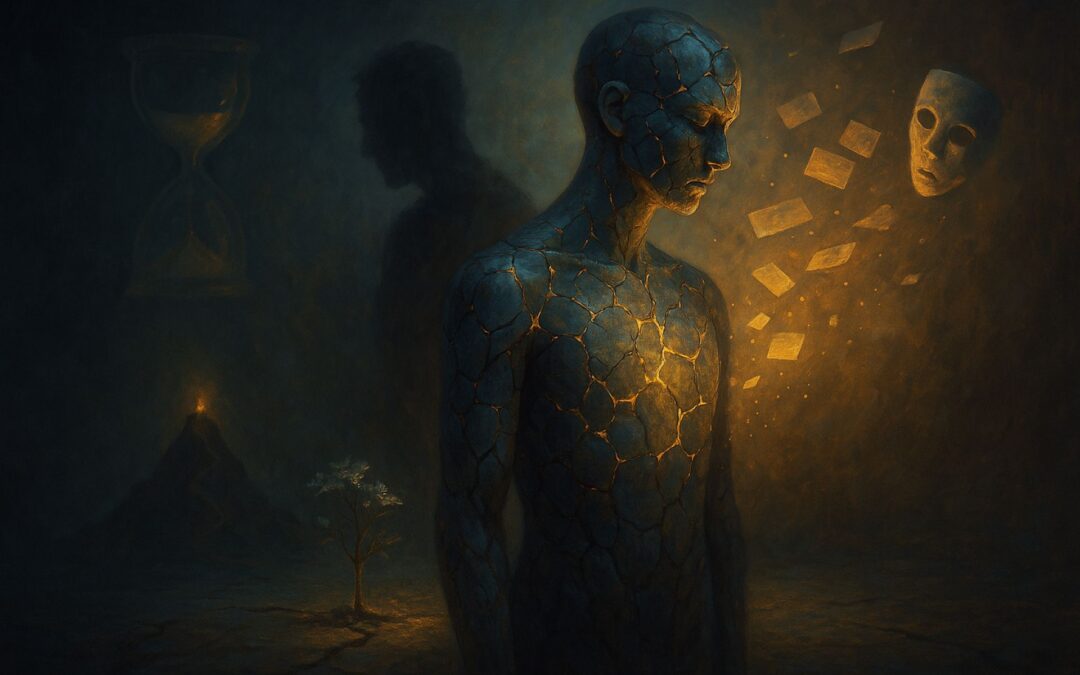
Some truths don’t comfort us; they confront us. They irritate, sting, or sit uncomfortably in the back of our minds like a whisper we’re not ready to acknowledge. Yet these same truths are the ones that deepen our relationships, sharpen our values, and push us toward the life we secretly want.
The irony is simple: beauty often hides behind discomfort. Meaning is forged in difficulty. And anything that lasts tends to come with a price that hurts a little. These aren’t the lessons people post on inspirational quote cards—but they’re the ones that actually shape a fulfilling life.
Truth #1 — Suffering Is the Price of a Meaningful Life
Most of us grow up believing that a good life is one where suffering has been minimized or eliminated. We quietly assume that comfort equals success, and discomfort equals failure. But the exact opposite is true: every meaningful part of your life is stitched together with effort, strain, frustration, uncertainty, and sacrifice. You won’t find a single worthwhile pursuit that doesn’t demand something painful from you.
This is where people get stuck. Pleasure is seductive. It’s instant, predictable, and emotionally frictionless. You can binge it, chase it, inject it into your day like a numbing agent. It costs nothing in the moment. But it gives nothing lasting in return. The problem is not that pleasure is bad—it’s that it is empty. It’s the emotional equivalent of junk food: sweet in the moment, hollow afterward.
Happiness, on the other hand, is structurally different. It’s slow-building, long-term, and deeply tied to responsibility. It’s rooted in commitment—choosing something difficult and refusing to walk away when it becomes unpleasant. We don’t usually call this “happiness” because we think happiness must feel good. But the deepest forms of happiness feel like direction, purpose, integrity, and alignment. They come from struggling for things you care about, not escaping discomfort.
There is also a profound difference between chosen suffering and uninvited suffering. Uninvited suffering is the chaos life throws at you—illness, loss, betrayal, accidents, injustice. Chosen suffering is everything you willingly carry: the discipline of waking up early, the vulnerability of intimacy, the uncertainty of pursuing a dream, the humility of learning, the courage of starting over. People often complain that life is unfair, but much of the suffering they feel is simply the cost of something they chose—without acknowledging they chose it.
This blind spot shows up everywhere. Someone wants to build a platform but dreads criticism. Someone wants to be admired but fears being misunderstood. Someone wants influence without accepting that visibility attracts hostility. Someone wants to protest but expects comfort to follow them into inconvenience. We want the rewards of our choices but pretend the consequences belong to someone else.
The truth is: when you choose a path, you also choose its hardship. The problem is not that life is painful. The problem is we tell ourselves stories where we are victims of a reality we actually signed up for. And when the pain arrives, we treat it like a mistake rather than a natural part of the process.
Here’s the liberating part. When you consciously acknowledge, “Yes, this is the suffering I willingly accept because the reward matters to me,” the pain transforms. It becomes purposeful. It becomes a signal of alignment rather than defeat. Imagine how differently people would live if they understood this: most resistance isn’t “I can’t do this,” it’s “I didn’t expect this to be part of what I wanted.”
Meaning arrives the moment you stop fantasizing about the benefit and start respecting the cost. The moment you say, “I choose this—even the uncomfortable parts.” The moment you realize that suffering, when chosen with intention, isn’t a punishment. It’s the down payment for a life that actually feels like your own.
Truth #2 — Trauma Can Break You, But It Can Also Grow You
Trauma is one of the few experiences that can rip your life cleanly into “before” and “after.” It destabilizes, disorients, and often destroys the version of yourself you relied on. Trauma is not gentle. It does not arrive with meaning attached. It does not ask if you’re ready. It shatters the mental architecture you built to feel safe in the world.
But here’s the uncomfortable truth most people never hear: after the breaking, something else becomes possible—something that often wasn’t accessible before. The psychological term is post-traumatic growth, and it describes the surprising, counterintuitive phenomenon where people emerge from the worst moments of their lives with greater strength, clarity, and purpose than they ever had during the easy years.
You don’t hear about this much because culturally we lean toward the more dramatic narrative: trauma as a permanent curse. Yet across hundreds of studies, across different cultures, ages, backgrounds, and events, researchers have repeatedly found that growth is more common than chronic decline. People report renewed appreciation for life. Stronger relationships. Greater resilience. A deeper sense of purpose. A complete reevaluation of what actually matters.
This is not because trauma is “good.” Trauma hurts. It injures. It destabilizes. It can linger in the nervous system like an echo you can’t silence. But trauma also delivers something most people go their entire lives without receiving: a forced confrontation with reality. A confrontation with your vulnerability, your values, your illusions, your mortality, your dependencies, your self-deception.
Trauma becomes transformative not because of the event itself, but because of what the event reveals.
And then there’s the energy. Trauma generates a kind of raw psychological voltage—a powerful, volatile emotional charge that has to go somewhere. If you don’t direct it, it will direct you. It leaks sideways into addiction, control, avoidance, compulsions, aggression, or numbness. But when that same energy is channeled intentionally, it becomes a catalytic force: creativity, discipline, empathy, ambition, purpose.
Maya Angelou captured this perfectly when she said writing was like dragging her pencil over her scars to sharpen it. She wasn’t celebrating her trauma. She was using it. She transformed pain into artistry, into clarity, into contribution. This is the fundamental truth behind post-traumatic growth: the wound doesn’t disappear, but it becomes repurposed.
One of the earliest researchers to observe this was Kazimierz Dabrowski in the 1950s. He followed Holocaust survivors—a population that experienced horror most of us cannot fathom—and found something remarkable. Many survivors later said they became better people because of what they endured. They developed deeper compassion, greater moral clarity, and a sense of meaning that didn’t exist before. They would never choose the trauma; they would never want it repeated. But they recognized the transformation it catalyzed.
There’s a modern misconception that trauma weakens everyone. But the data tells a different story: it is the narrative around trauma—not the trauma itself—that determines whether a person breaks or grows.
If you’re told trauma will define you forever, that it’s a lifelong psychological sentence, that you are permanently damaged, you’re more likely to fulfill that prophecy. If you’re shown that trauma can be integrated, reframed, and transformed into fuel, the mind begins to move in that direction instead.
Trauma doesn’t automatically elevate you. It doesn’t automatically destroy you either. It creates conditions for profound change—conditions that, when navigated with honesty and intention, can remake a person into someone wiser, stronger, more grounded, and more awake than before.
Growth after trauma doesn’t mean the pain disappears. It means the pain contributes to your becoming.
Truth #3 — Evil Lives in Us, Not Out There
We prefer to imagine that evil is something external—a force operating “out there” in other people, other ideologies, other groups, other corners of the world we can condemn without self-reflection. It’s comforting to believe wrongdoing belongs to “them,” because it protects us from confronting uncomfortable truths about ourselves. But this comfort comes at a cost: it blinds us.
The uncomfortable reality is that every human carries the capacity for cruelty, selfishness, dishonesty, and hypocrisy. These impulses don’t make you a monster—they make you human. The danger begins not when you feel these impulses, but when you deny they exist. That denial becomes the gateway to projection, moral arrogance, and destructive behavior disguised as righteousness.
This is why the people who scream the loudest about other people’s sins so often commit the same ones in secret. We’ve all seen it—the fire-and-brimstone preacher who turns out to be living a double life. The moral crusader who exploits the very group they claim to protect. The anti-corruption politician caught in the scandals they publicly condemn. Their certainty becomes a hiding place. Their moral rigidity becomes camouflage for the parts of themselves they refuse to face.
Psychology has a name for this: the shadow. Carl Jung argued that every person has a hidden side—a psychological basement where we store the traits we dislike, fear, or refuse to acknowledge. We repress the envy, the anger, the impulses, the insecurities, the prejudices. But repression doesn’t dissolve these qualities; it only pushes them into the unconscious, where they leak out in warped and destructive ways.
This shadow shows up in small, everyday moments long before it erupts into something big. Think of how quickly you can dehumanize a stranger in traffic. Or how effortlessly your mind jumps to judgment when someone inconveniences you. Or how righteous you feel when pointing out someone else’s mistakes, even when you’ve committed similar ones. That flash of superiority, that reflexive contempt—that’s the shadow peeking through.
Recognizing this doesn’t make you bad. It makes you honest.
Solzhenitsyn famously wrote that “the line between good and evil runs down every human heart.” It’s not a poetic flourish—it’s an operating manual for adulthood. The moment you decide that evil exists only in others is the moment your own capacity for harm goes unchecked. Because if you’re convinced you’re the “good one,” you can justify almost anything in the name of goodness.
History is full of atrocities committed by people who believed they were doing the right thing—people who thought they were morally obligated to act. Mary Shelley captured this perfectly when she said, “Every atrocity is committed in the name of the greater good.” The more certain someone is of their righteousness, the more dangerous they become.
You see echoes of this in modern subcultures too—spaces overflowing with anger disguised as clarity. The manosphere, for example, spends endless hours attacking women, blaming society, and diagnosing the world’s problems with a kind of feverish obsession. The irony is obvious: if something genuinely repulses you, you don’t spend your life fixating on it. Obsession is rarely about hatred—it’s about projection. The qualities they rage against are often the qualities they cannot face within themselves.
The antidote to all of this is not guilt or self-shaming. It’s humility. It’s saying:
“I’m not above the impulses I dislike in others. I’m not incapable of wrongdoing. I’m not exempt from contradiction.”
This kind of moral humility fundamentally changes how you behave. When you know you’re capable of cruelty, you become kinder. When you know you’re capable of judgment, you become slower to condemn. When you know you have blind spots, you become more curious. You stop attacking shadows in other people and start recognizing your own.
Evil doesn’t come from people who know they’re flawed. Evil comes from people convinced they’re flawless.
Truth #4 — Death Is What Gives Life Its Meaning
Death is the truth we spend most of our lives avoiding. Not because we’re weak, but because mortality forces us to confront something we’d rather ignore: that our time is limited, and therefore every choice has weight. Every decision eliminates infinite other possible lives you could have lived. Every year passed is a door that closes quietly behind you.
This is why death is not merely an event at the end of life. It is a lens—a clarifying force that sharpens everything you do.
We like to believe we have endless time. Endless summers left with our parents. Endless years left to travel. Endless opportunities to repair relationships we’ve quietly let deteriorate. Endless energy to chase dreams we keep postponing. But when death brushes up against your life—through a diagnosis, a loss, an accident, or even something as simple as noticing your parents aging—it rearranges your priorities instantly.
Suddenly the job that once felt prestigious now feels suffocating. The grudges you clung to for years look embarrassingly small. The arguments you replayed in your head disappear. The people you love become luminous. Time becomes precious because for the first time you can feel its finiteness.
Existentialists like Camus and Sartre argued that death is the foundation of meaning itself. Without death, nothing would truly matter because nothing would be at risk. If your time lasted forever, you’d have no reason to choose. No reason to commit. No reason to change. Death forces you to decide what is worth your days, your attention, your love, your energy.
This is also why near-death experiences, sudden losses, or even aging itself can cause people to radically shift their lives. Death isn’t just the end; it’s the mirror that shows you whether you’re living the way you intend to. It’s the disruption that wakes you from the trance of routine and exposes the illusions you’ve been living under—illusions like “I’ll get to it someday” or “there’s still time.”
Mortality also reveals two possible paths: hedonism or meaning. When someone becomes aware of death but hasn’t yet accepted it, the reaction often turns into panic—chasing pleasure, indulging impulses, numbing fear with distraction. This is the mindset behind YOLO culture: if life is short, squeeze out as much stimulation as possible before time runs out.
But once someone truly internalizes mortality—not as fear but as fact—the reaction flips. Instead of urgency to consume, there is urgency to align. Instead of indulging every impulse, there is clarity around which impulses matter. Instead of living fast, there is a desire to live deeply.
This is why awareness of death can lead to stronger boundaries, greater generosity, and more intentional living. Mortality strips away the noise. It highlights the relationships that nourish you and exposes the ones that drain you. It clarifies which dreams are real and which are fantasies you’ve been hiding behind. It shows you where you’ve been spending your time instead of investing it.
Real stories make this clear. A man saves for decades to take the dream trip of his life—only to be diagnosed with cancer two months after retiring. A family member you thought you’d have more time with is suddenly gone. A friend who survived a war returns home and says, “After what I saw, everything else feels easy.” These experiences reshape a person’s inner world. They make life vivid, urgent, precious.
Death’s power lies not in the fear of losing life, but in the perspective it gives you on how to live.
When you realize that time is not a renewable resource, you stop trading your life for things that don’t matter. You stop postponing the conversations you need to have, the boundaries you need to set, and the dreams you keep deferring. You stop waiting for permission to change. You stop needing a crisis to wake you up.
The fear of death diminishes when you start living in a way that honors your brief, irreplaceable time on earth.
Truth #5 — You Don’t Exist the Way You Think You Do
Most people walk through life assuming their identity is a fixed, solid thing: a personality carved in stone, a collection of traits etched into their nature, a “self” that must be discovered, protected, and defended. But identity is not a discovery; it’s a construction. And most of us built that construction without realizing it. We inherited bits of it from our childhood, borrowed pieces from culture, absorbed fragments from relationships, and stitched the rest together through repetition. Then we forgot we made it.
The self feels permanent because the story feels familiar. But familiarity is not truth. Many of the labels we cling to—“I’m shy,” “I’m broken,” “I’m anxious,” “I’m a perfectionist,” “I’m avoidant,” “I’m the responsible one”—are not facts. They’re coping mechanisms that hardened into identity. They were useful at one time, maybe even necessary. But identities that once protected you can eventually become the very things that imprison you.
This is where Buddhism offers a radical insight: the self is not an object. It’s not a singular “thing” living inside you. It’s a continuous process—a bundle of stories, associations, memories, beliefs, habits, and reactions that you mistake for a unified whole. When you strip away those stories, what’s left is not some deeper, truer “you.” What’s left is openness. Possibility. Awareness without labels.
The problem isn’t that we have identities. The problem is that we take them literally. We confuse the map for the territory. We mistake the boxes we draw around ourselves for the full truth of who we are.
This is why so many people feel stuck. When you say “I am avoidant,” you’re not just describing a behavior—you’re reinforcing a boundary. A boundary that dictates how you show up in relationships, how you interpret conflict, how you react to vulnerability. Behavior becomes identity. Identity becomes destiny.
But change becomes possible the moment you shift your language from identity to experience.
“I am avoidant” becomes “I feel safer when I pull away.”
“I am broken” becomes “I learned patterns that once protected me.”
“I am a failure” becomes “I’m afraid of trying because failure meant something painful in my past.”
These subtle shifts matter because they turn something fixed into something flexible. They turn destiny back into choice.
Modern therapy, at its core, is a process of uncovering the lines you drew inside your own mind and showing you that you can walk past them. A therapist doesn’t “fix” you—they help you see the scaffolding behind your identity. The beliefs you absorbed. The stories you inherited. The narratives you built to survive. And then they help you question them. And questioning is the beginning of freedom.
Because once you see that the self is not fixed, you realize something quietly astonishing:
You can be different.
You can react differently.
You can love differently.
You can forgive differently.
You can choose differently.
You can live differently.
Most people don’t suffer because of “who they are.” They suffer because they refuse to let go of who they think they are. They cling to outdated concepts of themselves long after those concepts have expired. They protect identities they don’t even like, simply because the alternative—freedom—is unfamiliar.
The truth that you don’t exist the way you think you do isn’t meant to destabilize you. It’s meant to liberate you. It means you’re not trapped by your past. You’re not condemned by your patterns. You’re not defined by your wounds. You are not the narrative—only the narrator.
And narrators can rewrite.
Conclusion — The Paradox That Makes Life Beautiful
Life’s beauty doesn’t come from perfection or ease. It comes from the very things we try so hard to avoid. Suffering clarifies our values. Trauma deepens our capacity. Our shadows humble us. Death sharpens our choices. And our identity, once loosened, frees us from the cages we didn’t know we built.
The truths we resist are often the ones that bring us home to ourselves. Pain isn’t a detour from a meaningful life—it’s part of the path. And when we stop running from the hard parts, life reveals its strange, surprising, unmistakable beauty.