
Every 12 years, millions of people converge at four sacred places in India to partake in one of the world’s largest and most significant spiritual gatherings—the Maha Kumbh Mela. But have you ever wondered why this event takes place at these specific locations, and why it draws such fervent devotion?
The origins of the Kumbh Mela are rooted in a cosmic battle that shaped the universe’s destiny, steeped in myth, divine intervention, and a quest for immortality. The journey of the Kumbh Mela begins long before the Earth as we know it—during a time when the cosmic balance teetered on the edge of the divine and the demonic.
The Cosmic Battle: Devas and Asuras
The story begins in the distant past, long before human civilization came into being. At this time, the universe was governed by two celestial factions—the Devas, the gods, and the Asuras, the demons. These two groups, though initially coexisting, were constantly at odds, each vying for supreme control of the cosmos. The Devas, led by Indra, the mighty king of the heavens, were the original rulers. They possessed unparalleled strength and cosmic power, able to maintain the delicate balance of the universe. However, their position of dominance was soon challenged.
The turning point came when the sage Durvasa, known for his fiery temperament and divine powers, cursed the Devas. Durvasa had been offended by the Devas’ behavior, and as a result, he invoked a curse that drained their strength and vitality. With their power diminished, the Devas found themselves increasingly vulnerable to the relentless attacks of the Asuras, led by their ambitious leader, Bali. The Asuras, emboldened by the weakening of the Devas, launched attacks, gradually overpowering them and taking control of various celestial realms. The balance of the universe was thrown into turmoil, and the Devas could no longer fend off the Asuras.
In their desperation, the Devas turned to Lord Vishnu, the preserver of the universe. Vishnu, known for his wisdom and understanding of cosmic balance, devised a bold plan. His solution was nothing short of audacious—he proposed that the Devas and Asuras unite to churn the cosmic ocean. The process, known as Samudra Manthan, would yield Amrit, the nectar of immortality. However, this would require the cooperation of both factions, something that was almost impossible given the centuries of animosity between them. Reluctantly, the Devas, under Indra’s leadership, approached the Asuras, offering the shared goal of immortality. The Asuras, too, were tempted by the prospect of eternal life, and thus, the reluctant alliance was forged.
The Churning of the Ocean: Forces of Creation and Destruction
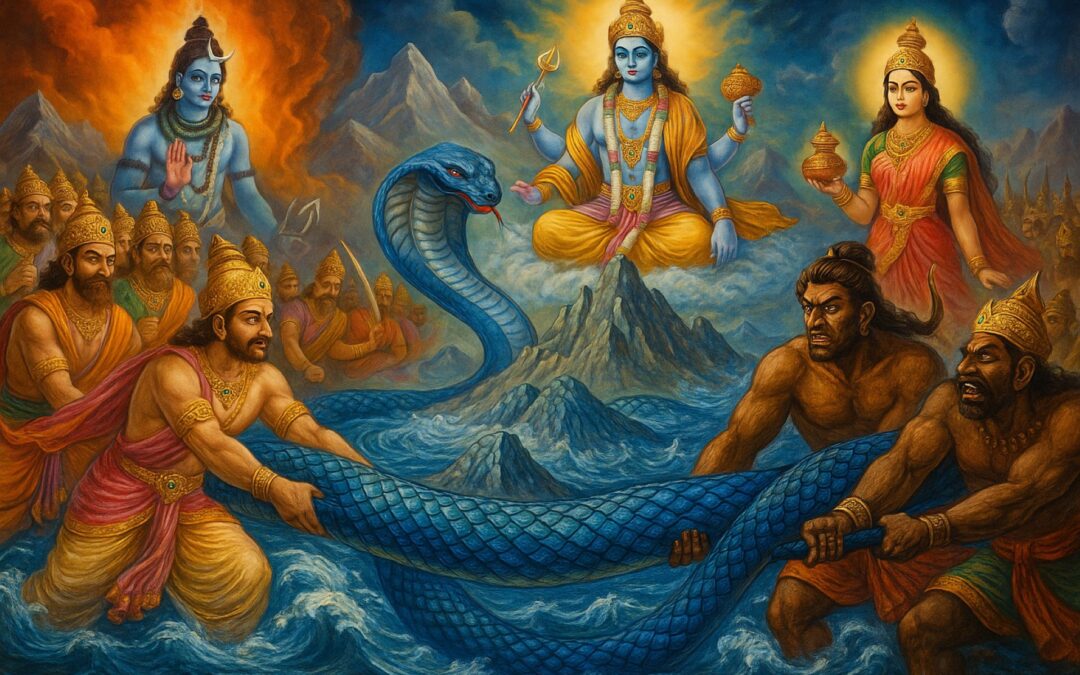
The churning of the cosmic ocean was no simple task. The process required immense strength and a vast display of cosmic powers, setting the stage for one of the most dramatic moments in Hindu mythology. To begin, Mount Mandara was chosen as the churning rod—a towering, sacred mountain that was to be placed in the center of the ocean. But moving such a massive mountain was no easy feat, and it required the combined strength of both the Devas and the Asuras. Mount Mandara would serve as the axis upon which the cosmic churning would occur.
To facilitate the churning, Vasuki, the great serpent, was used as the rope. The serpent’s massive length and power made it an ideal candidate for this task, and it was coiled around the base of Mount Mandara. The Devas and Asuras took their positions on either side of the serpent and began pulling with all their might, each side trying to gain an advantage. The tension was unbearable as the mighty serpent was pulled, and the ocean groaned under the strain of the cosmic force.
As the churning continued, the ocean began to release both divine treasures and terrifying horrors. First to emerge was Halahala, a deadly poison that threatened to destroy the entire universe. The poison spread across the cosmos, causing untold devastation, and it seemed as though all creation was on the brink of annihilation. The Devas and Asuras were horrified at the threat before them, but there was one being who could handle the poison—Lord Shiva. In an act of unimaginable sacrifice, Shiva drank the poison, which turned his throat blue. From this moment, he earned the name “Neelkanth” or “the blue-throated one.” Shiva’s act of selflessness was vital for the continued existence of the universe, as his intervention prevented the poison from destroying everything. This act of courage and commitment was symbolic of the balance between creation and destruction—a recurring theme throughout the cosmos.
As the churning continued, more celestial treasures emerged. Divine animals, precious jewels, and even celestial beings like the goddess Lakshmi, the embodiment of wealth and prosperity, appeared from the ocean. However, despite all these wondrous manifestations, the ultimate prize—the Amrit—remained elusive. The churning had been a monumental effort, but the tension between the Devas and Asuras only grew as they neared their goal. With every passing moment, the anticipation of the Amrit’s appearance became almost unbearable, and the rivalry between the two factions intensified.
The Amrit Emerges: A Cosmic Chase Begins
The moment that the Amrit finally emerged from the ocean was nothing short of electrifying. As the radiant Dhanvantari, the divine physician, appeared with the pot of Amrit in his hands, a glowing aura surrounded him. The nectar shimmered with a divine energy that promised immortality to whoever consumed it. This was the moment that all beings—mortal and immortal alike—had been waiting for. The Amrit was not just a physical substance but a symbol of ultimate power, eternal life, and the triumph over death.
However, this moment was not one of peace or celebration. The sight of the Amrit sent the Devas and Asuras into a frenzy of competition and greed. Both sides, each desperate to secure the nectar for themselves, rushed forward to claim it. Indra’s son, Jayanta, acted quickly and seized the pot of Amrit, fleeing to protect it from the Asuras. What followed was a cosmic chase that would span 12 divine days—equivalent to 12 human years. Jayanta, carrying the pot of Amrit, raced across the heavens and the Earth, evading the Asuras who were determined to wrest it from him.
As Jayanta ran, the pot tipped, spilling drops of Amrit at four places on Earth—Prayag (Allahabad), Haridwar, Ujjain, and Nashik. Each drop sanctified the land, turning these locations into centers of divine energy. These places would later become the sites of the Kumbh Mela, the great spiritual gathering that attracts millions of devotees every 12 years. The drops of nectar imbued these lands with a sacred presence, making them eternal centers of spiritual significance.
Jayanta’s journey with the Amrit was not just a physical chase but a symbolic one. It represented the struggle for immortality, the internal conflict between good and evil, and the desires and fears that drive every being. The Asuras, in their relentless pursuit, represented the dangers of unchecked desire and greed, while the Devas represented the hope for transcendence and spiritual purity. The cosmic chase was a manifestation of the human quest for power, immortality, and ultimately, salvation.
Vishnu’s Intervention: The Goddess Mohini and the Distribution of the Amrit
As the cosmic chase reached its peak, Vishnu, ever the wise protector of the universe, saw that the balance of the cosmos was at risk. The Asuras, driven by their insatiable hunger for immortality, were on the verge of obtaining the Amrit, which would make them immortal and supreme. To prevent this, Vishnu took the form of Mohini, a dazzlingly beautiful enchantress whose charm was irresistible. Mohini’s divine allure captivated the Asuras, distracting them long enough for the Devas to secure the Amrit.
Mohini’s intervention was a stroke of divine genius. With her mesmerizing beauty and irresistible charm, she bewitched the Asuras, diverting their attention away from the Amrit. As the Asuras were spellbound by Mohini, Vishnu ensured that the nectar was distributed among the Devas, restoring cosmic balance. The Asuras, realizing too late that they had been deceived, were left furious and vengeful. Despite their bitterness, they could do nothing to change the outcome. The distribution of the Amrit among the Devas guaranteed their immortality and supremacy, securing their position as the rulers of the universe.
Vishnu’s intervention as Mohini was not just a tactical move; it was a reminder of the power of divine wisdom and the importance of balance in the universe. The deception was a lesson in the dangers of unchecked desire and the consequences of seeking immortality through greed. In the end, Vishnu’s intervention ensured that the forces of good—represented by the Devas—would prevail, while the Asuras, though immortal, would be left to plot their next move.
The Sacred Sites: The Four Drops of Nectar
As the Amrit was spilled on the Earth during the cosmic chase, the four locations where the nectar fell became sacred. These drops of Amrit turned the land into powerful centers of spiritual energy. The locations—Prayag (Allahabad), Haridwar, Ujjain, and Nashik—became eternal symbols of divine presence and spiritual power. These sites are revered by millions of pilgrims who journey to them seeking purification, spiritual awakening, and the chance to wash away their sins.
Prayag, where the Ganges, Yamuna, and mythical Sarasvati rivers converge, is considered the holiest of these sites. Haridwar, known as the “Gateway to the Gods,” is where the Ganges flows out of the Himalayas and enters the plains, making it a crucial site for spiritual seekers. Ujjain, home to the revered Mahakaleshwar Temple, is a place of deep spiritual significance, especially for those seeking inner peace and connection with the divine. Nashik, along the Godavari River, completes the quartet, adding its own sacred energy to the Kumbh Mela.
These sites have become synonymous with the Kumbh Mela, a grand religious event that takes place every 12 years. During the Mela, millions of devotees gather to bathe in the holy rivers, believing that by doing so, they will be cleansed of their sins and attain spiritual liberation. The belief is that the sacred energy of the Amrit continues to flow through these places, making them potent sources of divine grace.
The 12-Year Cycle: The Cosmic Calendar
The Kumbh Mela is not held randomly. Its timing is based on the cosmic calendar, which aligns the sacred event with the celestial bodies of the universe. In Hindu cosmology, a day of the gods is equivalent to a human year. This principle is central to understanding the timing of the Mela. The event occurs when the Sun, Moon, and Jupiter align in specific zodiac signs, creating a rare celestial configuration. This alignment is believed to trigger the release of the sacred energy of the Amrit once again, drawing millions of devotees to the sacred sites.
This celestial alignment is more than just an astrological event—it is seen as a moment when the forces of creation, preservation, and destruction come into perfect harmony. The 12-year cycle is symbolic of the cyclical nature of time, where each moment holds the potential for spiritual renewal and transformation. The Kumbh Mela, therefore, is not just a religious festival; it is a cosmic event that marks the intersection of human time with divine eternity.
The Eternal Dance of Creation and Destruction
The story of the Kumbh Mela is deeply symbolic of the eternal dance between creation and destruction, good and evil, life and death. The Amrit, the nectar of immortality, represents humanity’s eternal quest to transcend death and reach a state of divine perfection. But this quest comes with immense struggles—greed, betrayal, sacrifice. Just as the Devas and Asuras fought for control of the Amrit, humanity too struggles with its desires for power, immortality, and spiritual growth.
The cosmic chase, the intervention of Lord Vishnu, and the ultimate distribution of the Amrit among the Devas represent the continual push and pull between creation and destruction. Every being, mortal or immortal, faces this struggle in different forms. The Kumbh Mela, therefore, serves as a reminder of this cosmic journey, where each individual must navigate the forces of life and death, creation and destruction, to find their own path to spiritual awakening.
The Kumbh Mela is more than just a religious ritual; it is a reflection of the eternal cycle of life, reminding us that even in the face of destruction, there is always the potential for renewal and rebirth. Just as the Amrit brought immortality to the Devas, the Mela offers the opportunity for pilgrims to wash away their sins, cleanse their souls, and reconnect with the divine forces that govern the universe.