
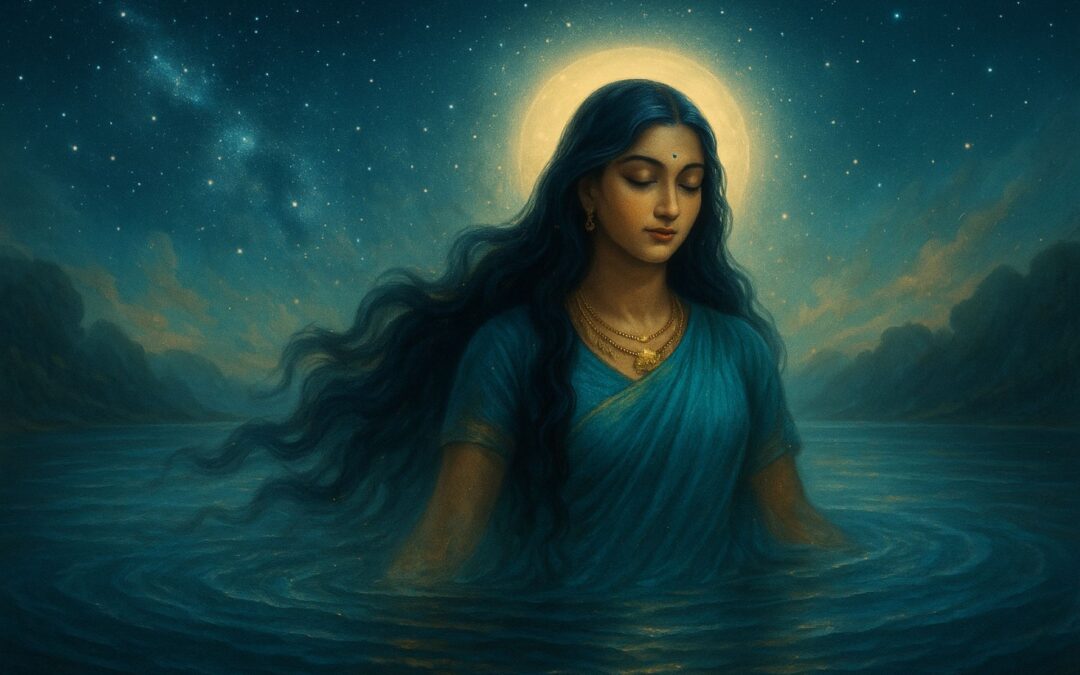
In the ancient annals of myth and legend, where gods whispered secrets that have long since faded from mortal memory, the story of Ganga, the River Goddess, stands out as one of the most profound tales of love, sacrifice, and divine duty. The tale is not just a story about a mother who lost her children but a saga that unfolds the complex relationship between fate, karma, and the unyielding commitment to promises made in the divine realms. It is a story that begins not in the mortal world, but in the heavens themselves, and it has been immortalized in the great epics of India.
The Divine Promise
Before Ganga became the river goddess known to mortals, she existed as a powerful celestial entity, flowing through the heavens, her waters a symbol of life, purity, and sometimes destruction. The cosmos was a place where divine beings roamed, each with a distinct role, but none quite like Ganga. Her connection to the universe was deep, as her waters were said to hold the very essence of life. But this connection was to be tested when a vow was made to a group of celestial beings known as the Vasus.
The Vasus, a group of eight radiant stars, were cursed to experience mortal life. They had once lived freely among the gods, part of the divine order, until they committed a grave error by stealing a possession of the sage Vashishtha. As punishment for their actions, the Vasus were cast down to live mortal lives, their once-immortal forms now bound by the constraints of human suffering. Mortality was a curse they could not escape. Their lives would be short, filled with grief, and burdened with the weight of their transgression.
In their desperation, the Vasus turned to Ganga, asking her to end their suffering. They sought mercy, hoping that the river goddess would intervene and deliver them from the agony of mortal life. It was at this moment that Ganga, moved by their pleas, made a solemn promise to them. She would grant them release from their suffering, and in doing so, she bound herself to a greater responsibility than any goddess had ever known before.
Her promise was not one that could be easily fulfilled. The Vasus asked for their suffering to be ended at birth, for each one to be drowned immediately after coming into the world so their souls could return to their celestial origin. Ganga agreed, but in doing so, she not only vowed to free the Vasus but also set in motion an irreversible cycle of sorrow that would change her forever. Each time she carried a child into the world, she would also carry the burden of their death. The complexity of the promise was not lost on her, but as the goddess of the river, she was bound to keep her word, regardless of the cost.
The King and the River Goddess
King Shantanu’s life took an unexpected turn the day he encountered Ganga. The ancient kingdom of Hastinapura, where he ruled, was a place of power and prosperity, but Shantanu himself had no idea that his fate would intertwine with that of a goddess. His encounter with Ganga was one of those rare moments in life where destiny seems to step forward and pull the strings of the universe, shaping lives in ways no one can predict.
Ganga appeared to Shantanu not as a goddess of water but as a woman, draped in the very essence of the river. She was a vision of beauty, her hair as dark as the night sky, her eyes flashing with the force of the monsoon’s lightning. To the king, she was no longer just a river, but a goddess with a mysterious allure. The moment they met, Shantanu was captivated, as though some unspoken force had drawn him to her. He asked her to marry him, seeing only the promise of love and joy in their future.
However, Ganga, bound by her own divine commitments, knew that her existence was not one of earthly pleasures. She agreed to marry Shantanu, but she placed a condition upon their union—an uncompromising rule: “Never question my actions, or I will leave you.” At the time, the king, blinded by his love, accepted this condition without fully understanding its implications. His love for her overshadowed any doubts or fears. Little did he know that this oath would become the foundation of a tragedy, one that would stretch the limits of his devotion and test his resolve.
The couple’s first child arrived with the spring rains, a time of renewal and joy. Shantanu, filled with happiness, watched as Ganga gently held their newborn son. The king’s heart swelled with pride, believing that this moment would mark the beginning of their shared happiness. However, Ganga’s actions shattered this joy in an instant. Without a word, she took the child into the river’s depths, allowing the currents to claim him. Shantanu’s heart broke, but his vow kept him silent. He was unable to voice his grief, unable to ask why his son was taken from him.
As Ganga returned again and again, each time bringing a new child, Shantanu’s sorrow deepened. The second son was drowned at dawn, the third under a blood-red moon. With each passing loss, the king’s grief hardened. By the time of the seventh son, Shantanu’s heart was a cold stone, and the silence between him and Ganga grew unbearable. She showed no emotion as she took each child from him, her actions always the same, her sorrow never visible. She had become a distant figure, a divine being whose duty had consumed her, leaving no room for the love she once promised.
The Eighth Son: The End of the Cycle
When Ganga bore her eighth son, the very air seemed to crackle with tension. This child was different. He did not weep as the others had, but his cries echoed like thunder, resonating with a power that none of the previous children had possessed. There was a glow about him, an ethereal light that set him apart from the rest. This was a child who would not succumb to the fate of his brothers. For the first time, Ganga hesitated, her divine hands trembling as she gazed upon him.
The realization that this child would not die struck her like a lightning bolt. Unlike his predecessors, who were destined to fade into nothingness, this child would live, and he would carry the weight of his immortality. This was not the fate of the Vasus, but a new path that would unfold in ways no one could have predicted. Ganga’s hands shook not from the weight of duty, but from the fear that for the first time, she was powerless to carry out her promise.
It was then that King Shantanu, no longer able to remain silent, confronted Ganga. His grief, which had been buried deep within him for so long, erupted in fury. He demanded to know why she had killed her sons and why this one would be spared. “You have slaughtered seven sons! Is your heart made of ice?” he cried, his voice rising in a mix of anger and sorrow.
For the first time, Ganga spoke her truth. She explained the nature of the Vasus and their curse, revealing the depth of her sacrifice. She told him that the Vasus were not mortal, but celestial beings who had fallen from grace. They had begged her to end their suffering, to allow their souls to return to the stars, and Ganga had agreed. Each time she held her sons, she felt their warmth and life, but she also felt the weight of their death. She had been forced to end their lives, not out of malice, but out of duty to the divine promise she had made. This was the tragedy of her existence, a burden she carried silently, year after year.
Shantanu, though filled with grief, began to understand the depth of Ganga’s actions. He realized that she had never wanted to kill her children. She had been bound to a duty that was far beyond anything he could comprehend. And yet, despite her sorrow, she vowed that the eighth son, the child who would carry the burden of immortality, would live. His name was Bhishma, and he would grow to be a man of great sacrifice, his life defined by duty, honor, and devotion.
The Redemption of the Vasus
As Ganga had prophesied, Bhishma grew into one of the most respected and revered figures in Indian history. His life was one of sacrifice, marked by his vow of celibacy and his refusal to marry, earning him the title Bhishma Pitamah—the revered grandfather. Bhishma’s life, however, was not just about his heroic deeds or his unwavering commitment to duty. It was about the lessons learned from the grief of his birth, the sacrifices made by a mother who had to choose between love and duty.
Bhishma’s story is a tale of resilience, of how a man who was born in sorrow rose above it to become a beacon of virtue. His life was shaped by the divine promise made by Ganga, but his destiny was his own to define. He became a symbol of unwavering commitment to duty, often putting the needs of his kingdom and family above his own desires. His celibacy and renunciation of power were choices that reflected the depth of his devotion to his principles.
But even as Bhishma stood as a towering figure in the Mahabharata, his past remained an indelible part of his identity. The grief of his birth and the curse of the Vasus were never far from his mind, and they influenced the choices he made throughout his life. His unwavering loyalty to the Kuru dynasty, his sacrifice during the Kurukshetra war, and his final moments on the battlefield, lying on a bed of arrows, all served as a reminder of the price he paid for his immortality.
Even as Bhishma lay dying, his connection to Ganga remained unbroken. His final words, whispered to her in the moment of his death, marked the culmination of his life’s journey. He had always been her son, but in that moment, he called out to her as his mother. Ganga, watching from the heavens, wept for the son she had given birth to and taken away. Her love for him was eternal, and in his final moments, Bhishma realized that despite the years of silence, she had always been there, watching over him.
The Eternal Flow of Ganga
Ganga’s waters continue to flow, ever-changing and yet constant in their essence. Her story, a tale of love, sacrifice, and divine duty, has been passed down through generations, a reminder of the complexity of life and the nature of sacrifice. Her rivers carry not only the waters of the earth but the weight of human history, the memory of the divine promise made in the heavens, and the tears of a mother who gave up her children for a greater good.
As you sit by the banks of the Ganga, watching her eternal flow, remember the story of her sacrifice. The river is not just a physical entity but a living symbol of love and duty, of the unspoken bond between mother and child, and of the sacrifices made for the sake of a divine promise. The Ganga whispers the ancient truth: love can be both a drowning force and an uplifting current. To love is to give all that you have, even when it means facing the greatest of hardships. And in that love, Ganga teaches us that even the most painful actions can be driven by the purest of intentions.
Conclusion
In the flowing currents of Ganga’s river, we find more than just water; we discover the eternal dance between love and sacrifice, duty and devotion. The story of Ganga and her seven sons transcends the boundaries of myth, revealing a profound truth about the nature of life itself. Ganga’s unwavering commitment to her divine promise—despite the unimaginable grief it caused her—teaches us that love is not always sweet and gentle. Sometimes, it is a force that demands great sacrifice and profound loss.
Bhishma, born of sorrow yet destined for greatness, embodies this ultimate lesson. His life, shaped by his mother’s love and sacrifice, stands as a testament to the power of duty, loyalty, and selflessness. As the Ganga continues to flow, so too does the legacy of her story—a story that reminds us of the complexities of fate, the weight of promises, and the depth of a mother’s love. By sitting at the river’s edge, we are not merely witnessing the passage of water, but the enduring strength of sacrifice and the timeless lessons it offers.