
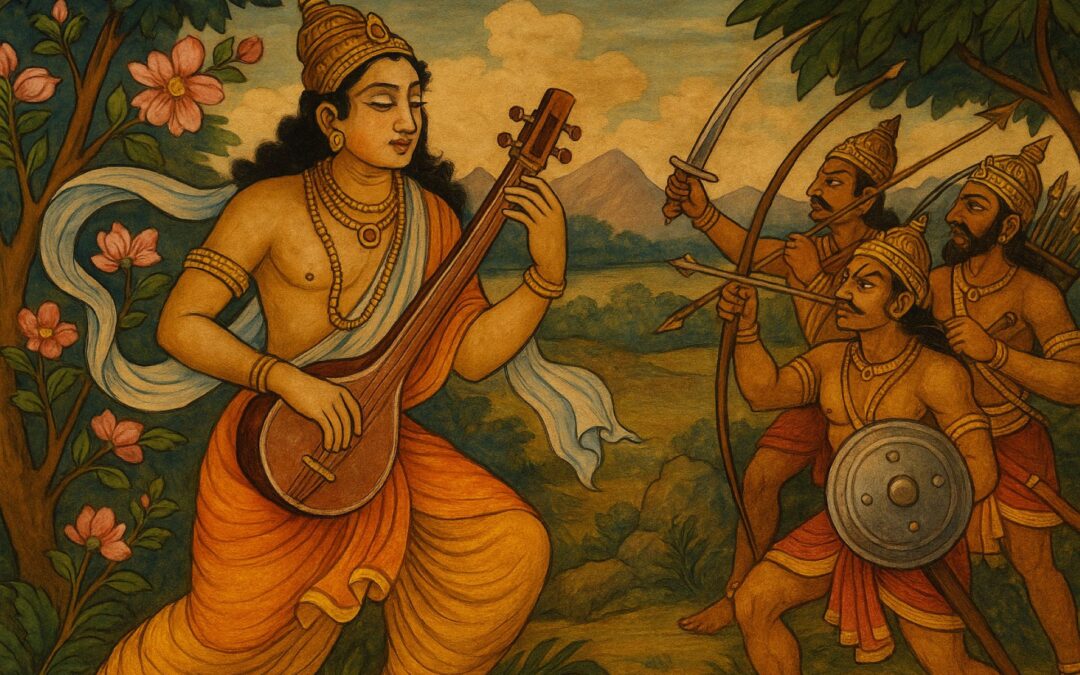
The Gandharvas, an extraordinary civilization from ancient India, exist in the annals of mythology as a fusion of celestial musicians and fierce warriors. Their presence was essential not only in divine courts but in the very balance of cosmic harmony. Their story, steeped in mysticism, combines the beauty of music with the prowess of martial skill, revealing a culture unlike any other in ancient lore. This article delves into the captivating legacy of the Gandharvas, the warrior musicians of the heavens.
The Birth of the Gandharvas
The origin of the Gandharvas is a tale woven into the very fabric of cosmic creation. Ancient texts describe their birth as an integral part of the primordial event known as the churning of the cosmic ocean, or Samudra Manthan. In this grand event, both the gods (Devas) and the demons (Asuras) worked together to churn the ocean to obtain amrita, the nectar of immortality. As the ocean swirled, bringing forth divine treasures, the Gandharvas emerged alongside the elixir, signifying their role as protectors of immortality and custodians of the cosmic order.
The birth of the Gandharvas was far from ordinary. Unlike other celestial beings, their essence was intricately tied to music and divine rhythms. Their first breath was a song so pure and harmonious that it resonated across the universe, setting the very foundation of the cosmos. This melody was not merely sound; it was a manifestation of the underlying cosmic energy that governed all existence. The Gandharvas’ music embodied the delicate balance of the universe, echoing the creation of life, its maintenance, and its eventual dissolution.
Their dual nature—both warriors and musicians—created a fascinating paradox. Music, an art form traditionally associated with peace, was combined with the discipline of martial skill. The Gandharvas were gifted with musical abilities that could manipulate the fabric of reality itself, yet they were also formidable warriors, tasked with maintaining order within the celestial realms. The very essence of their being was dedicated to the cosmic law, ensuring that the natural and supernatural forces operated in perfect harmony. They were not simply entertainers or soldiers; they were custodians of the divine balance, blending creativity with strength, melody with might.
This creation myth is not only a reflection of the Gandharvas’ origins but also sets the tone for their role in the cosmos. Their birth from the churning of the ocean symbolizes the emergence of order from chaos, a theme central to their existence. The Gandharvas, through their music and strength, played a critical role in shaping the universe, ensuring its ongoing stability. Their songs, born from the deepest cosmic truths, were far more than art—they were tools of divine intervention, capable of influencing the very forces of nature and existence.
The Gandharvas at Lord Indra’s Court
The Gandharvas’ relationship with Lord Indra, the king of the gods, highlights their importance in maintaining cosmic harmony. Indra’s court, located in the heavens, was a place where divine beings congregated to discuss and enact the order of the universe. As the ruler of the heavens and the protector of cosmic balance, Indra’s palace was a place where the divine forces of creation, destruction, and preservation converged. And at the heart of this celestial gathering were the Gandharvas, who played a pivotal role in sustaining the divine order.
The Gandharvas were not just musicians in Indra’s court—they were the very embodiment of cosmic music, wielding their instruments to maintain the delicate balance between the earthly and divine realms. Their music was woven with immense power, a force capable of both soothing and awakening the gods, calming storms and tempests, and bringing harmony to the cosmos. Each note, chord, and melody was infused with the essence of the universe. Their performances were not simple entertainment; they were ritualistic, sacred acts that maintained the rhythm of existence.
Beyond the beauty and power of their music, the Gandharvas had a deeper, more profound role in Indra’s court: they served as guardians of the sacred amrita, the nectar of immortality. This divine elixir was not only a symbol of eternal life but also the source of wisdom, knowledge, and divine inspiration. The Gandharvas’ duty to protect amrita was vital in ensuring that no mortal or demon could gain access to its transformative powers. They stood as both protectors and warriors, using their music and martial skill to defend this precious nectar from those who would misuse it.
Their dual role as musicians and guardians of divine secrets gave the Gandharvas unparalleled status in the heavens. They were trusted with responsibilities that extended far beyond performing for the gods. Their knowledge and abilities allowed them to influence the balance of nature itself. It is said that the Gandharvas’ songs could influence the weather, summon rains, and even restore order during times of divine discord. By maintaining the balance between realms, they were essential to the cosmic workings, ensuring that all forces—whether earthly or divine—remained in harmony.
The Gandharvas’ connection to Indra’s court also provided them with unique insight into the divine mysteries of the universe. They were privy to sacred knowledge that even other gods could not fully comprehend. This understanding of the cosmos, combined with their extraordinary musical abilities, made the Gandharvas essential figures in the divine order. They were not only participants in the divine court; they were the very keepers of its musical and spiritual energy, using their art to preserve the harmony of existence itself.
Chitraratha, the Brilliant Chariot King
Among the many Gandharvas, Chitraratha stands out as one of the most celebrated figures. His name, which means “having a brilliant chariot,” reflects not just his remarkable celestial vehicle but also his unparalleled prowess as both a musician and warrior. Chitraratha’s chariot was said to glow with the light of a thousand suns, a symbol of his divine status and his connection to the eternal light of the cosmos. This brilliant chariot was not merely a means of transport; it was a celestial manifestation of his power and glory, representing the Gandharvas’ unique fusion of art and might.
Chitraratha’s music was said to possess an enchanting quality capable of taming even the most fearsome celestial creatures. His melodies had the power to captivate and charm, soothing the spirits of the divine and ensuring peace in the heavens. His musical skills were unmatched, and he played an integral role in many of the cosmic events that unfolded in the divine realms. His music, imbued with the divine essence, was believed to have the ability to alter the very fabric of reality, bringing about transformation, healing, and even destruction when needed.
However, Chitraratha’s life took an unexpected turn when he encountered Arjuna, the great warrior of the Mahabharata, during Arjuna’s exile. This encounter, though initially hostile, became a defining moment in both their lives. Arjuna, while in exile, found himself in conflict with Chitraratha, a battle that would test both their skills and honor. The duel between Chitraratha and Arjuna was not just a physical contest but a philosophical one, highlighting the Gandharvas’ code of honor. Despite Chitraratha’s celestial powers, he respected Arjuna’s skill and valor, and their battle ended in a stalemate.
Rather than pursuing animosity, Chitraratha extended his hand in friendship to Arjuna. Recognizing Arjuna’s strength and bravery, Chitraratha taught him the secret language of the Gandharvas. This language, which was as ancient as the cosmos itself, held knowledge that would become essential in the great Kurukshetra War. Chitraratha’s teachings enabled Arjuna to understand the divine musical forces at play in the battle, and the secret language would later aid him in overcoming the forces arrayed against him.
The story of Chitraratha and Arjuna reveals a deeper aspect of Gandharva culture: their code of honor. Despite their immense power, the Gandharvas held themselves to high standards of fairness and respect. They believed in combat that was just and honorable, and they held those who displayed valor in the highest esteem. Chitraratha’s relationship with Arjuna highlights the Gandharvas’ belief in equality and mutual respect, as well as their commitment to the idea that true strength lies not just in power but in integrity and honor.
Chitraratha’s legacy, both as a warrior and a musician, demonstrates the unique duality of the Gandharvas. They were not merely guardians of divine knowledge or skilled artists; they embodied a balance between artistic expression and martial prowess, bringing together the beauty of music with the strength of the warrior spirit. Through their stories, the Gandharvas continue to represent the ideals of harmony, honor, and cosmic balance that permeated ancient Indian philosophy.
Guardians of Love and Marriage
The Gandharvas’ involvement in matters of love and marriage is one of the most unique and enchanting aspects of their celestial identity. In ancient texts, the Gandharvas are depicted as not only divine musicians and warriors but also as guardians of the sacred and invisible forces that bind lovers together across the universe. Their music was believed to possess an extraordinary power, capable of influencing the course of human relationships, especially in matters of love. It was said that the Gandharvas could perceive the threads that connected souls across time and space, a divine vision that allowed them to see the invisible ties of affection and desire that crossed the boundaries of worlds.
The Gandharvas were often called upon to bless marriages, both divine and mortal. At weddings, their music had the power to solidify unions, ensuring that the bond between partners would remain strong and harmonious for eternity. Their melodies were believed to have a divine influence on the hearts of the bride and groom, fostering mutual love, understanding, and respect between them. Their songs, filled with the energy of the cosmos, were more than just celebratory tunes; they were cosmic rituals that helped solidify the eternal connection between souls. Through their music, the Gandharvas ensured that the bonds formed between individuals would be blessed with harmony, resilience, and an enduring connection, overcoming any obstacles that life might throw their way.
But the Gandharvas’ role in relationships extended far beyond the ceremonial. They were also seen as mediators in troubled relationships, capable of resolving conflicts between lovers. When misunderstandings arose, when love turned to bitterness, the Gandharvas’ music could restore balance and healing. Their melodies were not just songs of joy but also songs of reconciliation and understanding, bringing peace to hearts that had been torn apart by strife. Their deep understanding of the emotional currents between individuals allowed them to guide people back to love, reminding them of the cosmic connection they shared.
Interestingly, the Gandharvas also played a pivotal role in divine matchmaking, particularly when it came to the gods themselves. Many divine unions, such as those of celestial beings and demi-gods, were guided or influenced by the Gandharvas. They were not mere spectators of divine love but active participants in ensuring that the right souls found each other. In many ways, the Gandharvas acted as the cosmic matchmakers, seeing the hidden affinities between beings and helping to foster connections that would bring about the creation of new worlds or the continuation of divine legacies.
Thus, the Gandharvas were integral to the divine machinery of the universe in ways that went far beyond mere art or music. They held sway over the most intimate and profound aspects of existence—love and union. Their music bridged the gap between the divine and human realms, weaving together the threads of affection and ensuring that the power of love, in all its forms, remained a central and unbroken force in the cosmos.
Masters of Multiple Realms
One of the most fascinating aspects of the Gandharvas was their ability to transcend the boundaries of different realms, traveling freely between the earthly, celestial, and even the underworld domains. Their music was not just a form of artistic expression; it was a key that unlocked the gates of these realms, allowing them to move fluidly between worlds. The Gandharvas’ unique position as interdimensional beings gave them a profound ability to communicate and interact with entities from different realms—whether gods, humans, or other supernatural creatures.
In the celestial realms, the Gandharvas served as messengers and envoys between the gods and mortals. Their ability to traverse the realms meant that they could carry messages of great importance, delivering divine wisdom to the humans or warning the gods about emerging threats in the mortal world. The Gandharvas’ music, infused with cosmic energy, acted as a bridge between these realms, helping to convey the desires and needs of each. For instance, if the gods wished to intervene in mortal affairs, the Gandharvas’ melodies would carry the divine will to the earthly realm, ensuring that the proper actions were taken. Similarly, they were entrusted with bringing messages from humans to the gods, acting as intermediaries who helped maintain the balance between the two worlds.
This interdimensional role extended to their ability to travel to the underworld, or the realm of the dead. While the gods resided in the heavens and mortals walked the Earth, the underworld was home to entities that existed beyond the physical plane. The Gandharvas, through their music, could move between these realms with ease, gathering secrets from the underworld or delivering messages from the gods. This unique ability positioned them as pivotal figures in the cosmic hierarchy, acting as the crucial link between the living and the dead, the divine and the mortal.
The Gandharvas’ travel between realms was symbolic of their role as bearers of knowledge and wisdom. They were not simply messengers of divine will but also guardians of sacred knowledge that spanned the entirety of existence. Through their journeys, they gathered secrets from each realm—spiritual truths, cosmic histories, and divine laws—and carried them back to their celestial home. This made them not only masters of music but also masters of wisdom, with knowledge that few others had access to.
This connection between music and interdimensional travel is essential to understanding the Gandharvas’ role in the universe. Their music was not just sound—it was a transformative power that allowed them to cross boundaries and bridge gaps between the physical and spiritual worlds. As they moved freely between these realms, they carried with them the power to influence both the material and the immaterial, serving as the guardians of divine communication and the keepers of cosmic knowledge.
The Consequences of Misusing Power
While the Gandharvas held immense power, their abilities were not without limitations. They were bound by strict cosmic laws that governed the use of their divine gifts. These laws, which ensured the integrity of the cosmic order, prohibited the Gandharvas from using their powers for personal gain or selfish purposes. Music, for the Gandharvas, was never just an art form for pleasure or entertainment—it was a sacred duty, a tool of cosmic balance. Their ability to manipulate sound and music was seen as a divine responsibility, and using it for frivolous or malicious reasons would be considered a violation of their cosmic role.
One of the most poignant tales about the consequences of misusing Gandharva power is the story of Tumburu. Tumburu was one of the most gifted Gandharvas, renowned for his musical abilities and his close association with the gods. However, Tumburu’s downfall came when he began to use his musical talents for personal gain, manipulating his music for selfish purposes within the halls of Indra’s palace. His actions violated the cosmic laws that the Gandharvas were sworn to uphold. As a result of his arrogance and disregard for the sacred nature of his music, Tumburu was cursed by the gods to be reborn as a mortal.
This punishment reflects a core belief within Gandharva culture: the importance of humility and responsibility when wielding power. Despite their celestial nature, the Gandharvas were not immune to the cosmic laws that governed the universe. Their powers, like all cosmic forces, were meant to serve a higher purpose. The misuse of these powers did not just result in personal consequences for the Gandharvas but had the potential to upset the balance of the entire universe. The curse of Tumburu serves as a cautionary tale, warning that even the most powerful beings must adhere to the cosmic code, or face the wrath of divine retribution.
The Gandharvas’ strict adherence to cosmic laws also speaks to their role as guardians of divine order. Their music was not only an artistic expression but a force that shaped the universe. By using their music for selfish reasons, they would risk disrupting the very fabric of existence. This responsibility weighed heavily on the Gandharvas, as their actions had far-reaching consequences not only for themselves but for the entire cosmic ecosystem.
The story of Tumburu’s fall from grace emphasizes the delicate balance of the Gandharvas’ existence. They were not merely celestial beings who could wield their powers without consequence; they were integral to the harmony of the universe. Their understanding of this responsibility, along with their unwavering adherence to cosmic laws, defined their role as protectors of both the divine and the human realms.
Guardians of Nature
The Gandharvas’ connection to nature was as profound and symbolic as their role in the celestial realms. They were believed to exist in the liminal spaces between Earth and Heaven, residing in places where the physical world met the divine. These spaces were often described as fragrant trees, flowing rivers, and lush groves—areas where the natural world and the spiritual world intersected. The Gandharvas were intrinsically tied to these environments, and their music was said to emanate from the natural world itself. In many ways, their melodies were a reflection of the deep rhythms and cycles of the Earth, as they served as conduits between the physical and spiritual realms.
The Gandharvas were not just residents of these natural spaces; they were also its stewards. Their music, deeply intertwined with the forces of nature, was believed to influence the flow of time and the cycles of life. For instance, it was said that their melodies could cause the flowers to bloom at the right time, mark the changing of the seasons, and even control the flow of rivers. Their music was more than just a tool for communication—it was an active force that could shape the world around them. The Gandharvas could harness the power of sound to influence nature, helping to maintain the delicate balance that allowed life to thrive.
In Indian classical music, certain ragas—melodic frameworks used in performance—are thought to have originated from the Gandharvas. These ragas, often associated with specific times of day, seasons, and moods, are believed to carry the essence of the Gandharvas’ celestial compositions. The connection between the Gandharvas and these ragas illustrates how their music was deeply linked to the natural world. Just as the Gandharvas’ songs could shape the seasons, the ragas they inspired were meant to evoke particular emotions and atmospheres, creating harmony between the inner and outer worlds.
The Gandharvas’ music was also thought to have the power to restore balance in nature. When the natural world fell out of sync—whether through storms, droughts, or other disturbances—the Gandharvas would use their celestial melodies to calm the forces of chaos. This ability to manipulate the forces of nature was not simply about power; it was about maintaining cosmic order. The Gandharvas were the keepers of the natural world’s rhythms, ensuring that the eternal cycles of creation, preservation, and destruction proceeded without interruption.
This intimate connection between the Gandharvas and nature is emblematic of a broader philosophical and spiritual understanding in ancient Indian thought: that all life is interconnected, and the divine is present in all aspects of the natural world. The Gandharvas, through their music, exemplified this unity, as their songs could harmonize both the spiritual and the earthly, creating a bridge between the divine and the mundane. Their guardianship of nature, then, was not just an ecological responsibility but a spiritual one, where their music could heal, restore, and maintain the sacred balance of the universe.
The Gandharvas and Their Cosmic Struggles
While the Gandharvas are often depicted as peaceful guardians and divine musicians, their story is also marked by fierce battles and cosmic struggles. These conflicts were not just about power or dominance; they were symbolic representations of the eternal struggle between opposing cosmic forces, each playing a critical role in the balance of the universe. One of the most notable adversaries of the Gandharvas were the Nagas—the serpent people who inhabited the Netherworld.
The Gandharvas and Nagas often found themselves at odds due to their fundamental differences. The Gandharvas, embodying the forces of music, light, and creation, were in direct opposition to the Nagas, who represented darkness, chaos, and destruction. The battles between the two were not simply physical clashes but metaphysical struggles that represented the eternal conflict between creation and destruction, light and dark, order and chaos.
In many ways, these battles between the Gandharvas and the Nagas were symbolic of the larger, cosmic conflict that defines the universe. The Gandharvas, with their celestial music, represented the forces of creation and harmony, while the Nagas, with their serpentine form, embodied the primal forces of destruction and upheaval. These struggles were not just about the preservation of one group over the other, but about maintaining the balance of cosmic forces. The Gandharvas’ music could counteract the destructive powers of the Nagas, restoring harmony to the universe when the forces of chaos threatened to disrupt it.
The Gandharvas’ role in these cosmic struggles also highlights their warrior aspect. Despite their musical prowess, they were formidable combatants, capable of defending their realm and upholding the divine order through both physical strength and their celestial melodies. Their music, when wielded in battle, could disarm their enemies or heal the wounded, making them unique warriors who fought not only with weapons but with the power of sound. Their martial prowess was inseparable from their musical abilities, as both were considered essential tools in maintaining cosmic equilibrium.
The conflict between the Gandharvas and the Nagas was just one example of the many struggles the Gandharvas faced in their role as protectors of the cosmic order. These struggles were not always violent but were often reflective of the larger metaphysical battles that shaped the universe. Whether they were fighting to preserve divine knowledge, protect sacred treasures, or maintain the balance between realms, the Gandharvas were always engaged in a larger cosmic drama, ensuring that the forces of light, creation, and order prevailed over the forces of darkness, destruction, and chaos.
Gandharvas’ Influence on Indian Classical Music
The Gandharvas’ influence on Indian classical music is perhaps their most lasting legacy. Their divine knowledge of music, known as Gandharva Veda, became the foundation of Indian classical music, a tradition that continues to shape musical practice today. Gandharva Veda was not merely a technical system of musical notation; it was a spiritual practice, a system of knowledge that connected the practitioner to the divine and to the cosmic rhythms of the universe.
Gandharva Veda was considered a sacred art form, and it was believed that the practice of music could elevate the soul and bridge the gap between the material world and the spiritual realm. The Gandharvas themselves were seen as divine musicians who could channel cosmic energy through their melodies, and their teachings laid the groundwork for the sophisticated musical traditions that developed in ancient India. Their understanding of sound, rhythm, and melody went far beyond mere entertainment—it was a means of reaching the divine and understanding the deeper truths of existence.
The principles of Gandharva Veda were passed down through generations, influencing the development of both Hindustani and Carnatic classical music. Many of the ragas (melodic modes) that form the foundation of Indian classical music are believed to have been inspired by the Gandharvas. These ragas are not just musical scales; they are designed to evoke specific emotions, times of the day, and even seasons, reflecting the Gandharvas’ deep connection to the rhythms of nature. The Gandharvas’ music was inherently tied to the cycles of time, and this connection can still be felt in the classical music traditions today.
The Gandharvas’ musical legacy also extends beyond the ragas themselves. The techniques and philosophies behind Gandharva Veda informed the structure of Indian classical music, including its improvisational nature, its use of ornamentation, and its focus on emotional expression. The Gandharvas’ understanding of sound as a spiritual force continues to influence the way music is approached in classical Indian traditions. Music, as taught by the Gandharvas, is not just about technical proficiency but about aligning oneself with the cosmic energies and allowing those energies to flow through the performance.
Indian classical music, deeply rooted in the teachings of Gandharva Veda, remains a living tradition that connects practitioners and listeners to the divine. Through its spiritual depth and emotional power, it continues to reflect the Gandharvas’ belief in the transformative power of sound and its ability to bridge the material and spiritual worlds. The Gandharvas’ influence on music is a testament to their understanding of the profound connection between art, nature, and the cosmos—a legacy that has endured for millennia and continues to shape the music of India today.
Conclusion
The Gandharvas, with their unparalleled blend of musical mastery and martial prowess, represent a unique and timeless force in the ancient cosmic order. As celestial beings born from the churning of the cosmic ocean, they were entrusted with guarding sacred knowledge, maintaining harmony across realms, and wielding the divine power of music. Their influence transcended mere entertainment, reaching into the very fabric of existence, from guiding the forces of nature to preserving cosmic balance through both melody and battle.
Their legacy lives on, not only in the rich traditions of Indian classical music but also in the enduring symbolism of their role as divine musicians and cosmic warriors. The Gandharvas remind us of the profound interconnectedness between the material and spiritual realms, the importance of honor and responsibility, and the transformative power of music. Though their civilization may belong to the myths, their impact on culture, music, and spiritual thought continues to resonate across the ages, leaving behind a rich legacy that bridges the past with the present. The Gandharvas, with their melodies and wisdom, remain timeless guardians of the cosmic order.