
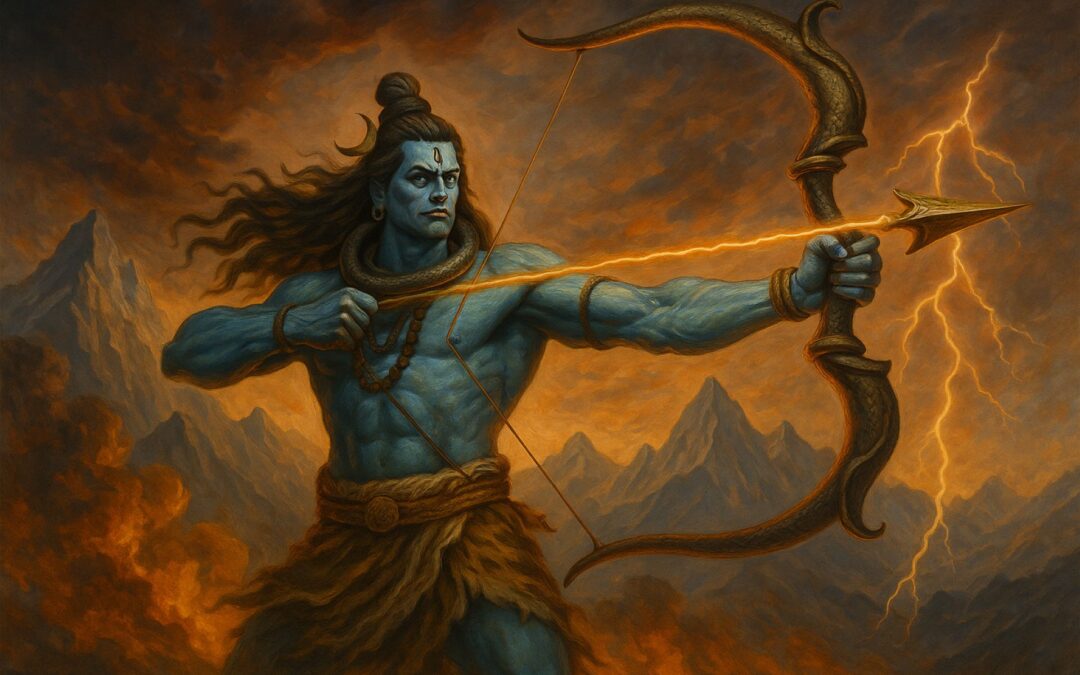
In the vast tapestry of Hindu mythology, Lord Shiva stands as a figure of unparalleled power and cosmic influence. As the Lord of Destruction, his role is not just to annihilate but to bring about transformation, to make way for renewal. Central to this aspect of Lord Shiva is his divine weapon, the Pinaka, a celestial bow that symbolizes his incredible strength and divine authority. Pinaka’s sheer destructive power is matched only by its ability to clear the path for new creation, embodying a deep cosmic truth that destruction and creation are two sides of the same coin.
The Origin and Power of Pinaka
The origins of Pinaka, Lord Shiva’s mighty celestial bow, are not merely mythical but are rooted in the profound essence of creation itself. Pinaka did not emerge from the crafts of divine smiths or celestial forges. Instead, it materialized directly from the depths of Lord Shiva’s own spiritual being. This divine weapon was born during a time of intense penance, when Shiva, through his deep meditation and fierce concentration, sought to rid the universe of forces that threatened to disturb its cosmic balance. It was during this intense period of spiritual discipline that his divine energy transformed into the weapons we know today, with Pinaka standing as the supreme symbol of his power.
The name Pinaka, which translates from Sanskrit as “that which brings an end,” encapsulates the very essence of the weapon. This bow signifies finality, the end of chaos, destruction, and corruption, and marks the arrival of justice. It is not merely a weapon of physical destruction but a tool of cosmic purification, wielded when the universe faces the overwhelming forces of negativity and disorder. As the ultimate agent of Lord Shiva’s will, Pinaka is intrinsically linked to the principles of balance and justice, playing a central role in maintaining cosmic harmony.
What sets Pinaka apart from conventional weapons, such as ordinary bows made of wood or metal, is its sheer size and power. The bow itself was larger than mountains, a reflection of the immense spiritual strength required to wield it. The sound it made when drawn was not a mere twang but a thunderous noise that resonated across the three worlds—the heavens, the earthly realm, and the underworld. This was a divine bow that could not be handled by just anyone. Only Lord Shiva, with his boundless divine energy, had the strength and the spiritual authority to draw its string and unleash its full potential. The power of Pinaka was not only physical but deeply metaphysical, a tool through which Lord Shiva could control the very fabric of the universe.
The Cosmic Role of Pinaka
While Pinaka is undoubtedly a weapon of great destructive power, its role transcends the simple function of a weapon of war. It embodies a much larger, more profound purpose in the cosmic dance of creation, preservation, and destruction. In Hindu philosophy, time is cyclical, with creation, preservation, and destruction occurring in an endless loop. Pinaka plays a crucial role in this cycle by serving as an instrument that aids in both the destruction and the eventual renewal of the universe.
When the gods and divine beings faced insurmountable threats from demons or chaotic forces, they turned to Lord Shiva, the ultimate force of cosmic justice. In these moments, the appearance of Pinaka in battle signified one thing: the powers of darkness and chaos were about to meet their end. The weapon was invoked not out of malice but to preserve the cosmic order, ensuring that Dharma, the natural law, remained intact.
What truly set Pinaka apart from any other divine weapon was the versatility of its arrows. These arrows could be shaped into any form that Lord Shiva desired, each one unleashing a unique form of destruction. Some of the arrows released from Pinaka could become raging fires capable of incinerating entire armies, turning them to ash in the blink of an eye. Others transformed into fierce storms, floods, or lightning strikes, wreaking havoc on the forces that opposed the divine order. The most powerful arrows from Pinaka would become versions of Pralaya, the cosmic dissolution, reducing entire worlds, or even cycles of the universe, to dust. These arrows symbolized Shiva’s absolute control over destruction and his ability to wield such power in a way that served the greater purpose of cosmic justice.
Thus, Pinaka was not merely a weapon for war—it was an instrument for the restoration of balance, wielded only by the one who could see the larger picture of existence and its cyclical nature. The arrows fired from this celestial bow represented Lord Shiva’s will—dynamic, precise, and always in harmony with the needs of the universe.
The Legendary Destruction of the Three Cities
The destruction of the three flying cities of Triura stands as one of the most famous and awe-inspiring displays of Pinaka’s power. These cities were no ordinary fortresses; they were the creation of Maya, the demon architect, who built them with unimaginable strength and impenetrable defenses. The cities themselves were imbued with supernatural power, floating high above the earth and hidden from the gaze of ordinary beings. These cities were virtually indestructible, possessing protections that rendered them invulnerable to the attacks of gods and demons alike. The only way to destroy them was during a very specific cosmic alignment when the cities’ positions in the sky allowed them to be vulnerable.
The gods, realizing that the balance of the cosmos was at risk, turned to Lord Shiva for assistance. In response, Shiva descended with a special celestial chariot created for him, driven by Lord Brahma, the creator god. This chariot was more than a vehicle—it was a divine instrument designed to carry Lord Shiva into battle, giving him the opportunity to unleash the full power of Pinaka. As the moment of cosmic alignment approached, Lord Shiva, with the chariot at his side, took aim with Pinaka. In a single instant, Shiva drew the bow and released an arrow, striking the three cities and reducing them to ashes. The destruction of Triura by Pinaka demonstrated the immense power of the weapon and the precise timing required to use it effectively.
This story highlights several important elements: the power of Pinaka to destroy seemingly indestructible forces, its ability to operate with divine precision, and its role as an instrument of cosmic balance. The destruction of the cities was not an arbitrary act but a necessary event in the divine plan. It reminds us that even the most powerful forces, when aligned against the cosmic order, must be dissolved to restore harmony. The victory of Lord Shiva, through the use of Pinaka, was not simply a triumph of destruction but a demonstration of the ultimate cosmic justice that ensures the continued existence of the universe in its proper form.
Pinaka: The Instrument of Creation and Destruction
While the stories of Pinaka are often focused on its destructive capabilities, its true essence lies in its role as an instrument of both destruction and creation. In the grand design of the universe, destruction is not a finality but a necessary prelude to creation. In Hinduism, the cyclical nature of existence—where creation, preservation, and destruction occur in a continuous loop—forms the foundation of reality. Pinaka embodies this philosophy, symbolizing that for creation to occur, destruction must first take place. Without the destruction of the old, the new cannot emerge.
In the cosmic dance of Shiva, when the universe reaches the end of its cycle, it must undergo a process of dissolution. Pinaka plays a central role in this dissolution. At the end of time, when the universe is to be destroyed, Lord Shiva’s divine bow resonates with the cosmic vibrations of Pralaya, the ultimate dissolution that brings everything back to its primordial state. This process is not something to be feared but embraced, as it marks the necessary end of one cosmic cycle and the beginning of another. Through Pinaka, the universe is broken down into its basic elements, only to be reformed again into a new creation.
Pinaka’s destructive power thus serves a greater purpose—the restoration of balance and the preparation for a new creation. Destruction, in this context, is not a negative force but an essential part of the cyclical nature of existence. The destruction of what is outdated or corrupt clears the way for new possibilities to arise, making space for the renewal of life, ideas, and the universe itself.
Pinaka’s Legacy: Entrusted to Devotees
The legacy of Pinaka is not confined to Lord Shiva alone. Over time, this powerful weapon was entrusted to some of Shiva’s most devoted followers, those who had proven their worth through devotion, penance, and spiritual discipline. These individuals were chosen to wield Pinaka, not for personal gain, but as a means to restore Dharma and bring justice to the world.
One of the most well-known figures to receive Pinaka was Parashurama, the sage and warrior. After years of intense meditation and devotion, Lord Shiva granted Parashurama the use of his divine bow. With Pinaka in hand, Parashurama became an unstoppable force, using the weapon to restore order in the world by defeating corrupt kings and oppressive rulers. His campaigns were legendary, and his ability to wield Pinaka helped him fulfill his divine mission of cleansing the earth of evil.
Another story of Pinaka’s legacy is the tale of King Janak of Mithila. According to various texts, King Janak possessed a divine bow, often believed to be Pinaka, which became the test for suitors seeking to marry his daughter, Sita. Many princes attempted to lift the bow, but none succeeded—its weight and divine power were beyond their reach. It was only Lord Rama, who, with divine strength, not only lifted the bow but strung it with such force that the bow snapped in two. This moment was more than just a demonstration of strength—it symbolized Rama’s divine nature and his right to marry Sita. The story of Pinaka’s transfer to worthy individuals highlights the weapon’s role as both a tool of divine justice and a means of ensuring that only those truly worthy could wield its power.
The Symbolism of Pinaka: Destruction and Renewal
At its core, Pinaka embodies the cyclical nature of existence. Destruction and creation are not opposing forces but complementary aspects of the universe’s continuous flow. In this sense, Pinaka is not just a weapon of war but a symbol of the eternal cycle of life, death, and rebirth. The bow’s ability to both destroy and create mirrors Lord Shiva’s own role in the universe as both the destroyer and the creator.
In Hindu philosophy, destruction is not an act of evil but a necessary part of the cosmic order. Pinaka represents this principle, reminding us that destruction, whether in the form of natural disasters or personal loss, is not the end of the story but a transition. Without destruction, new life cannot be born. Without the breakdown of the old, there can be no room for the new.
The bow’s symbolism extends beyond the cosmic. For devotees, Pinaka represents the clearing of obstacles on the spiritual path. Just as the bow removes physical and cosmic barriers, it is invoked to remove the inner obstacles that prevent one from reaching spiritual fulfillment. In this way, the weapon becomes a tool for personal transformation as well as universal renewal.
In the grand narrative of Pinaka, Lord Shiva teaches us that endings are not to be feared. Destruction, in its many forms, paves the way for new creation, new opportunities, and new phases of existence. The bow’s role in this cosmic dance of creation and destruction offers a profound lesson in understanding the nature of change and the necessity of embracing it in order to move forward.
Conclusion
Pinaka is more than just a weapon; it is a cosmic force, a symbol of Lord Shiva’s unparalleled power and wisdom. It represents the cyclical nature of existence—how creation and destruction are intertwined, each giving rise to the other. Whether it is used to obliterate cities or break down the universe itself, Pinaka’s ultimate purpose is to restore balance, ensuring that the cosmic order remains intact.
In the divine dance of destruction, Pinaka is not just an instrument of devastation but a reminder that endings are essential for new beginnings. The power of Pinaka lies not in its ability to destroy, but in its ability to clear the way for renewal, for the constant evolution of the universe. Through Lord Shiva’s mighty bow, we are reminded that destruction is not to be feared but embraced as part of the eternal cycle that sustains all life.