
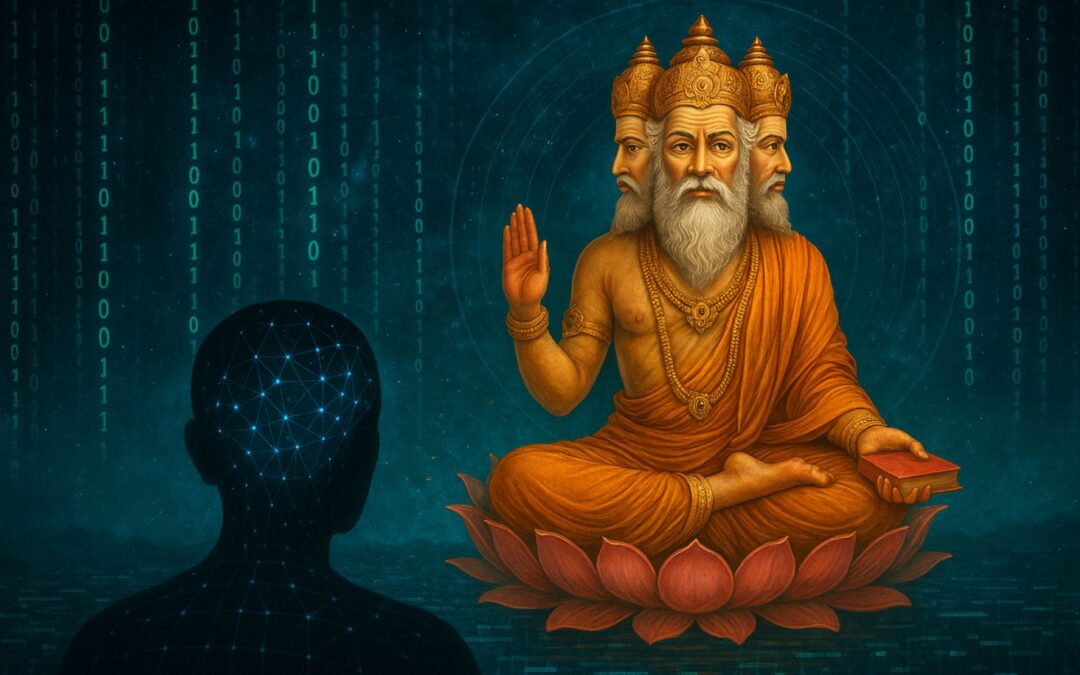
Imagine a world where everything you experience—the sights, sounds, and even emotions—is merely a projection of a higher consciousness. What if the universe we inhabit is not a solid, permanent reality but a cosmic illusion, a dream woven into existence by an ultimate creator? Hindu philosophy, with its ancient texts and timeless wisdom, reveals a strikingly similar idea: the world we know is a grand illusion—Maya—that hides the true, formless nature of reality.
In this article, we’ll explore how ancient wisdom from Hinduism suggests that we are living in Brahma’s matrix, a simulation crafted by Lord Brahma, the cosmic creator. We’ll dive into the nature of this illusion, the code behind it, and the path to liberation from its grasp. The journey to breaking free from this matrix may be more accessible than we think.
The Grand Illusion: Understanding the Cosmic Dream
At the core of many philosophical and spiritual traditions lies the notion that what we experience is not what it appears to be. Hinduism, particularly through the lens of its sacred texts, offers a compelling vision of this grand illusion. According to the Mandukya Upanishad, the universe is not a static, independent reality; rather, it is a projection—a mental construct dreamed into existence by the cosmic consciousness known as Brahman. This idea is not as distant as it may seem from modern-day theories of simulation and virtual realities.
The Mandukya Upanishad compares Brahman’s creation to the workings of a dream. In this dreamlike universe, Brahman, as the ultimate reality, is formless, yet it contains all forms, all potential, and all that exists. From this vast, infinite consciousness, Lord Brahma—the four-faced creator deity—emerges. However, Lord Brahma does not create the universe from nothing. He dreams it into existence, an act of cosmic imagination that unfolds through his consciousness.
This concept strongly parallels modern ideas of simulated realities, where a programmer uses code to create entire worlds, bringing them to life through thought and calculation. Just as a game developer uses programming languages to create virtual environments and populate them with characters, Brahma “creates” this universe, manifesting it through thought. But unlike the developer who controls a predefined set of rules, Brahma dreams the universe as an ever-evolving entity, constantly in flux and shaped by the whims of consciousness itself. It suggests that our understanding of the world, the structures of time, and the very nature of existence might be far less solid and tangible than we perceive.
When considering the nature of this “dream,” it is important to understand that the illusion does not imply that the world lacks purpose or significance. Instead, it raises the possibility that everything in the universe, from the smallest particle to the vast expanses of space, is part of a deeper, more profound narrative—a story written by consciousness itself. Thus, everything that happens in this universe might be seen as part of an ongoing cosmic play or dream, which is full of meaning, yet exists within an intricate matrix of illusion.
Maya: The Cosmic Illusion That Veils Ultimate Reality
The concept of Maya is integral to understanding how Hindu philosophy views the world. Maya is the cosmic illusion that shrouds the true, unchanging reality of Brahman. The material world, as we experience it, is but a temporary and ever-changing manifestation. Yet, this illusion is so convincing that we come to believe it is the only truth. Our senses, minds, and emotions are so deeply attuned to the sensory world that we often fail to question its authenticity, which is the central dilemma that Maya presents.
The ancient analogy of a rope mistaken for a snake in dim light encapsulates the essence of Maya perfectly. In the darkness, the mind perceives a rope as a snake, causing fear. The fear is real, but the snake is a mere projection of the mind’s perception, not the true nature of the rope. Similarly, the material world seems to be solid and permanent to us, but this appearance is only a projection of consciousness. Our attachment to this perception and our tendency to confuse it with ultimate reality is what leads to the suffering and confusion that so many people experience.
In Hindu texts like the Bhagavad Gita, Lord Krishna explains that overcoming this illusion is no simple task. Maya’s hold is powerful, and the mind is easily caught in its web. The belief that the material world is real keeps us bound to the cycle of birth, death, and rebirth. It causes us to mistake transient pleasures and pain for enduring truths. Only by transcending this illusion can one begin to experience the true nature of existence, which lies beyond the veil of Maya.
The idea of Maya offers an explanation for why so many people feel disconnected from the deeper, spiritual truths of existence. In modern terms, it might be likened to a dream where everything feels real while you’re in it, but once you awaken, you realize it was all an illusion. In this sense, Maya isn’t a lie—rather, it is a misdirection, a veil that distorts our perception of what truly is. This is what makes Maya so potent: it’s a reality that feels tangible, even though it isn’t the ultimate reality.
Beyond the Physical Realm: Our Consciousness Exists Elsewhere
Hindu philosophy emphasizes that we are not merely physical beings, bound to the limitations of our bodies and sensory experiences. Rather, we are Atman—the eternal self, a divine consciousness that transcends the physical realm. This concept is deeply connected to the notion of the soul, but Atman is more than just a spiritual essence—it’s the very fabric of consciousness itself, which connects every being to Brahman, the ultimate reality.
The material world, including our physical forms, emotions, and thoughts, is simply a temporary vessel through which Atman experiences the universe. In the same way that a video game character only exists within the confines of the game world, our physical bodies are the temporary avatars through which Atman navigates the material plane. However, unlike a video game character, we identify so completely with our physical forms that we forget we are not our bodies, but the eternal consciousness experiencing the world.
The Chandogya Upanishad, one of the most revered texts in Hinduism, offers a profound meditation on this topic. It suggests that the true nature of reality is not what we experience through our senses. Instead, the essence of reality is found in the Atman—the unchanging consciousness that underlies all of existence. The physical world, in this sense, is a temporary and illusory manifestation, a projection of the ultimate consciousness, Brahman. The task of spiritual growth, according to the Upanishads, is to recognize that our true identity is not our body, but Atman itself, the eternal consciousness that exists beyond time and space.
This realization, that our true nature is eternal and not bound to the physical realm, radically changes how we experience the world. It suggests that everything we know and feel—the highs and lows of life, the pleasure and pain—are simply part of an overarching cosmic play. We are not mere actors in this play; we are the essence of the story itself, experiencing the universe through the lens of consciousness.
The Cosmic Code: Sanskrit and the Blueprint of Reality
Sanskrit is not just an ancient language used for communication—it is a vibrational code that resonates with the very fabric of the universe. Hindu tradition teaches that the sounds of Sanskrit correspond to specific energies, patterns, and vibrations that shape the physical world. Each letter in the Sanskrit alphabet is believed to contain a unique vibration, which, when spoken or meditated upon, influences the material and spiritual realms.
The most sacred sound in Sanskrit is “Om,” often considered the primordial sound from which all creation emanates. Om is more than just a mantra; it is the sound of the universe itself. It represents the cosmic vibration that binds all of existence, linking every being to the source of all reality—Brahman. When chanted, the sound of Om is believed to bring the individual closer to the essence of the universe, aligning the mind, body, and spirit with the cosmic consciousness.
In a way, Sanskrit functions like the code in a computer program. Just as a programmer writes code to define the structure and functions of a virtual world, Sanskrit is the divine language that shapes the very reality we experience. Certain combinations of sounds, like mantras, can be used to influence the world around us, creating changes on both the physical and spiritual planes. This power of sound and vibration is deeply embedded in the spiritual practices of Hinduism, which teach that by mastering these vibrations, one can access hidden aspects of reality and transcend the limitations of the material world.
This perspective on language as a form of code is reminiscent of the way that modern science views the universe: as a collection of vibrations, frequencies, and energies. Quantum physics, for example, suggests that at the most fundamental level, all matter is energy, and everything in the universe is interconnected through vibrations. Hindu philosophy, with its emphasis on the vibrational nature of Sanskrit and mantras, provides a deeply resonant parallel to these modern scientific discoveries.
Atman: The Eternal Self Beyond the Illusion
Atman is the core of Hindu philosophy. It represents the true, eternal self—an essence that is unchanging and beyond the temporary fluctuations of the material world. In the same way that the sky is unaffected by the clouds that float through it, Atman remains unchanged despite the ebb and flow of thoughts, emotions, and physical sensations. The material world, with all its complexities and struggles, does not define who we are at our core. This core is the Atman, a divine consciousness that is indivisible from Brahman, the ultimate reality.
The Upanishads explain that Atman is the purest essence of existence, and it is through recognizing this eternal self that one can escape the cycle of birth, death, and rebirth. Our mistaken identification with the body and the mind is what binds us to the material world. When we forget our true nature and identify with our bodies, we become trapped in the illusion of Maya. The goal of spiritual practice in Hinduism is to dissolve this misidentification, to recognize that we are not our thoughts or feelings, but the eternal consciousness that witnesses them.
This realization of Atman is not merely a philosophical concept but a transformative experience. It is the moment when the individual realizes that they are not separate from the universe, but an integral part of it. It is the recognition that the very consciousness that perceives the world is not confined to the individual self but is the universal consciousness that pervades all existence.
In this sense, Atman is both a personal and a universal concept. On one hand, it is the individual soul—the true essence of each person. On the other hand, it is also the universal consciousness that binds all beings together. In recognizing the unity of Atman with Brahman, the individual experiences a profound sense of interconnectedness with all of existence.
Breaking Free: The Path to Liberation
The path to liberation, or Moksha, is the central goal of Hindu philosophy. Liberation is the release from the cycle of birth, death, and rebirth (samsara) and the realization of one’s unity with Brahman. In order to attain Moksha, one must break free from the illusion of Maya and recognize their true nature as Atman.
Hindu sages have developed various spiritual practices to help individuals achieve this liberation. Meditation, yoga, and self-inquiry are all means of quieting the mind and transcending the illusion of the material world. Meditation helps to still the mental chatter and bring awareness to the deeper layers of consciousness. Yoga, on the other hand, aligns the body’s energy with the cosmic energy of the universe, facilitating a deeper connection with the divine. Self-inquiry involves questioning one’s assumptions about identity and exploring the true nature of the self.
Through these practices, individuals can gain insight into the nature of reality and the self. As the mind quiets, the illusion of the material world fades away, and the true essence of Atman is revealed. This realization leads to Moksha, the ultimate liberation from the cycle of reincarnation. In this state, the individual no longer identifies with the body or mind but with the eternal consciousness that is at the core of all existence.
Breaking free from Maya is not an easy task. It requires dedication, discipline, and a willingness to look beyond the surface of the world. But through spiritual practices and a deep commitment to self-realization, one can transcend the illusion and experience the true nature of reality.
The Conclusion: You Are Not Just in the Simulation, You Are the Simulation
Ancient Hindu sages and modern simulation theorists share a remarkably similar conclusion about the nature of our reality. What we consider to be real might just be a constructed experience—a magnificent illusion designed to appear entirely real to us. But the key difference lies in who—or what—created the simulation. While modern theorists might point to advanced civilizations or artificial intelligence, Hindu tradition attributes it to Lord Brahma, who is himself a manifestation of the ultimate reality, Brahman.
The most profound realization is that we are not merely characters in someone else’s program. Our consciousness, our awareness, is intrinsically linked to the source code of existence. As the Upanishads proclaim, “Aham Brahmasmi”—I am the absolute. This realization is the key to breaking free from the illusion. Whether you call it “breaking free from The Matrix” or achieving enlightenment, the message remains clear: look beyond the illusion, and you might discover that you are not just in the simulation—you are an expression of that which created it.