
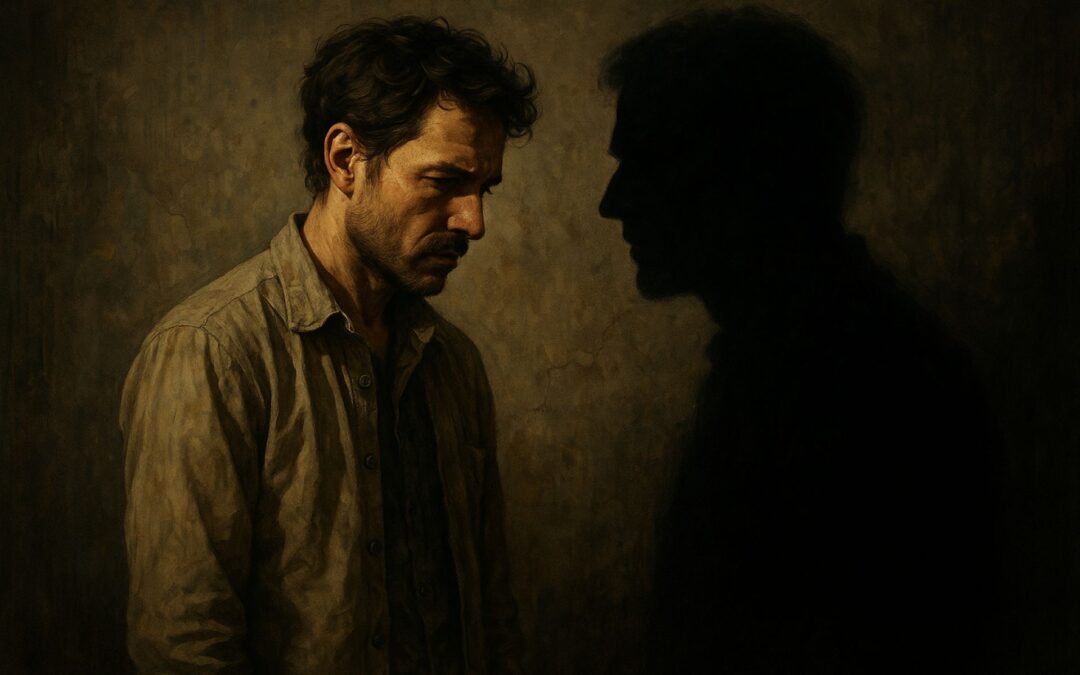
The Face We Refuse to Recognize
“Projections change the world into the replica of one’s own unknown face.”
— Carl Jung
There is something unsettling about this idea. It suggests that what disturbs us most in the world may not belong to the world at all—but to us. That the traits we condemn, the behaviors we resent, and the people we cannot stand might be reflecting something we have not yet faced within ourselves.
We tend to believe our judgments are objective. When we call someone weak, arrogant, selfish, or immoral, it feels like we’re simply describing reality. But Jung’s insight points in a different direction: that our reactions are not neutral observations, but deeply personal distortions. The world, in a psychological sense, becomes a mirror—one that reflects not who others are, but who we are unwilling to acknowledge ourselves.
This is not an easy idea to accept. It threatens the quiet comfort of moral certainty. After all, it’s far easier to identify flaws in others than to question the source of our own emotional intensity. Why does a stranger’s behavior provoke such disproportionate anger? Why do certain traits irritate us instantly, almost instinctively? And why do we feel so justified in our reactions?
To explore these questions, it helps to step away from abstraction and look at something more concrete. Because once you see this dynamic play out in real life, it becomes difficult to ignore.
Consider the story of a man who could not tolerate weakness in others—who reacted to it with such hostility that it defined his character. On the surface, his worldview seemed simple: strength is admirable, weakness is contemptible. But beneath that certainty lay something far more complicated, something he himself could not see.
And it is precisely in that blindness that Jung’s idea begins to take shape.
When Strength Becomes Cruelty
At first, he did not appear unusual. In fact, quite the opposite.
He was introduced as someone admirable—strong, dependable, emotionally grounded. The kind of man who had his life together. When he entered the picture, he was framed as the answer to a long search, someone who would bring stability and structure into an already complicated family situation.
There was a sense of certainty about him. Not just confidence, but conviction. He knew what kind of man he was, and more importantly, what kind of people he respected.
From the beginning, one value stood above all others: strength.
Strength, in his eyes, was not just a virtue—it was a dividing line. It separated people into categories. Those who had it were worthy of respect. Those who didn’t were dismissed, ridiculed, or condemned. There was very little room in between.
Weakness, on the other hand, was something he seemed to despise on a visceral level.
It wasn’t just that he disliked it. He reacted to it. Sharply. Instinctively. As if the mere presence of vulnerability—whether emotional or physical—provoked something in him that demanded an immediate response.
He had a word he used often. A crude one. A dismissive label for anyone who, in his eyes, failed to meet his standard of toughness. It didn’t matter who it was directed at—children, strangers, even people on television. If someone showed pain, fear, or hesitation, he would lash out with the same contempt.
And it wasn’t always directed at real situations. Even fictional portrayals of suffering seemed to trigger him.
There was a moment, watching a film together, that made this especially clear. A character suffers a brutal injury—his arm snapping under pressure, his reaction immediate and human: shock, pain, panic. It was a scene meant to evoke discomfort, even empathy.
But instead of reacting with concern, or even neutrality, he responded with ridicule.
He mocked the character. Called him weak. Dismissed his pain as exaggerated, unnecessary. As if the natural human response to injury was somehow a moral failure.
For anyone watching, the reaction felt disproportionate. Almost confusing. Why such intensity over something so ordinary? Why such hostility toward something as universal as pain?
Moments like this began to reveal a pattern.
Because this wasn’t limited to movies or distant figures. The same standard applied within the household. Pain, fear, vulnerability—these were not things to be acknowledged or comforted. They were things to be suppressed. Any expression of them was met not with understanding, but with irritation, even anger.
A child burns their hand. Another falls and cries. These are small, everyday moments. But in this environment, they became tests—tests that could only be passed by showing no reaction at all.
And when those tests were failed, the response was predictable.
Contempt.
Over time, something became clear: this wasn’t strength in any meaningful sense. It was something far more rigid. A narrow, unforgiving definition of what it meant to be human—one that left no room for fragility, even in situations where fragility was natural.
But the more absolute this standard appeared on the surface, the more it raised a quiet question beneath it.
What kind of person needs to reject weakness so completely?
And more importantly—what happens when someone like that is forced to confront it within themselves?
The Cracks Beneath the Persona
It didn’t take long for the image to fracture.
What initially appeared as strength began to reveal itself as something far less stable. The certainty, the authority, the rigid sense of superiority—it all started to shift once everyday life settled in and the pressure of reality replaced the illusion of first impressions.
The hostility toward weakness did not fade. It intensified.
Small moments became flashpoints. A raised voice over something trivial. Accusations that came out of nowhere. An atmosphere where tension could surface without warning. It was no longer confined to passing remarks or reactions to distant figures—it became embedded in daily interactions.
And what stood out most was not just the anger itself, but its direction.
It flowed downward.
Toward those who were smaller, younger, more vulnerable. Toward children who, by their very nature, could not meet the impossible standard being imposed on them. There was no allowance for age, context, or circumstance. The expectation remained the same: endure, suppress, do not show weakness.
Anything less invited ridicule or aggression.
The language reflected this. Labels were used not to correct behavior, but to define identity. To reduce a person to a single flaw and hold it against them as if it were permanent. And once that label was applied, it shaped every interaction that followed.
There was no space for nuance. No distinction between a moment of vulnerability and a person’s character. To show weakness, even briefly, was to be weak.
Over time, this created a strange contradiction.
The man who so strongly condemned emotional expression seemed to be driven by it. His reactions were not measured or controlled—they were intense, impulsive, and often disproportionate. Anger surfaced quickly and with force, yet it was never recognized as a form of weakness itself.
It was treated as something justified. Even necessary.
This is where the façade began to crack in a more subtle way. Because while vulnerability in others was unacceptable, his own emotional volatility was never questioned. It existed outside the rules he imposed on everyone else.
And that inconsistency didn’t go unnoticed.
There was also something else, harder to define but equally present—a sense of unease beneath the surface. As if the rigidity itself required constant maintenance. As if the identity he projected had to be defended, reinforced, and protected from anything that might challenge it.
The more absolute his stance became, the more fragile it seemed.
Because true strength doesn’t need to announce itself so aggressively. It doesn’t react to every perceived sign of weakness with hostility. It doesn’t require others to conform in order to remain intact.
This, on the other hand, did.
And so the pattern deepened: rejection, reaction, control. A cycle that grew more pronounced over time, even as the original image—the strong, reliable figure—continued to erode.
At some point, the contradiction became too large to ignore.
The question was no longer whether there were cracks in the persona.
It was how long they could be hidden before something gave way entirely.
The Ironic Collapse of the “Strong Man”
Eventually, the contradiction surfaced in a way that could no longer be explained away.
The man who had built his identity around strength—who rejected weakness so completely in others—was unable to cope with life himself. And not in a subtle, hidden way. In a way that was unmistakable.
He drank.
Not occasionally, not casually, but compulsively. It became his way of dealing with discomfort, pressure, and whatever it was he could not confront directly. When things became difficult, he didn’t endure them. He escaped.
The irony is almost too obvious, but it’s precisely this kind of irony that tends to go unnoticed by the person living it.
Because what is addiction, if not a form of dependence? What is the inability to face reality without numbing it, if not a kind of weakness—at least by the very standards he imposed on everyone else?
And yet, this contradiction did not lead to self-reflection. It did not soften his views or make him more understanding toward others. If anything, it seemed to intensify the rigidity.
The more he relied on alcohol, the more unpredictable he became. His behavior shifted. At times volatile, at times detached. The stability he was supposed to represent dissolved, replaced by something erratic and, at times, frightening.
For those around him, especially the children in the household, this unpredictability created a constant sense of unease. Not knowing which version of him would appear. Not knowing what might trigger a reaction. Living in an environment where control and chaos seemed to exist side by side.
And still, the narrative of strength persisted.
It persisted not because it was true, but because it had to be maintained. To admit otherwise would have required confronting something deeply uncomfortable—something that had likely been buried long before any of this unfolded.
There are hints of where it may have started.
Stories of his own upbringing. A father who ruled through control, who demanded toughness, who left no room for vulnerability. A childhood where weakness was not just discouraged, but denied altogether. Where certain emotions were not processed, but suppressed.
If that is the case, then the pattern begins to make more sense.
Because when something is rejected early enough, it doesn’t disappear. It gets pushed out of awareness. Hidden, denied, buried somewhere inaccessible. But it remains active, influencing behavior in ways that are not immediately obvious.
In his case, the rejection of weakness may have been so complete that he could no longer recognize it within himself. And yet, it found expression in other ways—through addiction, through volatility, through the very inability to cope that he condemned in others.
The collapse, when viewed from the outside, appears tragic but coherent.
A man who could not tolerate weakness ends up consumed by it.
A man who demanded control becomes ruled by something he cannot control.
And in the end, the cost is not just personal. It extends outward—to the people around him, to the family dynamic, to the long-term impact of living under such contradictions.
He eventually died at a relatively young age, leaving behind more than just an absence.
He left behind a question.
How can someone be so blind to what is so obvious to everyone else?
To answer that, we have to move beyond the surface of behavior and into something deeper—something Jung tried to articulate through a concept he called the Shadow.
Carl Jung and the Concept of the Shadow
To understand what was really happening beneath the surface, we have to step away from the story for a moment and look at the psychological framework behind it.
Carl Jung introduced the idea of the Shadow to describe a part of the human psyche that most of us would rather ignore. Not because it is unimportant, but because it is uncomfortable.
The Shadow is not some mystical force. It is, quite simply, a collection of traits, impulses, and tendencies that we reject in ourselves.
These are the parts that, at some point in our lives, were deemed unacceptable.
A child learns very early what is allowed and what is not. Some environments reward emotional restraint and punish vulnerability. Others discourage creativity, aggression, sensitivity, or independence. Whatever does not fit the expectations of that environment gets pushed aside.
But it doesn’t disappear.
Instead, it moves out of conscious awareness and settles somewhere deeper in the psyche. Hidden, but still active.
This is what Jung meant when he said that everyone carries a Shadow. It is not reserved for “bad” people. It is a universal feature of the human mind. The only difference lies in how much of it we acknowledge.
Because the more we deny these parts of ourselves, the more they accumulate in the background. And the less aware we are of them, the more influence they tend to have.
Jung described this in a way that feels almost unsettling in its precision: the less the Shadow is recognized, the darker and denser it becomes.
Not because it grows in some literal sense, but because it becomes more autonomous. Less integrated. Less under conscious control.
At that point, it doesn’t just sit quietly in the background.
It begins to express itself indirectly.
In moods that seem disproportionate. In reactions that feel automatic. In behaviors that contradict our own self-image. And most notably—in the way we perceive and judge other people.
This is where the concept of the Shadow begins to connect back to the earlier story.
If someone has learned that weakness is unacceptable, they may push that part of themselves out of awareness entirely. They may come to see themselves as strong, disciplined, emotionally controlled.
But the capacity for weakness doesn’t vanish. It simply becomes invisible to them.
And what remains invisible within has a tendency to become hyper-visible without.
Which leads directly to the next idea—one that explains not just behavior, but perception itself.
Projection.
Projection: Seeing Yourself in Others
If the Shadow is what we refuse to see in ourselves, projection is how it reappears.
It is not a conscious act. No one wakes up and decides to misinterpret reality. Projection happens automatically, almost seamlessly. It takes something internal—something disowned—and relocates it outward, onto other people.
In simple terms, psychological projection is the act of attributing to others what actually belongs to us.
Not what we consciously believe about ourselves, but what exists beneath that awareness. The traits we reject, the impulses we suppress, the emotions we deny—they don’t disappear. They find expression in perception.
And so, instead of recognizing them within, we encounter them in others.
This is why certain reactions feel so immediate, so charged. There is no pause, no reflection. Just a sharp emotional response that seems entirely justified in the moment. Anger, disgust, irritation—they arise as if triggered by something external.
But the intensity often tells a different story.
Because we don’t react this way to everything. Only to certain traits. Certain behaviors. Certain people. And the pattern is rarely random.
In the case of the man described earlier, his hostility toward weakness wasn’t occasional. It was constant, almost reflexive. He didn’t just dislike it—he seemed provoked by it.
From a Jungian perspective, this kind of reaction points inward, not outward.
If weakness had been fully integrated into his own sense of self, it wouldn’t have triggered such a strong response. He would recognize it, perhaps even empathize with it. But instead, it appeared as something alien, unacceptable, deserving of contempt.
Which suggests that it wasn’t absent from him.
It was disowned.
And because it was disowned, it had to be encountered somewhere else.
So it appeared in others—magnified, exaggerated, impossible to ignore.
This is the mechanism of projection. It doesn’t just distort our view of others; it protects our image of ourselves. It allows us to maintain a certain identity by outsourcing everything that contradicts it.
“I am strong, therefore weakness must belong to them.”
“I am rational, therefore they must be emotional.”
“I am honest, therefore they must be deceitful.”
These are not deliberate conclusions. They are psychological defenses, quietly shaping how we interpret the world.
And once they are in place, they reinforce themselves.
The more we project, the more evidence we seem to find. The more convinced we become that our perception is accurate. The more distant we grow from the possibility that what we’re reacting to is, in some form, our own reflection.
Which raises a difficult but necessary question.
If what we see in others is filtered through what we cannot see in ourselves—then how much of our judgment is actually about them?
And how much of it is about us?
The World as a Mirror
Once you begin to see projection at work, it becomes difficult to unsee.
What once appeared as simple judgment starts to reveal a pattern. The intensity of certain reactions, the fixation on specific traits, the emotional charge behind seemingly ordinary situations—it all begins to point inward rather than outward.
The world, in this sense, starts to function less like an objective reality and more like a reflective surface.
People often find themselves disproportionately irritated by very particular things. Someone driving an expensive car can trigger immediate resentment. A minor display of aggression can provoke outsized anger. A confident person may be perceived as arrogant without much evidence. These reactions feel justified in the moment, but their intensity often exceeds what the situation actually warrants.
From a Jungian perspective, this is not accidental.
The traits that disturb us the most tend to overlap with traits we have a complicated relationship with internally. Not always traits we possess openly, but traits we have suppressed, rejected, or never allowed ourselves to explore.
This is why projection doesn’t just produce mild annoyance—it produces fixation.
It explains why certain topics dominate people’s attention. Why some individuals seem almost obsessed with condemning specific behaviors or identities that have little direct impact on their lives. The emotional investment is too high to be explained by external circumstances alone.
A well-known fictional example of this dynamic appears in the character of Frank Fitts from the film American Beauty.
He presents himself as rigid, moral, and deeply opposed to homosexuality. His hostility is not casual—it is intense, ideological, and unwavering. But as the story unfolds, it becomes clear that this hatred is not rooted in objective belief. It is rooted in repression.
The very thing he condemns in others is something he cannot accept in himself.
His aggression, then, is not directed outward so much as it is displaced. A defense against confronting his own internal reality. Jung would describe this as a classic case of projection—the Shadow, denied internally, imposed externally.
And while this example is fictional, the pattern it illustrates is anything but rare.
You see it in public discourse, in online spaces, in everyday interactions. People who are relentlessly focused on criticizing others for specific traits, often with an emotional intensity that seems disproportionate to the situation.
This doesn’t mean every criticism is projection. That would be an oversimplification.
But when a reaction becomes obsessive, when it carries a certain urgency or hostility, it’s worth asking where that energy is coming from. Because more often than not, it has less to do with the external trigger and more to do with something unresolved beneath the surface.
The world, then, becomes a kind of psychological feedback system.
Not a perfect one, but a revealing one.
It shows us, in distorted form, what we have not yet made peace with.
When Projection Becomes Personal
It’s one thing to recognize projection in others. It’s far more uncomfortable to see it in yourself.
Because when it turns inward, the sense of clarity disappears. What once seemed obvious becomes ambiguous. Reactions that felt justified start to look questionable. And explanations that once made sense begin to feel like rationalizations.
Consider a case where someone consciously decides to step away from intimate relationships.
They tell themselves they don’t need one. That they are better off alone. Independent. Unaffected. On the surface, everything appears consistent. The decision feels deliberate, even rational.
But then something unexpected happens.
They find themselves irritated by couples.
Not mildly uncomfortable, but genuinely disturbed. Displays of affection provoke a subtle but persistent sense of annoyance. Weddings feel less like celebrations and more like something difficult to sit through. There’s a tension that doesn’t quite match the story they’ve told themselves.
And so, naturally, an explanation is constructed.
Perhaps they tell themselves they are being realistic. That they are simply aware of how fragile relationships can be. That their reaction comes from a place of concern, not resentment. That they are observing patterns others are too naive to see.
On the surface, this seems reasonable.
But the emotional response doesn’t quite align with the explanation.
Because if the decision to remain alone were fully integrated—if it truly reflected a lack of desire for intimacy—then other people’s relationships wouldn’t provoke such a reaction. They would simply exist, without triggering anything significant.
The irritation suggests something else.
From a Jungian perspective, it points to the possibility of repression.
Not necessarily a conscious denial, but a subtle disconnection from an underlying need. The desire for intimacy may still be present, but it has been reclassified as unnecessary, inconvenient, or even undesirable. And so it is pushed out of awareness.
But like all repressed material, it doesn’t remain inactive.
It surfaces indirectly.
In this case, through emotional reactions to others. Through discomfort that doesn’t quite make sense. Through a pattern that becomes visible only when you step back and question it.
This is what makes projection so difficult to identify in ourselves.
It doesn’t feel like projection. It feels like truth.
It feels like we’re seeing clearly, when in reality we’re interpreting selectively. Filtering external reality through internal conflicts we haven’t fully acknowledged.
And the more convincing our internal narrative is, the harder it becomes to challenge.
Which is why self-awareness, in this context, is not about immediately identifying what’s “wrong.”
It’s about noticing where our reactions don’t quite add up.
Where there’s a gap between what we say we believe and how we actually respond.
Because it is often in that gap that the Shadow begins to reveal itself.
The Hidden Opportunity in Projection
Up to this point, projection may seem like a purely negative phenomenon. A distortion. A flaw in perception. Something that leads to conflict, misunderstanding, and, in extreme cases, self-destruction.
But that’s only half the picture.
Because the same mechanism that misleads us can also inform us—if we’re willing to look at it differently.
Every strong emotional reaction carries information.
Not necessarily about the external situation, but about the internal landscape from which that reaction arises. When something provokes disproportionate irritation, anger, or even admiration, it often points to something unresolved, unexplored, or unacknowledged within ourselves.
In that sense, projection can function as a diagnostic tool.
It highlights areas where there is tension. Where certain traits have been rejected or suppressed. Where there may be a disconnect between how we see ourselves and what we actually experience.
The difficulty lies in interpretation.
Because the instinctive response is to focus outward. To analyze the other person, their behavior, their flaws. But if we momentarily suspend that impulse and turn the question inward, something shifts.
Instead of asking, “What’s wrong with them?” we begin to ask, “Why does this affect me so strongly?”
That question alone can be revealing.
Take the earlier example of irritation toward intimacy. If approached with curiosity rather than justification, it opens up the possibility that there is a part of oneself that has been pushed aside. A need that has been minimized or reframed to maintain a certain self-image.
Or consider someone who reacts strongly to creative individuals—dismissing them as impractical, unserious, or unrealistic. That reaction may not just be a judgment. It may reflect a disowned inclination toward creativity, something that was once present but had to be abandoned to meet external expectations.
The same applies to traits like ambition, vulnerability, assertiveness, even joy.
What we reject in others often corresponds to what we have not allowed in ourselves.
This doesn’t mean every reaction is a projection. Nor does it mean we should invalidate all criticism by turning it inward. There are real behaviors in the world that deserve to be challenged.
But when the reaction is emotionally charged, persistent, or disproportionate, it becomes worth examining.
Because in those moments, the external trigger may simply be activating something internal.
And if that internal element is brought into awareness, it can be integrated rather than denied.
Which changes the dynamic entirely.
Instead of being controlled by unconscious patterns, we begin to understand them.
Instead of reacting automatically, we gain the ability to respond more consciously.
Projection, then, is not just something to overcome.
It’s something to work with.
A signal, rather than a flaw.
One that, if interpreted correctly, can lead to a deeper understanding of who we are—and what we’ve been avoiding.
Integrating the Shadow
Recognizing projection is only the beginning. It tells us where to look, but not necessarily what to do with what we find.
This is where Jung’s idea of integration comes in.
To integrate the Shadow does not mean to eliminate it. Nor does it mean to act out every impulse or embrace every trait without restraint. It means something far more subtle—and far more difficult.
It means acknowledging what is already there.
Bringing into awareness the parts of ourselves we’ve rejected, denied, or ignored. Not to judge them, not to justify them, but to see them clearly.
Because as long as something remains unconscious, it operates without our consent.
It shapes perception. Influences behavior. Colors our reactions. And most importantly, it distances us from reality—both external and internal.
Integration begins with recognition.
The moment you notice a strong reaction and consider the possibility that it might be pointing inward, a shift occurs. The reaction is no longer absolute. It becomes something you can observe rather than something you are fully identified with.
From there, the process deepens.
You start to question the rigid identities you’ve built around yourself.
“I’m not the kind of person who gets jealous.”
“I don’t need validation.”
“I’m always in control.”
Statements like these often reflect not what we are, but what we insist on being. And anything that contradicts that image tends to be pushed into the Shadow.
Integration involves loosening that grip.
Allowing for contradiction. Accepting that multiple, even opposing traits can coexist within the same person. That strength and vulnerability are not mutually exclusive. That control and uncertainty can appear in the same moment.
This doesn’t weaken identity—it makes it more complete.
It also reduces the need for projection.
Because when a trait is recognized internally, it no longer needs to be located externally. The intensity of the reaction fades. What once provoked anger may now evoke understanding, or at the very least, neutrality.
There is also something else that emerges through this process.
Reclaimed potential.
Many of the traits we suppress are not inherently negative. They become problematic only when denied or expressed unconsciously. When brought into awareness, they can be redirected.
Vulnerability can deepen empathy.
Aggression can become assertiveness.
Desire can lead to connection.
Creativity, once dismissed, can reappear as a source of meaning.
In this sense, the Shadow is not just a collection of problems.
It is a reservoir of unrealized aspects of the self.
But accessing it requires a willingness to confront discomfort. To question assumptions. To step outside the certainty of one’s own perspective.
And that is not an easy process.
Because it involves giving up the illusion that we fully know ourselves.
But in doing so, something more grounded begins to take its place.
Not a perfect self, but a more honest one.
Turning the Enemy Into an Ally
Seen from the outside, the story of the man who could not tolerate weakness feels almost tragic in its simplicity.
A rigid worldview. A suppressed inner life. A pattern that repeats itself until it collapses under its own weight.
But when viewed through the lens of the Shadow, it becomes something else as well.
Understandable.
Not justified, not excusable—but intelligible in a way that goes beyond surface-level judgment. His hostility toward weakness was not random. It was structured. It followed a pattern that, once recognized, reveals the underlying mechanism.
He wasn’t simply reacting to others.
He was reacting to something within himself that he had never learned to face.
A part of him that had been pushed out of awareness long ago, likely under pressure to conform to an environment where vulnerability was unacceptable. And because it was never integrated, it remained active—unseen, but influential.
So it appeared in others.
And each time he encountered it, the reaction was immediate. Intense. Automatic.
What he fought externally, he avoided internally.
And that avoidance came at a cost.
Because what we refuse to acknowledge does not disappear. It persists. It shapes behavior. It narrows perception. It creates a world where certain traits are not just disliked, but actively hunted down and rejected—again and again, without resolution.
In that sense, the real conflict was never with other people.
It was internal.
This is what makes the idea of integration so significant.
Because it offers an alternative to that cycle.
Instead of rejecting parts of ourselves, we begin to recognize them. Instead of projecting them outward, we bring them inward. Not to indulge them blindly, but to understand them, to place them within a broader context of who we are.
And when that happens, something changes.
The emotional intensity begins to settle. The need to constantly judge, react, and defend starts to weaken. The world becomes less hostile, not because it has changed, but because the lens through which it is seen has shifted.
What once felt like a threat becomes information.
What once provoked anger becomes something that can be observed, questioned, even learned from.
This is why the Shadow, despite its name, is not purely negative.
It contains everything we have not yet made conscious.
And in that sense, it represents not just what we fear—but what we have yet to understand.
To turn it into an ally is not to eliminate it, but to bring it into relationship with the rest of ourselves.
To stop fighting it blindly.
And in doing so, to see the world a little more clearly—not as a replica of an unknown face, but as something that no longer needs to distort itself in order to be seen.