
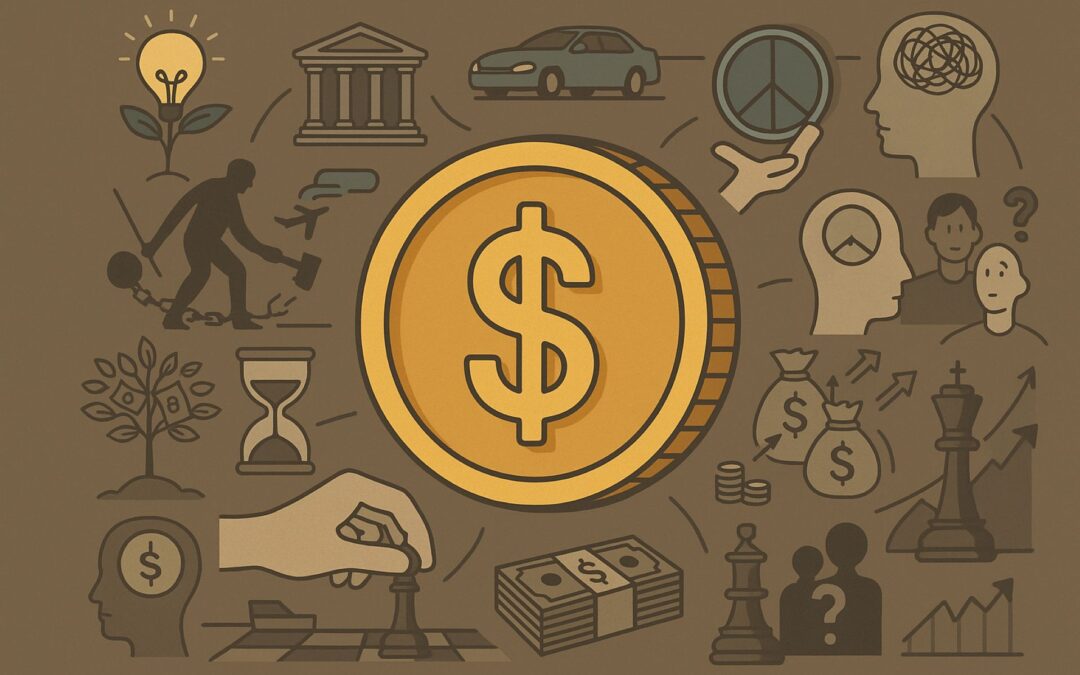
Money is often seen as a necessary evil—a tool for buying necessities and enjoying luxuries, yet fraught with anxiety and misunderstanding. For many, financial struggles create a cycle of stress and confusion, leading to a narrow view of what money truly represents.
However, by shifting our perspective and rethinking our relationship with money, we can unlock its potential to empower us, enhance our lives, and facilitate our journey toward personal and financial freedom.
This article explores 15 transformative ways to think about money, offering insights that can reshape your understanding and ultimately guide you toward a more fulfilling financial future.
1. Money Is a Tool to Move Value Across Space and Time
At the most fundamental level, money is an abstract tool designed to transfer value—whether it’s across physical distances or through different points in time. This perspective strips away the mystique and emotional charge that often cloud our thinking about money. Consider the analogy of a car: just as a car physically transports you from one location to another, money transports the value you create or earn from where and when you generate it to where and when you want to use it.
When you work a job, you are essentially converting your time, skills, and effort into monetary value. This value isn’t tied to the physical moment or place where you earned it; it becomes a portable asset. You can save money today and spend it years later, or earn money in one country and use it in another. This capacity to shift value through time and space is what makes money uniquely powerful.
Viewing money purely as a tool helps you detach from emotional reactions like anxiety or greed. It’s not something to hoard or fear losing; it’s a means to an end. Your success hinges on how effectively you “drive” this tool—whether you can allocate, invest, or protect the value it represents. Mismanaging money is like driving a car recklessly—you may get stuck or crash, but mastering it gives you control over where you want to go. This mindset turns money into a servant of your goals, not a master controlling your life.
2. Use Money to Buy Peace; Happiness Follows
The age-old saying that money can’t buy happiness has been misunderstood and overused to the point of cliché. The real nuance lies in recognizing that money can buy peace, which is the indispensable precursor to true happiness. Peace, in this context, means a state free from chronic stress and insecurity—a stable mental and emotional environment where your basic needs and safety are assured.
When you don’t have enough money, worries about survival—where your next meal comes from, paying rent, unexpected emergencies—consume your mental bandwidth. These “money problems” create constant anxiety that blocks any deeper sense of contentment. The moment you use money to eliminate these fears, you purchase a kind of psychological freedom that most people underestimate.
This foundational peace clears the way for the more intangible and profound experiences that constitute happiness: healthy relationships, purpose, self-acceptance, and growth. Without peace, happiness becomes a fleeting mirage. With peace secured, you can focus your energy on cultivating joy, fulfillment, and meaning in life.
Ultimately, money is the tool that removes external threats to your well-being. It is not the source of happiness but the gateway through which you pass to reach it.
3. Being Broke Is Temporary; Being Poor Is Permanent
The distinction between “broke” and “poor” is subtle but seismic in its implications for mindset and future outcomes. Being broke means you currently lack money. It’s a temporary, situational state—something that can and should change. Being poor, on the other hand, refers to a fixed belief system and identity: the conviction that your financial situation is unchangeable and that you’re doomed to remain in hardship indefinitely.
This difference shapes behavior profoundly. People who are broke view their situation as a hurdle to overcome. They see options, even if limited, and are willing to take action, no matter how small, to improve. They hold hope and invest effort in learning, hustling, and making incremental progress. The broke think in shades of gray and long-term possibilities.
The poor, conversely, often resign themselves to their fate. They externalize blame—“the system,” “bad luck,” “society”—and internalize helplessness. This fatalism creates self-fulfilling prophecies, trapping generations in cycles of scarcity. Worse, this mindset is passed down to children as inherited truth.
Escaping poverty requires a mental shift. You must reclassify yourself from poor to broke—acknowledging your current hardship without surrendering to it. This subtle change fosters resilience and a willingness to endure short-term discomfort for long-term gain. It’s the difference between being stuck and moving forward.
4. There Is No Money Cap; Wealth Is Infinite
One of the most limiting beliefs around money is the notion of a “cap”—that there’s a maximum amount you can earn or achieve financially. This scarcity mindset is deeply ingrained, stemming largely from traditional wage models where pay is tethered to hours worked or rigid structures.
The truth defies this limit. Money and wealth creation are virtually infinite. The global economy grows as innovation accelerates, markets expand, and new industries emerge. The supply of money is no longer bound by finite resources but is continually created through complex financial systems, credit, and digital currency.
Understanding that money is limitless liberates you from the ceiling mentality. Instead of competing for a fixed slice, you learn to expand the pie. This means creating new value, serving unmet needs, or tapping into emerging markets.
This infinite mindset transforms ambition. It encourages you to think exponentially, to invest in scalable ideas, and to innovate relentlessly. It removes the fear of hitting a wall because the only real boundaries are those you impose mentally.
When you internalize that money has no upper limit, you begin to play the game on a whole new level—with creativity, optimism, and boldness.
5. First You Learn, Then You Earn
The relationship between learning and earning is not just causal—it’s foundational. Your income potential is fundamentally tethered to the value you can provide to the marketplace, and that value stems directly from what you know and can do. The more you expand your skillset, deepen your expertise, and adapt to new tools, the more indispensable you become.
However, the critical nuance here is that it’s not just about accumulating information; it’s about mastering the art of learning itself. Learning how to learn efficiently, effectively, and continuously is the ultimate competitive advantage in an ever-evolving world. When you develop this meta-skill, you unlock an endless supply of new capabilities and opportunities.
Most people associate education with formal schooling—a finite chapter that ends with a diploma. But real education is lifelong and multidimensional. It encompasses self-directed study, mentorship, practical experimentation, and even failure. Embracing continuous learning means you’re always evolving, staying ahead of trends, and able to pivot into emerging fields.
When you invest in education—not just degrees but actionable skills and systems thinking—you increase your productivity and the breadth of problems you can solve. This translates into higher pay, better roles, and more influence. If you want to shift from being broke to building wealth, prioritize learning like it’s the most valuable asset you own, because it is.
6. Money Grows on Trees—If You Know Which Seeds to Plant
The cycle most people live in is frustratingly repetitive: they earn money, spend money, and then scramble to earn more to cover their expenses. This treadmill keeps many locked in a state of financial vulnerability. But the wealthy know a secret that turns this cycle on its head—money can generate more money when planted and nurtured correctly.
Think of money as seeds. When you invest it into the right “soil” — whether that’s stocks, real estate, businesses, or intellectual property — it can grow into a forest of financial security, producing income streams without your active labor. These are the “money trees” that differentiate the rich from the rest.
The poor tend to consume all their earnings, often out of necessity, but sometimes because of misplaced priorities or a craving for comfort. The middle class might save a little but rarely invest aggressively enough. The wealthy, however, deliberately sacrifice short-term comforts to accumulate and cultivate these financial seeds, understanding that delayed gratification is the price of freedom.
This metaphor also highlights the brutal truth that comfort can be a cage. Many would rather be comfortable in a constrained financial state than uncomfortable pursuing freedom. Recognizing how much excess capital you have—and choosing to plant it instead of consume it—is the defining factor in building generational wealth.
7. Money Is Never Truly Yours; It’s Your Turn to Hold It
Money is not static; it’s dynamic and transient. When you receive money, it’s only for a moment—your turn to hold it before it moves on to someone else. This flow is the bloodstream of the global economy, enabling goods, services, and opportunities to circulate continuously.
Understanding money as a temporary possession changes your entire relationship with it. Instead of hoarding or fearing loss, you begin to see money as part of a grand exchange system. Your role is to be a skilled participant who knows when to hold, when to invest, and when to let go.
This concept also teaches you to “move with the money.” Look for where capital is flowing and position yourself to ride the wave rather than swim upstream. It’s about aligning your efforts with market demand and the natural circulation of wealth, rather than clinging tightly to every dollar.
Wealth builds not by accumulating cash but by skillfully participating in this flow. The more effectively you can move money through your hands—turning it into value and receiving more in return—the more prosperous you become.
8. You’re Not Spending Money; You’re Spending Time Encapsulated
The saying “time is money” is often tossed around casually, but it’s more accurate to say that money is time encapsulated. When you earn money, you’re trading chunks of your life—hours, days, even years—for currency. Spending money, then, is literally spending pieces of your finite lifetime.
To illustrate: if you earn $100 an hour and purchase a $440,000 car, you’ve exchanged approximately 4,400 hours of your life for that vehicle. Those hours could represent over two years of full-time work. Thinking about expenses this way reveals the true cost of your purchases—not in abstract dollars but in lived time.
This perspective cultivates financial mindfulness. When you view spending through the lens of time, it becomes easier to prioritize purchases that bring lasting value and question those driven by impulse or status. It’s a tool for aligning your expenditures with what truly matters.
Moreover, recognizing that your time is irreplaceable helps you appreciate the value of passive income and investments—ways to “buy back” your time. By reducing the hours you trade for money, you gain freedom to spend your life as you choose, which is the ultimate form of wealth.
9. Debt Is Not Borrowing Money; It’s Renting Money at a Higher Price
Debt is often misunderstood as simply borrowing money to be repaid later. But this analogy misses a crucial distinction. When you borrow an object—say, a book or a tool—you return the same item intact after use. With money, however, borrowing involves paying back not just the principal amount but additional fees called interest, which means you’re effectively renting money at a premium.
Think of debt as leasing cash rather than borrowing it. You pay a recurring cost—interest—on top of what you initially received, increasing the total price substantially over time. This “rent” on money eats into your future earnings and limits your financial flexibility.
Moreover, debt carries risk. If you fail to repay, lenders have the power to seize your assets, adding pressure and potentially catastrophic consequences. Every dollar borrowed with interest is a portion of your future time and effort that’s taken away to satisfy today’s consumption.
Viewing debt through this lens exposes its true cost: you’re not gaining free money, but giving up future freedom. The present you is mortgaging the future you’s possibilities. This mindset shift urges caution and discipline, emphasizing the importance of minimizing debt and using it strategically only when it creates more value than it costs.
10. Money Is a Fungible Token—Replaceable and Equal
Fungibility is a technical term that means each unit of money is interchangeable with another unit of the same value. One $100 bill is equal in worth and function to any other $100 bill. This property is foundational to money’s role as a medium of exchange, making transactions seamless and efficient.
Understanding fungibility helps you grasp money’s abstract nature: it is not tied to a specific physical form or origin, but rather its agreed-upon value within society. This replaceability makes money highly liquid and versatile.
However, as you climb the wealth ladder, you encounter non-fungible assets—unique, irreplaceable items with value derived from their rarity or uniqueness. Examples include original works of art, vintage collectibles, or real estate with distinct features.
The rise of non-fungible tokens (NFTs) in the digital world has spotlighted this distinction further. Non-fungible assets command premiums because their value cannot be replicated or exchanged on a one-to-one basis.
For wealth-building, this distinction matters. While fungible money is essential for everyday transactions, accumulating non-fungible assets can create long-term value appreciation and diversification. To grow wealth sustainably, moving beyond fungible cash into unique, appreciating assets is often key.
11. Your Money Is Your Army—Send It to Conquer and Expand
Visualize your money as an army of soldiers—each dollar a recruit ready to be deployed in the battlefield of markets, investments, and opportunities. The goal of this army is to conquer territory: gaining market share, generating returns, and expanding your financial empire.
Idle money is like soldiers lounging in barracks—safe but ineffective. To grow wealth, your capital must be actively and strategically deployed. This involves investing in assets, launching businesses, or funding innovations that multiply your initial resources.
The battlefield analogy also introduces the concept of strategy. When you lack large amounts of capital, guerrilla tactics—small, calculated, and nimble moves—can outmaneuver larger, slower competitors. Creativity and timing become force multipliers.
Successful financial generals understand the importance of not letting their army be captured—avoiding risky, speculative moves that could lead to losses. Your money should be smartly positioned, protected, and reinvested to sustain momentum and build dominance.
This mentality encourages viewing your finances not as a passive pile but as a dynamic force requiring attention, strategy, and aggression to conquer lasting wealth.
12. You Chose This Life—Make Money Out of It
The acceptance that you consciously or unconsciously chose your current life path can be liberating. It removes the victim narrative and places responsibility squarely on your shoulders—empowering you to take control.
Since this is the life and career you inhabit, why not master it fully? Excellence and mastery require commitment, deliberate practice, and continual reinvestment in yourself and your resources. To compete at the highest levels, you must view making money not as a side effect but as an essential outcome of your efforts.
Quitting at the first sign of struggle guarantees failure. Instead, you must refocus—adjust your strategies, sharpen your skills, and double down on your purpose. Persistence in the face of adversity is the hallmark of those who transcend average results.
This mindset transforms your work from a mere obligation to a mission. When you own your choices and dedicate yourself to excelling, making money becomes a natural byproduct, sustaining and accelerating your journey toward success and fulfillment.
13. Money Loses Value Over Time—Invest It to Preserve Wealth
Inflation is the invisible thief that erodes the purchasing power of your money steadily and relentlessly. What you could buy for $100 fifty years ago requires approximately $2,500 today—a staggering depreciation. This decline isn’t just a minor inconvenience; it’s a fundamental economic truth that reshapes how you must think about holding and growing money.
Holding large sums of cash or letting money sit idle in low-interest accounts is effectively watching your wealth melt away. The dollar in your hand today is worth less tomorrow, and every day you delay deploying your money means you lose real value.
The wealthy understand this and take active steps to protect their capital. They invest in assets that outpace inflation: stocks, real estate, commodities, and businesses that appreciate or generate cash flow. This dynamic approach preserves and grows wealth rather than allowing it to diminish.
Recognizing money’s temporal decay forces a paradigm shift from hoarding to active management. Your money should be a working soldier, constantly engaged in battles against inflation and market risks. The goal isn’t just to save but to multiply—turning a shrinking pile of cash into a growing empire of assets.
14. Not All Money Is Equal—Think Beyond Borders
Money is not uniform across the globe; its value fluctuates dramatically depending on currency strength, purchasing power, and local economies. A million dollars earned and spent in New York might buy you a modest apartment, while the same sum in Vietnam could purchase an entire hotel and sustain your lifestyle indefinitely.
This global disparity opens a world of financial arbitrage—a strategy of leveraging differences in currency value and cost of living to maximize wealth and quality of life. Earning income in strong currencies like the U.S. dollar or Euro while spending in countries with weaker currencies magnifies your purchasing power exponentially.
Expanding your financial perspective beyond national borders unlocks opportunities unavailable domestically. It invites exploration of international investments, remote work, digital nomadism, and global entrepreneurship.
Adopting a global money mindset transforms how you allocate resources and plan your future. It shifts your thinking from limited, local constraints to expansive, worldwide potential, dramatically enhancing both your financial and lifestyle options.
15. Money Exists Only in Our Minds—It’s a Collective Illusion
At its core, money is a shared mental construct—a collective fiction that we all agree to believe in to facilitate exchange. Since the abandonment of the gold standard in 1971, money ceased to be tethered to physical commodities and became entirely abstract, existing as numbers on digital ledgers and screens.
This realization deflates the emotional power that money holds over us. Money is neither inherently good nor evil; it’s a neutral tool whose meaning we imbue. The moment you see money for what it truly is—an agreed-upon symbol of value rather than tangible wealth—you detach from fear, greed, and anxiety surrounding it.
This detachment paradoxically breeds empowerment. When money no longer controls your emotions, you can wield it strategically, without becoming enslaved by its illusion. Recognizing money as a mental construct frees you to navigate its flow with clarity and composure.
Understanding this collective illusion also illuminates how societal beliefs, trust, and psychological factors underpin financial systems. It underscores that your relationship with money is shaped as much by mindset as by numbers.
Bonus: Don’t Make Money—Make Things That Make Money
Many people exhaust themselves chasing paychecks, trading time for dollars in an endless cycle. The breakthrough to true financial freedom lies not in chasing money but in creating assets—systems, products, businesses—that generate money autonomously.
Building something of value with your own hands or mind gives you control over your financial destiny. It shifts you from employee to creator, from consumer to innovator. This process requires vision, discipline, and resilience but offers exponential rewards.
A paycheck is a finite, linear reward limited by hours worked or corporate budgets. In contrast, creations that solve problems or meet needs can generate infinite streams of income, scaling far beyond personal effort.
This mindset shift—from making money to making things that make money—is the foundation of entrepreneurship and wealth accumulation. It invites you to build legacies rather than just earn wages, transforming your relationship with money and your life’s trajectory.
Conclusion
Reevaluating your relationship with money can have profound implications for your life. By embracing these 15 perspectives, you can transcend limiting beliefs, foster financial security, and create opportunities for personal growth and happiness. Money is not just a means to an end; it is a powerful tool that, when wielded wisely, can open doors to experiences and fulfillment.
As you integrate these insights into your life, remember that your approach to money can serve as a catalyst for positive change, enabling you to navigate the complexities of the financial world with confidence and purpose. Ultimately, the way you think about money can transform your reality and pave the way for a prosperous future.