
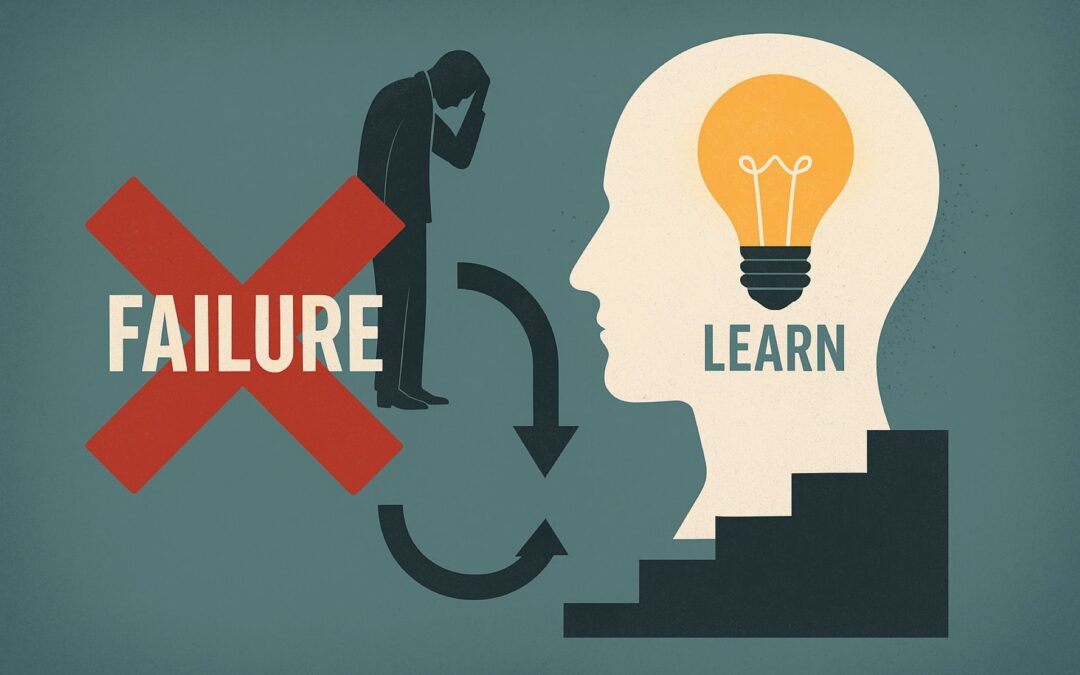
Most people repeat a familiar mantra: failure is a vital part of the process, a stepping stone to success. But here’s the stark, unvarnished truth — most people don’t truly learn from their failures. The culprit? Ego. It clings stubbornly, blocking any meaningful growth. Failure often just teaches people one thing: never do that again.
Start a business and it tanks? Statistically, you probably won’t try another one. Lose a big chunk of money investing? Chances are, you’ll shy away from the market forever. Failure isn’t a wise teacher — it’s a painful deterrent.
Failure Is an Optional Part of the Process, Not a Mandatory One
The phrase “failure is a part of the process” has become a mantra repeated in boardrooms, classrooms, and entrepreneurial circles. It suggests a linear journey where failure is inevitable, almost required, on the path to success. But this is a profound oversimplification that obscures a more important reality: failure is optional, not mandatory.
To understand this, start by considering what failure truly means in practical terms. Failure is the result of taking action without adequate preparation, insight, or adaptability. It’s a breakdown, a miscalculation, or a misstep that leads to an undesired outcome. But does every misstep have to end in failure? No. Many failures occur simply because people leap without looking — chasing blind hope rather than calculated risks.
This misguided bravado — “fail fast, fail often” — can encourage reckless behavior rather than intelligent experimentation. It frames failure as a rite of passage, even a virtue, when in fact, failure is a costly and avoidable hazard.
If failure is optional, what does that mean for how we approach challenges?
It means planning, research, and education can drastically reduce failure’s likelihood. Instead of relying on painful trial and error, you can invest time upfront to understand your market, competitors, and own strengths. This preparation transforms guesswork into educated guesses, minimizing unnecessary losses.
Another crucial aspect is adaptability. Failure often comes from stubbornly sticking to a failing strategy. Those who succeed quickly tend to be those who pivot early, using signals and data to adjust course before catastrophic loss. Failure is often the consequence of ignoring feedback, not the feedback itself.
Statistically, many people avoid trying again after failure because the psychological scars run deep. Failure breeds fear, which often manifests as paralysis or retreat. This is a natural response; the ego protects itself by steering clear of pain.
So, when failure teaches people “never do that again,” it’s less a lesson in resilience and more a survival mechanism.
The broader point is clear: while failure can be instructive, it often isn’t — especially if it stops you from continuing. Framing failure as essential risks romanticizing what is usually a painful setback. Instead, think of failure as a hazard to be managed and avoided where possible, not a necessary stage.
The Myth of the Relentless Failure Legend
The story of Colonel Harland Sanders, the founder of KFC, is often wielded as the quintessential example of persistence through failure. We hear he faced 1,009 rejections before his recipe gained traction. It’s a powerful tale of grit and tenacity that inspires millions. But the truth behind this legend is far less dramatic and far more instructive.
First, the exact number of rejections is unverifiable. It has taken on a life of myth — an urban legend amplified because it fits neatly into a narrative of triumph over adversity. This mythologizing does a disservice to real learning.
What is lost in this oversimplification is the complexity of Sanders’s journey. He didn’t start cold, pitching a fried chicken recipe door-to-door with no business acumen or experience. Rather, he spent decades in the restaurant industry, learning the ropes, developing relationships, and honing his business model. He understood franchising, supply chains, and customer preferences — all essential ingredients for his eventual success.
The story’s popular retelling suggests Sanders’s success was purely the product of stubborn refusal to quit. But a key detail often ignored is that Sanders largely did not change his core product or business model with each rejection. The recipe remained consistent, and the “why” behind the eventual acceptance remains ambiguous.
This matters because it reveals a critical flaw in the typical failure narrative: endurance alone isn’t enough. Without adaptation, persistence risks simply prolonging failure.
Moreover, this story’s popularity contributes to an over-glorification of failure. People celebrate the idea of “failing thousands of times” but rarely honor the hard, mundane work behind the scenes: strategic thinking, market research, iteration, and timing.
This myth obscures the real lessons:
- Success requires more than grit — it demands insight and flexibility.
- Failure without learning and adaptation is simply expensive repetition.
- The cultural obsession with heroic failure can lead to reckless persistence rather than smart course correction.
Instead of idolizing failure as inherently noble, it’s more productive to recognize it as a signpost signaling the need to rethink, recalibrate, or even pause.
Colonel Sanders’s story, stripped of exaggeration, becomes a lesson in how to balance persistence with pragmatism — a far richer and more actionable insight than simply “never give up.”
Failure Wastes Precious Time and Resources
When failure is framed as a necessary step toward success, it’s easy to overlook the very real costs it imposes—costs that are not just monetary but also emotional, psychological, and operational. Failure is rarely a clean, educational pause; more often, it’s a disruptive event that drains vital resources and diverts precious energy.
Imagine you decide to start an online dropshipping business. Enthusiastic and optimistic, you pour $10,000 into ad campaigns designed to attract customers. After running your ads, the results come in: minimal sales, poor conversion rates, and a substantial financial loss. You tell yourself you’ve “learned something valuable” about customer acquisition and marketing. But the harsh truth is that the $10,000 spent is gone, irretrievably siphoned from your limited capital.
This money could have been invested in a fraction of that cost—say, an intensive course, mentorship, or market research—that would have equipped you with the insights to avoid such a costly misstep. Failure here represents a grossly inefficient form of education, one that wastes both capital and time.
Time itself is an irreplaceable commodity. Unlike money, you cannot earn more hours in the day. Every failed attempt steals time that could have been used to refine your product, build meaningful relationships, or explore more promising avenues. Entrepreneurs who chase failure as a badge of honor often underestimate the opportunity cost—the projects and progress sacrificed while recovering from setbacks.
The emotional toll compounds the damage. Failure breeds frustration, anxiety, and diminished confidence. For those running a business, these feelings don’t exist in isolation; they ripple outwards, affecting employees, partners, and investors. A failed project doesn’t just erode your wallet; it chips away at morale and trust.
Moreover, failure often demands a recovery phase before any forward movement can occur. That means double the effort: first to regain footing, then to push ahead. If you have employees on payroll, investors demanding returns, or fixed operational costs, failure becomes even more punishing. The drag on momentum can stall growth for months or years.
This perspective flips the usual glorification of failure on its head. It’s not a quaint learning moment celebrated with high-fives; it’s a setback with ripple effects that must be reckoned with. When we acknowledge the true cost of failure, it becomes clear why managing and minimizing risk should always take precedence over embracing failure as a rite of passage.
Failure Isn’t a “Teachable Moment” Unless You Can Play Again
The notion that failure is an automatic “teachable moment” rests on a precarious assumption: that you have unlimited chances to try again. Unfortunately, for most people, life is not an endless replay.
Silicon Valley’s “fail fast” culture only works because many startups have access to abundant capital, safety nets, and a high tolerance for risk. If a venture fails, founders can bounce back quickly, learning and iterating with relative ease. But this scenario is the exception, not the rule.
For the vast majority, failure is a final warning sign, not a valuable lesson. Take stock market investing as an example. You might buy shares of your favorite company based on research and optimism. But what if you leveraged borrowed money to make that purchase, and the company collapses? Suddenly, the failure is not just losing your investment; it’s being trapped in debt you must repay. This is a failure that can’t be “learned from” in the traditional sense because the consequences are severe and often irreversible.
This reality demands a new approach: before making any major move, educate yourself about the worst-case scenario. What is the absolute maximum loss you could sustain? Can you absorb it without catastrophic damage? If the worst case is manageable, the risk might be worth taking. If it isn’t, walking away or finding alternatives becomes the prudent choice.
Minimizing downside risk requires discipline and foresight. It transforms risk-taking from blind gambling into a strategic decision. Failure ceases to be a random and painful teacher and instead becomes a foreseeable outcome to be prevented.
This mindset aligns closely with the concept of “playing to win” rather than “playing to learn.” If you can only afford a limited number of attempts, each one must be as calculated and informed as possible. Every decision becomes a trade-off—between hope and reality, risk and reward.
In sum, failure is only a true “teachable moment” when you have the capacity to continue playing the game. Without that capacity, failure is a hard stop, a line in the sand, a warning that the stakes are too high to be reckless. The smarter path lies not in courting failure but in managing risk and making informed choices that allow you to keep moving forward.
Master the Trade-Off Between Risk and Reward
Every meaningful decision, especially in the realms of business and investing, is a delicate balancing act—a trade-off between risk and reward. Mastering this trade-off is less about blind optimism and more about sharpening your ability to evaluate and manage uncertainty.
The first lever to pull is improving the accuracy of your educated guesses. Rather than operating on hopeful assumptions, success demands gathering information, studying trends, and grounding your expectations in reality. Take the example of someone wanting to start a YouTube channel. The hopeful fantasy might be quitting your day job, becoming an influencer overnight, and making a fortune. But reality tells a different story: channels often take years to gain traction, requiring consistent effort and a steep learning curve.
By researching average growth timelines, content strategies, and monetization avenues, you recalibrate your expectations. Suddenly, you recognize that building a sustainable secondary income through YouTube is a long-term endeavor. This shift from fantasy to informed projection allows you to commit more realistically and develop a strategic plan, making the trade-off between effort and outcome more favorable.
The second way to optimize this trade-off is to focus on asymmetric risk—situations where your potential upside vastly outweighs your downside. This concept is a cornerstone for those who build extraordinary wealth or breakthrough success.
Imagine a simple coin toss. If you lose, you lose a dollar; if you win, you get a dollar. That’s a symmetric risk-reward scenario. Now imagine if losing still costs you a dollar, but winning yields ten dollars. Suddenly, the expected value shifts dramatically in your favor. This is asymmetric risk.
In business and investing, spotting or creating such scenarios can make the difference between slow, incremental gains and exponential breakthroughs. The challenge is to minimize downside risk while maximizing upside potential. This often involves diversification, hedging bets, or innovating business models that offer scalable returns with limited capital at risk.
Without mastering asymmetric risk, many find themselves trapped in a game where the potential losses outweigh the gains, a losing proposition in the long run.
In essence, becoming adept at this trade-off means combining education and strategic risk assessment. The better you understand the landscape—the timelines, the pitfalls, the potential rewards—the more your decisions will favor success.
The Real Process Behind Success
The mythology of overnight success fueled by a trail of dramatic failures is seductive but misleading. Real success is usually far more unglamorous—rooted in decades of consistent, intelligent work rather than legendary stumbles.
Colonel Sanders, often celebrated for his persistence despite thousands of rejections, actually spent over twenty years building his restaurant business before franchising KFC. His empire wasn’t the product of sudden inspiration or a miraculous breakthrough after countless failures; it was the result of gradual refinement, relationship building, and steady progress.
This grounded reality challenges the “fail your way to success” narrative. Success doesn’t come from a few grand, heroic efforts but from continuous small wins, incremental improvements, and strategic patience. It’s the quiet discipline of showing up day after day, learning from data and feedback, and adapting accordingly.
If you find yourself needing to “succeed despite all odds,” it often signals that you made poor trade-offs earlier—risky bets without adequate preparation or risk mitigation. Such failures are costly, not heroic, and should be avoided.
True success involves:
- Prioritizing smart decision-making over sheer grit.
- Avoiding unnecessary failures by educating yourself.
- Balancing ambition with realism.
- Building on a foundation of knowledge and experience.
By reframing success as a marathon of deliberate, informed choices rather than a sprint fueled by repeated failures, you position yourself for sustainable achievement. It’s less about how many times you fall and more about how wisely you move forward.
Conclusion
Success is not born from glorified failure or relentless trial and error; it emerges from informed decisions, strategic risk management, and persistent, thoughtful effort. Failure, while sometimes inevitable, should never be romanticized or treated as a prerequisite. Instead, it must be understood as a costly setback to be minimized through education, preparation, and adaptability.
By mastering the delicate balance between risk and reward, and by focusing on smart, calculated moves rather than blind persistence, you pave a far clearer path to lasting success. Ultimately, the key lies not in how often you fail, but in how wisely you choose your next step.