
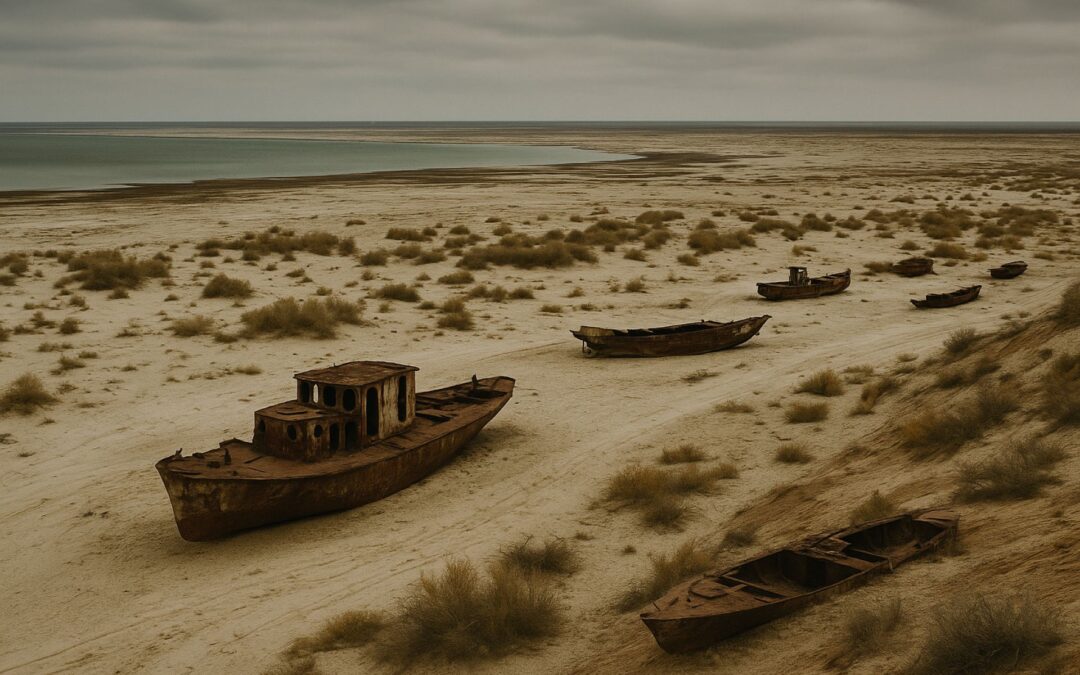
From orbit, it looks like an open wound — a pale scar in the middle of Central Asia where blue waters once shimmered. Just half a century ago, the Aral Sea was the world’s third-largest lake, a thriving ecosystem supporting millions across Kazakhstan and Uzbekistan.
Today, it’s a graveyard of sand, salt, and rusted ships. This wasn’t the work of time or climate, but of human hands — an empire’s ambition to command nature, to turn desert into farmland, to prove that ideology could rewrite geography.
What began as a Soviet dream of abundance became one of the greatest environmental catastrophes in history. This is the story of how Moscow’s obsession with “white gold” — cotton — drained an entire sea, devastated a region, and left behind a haunting testament to the cost of unchecked power.
The Grand Soviet Experiment
The story of the Aral Sea’s death begins not in the dust of Central Asia but in the marble halls of Moscow — a city that sought to reshape nature with the precision of an engineer and the arrogance of an empire.
In the aftermath of the Second World War, Joseph Stalin stood at the helm of a Soviet Union determined to prove its supremacy. The ideology of “socialism in one country” demanded that the USSR be self-reliant — a fortress of production insulated from the capitalist world. Every republic, every province, and every river was expected to serve a grand economic vision. For the deserts of Kazakhstan, Uzbekistan, and Turkmenistan, that vision was cotton.
Cotton was more than a crop — it was “white gold.” It clothed the Soviet population, drove industrial textile output, and provided a valuable export commodity. Stalin saw in the vast, sun-scorched plains of Central Asia a blank canvas: land that could, with enough canals and labor, be forced into fertility. The only missing ingredient was water — and water, the Soviets believed, could be redirected, controlled, and conquered.
In 1948, the Soviet government unveiled the Great Plan for the Transformation of Nature (Velikiy Plan Preobrazovaniya Prirody) — an audacious program to reshape ecosystems on a continental scale. It called for an enormous network of irrigation canals, reservoirs, and dams to convert deserts into cotton fields. It wasn’t simply an agricultural plan; it was a political statement, a demonstration of ideological dominance. Soviet propaganda posters depicted smiling workers in cotton fields, surrounded by mechanical marvels and slogans like “Man commands nature!” or “The desert blooms under socialism!”
The Amu Darya and Syr Darya, two ancient rivers that had sustained life in Central Asia for millennia, became the arteries of this new dream. Their waters had long flowed into the Aral Sea, maintaining a delicate ecological balance. But under the Soviet blueprint, they would be harnessed and rerouted to feed the thirsty fields of Uzbekistan and Turkmenistan.
This was an era when science bowed to ideology. Soviet hydrologists and engineers, pressured to fulfill impossible targets, built canals that leaked up to 75% of their water through unlined sand and evaporation. The Karakum Canal in Turkmenistan — one of the largest irrigation canals in the world — diverted billions of cubic meters of water each year, much of which vanished before reaching its destination. Yet officials hailed these projects as triumphs of human ingenuity, plastering success stories across newspapers while silencing any voices of caution.
When Nikita Khrushchev took power after Stalin’s death in 1953, the obsession with expansion intensified. Khrushchev was a man of restless energy and boundless faith in engineering solutions. He saw cotton not just as a commodity but as a symbol of modernization — a crop that could bring wealth to the Soviet south and secure independence from foreign imports. By the 1960s, canals snaked across the steppes, reservoirs shimmered in the desert, and cotton production surged.
But hidden beneath this grand narrative was a creeping disaster. The rivers feeding the Aral Sea had been turned into irrigation lifelines, their flow throttled before ever reaching the lake. The Soviet Union was creating an empire of abundance — but it was draining its own heart to do so. The cost, at first invisible, would soon become impossible to ignore.
By the late 1960s, even Soviet scientists began to whisper what no one dared to say aloud: the Aral Sea was dying. But in a system built on central control and denial, truth was often the first casualty. The state pressed forward, measuring success in tons of cotton rather than cubic meters of water. It was a Faustian bargain — prosperity for the few, paid for by the slow death of a sea.
A Sea Drained of Life
In 1960, the Aral Sea was a living giant — the fourth largest lake in the world, stretching over 68,000 square kilometers. It sustained an entire biosphere. Its waters fed wetlands teeming with migratory birds. Its shores were dotted with fishing villages that exported tens of thousands of tons of fish each year to Moscow and beyond. To the people of Moynaq, Aralsk, and Karakalpakstan, the sea was both their livelihood and their identity.
Then, within a single generation, it began to vanish.
The diversion of the Amu Darya and Syr Darya rivers — the twin arteries that once replenished the Aral — turned catastrophic almost immediately. In 1960, their combined inflow to the sea measured around 58 cubic kilometers annually. By 1974, that had fallen by nearly 87%, to just 8 cubic kilometers. By 1989, the figure dropped further still — only 7% of its natural level. The lake, cut off from its lifeblood, began to shrink like a puddle under the sun.
The transformation was visible even from space. Satellite imagery over the decades reveals a haunting sequence: the once-mighty sea retreating into scattered fragments, its deep blue fading to brown and gray. As the waterline receded, the remaining lake split in two — the North Aral Sea in Kazakhstan and the South Aral Sea in Uzbekistan. By the early 2000s, the southern section fractured yet again into smaller pools, many no deeper than a few meters.
What the Soviets failed to grasp — or chose to ignore — was that the Aral Sea was not just a body of water but a climate regulator for the entire region. Its vast surface once moderated temperature extremes, provided humidity, and stabilized rainfall patterns. As it shrank, summers grew hotter, winters harsher, and rainfall more erratic. Entire ecosystems began to crumble.
The increasing salinity of the remaining water was the death knell for life within it. Between 1960 and 2010, salinity levels increased thirteenfold, turning the water from brackish to toxic. Over two dozen species of fish disappeared, and the fishing industry that once employed 60,000 people collapsed. Canneries shut down, boats were abandoned where they last floated, and workers were laid off overnight.
But the disaster extended beyond economics. The exposed seabed — now a vast salt desert known as the Aralkum — became one of the most polluted landscapes on earth. Decades of industrial waste, chemical runoff, and pesticides that had accumulated in the sea were now baked into the soil. With no vegetation to anchor the dust, toxic particles were carried by the wind for hundreds of kilometers. Towns downwind of the former sea were soon cloaked in poisonous dust storms, their air thick with salt and residue from DDT, nickel, and cadmium.
The Soviet state, faced with evidence of ecological collapse, responded with indifference. Reports were classified; scientists were censored. The Aral was no longer considered an environmental issue — it was an acceptable casualty of economic planning. As one Soviet expert remarked coldly in 1968, “The evaporation of the Aral Sea is inevitable.”
And so the sea — once a symbol of vitality — became an emblem of decay. Where there had been water, there was now sand. Where there had been life, only rusted ships and salt. The empire that had sought to master nature had succeeded only in unmaking it.
The Collapse of a Region
When the waters of the Aral Sea retreated, they didn’t just leave behind salt and sand — they left behind broken economies, broken health, and broken communities. Entire regions that once pulsed with life became stagnant. What had been a maritime hub turned into a wasteland.
In the 1950s, Moynaq was a prosperous port town in the Uzbek SSR, home to a thriving fishing fleet and a bustling seafood industry that supplied the Soviet Union with tens of thousands of tons of fish annually. It had schools, hospitals, theaters, and paved streets — a model of Soviet progress in the remote steppes. But by the 1980s, that image began to crack. The sea’s shore had receded dozens of kilometers from the city, leaving ships stranded on dry land. Factories that once processed sturgeon, perch, and carp stood empty, their windows shattered by dust storms. The fishing fleet rusted where it stood, half-buried in sand.
When the Soviet Union collapsed in 1991, the economic lifeline of the Aral region collapsed with it. The collectivized farms and factories that had once been state-subsidized were suddenly abandoned. Thousands of workers found themselves unemployed overnight. In Moynaq alone, the population fell from 30,000 to barely 11,000, as families fled in search of work and clean water. The few who remained endured extreme poverty, unreliable electricity, and near-total isolation.
In Karakalpakstan, the autonomous republic that borders the Aral’s southern shore, the crisis ran even deeper. Its people — a Turkic ethnic group distinct from Uzbeks — had lived for generations as fishermen and herders. The sea’s disappearance erased their livelihood and identity alike. Once a center of cultural pride, Karakalpakstan became a symbol of neglect. Despite its autonomy on paper, the region was largely ignored by authorities in Tashkent. With its economy in shambles, it became one of the poorest places in Central Asia.
By 2023, Karakalpakstan’s poverty rate had climbed to 19.7%, compared to the national average of 14%. Its GDP per capita was half that of the rest of Uzbekistan, and unemployment was rampant. Across the border, Kazakhstan’s Kyzylorda region, home to the northern remnants of the Aral, shared a similar fate — its GDP per capita lagging 50% below the national average.
The economic fallout also triggered political unrest. In 2022, protests broke out across Karakalpakstan after the Uzbek government proposed constitutional changes that would weaken the republic’s autonomy. The demonstrations quickly turned violent, leaving dozens dead. Beneath the surface of the political anger was something more profound — the accumulated despair of decades of abandonment. People were no longer just mourning the loss of the sea; they were mourning the loss of hope.
But perhaps the most insidious consequence of the Aral’s collapse was the transformation of its seabed into a new kind of desert — the Aralkum. Once submerged under freshwater, it now stretches for tens of thousands of square kilometers, covered in a fine layer of salt, sand, and toxins. Each year, windstorms lift an estimated 75 million tons of this toxic dust into the air. Carried by the wind, it settles over towns, fields, and lungs. Crops are poisoned, livestock sickened, and human life slowly suffocated.
The Soviet state, obsessed with production quotas, had not only destroyed a sea — it had created a permanent ecological disaster zone. Generations later, its effects still ripple outward, blighting land, air, and blood.
The Human Cost
For the people living around the former Aral Sea, the catastrophe is not a historical event — it’s a daily reality, woven into their breath and bloodstream. Every gust of wind carries salt. Every sip of water carries disease. Every birth carries risk.
When the sea began to shrink, it left behind a thick crust of minerals and agricultural chemicals — remnants of decades of pesticide use, including DDT, once sprayed liberally over Soviet cotton fields. As the waters evaporated, these toxins concentrated in the soil. Today, every storm that sweeps across the Aralkum lifts microscopic particles of arsenic, cadmium, nickel, and pesticide residue, dispersing them across hundreds of kilometers. The wind carries poison — into crops, into homes, into lungs.
The health impact has been catastrophic. In Karakalpakstan, the rates of respiratory disease, cancer, and anemia are among the highest in the world. A 2016 study found that adult cancer rates in the Aral region were 1.5 times higher than in control areas, largely due to inhalation of heavy metals. Asthma, bronchitis, and throat cancers are widespread, while 50% of deaths are linked to respiratory illnesses.
Children bear the brunt of it. Birth defects are five times more common here than in Europe. Many infants are born underweight or with neurological disorders. Between 1985 and 2005, infant mortality in Kazakhstan’s Aral region rose by 50%, while maternal mortality in Karakalpakstan is now 150% higher than the national average. Women suffer from chronic iron-deficiency anemia — as high as 90% among those of childbearing age. “Every woman here has anemia,” said one local resident. “It’s not a condition; it’s a way of life.”
The human suffering doesn’t stop with health. The psychological toll of watching one’s homeland deteriorate has bred a generation of quiet despair. Alcoholism, depression, and suicide have risen in the region. Entire families live in a state of survival, cut off from the prosperity enjoyed by urban Uzbekistan and Kazakhstan. Clean water is scarce, and many communities rely on wells contaminated by salt and agricultural runoff.
During the Soviet era, the irony was bitter. The very cotton industry that destroyed the Aral Sea relied on forced labor. For decades, the state sent over a million people annually — including teachers, doctors, and children — to the fields each autumn to hand-pick cotton. Those who refused were punished or dismissed from their jobs. The work was grueling and hazardous, often involving exposure to pesticides without protection. It wasn’t until 2012 that Human Rights Watch reported on the scale of this exploitation, and not until 2022 that the International Labour Organization finally declared Uzbek cotton “free from forced labor.”
But the legacy of that exploitation lingers — both in the poisoned land and in the generational trauma of the people who toiled for a promise that never came true.
A haunting irony persists in the region’s memory: the Soviet Union once touted the cotton fields as a victory of socialism — “the desert brought to bloom.” Today, the same desert has reclaimed its victory. The soil, once forced into fertility, has turned to salt. The canals that once carried life now carry death.
The Aral Sea’s demise is not simply an ecological failure or a political miscalculation — it’s a story of human suffering on an epic scale. It is what happens when progress is pursued without conscience, when people become statistics, and when nature becomes a victim of ideology.
For the people of Karakalpakstan, the cost of that ideology is still being paid — in every breath, every harvest, and every heartbeat.
The Desert of Forgotten Dreams
Step into Moynaq today and the silence feels unnatural — as if the land itself remembers what was lost. The wind that once carried the smell of salt and fish now carries dust, rust, and grief. A ghost fleet of corroded ships lies stranded in the sand, their hulls flaking under the desert sun. These are the skeletons of an era — fishing trawlers that once sliced through waves now sit motionless in dunes that stretch to the horizon.
Fifty years ago, Moynaq was a port city with life, rhythm, and purpose. Its cannery operated day and night, producing tens of thousands of tons of fish for the Soviet Union. Men worked the docks, women cleaned and salted the catch, and trains rolled out daily with cargo bound for Moscow. The Aral Sea wasn’t just nearby — it was the reason this town existed.
Now, the sea is gone, and so are the jobs, the boats, and most of the people. The distance between Moynaq and the new shoreline is over 100 kilometers. Where once waves lapped against concrete piers, there is only cracked earth. The port’s cranes rust in silence. The playgrounds are deserted. You walk through town and find only the elderly, children, and the faint echo of what used to be.
The loss of the Aral didn’t just destroy Moynaq’s economy — it hollowed out its spirit. It broke the generational bond between land and livelihood. For centuries, the people of Karakalpakstan and Kazakhstan saw the sea as their provider. It dictated their seasons, their songs, their identity. To lose it was like losing language — something primal and irreplaceable.
The younger generation grows up surrounded by reminders of a life they’ve never known. They play football on the dry seabed. They climb the rusted ships as if they were monuments, not tombstones. And for them, the sea is more myth than memory. Their parents speak of tides and fish and salt breezes as if describing another planet.
Visitors who come to Moynaq today often call it an “open-air museum” — but the locals despise that phrase. A museum implies preservation, order, curation. Moynaq is none of those things. It is decay frozen in time, a place still dying slowly. What outsiders photograph as “haunting beauty” is, for the people here, a wound that won’t close.
The government has tried to paint the tragedy in patriotic colors — erecting memorials and slogans that celebrate “the resilience of the Karakalpak people.” But resilience is a poor substitute for justice. It cannot replace the clean air, the fertile soil, or the lost livelihoods. In truth, Moynaq stands as a monument to abandonment — not only by the Soviet Union that caused its suffering, but also by the modern states that inherited the wreckage.
And yet, in the stillness of this desert, there is something hauntingly profound. The ships, half-buried in sand, have become symbols of human folly and endurance — reminders that empires rise and fall, but their mistakes remain etched in the earth.
The Faint Pulse of Revival
And yet, even here — amid the salt flats and ruins — there are flickers of renewal. The Aral Sea, though irreparably scarred, has not disappeared entirely. Nature, stubborn and silent, resists total defeat. On the northern edge, where Kazakhstan took control after the collapse of the Soviet Union, a remarkable effort has been underway: the revival of the North Aral Sea.
In 2005, with financial backing from the World Bank, Kazakhstan built the Kok-Aral Dam, an engineering lifeline designed to separate the North and South Aral basins. The idea was deceptively simple — trap what little water still flowed from the Syr Darya River to prevent it from draining south into the desert. Against expectations, the project worked. Water levels rose by several meters within a few years, salinity dropped, and fish — long thought extinct in the area — began to return.
By the 2010s, small fishing communities re-emerged on the Kazakh side. Fishermen returned to their boats. Children who had grown up without ever seeing the sea could finally touch its waters again. The North Aral’s surface area expanded by more than 20%, and the local climate began to stabilize. For the first time in decades, there was hope — tangible, measurable hope.
But this fragile revival stops at the border. Across the line in Uzbekistan, the South Aral Sea remains a wasteland. Deprived of inflows from the Amu Darya, it continues to shrink each year. Most of what was once open water is now the Aralkum Desert — an expanse of salt and dust that emits toxic storms powerful enough to reach Afghanistan and northern India. While Kazakhstan’s government embraced cooperation and international aid, Uzbekistan’s approach has been largely defensive — focused on mitigation, not restoration.
To its credit, Uzbekistan has begun reforestation programs to plant salt-tolerant trees such as saxaul and tamarisk across the Aralkum. These trees help anchor the shifting sand and reduce the scale of dust storms. The government is also introducing new crops better suited to saline soil and investing in irrigation reforms to limit water waste. Billions of cubic meters of water that once disappeared into leaky Soviet canals are now being better managed through modernization efforts.
Still, the reality is stark: most locals don’t believe the Aral Sea will ever return. “The Aral has disappeared many times,” said Feride Makhsetova, a journalist from Karakalpakstan. “And it will return — but not in our lifetime.” Her words capture both the fatalism and quiet defiance of those who remain. They live between nostalgia and necessity, trying to salvage dignity from desolation.
The international community occasionally turns its attention here — with conferences, funding pledges, and environmental campaigns — but interest fades quickly. The Aral is no longer a front-page catastrophe; it’s a forgotten crisis. Yet for the people who breathe its dust every day, the story isn’t over.
There are tentative signs of new life beyond the water’s edge. Ecotourism has begun to take root in parts of western Uzbekistan. Artists and documentarians come to capture the strange beauty of the ship graveyard. NGOs work quietly on public health initiatives, bringing filters, medicine, and education to communities long neglected.
Still, the larger truth remains: revival here does not mean restoration. It means containment — keeping the disaster from spreading, holding the line between ruin and resilience. The North Aral may pulse with faint life, but the South remains a scar.
The future of the Aral Sea is not one of return, but of reckoning — a long, painful attempt to coexist with the consequences of hubris. The desert that once swallowed the sea now stands as both tomb and teacher. It whispers an unchanging truth: nature forgives slowly, if at all.
Lessons Written in Sand
The tragedy of the Aral Sea is not merely a story of one vanished lake — it is a mirror reflecting humankind’s oldest delusion: that progress can exist apart from consequence. What unfolded here was not a freak accident or a failure of technology; it was the logical result of an ideology that believed nature could be bent to political will, that rivers could be commanded like soldiers, and that success could be measured only in tons of cotton or kilometers of canal.
For the Soviet Union, mastery over nature was a central part of its mythology. Stalin, Khrushchev, and their engineers saw themselves as modern Prometheans — bringing light, order, and productivity to the wilderness. Nature, in this worldview, was chaos to be subdued. Deserts were “empty,” rivers “wasted,” and seas “idle” unless they served the machinery of the state. The Aral Sea disaster was simply one of the most visible casualties of this war against the natural world — a war fought not with guns, but with ideology, propaganda, and bulldozers.
But the lesson reaches far beyond the Soviet Union’s borders or its history. What happened in Central Asia is a warning to every nation that places economic output above ecological balance. It’s a case study in what happens when short-term political gain overrides the long-term health of a planet. Every drop of water stolen from the Amu Darya and Syr Darya fed an empire’s pride — and bled its people dry.
For decades, Soviet scientists who dared to speak the truth were silenced or ignored. Reports describing the sea’s rapid shrinkage were buried in archives. Photographs showing dead fish and dust storms were censored. The state demanded optimism even as disaster unfolded. And yet, the propaganda persisted: the canals were “monuments of progress,” the cotton fields “proof of man’s triumph.” The more the Aral died, the louder the slogans grew.
This pattern — denial, deflection, destruction — is not uniquely Soviet. It is the same story repeated wherever humans confuse control with wisdom. In modern times, we see echoes of the Aral in the deforestation of the Amazon, in China’s diversion of the Yellow River, in the drying of California’s Owens Lake, and in the over-extraction of the Colorado River in the American West. Each case begins with the same conviction: that human ingenuity can outsmart the earth. Each ends with dust, scarcity, and regret.
The Aral Sea’s disappearance offers a profound ecological and moral lesson. Once the world’s fourth-largest lake, it now serves as one of the planet’s greatest man-made disasters — visible even from orbit. NASA satellites capture its slow death in a time-lapse of arrogance: blue fading to beige, life giving way to emptiness. But the greater tragedy is not just environmental — it’s human. Entire generations were born into poverty, illness, and exile because of decisions made thousands of kilometers away by men who would never breathe the poisoned air of Karakalpakstan.
In that sense, the Aral Sea stands as a symbol of distance — political, moral, and emotional. The planners in Moscow saw only numbers on a chart, never faces in the dust. They believed in the “rational order of progress”, but their rationality stripped the world of empathy. The closer you get to Moynaq or Aralsk today, the more you feel that distance collapse — not between people and nature, but between decision and consequence.
And yet, amid the despair, the Aral teaches one more lesson — that nature is resilient, but only to a point. The partial revival of the North Aral Sea proves that restoration is possible when humility replaces hubris. It shows that when nations cooperate, when science leads instead of ideology, even a dying ecosystem can breathe again. The earth does not demand perfection from us — only balance, restraint, and respect.
The poet and environmentalist Wendell Berry once wrote, “We do not inherit the earth from our ancestors; we borrow it from our children.” The Soviets, blinded by the promise of a self-sufficient empire, borrowed everything and returned nothing. Their legacy lies scattered in the salt storms of the Aralkum — a vast, shimmering graveyard that will take centuries to heal.
In the end, the story of the Aral Sea is a monument to misplaced faith — the faith that power guarantees control, that ambition ensures progress, that nature will yield forever. The desert now whispers the truth that Moscow refused to hear:
Man can never win a war against nature — only learn, too late, that he was fighting himself.
Conclusion
The Aral Sea stands as one of humanity’s starkest warnings — a mirror reflecting what happens when pride outweighs prudence. In trying to conquer nature, the Soviet Union conquered itself, leaving behind poisoned land, broken lives, and a silence where waves once sang. The tragedy of the Aral isn’t just about water; it’s about distance — between ruler and ruled, decision and consequence, ambition and wisdom. Yet, amid the desolation, there is faint hope: the slow revival of the North Aral, the replanting of life in the salt-scarred sands, the persistence of people who refuse to leave their home.
The lesson is simple, though the world keeps forgetting it — nature is patient, but not forgiving. Progress built on domination is never sustainable; it merely postpones collapse. The ships of Moynaq, now stranded in the desert, are not relics of the past but symbols of the future we risk repeating. The Aral Sea’s silence speaks for us all: that no empire, no economy, no ideology can ever truly master the earth — only learn to live within its bounds.