
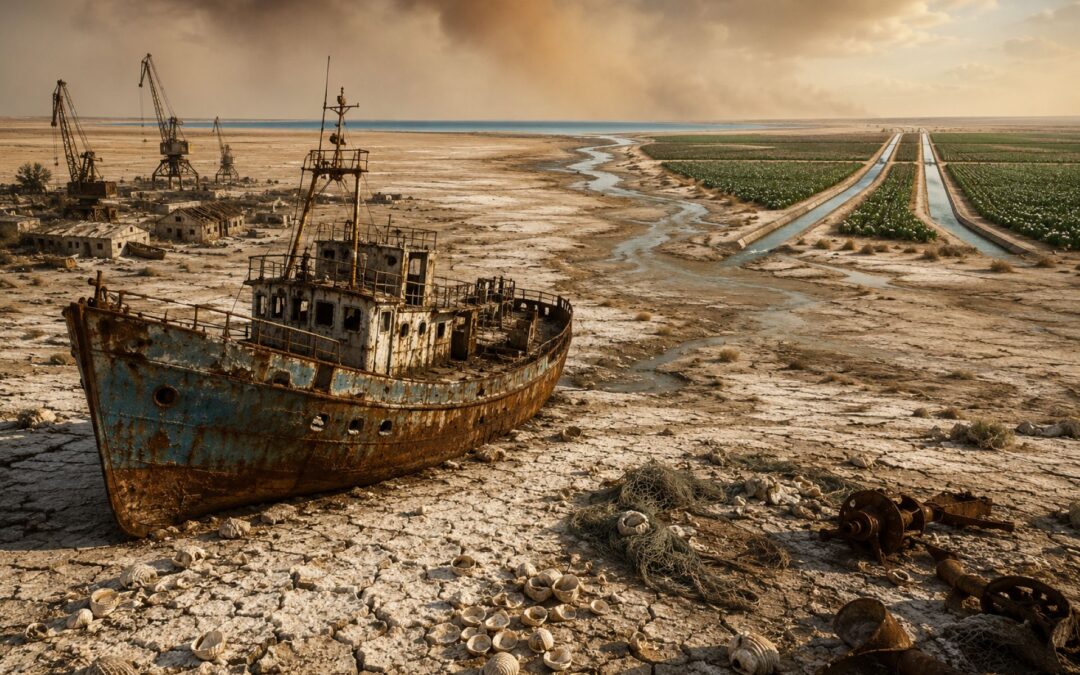
In the desert outside Moynaq, Uzbekistan, the rusting remains of fishing vessels stand on a landscape of sand, salt and scattered seashells. Their hulls once floated on the Aral Sea, and the town behind them was a working port with fishing boats, processing factories and an economy built around the water. Today, reaching what remains of the southern sea can require hours of travel across the exposed seabed. The abandoned ships have become a reminder of how completely a landscape, and the lives depending on it, can change within a few generations.
The Aral Sea was not emptied by an earthquake or a sudden natural catastrophe. Beginning in the Soviet period, the rivers that sustained it were increasingly diverted into irrigation canals to grow cotton and other crops across Central Asia. Agricultural production expanded, but the sea lost the water it needed to survive. Its disappearance destroyed ecosystems, undermined local industries, exposed polluted sediments and left communities struggling with consequences that continued long after the Soviet Union collapsed.
The Aral Sea disaster reveals what happens when economic development is measured through immediate production while its environmental and human costs are largely ignored. Understanding how it happened also explains why one part of the sea is now recovering while another remains among the most severely damaged landscapes on Earth.
The Aral Sea Before It Became a Desert
The Aral Sea lies between Kazakhstan to the north and Uzbekistan to the south, in the arid heart of Central Asia. Despite its name, it was an enormous inland lake without a natural connection to the world’s oceans. Before its modern collapse, it covered approximately 67,000 square kilometres, contained more than 1,000 cubic kilometres of water and was commonly described as the world’s fourth-largest inland lake.
Two major rivers sustained this vast body of water. The Syr Darya flowed towards the lake from the northeast, while the Amu Darya approached from the south. Both drew much of their water from snowmelt, glaciers and precipitation in the mountainous regions of Central Asia before crossing extensive agricultural and desert landscapes.
Because the Aral Sea had no natural outlet, its survival depended on the relationship between river inflow and evaporation. Water continuously escaped into the atmosphere, but the rivers replenished much of what was lost. As long as sufficient water entered the basin, the lake could maintain a broadly stable level despite the surrounding arid climate.
Its water was naturally brackish, meaning it contained more dissolved salts than freshwater but substantially less than ordinary seawater. That balance supported fish populations, including carp, bream and pike-perch, which sustained commercial fisheries and processing industries. Around the river deltas, reeds, marshes, lagoons and wetlands provided habitats for wildlife, while surrounding communities depended on livestock, fishing and agriculture.
The sea also influenced the local climate. Water absorbs and releases heat more slowly than land, moderating seasonal temperatures and helping soften the contrast between hot summers and cold winters. Its disappearance would eventually weaken that effect, exposing surrounding areas to more severe climatic conditions and affecting local growing seasons.
Central Asia was never a region without irrigation. Communities had diverted river water into agricultural fields for centuries because farming in such a dry environment required reliable access to water. What changed during the twentieth century was the extraordinary scale of irrigation expansion and the willingness of the Soviet state to treat the rivers as resources that could be redirected almost entirely towards agricultural production.
Why Soviet Planners Put Cotton Ahead of Water
Cotton was one of the Soviet Union’s most strategically important agricultural products. It supplied the textile industry, supported manufacturing and reduced the need to obtain raw materials from foreign producers. Known as white gold, cotton offered both economic value and political prestige to a government determined to demonstrate the productive capabilities of its centrally planned economy.
Central Asia appeared ideally suited to growing it. The region contained extensive flat land, long summers and abundant sunlight, all favourable conditions for cotton cultivation. The missing ingredient was water, but Soviet planners believed that engineering could overcome this limitation by redirecting rivers through enormous irrigation networks.
This ambition reflected a broader political philosophy. Under Joseph Stalin, the Soviet state promoted projects designed to transform landscapes, control rivers and increase agricultural production. The Great Plan for the Transformation of Nature, announced in 1948, symbolised the belief that scientific planning and large-scale engineering could reorganise the natural environment according to economic priorities.
The irrigation system that ultimately devastated the Aral Sea was not the product of one decree or a single construction project. It developed over several decades, accelerating after Stalin’s death in 1953 and continuing under subsequent Soviet leadership. Canals, reservoirs and irrigation infrastructure expanded throughout the region, including the enormous Karakum Canal in what is now Turkmenistan.
Water from the Amu Darya and Syr Darya increasingly flowed towards cotton plantations, rice fields and other agricultural developments instead of reaching the Aral Sea. Uzbekistan became a major cotton-producing territory, while agricultural output also expanded substantially in neighbouring Soviet republics. Measured narrowly through cultivated acreage and harvest quantities, the programme appeared successful.
Yet this agricultural transformation contained serious structural inefficiencies. Many canals were unlined, allowing large quantities of water to seep into the surrounding ground or evaporate before reaching crops. Poor drainage created waterlogged fields, while the repeated application of irrigation water left salts accumulating in agricultural soils.
Cotton monoculture also discouraged crop rotation and balanced land use. Farmers relied heavily on mineral fertilisers and pesticides to maintain yields, while degraded soil conditions increased pressure to apply additional water and agricultural chemicals. These practices damaged the very land that the irrigation programme was supposed to make permanently productive.
A World Bank case study by David Tarr and Eskender Trushin examines how the Soviet commitment to cotton self-sufficiency encouraged extensive irrigation while neglecting the environmental costs of water use. Their analysis raises a fundamental economic question: would the enormous expansion of cotton production have appeared worthwhile if the value of lost water, damaged ecosystems and degraded land had been properly included in its costs?
The Soviet system provided few incentives to answer that question. Officials were rewarded for meeting production targets, expanding irrigated land and delivering larger harvests. A shrinking inland sea hundreds of kilometres downstream did not immediately appear as a loss in the statistics used to measure agricultural success.
This created a profound imbalance between those receiving the benefits and those bearing the costs. Cotton production supplied industries and supported national economic objectives, while fishing communities, river deltas and downstream settlements absorbed the damage. The apparent prosperity of irrigated agriculture depended partly on treating the water sustaining the Aral Sea as though it had no alternative economic or ecological value.
How Two Diverted Rivers Destroyed the Sea
The destruction of the Aral Sea did not require engineers to drain the lake directly. Its water balance could be disrupted simply by withdrawing enough water from the rivers supplying it. Evaporation continued across the surface, but the Amu Darya and Syr Darya increasingly failed to replace the water that disappeared into the atmosphere.
Before the expansion of large-scale Soviet irrigation, the Aral Sea received roughly 50–60 cubic kilometres of river water annually, although estimates vary with the period and method of measurement. As irrigation withdrawals increased, this inflow declined dramatically. By the 1970s, only a fraction of the earlier volume reached the lake, and during some subsequent years the flow approached zero.
The consequences accumulated gradually. Water levels fell, shorelines retreated and formerly submerged land emerged around the lake’s margins. The sea was losing water stored over many generations, making it increasingly difficult for ordinary fluctuations in rainfall or seasonal river flow to reverse the decline.
This process was not entirely unexpected. Soviet scientists and planners understood that large river diversions could cause the Aral Sea to shrink, but agricultural production generally received higher priority than preserving the lake. Some considered its economic value comparatively insignificant, while more ambitious proposals imagined replacing lost water through enormous engineering schemes, including the possible diversion of rivers from Siberia.
Those alternatives never provided the sustained inflow necessary to preserve the sea. Instead, withdrawals continued, and the physical transformation accelerated. By the late 1980s, the declining water level had divided the original lake into two principal bodies: the smaller North Aral Sea in Kazakhstan and the much larger South Aral Sea, predominantly in Uzbekistan.
As water volume diminished, salinity increased. Dissolved salts that had previously been distributed through an enormous lake became concentrated in progressively smaller bodies of water. Many fish species could no longer tolerate the conditions, while shrinking wetlands destroyed important habitats and breeding grounds.
The South Aral subsequently fragmented into separate eastern and western basins. The shallow eastern basin proved especially vulnerable to variations in river inflow and drought. NASA’s satellite record of the shrinking Aral Sea documents the retreat of the water over successive decades, including the complete disappearance of the eastern lobe in 2014. That basin has experienced subsequent fluctuations, but the original continuous sea has not returned.
Across the former seabed, a new desert emerged: the Aralkum. Covering tens of thousands of square kilometres, it is among the world’s youngest major desert landscapes. Its surface contains sediments, salts and residues left by the former lake and the agricultural drainage that entered it.
These sediments created another environmental danger. The Soviet cotton system used substantial quantities of pesticides, fertilisers and industrial chemicals, some of which travelled through waterways and accumulated in the Aral basin. As the sea retreated, material that had once remained beneath the water became exposed to the wind.
Dust and salt storms now carry particles from the exposed seabed across surrounding regions. Satellite observations have recorded enormous dust plumes originating in the Aralkum, demonstrating that the consequences of the disaster extend far beyond the former shoreline. The contamination of soils, crops and water systems remains a concern, although the composition and health significance of airborne material vary by location and exposure.
The changing landscape has also affected the local climate. Without the moderating influence of such a large body of water, surrounding areas experience stronger seasonal temperature extremes, which can make farming and livestock production more difficult. This adds to the challenges already created by declining water supplies and increasingly saline soil.
The disaster therefore involved much more than a lake losing surface area. A functioning ecological system fragmented, its water became too saline for many species, its wetlands deteriorated and its seabed turned into a source of environmental exposure. Once these processes were underway, communities around the Aral Sea began losing the industries and resources on which they had built their lives.
Moynaq and the Economy Left on the Seabed
Moynaq illustrates how environmental collapse can destroy an entire local economy. Before the Aral Sea retreated, the town operated as an important fishing port with commercial vessels, processing facilities, transport connections and workers employed throughout the industry. Fishing supported not only those who went out on the water but also the people who maintained boats, processed catches, supplied equipment and transported products to markets across the Soviet Union.
As the shoreline retreated, ports became separated from the water by increasing distances. Rising salinity reduced fish populations, undermining the commercial basis of the industry even where some water remained. Factories closed, fishing vessels were abandoned and equipment that had once been essential to the town’s prosperity lost much of its practical value.
The ships outside Moynaq are the most visible evidence of this transition. They stand in the desert because the landscape around them changed, not because the town deliberately constructed an unusual monument. Seashells scattered across the sand reveal the area’s former ecology, while the stranded vessels demonstrate how quickly economic infrastructure can become useless when the natural system supporting it disappears.
The consequences extended beyond the fishing industry. River deltas and wetlands provided grazing areas, vegetation and water for livestock, all of which deteriorated as the hydrological system changed. Agricultural soils became increasingly saline, and local farming faced additional difficulties from water scarcity and altered climatic conditions.
Employment losses encouraged people to leave in search of better opportunities. Others remained in communities where traditional skills and established industries could no longer generate the same income. The resulting disruption affected families, local businesses and public services, reinforcing the disadvantages of an already geographically isolated region.
The wider economic situation requires careful interpretation. Karakalpakstan has experienced substantial poverty and development challenges, but these cannot all be attributed directly to the disappearance of the Aral Sea. Political decisions, regional investment, national economic reforms and broader structural conditions have also shaped living standards.
According to Uzbekistan’s official regional poverty statistics, Karakalpakstan’s poverty rate was 13.6% in 2023, compared with a national rate of 11.0%. By 2025, the reported figures had declined to 6.6% and 5.8%, respectively. These improvements are important, but falling poverty rates do not mean that damaged ecosystems, disappearing fisheries or inadequate water infrastructure have been restored.
The Aral Sea disaster also demonstrates the limitations of measuring economic success through one industry’s production. Cotton expanded agricultural output, but the associated accounting did not adequately subtract the value of destroyed fisheries, lost livestock resources, deteriorating soil, migration, public-health burdens or eventual restoration expenses. Many of those costs appeared years later and were borne by people who had little influence over the decisions creating them.
Moynaq’s experience reveals the economic problem at the centre of the disaster. The Soviet Union created productive cotton fields by redirecting water away from an existing network of communities and industries. The expansion of one sector undermined the foundations of another, with consequences that continued long after the original agricultural targets had been achieved.
Toxic Dust, Unsafe Water and the Limits of Health Evidence
The health consequences of the Aral Sea disaster are among its most troubling features, but they are also difficult to measure precisely. People living around the former sea face overlapping environmental and social risks, including saline and contaminated water, airborne dust, poverty, poor sanitation, inadequate nutrition and limited access to healthcare. These conditions interact, making it difficult to attribute every illness to one cause.
The exposed seabed provides a clear potential pathway for environmental exposure. Winds lift salt and fine sediments from the Aralkum, sometimes carrying material containing residues associated with agricultural runoff and pollution. People may inhale airborne particles, while deposited dust can affect crops, soil and water sources. The quantity and composition of these contaminants differ across locations, so exposure cannot be assumed to be identical throughout the region.
Historical pesticide use is another concern. Agricultural chemicals and other persistent pollutants entered the wider environment through irrigation drainage, rivers and contaminated soil. Some substances can accumulate in food systems or human tissues, creating risks that may persist long after their original application.
However, identifying contamination does not automatically establish that a particular disease was caused by it. Public-health researchers must consider exposure levels, nutritional conditions, smoking, occupational factors, healthcare access and differences between the populations being compared. Without these distinctions, dramatic statistics can create a misleading impression of scientific certainty.
A review of children’s health research in the Aral Sea region examined 26 scientific papers and four major reports published between 1994 and 2008. It identified significant concerns involving anaemia, diarrhoeal diseases and elevated burdens of toxic contaminants. At the same time, the researchers found no clear evidence directly linking measured dust exposure with impaired respiratory function, illustrating the limitations of the available studies.
That uncertainty does not make the region’s health problems unimportant. It means their causes are complex and require careful investigation. Environmental exposure may operate alongside malnutrition, insufficient sanitation and economic hardship rather than independently explaining every pattern of illness.
Drinking-water insecurity is particularly significant. A UNICEF project document concerning water and sanitation in Karakalpakstan reported that 37% of the republic’s population, and almost half its rural population, lacked access to centralised drinking-water systems at the time of its assessment. It also described serious water-quality problems, including water samples that failed chemical or bacteriological standards. These figures describe the conditions documented for that programme, rather than a claim that water-service coverage has remained unchanged.
Improving access to piped water is only part of the solution. Treatment, reliable distribution, maintenance and water-quality monitoring are also necessary because connection to a supply system does not guarantee that water is consistently safe to drink. In remote communities, unreliable infrastructure can place an additional burden on households already facing economic difficulties.
Anaemia has been repeatedly identified as a major health concern among women and children in the Aral Sea region. Researchers have also examined kidney and liver problems, respiratory illnesses, tuberculosis, reproductive health outcomes and other conditions associated with environmental and socioeconomic deprivation. Some studies in the Kazakh part of the disaster zone have reported higher cancer incidence than in selected comparison populations, but their findings depend on the populations, periods, exposures and methods examined.
These results should not be converted into universal claims about everyone living around the former sea. A cancer comparison involving particular districts does not establish the same risk throughout Kazakhstan and Uzbekistan, just as an observed association between exposure and illness does not necessarily demonstrate causation. The evidence supports serious concern without requiring exaggerated statements about disease rates.
The indirect effects of environmental destruction may be just as consequential. When families lose stable employment, their diets and housing conditions may deteriorate. When access to clean water becomes unreliable, preventable illnesses become harder to avoid. When healthcare services are limited, pregnancy complications, childhood illnesses and chronic conditions can become more dangerous.
The Aral Sea’s health burden is therefore best understood as the cumulative effect of damaged environmental and social systems. The disappearance of the water weakened food security, employment, sanitation and local resilience while creating new exposure risks. Even where scientific uncertainty remains about individual diseases, the need for cleaner water, better healthcare and improved living conditions is clear.
Karakalpakstan: The Political Burden of an Environmental Disaster
Karakalpakstan is an autonomous republic in western Uzbekistan, occupying much of the territory around the former southern Aral Sea and the lower Amu Darya. It is home to the Karakalpaks, a Turkic people whose language and cultural identity are distinct from those of Uzbekistan’s majority population. The republic has constitutionally recognised autonomous status, although the practical extent of its political independence has long been a sensitive issue.
Its geographical position has made it especially vulnerable to decisions taken elsewhere. Much of the Amu Darya’s water is withdrawn upstream before the river reaches the region, while agricultural drainage and environmental pollution can travel downstream. As the Aral Sea retreated, communities already distant from the country’s main economic centres faced diminishing fisheries, degraded agricultural land and increasing pressure on water supplies.
These disadvantages intersect with broader questions about regional investment, government accountability and political representation. The ecological crisis did not create every problem experienced by Karakalpakstan, but it intensified the difficulty of building stable livelihoods and securing public services. For families considering migration, the relevant pressures can include limited employment, health concerns, unreliable water and uncertainty about their children’s future.
Environmental grievances also form part of the wider history of relations between Karakalpakstan and Uzbekistan’s central government. Nevertheless, they should not be confused with the immediate causes of particular political events. The major protests that erupted in Nukus in July 2022 were triggered by proposed constitutional amendments affecting the republic’s autonomous status and its provisions concerning a referendum on secession.
The protests were met with a violent security response. In its June 2026 concluding observations on Uzbekistan, the United Nations Committee on the Elimination of Racial Discrimination expressed serious concern about reported abuses during and after the unrest. These included allegations of excessive force, the unlawful killing of at least 21 protesters, injuries, arbitrary detention and ill-treatment. The disputed constitutional proposals were subsequently withdrawn.
The committee also raised concerns about the practical exercise of Karakalpakstan’s autonomy and the participation of Karakalpak people in political decision-making. Its observations linked these governance issues with wider concerns affecting the region, including environmental degradation. They do not establish that the Aral Sea disaster directly caused the 2022 protests, but they illustrate why ecological damage cannot be understood separately from the social and political position of the communities experiencing it.
Karakalpakstan’s experience reflects a broader difficulty of centralised development. Decisions made for national economic objectives may impose severe costs on regions with relatively little influence over those decisions. When ecological damage persists for decades, those costs can contribute to inequality, migration and distrust of political institutions.
Cotton’s Other Human Cost: Forced Labour
The environmental destruction associated with cotton production was accompanied by another serious problem: the use of coercion to secure agricultural labour. Under the Soviet system, meeting production targets carried political importance, and local officials operated under pressure to deliver the expected harvest. After Uzbekistan gained independence in 1991, many of the institutions and incentives surrounding state-controlled cotton production remained in place.
For years, authorities mobilised teachers, doctors, students, public employees and other citizens to participate in cotton harvesting. Children were also drawn into the fields, while adults could face threats affecting their employment, education or public benefits if they refused. The harvest became a nationwide campaign in which fulfilling production requirements frequently took precedence over individual choice.
International labour organisations, activists and businesses increasingly challenged these practices. More than 300 brands and retailers participated in a boycott of Uzbek cotton, while monitoring programmes documented the use of child labour and forced mobilisation. The government eventually introduced reforms intended to end these abuses and improve conditions in the agricultural sector.
These reforms produced measurable progress. Following extensive monitoring of the 2021 cotton harvest, the International Labour Organization reported that systematic child labour and systematic forced labour had ended. Its findings indicated that the overwhelming majority of cotton pickers participated voluntarily, although isolated cases and perceived coercion had not disappeared entirely. The Cotton Campaign lifted its international boycott in March 2022.
That achievement should be recognised without suggesting that every labour-rights problem in the cotton industry was resolved. A February 2026 investigation by Human Rights Watch and Uzbek Forum found that farmers continued to face significant restrictions, including state interference in production, insecure land rights and pressure over agricultural obligations. These practices differ from the earlier systematic mobilisation of cotton pickers but reveal continuing problems with coercive agricultural governance.
Related tensions can also be seen elsewhere in Central Asia. Turkmenistan’s state-controlled cotton industry has faced its own allegations of compulsory labour and pressure on public-sector employees, although the political circumstances and reform histories of the two countries differ.
The labour history reinforces the economic lesson of the Aral Sea disaster. Agricultural production can appear successful when governments count the crops harvested without adequately accounting for the resources consumed or the burdens imposed on workers. Uzbekistan’s progress in ending systematic forced picking demonstrates that harmful institutions can change, while continuing farmer-rights concerns show why the quality of development cannot be judged by output alone.
How Kazakhstan Saved Part of the North Aral
Although the Aral Sea is often described as having disappeared, its surviving basins have followed very different paths. In northern Kazakhstan, the North Aral Sea has experienced a substantial partial recovery. The South Aral, by contrast, remains severely diminished, with extensive areas of its former basin transformed into desert.
The North Aral’s recovery became possible because it is a smaller basin supplied by the Syr Darya. Preserving more of that river’s inflow offered a realistic way to raise water levels and reduce salinity. Unlike an attempt to restore the entire historical Aral Sea, the project concentrated available water within a more manageable ecological area.
Early attempts to separate the northern and southern basins relied on temporary earthen barriers, which repeatedly failed. Kazakhstan subsequently worked with the World Bank to construct the more durable Kok-Aral Dam, completed in 2005. The dam reduced the loss of water from the northern basin into the southern basins, allowing the North Aral to retain more of the water entering from the Syr Darya.
The results were substantial. Water levels rose, salinity declined and fish species began returning to parts of the northern basin. Commercial fishing recovered, helping restore economic opportunities to communities that had previously lost much of their traditional livelihood.
The recovery also benefited Aralsk, a former port city that had been left far from the water as the sea retreated. World Bank reporting on the initial restoration project described the distance between the city and the shoreline falling from approximately 75 kilometres to around 20 kilometres. Fish production increased considerably, while lower salinity allowed the return of species that had been unable to survive the earlier conditions.
These achievements demonstrate that severe ecological damage is not necessarily irreversible. A smaller but functioning lake can again support fisheries, businesses and wildlife when enough freshwater is retained and managed. The northern project offers a striking contrast to the preceding decades, during which engineering had been used primarily to remove water from the Aral basin.
Recovery has continued, although its progress varies with river conditions and water management. Kazakh government figures reported in 2026 put the North Aral’s water volume at approximately 23.4 billion cubic metres, compared with about 18.9 billion cubic metres in 2022. Plans to improve the Kok-Aral Dam and expand the lake further remain subject to implementation, funding and continued water availability.
The recovery nevertheless has important limitations. The North Aral remains far smaller than the original lake, and its revived fishing industry cannot automatically recreate the scale or diversity of the former regional economy. Water levels depend on the Syr Darya, reservoir operations, upstream agricultural demand and cooperation among countries sharing the river basin.
The dam also involves an ecological trade-off. Retaining more water in the northern basin reduces the amount passing into the southern basins, which helps explain why success in Kazakhstan does not necessarily translate into recovery farther south. Protecting a viable North Aral has been possible partly because restoration efforts accepted a smaller geographical objective rather than attempting to refill the entire original lake.
The experience shows what targeted environmental repair can achieve. It also demonstrates that recovery depends on continuing decisions about water allocation, maintenance and regional cooperation. Without sustained river inflow, the gains made since 2005 could become vulnerable to drought, climatic change and growing demands on water resources.
Why the South Aral Cannot Simply Be Restored
The South Aral faces a far more difficult future because its former basin is enormous and its principal source of water, the Amu Darya, remains heavily used for irrigation. Agriculture across Uzbekistan and Turkmenistan depends on withdrawals from the river, while evaporation continues across whatever water reaches the surviving southern basins. Recreating the historical sea would require sending vast and sustained quantities of freshwater past fields, canals and settlements that now depend on it.
Such a change would involve more than constructing a new dam or changing the course of one canal. It would require extensive reforms to agricultural production, major improvements in water-use efficiency and long-term agreements among countries sharing Central Asia’s rivers. Reducing withdrawals on the necessary scale could also impose serious economic consequences on existing farming communities if alternative livelihoods and production systems were not developed.
Climate change makes these decisions more difficult. Higher temperatures can increase evaporation and agricultural water demand, while changes in mountain snowpack, glaciers and seasonal runoff affect the rivers feeding the basin. The combined pressure of water scarcity, population needs and agricultural dependence leaves limited room for restoring the South Aral to anything resembling its former size.
Yet the difficulty of complete restoration does not mean that every part of the southern environment must be abandoned. The World Bank’s assessment of Uzbekistan’s development challenges highlights the importance of better resource management and environmental rehabilitation. Selected wetlands, delta ecosystems and surviving water bodies may be capable of partial recovery even if restoring the entire original sea is unrealistic.
This distinction matters because environmental rehabilitation can produce meaningful benefits without recreating the geography of 1960. Maintaining river-delta lakes, improving water availability for communities and protecting remaining habitats can support wildlife and local livelihoods. More efficient irrigation and less water-intensive farming practices may also reduce pressure on rivers, although savings depend on how agricultural water use is actually managed.
Uzbekistan has increasingly focused on addressing the consequences of the exposed seabed. One approach involves planting saxaul and other salt-tolerant vegetation, whose root systems can help stabilise loose sediments and reduce wind erosion. Such planting is intended to make sections of the Aralkum less vulnerable to dust movement rather than to restore the former seabed to open water.
Through its Green Aral Sea initiative, the United Nations Development Programme has supported this work with Uzbek authorities. In March 2025, the initiative completed another planting stage involving 80,000 saxaul seedlings across 80 hectares of the former seabed in the Moynaq district. The programme is a practical example of ecological rehabilitation, but it also illustrates the difference in scale between individual projects and a former sea covering tens of thousands of square kilometres.
The effectiveness of planting programmes depends on more than the number of seedlings placed in the ground. Survival rates, soil conditions, water availability and long-term maintenance determine whether vegetation can meaningfully stabilise the landscape. Afforestation can help reduce certain local consequences of desertification, but it cannot by itself replace a lake, revive marine fisheries or eliminate all regional dust pollution.
Other priorities include improving drinking-water infrastructure, maintaining treatment systems, supporting alternative employment and helping farmers adopt more sustainable practices. Governments must also coordinate their use of shared rivers. In July 2026, the World Bank approved a regional water-management and conservation initiative to strengthen cooperation, data sharing and investment in water efficiency across Central Asia.
These measures address different parts of the same problem. Better water management can reduce waste and support surviving ecosystems, while healthcare, infrastructure and economic programmes can improve living conditions in communities already affected by decades of environmental damage. None should be confused with a promise that the entire South Aral will return.
The future of the southern region is therefore likely to involve a combination of surviving water bodies, rehabilitated wetlands, stabilised sections of desert and communities adapting to a permanently altered landscape. The central objective is no longer simply to recreate the historical shoreline. It is to prevent further deterioration, restore what remains ecologically feasible and ensure that people living around the former sea are not left to bear the consequences indefinitely.
The rusting ships outside Moynaq reveal how deeply the Soviet Union’s agricultural decisions transformed Central Asia. Cotton fields expanded because rivers were redirected, but the resulting gains were achieved by weakening the water system that sustained the Aral Sea and its surrounding communities. The costs emerged gradually through ecological collapse, lost livelihoods, polluted land and water, and a prolonged struggle to recover.
The contrasting experiences of Kazakhstan and Uzbekistan show that the disaster’s future is not predetermined. Kazakhstan’s partial restoration of the North Aral demonstrates that deliberate water management can revive damaged ecosystems, while the South Aral’s condition reveals the limits imposed by decades of dependence on irrigation. Both experiences involve difficult choices about resources, economic priorities and the people affected by them.
The Aral Sea remains a warning against treating nature as an unlimited resource whose loss can be excluded from the calculation of economic progress. Its destruction was shaped by political decisions that valued immediate agricultural output above the long-term health of an entire region. The same capacity to make collective decisions now determines how much of its remaining environment can be protected and whether the communities surrounding it can build a more secure future.
Last Updated on October 20, 2026 by Aseem Gupta