

Without knowing what you value, you can’t truly know what you want. You might achieve success, but it will feel like someone else’s dream. People might surround you, yet feel misaligned in every conversation. The hardest part of becoming yourself isn’t ambition—it’s alignment. And alignment begins with understanding your values.
Values are the compass beneath the noise. They’re not lofty words on a vision board; they’re the quiet decisions you make when no one’s watching. Finding them isn’t about self-improvement—it’s about self-clarity.
The Invisible Architecture of Values
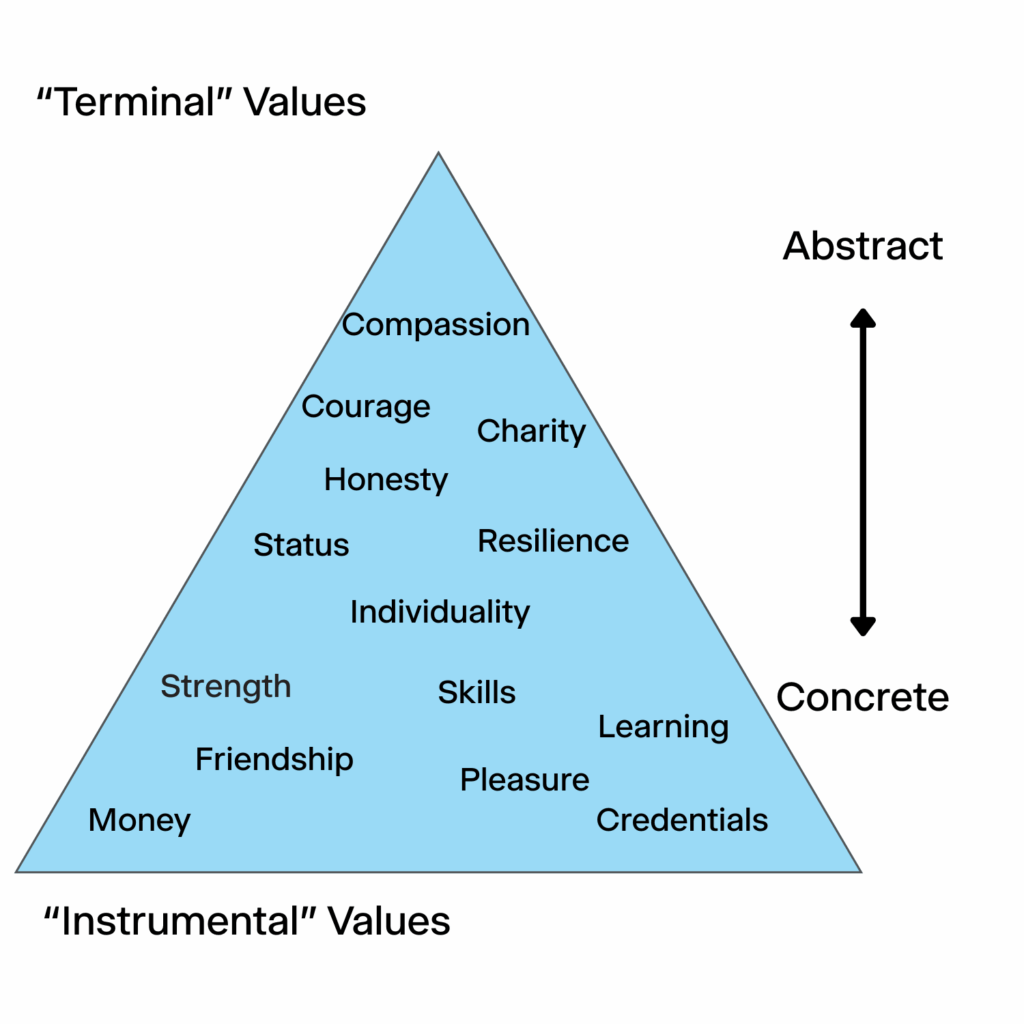
Every human life is built on a quiet framework that most people never stop to notice. Beneath your ambitions, your relationships, your daily routines—beneath the surface of who you believe yourself to be—lies an intricate structure of values. These values are the unseen logic of your existence. They determine what feels meaningful, what provokes guilt, what commands your loyalty, and what you’re willing to fight or suffer for. You live by them long before you can name them.
But here’s the paradox: very few of us actually choose our values. They’re mostly inherited—passed down through the subtle conditioning of childhood, the silent scripts of culture, the emotional tone of family, and the unspoken rules of belonging. Long before we ever reflect consciously, we absorb lessons about what’s admirable and what’s shameful. We learn that obedience earns approval, that achievement earns love, that comfort equals safety. By the time we reach adulthood, this invisible architecture is already standing, quietly dictating the boundaries of our choices.
You can see this inheritance at work in almost every domain of life. A person raised in a household that prized stability above all else might find themselves pursuing a “safe” career, even when their soul craves adventure. Another, brought up to equate worth with performance, may overwork endlessly, unable to feel valuable unless they are productive. We often refer to these tendencies as “personality,” but they’re actually the echo of old value hierarchies. We live out blueprints we never drafted.
The danger of inherited values is that they often conflict with the ones that naturally emerge from your lived experience. When that happens, life begins to feel subtly off-key. You might achieve everything you were taught to desire and still feel an emptiness that success can’t touch. You might wake up in the home, the job, or even the relationship that looked perfect on paper—and realize you built your life on borrowed foundations. That’s when a deeper reckoning begins.
Recognizing this borrowed architecture is uncomfortable because it challenges the very framework of identity. It means admitting that parts of your ambition, morality, or self-image were constructed to please someone else—parents, teachers, society. It means letting go of the comfort of belonging to build something truer but lonelier. The ego resists this fiercely because it threatens the illusion of certainty. Yet every authentic transformation begins with this kind of demolition.
To uncover your core values, you have to strip away the ornamental scaffolding—everything that was installed for appearance rather than function. You do this not by condemning what shaped you, but by interrogating it. Ask: What was I taught to admire? What was I taught to fear? Whose approval guided my decisions? These questions are chisels that help you loosen the stones of false identity.
Eventually, you’ll begin to see where the structure bends toward others’ expectations rather than your own truth. Perhaps you realize you’ve valued harmony so much that you’ve neglected honesty. Or that you’ve pursued success when what you actually wanted was freedom. Each revelation destabilizes the old architecture, but that instability is necessary. The cracks that appear are not signs of collapse—they’re signs of light breaking through.
Real maturity is not about adopting new values; it’s about reclaiming the authorship of the ones that already define your life. It’s about moving from unconscious inheritance to conscious alignment. When you begin to ask, What would I still care about if no one else approved?—you start rebuilding on bedrock rather than sand.
This is the beginning of all clarity. Not the addition of more beliefs, but the quiet subtraction of everything that isn’t truly yours. Only then does the architecture become visible—not as a cage, but as a cathedral designed from within.
Excavating the Self
Finding your core values isn’t about crafting a new identity—it’s about unearthing an ancient one. It’s the psychological equivalent of archaeology. You don’t sit down and invent who you are from scratch. You dig. You brush away the layers of expectation, fear, and imitation that have settled over the years, and what emerges isn’t something you build—it’s something you rediscover.
Most people confuse this excavation with self-improvement. They set out to “fix” themselves as though they were broken machines. But values work isn’t about repair—it’s about revelation. Beneath every adaptation and defense mechanism lies a self that has been constant all along, patiently waiting to be seen. The challenge is that this self is often buried under debris: the debris of trying to be good enough, successful enough, or lovable enough according to other people’s terms.
The first layer you uncover is often discomfort. When you start asking deep questions—What truly matters to me? What am I pretending to care about? What am I afraid to admit I don’t believe in?—you awaken a quiet anxiety. That discomfort is your compass. It means you’ve stopped performing and started paying attention. Real self-discovery always begins with dissonance.
Imagine your identity as a series of masks. Each one represents a role you’ve played—the obedient child, the ambitious professional, the agreeable friend. These masks aren’t lies; they’re adaptive tools. They helped you survive certain environments, earn affection, or avoid punishment. But the longer you wear them, the more they fuse to your face. You forget where the mask ends and you begin. Excavating your values means daring to take them off, one by one, even when it leaves you feeling raw and unrecognizable.
As you dig deeper, you begin to notice recurring patterns—moments in your life when you felt alive, whole, or quietly certain. These are clues. Maybe you’ve always been drawn to creative problem-solving, or found deep satisfaction in helping others find clarity. Maybe you’ve repeatedly clashed with authority, not because you’re rebellious, but because freedom and autonomy are part of your moral DNA. These recurring themes are not random—they’re the fossils of your authentic values.
To excavate them properly, you must practice radical honesty. That means admitting the gap between the values you claim to hold and the ones you actually live. You may tell yourself you value integrity, but do you compromise when it’s inconvenient? You may think you value generosity, but does your calendar or bank statement reflect it? Confronting these discrepancies isn’t about guilt—it’s about alignment. The goal is to bring your lived reality closer to your declared ideals.
And yet, this process isn’t linear. You will oscillate between clarity and confusion, pride and shame. Some discoveries will liberate you; others will humble you. You might realize you’ve built parts of your identity on fear—the fear of disappointing others, of losing approval, of standing alone. When you name those fears, they lose their power. Beneath them lies a truer compass, one that doesn’t need external validation to point north.
Excavation also requires compassion. As you uncover old wounds or misplaced priorities, it’s tempting to judge your past self for being blind or weak. Don’t. Every false value you once clung to served a purpose—it protected you until you were ready to outgrow it. Excavation is not demolition; it’s preservation of what’s real beneath what was necessary.
With time, you begin to notice something miraculous. The more you strip away, the lighter you feel. What once seemed like identity loss becomes liberation. You no longer carry the burden of living someone else’s definition of “enough.” You start to make decisions that feel less like calculations and more like recognition—an intuitive “yes” that comes from the bones.
This is the quiet power of excavation. You stop striving to become and start remembering what it feels like to be. The process doesn’t end in certainty—it ends in coherence. You begin to act, speak, and live from the same center. And that alignment, though fragile at first, grows stronger with every honest choice you make.
When you reach that point, you realize something profound: authenticity isn’t something you find—it’s what’s left when you stop pretending.
Thought Experiments to Find Your Values
Introspection is a slippery art. Ask someone what they value, and they’ll often repeat whatever sounds noble—honesty, kindness, family, success. But if you look closely at their life, those declarations often don’t hold up. They might say they value health while neglecting their body, or claim integrity while bending truth for convenience. It’s not hypocrisy; it’s blindness. We mistake what we admire for what we live.
That’s why abstract reflection isn’t enough. You can’t think your way to your core values—you have to feel your way there. The best way to do that is through thought experiments that bypass logic and tap into emotion. They help you see the tension between who you say you are and who you actually are when no one’s watching.
These mental exercises aren’t intellectual games; they’re mirrors. They reveal what you love, what you fear, what you crave, and what you’re willing to endure. The key is honesty—not the polished kind that sounds good, but the raw kind that stings a little.
The Ideal Day Exercise
If you could live one perfect day, free of judgment, consequence, and obligation—what would you do? Don’t overthink it. Don’t censor it. Just imagine waking up with absolute freedom.
Would you stay in bed, walk through nature, or start a new project? Would you spend it alone, with family, or with strangers? Would it be quiet or full of motion?
Now look for patterns, not details. If your ideal day centers on solitude, maybe you value peace or introspection. If it overflows with conversation, you might value connection or contribution. If you imagine creating or building, your value might be mastery or self-expression.
The ideal day reveals what energizes you—not what you think should matter, but what naturally calls you. When repeated enough times, this visualization becomes diagnostic: it shows you not who you wish to be, but who you already are beneath routine and performance.
The Reverse Eulogy
Imagine your funeral. The people you love most stand before a crowd, speaking about your life. What would you want them to say?
Most people focus on achievements—they want to be remembered as successful, ambitious, or accomplished. But sit with the question longer, and the tone changes. You start to care less about what you did and more about how you were. You want to be remembered for your character: for being kind, courageous, consistent, compassionate.
The reverse eulogy strips away vanity. It doesn’t care about what you achieved in the world; it cares about the imprint you left on others. It forces you to define success not in external terms but in emotional ones.
Ask yourself: If I lived the next ten years guided by the qualities I want mentioned in my eulogy, what would change about my daily life right now? The answer often exposes the gap between your intention and your practice.
The Trade-Off Test
Every value costs something. The mistake people make is believing they can have all virtues in equal measure. But life is a constant negotiation between conflicting goods: freedom versus stability, ambition versus balance, honesty versus diplomacy.
Ask yourself: What am I willing to suffer for?
The things you’re willing to sacrifice for—time, energy, comfort, approval—reveal your deepest loyalties.
If you’re willing to face rejection for creativity, you value self-expression. If you’re willing to risk comfort for integrity, you value truth over ease. If you’ll tolerate discomfort to protect someone else’s dignity, you value compassion.
Pain is the purest test of value because it can’t be faked. We’ll always choose to endure suffering only when it serves something sacred to us. Every act of devotion, every late night, every argument worth having—these are offerings to the gods of your internal hierarchy.
So the next time you feel drained, ask: What value am I paying for right now? If the cost feels pointless, you’re probably living by someone else’s priorities.
The Mirror Question
Whose approval do you crave most—and why?
This question exposes your hidden allegiances. You might think your actions are guided by reason, but often, they’re guided by a need to be seen a certain way by someone whose opinion still shapes you—a parent, a mentor, a peer group, even a phantom version of yourself from years ago.
Craving approval isn’t inherently wrong—it’s human. But when that craving dictates your choices, you become an actor in someone else’s story. Your values warp to fit their expectations. The moment you realize this, you gain the power to step off their stage.
Ask yourself: If no one I admire were watching, what would I still do? The answer to that question is your authentic compass. It separates intrinsic motivation (what you find meaningful) from performative morality (what earns applause).
These exercises aren’t meant to give you tidy answers. They’re meant to unsettle you—to expose the fractures between who you pretend to be and who you are when the pretending stops.
If you approach them sincerely, patterns begin to emerge. The same emotions, the same themes, the same values rise again and again like symbols in a dream: freedom, curiosity, stability, contribution, truth, love. Write them down. Sit with them. Then compare them against how you actually live.
The real revelation comes not from what you discover, but from what you can no longer ignore. Your life is already broadcasting your values—your attention, your time, your energy are the evidence. These thought experiments simply tune you to the right frequency to hear it.
The Instrumental Value of Golf
At first glance, golf seems like a simple pastime—a leisurely game for the patient and privileged. Yet beneath its calm surface lies an entire moral philosophy. Golf is not really about winning; it’s about integrity, restraint, and alignment. Every swing is a microcosm of human character, testing how well your inner world holds under quiet pressure. The fairway becomes a mirror—one that reflects your values more clearly than any self-help book ever could.
In golf, the objective is simple but unforgiving: guide a small white ball into a distant hole using the fewest strokes possible. But the true challenge lies in the invisible dimensions—discipline, composure, and honesty. There’s no referee watching your every move. It’s up to you to call your own penalties, to admit when your ball moved, to correct your score even if no one else noticed. This self-regulation is what makes the game spiritual. It demands moral alignment as much as physical precision.
The same holds true in life. Most of your moral tests happen when no one is watching. Your reputation may depend on how you perform in public, but your integrity is defined by what you do in private. Golf dramatizes this principle—it’s not a game of spectacle, but of self-control. Success comes not from dominating others, but from mastering your own impulses.
Now, consider the deeper metaphor: in philosophy, we often talk about intrinsic versus instrumental values. An intrinsic value is good in itself—honesty, love, curiosity. An instrumental value is valuable only because it leads to something else—money, fame, power, recognition. Most people say they live by intrinsic values, yet spend their lives chasing instrumental ones. Golf exposes this contradiction perfectly.
When you play solely to win—to collect trophies, admiration, or superiority—you lose the essence of the game. The obsession with outcomes corrupts the process. You start cutting corners, losing patience, or blaming conditions. But when you play for the love of precision, for the rhythm of the swing, for the meditative repetition—you begin to experience flow. The paradox is that the moment you stop obsessing over the score, your performance actually improves.
Life works the same way. Many people treat success as a scoreboard—numbers in a bank account, followers online, symbols of achievement. These are instrumental goals, and there’s nothing wrong with them—until they replace the very values they were meant to serve. You chase wealth for freedom, but the pursuit enslaves you. You chase fame for connection, but the spotlight isolates you. You chase excellence for pride, but it becomes perfectionism. Every instrumental value carries the risk of inversion—it starts as a means, then quietly becomes the end.
Golf, in this sense, is training for moral clarity. It teaches that consistency is more important than flash, that control outweighs force, that patience outperforms intensity. It’s a game that rewards humility—the willingness to adjust your stance, to admit your errors, to start over after every bad shot. Each hole becomes a miniature philosophy lesson: alignment matters more than ambition, tempo more than speed, presence more than power.
When you stand at the tee, club in hand, staring down a long fairway, you’re not just measuring distance—you’re measuring self-trust. You have to let go of control without losing focus. You have to strike with conviction but remain unattached to the outcome. That’s a metaphor for every meaningful pursuit—love, work, art, leadership. The swing matters more than the applause.
The deeper lesson is this: your life, like golf, is a game of invisible rules. You can cheat others, but you can’t cheat yourself. The scorecard may impress the world, but only you know whether the numbers are true. Living by your values means choosing the honest swing every time—even when no one sees, even when it costs you the game.
If you live that way, success ceases to be a performance and becomes a byproduct. You start to feel that quiet satisfaction that comes not from victory but from alignment—the rare peace of knowing your inner game matches your outer one.
In the end, values function like the invisible physics of golf. They don’t just determine how you swing; they determine why you swing at all. Are you chasing the trophy or chasing truth? Are you playing for the crowd or for coherence?
The fairway is life itself. The ball is your intention. The swing is your action. And the course? That’s your character. You can’t control the wind, the terrain, or the bounce—but you can control your form. That’s all mastery ever asks of you: not perfection, just integrity in motion.
When Life Reshuffles the Deck
There are moments when everything you’ve built suddenly collapses—careers dissolve, relationships end, plans implode, and you find yourself staring at the fragments of what you thought was a solid life. At first, it feels like devastation. But underneath the chaos, something else is happening. Life is quietly reorganizing your values. It’s reshuffling the deck, forcing you to see which cards still matter and which were only ever borrowed illusions.
Trauma, heartbreak, loss, and failure are not interruptions to life’s rhythm—they are the rhythm. They strip away the nonessential. They take what you’ve outgrown but refused to release. In those moments, your priorities aren’t politely adjusted; they’re violently rearranged. You’re forced to confront what’s truly worth clinging to and what no longer deserves the weight of your loyalty.
Pain is a purifier. It burns through the false values we construct in comfort. When everything is easy, you can afford to lie to yourself—to chase status, to fake confidence, to pretend that your calendar reflects meaning. But when the ground gives way, only the essentials remain. A health scare makes you realize that vitality outranks vanity. A betrayal teaches you that trust is sacred. A failure exposes that integrity feels better than applause. Suffering is not random punishment—it’s radical clarity.
Consider what happens after profound loss. The grieving person often speaks in different terms than before. They talk about presence, connection, gratitude. The metrics of worth shift from how much to how real. The illusion of control fades, replaced by humility and appreciation. That transformation doesn’t come from intellectual insight—it comes from being broken open.
Trauma can be cruel, but it’s also honest. It doesn’t care about your plans, your ego, or your reputation. It dismantles every fragile identity built on pretense and leaves you with what can’t be destroyed. That indestructible core—that’s your true value system. It’s not chosen; it’s revealed through endurance.
Philosophers call this process post-traumatic growth—the phenomenon where adversity doesn’t just scar you; it refines you. You don’t emerge as the same person with a few new lessons. You emerge with an entirely reconfigured sense of what matters. It’s not that pain creates meaning; it exposes it. You learn that peace isn’t the absence of hardship—it’s the alignment that remains once everything unnecessary has fallen away.
When life reshuffles the deck, you have two choices: resist or realign. Resistance looks like nostalgia, the desperate attempt to restore what once was. You cling to broken patterns, try to resurrect obsolete goals, or mourn the loss of an identity that was already decaying. Realignment, however, looks like surrender—not in defeat, but in awareness. You accept that the old framework can no longer contain who you’ve become. You start asking quieter, braver questions: What truth am I being asked to live now?
This reshuffling happens many times throughout life, not just once. The values that guided you in your twenties may not serve you in your forties. The ones that fit you in youth might suffocate you in maturity. We tend to idolize consistency, but real wisdom lies in fluidity. To evolve is not to betray your past—it’s to remain faithful to the truth as it changes shape.
Every rupture, every heartbreak, every disappointment is a subtle invitation to return to authenticity. Life will keep rearranging the cards until your outer choices match your inner truth. Sometimes, it will use discomfort as a whisper. Other times, it will use disaster as a megaphone. Either way, the message is the same: it’s time to reorder your values.
And when you finally do, something remarkable happens. The chaos doesn’t end, but it starts to make sense. You stop fearing change because you realize it’s not the enemy—it’s the architect. Each disruption is not the destruction of meaning but its reconstruction. The storm doesn’t wash away who you are; it clears the debris so you can finally see it.
So when life reshuffles your deck, don’t rush to pick up the cards. Let them fall. Study what remains on the table. You’ll find that what’s left—love, courage, presence, integrity—isn’t fragile at all. It’s the solid ground on which every new beginning stands.
Testing Your Values in the Real World
You can spend years talking about values, writing them down, refining them, and still have no idea if they’re real. A value isn’t real until it costs you something. It’s not the words on your wall or the list in your journal—it’s the pattern in your behavior when life becomes inconvenient. The real measure of your values isn’t what you say when it’s easy; it’s what you do when your comfort, ego, or reputation is at stake.
This is why philosophy means nothing without practice. You can’t confirm a value through contemplation alone—you have to verify it in friction. Every choice you make, every compromise you tolerate, every line you refuse to cross becomes a quiet test. Each moment asks, Do you mean what you say you believe?
If you claim to value honesty, what happens when the truth threatens your image? If you claim to value freedom, what happens when security tempts you to settle? If you say you value love, what happens when forgiveness feels humiliating? These aren’t hypotheticals—they’re daily exams in integrity. And every small decision, no matter how trivial it seems, either reinforces your declared values or contradicts them.
The simplest way to see what you truly value is to audit your life. Forget what you tell yourself—look at what your days reveal. Open your calendar: how do you spend your time? Open your wallet: where does your money go? Open your mind: what occupies your thoughts most often? These three ledgers—time, money, and attention—are the truest confessions of your priorities. They don’t lie, because they record what you actually worship.
If you say family comes first, but your schedule never reflects it, that’s a misalignment. If you say health is sacred, but you constantly sacrifice it for work, that’s self-deception. If you say growth matters, but you avoid challenge, that’s fear masquerading as value. The solution isn’t guilt—it’s adjustment. Alignment doesn’t require perfection; it requires honesty. The gap between your values and your actions isn’t a failure—it’s feedback.
Living in alignment with your values means making small, consistent choices that reinforce what matters most, even when it’s inconvenient. It might mean leaving a lucrative job that conflicts with your ethics. It might mean setting boundaries with people you love. It might mean saying no to opportunities that look impressive but feel wrong. These are not easy decisions. But each time you choose integrity over approval, coherence over comfort, your life begins to straighten itself.
The beauty of values is that they scale. They don’t just guide moral dilemmas; they shape everyday details. A person who values curiosity reads differently, listens differently, travels differently. Someone who values discipline wakes up differently. Someone who values peace argues differently. When your actions and principles finally sync, life feels less like management and more like music—you’re not forcing harmony; you’re living in rhythm.
Of course, alignment is not static. Circumstances evolve, and so do you. What felt sacred at one point may lose its relevance as your world expands. That’s why self-reflection must become a recurring ritual. At least once in a while, stop and ask yourself: Are the values I’m living still the values I believe? This question isn’t about doubt—it’s about maintenance. Just as instruments require tuning, your moral compass does too.
The most profound indicator of value alignment is peace. Not the fleeting calm that comes from comfort, but the steady stillness that comes from congruence. When what you do, say, and believe begin to echo one another, tension dissolves. You stop chasing validation because your integrity becomes its own reward. You stop performing goodness and start embodying it.
And that’s the quiet irony of values—they don’t need to be declared loudly to be lived deeply. The people who are most grounded in theirs rarely talk about them. You can see it in how they listen, how they decide, how they show up when no one else does. Their actions hum with coherence.
To test your values, you don’t need a crisis. You just need awareness. Watch what you choose when no one’s watching. Notice which promises you keep when no one will notice if you break them. That’s where your values reveal themselves—in the invisible moments, in the small, unglamorous choices that define who you are when the world isn’t looking.
So ask yourself, sincerely: Does my calendar match my character? It’s a confronting question because it’s measurable. You can’t bluff your way through it. But when your answer begins to resemble “yes,” something extraordinary happens. You stop living reactively and start living deliberately. You stop chasing the illusion of a “balanced” life and begin to experience an integrated one.
In the end, values are not meant to decorate your identity—they’re meant to direct it. They are the internal physics of a coherent existence, the silent laws that keep you upright when the world tilts. Testing them in the real world isn’t a burden—it’s a privilege. Because the more your life reflects what you truly value, the less you need to prove anything to anyone, including yourself.
Living in Alignment
Living by your values isn’t about perfection—it’s about coherence. You will falter, contradict yourself, and evolve. That’s the point. The goal isn’t to become unshakably certain but to remain internally consistent as you grow.
Think of it like tuning an instrument. You don’t tune it once; you adjust constantly, listening for harmony. Life is the same. Your values aren’t static—they breathe with you.
In the end, your values are not what you declare—they’re what remain when the noise stops. Find them, honor them, and let them quietly shape the way you move through the world.