
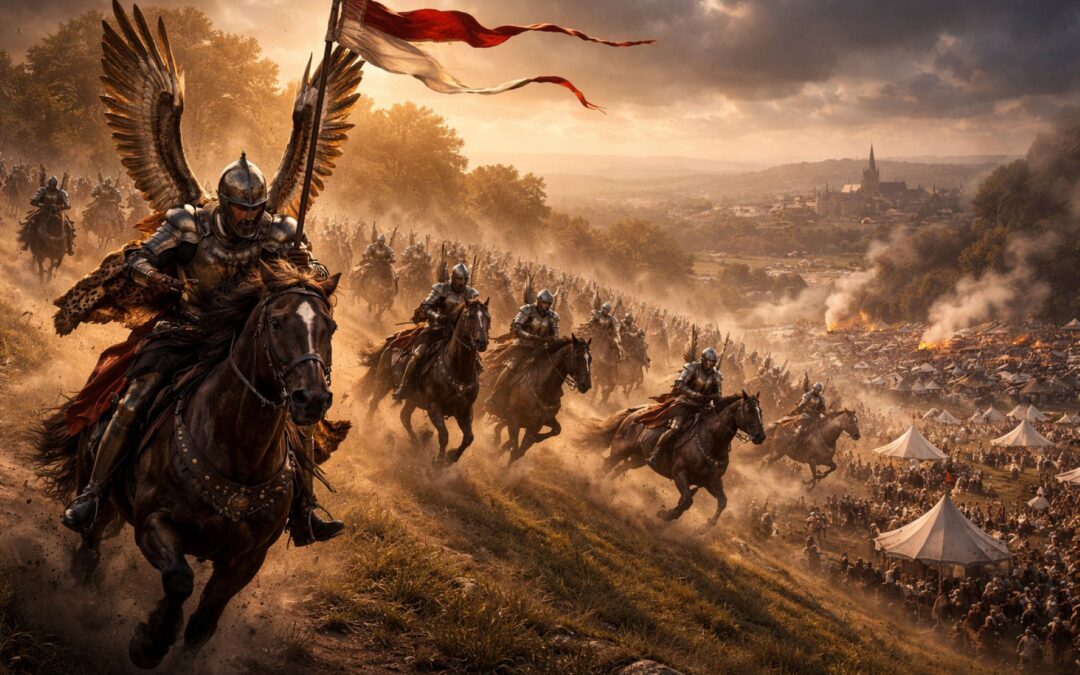
On the morning of 12 September 1683, the fate of Europe hung in the balance outside the walls of Vienna. For nearly two months, the city had endured one of the most intense sieges in early modern history. A vast Ottoman army under Grand Vizier Kara Mustafa Pasha surrounded the Austrian capital, its trenches creeping steadily closer to the walls while miners dug tunnels beneath the fortifications to blast them apart. Inside the city, disease spread, food supplies dwindled, and the exhausted defenders struggled to hold the collapsing defenses. Many believed Vienna’s fall was only a matter of days.
Yet beyond the hills overlooking the city, a relief army was gathering. Soldiers from across Europe—Austrians, Germans, Poles, and others—had assembled in a desperate coalition to break the siege. Leading them was King John III Sobieski of Poland, a seasoned commander whose elite heavy cavalry included the legendary Winged Hussars, widely regarded as the most formidable horsemen in Europe. If they failed, Vienna would almost certainly fall, opening a path for the Ottoman Empire to push deeper into the heart of the continent.
By the afternoon of that day, the battle reached its decisive moment. From the heights above Vienna, Sobieski unleashed an enormous cavalry assault. In four massive columns, around 18,000 horsemen thundered downhill, lances lowered as they crashed into the Ottoman lines. It was the largest cavalry charge in history—and within hours it shattered the besieging army and lifted the siege of Vienna.
The events of 1683 were far more than a dramatic battlefield victory. The Siege of Vienna marked a turning point in European history, halting the Ottoman Empire’s westward expansion and triggering a new phase of wars that would gradually push Ottoman power back across southeastern Europe. For centuries afterward, the battle would be remembered as the moment when the balance of power between two great civilizations began to shift.
To understand why Vienna mattered so much—and how the clash unfolded—it is necessary to explore the centuries of rivalry that led to that dramatic September day when the fate of Europe was decided outside the city’s walls.
Europe on the Edge: The Rise of Ottoman Power
The Fall of Constantinople and the Ottoman Expansion
The story of the Siege of Vienna cannot be understood without looking back to 1453, the year the Ottoman Empire captured Constantinople, the capital of the Byzantine Empire. When Sultan Mehmed II finally breached the city’s legendary walls after a long siege, the event sent shockwaves across Europe. Constantinople had been one of the great cities of Christendom for more than a thousand years. Its fall symbolized not only the collapse of the Byzantine Empire but also the dramatic rise of a new imperial power.
From their new capital on the Bosporus, the Ottoman sultans rapidly expanded their domains. Over the next century, the empire conquered vast territories across the Balkans, the eastern Mediterranean, and the Middle East. Powerful Ottoman armies advanced through southeastern Europe, bringing regions such as Serbia, Bulgaria, Greece, and much of Hungary under their rule.
This expansion was driven by a combination of political ambition, military organization, and ideological legitimacy. The Ottoman rulers presented themselves as heirs to the legacy of the Roman emperors who had once ruled from Constantinople. At the same time, they framed their conquests as part of a broader struggle that blended imperial expansion with religious identity.
Ottoman military power during this period was formidable. The empire fielded highly disciplined troops, including the famous Janissaries, elite infantry units recruited and trained through the devshirme system. Alongside them were skilled cavalry forces such as the Sipahis, as well as artillery units that had become increasingly important in early modern warfare. These forces allowed the Ottomans to project power across enormous distances and defeat many of their rivals.
By the early sixteenth century, under the rule of Suleiman the Magnificent, the Ottoman Empire reached the height of its territorial expansion. Suleiman’s campaigns pushed deep into Central Europe, defeating Hungarian armies and establishing Ottoman dominance across large parts of the region. The empire now stood at the doorstep of the Habsburg lands, the heart of Central Europe.
Why Vienna Became the Gateway to Europe
At the center of this growing confrontation stood the city of Vienna. Strategically located along the Danube River, Vienna occupied one of the most critical positions in Europe. The city lay at the crossroads between the Balkans, Central Europe, and the German states. Whoever controlled Vienna possessed a gateway that could open routes deeper into the continent.
The geography of the region made this location even more significant. To the west lay the Alps, forming a natural barrier that limited large-scale military movement. To the east stretched the plains of Hungary, terrain that allowed armies to maneuver with relative ease. Vienna therefore served as the key defensive position protecting the routes into southern Germany, northern Italy, and the wider Holy Roman Empire.
For the Habsburg dynasty, which ruled Austria and held the title of Holy Roman Emperor, Vienna was not merely a strategic fortress—it was the political heart of their realm. Losing the city would mean exposing the entire region to Ottoman invasion and potentially destabilizing the balance of power across Europe.
For the Ottomans, however, capturing Vienna offered the possibility of something even greater. With the city in their hands, Ottoman armies could march further west into the fragmented territories of the Holy Roman Empire, where dozens of rival states and princes struggled to coordinate their defenses. From Vienna, campaigns could potentially threaten southern Germany, northern Italy, and even the road to Rome.
This strategic reality turned Vienna into one of the most coveted objectives in European warfare. By the early sixteenth century, the Ottoman leadership understood that controlling this city could unlock the door to the rest of Europe.
The first attempt to seize that key would come in 1529, when the greatest Ottoman ruler of the age personally led his army to Vienna’s walls.
The First Ottoman Attempt to Take Vienna
Suleiman the Magnificent and the Siege of 1529
The first great confrontation between the Ottoman Empire and Vienna occurred more than 150 years before the famous siege of 1683. In 1529, Sultan Suleiman the Magnificent, widely regarded as the most powerful Ottoman ruler in history, led a massive army into Central Europe with the aim of capturing the city.
Suleiman had already established Ottoman dominance across much of southeastern Europe. His forces had crushed the Kingdom of Hungary at the Battle of Mohács in 1526, killing King Louis II and shattering Hungary’s defenses. In the years that followed, the Ottomans occupied large portions of the country and installed a loyal ruler in the eastern regions while the Habsburg dynasty attempted to assert control over the rest.
This power struggle over Hungary quickly escalated into a direct confrontation between the Ottomans and the Habsburgs. For Suleiman, Vienna represented the ultimate strategic prize. Capturing the city would not only cripple Habsburg resistance but also open the road deeper into the fragmented states of Central Europe.
In the spring of 1529, Suleiman assembled a vast army and began marching northward. Contemporary estimates vary widely, but the Ottoman force likely numbered well over 100,000 soldiers, accompanied by thousands of camp followers, supply wagons, and artillery pieces. As the army advanced through Hungary toward Austria, towns and fortresses fell one by one.
By late September, the Ottoman army reached Vienna and began preparing for a siege.
The defenders of Vienna were vastly outnumbered. The city’s garrison consisted of around 20,000 soldiers, including German mercenaries and local militia. Under the command of Count Niklas von Salm, the defenders hastily strengthened the city’s walls and prepared for a desperate fight.
Ottoman artillery soon opened fire on Vienna’s fortifications while engineers began digging tunnels beneath the walls in an attempt to place explosive charges. The defenders responded with their own countermining efforts, attempting to intercept the tunnels before they reached the city’s foundations.
Despite their numerical advantage, the Ottomans quickly ran into serious problems. Vienna’s defensive walls proved stronger than expected, and the approaching autumn weather created major difficulties for the besieging army. Heavy rain turned the surrounding terrain into mud, slowing movement and disrupting supply lines that stretched hundreds of kilometers back into Ottoman territory.
Why the Ottomans Failed the First Time
As the siege dragged on, the Ottoman army faced mounting logistical challenges. Many of their heavy artillery pieces had been abandoned earlier in the campaign because muddy roads made transport impossible. Without sufficient heavy guns, it became far more difficult to breach Vienna’s fortifications.
Meanwhile, the defenders fought with remarkable determination. Each time Ottoman miners blew holes in the walls, the garrison rushed forward to block the breaches with makeshift barricades. Fierce hand-to-hand fighting erupted in the shattered sections of the defenses as Ottoman soldiers attempted to storm the city.
The worsening weather made matters even worse for Suleiman’s forces. Cold rains and early snowfall began to set in as October approached. Ottoman troops, many of whom had marched for months through difficult conditions, struggled with fatigue, illness, and dwindling supplies.
Realizing that the siege was unlikely to succeed before winter, Suleiman made the difficult decision to abandon the attempt. In mid-October 1529, the Ottoman army lifted the siege and began retreating southward.
Although the campaign had failed to capture Vienna, it demonstrated just how vulnerable Central Europe had become to Ottoman military power. The Habsburgs and their allies had narrowly escaped a disaster that might have reshaped the political map of Europe.
After this setback, Ottoman expansion in Central Europe slowed considerably. A long and uneasy frontier emerged across Hungary, dividing the Ottoman and Habsburg spheres of influence. Skirmishes and limited wars continued along this border for decades, but Vienna itself would remain safe from direct attack.
For more than a century, the city stood as a tense frontier between two great empires. But by the late seventeenth century, new political and religious tensions would reignite the conflict—and Vienna would once again become the ultimate prize.
The Political Crisis That Reignited War
Religious Tensions in Central Europe
By the late seventeenth century, the fragile balance between the Habsburg Monarchy and the Ottoman Empire had begun to unravel. The long frontier that stretched across Hungary had remained relatively stable for decades, but beneath the surface, political and religious tensions were steadily building.
The Holy Roman Emperor Leopold I, who ruled the Habsburg lands, was a staunch defender of Catholicism. During his reign, the Habsburg government aggressively pursued policies aimed at reversing the spread of Protestantism within its territories. This effort formed part of the broader Counter-Reformation, a movement within the Catholic Church that sought to restore Catholic dominance in regions that had embraced Protestant beliefs during the sixteenth century.
These policies created deep resentment, particularly in Hungary, where a large portion of the population adhered to Protestant denominations such as Calvinism and Lutheranism. Many Hungarian nobles and landowners feared losing their religious freedoms as well as their political autonomy under Habsburg rule.
As imperial pressure increased, opposition within Hungary began to organize. What started as political dissatisfaction soon evolved into open rebellion.
The Hungarian Rebellion and Ottoman Intervention
The most prominent leader of the anti-Habsburg movement in Hungary was Imre Thököly, a young Protestant nobleman who became the face of resistance against imperial authority. By the early 1680s, Thököly had rallied a considerable following among Hungarian nobles, soldiers, and dissatisfied peasants.
Recognizing that his forces alone could not defeat the Habsburg Empire, Thököly sought assistance from the Ottomans. This request presented the Ottoman leadership with a valuable opportunity. Supporting the rebellion would weaken the Habsburgs and potentially reopen the path toward further expansion into Central Europe.
The Ottoman Grand Vizier Kara Mustafa Pasha, one of the most ambitious statesmen of his time, quickly recognized the strategic potential of the situation. Kara Mustafa had long sought a major military victory that could elevate his prestige within the Ottoman court. Supporting the Hungarian rebels offered him a chance to launch a large-scale campaign against the Habsburg Empire.
In 1682, the Ottomans formally recognized Thököly as the ruler of Upper Hungary, effectively creating a pro-Ottoman buffer state along the frontier. Ottoman forces began providing military assistance to his rebellion, escalating the conflict with the Habsburgs.
But Kara Mustafa had far grander ambitions than simply supporting a regional uprising.
Kara Mustafa Pasha’s Ambition
Kara Mustafa believed that the moment had arrived for the Ottoman Empire to strike decisively at its long-standing rival. With Habsburg authority weakened by internal rebellion and European powers divided by their own rivalries, he saw an opportunity to revive the Ottoman dream of conquering Vienna.
Convincing the Ottoman Sultan Mehmed IV to authorize a major campaign, Kara Mustafa framed the operation as an effort to assist their Hungarian allies. In reality, however, the true objective was unmistakable. Vienna, the symbolic and strategic heart of Habsburg power, had once again become the target.
Preparing such an expedition required enormous resources. Over the following months, Ottoman administrators worked to organize one of the largest military campaigns the empire had ever attempted. Roads and bridges across the Balkans were repaired, supply depots were stocked, and troops from across the vast Ottoman domains were summoned to join the army.
By early 1683, an enormous force had assembled. Soldiers from across the Ottoman world—including elite Janissary infantry, Sipahi cavalry, and contingents from various vassal states—prepared to march toward Central Europe.
As the army gathered strength, the scale of the coming conflict began to alarm observers across Europe. Many rulers understood that if the Ottomans succeeded in capturing Vienna, the political and military consequences could be profound.
But Europe itself remained deeply divided—and few leaders initially realized just how close the Ottoman army was to the gates of Vienna.
The Ottoman Army Marches Toward Vienna
Assembling One of the Largest Armies in Europe
Preparing an expedition against Vienna required the Ottoman Empire to mobilize enormous resources. Grand Vizier Kara Mustafa Pasha spent months organizing what would become one of the largest military campaigns of the seventeenth century.
Across the Ottoman domains, orders were sent to provincial governors and vassal rulers to assemble troops for the coming campaign. The core of the army consisted of the empire’s elite forces: the Janissaries, disciplined infantry trained for siege warfare, and the Sipahis, heavily armed cavalry drawn from the Ottoman feudal system. These troops formed the backbone of the imperial army and had long been responsible for many of the empire’s greatest victories.
In addition to these central units, the Ottoman army was reinforced by a wide range of auxiliary forces from across the empire and its client states. Contingents arrived from Transylvania, Wallachia, and Moldavia, while the Crimean Khanate sent large numbers of Tatar cavalry who specialized in fast-moving raids and reconnaissance.
Alongside the soldiers marched the immense logistical apparatus required to sustain such an army. Siege artillery, wagons loaded with gunpowder and supplies, engineers, laborers, camels, horses, and thousands of camp followers accompanied the expedition. The Ottoman military machine was not merely an army—it was a moving city that stretched for miles across the landscape.
Contemporary estimates suggest that the total Ottoman force involved in the campaign may have reached as many as 150,000 to 170,000 men, making it one of the most formidable armies assembled in Europe during the early modern period.
The Advance Through the Balkans and Hungary
With preparations complete, the Ottoman army began its march in early 1683 from the city of Edirne, one of the empire’s major administrative centers in the Balkans. From there, the massive force advanced northwestward through the Balkans toward Hungary, following well-established military roads that had been used in earlier campaigns.
The scale of the army’s movement was staggering. Columns of soldiers, artillery, and supply trains stretched across the countryside, while engineers worked ahead of the army repairing roads and strengthening bridges to ensure that the massive force could continue its advance.
As the Ottomans moved closer to Habsburg territory, local populations watched anxiously. Towns and villages along the frontier braced for the arrival of the imperial army, aware that the campaign could bring devastation if resistance was offered.
Meanwhile, news of the Ottoman advance spread across Europe. Reports of a massive army moving toward Austria created alarm among European rulers, many of whom understood that Vienna was the likely objective. Yet political divisions across the continent made a coordinated response difficult.
By the summer of 1683, the Ottoman army had crossed into Austrian lands and continued its steady advance toward the Habsburg capital. The scale and speed of the campaign soon made it clear that Vienna itself was in grave danger.
Inside the city, preparations for defense began in earnest—but even before the Ottoman army arrived, Vienna would experience a moment of panic that revealed just how uncertain its fate had become.
Vienna Prepares for the Worst
The Emperor Flees the Capital
As news of the massive Ottoman army moving through Hungary reached Vienna, the situation quickly became clear: the city itself was the target. For the Habsburg monarchy, the prospect was alarming. Vienna was not only the political center of their power but also one of the most important cities in Central Europe. If it fell, the consequences for the entire region could be catastrophic.
Faced with the imminent arrival of the Ottoman army, Emperor Leopold I made a controversial but pragmatic decision. Rather than risk being trapped inside a besieged city, he chose to leave Vienna and relocate the imperial court to safety.
On 7 July 1683, Leopold departed the capital along with his family, senior officials, and important state archives. The imperial treasury and other valuable items were hurriedly transported away from the city to prevent them from falling into enemy hands.
The emperor’s departure triggered widespread panic among Vienna’s inhabitants. As word spread that the imperial court was fleeing, thousands of civilians began leaving the city as well. Carriages, wagons, and long columns of refugees streamed out of Vienna’s gates, hoping to escape the coming siege.
Historians estimate that around 60,000 residents, nearly half of Vienna’s population at the time, fled in the days before the Ottoman army arrived. Those who remained behind understood that they would soon be trapped inside a city surrounded by one of the largest armies in Europe.
Count Ernst Rüdiger von Starhemberg and the Defense
With the emperor gone, responsibility for defending Vienna fell to Count Ernst Rüdiger von Starhemberg, a seasoned Austrian military commander known for his discipline and determination. Starhemberg was fully aware that the city would face an enormous challenge.
The available defenders numbered around 15,000 men, including professional soldiers, militia units, and armed citizens. Although this force was vastly outnumbered by the approaching Ottoman army, Starhemberg believed that Vienna’s fortifications could still hold long enough for a relief army to arrive.
The city’s defenses were strengthened with roughly 370 cannons, positioned along the walls and bastions to repel enemy assaults. Every available soldier and volunteer was assigned to defensive positions, while engineers inspected the fortifications for weaknesses.
Starhemberg also knew that the key to survival would be endurance. If the defenders could hold the walls long enough, there remained the possibility that allies from across Europe might assemble a relief force.
Preparing the City for Siege
In the final days before the Ottomans arrived, Vienna’s defenders made urgent preparations for the coming siege. One of the first steps was to clear the area surrounding the city’s walls.
Buildings, houses, and entire suburbs outside the fortifications were deliberately destroyed. Although this meant sacrificing large sections of the city’s outskirts, the destruction created a wide open space that would expose any approaching enemy troops to defensive fire from the walls.
Food and supplies were gathered wherever possible, though the sudden exodus of civilians and the speed of the Ottoman advance meant that the city’s stockpiles were far from ideal. Once the siege began, resupply from the outside world would become almost impossible.
By mid-July, Vienna stood ready as best it could. The fortifications were manned, the artillery positioned, and the defenders prepared for the worst.
On 14 July 1683, the Ottoman army finally arrived outside the city. As thousands of tents spread across the plains around Vienna, the grassy fields beyond the walls were transformed into a vast military camp.
The long-awaited siege had begun.
The Siege Begins
Ottoman Siege Warfare and Trench Systems
When the Ottoman army arrived outside Vienna on 14 July 1683, Grand Vizier Kara Mustafa Pasha established his headquarters in a grand command tent that quickly became the center of an enormous military encampment. Across the plains surrounding the city, thousands of tents and pavilions appeared as soldiers, engineers, and support personnel settled into position. What had once been open farmland soon resembled a sprawling city of canvas and banners.
Following established Ottoman custom, Kara Mustafa initially offered the defenders a chance to surrender. Envoys approached the city with a clear ultimatum: if Vienna capitulated peacefully, its inhabitants would be spared. If the city resisted, however, the Ottomans would show no mercy.
The defenders refused without hesitation. They had heard reports of what had happened at nearby towns that had surrendered, where promises of safety were ignored and civilians were enslaved or killed. Knowing this, Count Starhemberg and the defenders chose to resist at all costs.
Soon after, the siege began in earnest.
Ottoman engineers started digging an elaborate system of zigzagging trenches that gradually advanced toward the city’s walls. These trenches allowed soldiers and artillery crews to move closer to the fortifications while remaining partially protected from cannon fire. Step by step, the Ottoman siege lines crept closer to Vienna.
At the same time, around 130 Ottoman cannons began bombarding the city day and night. The thunder of artillery echoed constantly across the battlefield as Ottoman gunners attempted to weaken Vienna’s defenses.
Yet the bombardment achieved less than Kara Mustafa had hoped. Vienna’s fortifications had been strengthened during previous decades and proved far more resilient than expected. The thick walls absorbed much of the artillery fire, forcing the Ottomans to rely on other methods to break through.
Mining the Walls of Vienna
Unable to quickly breach the walls with artillery, the Ottoman commanders turned to one of the most dangerous techniques of early modern siege warfare: mining.
Teams of Ottoman sappers began digging tunnels beneath Vienna’s bastions. These tunnels were carefully supported with timber beams and packed with gunpowder. Once completed, the explosives could be detonated to collapse entire sections of the defensive walls.
The defenders inside Vienna were well aware of this tactic and immediately began their own countermeasures. Engineers and soldiers dug countermines, tunnels designed to intercept the Ottoman sappers before they could reach the walls. Listening posts were established underground where soldiers pressed their ears against the earth, attempting to detect the faint sounds of digging beneath the city.
Throughout August 1683, this subterranean struggle intensified. Beneath the battlefield, opposing miners raced to outmaneuver one another in a deadly contest fought in darkness and confined spaces.
At times, the Ottoman sappers succeeded in placing explosive charges that blew apart sections of the city’s defenses. When this happened, the resulting explosions created breaches in the walls where Ottoman soldiers—particularly the elite Janissaries—attempted to storm the city.
Each time a breach appeared, Vienna’s defenders rushed forward to block the gap with barricades, earthworks, and desperate hand-to-hand combat. Fierce fighting erupted amid the rubble as the defenders struggled to prevent the Ottomans from forcing their way into the city.
Life Inside the Besieged City
While the fighting raged along the walls, life inside Vienna grew increasingly grim.
The Ottoman army had successfully surrounded the city, cutting off nearly all external supplies. Food reserves began to dwindle as the weeks passed. Rationing was introduced, and civilians struggled to survive on increasingly scarce provisions.
At the same time, disease spread rapidly through the crowded streets. Poor sanitation, malnutrition, and exhaustion created the perfect conditions for outbreaks of dysentery and typhus, which began to claim lives among both soldiers and civilians.
The defenders themselves were also suffering heavy losses. Constant artillery fire, sniper attacks, and the brutal fighting at the breached walls gradually reduced the city’s already small garrison.
By early September 1683, Vienna’s situation had become desperate. Of the roughly 15,000 defenders who had originally taken up arms, thousands had already been killed, wounded, or incapacitated by disease. Fewer than 5,000 soldiers remained fit for combat.
Yet despite the mounting hardships, the defenders refused to surrender. They continued to hold the walls, hoping that somewhere beyond the horizon a relief army was gathering.
Unknown to many within the city, that hope was about to become reality.
Europe Finally Unites
Pope Innocent XI and the Formation of a Coalition
As Vienna endured the grinding siege, the fate of the city was being debated far beyond its walls. Across Europe, rulers understood that the fall of Vienna could dramatically shift the balance of power on the continent. Yet political rivalries and long-standing alliances made it difficult to organize a unified response.
One of the most determined figures pushing for action was Pope Innocent XI. From Rome, the pope viewed the Ottoman advance as a grave threat to Christian Europe and worked tirelessly to rally support for a defensive coalition. Recognizing that many rulers were reluctant to commit troops without financial support, the papacy offered subsidies and diplomatic pressure to encourage participation in a relief effort.
The pope’s efforts focused primarily on persuading the Holy Roman Empire’s German princes and the Polish–Lithuanian Commonwealth to join forces with the Habsburg monarchy. While these states often competed with one another politically, the danger posed by the Ottoman campaign gradually convinced them that cooperation was necessary.
Not every European power was willing to assist. France, under the powerful King Louis XIV, refused to help the Habsburgs. France had long viewed the Habsburg monarchy as its main rival in Europe and had historically even cooperated with the Ottoman Empire to weaken Habsburg influence. As a result, Vienna could expect no aid from one of the continent’s strongest states.
Nevertheless, enough allies eventually answered the call.
The Polish King John III Sobieski Joins the War
The most important reinforcement came from the Polish–Lithuanian Commonwealth, whose ruler King John III Sobieski was widely respected as one of Europe’s most capable military commanders.
Sobieski had built his reputation through earlier victories against Ottoman forces, including a major triumph at the Battle of Khotyn in 1673. His experience fighting the Ottomans made him a natural leader for the coalition forming to relieve Vienna.
After negotiations with the Habsburgs, Sobieski agreed to lead a Polish army into Austria if the Ottoman threat reached Vienna. True to his promise, he began mobilizing his forces once news of the siege arrived.
The Polish army included roughly 30,000 troops, among them the famed Winged Hussars, heavy cavalry renowned for their discipline, powerful charges, and distinctive winged armor. These cavalrymen had become legendary across Europe for their ability to break enemy formations on the battlefield.
Sobieski’s decision to personally lead his army into Austria would prove crucial. His leadership would ultimately unite the multinational coalition and give the relief army the decisive command structure it needed.
An Army of Many Nations
While the Polish army marched south, other forces were also gathering to challenge the Ottoman siege.
Within the Holy Roman Empire, several German states contributed troops to the relief effort. Contingents arrived from Saxony, Bavaria, Franconia, Swabia, and Baden, each sending soldiers to join the growing coalition.
The Habsburg imperial army, commanded by Duke Charles of Lorraine, also mobilized its forces. Charles had already been conducting military operations against Ottoman forces in Hungary and now coordinated his troops with the incoming allies.
Additional volunteer units joined as well. Among them were Cossack fighters from Ukrainian territories under Polish influence, eager to participate in the campaign against the Ottomans.
By early September 1683, these various forces had gathered north of the Danube River. Despite differences in language, culture, and military traditions, the coalition commanders managed to establish a cooperative command structure.
The combined army numbered around 70,000 to 80,000 soldiers.
King John III Sobieski was appointed overall commander of the relief army, while Duke Charles of Lorraine served as his principal subordinate and commanded the Imperial and German contingents.
Together, this multinational army began moving toward Vienna.
Inside the city, the defenders still fought desperately to hold the walls. But far beyond the siege lines, a new battle was about to begin—one that would determine whether Vienna would fall or be saved.
The Relief Army Approaches Vienna
Crossing the Danube
By early September 1683, the multinational coalition army had gathered north of the Danube River, preparing to move toward Vienna and confront the Ottoman forces besieging the city. The assembled army represented one of the most remarkable alliances Europe had produced in decades—soldiers from different kingdoms, duchies, and principalities united by the urgent need to save Vienna.
The overall command of the coalition rested with King John III Sobieski of Poland, whose reputation as an experienced commander made him the natural choice to lead the combined forces. Working alongside him was Duke Charles of Lorraine, who commanded the Imperial Austrian and German contingents and played a key role in coordinating the multinational army.
On 6 September 1683, the relief army began its final advance toward Vienna. To approach the city, the coalition needed to cross the Danube and maneuver around Ottoman positions that guarded the surrounding plains. Engineers constructed pontoon bridges, allowing tens of thousands of soldiers, cavalry, and artillery to cross the river approximately 30 kilometers northwest of Vienna.
Once across the river, the coalition army advanced toward the city from the north and west, a direction the Ottomans had not fully anticipated. Most of the Ottoman forces had been concentrated on the southern and eastern approaches to Vienna, where the siege works had been constructed. This unexpected maneuver gave the coalition army an important strategic advantage.
As the army moved closer to the city, the soldiers could see the distant smoke rising from the Ottoman siege lines and the sprawling camp that surrounded Vienna. For many of them, the scale of the Ottoman army was shocking. Thousands of tents covered the plains, stretching across the landscape like a vast military metropolis.
But the coalition commanders understood that speed was essential. Vienna’s defenders had already endured nearly two months of siege. If the relief army delayed too long, the city might fall before they could intervene.
The Strategic Heights of the Kahlenberg
By 11 September, the coalition army had reached the Kahlenberg ridge, a line of wooded hills overlooking Vienna from the northwest. From these heights, the commanders could clearly see the Ottoman camp spread across the plains below and the battered walls of the city beyond.
The Ottomans had largely neglected to fortify these high positions, focusing their attention instead on the siege works surrounding Vienna. This oversight allowed the coalition army to occupy the ridge without facing major resistance.
As evening approached on the 11th, allied troops began lighting signal fires along the hilltops. These fires served two purposes. They allowed the various units of the coalition army to coordinate their positions, and they also sent a powerful message to the defenders inside Vienna.
From the city walls, the exhausted defenders could see the lights appearing on the distant hills. After weeks of uncertainty, the signal fires confirmed what they had desperately hoped for: a relief army had finally arrived.
That night, the coalition commanders gathered to finalize their plan for the coming battle.
The army was deployed along the slopes of the Kahlenberg ridge in a broad formation. On the left flank, nearest the Danube, stood the Imperial Austrian and German troops under Duke Charles of Lorraine. In the center, additional Imperial and Bavarian forces prepared to advance. On the right flank, positioned on the wooded hillsides, were the Polish troops commanded by King Sobieski, including the powerful cavalry that would soon play a decisive role.
Below them, in the Ottoman camp, Kara Mustafa Pasha had finally realized that a large enemy army had appeared on the heights.
He now faced a critical decision: abandon the siege and concentrate his forces against the approaching army—or continue the siege and attempt to defeat the relief force with only part of his troops.
Confident that Vienna was on the verge of collapse, Kara Mustafa chose the latter.
It would prove to be the most consequential mistake of the entire campaign.
The Battle of Vienna: September 12, 1683
The Morning Battle on the Allied Left
Before dawn on 12 September 1683, the armies assembled outside Vienna prepared for the decisive confrontation that would determine the outcome of the siege. The coalition forces stood along the slopes of the Kahlenberg ridge, while the Ottoman army remained spread across the plains below, its siege lines still encircling the city.
The battle began early in the morning, around 4:00 a.m., when Ottoman skirmishers and cavalry moved forward to attack the Allied left flank, commanded by Duke Charles of Lorraine. The Ottomans hoped that aggressive strikes might disrupt the coalition army before it could fully organize its advance down the hills.
Lorraine’s troops—mainly Austrian and German infantry—absorbed the initial attacks and then pushed forward in disciplined formations. Despite the steep terrain and dense woods in places, the Imperial troops began steadily advancing toward Ottoman positions that had been established across the villages and fields north of Vienna.
These early engagements were fierce but limited in scale. Both sides probed each other’s positions while attempting to gain control of key terrain that would influence the larger battle later in the day.
Fighting in the Villages and Fields
As the morning progressed and daylight spread across the battlefield, the conflict intensified. The coalition forces gradually began pressing down the slopes of the hills, engaging Ottoman troops stationed in a series of fortified villages and defensive positions that formed part of the Ottoman outer line.
Several villages north of Vienna became focal points of intense fighting. Coalition infantry advanced methodically, storming buildings and defensive positions with pikes, muskets, and bayonets. Each captured position allowed the relief army to move closer to the Ottoman camp and expand its control of the battlefield.
The Ottoman commanders attempted to slow the advance by launching repeated counterattacks, often using their cavalry forces. Units of Sipahi cavalry and Tatar horsemen swept across the plains, striking at exposed Allied formations in an effort to disrupt their momentum.
For a time, these counterattacks succeeded in slowing the coalition’s progress. The fighting across the fields and villages was brutal, with both sides suffering casualties as they struggled for control of the terrain.
Nevertheless, by midday, the coalition forces had begun to gain the upper hand. On the Allied left flank, Duke Charles of Lorraine’s troops gradually secured the high ground and pushed the Ottoman defenders back toward their main camp.
The Ottoman Strategic Mistake
While the battle unfolded outside the city, the Ottoman army remained dangerously divided.
Grand Vizier Kara Mustafa Pasha had made the crucial decision to continue the siege of Vienna even after learning that a large coalition army had arrived nearby. Believing that the city was close to collapse, he kept many of his best troops—including large numbers of Janissaries—in the siege trenches surrounding the city rather than redeploying them to face the relief army.
As a result, the Ottoman forces confronting the coalition army initially consisted of only about 20,000 to 30,000 soldiers, far fewer than the total strength of the Ottoman host.
This decision created a major disadvantage. The coalition army was able to concentrate its forces against a smaller Ottoman field army while large portions of the Ottoman troops remained tied down in the siege lines.
Meanwhile, the defenders inside Vienna continued resisting fiercely. At one point during the battle, Ottoman sappers prepared a massive explosive charge intended to destroy a section of the city walls and allow a final assault. Vienna’s defenders discovered the mine just in time and managed to disable it before it could detonate.
This failure forced Ottoman troops to abandon the planned attack on the city and redirect some of their forces toward the battlefield outside the walls.
By the afternoon, the situation for the Ottomans had become increasingly dangerous. The coalition army was steadily pushing forward from the hills, threatening to break through the Ottoman defensive lines.
At the same time, the Polish forces under King Sobieski were moving into position on the coalition’s right flank—preparing for the moment that would soon decide the entire battle.
The Largest Cavalry Charge in History
The Polish Winged Hussars Prepare
By the late afternoon of 12 September 1683, the balance of the battle had begun to tilt decisively in favor of the coalition army. The Austrian and German troops on the Allied left and center had steadily pushed the Ottoman forces back across the plains, capturing villages and forcing the defenders to abandon key positions.
At the same time, King John III Sobieski had been carefully maneuvering his forces on the Allied right flank, waiting for the precise moment when a decisive strike could break the Ottoman army.
The terrain in this sector had initially slowed the Polish advance. The hillsides west of Vienna were cut by ravines and covered in woodland, making it difficult for large cavalry formations to move quickly. Sobieski therefore spent much of the day positioning his troops while his infantry cleared Ottoman defenders from the surrounding villages.
By mid-afternoon, the situation began to change. Polish infantry succeeded in capturing the village of Gersthof, which lay close to the main Ottoman camp. With this position secured, the ground ahead of the Polish army finally opened into the broad plains where cavalry could operate effectively.
Sobieski now prepared his most powerful weapon: the Polish heavy cavalry, including the legendary Winged Hussars.
These cavalrymen were among the most feared soldiers in Europe. Equipped with long lances, sabers, pistols, and distinctive winged frames mounted behind their armor, the hussars specialized in devastating shock charges capable of shattering enemy formations.
Throughout the battle, Sobieski had deliberately held these elite troops in reserve, waiting for the moment when the Ottoman lines began to weaken.
Sobieski’s Charge Down the Hill
As the afternoon progressed, the Ottoman army was increasingly caught between advancing coalition forces. Austrian and German troops were pushing forward from the north, while Polish units were closing in from the west. Ottoman counterattacks were losing momentum, and discipline within parts of the army began to falter.
To test the strength of the Ottoman defenses, Sobieski ordered a small probing charge by approximately 120 Winged Hussars. The heavily armored horsemen rode down the slope toward the Ottoman lines, striking the enemy and then withdrawing.
Although this initial charge suffered casualties, it confirmed what Sobieski suspected: the Ottoman flank was weakening.
With the enemy beginning to lose cohesion, Sobieski made his decision.
At around 5:00 p.m., the Polish king gave the order for a full cavalry assault.
Four massive columns of cavalry began to form along the hillside. Altogether, around 18,000 horsemen—including Polish cavalry as well as Austrian and German mounted troops—prepared to charge down toward the Ottoman positions.
At the head of the formation rode approximately 3,000 Winged Hussars, led personally by Sobieski himself.
Then the charge began.
Thousands of horses surged forward, galloping downhill toward the Ottoman lines. The thunder of hooves echoed across the battlefield as the cavalry accelerated down the slope, lances leveled toward the enemy.
It was the largest cavalry charge in recorded history.
The Collapse of the Ottoman Army
The impact of the charge was devastating.
The Ottoman soldiers, already exhausted from hours of fighting and shaken by the steady advance of coalition forces, were unable to withstand the enormous shock of the cavalry assault. As the charging horsemen smashed into the Ottoman lines, many formations collapsed almost immediately.
Some Ottoman units attempted to resist, but the sheer momentum of the charge shattered their defenses. Soldiers were scattered, trampled, or forced into retreat as the cavalry swept through the battlefield.
Within minutes, the coalition horsemen had broken through the Ottoman flank and surged directly into the Ottoman camp itself. Artillery positions were overrun, tents were torn apart, and the massive command pavilion of Kara Mustafa Pasha was captured as Ottoman troops fled in panic.
At nearly the same moment, the defenders of Vienna launched a sortie from the city gates, attacking the Ottoman siege trenches from within the city. With enemy forces now striking from multiple directions, the Ottoman army’s cohesion completely disintegrated.
What had begun as a hard-fought battle quickly turned into a full-scale rout.
By nightfall, the Ottoman army was in retreat, abandoning its camp and fleeing southward in disorder. The siege of Vienna—after nearly two months of relentless pressure—had been decisively broken.
The Aftermath of the Siege
The Ottoman Retreat
As darkness fell on 12 September 1683, the battlefield outside Vienna was filled with the signs of a decisive victory. The Ottoman army, which had surrounded the city for nearly two months, had collapsed under the pressure of the coalition attack and was now fleeing southward in disorder.
The speed of the retreat was remarkable. Ottoman soldiers abandoned large quantities of equipment and supplies in their haste to escape the advancing coalition forces. The vast camp that had once housed one of the largest armies in Europe was left behind almost entirely intact.
Inside the camp, the victorious soldiers discovered enormous amounts of war booty. Tents, artillery, wagons, food stores, horses, camels, and valuable treasures had all been abandoned during the chaotic withdrawal. Contemporary accounts suggest that the quantity of captured goods was so great that it took nearly a week for the coalition soldiers and the citizens of Vienna to collect everything that had been left behind.
The coalition forces did not simply remain in Vienna after the battle. Units from the allied armies quickly began pursuing the retreating Ottoman forces across the countryside. These pursuit operations aimed to harass the fleeing army and ensure that it could not regroup for another attempt against the city.
For the Ottomans, the defeat was devastating. Not only had they failed to capture Vienna, but they had also lost most of their artillery, supplies, and much of their prestige as a dominant military power in the region.
The Execution of Kara Mustafa Pasha
Responsibility for the disaster fell squarely on the shoulders of Grand Vizier Kara Mustafa Pasha, the architect of the entire campaign.
After escaping the battlefield, Kara Mustafa retreated southward toward Belgrade, hoping to explain the failure to the Ottoman court. However, the scale of the defeat made it almost impossible to avoid punishment.
Within the Ottoman political system, military failure at such a monumental scale often resulted in severe consequences. The sultan and his advisors viewed the failed siege as a catastrophic miscalculation that had wasted enormous resources and damaged the empire’s reputation.
Two months after the battle, the fate of Kara Mustafa was sealed.
On 25 December 1683, the disgraced grand vizier was executed on the orders of Sultan Mehmed IV. Following Ottoman custom for high-ranking officials, he was strangled with a silken cord, a method reserved for members of the ruling elite.
His execution symbolized the Ottoman leadership’s attempt to assign responsibility for the defeat to a single individual. Yet the consequences of the failed siege would extend far beyond the fate of one commander.
The battle outside Vienna had not only saved the city—it had also set in motion a series of events that would reshape the balance of power across Europe.
Why the Siege of Vienna Changed European History
The End of Ottoman Expansion into Europe
The Ottoman defeat at Vienna in 1683 marked a profound turning point in the long struggle between the Ottoman Empire and the powers of Central Europe. For more than two centuries, Ottoman armies had steadily expanded westward, conquering vast territories across the Balkans and threatening the heart of the European continent.
The failure to capture Vienna represented the last serious attempt by the Ottomans to push deeper into Central Europe. Although the empire remained a powerful state for many years afterward, its ambitions of conquering major European capitals effectively ended with this defeat.
The battle demonstrated that the Ottoman military machine—once considered nearly unstoppable—could be decisively defeated by a coordinated European coalition. It also revealed structural weaknesses within the Ottoman command system and logistical challenges that became increasingly difficult to overcome as warfare evolved.
From this point onward, the strategic initiative in the region gradually shifted away from the Ottoman Empire.
The Formation of the Holy League
The victory at Vienna inspired a renewed sense of cooperation among several European powers. Encouraged by the success of the relief army, Pope Innocent XI pushed for the creation of a formal alliance dedicated to continuing the struggle against the Ottoman Empire.
In 1684, this effort led to the formation of the Holy League, a coalition that included the Habsburg monarchy, the Polish–Lithuanian Commonwealth, and the Republic of Venice. A few years later, the Tsardom of Russia also joined the alliance.
Unlike earlier, short-lived coalitions, the Holy League maintained sustained military coordination over the following years. The alliance launched a series of campaigns aimed at reclaiming territories that had long been under Ottoman control.
Over the next decade, the Holy League armies achieved major successes across Hungary, Transylvania, Serbia, and parts of the Balkans. Important fortresses fell, and Ottoman control over Central Europe steadily weakened.
These campaigns ultimately culminated in the Treaty of Karlowitz in 1699, which forced the Ottoman Empire to cede large territories to the Habsburgs and their allies. For the first time in its history, the Ottoman Empire had suffered a major territorial rollback in Europe.
The Beginning of Ottoman Decline
Although the Ottoman Empire would continue to exist for more than two centuries after the Siege of Vienna, the battle marked the beginning of a long period of strategic decline.
The empire remained influential across southeastern Europe and the eastern Mediterranean, but it no longer possessed the same ability to project power deep into the European continent. The balance between the Ottoman state and its European rivals had fundamentally shifted.
At the same time, European states were entering a period of rapid transformation. Advances in military organization, finance, and administration allowed countries such as Austria, Russia, and Prussia to build increasingly powerful armies.
As these states grew stronger, the Ottoman Empire found it increasingly difficult to compete with the emerging military and economic systems of Europe.
In this sense, the Siege of Vienna symbolized more than a single battlefield victory. It represented a moment when the centuries-long expansion of one empire ended and a new balance of power began to emerge in Europe.
The events of September 1683 therefore stand as one of the most important turning points in early modern European history—a moment when the fate of an entire region was decided in a single dramatic day outside the walls of Vienna.