
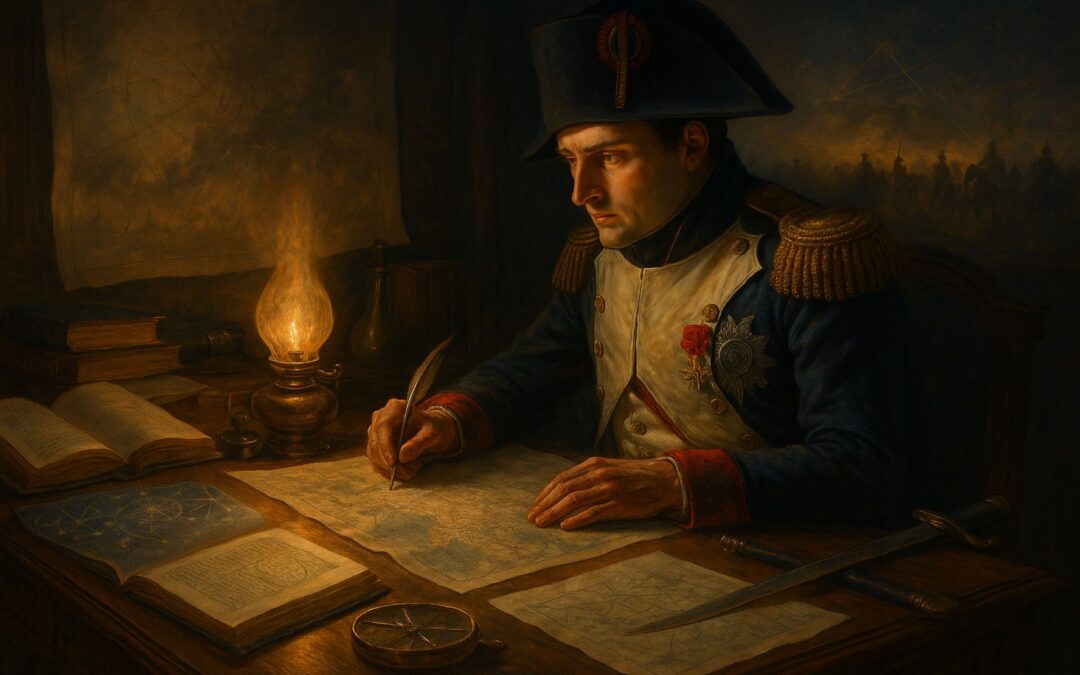
Some minds are built for comfort; others for conquest. Napoleon Bonaparte belonged to the latter. Long before he commanded armies, he commanded his own attention — directing it toward books, ideas, and patterns that others ignored. As a young cadet, he didn’t seek recognition or promotion; he sought comprehension.
His hunger for knowledge was so relentless that it became a transformative force, turning a provincial outsider into one of the most formidable strategists in history. His story is not merely about military genius — it’s about what happens when curiosity becomes an obsession, when the mind refuses to rest until it understands how the world truly works.
Every great achievement begins this way: with a mind unwilling to stop learning. Napoleon’s example is a reminder that knowledge is not a collection of facts but a living energy — one that grows stronger the more it is fed. Mastery is not born in the moment of success, but in the quiet, unseen hours of study that prepare the ground for it. Those who treat learning as an endless pursuit — not a phase, not a goal — are the ones who rise above imitation and enter the realm of creation.
Daily Law: Find the deepest pleasure in absorbing knowledge and information. Feel like you never have enough.
powerseductionandwar.com, October 1, 2012
The Apprenticeship of Obsession
Napoleon’s path to mastery was built not on luck or privilege, but on the relentless accumulation of knowledge. As a boy in Corsica, he was introspective and solitary — a quiet observer in a noisy household. His classmates mocked his accent and modest origins, but while others sought acceptance, Napoleon sought understanding. He devoured books on history, strategy, and philosophy. Plutarch’s Lives, Caesar’s Commentaries, and the works of Voltaire became his companions. From each, he drew lessons not just about tactics, but about the psychology of ambition — how great leaders think, act, and adapt.
At the military academy in Brienne and later in Paris, his hunger for knowledge became his greatest weapon. He spent long nights copying maps by hand, studying troop formations, and analyzing the smallest details of historical campaigns. Every line on a page became an opportunity to understand movement, timing, and human behavior. When instructors assigned him work, he went beyond it, teaching himself engineering, mathematics, and the history of empires. He read so widely that his superiors soon noticed — not just his intellect, but his intensity. Knowledge wasn’t a requirement for him; it was oxygen.
This obsession gave Napoleon something his peers lacked — the ability to think independently. Most cadets memorized military manuals to earn promotion; Napoleon dismantled them to understand their logic. He questioned established tactics, tested theories in thought experiments, and learned to combine precision with imagination. By the time he entered the army, he had already lived a hundred campaigns in his mind. His superiors soon began to entrust him with responsibilities far beyond his age. His early reports displayed a mind that didn’t just see details — it saw systems.
What made Napoleon exceptional was not just the amount of information he absorbed, but the way he processed it. He didn’t collect knowledge for prestige or debate; he internalized it until it became instinct. He trained his memory like a weapon, connecting ideas across disciplines — politics, geography, artillery, and human nature. His curiosity was total, his focus almost frightening. That intensity of learning forged a mind capable of seeing not only what was, but what could be. And when the time came to lead, he did not imitate — he innovated.
Napoleon’s apprenticeship was not a phase; it was a mindset. Every success he achieved in later life was rooted in these unseen years of immersion and preparation. The world saw his victories; only he knew the hours spent in solitude, turning knowledge into foresight. His story reminds us that mastery is not born from talent — it is sculpted from obsession.
Knowledge as the Ultimate Weapon
Knowledge, in Napoleon’s world, was not a luxury — it was survival. He understood that in the shifting terrain of power, everything could be taken away except the contents of one’s mind. Armies could fall, fortunes could fade, but a well-trained intellect could rebuild from nothing. This belief became the foundation of his rise. Before he ever commanded soldiers, he commanded ideas.
He approached learning like a strategist preparing for battle. Every subject had a purpose. Mathematics trained his logic; history revealed patterns of power; geography taught him how terrain shapes destiny. When others studied for exams, he studied for eternity — for the understanding that transcends circumstance. He treated every book like a battlefield and every idea like an ally or opponent to be tested. This intellectual discipline gave him what few others possessed: perspective. While most people saw isolated facts, Napoleon saw relationships — the invisible threads that connected events across time and space.
As he rose through the ranks, this depth of learning became his secret advantage. Where his rivals relied on hierarchy and habit, he relied on comprehension. He could predict enemy movements not because of luck, but because he understood the logic of command. He could improvise under pressure because he had absorbed the principles that governed every decision. His strategies were not guesses — they were the natural expressions of a mind so saturated with knowledge that intuition had become second nature.
What made this approach revolutionary was its breadth. Napoleon refused to confine himself to a single discipline. He studied art, literature, politics, and human behavior with the same intensity as military science. He wanted to understand not only how to win battles, but how to rule minds. His grasp of psychology — of ambition, fear, loyalty, and pride — allowed him to lead not merely through orders, but through energy. He understood people because he had studied what drives them. This gave his command a magnetic quality: soldiers followed him not just because he was skilled, but because he understood them.
In our age, this principle holds more relevance than ever. Information is abundant, but integration is rare. Many people consume knowledge the way one skims headlines — scattered, shallow, and forgettable. Napoleon’s method was the opposite: absorb, analyze, and apply. He did not move on to the next thing until the current one had transformed him. Knowledge, in his view, was not about accumulation — it was about assimilation. It had to sink deep enough to alter the way he saw the world.
When knowledge becomes reflex, it becomes power. Napoleon demonstrated that the true master is not the one who knows the most facts, but the one who can use knowledge to shape reality. His command of information was not decorative; it was decisive. In his hands, learning became the sharpest sword of all.
The Coup d’Oeil — Seeing Beyond Sight
Among Napoleon’s many legendary abilities, none fascinated observers more than his coup d’œil — the mysterious “glance of the eye.” His generals described it as a kind of sorcery, the power to grasp an entire battlefield in an instant and know exactly where to strike. But what looked like supernatural intuition was, in fact, the final stage of a long and deliberate education. The coup d’œil was the visible result of invisible labor — years of disciplined study, endless observation, and the gradual merging of knowledge with instinct.
Napoleon’s mind had been conditioned to recognize patterns before others could even name them. He trained himself to read landscapes like maps and maps like stories. Every contour of terrain told him something — how troops would move, where morale would falter, how the weather would change the rhythm of combat. To him, battle was not chaos but choreography. He had rehearsed its logic so deeply that, when the real thing came, his perception operated faster than conscious thought. His decisions appeared instantaneous, but they were the culmination of thousands of quiet lessons internalized over years.
This kind of intuition cannot be faked or borrowed; it can only be earned. The coup d’œil is not born from arrogance or impulse, but from humility — from the willingness to study so thoroughly that the mind begins to anticipate rather than merely react. What Napoleon demonstrated was the highest form of intelligence: the ability to see structure within disorder. When his rivals hesitated, drowning in complexity, he saw clarity. When others debated possibilities, he moved with certainty. His coup d’œil was the mind’s reward for its discipline — the gift that only comes to those who have first done the work of learning.
In modern life, this principle remains unchanged. We often mistake intuition for luck or talent, but in truth, it is the residue of preparation. The designer who senses a pattern before data confirms it, the entrepreneur who detects a shift in the market before analysts do, the writer who feels the rhythm of a sentence before it’s written — all of them are exercising their own coup d’œil. The mind, when saturated with experience, begins to operate at another level. It no longer analyzes step by step; it simply sees.
This is the paradox of mastery: the more you study, the less you have to think. Napoleon’s “glance” wasn’t divine; it was disciplined. And discipline, practiced long enough, begins to look like magic.
The Modern Lesson: Hunger Never Ends
Napoleon’s life, though marked by conquest and controversy, holds a deeper moral beneath the grandeur — the unending hunger for knowledge. Even as Emperor, with the world at his feet, he continued to read late into the night. Reports from his aides describe him surrounded by piles of books — mathematics, geography, philosophy, history. He studied as if his empire depended on it, because he knew that the real enemy of greatness is stagnation. The mind, once it believes it has learned enough, begins to decay.
This insatiable curiosity was the secret engine of his power. Every victory only deepened his appetite to understand more — about systems, about people, about life itself. He understood that to remain vital, one must keep expanding the perimeter of the possible. When he occupied foreign lands, he didn’t just see them as conquests; he saw them as classrooms. He studied local customs, architecture, languages, and technologies. He admired how the Egyptians built monuments aligned with the stars, how Roman roads still shaped Europe’s movement centuries later. Everything was data — every encounter, a lesson. For Napoleon, knowledge was not academic; it was alive.
In our own time, the hunger for depth has been replaced by the addiction to speed. We scroll, skim, and consume, mistaking information for understanding. We chase novelty instead of nuance. Napoleon’s example reminds us of what we’ve lost: the joy of deliberate learning, of wrestling with complexity until it yields wisdom. To learn like he did is to commit to slowness — to revisit, reread, and refine until comprehension becomes clarity. This form of learning changes who you are, not just what you know.
The true lesson of this law is not simply to seek knowledge, but to remain perpetually unsatisfied with it. The moment you feel full, you stop growing. Napoleon’s greatness lay not in his victories, but in his vigilance — the sense that mastery is a moving horizon, always receding, always calling. In every field, the mind that stays curious stays young. The one that stops questioning starts to crumble.
To cultivate this hunger is to align yourself with progress itself. The artist who keeps experimenting, the scientist who keeps doubting, the leader who keeps reading — they all share the same quiet power. They understand that learning is not a stage of life; it is the essence of it. Napoleon’s story, when stripped of empire and myth, becomes a mirror for anyone seeking growth: the truly educated are those who are never done.
Conclusion
Napoleon’s story reveals the paradox of mastery: the more you know, the more aware you become of what you don’t. His victories were forged not by arrogance, but by a humility before knowledge — an understanding that true power lies in perpetual learning. Even as an emperor, he remained a student, restless in his curiosity and disciplined in his study. His mind was his greatest empire.
In a world overflowing with information yet starving for understanding, this lesson matters more than ever. The pursuit of knowledge is not a race to accumulate facts, but a lifelong apprenticeship in awareness. To learn deeply is to live fully; to stop learning is to start fading. Napoleon’s life reminds us that there is no such thing as enough knowledge — only the next question, the next book, the next horizon. The mind that never stops hungering is the one that never stops growing.
This article is part of The Daily Laws Series based on Robert Greene’s book.