
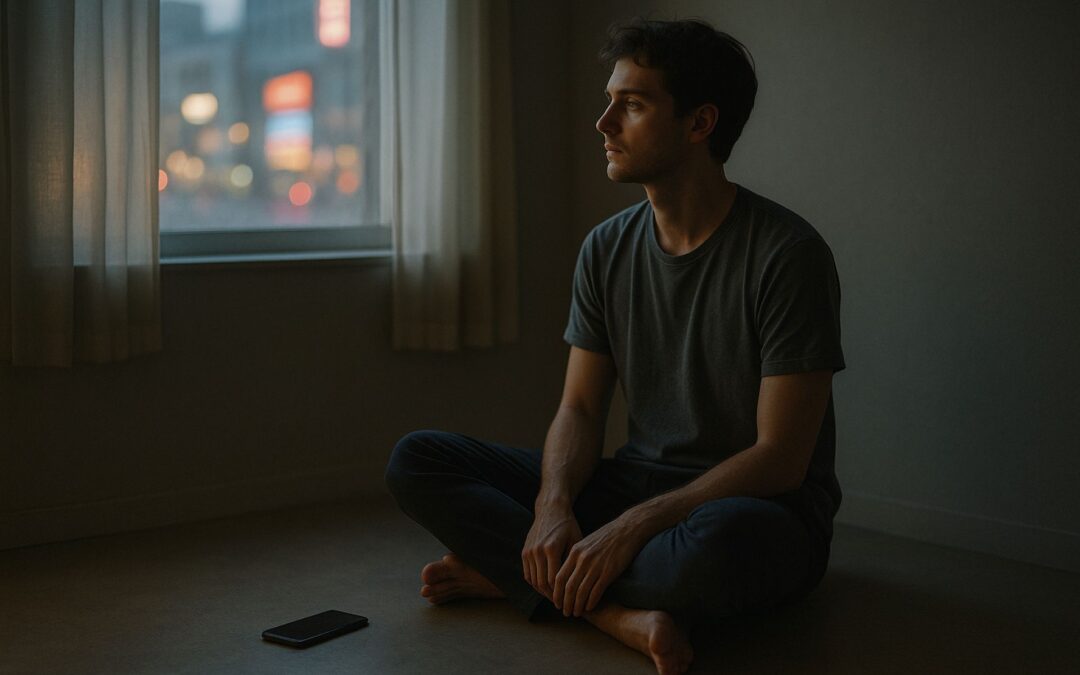
Why We Can’t Sit Still Anymore
“All of humanity’s problems stem from man’s inability to sit quietly in a room alone.”
— Blaise Pascal
Look around for a moment—not at others, but at your own habits.
A notification goes off. You check it. Nothing important.
A few seconds pass. Silence creeps in.
Your hand reaches for your phone again.
Not because you need to. Because you can’t not.
This is the quiet reflex of modern life. The elimination of even the smallest pockets of emptiness. Waiting in line, sitting in a cab, walking alone, pausing between tasks—these used to be moments of nothing. Now they are moments to be filled. Instantly. Automatically.
The smartphone didn’t create this impulse, but it perfected it.
It is, by every functional metric, a remarkable tool. It has compressed the world into something you can hold in your palm. Infinite information. Endless entertainment. Constant connection. Entire industries built on its back. For many, especially in developing parts of the world, it has been transformative.
But it comes with a cost that is subtle enough to go unnoticed.
We no longer tolerate stillness.
Idleness, even for a few seconds, feels like something is wrong. Something missing. Something that needs to be fixed immediately. And so we fix it the only way we know how—by adding more noise, more input, more distraction.
The result is a new kind of human. Restless. Stimulated. Always engaged.
And quietly incapable of doing nothing.
We’ve become experts at avoiding a very specific experience. One that feels trivial, even annoying. One that we’ve trained ourselves to escape at all costs.
Boredom.
Not the dramatic kind. Not the kind that ruins your day.
The small, ordinary kind. The kind that shows up in the gaps.
And disappears just as quickly—because we don’t let it stay long enough to understand it.
That might be the problem.
The Strange Discomfort of Boredom
Boredom is harder to define than it seems.
It’s not rest. When you’re truly at rest, there’s a sense of ease, a kind of quiet completeness. Nothing is happening, but nothing needs to happen. Boredom isn’t that.
It’s also not activity. You’re not engaged, not absorbed, not moving toward anything. But unlike rest, this absence feels wrong.
Boredom sits in between. An uneasy middle ground.
You’re doing nothing—yet you feel like you shouldn’t be.
You’re inactive—but you feel a pressure to become active.
That tension is what makes boredom uncomfortable.
Think about the last time you scrolled through Netflix without picking anything. Or opened one app, closed it, then opened another without any real intention. There’s no urgency, no clear desire, and yet there’s a subtle agitation underneath it all.
Something feels off.
As children, boredom showed up when nothing around us could hold our attention. Toys lost their appeal. Options ran out. There was a kind of dull frustration in not knowing what to do next.
As adults, the context changes—but the feeling doesn’t.
Now, we are surrounded by options. Endless ones. But instead of eliminating boredom, this abundance seems to intensify it. We scroll more, switch faster, and commit to nothing. The problem is no longer a lack of stimulation—it’s a lack of satisfaction.
And so boredom becomes something else entirely.
Not just the absence of activity, but the absence of meaning in that activity.
That’s why it feels intolerable. Not because nothing is happening, but because nothing feels worth happening.
So we try to escape it. Quickly. Almost reflexively.
We check our phones. Refresh feeds. Open tabs. Play something in the background. Anything to replace that strange, hollow in-between state with something more defined.
Something easier to sit with.
But in doing so, we treat boredom like a problem to eliminate rather than a signal to understand.
We never stay with it long enough to ask what it’s actually pointing to.
The Cycle of Desire and Emptiness
Arthur Schopenhauer had a bleak but uncomfortably accurate view of human life.
At the center of his philosophy is something he called the will—an irrational, restless force that drives everything we do. It’s what pushes us to want, to pursue, to achieve, to become. It’s behind ambition, desire, hunger, lust, curiosity—every forward movement of life.
On the surface, this seems like a good thing. It gives life direction. Momentum. Purpose.
But there’s a catch.
The will never stops.
When we want something, we feel tension. A kind of lack. So we move toward the object of our desire—thinking that once we have it, the tension will dissolve.
And sometimes, briefly, it does.
You get the job. You buy the thing. You achieve the goal.
For a moment, there’s relief.
Then something strange happens.
The tension doesn’t disappear—it transforms.
Because once a desire is fulfilled, the will has nothing to chase. No object to pursue. No direction to move in. And in that absence, a new feeling emerges.
Boredom.
For Schopenhauer, life swings like a pendulum between these two states:
desire and boredom.
When we lack something, we suffer because we want.
When we have everything we want, we suffer because we don’t know what to do next.
Either way, we are restless.
This explains why satisfaction is so fleeting. Why achievements don’t feel as meaningful as we expect them to. Why even comfort, when stretched long enough, becomes unbearable.
We don’t just seek pleasure. We seek escape—from boredom.
And so we fill our lives with more desires. More goals. More stimulation. Not necessarily because we need them, but because they keep us from confronting the emptiness that follows when nothing is left to pursue.
That’s the trap.
The more efficiently we eliminate desire, the faster we run into boredom.
And the more we fear boredom, the more desperately we create new desires.
It becomes a loop.
A quiet, invisible one.
And once you see it, a lot of modern behavior starts to make sense.
The Age of Hyperactivity
Byung-Chul Han describes modern life with unsettling precision.
We no longer live in a world defined by external pressure—rules, discipline, authority telling us what to do. That was the old model. What he calls the disciplinary society.
Today, the pressure is internal.
We push ourselves.
We optimize, improve, hustle, and perform—not because someone is forcing us to, but because we’ve absorbed the expectation. Productivity isn’t just something we do. It’s something we’ve become.
Han calls this the achievement society.
In this world, doing is everything. Being is nothing.
To sit still is to waste time. To do nothing is to fall behind. Every moment carries an implicit question: Could this be used better?
And so we fill it.
We stack tasks. Multitask. Listen to something while doing something else. Even rest becomes instrumental—something we do so we can return to productivity with more energy.
We don’t rest for the sake of rest.
We rest to work better.
Over time, this creates a baseline state of subtle agitation.
We are always slightly on edge. Slightly behind. Slightly unfinished.
Even when there’s nothing urgent to do, the body doesn’t quite relax. The mind keeps scanning for the next input, the next task, the next piece of stimulation.
This is where boredom becomes intolerable.
Not because it’s inherently painful—but because it interrupts the system we’ve built our identity around. A system that depends on constant motion.
When nothing is happening, it feels like something is broken.
Han argues that this relentless activity comes at a cost.
We lose the ability to linger. To stay with a thought. To let time stretch instead of compressing it into productivity units. Our attention fragments. Our thinking becomes reactive instead of reflective.
He makes a striking comparison: if sleep is the highest form of physical relaxation, then deep boredom is the highest form of mental relaxation.
But we rarely experience it.
Because the moment boredom appears, we override it with activity. We suppress it before it has a chance to deepen into something else.
Something quieter. Something more expansive.
Instead, we remain trapped in a loop of constant engagement.
Always doing.
Never arriving.
Homo Smartphonicus: Addicted to Stimulation
There’s a specific kind of human that has emerged from this environment.
Always connected. Always stimulated. Always within reach of something to consume.
You could call him Homo Smartphonicus.
He doesn’t experience boredom the way previous generations did—not because it’s gone, but because he never lets it surface. The moment there’s a gap, he fills it. Instantly.
A notification. A quick scroll. A video. A message.
Something—anything—to keep the stream going.
This isn’t a conscious decision. It’s automatic.
The smartphone has trained us into a new baseline of attention. One where silence feels unnatural. Where waiting feels inefficient. Where doing nothing feels like a mistake.
Think about how quickly discomfort sets in when there’s no input.
No music. No podcast. No screen. No conversation.
Just you and the moment.
It doesn’t take long before the urge kicks in. That familiar pull toward stimulation. Not because something important is waiting—but because something should be happening.
This is what constant access does.
It collapses the space between impulse and satisfaction.
Before, boredom had time to develop. To stretch. To become noticeable. Now, it’s intercepted at the earliest possible moment. Neutralized before it can even register fully.
And over time, this changes your tolerance.
The more stimulation you consume, the less you can sit without it. The threshold lowers. What once felt normal—walking in silence, sitting alone, waiting without distraction—now feels uncomfortable, even unbearable.
It’s not that life has become more boring.
It’s that we’ve become less capable of experiencing it without interference.
And so the cycle intensifies.
More stimulation leads to less tolerance for stillness.
Less tolerance leads to more stimulation.
Until eventually, the idea of simply being—without input, without distraction, without movement—starts to feel almost impossible.
Not because it is.
But because we’ve trained ourselves out of it.
What We’ve Lost in the Process
At first glance, nothing seems lost.
We are more informed than ever. More connected. More entertained. There is always something to watch, read, listen to, or respond to. The surface of life is full.
But beneath that surface, something has quietly eroded.
Our ability to stay with anything long enough for it to deepen.
Attention has changed shape. It used to settle. Now it jumps. One tab to another. One thought to the next. One piece of content replaces another before it has time to leave any real imprint.
We don’t lack input.
We lack absorption.
And without absorption, something essential disappears.
Deep thinking becomes difficult. Not impossible—but effortful in a way it didn’t used to be. To follow a thought without interruption, to sit with a problem, to let ideas evolve slowly—this requires a kind of mental stillness that our current habits actively resist.
Creativity suffers in the same way.
Not because we aren’t exposed to enough ideas, but because we’re exposed to too many, too quickly. Nothing lingers long enough to transform into something new. Original thought doesn’t emerge from constant consumption. It emerges from digestion.
From silence. From gaps. From moments where nothing is being fed into the system.
That’s what boredom used to provide.
A kind of empty space where the mind, left to itself, begins to wander. And in that wandering, connections form. Questions arise. Ideas take shape without being forced.
Now, those spaces are gone.
Or rather, they’re still there—but we don’t allow ourselves to enter them.
Even relaxation has changed.
We don’t really unwind anymore. We switch modes. From work to entertainment. From effort to distraction. But both states are active. Both keep the mind occupied. Both prevent it from settling.
So we remain tired.
Not from doing too much in the traditional sense, but from never truly stopping.
This is the paradox.
We are constantly engaged, yet rarely at ease.
Constantly stimulated, yet increasingly restless.
And somewhere in that restlessness lies the cost of everything we’ve gained.
Boredom as a Gateway, Not a Problem
Everything about our conditioning tells us the same thing:
Boredom is bad. Avoid it.
It feels unpleasant, so we treat it like a malfunction. A signal that something is wrong with the moment—something missing that needs to be fixed. And the fix is always the same.
Add stimulation.
But what if that instinct is backward?
What if boredom isn’t the problem—but the doorway?
The discomfort of boredom doesn’t come from doing nothing. It comes from the inability to be at ease while doing nothing. That restless tension, that urge to escape—it’s not boredom itself. It’s withdrawal.
Withdrawal from constant activity. From stimulation. From distraction.
And like any withdrawal, it feels uncomfortable at first.
If you’ve ever tried to sit without reaching for your phone, you’ve probably felt it. The mind starts searching for something to latch onto. Thoughts become louder. Time seems to slow down. There’s a subtle agitation in the background, pushing you to break the stillness.
That’s the threshold.
Most people never cross it.
Because the moment that discomfort appears, they reach for something—anything—to make it go away. And just like that, the process resets. The mind never gets the chance to settle.
But if you stay with it—just a little longer—something shifts.
The agitation begins to lose its grip. The urgency softens. The need to “do something” fades, not because you satisfied it, but because you stopped feeding it.
And what’s left behind is something different.
A quieter state. Less reactive. Less dependent on constant input.
This is why boredom matters.
Not because it’s enjoyable, but because it’s transitional. It’s the space between compulsive activity and genuine stillness. You can’t bypass it. You have to move through it.
That’s what makes it valuable.
We’ve been treating boredom like a dead end—something to eliminate as quickly as possible. In reality, it’s more like a threshold.
On one side: noise, distraction, constant engagement.
On the other: calm, clarity, and the ability to simply be.
Most of us turn back before we ever find out what’s on the other side.
Relearning the Art of Doing Nothing
If boredom is a threshold, then the question becomes simple.
How do you stay long enough to cross it?
Not through theory. Through small, deliberate shifts in how you move through your day. Nothing dramatic. Nothing performative. Just changes that reintroduce friction into a system that has become too seamless.
Start with something deceptively simple: waiting.
The next time you’re in line, sitting in a cab, or waiting for something to load—do nothing. No phone. No distraction. Just observe. Notice how quickly the urge to reach for stimulation appears. Don’t fight it. Just don’t act on it.
At first, it will feel pointless.
That’s the point.
You’re retraining a reflex. Rebuilding your tolerance for stillness, one small moment at a time.
Then there’s digital fasting.
You don’t need to disappear into the woods or delete everything. Just create pockets where the noise is cut off. An hour without your phone. An evening without scrolling. A morning where you don’t immediately check notifications.
What you’ll notice isn’t peace—at least not immediately.
You’ll notice restlessness.
Again, that’s the point.
You’re not removing stimulation to feel better instantly. You’re removing it to expose the dependency you’ve built on it. Only then can it begin to loosen.
Another shift is slowing things down on purpose.
Walk without headphones. Eat without watching something. Sit without filling the silence. These are small acts, but they go directly against the grain of how we’ve conditioned ourselves to live.
They reintroduce depth into time.
Moments stop being things to get through and start becoming things you actually experience. Not in some idealized, poetic sense—but in a very practical one. You’re there, instead of somewhere else.
Rituals help anchor this.
Not grand, ceremonial ones. Simple, repeatable actions that don’t aim to achieve anything. A cup of tea at the same time each day. A walk after dinner. Reading before bed instead of scrolling.
They don’t optimize your life.
They stabilize it.
And then there’s meditation—which, for most people, sounds like the most boring thing imaginable.
Sitting still. Doing nothing. Watching your breath.
It’s almost a direct confrontation with everything we’ve been avoiding.
Which is precisely why it works.
Not because it’s mystical or profound, but because it forces you to face the very thing you’ve trained yourself to escape. And if you stay with it long enough, that resistance begins to fade.
You don’t need to adopt all of this at once.
The goal isn’t to become a different person overnight.
It’s to reintroduce something that has quietly disappeared from your life.
The ability to sit, without needing to fill the space.
Conclusion: The Courage to Be Alone With Yourself
At some point, this stops being about smartphones, productivity, or even boredom.
It becomes personal.
Because beneath all the stimulation, all the activity, all the constant engagement, there’s a quieter question waiting:
What happens when there’s nothing left to distract you?
No screen. No task. No input.
Just you.
For most people, that space feels uncomfortable. Not dramatic, not overwhelming—just subtly unsettling. Which is why it’s so easy to avoid. There’s always something within reach to fill it.
And so we do.
Again and again.
But that avoidance comes at a cost.
When you never allow yourself to be alone with your thoughts, you never really encounter them. You stay on the surface. Moving, reacting, consuming—but rarely understanding.
Stillness changes that.
Not instantly. Not in some profound, life-altering moment. But gradually. Quietly. It gives your mind room to unfold without interference. It lets thoughts complete themselves instead of being interrupted. It creates space for clarity where there was only noise.
But you don’t get there by accident.
You get there by doing something that feels almost unnatural now.
You stop.
You sit.
And you stay long enough for the discomfort to pass.
That’s the part most people avoid. The initial friction. The restlessness. The sense that you should be doing something else.
It takes a certain kind of patience to move through that. A certain willingness to not immediately fix what feels uncomfortable.
You could call it discipline.
Or you could call it something simpler.
Because in the end, being alone in a quiet room isn’t difficult.
Staying there is.