
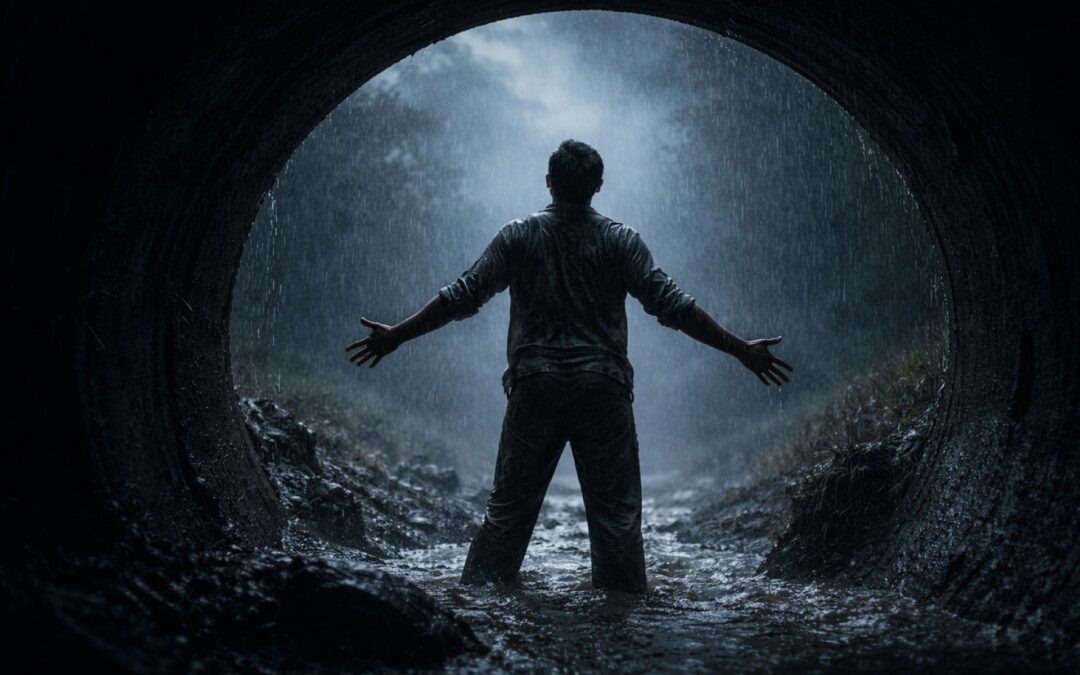
The Shawshank Redemption has a strange kind of permanence. It isn’t just widely loved—it lingers. Long after the credits roll, certain images refuse to fade: a man standing in the rain with his arms stretched toward the sky, a quiet conversation about hope in a prison yard, a tunnel carved patiently through stone over decades.
On the surface, it is a prison drama—tightly written, beautifully acted, and emotionally satisfying. But that alone doesn’t explain its enduring grip. Plenty of films are well-made. Very few stay with people the way this one does.
What gives The Shawshank Redemption its weight is something less obvious but far more universal. Beneath its story lies a deeply human tension: the conflict between the life we are given and the life we try to shape. Between what happens to us and what we choose to do about it.
The world of Shawshank is built on control. Every movement is regulated, every routine enforced, every ounce of autonomy stripped away. It is a place designed to reduce individuals into functions—numbers in a system, bodies in a structure. And yet, within this rigid environment, something unexpected persists.
Choice.
Not the kind of freedom we usually think of—the ability to go anywhere, do anything—but a quieter, more stubborn form of freedom. The freedom to decide how to respond. How to think. Whether to surrender or resist. Whether to hope or to abandon hope altogether.
This is where the film reveals its deeper philosophical core. Through the lives of Andy Dufresne and Ellis “Red” Redding, The Shawshank Redemption becomes less a story about imprisonment and more a meditation on freedom itself—not as a condition, but as a stance.
Because Shawshank does not just confine bodies. It confronts something far more fragile: the human capacity to remain inwardly free in a world that denies it.
Shawshank as a World of Facticity
The first thing Shawshank does is erase.
It erases identity, autonomy, and the illusion that life can be shaped freely. The moment the new inmates step off the bus, they are no longer individuals in any meaningful sense. They are processed, stripped, inspected, and assigned. Their pasts—careers, relationships, personal histories—become irrelevant. What remains is a single, defining condition: they are prisoners.
This is where the concept of facticity becomes useful. In existentialist thought, facticity refers to everything about our existence that is already given—the circumstances we did not choose and cannot immediately change. Our past, our environment, our limitations. These are not optional. They are the conditions within which we must operate.
Shawshank is facticity in its most concentrated form.
For most people, facticity is subtle. It appears in things like social class, upbringing, or physical limitations. But in prison, it becomes impossible to ignore. The walls are literal. The restrictions are absolute. There is no pretending that one is free in the conventional sense.
The film makes this painfully clear from the beginning. The first night is not just an initiation—it is a psychological rupture. A man breaks down crying for his mother and is beaten to death by a guard. The message is immediate and brutal: whatever life you had before is gone. Whatever you thought you controlled, you no longer do.
Even the smallest aspects of existence are dictated by others. When to eat. When to sleep. When to speak. When to move. The guards’ authority is total, and the environment itself reinforces submission. Over time, the prison does not just control behavior—it reshapes identity.
This is the true power of Shawshank. It does not simply confine the body; it conditions the mind. It creates a world where the limits imposed on you begin to feel natural, even inevitable. A world where resistance seems pointless, and adaptation becomes the only viable strategy.
But facticity, by itself, is not the full story.
Because even in a place like Shawshank—especially in a place like Shawshank—something remains unresolved. The question is not just what is imposed on you, but what you do with it.
The Paradox of Freedom in Confinement
At first glance, Shawshank seems like the perfect negation of freedom. Every visible aspect of life inside the prison points in the same direction: restriction, control, inevitability. The conclusion appears obvious—freedom is gone.
And yet, the film quietly resists this conclusion.
Because while the inmates have lost external freedom, they have not been relieved of something far more burdensome: the need to choose.
This is the paradox.
Even in a place where almost everything is decided for you, something remains undecided. How you interpret your situation. How you respond to it. What kind of person you become within it. These are not dictated by the walls, even if the walls try to make it feel that way.
This is where Shawshank becomes less about imprisonment and more about responsibility. The inmates are not free in the traditional sense, but they are still responsible for the stance they take toward their condition. And that responsibility cannot be escaped—it can only be ignored.
The film shows this in subtle ways. Some inmates become violent, consumed by impulse and dominance. Others dissolve into routine, blending into the system so completely that they no longer seem separate from it. Some cling to small rituals or roles that give them a sense of stability. Each response is different, but all of them share a common feature: they are ways of dealing with the same underlying condition.
This is what makes Shawshank so psychologically precise. It doesn’t portray prisoners as passive victims of circumstance. Instead, it shows how people actively adapt to those circumstances—sometimes consciously, often unconsciously—until their way of coping becomes their identity.
And this is where the real tension begins to take shape.
If freedom still exists in some form, then giving up is not simply something that happens to you. It becomes something you participate in. Not because the situation isn’t harsh—it clearly is—but because there is always a remaining margin, however small, in which a person can still respond differently.
That margin is easy to overlook. It doesn’t look like freedom in any grand sense. It doesn’t change the walls, shorten the sentence, or guarantee a better outcome. In many cases, it changes nothing externally at all.
But internally, it changes everything.
It is within this narrow space—between what is imposed and how one responds—that the film locates its most important question:
When you cannot change your circumstances, what do you become in relation to them?
Red: The Logic of Resignation
If Shawshank is a world that pressures individuals to adapt, Red is what successful adaptation looks like.
He understands the system. More than that, he has made himself indispensable within it. He knows how to talk to the guards, how to navigate the informal economy among inmates, how to survive without drawing unnecessary attention. If someone needs something—a cigarette, a poster, a small comfort from the outside world—Red is the one who can get it.
In many ways, he has carved out a stable existence in an unstable place. There is a quiet competence to him, even a kind of authority. Other inmates respect him. He belongs.
But this belonging comes at a cost.
Red’s worldview is built on a kind of controlled surrender. He does not fight the system because he has already accepted it as unchangeable. His routines are not just habits—they are anchors. Predictable, repeatable, safe from disappointment.
This is most visible in his attitude toward parole. Each hearing follows the same pattern, and each rejection confirms what he already believes: nothing will change. Over time, the process itself becomes meaningless. Not a possibility, but a ritual. Something to go through, not something to believe in.
“Same old shit, different day.” The line is casual, almost dismissive, but it captures the core of his philosophy.
Red survives by lowering the horizon of expectation. He does not allow himself to imagine a different future, because imagining it would make its absence unbearable. In this sense, his rejection of hope is not irrational—it is protective. Hope introduces uncertainty, and uncertainty carries the risk of disappointment. By eliminating hope, he eliminates that risk.
What remains is a kind of hardened realism. Accept what is. Adapt to it. Don’t reach beyond it.
From the outside, this can look like strength. And in a way, it is. Red has found a way to endure without breaking. But endurance is not the same as freedom.
Because in aligning himself so completely with his circumstances, Red begins to blur the line between who he is and where he is. The prison no longer feels like something imposed on him—it starts to feel like something he is.
This is the deeper cost of his adaptation.
He has not just accepted his facticity. He has internalized it.
Why Hope Becomes Dangerous
Red’s rejection of hope isn’t casual cynicism. It’s a carefully constructed position—one that makes perfect sense within the logic of Shawshank.
Hope, in a place like this, is not comforting. It’s destabilizing.
To hope is to imagine a future that does not yet exist. It is to project yourself beyond your current condition, to entertain the possibility that things could be different. But in an environment where change is rare and often illusory, that projection becomes risky. The higher the hope, the sharper the fall when it collapses.
Red understands this intuitively. For him, hope is not a virtue—it’s a liability. Something that can unmoor a person from reality and leave them exposed to disappointment, frustration, even madness. In his eyes, the safest way to survive is to narrow your expectations until they align perfectly with what is.
This is why predictability becomes so valuable. Routine may be monotonous, but it is stable. It offers a kind of psychological shelter. Within repetition, there are no surprises, no false promises, no emotional volatility. Life becomes smaller, but also more manageable.
Hope disrupts that equilibrium. It introduces tension between the present and the possible. And in Shawshank, that tension is difficult to sustain.
The film reinforces this idea through the broader prison culture. There is an unspoken agreement among the inmates: don’t think too far ahead. Don’t expect too much. Stay grounded in what you know will happen, not in what might happen. It’s a shared strategy of survival, one that discourages longing in favor of acceptance.
But beneath this logic lies something more fragile.
Red’s rejection of hope is not the absence of desire—it is the suppression of it. The longing for freedom doesn’t disappear. It is pushed aside, buried under routine and rationalized into irrelevance. By convincing himself that hope is dangerous, Red protects himself from confronting how much he still wants something beyond the walls.
And this is where the tension quietly deepens.
Because the very thing Red avoids—hope—is also the thing that keeps open the possibility of change. Without it, life becomes stable, but static. Safe, but closed.
In eliminating the risk of disappointment, he also eliminates the chance of transformation.
Andy: The Refusal to Become His Circumstances
Andy Dufresne does not arrive at Shawshank as a rebel. He doesn’t make speeches, he doesn’t challenge authority openly, and he certainly doesn’t try to fight the system in any obvious way. If anything, his initial presence is almost ghostlike—quiet, distant, difficult to read.
But that quietness is misleading.
What sets Andy apart is not that he denies the reality of his situation. He understands it as clearly as anyone else. He knows where he is, what he’s up against, and how little control he has over the external structure of his life. What he refuses to do is let that reality define the limits of who he can be within it.
This is a subtle but crucial distinction.
Where Red adapts by aligning himself with the prison, Andy maintains a distance from it. He participates when necessary, but he never fully identifies with his role as an inmate. There is always something about him that remains untouched, as if a part of him exists just outside the reach of Shawshank’s influence.
Red notices this early on. He describes Andy as someone who walks around “like he had an invisible coat that would shield him from this place.” It’s not that Andy is unaware of the brutality around him—it’s that he doesn’t internalize it in the same way.
This refusal shows itself in small, almost unremarkable decisions. He asks for a rock hammer—not as a tool of escape, at least not initially, but as a way to pursue a personal interest. He carves chess pieces out of stone. He surrounds himself with fragments of a world that exists beyond the prison walls. These actions don’t change his circumstances, but they assert something important: he is still a person who chooses, not just someone things happen to.
Even when subjected to violence and harassment, Andy does not reshape himself in response. He endures, but he does not become hardened in the same way others do. He doesn’t seek power within the prison hierarchy, nor does he retreat into passive routine. Instead, he continues to act—quietly, deliberately—according to a standard that does not originate from Shawshank.
This is what makes his character philosophically significant.
Andy embodies a different response to facticity. He does not reject the limits imposed on him, but he refuses to collapse into them. He treats those limits as conditions to work within, not definitions to live by.
And in doing so, he preserves something that Shawshank is designed to erode: the sense that one can still act meaningfully, even when the scope of action is severely restricted.
Small Acts of Freedom
Andy’s resistance does not begin with escape. It begins with something far less dramatic, and far more important—small, deliberate acts that assert his agency within a system designed to erase it.
At first glance, these actions seem insignificant. A request for a rock hammer. The carving of chess pieces. A poster on a wall. None of these things challenge the structure of the prison in any direct way. They don’t alter his sentence, weaken the authority of the guards, or change the daily routine.
And yet, they matter.
Because each of these acts carries the same underlying message: I am still capable of choosing.
The rooftop scene captures this especially well. Andy overhears Captain Hadley complaining about taxes on an inheritance and decides to intervene. It’s an absurd risk. He is a prisoner approaching a volatile guard with unsolicited advice—something that could easily get him thrown off the roof. And for a moment, it almost does.
But Andy persists, and in doing so, he reshapes the situation. What begins as a moment of danger turns into a brief pocket of freedom—not for himself alone, but for the group. The beers shared on the rooftop are not just a reward; they are a temporary suspension of the prison’s usual logic. For a short time, the men are not merely inmates following orders. They are participants in something chosen.
Red later wonders why Andy did it. To make friends? To gain favor? To feel normal again?
Each explanation captures part of the truth, but none fully explains the act. What Andy demonstrates in that moment is not strategy alone, but assertion. He refuses to remain a passive object within the system. He steps forward, takes a risk, and in doing so, reminds both himself and others that their roles are not as fixed as they appear.
The same pattern repeats in quieter ways.
Andy expands the prison library, not through a single bold move, but through years of persistence. One letter a week, unanswered for a long time, until finally something changes. Then more letters. More books. More possibilities. What was once dismissed as impossible slowly becomes real—not because the system allowed it, but because Andy refused to accept its initial limits.
These actions do not dismantle Shawshank. The walls remain. The routines continue. The power structure is intact.
But something shifts internally.
Through these small acts, Andy creates a space—however limited—where freedom is still practiced. Not as an abstract idea, but as a lived reality expressed through choice, effort, and persistence.
And in doing so, he reveals something crucial: freedom does not always announce itself in grand gestures. Sometimes, it appears in the quiet insistence that even here, even now, something is still up to you.
Time, Patience, and the Long Strategy
What distinguishes Andy’s actions is not just that he acts, but how he acts.
There is nothing impulsive about him. No dramatic rebellion, no sudden outbursts against the system. His approach is slow, almost imperceptible. If you were to observe him casually, you might not notice anything unusual at all. He follows routines, does his work, keeps to himself.
And yet, beneath that surface, something is unfolding.
Andy operates on a different timescale than everyone else. While the prison reduces life to repetition—days blending into one another, years dissolving into habit—he treats time as something that can still be shaped. Not quickly, not forcefully, but steadily.
This is most evident in the way he pursues change. The library does not expand overnight. It grows letter by letter, over years of persistence. The small privileges he secures are not taken—they are accumulated. Even his relationships evolve gradually, built on consistency rather than intensity.
Nothing about his method depends on immediate results.
This is where his approach becomes philosophically distinct. Most responses to confinement fall into one of two patterns: resistance that burns out quickly, or resignation that settles into permanence. Andy does neither. He neither fights the system head-on nor submits to it. Instead, he works within it—patiently, methodically—until its rigid structure begins to reveal weaknesses.
His mindset reflects a kind of quiet confidence in process. He does not need constant reinforcement that what he is doing will succeed. He acts as if it will, and lets time do the rest.
This stands in sharp contrast to the psychological environment around him. Shawshank conditions its inmates to think in short cycles. To endure the day. To get through the week. To repeat. Long-term thinking becomes almost irrelevant when the future feels closed off.
Andy resists this narrowing of perspective. He stretches his sense of time beyond the prison’s rhythm. He invests in outcomes that may take years—decades even—to materialize.
And this is where patience becomes something more than endurance.
For most inmates, time is something to survive. For Andy, it becomes something to use. Each day is not just another repetition, but a small addition to a larger, unseen trajectory.
From the outside, it looks like nothing is happening.
But over time, those small, consistent actions begin to accumulate. And when they finally reveal their purpose, it becomes clear that what seemed like stillness was, in fact, movement all along.
The Escape: Freedom Made Visible
When Andy finally escapes, it feels sudden. One moment he is there, locked in the same routine as always, and the next, he is gone—vanished into the night, leaving behind an empty cell and a trail of disbelief.
But the escape is only sudden on the surface.
In reality, it is the visible outcome of years of invisible work. Every small act, every patient decision, every seemingly insignificant choice has been moving toward this point. The rock hammer, the posters, the quiet discipline—all of it converges into a single moment where the accumulated weight of those actions finally breaks through the limits imposed on him.
This is what makes the escape more than just a clever plot twist. It is a philosophical statement.
Andy does not wait for freedom to be granted. He constructs the conditions for it himself. Slowly, methodically, and at enormous personal risk. At any point, the plan could have been discovered. A random search, a misplaced suspicion, a single mistake—and everything would have collapsed. The consequences would not just be failure, but permanent confinement under even harsher conditions.
And yet, he continues.
This is where the contrast with Red becomes sharpest. Red chooses safety. He minimizes risk, adapts to the environment, and avoids investing in uncertain outcomes. Andy does the opposite. He accepts uncertainty as the price of possibility.
The difference is not simply one of personality—it is one of orientation.
Andy acts as if freedom is still worth pursuing, even when the odds are overwhelmingly against him. He does not deny the risks; he moves forward despite them. In doing so, he transforms risk from something to be avoided into something that must be embraced if change is to occur at all.
The escape itself—the crawl through darkness, the emergence into the storm—feels almost symbolic in its clarity. It is not just a physical transition from inside to outside. It is the culmination of a long internal stance made visible.
For years, Andy has been living as if he were not entirely defined by his imprisonment. The escape is simply the moment where that internal position becomes external reality.
And this is what gives the scene its emotional force.
It is not just that a man has broken out of prison. It is that he has proven, through sustained action, that the limits imposed on him were not absolute. They were real, oppressive, and dangerous—but not final.
Freedom, in this sense, is not something he discovers at the end.
It is something he has been practicing all along.
Brooks: When Freedom Becomes Intolerable
If Andy represents the persistence of freedom, Brooks represents what happens when that persistence disappears.
Brooks is not a weak character. Within Shawshank, he is stable, respected, and deeply integrated into the environment. He runs the library, interacts easily with others, and moves through the prison with a kind of quiet familiarity. Like Red, he has adapted—but unlike Red, his adaptation is complete.
Shawshank is no longer something imposed on him. It has become his world.
When Brooks is released, this transformation reveals its cost.
Outside, the world is unrecognizable. The pace is faster, the rules are different, and the structures that once guided his life are gone. Simple tasks become overwhelming. Crossing a street feels dangerous. Holding a job feels unnatural. The freedom he has been given is not experienced as liberation, but as disorientation.
This is the paradox the film exposes with unsettling clarity: a person can become so aligned with constraint that the absence of it becomes unbearable.
Brooks does not fail because he lacks strength. He fails because his sense of self has been built entirely within a system that no longer exists. Without the routines, the expectations, the walls—there is nothing left to orient himself around. Freedom, instead of opening possibilities, removes the only structure he knows how to navigate.
This is what institutionalization looks like at its deepest level.
Over time, Shawshank has done more than control Brooks’ actions—it has reshaped his identity. It has defined what is normal, what is safe, and what is meaningful. When those definitions disappear, he is left without a framework to rebuild from.
And this is why his story matters within the larger narrative.
Brooks serves as a warning, not just about prison, but about the human tendency to adapt so completely to a given condition that we lose the ability to exist outside it. He shows what happens when the space between facticity and freedom collapses entirely—when a person no longer experiences themselves as someone who can choose differently.
In that sense, Brooks is not just a tragic figure. He is a mirror.
He reveals what is at stake in the choices the other characters are making.
Red’s Transformation
Red does not change all at once. There is no single moment where his worldview collapses and is replaced by something new. His transformation is gradual, almost reluctant—shaped less by argument and more by exposure.
Andy does not try to convince him in any direct way. He doesn’t debate him about hope or challenge his beliefs head-on. Instead, he lives differently. And over time, that difference becomes difficult for Red to ignore.
At first, Andy is an anomaly. Someone who hasn’t yet adjusted. Someone who will eventually learn, as everyone else does, to accept the reality of Shawshank. But that moment never comes. Andy does not settle into the same patterns. He continues to act as if something more is possible.
This persistence creates a quiet tension.
Red’s worldview is internally consistent—it protects him, stabilizes him, allows him to function. But Andy’s presence exposes its limits. If hope is truly useless, then Andy should have broken down long ago. If change is impossible, then Andy’s efforts should have led nowhere. And yet, neither of those things happens.
Instead, Andy keeps moving forward in small, deliberate ways. And Red, whether he admits it or not, begins to absorb this.
The shift is subtle. It appears in moments of hesitation, in the way Red begins to entertain ideas he once dismissed outright. The concept of hope, which he once rejected as dangerous, starts to lose its absolute certainty. Not because it becomes safe, but because he can no longer fully deny its presence.
Still, the transformation remains incomplete within the walls of Shawshank. Red does not suddenly become hopeful. He continues to rely on routine, continues to see the system as fixed. The habits of resignation are deeply ingrained, and they do not dissolve easily.
It is only after his release that the full weight of his worldview becomes apparent.
Outside, Red finds himself in a position similar to Brooks. The structure that once defined his life is gone, and in its place is a freedom he does not know how to navigate. The routines that once provided stability no longer exist. The predictability he relied on has been replaced by uncertainty.
And for a time, he drifts toward the same conclusion Brooks reached.
This is where Andy’s influence becomes decisive. Not as a memory alone, but as a lingering alternative—a different way of relating to the same condition. The promise Andy leaves behind, the possibility of something beyond what Red has always known, creates a point of tension he can no longer ignore.
Red stands at a threshold.
On one side is the safety of resignation—the familiar logic that has carried him through decades of imprisonment. On the other is something far less certain: the possibility of acting differently, of stepping into a future that offers no guarantees.
For the first time, the choice becomes unavoidable.
The Dizziness of Freedom
When Red finally decides to leave—to follow Andy’s instructions, to cross the border, to step beyond the narrow path laid out for him—nothing about the moment feels secure. There is no guarantee of success. No assurance that what lies ahead will be better than what he is leaving behind.
What he experiences instead is something far more ambiguous.
A mixture of anticipation and unease.
This is what makes the moment feel real. Freedom, in its raw form, is not purely liberating. It is disorienting. When the structures that once dictated your life fall away, you are not just released from constraint—you are confronted with possibility. And possibility is unstable. It demands decision, responsibility, and the acceptance that outcomes are uncertain.
This is where freedom reveals its other side.
For years, Red avoided this condition. Within Shawshank, his life was restricted, but it was also defined. The boundaries were clear. The expectations were known. His role was established. In that environment, the burden of choice was reduced.
Outside, that burden returns in full.
Every step forward is now something he must decide for himself. Where to go. What to do. Who to become. These are no longer abstract questions—they are immediate, unavoidable. And with them comes a kind of vertigo, a sense of standing at the edge of something open and undefined.
This is what existential thinkers have described as the “dizziness of freedom”—the unsettling realization that nothing external is going to determine your path for you. That the responsibility for your life, in a very real sense, rests entirely on your shoulders.
It is tempting, in moments like this, to retreat. To return to something structured, predictable, controlled. To trade possibility for stability.
And for a time, Red is pulled in that direction. The habits of resignation do not disappear overnight. The desire for certainty remains strong.
But something has changed.
Where once he would have closed himself off from uncertainty, he now moves toward it. Not because it is comfortable, but because he can no longer pretend that safety is enough. The influence of Andy—of a different way of living within constraint—has shifted his threshold.
Hope, in this moment, is no longer a passive expectation that things will improve. It becomes something else entirely.
A decision to move forward without guarantees.
Red does not know what he will find. He does not know if the journey will end the way he imagines. But for the first time in a long time, that uncertainty does not paralyze him.
It propels him.
What the Film Ultimately Says About Life
By the time The Shawshank Redemption reaches its end, the prison itself begins to feel secondary. The walls, the guards, the routines—they remain important, but they no longer carry the full weight of the story. What lingers instead is the underlying structure the film has been quietly building all along: the relationship between what we are given and what we do with it.
Because Shawshank, in a sense, is not unique.
Most lives are not defined by literal imprisonment, but they are still shaped by conditions that are not freely chosen. Circumstances, limitations, past decisions, social structures—these form the boundaries within which we operate. They are less visible than prison walls, but they function in similar ways. They constrain, influence, and sometimes overwhelm.
The temptation, then, is to respond as Red initially does. To adapt, to stabilize, to reduce expectation until it matches reality. There is a certain logic to this approach. It minimizes disappointment. It creates predictability. It allows life to be managed rather than constantly confronted.
But the film suggests that this strategy, while effective in the short term, carries a hidden cost.
In aligning too closely with our circumstances, we risk becoming defined by them. What begins as adaptation turns into identification. The line between “this is my situation” and “this is who I am” begins to blur. And once that line disappears, the possibility of change becomes increasingly difficult to access—not because it is impossible, but because it no longer feels real.
Andy represents the alternative. Not a denial of reality, but a different relationship to it. He accepts the limits imposed on him, but he refuses to treat them as final. He continues to act, to build, to invest in outcomes that may never materialize.
This is where the film reframes hope.
Hope is not presented as blind optimism or naive belief that things will work out. It is not a guarantee, nor is it a comfort. It is closer to a commitment—a decision to continue acting toward a future that is uncertain.
This is why hope is dangerous in Shawshank.
Because it disrupts stability. It introduces risk. It forces confrontation with the possibility that things could be different—and that you might have to take responsibility for pursuing that difference.
But it is also what keeps life open.
Without it, existence becomes closed, repetitive, and predictable. With it, even the most constrained situation retains a margin of possibility. Not a promise, but a space in which something new can still emerge.
In the end, The Shawshank Redemption is not simply about escaping prison.
It is about resisting the quieter form of imprisonment that comes from surrendering that space entirely.
Conclusion
What makes The Shawshank Redemption endure is not just its story, but the question it leaves behind.
Not whether Andy escaped, or whether Red finds him at the end—but something far more personal:
What do you do with the life you have, when it isn’t the life you would have chosen?
The film does not offer a comforting answer. It does not pretend that circumstances are easily changed, or that hope guarantees a better outcome. In fact, it shows quite clearly that hope comes with risk, uncertainty, and the constant possibility of failure.
And yet, it refuses to accept resignation as the final word.
Through Andy, it suggests that even within severe limitation, there remains a way of living that does not collapse into those limits. A way of acting, building, and persisting that keeps the future open, even when it seems closed.
Through Red, it shows how difficult that stance is to adopt—and how easy it is to retreat into safety, routine, and reduced expectation. His transformation is not dramatic because real change rarely is. It is hesitant, uncertain, and incomplete. But it is real.
And that is enough.
Because the film’s final message is not that freedom is easily won, but that it is never entirely lost. It exists in the space between what happens to us and how we respond. In the quiet decisions that accumulate over time. In the willingness to move forward without guarantees.
“Get busy living, or get busy dying.”
It’s a simple line, almost blunt in its phrasing. But within the world of Shawshank—and beyond it—it carries a precise meaning.
Life does not wait for perfect conditions. It unfolds within whatever conditions exist. And within those conditions, however narrow they may be, there remains a choice.
Not a choice that removes uncertainty.
But a choice that keeps something essential alive.