
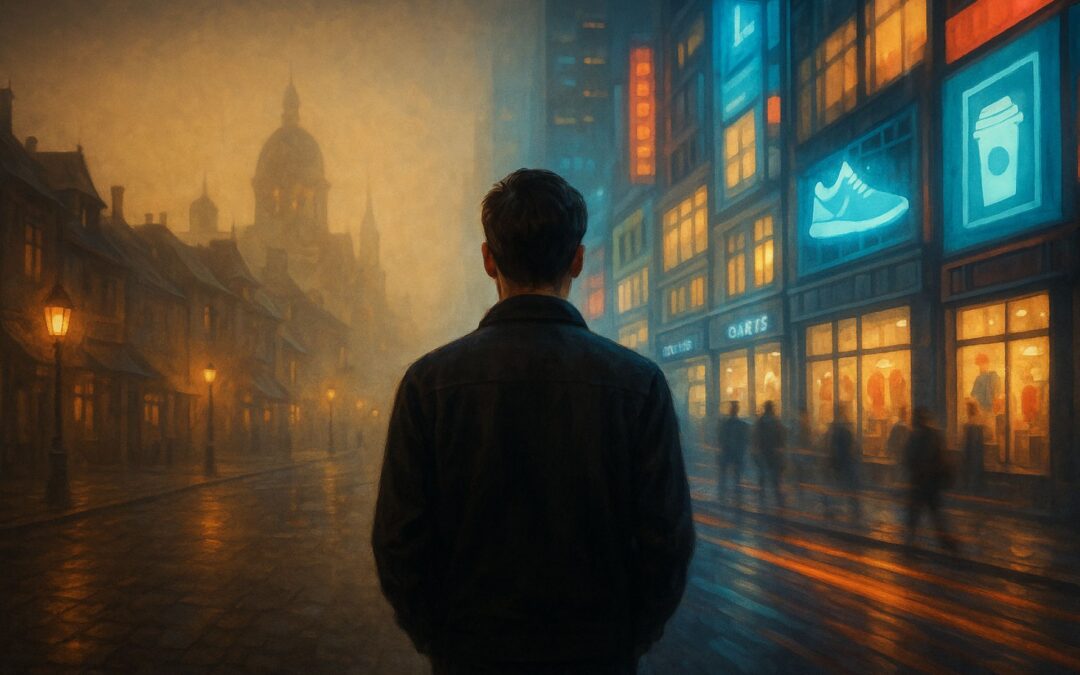
There was a time when the world felt impossibly large—so vast, so obscure, so filled with unreachable corners that the very act of imagining it stirred a sense of awe. Cities you’d never seen took on mythical proportions in your mind. Countries you’d only heard about in passing felt like distant realms. The simplest map could ignite a cascade of fantasies, because behind every line, every name, every shaded region lay a mystery. Not knowing was the point. Not knowing made the world big.
Today, the world remains geographically unchanged, but mentally, emotionally, spiritually, its scale has collapsed. We’ve compressed the unknown into the familiar and flattened the mysterious into the ordinary. When everything is visible, previewable, documented, and explained, nothing feels like an adventure anymore. And so, with a strange collective melancholy, we ask: why does life feel so dull now? Why does everything look the same? Why does nothing shake us, surprise us, or pull us into the deeper currents of experience?
The Vanishing Mystery of the World
Mystery used to be a natural part of human existence, not a luxury or a curated experience. You didn’t need to travel across the world to feel it—you felt it standing in your own neighborhood, wondering what lay beyond the borders of your lived reality. A map wasn’t a tool; it was a portal. A single dot on a globe could keep your mind occupied for days because the distance between what you knew and what you didn’t was vast enough to spark imagination.
That distance has collapsed.
The disappearance of mystery isn’t just about information being more available. It’s about the pace at which it enters your mind. The human brain evolved in a world where knowledge came slowly, where insights accumulated over years, not seconds. When the unknown was massive, you had space—cognitively and emotionally—to project fantasies, build narratives, and fill in the blanks with your own creativity. Those blanks are essential for wonder; they are the canvas on which awe paints itself.
Today, nothing stays blank long enough to stir curiosity. Every question you ask is answered instantly, robbing your imagination of the chance to wander or speculate. When you were young, a vague description of another country felt like a myth. A grainy photograph felt like an artifact from another universe. Now, complete immersion is available on demand: walkthroughs of entire cities, hyper-detailed drone footage, street-by-street mapping, cultural deep-dives condensed into five-minute videos.
The mystery that once expanded your world has been replaced by clarity that shrinks it.
The emotional impact of this shift is subtle but profound. Mystery is not just a feature of the world; it is a nutrient for the human spirit. When everything is explained, shown, documented, and visualized, you lose the mental muscles that once allowed you to imagine the unseen. Without the unknown, your inner landscape withers. The world loses its depth and becomes a two-dimensional plane of facts rather than a three-dimensional experience of wonder.
This is why modern life feels strangely weightless. Not because the world is less interesting, but because your mind has fewer places to roam. When all paths are illuminated, the journey no longer feels like an adventure—it feels like a guided tour.
When Accessibility Kills the Adventure
Accessibility is a quiet thief. It steals meaning in ways you don’t notice until the loss is irreversible. The very technologies designed to enhance your life often erode the emotional layers that once made experiences impactful. Travel used to be a slow-building crescendo: the planning, the dreaming, the saving, the buildup of anticipation. Weeks or months might pass between the idea of a destination and the actual trip. In that gap lived excitement, fear, curiosity, and longing.
That gap is gone.
With instant booking systems and algorithmic suggestions, travel is no longer a journey; it’s a purchase. The psychological runway that once prepared your mind for novelty has been paved over by urgency and efficiency. You don’t have to dream about a place—you can preview it instantly. You don’t have to imagine what a street might feel like—you can watch someone else walk down it in real time. The act of exploration has been outsourced to influencers, reviewers, and satellite cameras.
And previews destroy adventure.
Adventure requires uncertainty—moments where your expectations are mismatched with reality, forcing you to adapt, discover, and learn. When you’ve already consumed a destination digitally, your mind treats the real experience as a formality, not a revelation. You arrive not to discover but to confirm. And confirmation is emotionally sterile.
Accessibility also homogenizes the journey itself. Airports, once gateways to the unknown, feel like identical copies of each other. Hotels follow standardized global aesthetics. Tourist hotspots are photographed so frequently that your first view of them feels like déjà vu instead of awe. Even the intangible elements—sounds, smells, street rhythms—lose their impact when you’ve already watched them online.
The consequence is existential: you lose the sensation of stepping into a world that is meaningfully different from your own.
Human beings need friction to form memorable experiences. Difficulty anchors emotion. Effort intensifies meaning. When everything is smooth, quick, predictable, and optimized, your encounters with the world become fleeting impressions rather than lasting transformations.
Adventure dies not because the world has changed—but because we’ve removed every obstacle that once made it meaningful.
The Death of Spiritual Labor
Zapffe’s idea of spiritual labor is one of the most overlooked explanations for why modern life feels emotionally thin. At its core, spiritual labor is the inner work you perform when confronting uncertainty, adversity, limits, and the unknown. It is the psychological engagement that happens when life requires something from you—courage, patience, resilience, imagination, or sacrifice. The paradox of technological progress is that it has made life safer and more convenient while simultaneously stripping away the very experiences that once cultivated depth.
Consider the emotional magnitude of a journey in the 18th century. Traveling from Amsterdam to Edo wasn’t merely logistical—it was transformative. Everything about it demanded the total activation of the self. You had to wrestle with fear, hope, boredom, danger, sickness, weather, loss, longing, and the dizzying vastness of the world. You left as one person and returned as another, because the journey wasn’t a change in location—it was a confrontation with reality.
Spiritual labor lived in every mile of the voyage.
Modern travel offers none of this psychic engagement. When discomfort is minimized, transformation is minimized. The trip compresses to a few hours suspended between sanitized terminals. Nothing is demanded of you except patience with minor inconveniences. You do not wrestle with fate; you kill time with entertainment. Your body moves across the world, but your inner world remains untouched.
Zapffe’s warning becomes clear: life that demands nothing gives nothing.
Humans are meaning-seeking creatures. But meaning is rarely found in frictionless environments. We derive significance from the trials we endure, the unknowns we confront, and the risks we willingly take. When the world removes those dimensions, it also removes the emotional scaffolding they once built inside us. We end up with experiences that are easy but empty—pleasant but forgettable.
This is why so many modern experiences feel weightless. We glide through life without psychological engagement. Without spiritual labor, the soul atrophies, not because the world is insufficient, but because we are no longer required to show up fully. The ease of modern life, while materially beneficial, has created a spiritual vacuum: a world where everything is accessible, but nothing feels earned.
The Commodified Life: Experiences Turned Into Products
One of the most corrosive effects of modernity is the way it turns everything—travel, relationships, encounters, even personal identity—into products to be browsed, judged, selected, and consumed. The moment an experience becomes a commodity, its emotional depth erodes. Commodities are designed for efficiency, predictability, and scalability. But the human psyche thrives on unpredictability, tension, and genuine connection—qualities inherently incompatible with commodification.
Take the modern dating landscape. What once required courage, vulnerability, timing, and the unpredictability of real-life chemistry has been transformed into an interface. Profiles replace personalities. Swipe gestures replace meaningful encounters. Algorithms filter potential partners the way e-commerce platforms filter sneakers—by specifications, preferences, and trends. Romance becomes transactional, and intimacy becomes optional.
The emotional consequences are profound. When potential partners become products, desire weakens, commitment declines, and appreciation evaporates. What was once a spark becomes a comparison chart. The magic of meeting someone in the wild—catching their eye, noticing their gestures, reading their energy—gets replaced by scrolling through curated photos and optimized prompts. We don’t meet people anymore; we evaluate them. And evaluation kills wonder.
Travel suffers a similar reduction. Instead of immersing yourself in a place, you consume it. Instead of experiencing it, you document it. Destinations become checkboxes, not discoveries. Even the way cities advertise themselves resembles packaging: “Top 10 must-see spots,” “the most Instagrammable places,” “hidden gems” that are no longer hidden. The entire process is engineered around visibility, not authenticity.
And identity itself is no longer an inward journey but an outward performance. Online personas are crafted systems of self-branding. Every hobby, viewpoint, outfit, and relationship becomes a broadcast. We turn ourselves into products without realizing it.
The central tragedy is that commodification creates the illusion of abundance while delivering spiritual poverty. You gain more options but lose more meaning. You have greater access but weaker connection. You experience more things but with less emotional intensity.
When life becomes a marketplace, depth becomes a casualty. Experiences that were once lived are now consumed. And consumption, no matter how pleasurable, cannot nourish the parts of us that hunger for mystery, authenticity, and soul.
The Rise of Global Sameness
One of the strangest paradoxes of globalization is that the more connected the world becomes, the more homogenous it feels. You would think that increased exposure to other cultures would heighten your sense of difference and diversity. Instead, the opposite happens. The world begins to resemble a mirrored hall—everywhere you go, you encounter a slightly modified version of the place you just left.
Cities once had distinct personalities shaped by local businesses, customs, aesthetics, and rhythms. Paris felt unmistakably Parisian. Tokyo felt intensely Tokyo. A village in Spain didn’t feel like a village in the Netherlands, and you sensed the difference even before you saw it—you felt it in the unfamiliar currency, the smell of local bakeries, the architectural quirks, the way people moved or spoke. Travel used to surprise you. It disoriented you. It expanded your internal map of what was possible.
But with hyperglobalization, everything moves toward the same template.
Chain stores spread across continents, bringing with them the same signage, products, pricing, and interior design. Fast-fashion brands clothe entire populations in identical styles. Coffee shops replicate the same menu in Tokyo, Amsterdam, Berlin, and Singapore. Even digital aesthetics—fonts, colors, layout styles—have synchronized globally through the influence of a handful of platforms. The texture of place dissolves into a universal sameness.
This erosion of local character doesn’t just alter physical spaces—it alters psychological ones. When everywhere feels familiar, nowhere feels profound. When you can predict what a street in another country will look like, the moment of arrival loses its emotional charge. Travel becomes lateral movement within a single culture rather than a vertical descent into a new one. You don’t feel transported; you feel relocated.
And beneath the surface of this homogenization lies a deeper trend: humanity gravitates toward the safe, repetitive, and familiar. We choose what we know. We prefer brands we’ve seen before. We follow tastes formed by global standards rather than local ones. Over time, these preferences reshape societies. Local shops close. Local customs fade. Local aesthetics disappear.
Globalization makes life smoother and more efficient, but it also flattens the emotional landscape of the world. Difference becomes a commodity instead of a natural condition. Novelty becomes curated instead of lived. And perhaps most troubling of all, we begin to mistake the comfort of familiarity for the richness of experience.
Sameness is convenient, but convenience rarely nourishes the soul.
Algorithmic Echo Chambers and the Terror of the Same
If globalization homogenizes the physical world, algorithms homogenize the inner one. Byung-Chul Han’s idea of the terror of the same describes how modern society systematically eliminates the unfamiliar, leaving us trapped inside worlds of predictable, self-reinforcing content. Instead of encountering difference—the raw material of growth—we are fed versions of ourselves.
The mechanism is deceptively simple. Algorithms observe your preferences, track your behavior, and serve you more of what you’ve already consumed. They filter the world not based on what you might need, but on what will keep you engaged. Your digital environment becomes a loop: familiar styles, familiar opinions, familiar personalities, familiar aesthetics. You don’t discover—your feed defines.
This has a profound psychological effect. The unfamiliar becomes jarring. Dissonance feels like a threat. You grow intolerant of perspectives that differ from your own because the digital world has conditioned you to expect alignment. Your sense of reality contracts. Curiosity dulls. You do not stretch your mind; you soothe it.
And the tragedy goes deeper: algorithms destroy the experience of randomness, which is one of the core drivers of human creativity and wonder. Serendipity—the unexpected encounter, the accidental discovery, the strange book you stumble upon, the conversation you didn’t plan—rarely survives inside algorithmic curation. Everything is optimized. Everything is tailored. Everything is repeated.
Han’s insight reveals why modern life feels so monotonous: we are not just surrounded by sameness—we’re surrounded by sameness dressed as choice. Infinite scrolling creates the illusion of variety, but the underlying content is eerily similar. The same faces. The same aesthetics. The same jokes. The same political opinions. The same types of people, filtered endlessly by digital systems.
We live inside worlds that reflect us so completely that we stop encountering anything that expands us.
This internal homogenization shrinks the emotional palette with which we perceive the world. When nothing challenges your assumptions, nothing changes you. When everything you consume aligns with who you already are, you never become anything more. You drift inside a soft cocoon of the familiar, comfortable but spiritually paralyzed.
The terror of the same is not loud or dramatic—it is silent, creeping, and total. It makes you feel like you’re exploring, while quietly ensuring that you never truly encounter the world or yourself in a new way.
Why Everything Feels Predictable and Spiritually Grey
Emotional richness requires contrast—moments that shock you out of autopilot, environments that unsettle your expectations, textures of life that crack open your attention. But modern existence is structured to minimize surprise. We’ve engineered away unpredictability in every domain: travel, work, relationships, entertainment, even our self-expression. Life becomes a controlled climate, a kind of emotional air-conditioning in which nothing is too intense, too risky, too strange, or too overwhelming.
Without contrast, your experiences lose depth. You cannot feel awe without uncertainty. You cannot feel exhilaration without stakes. You cannot feel wonder without mystery. When nothing breaks the pattern, nothing moves the heart.
This predictability creates a kind of existential flatline. It’s not depression, not boredom—it’s a numbing sameness that stretches across days, months, even years. Life has sensations, but no peaks. Movements, but no momentum. Motion, but no meaning. You glide from task to task, place to place, screen to screen, without any internal shift. The world becomes a series of familiar scripts, replayed endlessly.
Part of this greyness comes from overstimulation. When your senses are continuously fed stimuli—notifications, videos, ads, micro-entertainments—you lose the ability to register nuance. Everything is loud, so nothing feels loud. Everything is available, so nothing feels rare. The emotional capacity that once ignited at the sight of vast mountains or bustling foreign streets now struggles to respond because it is perpetually saturated.
Another part comes from routine disguised as choice. You move through infinite content, infinite recommendations, infinite products—but the variation is superficial. Underneath the glossy options lies a monotonous sameness. Algorithms curate your preferences so tightly that you only ever encounter slightly different versions of what you already like. The sense of exploration vanishes.
But perhaps the deepest layer of greyness comes from the loss of genuine transformation. When the world no longer challenges you, you no longer evolve. Growth used to be inseparable from life because life used to be unpredictable. You didn’t just go through experiences—you were altered by them. Now you move toward experiences with the safety of foreknowledge. You see the destination before you arrive. You know the story before you participate. You live inside a world where change is optional.
When nothing pushes against your identity, your identity stops stretching. When nothing disrupts your expectations, your expectations petrify. The result is not unhappiness—it is emotional stagnation. The soul becomes a still pond reflecting the same sky every day.
This is why everything feels spiritually grey. The world did not lose its magic. We lost the friction that reveals it.
Reawakening Wonder in a World Without Mystique
The modern world is stingy with mystery, but that doesn’t mean mystery is extinct. It means that wonder is no longer passive—it must be cultivated. You can no longer rely on the world to surprise you. You must create the conditions in which surprise becomes possible again.
The first step is rejecting the tyranny of previews. Avoid the instinct to gather information before every experience. Don’t watch walkthroughs of cities you plan to visit. Don’t search for reviews of every restaurant. Don’t over-research your destinations. Leave blank spaces in your imagination—let curiosity stretch its legs. Mystery must have room to breathe.
The second step is embracing intentional friction. Choose activities that require effort, patience, or uncertainty. Take the long route. Walk without Google Maps. Enter a café without checking the menu. Travel to a town you’ve never heard of. Talk to someone outside your social bubble. Do things that make you slightly uncomfortable, because discomfort reawakens the dormant parts of your mind.
The unfamiliar is the gateway to wonder.
You must also disrupt your digital habits. Curate randomness into your life. Read genres you normally avoid. Follow creators with radically different perspectives. Break out of algorithmic tunnels. Expand your informational diet the way you’d diversify your nutrition. The mind needs exposure to difference to stay alive.
Finally, reconnect with the raw materials of presence—attention, silence, and curiosity. Modern life has trained us to look without seeing and consume without feeling. Slow down. Sit with things. Notice textures, sounds, atmospheres. Wonder is often not in the object but in the intensity of your attention.
Reawakening wonder is a spiritual practice. It is not about escaping modernity or rejecting technology. It is about reclaiming the aspects of humanness that the modern world numbs: awe, vulnerability, imagination, courage, and the capacity to be moved by something larger than yourself.
Mystery still exists—but it hides in the margins, in the uncurated, unoptimized, unplanned parts of life. And if you’re willing to seek it, even the most familiar world can become enchanted again.