
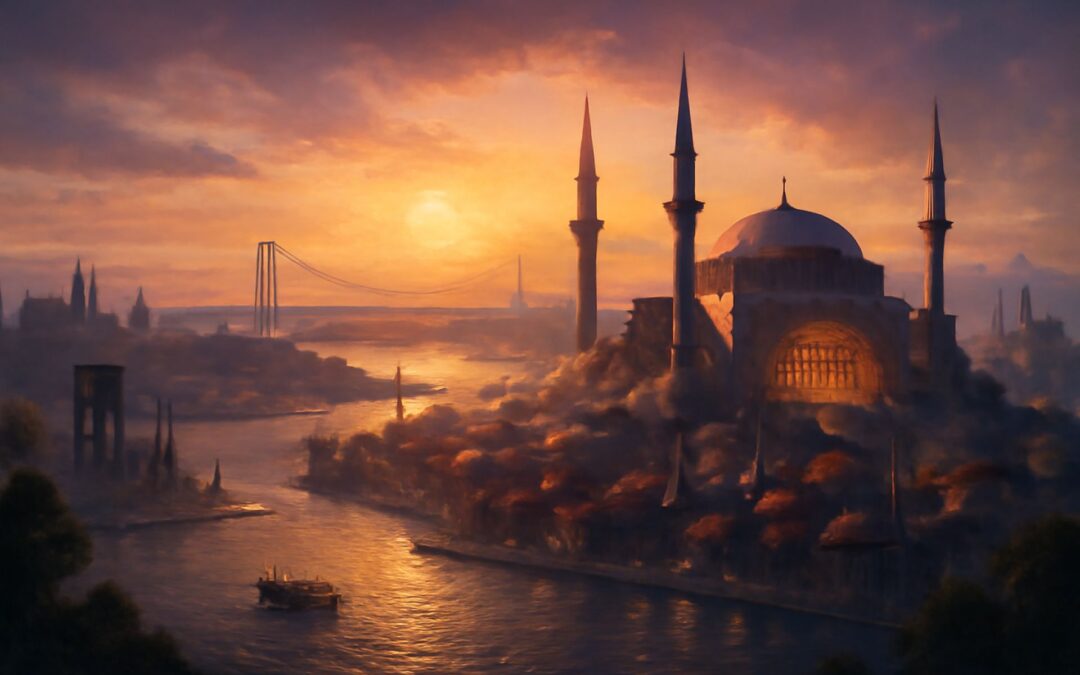
Introduction: Where Civilizations Collide
Istanbul is one of the few cities on Earth whose very existence feels improbable. It sits on a narrow peninsula between continents, balanced on the hinge where Europe meets Asia, surrounded by waters that shaped the destiny of empires. Geography alone cannot explain its endurance, but geography is where its story begins: a triangular strip of land with a natural harbor, commanding the Bosphorus—the only passage between the Black Sea and the Mediterranean.
For more than 2,600 years, this unique position has made the city a magnet for power. It has been a Greek colony, a Roman stronghold, the capital of Christian Byzantium, the heart of the Ottoman Empire, and a modern megacity anchoring the Republic of Turkey. Each era left behind architecture, language, religion, and cultural memory, creating layers so dense that no single identity can define the city. Istanbul is not just old; it is continuously renewed, rebuilt, and repurposed by every civilization that claimed it.
This is why Istanbul’s history reads like a compressed narrative of world history. Greeks, Persians, Romans, Byzantines, Vikings, Crusaders, and Ottomans all converged on this single point, each believing the city to be the key to their strategic future. Few places capture the rise and fall of empires with such clarity. In Istanbul, political transitions were not abstract—they were visible in the bricks of the walls, the shape of the skyline, and the rituals performed in its temples, churches, and mosques.
Across its timeline, one pattern repeats: destruction followed by reinvention. The city has been besieged, burned, looted, conquered, depopulated, and rebuilt more times than almost any major city in the world. From Roman civil wars to the Nika riots, the Fourth Crusade, the Ottoman conquest, and the turbulence of the early 20th century, each catastrophe reshaped the city’s form and identity.
Yet Istanbul never vanished. It absorbed architects, merchants, scholars, soldiers, diplomats, pilgrims, and migrants from across the known world. It became a crossroads of trade routes that carried silk, spices, grain, slaves, ideas, religions, and technologies. It preserved the knowledge of ancient Greece and Rome when Western Europe fell into disarray. It guarded the gates of Europe during the Arab conquests. It connected the Viking world to the Mediterranean. It symbolized imperial power for both Byzantium and the Ottomans. And in the 20th century, it adapted again—this time to secular republican modernity and the forces of global capitalism.
To understand Istanbul is to understand how geography, ambition, belief, and conflict shape the fate of cities. It is a place where empires projected their aspirations onto stone and marble, where religions struggled for dominance, and where cultural exchanges produced hybrid identities that still define the city today.
The story begins not with an empire, but with a Greek legend—of a leader guided by prophecy to a peninsula that would one day become the most coveted urban prize in world history.
The Greek Origins
The story of Istanbul begins long before empires, armies, and world-changing religions—before it became Constantinople or Istanbul—when it was a modest Greek outpost called Byzantion. Its earliest history is wrapped in legend, but the legend itself encodes a deeper truth about the city’s geography and destiny.
Byzantion: The Oracle and the Peninsula
According to Greek tradition, a leader named Byzas journeyed from the city of Megara around 600 BC in search of a new settlement. Before leaving, he consulted the Oracle of Delphi, who, in typical cryptic style, instructed him to establish his city “opposite the land of the blind.”
Byzas interpreted the riddle only upon reaching the Bosphorus. On the Asian shore sat Chalcedon, an older Greek colony. Byzas judged its founders “blind” for failing to choose the superior site across the strait: a natural peninsula protected by water on three sides, commanding the narrow waterway that linked two seas and two continents.
This insight was not mystical—it was strategic. The location offered everything a growing city needed: a defensible position, maritime access, and a vantage point over one of the most valuable trade corridors in the ancient world. Geography was destiny, and Byzas understood it.
A Greek City-State
Byzantion quickly grew into a typical Greek polis, with all the architectural and civic features of its era. It possessed:
- an acropolis, where temples and fortifications crowned the hill
- an agora, the central marketplace of trade and community life
- sturdy walls, necessary to guard against the turbulence of regional politics
- a thriving harbor, later known as the Golden Horn, which became one of the most strategic natural harbors in history
Its population engaged in commerce, fishing, shipping, and regional trade. Although small, Byzantion’s position meant it could profit from controlling traffic between the Black Sea and the Mediterranean—a privilege that would gain extraordinary importance in later centuries.
Persian and Greek Conflicts
With its strategic location came vulnerability. Byzantion was absorbed into the Persian Achaemenid Empire in 513 BC during Darius I’s European campaigns. Later, during the Peloponnesian War between Athens and Sparta, the city became a point of contention as both sides recognized its economic and military value.
This early tug-of-war between larger powers previewed the city’s entire future. Byzantion was too valuable to remain independent and too strategically placed to be ignored. Control of Byzantion meant control of the strait, and control of the strait meant influence over the entire region’s trade and warfare.
By the 4th century BC and into the Hellenistic period, the city shifted hands multiple times. Yet throughout these struggles, it retained its Greek identity and cultural continuity, even as the Mediterranean world moved steadily toward the dominance of Rome.
By the 2nd century BC, that transition was complete. Byzantion would soon become part of a much larger imperial system—one that would elevate its importance, reshape its architecture, and lay the groundwork for its future transformation into a capital.
Byzantium Under Rome
By the 2nd century BC, Byzantion’s fate became intertwined with the expanding power of Rome. The Romans valued the city not as a cultural prize but as a strategic asset—an indispensable checkpoint controlling naval movement between the Black Sea and the Mediterranean. As Roman influence enveloped the eastern Mediterranean, Byzantion shifted from a contested Greek outpost to a minor but significant frontier city within a vast imperial system.
Absorption Into the Roman Republic
Rome initially treated Byzantion as a semi-autonomous ally. Its Greek character remained intact: the language, institutions, and civic identity persisted. But autonomy in the Roman world was conditional. When the city’s political maneuvers clashed with Rome’s interests, its independence was quickly curtailed.
Over time, the city was integrated fully into the Roman Republic. This integration brought stability, access to imperial trade networks, and protection—benefits that would reshape the city and prepare it for larger transformations. Even so, Byzantion remained a peripheral settlement. No one yet imagined it would become the center of the world.
The Siege by Septimius Severus
The turning point came during a Roman civil war. In 193 AD, amidst a power struggle following Emperor Commodus’s death, Byzantion backed a losing claimant. The victor, Septimius Severus, responded with calculated vengeance.
He besieged the city for three years, a punishment intended not just for Byzantion but as a message to any city that dared to defy Rome’s chosen ruler. When Severus finally captured the city in 196 AD, he razed its defenses, inflicted severe damage, and stripped away its autonomy.
But punitive destruction was followed by strategic reconstruction. Recognizing the city’s value, Severus ordered major rebuilding works:
- He restored the walls.
- He redesigned the city with a more Roman urban layout.
- He constructed new public buildings, including forums and baths.
- He established the first major Hippodrome, a grand stadium that would later become one of the defining institutions of Constantinople.
This transformation marked a critical shift: Byzantion was no longer just a Greek trading town — it was becoming a Roman imperial city.
Early Roman Infrastructure
By the early 3rd century, the Romanized city had a clearer identity. The new layout incorporated hallmark Roman features:
- forums for administrative and commercial life
- baths, essential for Roman social culture
- an arena, foreshadowing the immense Hippodrome that would later dominate the city’s social and political life
The fusion of Greek heritage with Roman architecture created a hybrid urban environment. It was at once ancient and newly Roman, a precursor to its future as a city that continually blended old foundations with new imperial visions.
A City Waiting for a Purpose
Despite these developments, Byzantium still wasn’t the jewel of the empire. It was a fortified waypoint, a useful hub, a place with potential but without a defining role. Rome’s administrative center remained far away, and the empire looked elsewhere for its symbolic heart.
All of that changed in the 4th century, when one leader perceived not only the city’s strategic advantages but its potential to become the stage for a new imperial order.
That leader was Constantine.
Constantinople: A New Imperial Capital
The transformation of Byzantium into Constantinople is one of the most consequential decisions in world history. In a single stroke, Emperor Constantine elevated a modest provincial city into the heart of a new imperial vision—one that would outlast Rome itself. The choice was not merely geographical or administrative; it was ideological. Constantine sought a fresh center of power, free from the political entanglements of old Rome, strategically positioned to manage the empire’s eastern frontier, and symbolically aligned with his new Christian identity.
Constantine’s Vision
After securing his position as sole ruler in 324 AD following yet another civil war, Constantine began searching for a site that could serve as a forward-facing capital. Rome was burdened by senatorial politics, aging infrastructure, and limited strategic utility. The eastern provinces were wealthier, more stable, and increasingly crucial to imperial defense.
Byzantium provided everything Constantine needed:
- A defensible peninsula, surrounded by the Golden Horn, the Sea of Marmara, and the Bosphorus.
- A central position linking Europe and Asia, essential for military mobility.
- Control over the major east–west maritime trade routes, ensuring economic power.
- A symbolic blank slate—a place he could refashion into a Christian imperial city.
In 330 AD, the city was formally inaugurated as Constantinopolis—Constantine’s city.
This moment marked the beginning of Constantinople’s ascent as one of the most influential cities in history.
Imperial Urban Expansion
Constantine’s redesign was ambitious. The old Greek and Roman town was too small to serve an imperial purpose, so planners expanded the boundaries dramatically to encompass the entire peninsula. Massive infrastructure works reshaped the urban landscape:
- New land walls were built to protect the growing population on the western side, the only vulnerable frontier.
- The Great Palace rose near the imperial center, a sprawling complex overlooking the sea.
- The Hippodrome, originally begun under Septimius Severus, was expanded into a monumental arena capable of holding tens of thousands.
- Broad avenues and new public spaces created a unified cityscape that reflected Roman grandeur but in a distinctly eastern setting.
These works created the framework for a city designed to endure sieges, manage trade, house a large imperial bureaucracy, and project imperial authority for centuries.
Rise of Christian Power
Constantine’s embrace of Christianity deeply influenced the cultural and political identity of the new capital. Although he did not make Christianity the official religion during his lifetime, he seeded the institutional foundations that would soon make Constantinople the epicenter of Eastern Christendom.
Key developments included:
- Construction of major churches, setting the architectural language for future basilicas.
- Establishment of Constantinople as a major episcopal seat, second only to Rome.
- Imperial patronage of Christian clergy, scholarship, and religious institutions.
By the late 4th century, under Emperor Theodosius I, Christianity became the official religion of the empire. With this shift, Constantinople assumed a new religious authority. Its patriarch became one of the leading figures of the Christian world, rivaled only by the pope.
A Capital Unlike Any Other
Constantinople was not simply a replacement for Rome—it was its successor with a new mission. It embodied three identities at once:
- Roman, in law, administration, and imperial tradition.
- Greek, in language, culture, and intellectual heritage.
- Christian, in worldview and institutional authority.
This fusion created a distinct civilization: the Byzantine Empire. Constantinople stood at its center, shining as the greatest city of the medieval world.
The rise of Constantinople marks the true beginning of Istanbul’s imperial story. Athletes, priests, scholars, merchants, soldiers, and emperors all passed through its gates. Its walls would withstand assaults that would have toppled lesser cities. Its palaces and churches would set standards for architecture. Its culture would influence regions from the Mediterranean to the Slavic lands.
And under the next great ruler—Justinian—the city would reach heights of architectural and political ambition unmatched in its era.
The Byzantine Golden Age
With Constantine’s foundations in place, Constantinople entered a period of expansion, innovation, and cultural flourishing unmatched in its early history. This era—stretching from the 4th to the 10th centuries—saw the city grow into the greatest metropolis of the medieval world. Its population exceeded half a million, its trade networks spanned continents, and its architectural achievements set global standards. Yet the defining moment of this era came under one emperor whose ambition permanently transformed the skyline: Justinian I.
Justinian and the Nika Revolt
Justinian’s reign (527–565 AD) was characterized by extraordinary ambition. He sought to restore the Roman Empire’s former territorial glory, codify its laws, and reaffirm Constantinople as its political and cultural heart. But early in his rule, his authority was nearly destroyed by an unexpected explosion of civil unrest.
The Nika Revolt of 532 began as a conflict between two chariot racing factions—the Blues and Greens—whose rivalries often spilled into politics. What started as a localized dispute escalated into a city-wide rebellion fueled by grievances against taxation, corruption, and imperial policy.
For several days, angry crowds set fire to neighborhoods, government buildings, and religious structures. The destruction was immense:
- Half the city was burned.
- The original Hagia Sophia was completely destroyed.
- As many as 30,000 people were killed when Justinian’s forces finally crushed the uprising inside the Hippodrome.
Most rulers would have been humbled by such chaos; Justinian used it as an opportunity.
Building Hagia Sophia
In the ashes of the revolt, Justinian embarked on an unprecedented building program. At its center was the architectural marvel that became the symbol of Byzantium: Hagia Sophia, completed in just five years (537 AD).
This was not merely a cathedral; it was a declaration of imperial power, spiritual authority, and engineering genius:
- The main dome appeared to float weightlessly above the nave.
- Light filtered in from hidden windows, creating an otherworldly aura.
- Mosaics and marble panels glittered across vast surfaces.
- Architects Anthemius and Isidore used daring mathematical and structural innovations that had no precedent in the ancient world.
For nearly a thousand years, Hagia Sophia remained the largest enclosed space on Earth. No other building, church, or mosque matched its scale or influence until the Renaissance.
It encapsulated the essence of Constantinople: a city where ingenuity, faith, and power intertwined.
A Cosmopolitan Empire
During this period, Constantinople was the center of a vast economic network. Goods from across three continents passed through its harbors:
- silk from China
- spices from India
- grain from Egypt
- furs, wax, and slaves from the Slavic and steppe regions
- olive oil and wine from the Mediterranean
The Golden Horn was among the busiest ports in the world, crowded with merchant ships, warehouses, and markets. The city was home to Greeks, Romans, Armenians, Syrians, Jews, Slavs, Persians, and merchants from distant lands. Its libraries and schools preserved classical Greek and Roman knowledge, making the city a refuge of ancient learning during eras when much of Europe struggled to maintain literacy.
External Threats
Despite its wealth, Constantinople lived under constant pressure from rival powers.
- Persian armies threatened the eastern frontier.
- Arab and later Umayyad forces seized Syria, Egypt, and North Africa and attempted to capture Constantinople directly.
- The city survived two major Arab sieges (674–678 and 717–718), thanks in part to its invincible land walls and the terrifying technology known as Greek fire, an incendiary weapon launched from flamethrower-like devices.
Greek fire became legendary—capable of burning even on water—and served as a psychological deterrent against enemy fleets. It was one of the reasons the city remained unconquered for centuries.
Internal Upheavals
Not all threats came from outside. The empire was destabilized from within by theological and political conflict, especially the Iconoclast Controversy (726–843). Several emperors banned the veneration of icons, leading to the destruction of many mosaics and artworks.
This conflict divided society into:
- iconoclasts, who opposed icons, and
- iconophiles, who defended them
The controversy lasted more than a century and reshaped Byzantine art and politics. When icons were finally restored in 843 during the “Triumph of Orthodoxy,” the city saw a renaissance of mosaic art, with brilliant new works filling the vaults of Hagia Sophia and other churches.
A City at Its Height
By the end of this golden age, Constantinople had become:
- the largest city in the world
- the most fortified capital on Earth
- a global center of trade, culture, and religion
- a repository of classical knowledge
- the beating heart of Eastern Christendom
It was the city that foreign visitors described with awe and envy, the city that inspired legends, and the city that seemed unbeatable.
But no golden age lasts forever.
A new dynasty would revive Constantinople’s fortunes again—only for deeper divisions to emerge later.
The Second Golden Age and the Varangian Era
After the turbulence of the 7th and 8th centuries, Constantinople entered a period of renewed stability and cultural revival under the Macedonian dynasty. This era, spanning roughly the 9th to 11th centuries, is often called Byzantium’s Second Golden Age. It was marked by military resurgence, territorial recovery, artistic flourishing, and expanding connections with the northern world—particularly the emerging societies of the Slavs and Vikings.
Macedonian Dynasty Revival
Founded by Basil I in 867 AD, the Macedonian dynasty brought strong leadership, administrative reform, and a revitalized sense of imperial purpose. Under rulers such as Leo VI, Constantine VII, and Basil II, the Byzantine Empire regained much of its stability and influence.
During this period:
- The empire expanded into Bulgaria and parts of the Caucasus.
- Trade routes became more secure.
- Scholarship flourished, leading to the compilation of encyclopedias, legal codes, and historical works.
- Court culture grew more elaborate, reinforcing Constantinople’s image as the epicenter of imperial sophistication.
Art and architecture also revived. Mosaic craftsmanship reached new heights, icons regained their importance after the end of iconoclasm, and imperial ceremonies became more grandiose.
The city itself grew once again. Its markets swelled with merchants, its harbors filled with ships, and its palaces hosted envoys from as far as the Rus, Arabia, and Western Europe.
Viking and Rus Connections
One of the most fascinating developments of this era was Constantinople’s expanding contact with the northern world—specifically, the Rus (the ancestors of modern Russians and Ukrainians) and Scandinavian Vikings who moved along the river routes of Eastern Europe.
These northern traders, adventurers, and warriors saw Constantinople as a place of extraordinary wealth. They traveled down the Dnieper and Dniester rivers, carrying:
- furs
- wax
- honey
- amber
- slaves
In exchange, they sought silk, wine, coins, and luxury goods.
The city they called Miklagard, or “The Great City,” became an integral node in Viking-era trade networks. From the Baltic to the Black Sea, Constantinople was the ultimate destination.
The Varangian Guard
This contact had profound political consequences. In the late 10th century, a unique military institution emerged: the Varangian Guard, an elite unit of foreign warriors loyal exclusively to the Byzantine emperor.
Key features:
- Originally composed of Rus warriors under agreements forged with their princes.
- Later augmented by Scandinavian Vikings seeking wealth and honor.
- After 1066, many exiled Anglo-Saxon warriors (displaced by the Norman conquest of England) also joined the ranks.
The Varangian Guard became the emperor’s personal bodyguard—renowned for their towering stature, iron discipline, and fearsome axes. Their loyalty was prized because, unlike local soldiers, they had no factions or political ties within the empire.
Their presence added a new cosmopolitan dimension to Constantinople. Norse sagas and Byzantine chronicles alike describe these northern warriors walking the streets of the imperial capital, stationed in palaces, and fighting in key battles.
A Cosmopolitan and Confident City
By the 10th century, Constantinople had again become the dominant city of the region. Travelers from far-flung lands described it in admiring terms:
- European envoys marveled at its wealth.
- Arab geographers praised its defenses and urban sophistication.
- Rus traders saw it as the greatest market in the world.
This second golden age was one of cultural synthesis—Greek, Roman, Christian, and foreign influences blending into a unique imperial civilization.
But beneath this prosperity, tensions were forming. Growing divisions between Eastern and Western Christendom, military pressures on the eastern frontiers, and emerging political instability set the stage for a new era of conflict.
The cracks that would ultimately lead to Byzantine decline were beginning to appear.
The Great Schism and the Decline
By the 11th century, Constantinople remained a dazzling metropolis—wealthy, fortified, and culturally unmatched. Yet beneath the surface, the empire had entered a period of fragmentation. Political strains, religious tensions, and external threats converged, eroding the stability built during the Macedonian revival. What followed was a sequence of events that would devastate Byzantium from within and without, culminating in one of the most catastrophic episodes in medieval history: the sack of Constantinople during the Fourth Crusade.
The Schism of 1054
The most symbolic rupture of this era was the formal split between the Eastern Orthodox and Roman Catholic Churches in 1054.
Though tensions had existed for centuries—driven by doctrinal disagreements, political rivalries, and cultural differences—the schism made the division official.
Key issues included:
- disputes over papal authority
- theological disagreements like the Filioque clause
- divergent liturgical traditions
- differing political interests between East and West
The schism did not immediately cause open conflict, but it laid the foundation for distrust, hostility, and ultimately tragedy. As the Byzantine Empire’s military weakened, the West’s willingness to assist grew conditional and transactional. Constantinople and Rome no longer saw each other as partners in a shared Christian world.
Seljuk Pressures and the Battle of Manzikert
While religious tensions simmered, a more direct threat emerged from the east. The Seljuk Turks, a rising power with rapid military momentum, challenged Byzantine supremacy in Asia Minor.
This crisis reached its peak in 1071 at the Battle of Manzikert, where the Byzantine army suffered a catastrophic defeat:
- Emperor Romanos IV was captured.
- Much of Anatolia—the empire’s heartland and economic base—fell to the Seljuks.
- The Byzantine military was destabilized, and internal political chaos followed.
The loss of Anatolia was more than territorial; it crippled tax revenues, recruitment capacity, and the supply chains that had long supported Constantinople’s dominance.
Manzikert marked the beginning of Byzantine decline.
The Crusades: From Allies to Adversaries
Facing the Turkish threat, Byzantine emperors appealed to the West for military aid. This appeal helped spark the First Crusade (1096–1099), which initially restored some territory to Byzantine control. Relations were cautious but functional.
However, as more crusaders passed through the region throughout the 12th century, tensions escalated. Several factors poisoned relations:
- cultural misunderstandings
- competition over trade and influence
- Latin resentment of Byzantine wealth and ceremony
- Byzantine distrust of crusader motives
- disputes over control of captured cities
Crusaders saw Constantinople as decadent and treacherous; Byzantines saw the crusaders as unruly, violent, and opportunistic.
This mutual suspicion would prove fatal.
The Sack of 1204: The Fourth Crusade
Nothing in Constantinople’s long history—no siege by Persians, Arabs, or Rus—matched the devastation unleashed by the Fourth Crusade. What was meant to be a campaign to retake Jerusalem spiraled into a geopolitical disaster engineered by Venetian interests, internal Byzantine politics, and Western opportunism.
In 1204, crusader armies diverted to Constantinople, stormed the city, and unleashed three days of unrestrained plunder.
The consequences were catastrophic:
- Hagia Sophia was desecrated, its treasures ripped out and its sacred spaces violated.
- Churches were looted; relics, icons, and gold were shipped to Europe.
- Palaces and homes were burned.
- Countless civilians were killed.
- Priceless classical and Christian art was destroyed or stolen.
- The famed bronze horses of the Hippodrome were taken to Venice, where they still stand today.
Constantinople—once the wealthiest and most magnificent city in Christendom—was left a smoldering ruin.
In the aftermath, the crusaders established the Latin Empire (1204–1261), replacing Byzantine rule with a regime that struggled to maintain control and alienated the local population. Byzantine power fractured among exile states like Nicaea, Trebizond, and Epirus.
The sack of 1204 marked a fatal turning point.
The city that had withstood centuries of external threats was brought low not by enemies, but by supposed allies.
A Civilization in Decline
Although Byzantines eventually recaptured Constantinople in 1261, the empire they recovered was only a shadow of its former glory. The city’s population had collapsed from around 500,000 to roughly 50,000. Entire districts were reduced to ruins or farmland. Trade networks shifted toward Italian city-states, weakening the empire’s economic lifelines.
This era reveals a central truth of Constantinople’s history:
Its greatest threats often came not from foreign invaders but from internal divisions and geopolitical miscalculations.
With the city weakened beyond repair, a new power rose in the east—one that would ultimately succeed where others had failed.
Paleologan Restoration and Final Fall
The recapture of Constantinople in 1261 by Michael VIII Palaiologos marked a symbolic victory for the Byzantine world—but not a true recovery. The empire he reclaimed was no longer the formidable superpower of Justinian’s age or the cosmopolitan hub of the Macedonian renaissance. It was a hollowed-out, depopulated shell struggling to survive in a region transformed by new powers, shifting trade routes, and accelerating political fragmentation.
This final era of Byzantine rule is defined by a paradox: the proud restoration of an ancient city that could no longer sustain itself, and the slow, inevitable rise of a new empire forming in its shadow.
Byzantine Recovery Under Michael VIII
When Michael VIII entered the city in 1261, Constantinople was barely recognizable:
- Population had dwindled to around 50,000, a tenth of its former size.
- Large sections of the city lay in ruins or had reverted to open fields.
- Churches, palaces, and public buildings had been stripped, burned, or destroyed by the Fourth Crusade.
- The once-glittering capital had lost its political, economic, and cultural dominance.
Michael VIII worked quickly to revive the city:
- He restored the Theodosian Walls, essential for defense.
- Repaired major churches and public buildings.
- Re-established imperial ceremonies to project legitimacy.
- Encouraged migration back into the city to boost population.
These efforts brought partial stabilization, but the empire lacked the resources to fully rebuild. The damage inflicted in 1204 had permanently altered the city’s trajectory.
A Fragile Empire in a Changing World
From the mid-13th to the mid-15th centuries, Byzantium was squeezed between rising powers and internal weaknesses. Its territory continued to shrink, and the empire became increasingly reliant on diplomacy, alliances, and compromises to survive.
Key problems included:
- Financial collapse
- A series of civil wars that drained resources
- Dependence on Italian maritime republics like Venice and Genoa, who dominated trade and extracted heavy commercial privileges
- Loss of agricultural heartlands in Anatolia
- Declining population and tax base
The empire remained culturally vibrant but politically fragile, unable to generate the military force necessary to defend its land.
Ottoman Encirclement
Meanwhile, a new power rose on the Anatolian frontier: the Ottoman Turks. Originating as a small frontier principality in the late 13th century, the Ottomans expanded rapidly through:
- superior military organization
- strategic use of cavalry and gunpowder
- incorporation of conquered peoples
- relentless pressure on Byzantine-held territories
By the 14th century, the Ottomans had crossed into Europe, capturing key cities and tightening their grip around Constantinople. The city was increasingly an isolated outpost, surrounded on all sides by Ottoman-controlled lands.
During the early 15th century:
- multiple Ottoman sieges tested the city’s defenses
- Byzantine emperors sought help from Western Europe, offering church union in exchange for aid
- internal religious disputes over union further destabilized the city
- the empire became a de facto vassal state, paying tribute to the Ottomans
Despite brief reprieves, the end was clearly approaching.
The Final Siege (1453)
The decisive moment came when Mehmed II, a young and ambitious Ottoman sultan, resolved to capture the city once and for all. In April 1453, he launched a massive siege with over 100,000 troops, far outnumbering the roughly 7,000 defenders inside the walls.
Mehmed deployed both traditional siege tactics and a technological breakthrough:
- gigantic cannons, engineered by Orban, capable of blasting holes in the ancient Theodosian Walls
- naval blockades to cut off the Golden Horn
- relentless bombardment over the course of seven weeks
Inside the city, Emperor Constantine XI Palaiologos led the defense with determination, despite overwhelming odds. According to tradition, on the final day he removed his imperial regalia and charged into battle as a soldier, dying in the city’s last stand.
On 29 May 1453, Ottoman forces breached the walls. Constantinople fell after nearly 1,100 years as the capital of the Eastern Roman (Byzantine) Empire.
The End of an Era
The fall of Constantinople carries immense historical weight:
- It ended the last remnant of the Roman Empire.
- It shifted the balance of power decisively toward the Ottomans.
- It sent shockwaves across Europe, contributing to the Renaissance as Greek scholars fled west.
- It marked the beginning of a new era for the city—one defined not by decline, but by a spectacular rebirth under the Ottomans.
Constantinople did not die in 1453.
It changed owners, identities, and ambitions—but it remained the center of a powerful empire.
Mehmed II would soon transform it once again, initiating a period of renewal that produced the Istanbul the world knows today.
Istanbul Under the Ottomans
The Ottoman conquest of 1453 did not just end Byzantine rule—it initiated one of the most remarkable urban revivals in world history. Under Ottoman leadership, Constantinople was transformed from a depopulated, war-scarred relic into a thriving imperial capital once more. The Ottomans rebuilt the city physically, repopulated it demographically, reorganized it administratively, and reimagined it culturally. Over the next four centuries, Istanbul (as it gradually came to be called) became the beating heart of a multi-ethnic, multi-religious empire that spanned three continents.
Rebuilding a Ruined City
When Mehmed II entered the conquered city, he encountered devastation: empty streets, ruined buildings, collapsed neighborhoods, and a mere fraction of the population needed to sustain an imperial center. His first objective was to reverse this decline.
He initiated a massive reconstruction and repopulation program:
- Invited and relocated people from across Anatolia and the Balkans to repopulate the city.
- Allowed Greek Orthodox, Armenian, and Jewish communities to re-establish themselves.
- Repaired and repurposed key Byzantine structures.
- Reorganized the city into administrative districts.
- Converted Hagia Sophia into a mosque, symbolically marking the new era.
Far from eliminating the city’s multicultural character, Mehmed preserved it. His policy of allowing religious communities autonomy under the millet system laid the foundation for a cosmopolitan imperial capital.
Topkapı Palace & Imperial Administration
In the 1460s, Mehmed II began constructing Topkapı Palace, the new seat of Ottoman power. Unlike European palaces built as grand singular structures, Topkapı was a sprawling complex of courtyards, pavilions, gardens, and service buildings. It functioned both as:
- the imperial residence
- the administrative center of the empire
Within its walls, foreign envoys were received, the imperial council convened, state archives were stored, and the sultan’s family—including the harem—resided in guarded seclusion.
Topkapı embodied Ottoman political culture: hierarchical, disciplined, ceremonial, yet deeply integrated with the daily rhythms of the city around it.
A Cosmopolitan Imperial Capital
Under Ottoman rule, Istanbul became one of the world’s most diverse and vibrant cities. Its population—Muslims, Christians, and Jews—grew rapidly as trade revived and state patronage diversified the economy.
Religious communities had their own leaders, courts, and institutions. This millet system gave them stability and autonomy while integrating them into the imperial structure.
Commerce flourished again:
- The Grand Bazaar, founded under Mehmed II, evolved into one of the largest covered markets in the world.
- The harbor buzzed with ships carrying goods from Africa, Europe, Central Asia, and the Middle East.
- The city became a node in global networks linking the Mediterranean, the Silk Road, and the Indian Ocean.
Each district had its own character, from the bustling Muslim quarters to the Greek neighborhoods of Fener, the Armenian district around Kumkapı, and the Jewish communities near Balat.
The Ottoman Golden Age
The city reached one of its greatest heights under Suleiman the Magnificent in the 16th century. This period saw an explosion of architectural, cultural, and administrative development.
The defining figure of this era was Mimar Sinan, the empire’s chief architect. A former Janissary who discovered extraordinary talent, Sinan designed hundreds of structures across the empire, many of them in Istanbul. His masterpieces include:
- Süleymaniye Mosque, a monumental complex overlooking the Golden Horn
- Multiple aqueducts, bridges, medreses (schools), and public works
- Innovations that pushed the boundaries of Ottoman engineering and aesthetics
A century later, the Blue Mosque—commissioned by Sultan Ahmed I—added a new jewel to the skyline, with its cascading domes and six elegant minarets.
Istanbul during this period was a city of:
- imperial splendor
- strategic military importance
- flourishing arts and crafts
- intellectual life driven by scholars, poets, and theologians
- thriving guilds and commercial networks
The empire’s expansion across the Middle East, North Africa, and southeastern Europe funneled wealth into the city, reinforcing its status as a global capital.
The Long Decline
From the late 17th century onward, the Ottoman Empire faced military defeats, economic pressure, and administrative stagnation. Istanbul experienced:
- fiscal strain
- technological lag compared to Europe
- occasional unrest and palace coups
- diminishing influence over global trade routes
European powers began referring to the empire as the “sick man of Europe,” a phrase that reflected both geopolitical rivalry and the Ottomans’ growing struggle to modernize.
Yet Istanbul remained dynamic. Its population continued to grow, its cultural life endured, and its role as a political and religious center persisted even as the empire weakened.
The next era would bring the most radical transformation since the rise of Constantinople itself—a period of modernization, Western influence, and political upheaval that would reshape the city’s identity once again.
Modernization and Western Influence
By the 18th and especially the 19th century, Istanbul had entered a new phase—one defined not by imperial expansion or architectural grandeur, but by the existential need to modernize. The Ottoman Empire was struggling to compete with rapidly industrializing European powers, and Istanbul became both the laboratory and the battleground for reforms that aimed to rescue a declining state. This era dramatically reshaped the city’s architecture, governance, demographics, and cultural orientation.
The Tanzimat Reforms: Reinventing an Empire
Beginning in 1839, the Ottoman leadership introduced a sweeping set of reforms known as the Tanzimat (“Reorganization”). These reforms sought to modernize the empire’s institutions along European lines and prevent further territorial losses.
Key changes that transformed Istanbul included:
- legal modernization, with new civil and criminal codes inspired by European models
- centralized education, including secular schools and specialized academies
- administrative reforms, reorganizing ministries and bureaucracies
- modern police and postal systems
- new tax structures and property rights
Istanbul became a showcase for these transformations. New ministries, courts, and administrative complexes arose around the city, signaling a shift toward bureaucratic governance.
European Architecture & Urban Life
As Western influence grew, Istanbul’s urban landscape began to reflect European tastes. This was especially visible in the districts of Galata and Pera (modern Beyoğlu), which became cultural and commercial centers for diplomats, merchants, and foreign banks.
Key architectural developments included:
- Dolmabahçe Palace (1856), a grand structure in neoclassical and Baroque styles, replacing Topkapı as the imperial residence
- Beylerbeyi Palace and Çırağan Palace, further expressions of European influence
- opulent theaters, embassies, and hotels in the Pera district
- broad avenues and promenades modeled after Western capitals
This era produced a striking contrast: the old Ottoman wooden neighborhoods coexisted with stone and marble European-style boulevards, creating a dual identity within the city.
Infrastructure and Technology
Istanbul also embraced technological progress, making it one of the first cities outside Western Europe to adopt modern transportation and communication systems.
Notable innovations included:
- Tünel (1875), the world’s second-oldest subway after London’s
- horse-drawn trams in the late 19th century, later electrified in the early 20th
- telegraph lines, gas lighting, and modern port facilities
- early photography studios, which documented the city’s transformation
These developments accelerated the city’s integration into global networks of trade and culture.
Intellectual and Social Shifts
Alongside modernization came a new intellectual dynamism:
- newspapers proliferated in Turkish, French, Greek, Armenian, and Ladino
- debates about nationalism, science, and reform became central to urban life
- coffeehouses evolved into hubs of political discussion
- Western literature, fashion, and music gained influence among elites
The Ottoman Empire was not simply importing European ideas—it was actively debating its identity in a rapidly changing world.
Political Upheavals and the Road to Collapse
Modernization brought progress, but also instability. The 19th and early 20th centuries were marked by political turbulence:
- Sultan Abdülhamid II first allowed, then suspended, a constitutional government
- opposition groups formed underground networks to challenge his rule
- the Young Turk Revolution of 1908 forced the restoration of the constitution
- competing visions of nationalism, constitutionalism, and tradition clashed in the capital
Then came the ultimate crisis: World War I.
As the Ottoman Empire aligned with the Central Powers, Istanbul found itself exposed to the consequences of a global conflict. After years of military defeats and internal exhaustion, the empire capitulated. In 1918, Allied forces from Britain, France, Italy, and Greece occupied Istanbul.
For the first time since Mehmed II’s conquest, foreign soldiers patrolled the city’s streets. Warships filled the Bosphorus. The empire’s last remnants were being partitioned under the harsh Treaty of Sèvres (1920). Istanbul was on the brink of losing not just political power, but its identity as an imperial capital.
Yet even in this moment of weakness, a new movement was forming—one that would reshape Turkey and redefine Istanbul’s place in the world.
The Republic and the Transformation of Istanbul
The collapse of the Ottoman Empire at the end of World War I was not the end of Istanbul’s story—but it was the end of its era as an imperial capital. What followed was one of the most dramatic transformations in the city’s long history. Istanbul would shift from the seat of a sprawling empire to a modern commercial and cultural center within a new nation-state: the Republic of Turkey.
From Occupation to Liberation
After the Ottoman defeat in 1918, Istanbul endured several years of foreign occupation. British, French, Italian, and Greek troops controlled the city, while Allied warships anchored imposingly in the Bosphorus. Officially, Istanbul remained the capital, but in reality the government operated under foreign supervision.
Meanwhile, in Anatolia, a new nationalist movement led by Mustafa Kemal Atatürk was gaining momentum. His vision rejected the dismemberment of Ottoman lands and sought to establish a sovereign, secular republic.
By 1922, the nationalists had expelled invading forces in Anatolia and forced the Allies to renegotiate. The occupation of Istanbul ended in October 1923, following the Treaty of Lausanne, which recognized the Republic of Turkey as an independent state.
A Capital Lost, and a New Identity Found
On 29 October 1923, the Republic of Turkey was officially proclaimed.
One of the new government’s earliest and most symbolic decisions was extraordinary:
Istanbul would no longer be the capital.
Instead, the capital moved to Ankara, a smaller, inland city chosen for its strategic neutrality and distance from imperial history. For the first time since Constantine’s founding of Constantinople, the city lost its political centrality.
The consequences were immediate:
- Istanbul’s population declined to around half a million, far below its early 20th-century peak.
- Bureaucrats, diplomats, and political elites relocated to Ankara.
- The city lost its administrative purpose and faced economic stagnation.
Yet this shift also freed Istanbul from the weight of imperial expectations. It could reinvent itself—not as a seat of power, but as a modern metropolis.
Atatürk’s Secular Revolution
The 1920s and 1930s brought sweeping reforms that reshaped Istanbul:
- Sharia courts were abolished, replaced by a secular legal system.
- The Arabic script was replaced in 1928 with the Latin alphabet, rapidly modernizing literacy and print culture.
- Women gained civil and political rights, including suffrage.
- The fez was banned, symbolizing a break from Ottoman identity.
- Religious schools were closed or restructured under state authority.
- Western styles of dress, education, and public life gained prominence.
These reforms modernized the city but also reshaped its social fabric. Traditional cultural norms weakened; secularism became dominant; and religious minorities faced increasing pressures.
Demographic Shifts and Loss of Minorities
Although the Greek Orthodox community of Istanbul was exempt from the 1923 population exchange between Greece and Turkey, demographic shifts continued:
- Economic nationalism and rising Turkish identity marginalized minorities.
- Political tensions and periodic violence—especially in the mid-20th century—accelerated the departure of many Greeks, Armenians, and Jews.
- The city became increasingly homogeneously Turkish and Muslim, a stark contrast to its cosmopolitan Ottoman past.
This transformation marked a profound cultural transition, one still visible today in the city’s shrinking historic minority districts.
Late 20th Century Urban Explosion
From the 1950s onward, Istanbul experienced explosive, often unmanaged growth. Waves of migrants from rural Anatolia flooded into the city, seeking jobs in factories, construction, transportation, and commerce.
The consequences were dramatic:
- Population surged from 1.5 million in 1960 to 10 million by 2000.
- Entire new districts appeared, often as informal housing (gecekondu settlements).
- The city spread far beyond its historic core into surrounding hills and coastlines.
- Industry and manufacturing boomed, reshaping Istanbul into Turkey’s economic powerhouse.
- Infrastructure lagged behind population, leading to congestion, pollution, and urban sprawl.
Despite these challenges, the surge laid the groundwork for Istanbul’s rebirth as a global megacity.
21st Century Megacity
In the new millennium, Istanbul entered yet another dramatic phase of transformation. The city emerged as:
- Turkey’s financial center, hosting major banks, corporations, and business districts like Levent and Maslak.
- A transportation hub, linked by bridges, tunnels, and highways connecting Europe and Asia.
- A tourist magnet, drawing millions to its mosques, palaces, bazaars, and waterfronts.
- A cultural capital, home to film festivals, contemporary art galleries, and a revived creative scene.
Massive projects—new bridges, airports, metro lines, and skyscrapers—reshaped the skyline once again.
Yet Istanbul also faces modern challenges:
- political polarization
- rapid gentrification
- seismic vulnerability
- pressures on housing, water, and transportation
- debates over heritage preservation vs. development
It remains, as always, a city in motion—caught between continuity and reinvention.
A City Reinvented Again
The republic did not diminish Istanbul; it transformed it.
The city shed its imperial mantle and evolved into a modern urban giant, blending ancient heritage with contemporary dynamism. Its identity today is neither wholly Ottoman nor fully Western—it is uniquely its own.
Conclusion: The City That Never Stops Transforming
Istanbul’s history is not a linear narrative—it is a series of reinventions built atop one another, each era layering new institutions, beliefs, architectures, and identities onto the same peninsula. Few cities in the world have lived so many lives under so many names: Byzantion, Byzantium, Constantinople, and Istanbul. Yet the geography has remained constant, and with it, the city’s strategic and cultural gravity.
Across 2,600 years, Istanbul has been:
- a Greek trading post shaped by myth
- a Roman stronghold remade by imperial ambition
- the shining capital of Eastern Christendom
- the cosmopolitan heart of the Ottoman Empire
- a modern megacity redefining Turkey’s place in the world
Every transformation reflects a broader shift in global history. When empires expanded, Istanbul prospered. When trade routes changed, it adapted. When religions rose or fractured, the city became their battleground and their meeting point. When the modern world arrived with railways, subways, reforms, and republics, Istanbul reshaped itself once again.
Its survival is not accidental. The peninsula’s geography—its harbors, hills, and waterways—made it militarily defensible and economically irresistible. But geography alone cannot explain how it endured sackings, riots, plagues, fires, invasions, and political collapses. Istanbul’s resilience lies in its ability to absorb change without losing its essential character as a crossroads.
The city has always been defined by:
- movement
- exchange
- diversity
- ambition
- conflict
- synthesis
It has hosted emperors, sultans, crusaders, merchants, scholars, and migrants from every corner of the world. It has seen both the heights of imperial glory and the depths of ruin. And yet, it has always emerged reshaped but still central—a testament to the city’s magnetic pull on human civilization.
Today, Istanbul stands as a vast, pulsating metropolis of more than 15 million people. Skyscrapers rise beside ancient walls; ferries cross waters navigated by Greek colonists and Ottoman fleets; the call to prayer echoes near Byzantine domes. The city remains suspended between continents, religions, cultures, and eras—neither fully East nor fully West, because it has always been both.
Istanbul’s story is not finished.
Its past is long, but its future is open, shaped by the same forces—geography, ambition, belief, and reinvention—that have defined it for millennia. Few places offer such a vivid demonstration of how cities can endure, evolve, and continually redefine themselves.
In Istanbul, history is not something buried beneath the streets; it is present in every skyline, every shore, every stone worn by centuries of footsteps. It is a living archive of human civilization—a city that never stops transforming.