
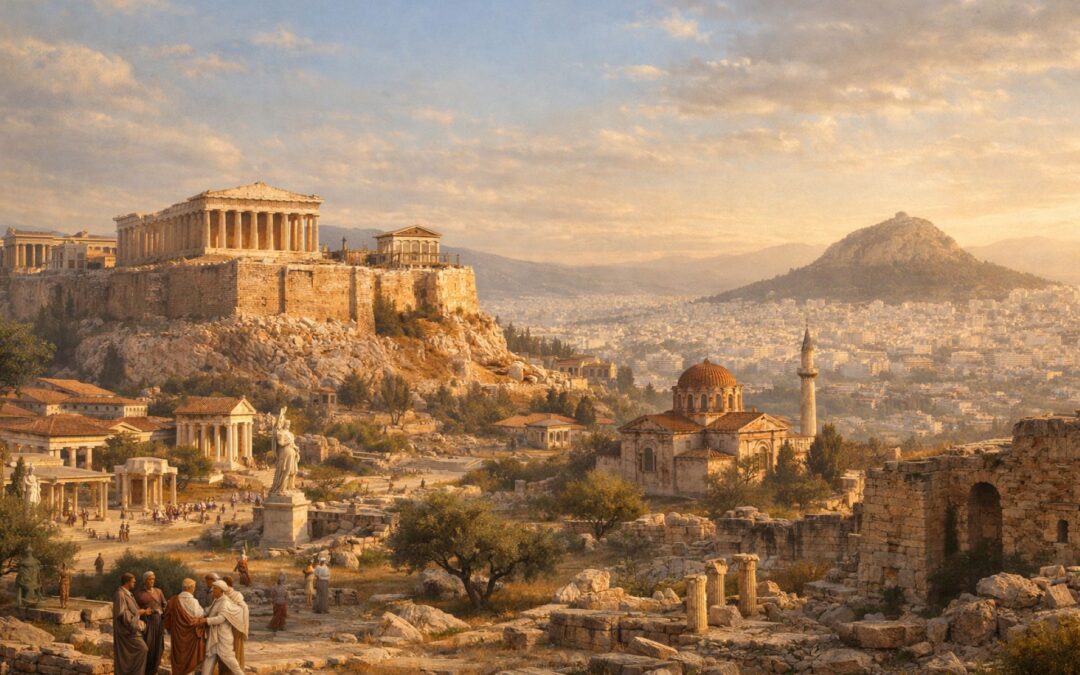
Few cities in human history have exerted as profound an influence on civilization as Athens. From the rocky plateau of the Acropolis emerged ideas and institutions that would shape the political, intellectual, and cultural foundations of the modern world. Athens is often remembered as the birthplace of democracy and the home of philosophers such as Socrates and Plato, yet its significance extends far beyond these achievements. For over seven thousand years, the city has served as a stage upon which some of history’s most important developments in politics, philosophy, art, and science have unfolded.
What makes Athens particularly remarkable is not only the brilliance of its classical age, but also its extraordinary resilience. Across the centuries, the city experienced dramatic cycles of rise, decline, conquest, and rebirth. It endured the collapse of ancient civilizations, survived the political turmoil of the Greek Dark Ages, and rose to become the most influential city-state in the ancient Greek world. Later it would fall under the control of Macedonian kings, Roman emperors, Byzantine rulers, Crusader lords, Venetian merchants, and Ottoman sultans. At various points it was a thriving imperial capital, a provincial town, a center of learning, and a neglected outpost.
Despite these transformations, Athens repeatedly reinvented itself. Even when it lost political power, its intellectual and cultural legacy continued to shape the civilizations that followed. Roman elites sent their children there to study philosophy, Byzantine scholars preserved its ancient heritage, and European thinkers of the Enlightenment looked to Athens as the symbolic origin of Western civilization.
In the modern era, the city once again reclaimed a central role in Greek life. After centuries of foreign rule, Athens emerged as the capital of an independent Greece in the nineteenth century. From a modest town surrounded by ancient ruins, it gradually developed into the vibrant metropolitan center that exists today.
The story of Athens therefore spans not only the history of a single city but the evolution of an entire civilization. From prehistoric settlements and the rise of the Greek city-state to the golden age of democracy, the struggles of empire, and the rebirth of the modern Greek nation, Athens has remained a powerful symbol of human creativity, political experimentation, and cultural endurance.
To understand Athens is, in many ways, to understand the long historical arc of Western civilization itself.
Athens Before History: Neolithic Settlement and the Mycenaean World
Early Human Settlement in Attica
The history of Athens begins long before the emergence of classical Greece. Archaeological evidence indicates that the region of Attica, where Athens is located, has been inhabited since at least 7000 BC, during the Neolithic period. Early human communities were attracted to the area by its fertile soil, mild Mediterranean climate, and access to water sources. These first inhabitants lived in small agricultural settlements, cultivating crops, raising livestock, and gradually establishing permanent communities.
Over time, these settlements grew in size and complexity as farming techniques improved and populations increased. Villages began to develop social hierarchies, organized religious practices, and early forms of trade with neighboring communities. The geographic features of the area also played an important role in shaping the early settlement pattern. Attica is surrounded by mountains on three sides and open to the sea to the south, a landscape that offered both natural protection and access to maritime trade routes.
Although these early communities left few written records, the archaeological remains of pottery, tools, and dwellings suggest a steady progression from simple agrarian villages toward more organized social structures.
The Rise of the Acropolis as a Political and Religious Center
One geographical feature quickly became central to the development of the early settlement: a massive limestone outcrop rising approximately 150 meters above the surrounding plains. This natural fortress would later become known as the Acropolis, meaning “high city.”
Because of its elevated position, the Acropolis served several important functions for the early inhabitants. It provided a defensible refuge during times of conflict and a central gathering place for religious ceremonies and communal activities. Over generations, the site gradually evolved into the focal point of political and spiritual life in the region.
Even in these early stages, the Acropolis began to acquire symbolic significance. Temples and sacred spaces would later be constructed there, turning the plateau into one of the most important religious centers in the ancient Greek world.
Athens Within the Mycenaean Civilization
By around 1600 BC, the Greek mainland entered a period dominated by the Mycenaean civilization, a network of powerful palace-centered kingdoms that formed the first major advanced society in Greece. These states controlled trade across the Aegean and eastern Mediterranean and developed sophisticated administrative systems, architecture, and military organization.
Athens became part of this broader Mycenaean world. Although it was not as powerful as major centers such as Mycenae, Tiryns, or Pylos, the city developed into a regional hub of trade and influence. Archaeological evidence indicates that the Acropolis was fortified during this time with defensive walls, suggesting that Athens served as a local administrative and military center.
Written records from the late Mycenaean period also mention a settlement called “Atheni”, which may represent one of the earliest references to the city in historical sources. According to later Greek mythology, the city was named after the goddess Athena, who was believed to have won patronage over the city by gifting its inhabitants the olive tree, a symbol of prosperity and peace.
The Late Bronze Age Collapse and the End of the Mycenaean World
The Mycenaean civilization flourished for several centuries before collapsing suddenly around 1100 BC, during a widespread upheaval known as the Late Bronze Age collapse. Across the eastern Mediterranean, many major kingdoms and urban centers were destroyed or abandoned. Trade networks disintegrated, political structures collapsed, and populations declined dramatically.
The exact causes of this collapse remain debated among historians. Possible explanations include invasions, internal rebellions, economic breakdown, natural disasters, or a combination of these factors.
While many Mycenaean cities were destroyed entirely, Athens appears to have avoided complete devastation. Although its political institutions weakened and its population declined, the settlement itself survived. This continuity allowed Athens to persist through the turbulent centuries that followed.
The collapse of the Mycenaean world marked the beginning of a long transitional period known as the Greek Dark Ages, during which many of the achievements of Bronze Age civilization faded from memory. Yet it was during this era of decline that the foundations of the later Greek city-states—including Athens—began to take shape.
The Greek Dark Ages and the Survival of Athens
Collapse of Mycenaean Political Structures
The destruction of the Mycenaean palace kingdoms around 1100 BC ushered in a long and uncertain period in Greek history commonly referred to as the Greek Dark Ages. With the collapse of centralized authority, the sophisticated administrative systems that had governed the Mycenaean world disappeared. Large palace complexes were abandoned, long-distance trade networks deteriorated, and the political unity that once linked much of the Greek mainland fragmented into smaller, localized communities.
Without the palace economies that had organized production and distribution, society became far less structured. Power shifted away from centralized rulers and instead rested with local leaders who governed small settlements and rural communities. These leaders often derived their authority from kinship ties, wealth, or military strength rather than formal institutions.
Across Greece, this period was marked by a dramatic reduction in urban life. Many previously thriving cities declined significantly in size or were abandoned altogether. The loss of political cohesion and economic stability led to a general contraction of society, affecting population levels, trade, and cultural production.
Population Decline and the Loss of Writing
One of the most significant consequences of the collapse was the disappearance of the Mycenaean writing system, known as Linear B. This script had been used primarily for palace administration, recording economic transactions and inventories. When the palace systems collapsed, the need for written administration disappeared, and with it the use of writing itself.
For several centuries, Greek society became largely non-literate, meaning that historical records from this era are extremely scarce. Much of what historians know about this period comes from archaeology rather than written documentation.
The loss of writing was accompanied by a broader decline in population and economic activity. Settlements became smaller and more isolated, and many technological and cultural practices from the Bronze Age were lost or simplified. Despite these setbacks, communities gradually adapted to their new circumstances, developing new social structures suited to the smaller scale of life during this era.
Oral Traditions and the Homeric World
Although writing had vanished, the cultural memory of the Mycenaean age did not disappear entirely. Instead, it survived through oral storytelling traditions that preserved the legends, heroes, and events of earlier times.
It was during this period that the famous Homeric epics, the Iliad and the Odyssey, were likely first composed in oral form. These poems described a heroic age of kings, warriors, and great conflicts such as the Trojan War. While the stories themselves blended myth and history, they preserved echoes of the Mycenaean world that had existed centuries earlier.
Bards and poets traveled between communities reciting these stories, helping to maintain a shared cultural identity among the scattered Greek populations. Through these oral traditions, ideas about honor, heroism, leadership, and the relationship between humans and the gods continued to shape Greek society.
The Emergence of Early Greek City-States
Despite the hardships of the Dark Ages, this period also laid the groundwork for one of the most distinctive political developments in ancient history: the emergence of the polis, or city-state.
As populations slowly began to recover, small communities increasingly organized themselves around central settlements that served as political, economic, and religious centers. Each polis developed its own governing institutions, social hierarchies, and territorial boundaries.
Athens was one of the settlements that successfully navigated this transition. Unlike many other Mycenaean centers that were completely abandoned, Athens retained a continuous population throughout the Dark Ages. This continuity allowed it to gradually evolve from a modest settlement into a more organized political community.
By the end of the Dark Ages, the foundations of the Athenian polis had begun to take shape. The city would soon enter a new era of recovery and expansion known as the Archaic Period, during which trade, culture, and political experimentation would once again flourish across the Greek world.
The Archaic Revival and the Rise of the Athenian Polis
Reconnection With Mediterranean Trade Networks
Around 800 BC, Greek society began to emerge from the long stagnation of the Dark Ages and entered a period of renewed growth known as the Archaic Age. Across the Greek world, population levels began to rise, settlements expanded, and long-distance trade networks gradually reappeared. Athens participated actively in this broader revival.
Contact with the wider Mediterranean world—particularly with Egypt, Phoenicia, and the Near East—brought new goods, artistic influences, and technological ideas into the Greek mainland. Trade routes across the Aegean Sea once again connected Greek communities with foreign markets, allowing Athens to benefit from its advantageous location near important maritime corridors.
This revival stimulated economic development throughout Attica. Agricultural production expanded, crafts and metallurgy improved, and the city began to establish stronger commercial relationships with neighboring regions. These developments helped Athens transition from a relatively modest settlement into a more prosperous and organized urban center.
The Adoption of the Greek Alphabet
One of the most transformative developments of the Archaic revival was the reintroduction of writing. Greek communities adopted a new writing system based on the Phoenician alphabet, adapting it to suit the Greek language. Unlike the earlier Linear B script used by the Mycenaeans, this new alphabet was simpler and more flexible, allowing it to spread quickly throughout Greek society.
The return of literacy had profound consequences. Laws, poetry, religious texts, and commercial transactions could now be recorded in written form. Oral traditions that had been passed down for generations—such as the Homeric epics—were finally written down, preserving them for future generations.
In Athens, the spread of literacy helped strengthen political organization and administrative control. Written laws and public inscriptions allowed civic institutions to become more transparent and standardized, laying the groundwork for the political innovations that would soon transform the city.
The Rise of Aristocratic Rule and the Archons
During the early Archaic period, Athens was no longer ruled by hereditary kings as it had been in earlier times. Instead, political power gradually shifted into the hands of aristocratic families, wealthy landowners who dominated the social and political life of the city.
The monarchy was replaced by a system of magistrates known as archons, who were responsible for administering the city’s government, overseeing legal matters, and managing religious functions. Initially these positions were held by members of the most powerful noble families, ensuring that political authority remained concentrated within the aristocratic elite.
This system created a form of oligarchic rule, in which a small number of wealthy families controlled the major institutions of the state. Although this arrangement provided stability, it also generated tensions within Athenian society. Many citizens—particularly small farmers and laborers—found themselves excluded from political participation and increasingly burdened by economic hardship.
Expansion Across Attica and the Formation of the Athenian State
As Athens grew stronger during the Archaic period, it began to expand its influence across the surrounding region of Attica. Smaller settlements and villages gradually came under Athenian authority, integrating the region into a single political community centered on the city.
This process created one of the largest and most powerful city-states in mainland Greece. Control of Attica provided Athens with access to agricultural land, natural resources, and coastal trade routes, strengthening its economic base.
However, this expansion also intensified social divisions within the population. The concentration of land ownership among aristocratic families and the growing economic disparities between rich and poor created increasing pressure on the political system.
By the 7th and 6th centuries BC, these tensions would erupt into a series of political crises that forced Athens to confront fundamental questions about law, power, and social justice. The reforms that followed would ultimately reshape the city’s political institutions and set Athens on the path toward one of its most famous innovations: democracy.
Crisis and Reform: From Draco to Solon
Social Conflict Between Aristocrats and the Lower Classes
By the 7th century BC, the rapid economic and social changes of the Archaic period had created deep divisions within Athenian society. Political power remained firmly in the hands of the aristocratic elite, while many ordinary citizens—especially small farmers and laborers—struggled under mounting economic pressure.
One of the most serious issues facing Athens at the time was debt bondage. Farmers who borrowed money from wealthy landowners and failed to repay their debts could lose their land and, in many cases, their personal freedom. Some were forced into slavery, while others were sold abroad to satisfy their creditors. As economic inequalities widened, resentment toward the aristocratic ruling class intensified.
These tensions created a volatile political environment. The possibility of rebellion or civil conflict loomed over the city, forcing Athenian leaders to search for solutions that might stabilize society and prevent the complete breakdown of order.
Draco’s Harsh Legal Code
The first major attempt to address the growing crisis came in 621 BC, when the lawgiver Draco was tasked with creating Athens’ first written legal code. Before this time, laws had largely been based on unwritten customs and traditions, which were interpreted and enforced by aristocratic judges. This system allowed the ruling elite considerable flexibility in applying justice, often in ways that favored their own interests.
Draco’s code sought to standardize the legal system by clearly defining offenses and their corresponding punishments. For the first time, the laws of Athens were written down and publicly displayed, making them accessible to all citizens rather than known only to the aristocracy.
However, Draco’s laws quickly gained notoriety for their extreme severity. Many offenses—even relatively minor ones—were punishable by death. This harshness gave rise to the modern term “draconian,” used to describe excessively severe or oppressive laws.
Although Draco’s code established an important precedent by introducing written law, it did little to resolve the underlying social tensions. The legal system remained largely favorable to the aristocratic elite, and economic inequalities continued to fuel discontent among the lower classes.
Solon’s Reforms and the End of Debt Slavery
Recognizing that Athens remained dangerously unstable, the city turned to a respected statesman and poet named Solon in 594 BC. Solon was granted extraordinary authority to restructure the political and economic system in an effort to restore balance within Athenian society.
His reforms were sweeping and transformative. One of his most significant measures was the abolition of debt slavery, which freed those who had been enslaved due to unpaid debts and prohibited the practice in the future. He also canceled many outstanding debts and returned confiscated land to former owners.
Solon further restructured the social order by dividing Athenian citizens into four property-based classes determined by wealth rather than family background. While the wealthiest classes retained eligibility for the highest political offices, the lower classes were granted greater participation in public life.
The Foundations of Political Participation
Although Solon’s reforms did not eliminate social inequality, they fundamentally altered the political structure of Athens. Citizens from lower classes were now allowed to participate in the Ecclesia, the popular assembly where public matters could be debated and decisions made collectively.
Solon also created new institutions to oversee governance and reduce the concentration of power among aristocratic families. These changes introduced the principle that political participation should extend beyond a narrow hereditary elite.
Nevertheless, Solon’s reforms did not completely resolve the factional rivalries within Athens. Different political groups continued to compete for influence, and the city remained vulnerable to instability. Within a few decades, these tensions would pave the way for the rise of a new form of rule—tyranny—that would temporarily reshape the political landscape of Athens before the eventual emergence of democracy.
Tyranny and Transformation in Athens
The Rise of Peisistratus
Despite Solon’s attempts to balance the interests of Athens’ competing social groups, political tensions continued to divide the city. Rival factions emerged, often representing different regional interests within Attica. These factions frequently struggled for dominance, creating an environment of instability that allowed ambitious individuals to seize power.
One such figure was Peisistratus, a charismatic aristocrat and military leader who managed to gain popular support among the poorer citizens of Athens. In 561 BC, he successfully seized control of the city and established himself as tyrant, a term that in the ancient Greek context referred to a ruler who had taken power outside the traditional political system rather than necessarily governing with cruelty.
Peisistratus’ rule was marked by a combination of political pragmatism and calculated populism. Although he had come to power through force, he chose to preserve many of Solon’s reforms rather than dismantling them. By maintaining the existing political institutions while exercising personal authority over them, he was able to stabilize the city and maintain broad support among the population.
Economic Development and Cultural Patronage
Under Peisistratus, Athens experienced a period of economic and cultural growth. The tyrant promoted agricultural development and supported small farmers by providing loans and encouraging the cultivation of olives and other valuable crops. These policies helped stimulate trade and strengthen the city’s economic foundations.
Peisistratus also invested heavily in public works and religious festivals. He sponsored major construction projects, improved infrastructure, and enhanced the city’s temples and sanctuaries. These efforts not only beautified Athens but also reinforced civic identity and loyalty to the state.
One of his most important cultural contributions was the expansion of the Panathenaic Festival, a major religious celebration honoring the goddess Athena. The festival included athletic competitions, musical performances, and public ceremonies, helping to unify the population and promote Athens’ cultural prestige.
The Tyranny of Hippias and Hipparchus
After Peisistratus died in 527 BC, power passed to his sons Hippias and Hipparchus, who initially continued their father’s policies. For a time, the regime maintained stability and prosperity, but the political climate gradually deteriorated.
The situation worsened dramatically after Hipparchus was assassinated in 514 BC by two Athenians known as Harmodius and Aristogeiton, who later became celebrated as heroes of resistance against tyranny. Following this event, Hippias became increasingly suspicious and authoritarian in his rule.
Repressive measures and political purges soon alienated many Athenians, including members of the aristocracy who had once supported the regime. The growing discontent created an opportunity for opposition groups to organize against Hippias.
The Overthrow of Tyranny and the Path to Reform
In 510 BC, a coalition of Athenian exiles and political rivals successfully overthrew Hippias with the assistance of Sparta, one of the most powerful Greek city-states at the time. Hippias was forced into exile, bringing an end to the Peisistratid tyranny that had ruled Athens for nearly half a century.
Although the tyranny had initially provided stability and economic growth, its collapse reopened the question of how Athens should be governed. Competing political factions once again struggled for influence, but the turmoil also created the conditions for a revolutionary transformation.
Within just a few years, a reformer named Cleisthenes would introduce a series of changes that fundamentally reshaped the political structure of Athens. These reforms would weaken the power of aristocratic families and dramatically expand citizen participation in government, laying the foundations for what would become the first democratic system in world history.
The Birth of Athenian Democracy
Cleisthenes and the Reorganization of Athenian Society
Following the overthrow of the tyrant Hippias in 510 BC, Athens entered another period of political struggle. Rival aristocratic factions competed to fill the power vacuum left by the collapse of the Peisistratid regime. Among the leading figures in this conflict were Cleisthenes, a member of the powerful Alcmaeonid family, and his rival Isagoras, who sought to restore a more traditional aristocratic form of governance.
When Isagoras attempted to seize control of the government with the support of Sparta, Cleisthenes responded by appealing directly to the Athenian people for support. This decision proved decisive. The citizens of Athens rose against Isagoras and forced him into exile, allowing Cleisthenes to implement a series of sweeping reforms beginning in 508 BC.
Cleisthenes’ objective was to break the political dominance of aristocratic families and reorganize Athenian society in a way that would give ordinary citizens a greater role in government. His reforms fundamentally transformed the political structure of the city-state.
New Political Institutions and the Council of 500
One of Cleisthenes’ most important innovations was the restructuring of the Athenian population into new administrative units called tribes. Instead of organizing society around family ties and traditional aristocratic alliances, citizens were grouped based on geographic districts. This system deliberately mixed people from different regions of Attica, weakening the influence of powerful noble families.
Each tribe selected representatives to serve in a newly established governing body known as the Council of 500, which became responsible for preparing legislation and supervising many aspects of the city’s administration. Members of the council were chosen annually, ensuring regular participation by citizens in the workings of government.
At the same time, the Ecclesia, or popular assembly, became the central decision-making institution of Athens. All male citizens were allowed to participate in the assembly, where they could debate policies, vote on laws, and make decisions regarding war, alliances, and public policy.
These reforms significantly expanded political participation and introduced mechanisms that allowed ordinary citizens to influence the direction of the state.
Ostracism and the Protection of Democracy
Cleisthenes also introduced a unique political safeguard known as ostracism. Once each year, the Athenian assembly could vote to temporarily exile any individual considered a potential threat to the stability of the state. If enough citizens voted against a particular person, that individual would be forced to leave Athens for ten years.
Ostracism was not intended as punishment for a crime but rather as a preventive measure designed to stop powerful individuals from accumulating excessive influence and potentially establishing another tyranny.
Although the practice was not used frequently, it reflected the Athenians’ deep concern about protecting their political system from domination by ambitious leaders.
The Democratic Experiment in the Greek World
The reforms of Cleisthenes marked the beginning of what historians often describe as the first democratic system in human history. While Athenian democracy was far from inclusive by modern standards—women, slaves, and foreign residents were excluded—it nevertheless represented a radical departure from the monarchies and oligarchies that dominated most of the ancient world.
For the first time, a large portion of a city’s population participated directly in the political decision-making process. Citizens debated public policies, voted on laws, and served in government institutions, creating a political culture that valued civic engagement and collective responsibility.
These developments transformed Athens into one of the most politically innovative societies of the ancient world. Yet the survival of this new democratic system would soon be tested by an external threat of enormous scale: the expanding power of the Persian Empire, which was preparing to invade the Greek mainland.
Athens and the Persian Wars
The Ionian Revolt and the Persian Threat
At the beginning of the 5th century BC, Athens faced one of the greatest challenges in its history. Across the Aegean Sea in Asia Minor, many Greek cities had fallen under the control of the vast Persian Empire, which by this time stretched from Egypt to Central Asia. In 499 BC, several of these Greek cities launched a rebellion against Persian rule in what became known as the Ionian Revolt.
Athens, sharing cultural and linguistic ties with these cities, chose to support the rebellion by sending ships and troops. Although the uprising was eventually crushed by Persian forces, Athens’ involvement provoked the Persian king Darius I, who vowed to punish the Greek city-states that had aided the rebels.
This decision set the stage for a series of conflicts that would come to be known as the Persian Wars, a struggle between the powerful Persian Empire and a coalition of independent Greek city-states determined to preserve their autonomy.
The Battle of Marathon
The first major Persian invasion of mainland Greece came in 490 BC, when Darius dispatched a large army across the Aegean Sea. The Persians landed on the plain of Marathon, located northeast of Athens, intending to defeat the Athenians and bring the region under Persian control.
The Athenians, joined by a small force from the city of Plataea, marched out to confront the invading army. Despite being heavily outnumbered, the Greek forces launched a bold attack that caught the Persians by surprise. The Battle of Marathon ended in a decisive Athenian victory, with the Persian army forced to retreat.
According to later tradition, a messenger named Pheidippides ran from the battlefield to Athens—a distance of roughly twenty-six miles—to announce the Greek victory before collapsing from exhaustion. This story later inspired the modern marathon race, commemorating the endurance and determination displayed during the battle.
The victory at Marathon was immensely important. It demonstrated that the Persian Empire was not invincible and gave the Greeks confidence that they could resist further invasions.
The Second Persian Invasion and the Destruction of Athens
A decade later, the Persians returned with an even larger force under King Xerxes I, the son of Darius. In 480 BC, Persian armies and fleets launched a massive invasion aimed at conquering all of Greece.
The Persian advance initially met little resistance. Greek forces attempting to block the invasion were defeated at the famous Battle of Thermopylae, where a small Spartan-led force made a heroic but ultimately unsuccessful stand against the Persian army.
With the main defensive line broken, the road to Athens lay open. Recognizing that the city could not be defended on land, many Athenians evacuated their homes and fled to nearby islands. The Persians soon entered Athens and burned much of the city, including sacred temples on the Acropolis.
Despite this destruction, the Athenian navy remained intact and prepared for a decisive counterattack.
The Naval Victory at Salamis and the Greek Counteroffensive
Later in 480 BC, the Greek alliance, led largely by Athens, confronted the Persian fleet in the narrow waters near the island of Salamis. The Athenians possessed one of the most powerful naval forces in the Greek world, and their strategy relied on luring the larger Persian fleet into confined waters where maneuverability would be limited.
The plan succeeded. In the Battle of Salamis, Greek ships overwhelmed the Persian fleet, destroying a significant portion of it and forcing Xerxes to withdraw much of his army from Greece.
The following year, Greek forces achieved additional victories on land and sea, ultimately driving the Persians out of the Greek mainland entirely by 479 BC.
The defeat of Persia marked a turning point in Greek history. Athens emerged from the conflict with immense prestige and influence. Its powerful navy and leadership during the war allowed it to assume a dominant role among the Greek city-states.
In the decades that followed, Athens would use this position to establish a vast maritime alliance that would gradually evolve into an empire—ushering in the city’s most celebrated era, often referred to as the Golden Age of Athens.
The Athenian Empire and the Golden Age
The Creation of the Delian League
In the aftermath of the Persian Wars, many Greek city-states remained concerned about the possibility of another Persian invasion. To defend against this threat and continue offensive operations against Persian territories in the Aegean, a military alliance known as the Delian League was formed in 478 BC.
Athens quickly emerged as the leader of this coalition. Member states contributed ships or financial tribute to support the collective defense effort, and the league’s treasury was initially kept on the sacred island of Delos, from which the alliance took its name.
Although the league was originally conceived as a partnership among independent city-states, Athens soon became the dominant force within the organization. Its powerful navy allowed it to control maritime routes across the Aegean, and many smaller cities came to rely on Athenian protection.
The Transformation of the League Into an Empire
Over time, the Delian League gradually evolved into what historians now describe as the Athenian Empire. Many member states preferred to pay tribute rather than maintain their own fleets, effectively placing military control in Athenian hands.
Athens began to enforce loyalty among its allies, often suppressing attempts by member states to withdraw from the league. In 454 BC, the league’s treasury was moved from Delos to Athens itself, symbolizing the city’s increasing dominance.
The tribute collected from allied states financed the expansion of Athens’ navy and funded ambitious public building projects within the city. While this wealth greatly strengthened Athens, it also generated resentment among other Greek states that viewed the league as a tool of Athenian imperial power rather than a cooperative alliance.
The Leadership of Pericles
The height of Athenian power came during the leadership of the statesman Pericles, who played a central role in shaping the political and cultural life of the city during the mid-5th century BC.
Under Pericles, Athens consolidated its democratic institutions while also expanding its influence across the Aegean. He introduced policies that allowed poorer citizens to participate more actively in public life by providing compensation for service in government institutions such as juries and councils.
Pericles also oversaw an ambitious program of architectural and cultural development designed to showcase the city’s wealth and prestige. These projects transformed Athens into one of the most magnificent cities of the ancient world.
Monumental Architecture and the Building of the Parthenon
One of the most enduring legacies of the Golden Age was the construction of monumental buildings on the Acropolis, which had been heavily damaged during the Persian invasion. Under Pericles’ leadership, Athens launched a massive rebuilding effort that reshaped the city’s skyline.
The most famous of these structures was the Parthenon, a magnificent temple dedicated to the goddess Athena, completed in 438 BC. Built from gleaming white marble and decorated with elaborate sculptures, the Parthenon symbolized both Athens’ devotion to its patron goddess and its newfound wealth and power.
Other important structures constructed during this period included the Propylaea, the monumental gateway to the Acropolis, and various temples and public buildings that reflected the artistic sophistication of classical Athens.
These architectural achievements were accompanied by extraordinary developments in literature, philosophy, and the arts. Athens became the intellectual and cultural center of the Greek world, attracting thinkers, artists, and playwrights whose works would influence Western civilization for centuries.
Yet the very success of the Athenian Empire also created new rivalries and tensions among the Greek city-states. Chief among Athens’ rivals was the militaristic state of Sparta, whose growing hostility toward Athenian power would eventually lead to one of the most devastating conflicts in ancient Greek history: the Peloponnesian War.
Athens as the Intellectual Center of the Ancient World
Drama, Theater, and the Cultural Life of the City
During the 5th century BC, Athens became the undisputed cultural center of the Greek world. The wealth and stability produced by the Athenian Empire allowed the city to invest heavily in artistic and intellectual life, turning it into a vibrant hub of creativity and public debate.
One of the most significant cultural institutions of classical Athens was the theater, particularly the Theater of Dionysus, located on the southern slope of the Acropolis. Here, dramatic festivals were held in honor of the god Dionysus, drawing audiences from across the Greek world. These festivals featured performances of tragedies and comedies that explored themes of morality, politics, religion, and human nature.
Playwrights such as Aeschylus, Sophocles, and Euripides produced tragedies that examined profound questions about justice, fate, and the relationship between humans and the gods. At the same time, comic playwrights like Aristophanes used satire to criticize political leaders and social trends, reflecting the lively and often contentious public discourse that characterized Athenian democracy.
The prominence of theater in Athenian society demonstrated the city’s commitment to civic engagement and intellectual exploration. Public performances were not merely entertainment; they were an important part of the cultural and political life of the community.
Socrates and the Birth of Western Philosophy
Perhaps the most influential figure associated with classical Athens was the philosopher Socrates, whose method of questioning and dialogue fundamentally reshaped philosophical inquiry. Rather than teaching through formal lectures, Socrates engaged citizens in conversations in public spaces such as the Agora, challenging them to examine their beliefs about morality, knowledge, and the nature of truth.
Socrates believed that wisdom began with recognizing one’s own ignorance. Through a process of careful questioning—later known as the Socratic method—he encouraged individuals to critically analyze their assumptions and pursue deeper understanding.
His unconventional approach and willingness to question established ideas eventually brought him into conflict with the Athenian authorities. In 399 BC, Socrates was tried and convicted on charges of corrupting the youth and impiety. He was sentenced to death and famously accepted the verdict, drinking a cup of poisoned hemlock rather than fleeing into exile.
Despite his execution, Socrates’ ideas had a profound and lasting impact on philosophy, influencing generations of thinkers who sought to explore the fundamental questions of human existence.
Plato and the Academy
One of Socrates’ most important students was Plato, who preserved many of his teacher’s ideas through a series of philosophical dialogues. Plato went on to establish one of the most influential educational institutions of the ancient world: the Academy, founded in 387 BC.
The Academy served as a center for advanced study and philosophical discussion, attracting students from across the Greek world. Its curriculum covered a wide range of subjects, including mathematics, astronomy, politics, ethics, and metaphysics.
Plato’s writings explored topics such as justice, governance, knowledge, and the nature of reality. His concept of an ideal state governed by philosopher-kings would influence political thought for centuries.
The Intellectual Legacy of Classical Athens
The intellectual achievements of classical Athens extended far beyond philosophy and drama. The city fostered advances in fields such as history, mathematics, science, rhetoric, and political theory. Historians like Herodotus and Thucydides pioneered systematic approaches to recording and analyzing historical events, laying the foundations for modern historical scholarship.
Athens also became a center of education and intellectual exchange, where scholars and thinkers debated ideas that would shape the intellectual traditions of the Western world. The city’s emphasis on open discussion, civic participation, and philosophical inquiry created an environment uniquely suited to intellectual innovation.
Even after Athens’ political power began to decline, the influence of its thinkers, artists, and institutions continued to resonate across the Mediterranean world. The ideas developed in Athens during this period would remain central to the intellectual heritage of Western civilization for more than two millennia.
The Peloponnesian War and the Fall of Athenian Power
Rising Tensions Between Athens and Sparta
By the mid-5th century BC, Athens had reached the height of its power. Through the Delian League, it controlled a large maritime empire and dominated trade across much of the Aegean Sea. However, this expansion alarmed other Greek city-states, particularly Sparta, the leading military power on the Greek mainland.
Sparta led its own alliance of states known as the Peloponnesian League, which included many of Athens’ political rivals. The contrasting political systems of the two powers intensified the rivalry: Athens was a democracy with a powerful navy and a commercial empire, while Sparta was an oligarchic and militaristic state built on a strong land army.
As Athens continued to expand its influence and intervene in the affairs of other Greek cities, tensions between the two alliances steadily increased. Diplomatic disputes, regional conflicts, and mutual suspicions eventually escalated into open warfare in 431 BC, marking the beginning of the Peloponnesian War.
Contrasting Military Strategies of the Two Powers
The war was shaped by the different strengths of the two adversaries. Sparta possessed the most formidable land army in Greece, while Athens controlled a powerful navy and a vast maritime network.
Athenian strategy relied heavily on its naval superiority. Citizens from the countryside of Attica were brought inside the fortified Long Walls that connected Athens to its port at Piraeus, allowing the city to remain supplied by sea even if Spartan armies ravaged the surrounding farmland. From the safety of the city and its harbor, Athens could launch naval raids and maintain control over its empire.
Sparta, on the other hand, focused on land campaigns, repeatedly invading Attica and attempting to weaken Athens economically by destroying crops and forcing rural populations to seek refuge within the city walls.
Internal Crisis and Strategic Failures
Despite its early advantages, Athens soon faced serious internal challenges. In 430 BC, a devastating plague swept through the overcrowded city, killing a large portion of the population—including the influential leader Pericles. The loss of leadership and manpower significantly weakened Athens’ position.
The war dragged on for decades, marked by shifting alliances, costly battles, and political instability within both camps. One of the most disastrous decisions made by Athens was the Sicilian Expedition in 415 BC, an ambitious attempt to conquer the powerful city of Syracuse in Sicily.
The campaign ended in catastrophe. A large portion of the Athenian fleet and army was destroyed, leaving Athens severely weakened both militarily and economically.
Defeat at Aegospotami and the End of the Empire
In the final years of the conflict, Sparta gained a decisive advantage by building its own fleet with financial support from Persia. This allowed Spartan forces to challenge Athenian naval supremacy.
The decisive moment came in 405 BC at the Battle of Aegospotami, where the Spartan commander Lysander destroyed the remaining Athenian fleet. Without its navy, Athens could no longer maintain control over its empire or protect its supply routes.
The following year, 404 BC, Athens surrendered. The city’s defensive walls were dismantled, its empire dissolved, and its political power greatly diminished.
The defeat marked the end of Athens’ dominance in the Greek world. Although democracy would eventually be restored after a brief period of oligarchic rule, the city never regained the power and influence it had enjoyed during its golden age. A new force would soon rise to reshape the political landscape of Greece: the kingdom of Macedon under Philip II.
Macedonian Domination and the End of Athenian Independence
The Rise of Macedon Under Philip II
In the decades following the Peloponnesian War, the Greek world remained politically fragmented and unstable. Athens attempted to rebuild its strength, but it never fully recovered the influence it had once possessed. Meanwhile, a new power was rising to the north: the kingdom of Macedon.
Under the leadership of King Philip II, Macedon underwent a dramatic transformation. Philip reorganized the Macedonian army, introducing innovative tactics and creating a formidable military force built around the Macedonian phalanx. Through a combination of military conquest, diplomacy, and strategic alliances, Philip gradually expanded his influence across much of the Greek mainland.
As Macedon’s power grew, many Greek city-states—including Athens—became increasingly alarmed. Athens attempted to form alliances with other states in an effort to resist Macedonian expansion, but the divided Greek world struggled to present a unified opposition.
The Battle of Chaeronea
The decisive confrontation between Macedon and the Greek city-states occurred in 338 BC at the Battle of Chaeronea. Athens joined forces with Thebes and several other allies to halt Philip’s advance into central Greece.
Despite the determination of the Greek coalition, Philip’s well-trained army proved superior. The Macedonian forces defeated the allied armies in a decisive battle that effectively ended the independence of the major Greek city-states.
Although Athens avoided complete destruction, the defeat forced it to accept Macedonian dominance. Philip established a new political order across Greece known as the League of Corinth, which brought the city-states under Macedonian leadership while allowing them limited internal autonomy.
Athens Under Alexander the Great
After Philip II was assassinated in 336 BC, his son Alexander III, later known as Alexander the Great, inherited the Macedonian throne. When several Greek cities attempted to revolt against Macedonian authority following Philip’s death, Alexander quickly suppressed the uprisings and reaffirmed Macedonian control.
Athens, recognizing the futility of direct resistance, chose a more cautious approach and avoided confrontation with Alexander. While the city retained its cultural importance and many of its institutions, it no longer possessed real political independence.
Alexander soon turned his attention eastward, launching his famous campaigns against the Persian Empire. As his conquests expanded across Asia, Greece—including Athens—became part of a much larger imperial world dominated by Macedonian power.
The Failed Revolts After Alexander’s Death
When Alexander the Great died unexpectedly in 323 BC, his vast empire fragmented as his generals fought for control of its territories. In Greece, many city-states saw an opportunity to regain their independence from Macedonian rule.
Athens joined a coalition of Greek states in what became known as the Lamian War, an uprising against Macedonian authority. However, the revolt was ultimately unsuccessful. Macedonian forces defeated the coalition and reasserted control over Greece.
Following this defeat, Athens lost even more of its political autonomy. Democratic institutions were restricted, and Macedonian influence over the city increased. Although Athens remained an important cultural and intellectual center, its era as a politically dominant city-state had come to an end.
Over the next centuries, Greece would become increasingly entangled in the struggles among the successor kingdoms that emerged from Alexander’s empire. Eventually, a new power rising in the west—the Roman Republic—would extend its influence into the region, bringing Athens and the rest of Greece under Roman rule.
Athens in the Roman World
Roman Conquest of Greece
By the 2nd century BC, the balance of power in the Mediterranean had shifted dramatically. The rapidly expanding Roman Republic had begun extending its influence eastward, becoming involved in the political struggles between the various Hellenistic kingdoms that had emerged after the death of Alexander the Great.
Rome fought a series of conflicts known as the Macedonian Wars against the Kingdom of Macedon. After several decades of fighting, Roman forces ultimately defeated Macedon and dismantled its power in Greece. In 146 BC, following the suppression of a major Greek revolt, Rome formally established control over the Greek mainland.
Athens, like many other Greek cities, was incorporated into the Roman sphere of influence. Although the city lost its political independence, it avoided the destruction suffered by other Greek centers and was allowed to maintain a degree of local autonomy under Roman oversight.
Athens as a Center of Learning in the Roman Empire
Despite its diminished political role, Athens retained immense prestige as a center of philosophy, rhetoric, and education. The cultural achievements of classical Athens had left such a deep impression on the Roman world that many Roman elites viewed Greek learning as essential to a proper education.
Young Romans from wealthy families were often sent to Athens to study philosophy and rhetoric under renowned teachers. The city’s philosophical schools—such as the Academy, the Lyceum, and the Stoic and Epicurean schools—continued to attract students from across the Mediterranean.
This intellectual reputation allowed Athens to maintain its influence even under Roman rule. While no longer a political powerhouse, it remained one of the most respected cultural and educational centers of the ancient world.
Imperial Patronage and the Building Programs of Hadrian
Several Roman emperors showed a particular admiration for Athens and contributed to its development. Among the most notable was Emperor Hadrian, who ruled during the early 2nd century AD and was known for his strong appreciation of Greek culture.
Hadrian funded numerous building projects in the city, helping to restore and expand its infrastructure. One of his most important contributions was the construction of the Library of Hadrian, completed in 132 AD, which served as a major center for learning and scholarship.
He also sponsored the construction of temples, sanctuaries, public baths, and a gymnasium. In addition, Hadrian completed the long-unfinished Temple of Olympian Zeus, one of the largest temples in the Greek world, whose construction had originally begun centuries earlier during the Archaic period.
These projects revitalized Athens and reinforced its reputation as a city of culture and learning within the Roman Empire.
A Cosmopolitan Intellectual City
By the 2nd and 3rd centuries AD, Athens had become a cosmopolitan city populated by people from across the Roman world. Greek traditions remained deeply rooted in the city’s identity, but Roman influence was also visible in its architecture, institutions, and social life.
Although traditional Greek religious practices continued for many centuries, new ideas and beliefs gradually spread throughout the empire. One of the most significant developments during this period was the rise of Christianity, which began gaining followers across the Roman world.
This religious transformation would eventually reshape the cultural landscape of Athens. As the Roman Empire gradually transitioned into the Byzantine Empire and Christianity became the dominant religion, many of the pagan institutions and traditions that had defined classical Athens would fade into the background.
Over time, the city’s role as a major intellectual center would decline, marking the beginning of a long period in which Athens became a relatively minor provincial town within the Byzantine world.
Christianity, Byzantium, and the Decline of Classical Athens
The Spread of Christianity in the Late Roman Empire
During the 4th century AD, the Roman world underwent a profound religious transformation. Christianity, which had begun as a small religious movement in the eastern provinces of the empire, rapidly expanded and gained increasing political support. This shift was accelerated under Emperor Constantine, who legalized Christianity and gradually promoted it within the imperial administration.
As Christianity spread across the Mediterranean, traditional Greco-Roman pagan religions began to decline. Temples that had once been central to civic life were abandoned, repurposed, or converted into churches. Athens, long associated with classical religious traditions and philosophical schools, was not immune to these changes.
Although pagan practices remained influential for some time, Christianity steadily gained ground in the city. Christian communities expanded, and new religious institutions were established, gradually reshaping the spiritual identity of Athens.
The Closure of Pagan Institutions
The transformation of the religious landscape had significant consequences for Athens’ intellectual life. Many of the city’s ancient philosophical schools had been closely tied to traditional pagan beliefs. As Christianity became more dominant within the empire, these institutions came under increasing pressure.
In the 6th century AD, the Byzantine Emperor Justinian I ordered the closure of several pagan philosophical schools across the empire, including the famous Academy in Athens, which had been founded by Plato nearly a thousand years earlier.
The closure of these schools symbolized the end of Athens’ long tradition as the foremost intellectual center of the ancient world. The city’s role in philosophical and scientific inquiry gradually diminished as new centers of learning emerged elsewhere in the Byzantine Empire.
Constantinople’s Rise and Athens’ Decline
Another major factor in Athens’ decline was the rise of Constantinople, which had been founded by Constantine in 330 AD as the new capital of the Roman Empire in the East. As the political and cultural heart of the Byzantine world shifted to Constantinople, Athens lost much of the influence it had once held.
While the city still possessed great historical prestige, it was no longer a major political or economic center. Trade networks, administrative institutions, and cultural patronage increasingly focused on Constantinople and other large urban centers of the Byzantine Empire.
Over time, Athens became a relatively small provincial city within the empire, overshadowed by larger and more strategically important locations.
Athens as a Provincial Byzantine Town
Throughout the early Byzantine period, Athens experienced repeated challenges including barbarian invasions, economic instability, and shifting political conditions. Many of the monumental buildings of classical Athens were damaged, abandoned, or repurposed for new uses.
Some ancient temples were converted into Christian churches, reflecting the broader transformation of religious life across the empire. The Parthenon, for example, was eventually transformed into a Christian church dedicated to the Virgin Mary.
By the middle Byzantine period, Athens had largely faded from its former prominence. What had once been the intellectual and cultural center of the Greek world had become a modest provincial town within a vast Christian empire.
Yet the story of Athens was far from over. The weakening of the Byzantine Empire during the medieval period would soon expose the city to new waves of conquest and foreign rule. The next dramatic chapter in Athens’ history would arrive during the upheaval of the Crusades, when Western European forces reshaped the political landscape of the eastern Mediterranean.
Crusaders, Frankish Rule, and the Medieval Duchy of Athens
The Fourth Crusade and the Sack of Constantinople
By the beginning of the 13th century, the Byzantine Empire had entered a period of severe decline. Internal political struggles, economic difficulties, and the growing pressure from external enemies weakened the empire’s ability to maintain control over its territories.
In 1202, Western European forces launched what became known as the Fourth Crusade, originally intended to recapture the city of Jerusalem from Muslim control. However, a series of political and financial complications redirected the crusading army toward the Byzantine capital of Constantinople.
In 1204, the crusaders captured and brutally sacked Constantinople, an event that shattered the Byzantine Empire and dramatically reshaped the political landscape of the eastern Mediterranean. The empire was divided into several smaller states ruled by Latin (Western European) leaders.
Among the territories created in the aftermath of the crusade was the Duchy of Athens, a new political entity centered on the historic city.
The Creation of the Duchy of Athens
Following the fragmentation of Byzantine authority, Athens became the capital of the newly established Frankish Duchy of Athens. The duchy was ruled by Western European nobles—primarily from French and Italian families—who introduced elements of feudal governance similar to those practiced in medieval Western Europe.
These rulers replaced many aspects of the Byzantine administrative system with their own institutions. The local Greek population remained the majority in the region, but political power was held by a Latin aristocracy that governed according to feudal customs.
The Acropolis itself was transformed into a fortified castle, serving as the political and military center of the duchy. The ancient monuments of Athens, including the Parthenon, were repurposed to fit the needs of medieval rulers.
Western Feudal Rule Over a Greek Population
Under Frankish rule, Athens became part of a broader network of Latin-controlled territories across Greece. The duchy maintained close connections with Western European powers, including the Kingdom of Sicily and various Italian states.
The local Greek population largely continued its traditional way of life, maintaining its language, customs, and Orthodox Christian faith. However, the Latin rulers introduced Roman Catholic institutions and feudal landholding systems that reshaped the region’s political structure.
Although Athens was no longer a major center of intellectual life, it retained symbolic importance due to its classical heritage. Medieval travelers and scholars occasionally visited the city, intrigued by the remains of its ancient monuments.
Catalan and Italian Control of the City
The political situation in Athens remained unstable throughout the later medieval period. In 1311, the Duchy of Athens was taken over by a group of Catalan mercenaries known as the Catalan Company, who had originally been hired as soldiers but eventually seized power themselves.
The Catalans ruled Athens for several decades before control eventually passed to various Italian noble families, particularly the Florentine Acciaioli dynasty, which governed the city during the late 14th and early 15th centuries.
These shifting regimes reflected the broader political instability of the eastern Mediterranean during this era. As the medieval period progressed, a new and rapidly expanding power began to dominate the region: the Ottoman Empire.
By the mid-15th century, Ottoman forces were steadily advancing across southeastern Europe. In 1458, the Ottoman Sultan Mehmed II, who had already conquered Constantinople, captured Athens and incorporated the city into the expanding Ottoman state. This conquest marked the beginning of nearly four centuries of Ottoman rule, which would once again transform the city’s political, cultural, and religious landscape.
The Ottoman Conquest and Four Centuries of Foreign Rule
The Ottoman Expansion Into Greece
By the 15th century, the balance of power in southeastern Europe had shifted dramatically. The rapidly expanding Ottoman Empire, which had already captured Constantinople in 1453, continued pushing westward into the territories that had once belonged to the Byzantine and Latin states.
Greek lands across the Balkans and the Aegean gradually fell under Ottoman control as the empire expanded its influence throughout the region. Athens, still governed by Latin rulers during the late medieval period, soon faced the advancing Ottoman armies.
In 1458, the Ottoman Sultan Mehmed II, known for his conquest of Constantinople, captured Athens and incorporated the city into the Ottoman Empire. This marked the beginning of nearly four centuries of Ottoman rule, fundamentally transforming the political and social structure of the city.
Athens Under Ottoman Administration
Under Ottoman administration, Athens became a provincial town governed by an Ottoman official responsible for maintaining order and collecting taxes. Compared to its former prominence in antiquity, the city now played only a minor role within the vast Ottoman state.
Although the Ottomans introduced a new administrative system, they generally allowed the Greek Orthodox population a degree of religious autonomy. The Orthodox Church continued to function as an important institution within Greek society, preserving language, cultural traditions, and religious identity under Ottoman oversight.
At the same time, the Ottoman presence brought visible cultural changes to the city. Mosques, public baths, and other Islamic architectural structures were constructed, reflecting the new ruling elite. Several ancient buildings were repurposed for new religious and civic uses.
Religious Transformation and Cultural Change
One of the most symbolic transformations during this period involved the Parthenon, the ancient temple dedicated to the goddess Athena. Over the centuries it had already undergone several changes in function—first becoming a Christian church during the Byzantine period and later serving as a Catholic cathedral under Latin rule.
After the Ottoman conquest, the Parthenon was converted into a mosque, representing the shift in religious authority within the city. Despite these changes, many elements of the city’s ancient architecture remained standing, though often in altered or deteriorating forms.
Athens itself remained relatively small and quiet during much of the Ottoman period. While it retained historical significance due to its classical past, it was not considered an important political or economic center within the empire.
The Parthenon Explosion of 1687
One of the most dramatic events of the Ottoman era occurred in 1687, during a conflict between the Ottoman Empire and the Republic of Venice. Venetian forces launched an attack on Athens, seeking to weaken Ottoman control over the region.
During the siege of the city, the Ottomans used the Parthenon—then serving as a mosque—as a storage site for gunpowder and ammunition. When Venetian artillery fired upon the Acropolis, a mortar shell struck the building and detonated the stored gunpowder.
The resulting explosion caused catastrophic damage to the structure, destroying much of the Parthenon’s roof and walls. The temple, which had survived for more than two thousand years, was reduced to the ruined state in which it largely remains today.
Although Athens continued to exist as a modest provincial town within the Ottoman Empire, the city never fully regained the prestige it had once possessed in the ancient world. Nevertheless, the enduring ruins of its classical past continued to attract the attention of European travelers, scholars, and collectors.
By the early 19th century, growing nationalist movements across the Balkans and the weakening of Ottoman authority would create the conditions for a dramatic transformation. Athens would soon become a focal point in the struggle for Greek independence, leading to the rebirth of the city as the capital of a modern nation.
Enlightenment Rediscovery and the Greek War of Independence
European Interest in Classical Greece
During the 18th century, Europe experienced a period of intellectual awakening known as the Enlightenment, which placed renewed emphasis on reason, science, and classical learning. Scholars, artists, and philosophers across Europe began to look back to ancient Greece as the cultural foundation of Western civilization.
Athens, with its famous ruins and historical associations, became an important destination for European travelers participating in the Grand Tour, a journey undertaken by educated elites to explore the cultural landmarks of Europe. These visitors studied the city’s ancient monuments, recorded its architecture, and collected artifacts that provided insights into the classical past.
Although Athens itself remained a relatively small provincial town under Ottoman rule, its ancient heritage attracted growing international attention. Scholars produced detailed drawings and descriptions of the Acropolis, helping to spark wider interest in the preservation and study of Greek antiquities.
The Removal of the Parthenon Sculptures
One of the most controversial events of this period occurred in the early 19th century, when Lord Elgin, the British ambassador to the Ottoman Empire, arranged for the removal of numerous sculptures and architectural fragments from the Parthenon and other monuments on the Acropolis.
Between 1801 and 1812, large sections of the Parthenon’s decorative friezes, statues, and reliefs were transported to Britain. These artifacts eventually became known as the Elgin Marbles and were placed in the British Museum, where they remain today.
The removal of these sculptures sparked debate even at the time, and the issue remains controversial in modern discussions about cultural heritage and the ownership of historical artifacts.
The Greek War of Independence
By the early 19th century, the Ottoman Empire was showing increasing signs of political weakness. Inspired by nationalist movements and revolutionary ideas spreading across Europe, many Greeks began seeking independence from Ottoman rule.
In 1821, a widespread rebellion known as the Greek War of Independence erupted across several regions of the Greek world. Athens soon became one of the centers of conflict as Greek rebels fought to drive Ottoman forces out of the city.
The war was brutal and destructive. Athens changed hands several times during the fighting, and many of the city’s historical structures suffered additional damage. Despite these hardships, the revolutionary movement gained momentum.
International support played a decisive role in the outcome of the conflict. Major European powers—including Britain, France, and Russia—intervened diplomatically and militarily on behalf of the Greek rebels.
Liberation of Athens in 1833
After nearly a decade of fighting, negotiations between the European powers and the Ottoman Empire resulted in the establishment of an independent Greek state. In 1833, Ottoman forces finally withdrew from Athens, marking the end of centuries of foreign domination.
That same year, Prince Otto of Bavaria arrived in Greece to become the first king of the newly formed Kingdom of Greece. Athens, which at the time had a population of only about 10,000 people, was chosen as the capital of the new nation.
The decision was largely symbolic. Although the city was small and underdeveloped, its connection to the ancient glory of classical Greece made it an ideal representation of the newly independent state’s cultural identity.
From this modest beginning, Athens would gradually transform into the political, cultural, and economic center of modern Greece. The following decades would see extensive urban development as the city began its long journey from provincial town to modern European capital.
The Birth of Modern Athens
Athens Chosen as the Capital of Greece
When Greece gained independence in the early 19th century, the country faced the enormous challenge of building a modern state after centuries of Ottoman rule. At the time, Athens was little more than a modest town surrounded by the ruins of its ancient past. Its population was small, its infrastructure limited, and many of its historic monuments were in a state of decay.
Despite these limitations, Athens was chosen in 1834 as the capital of the newly established Kingdom of Greece under King Otto of Bavaria. The decision was largely symbolic. Although other cities such as Nafplio were more developed, Athens carried immense historical significance as the heart of ancient Greek civilization. Establishing the capital there helped link the modern Greek state to the cultural achievements of classical Greece.
Urban Development Under King Otto
Once Athens was designated the capital, efforts began to transform the small town into a functioning national center. Urban planners and architects—many of them influenced by European neoclassical design—developed ambitious plans to modernize the city.
New government buildings, administrative centers, and public institutions were constructed. Wide boulevards and public squares were laid out to organize the city’s growth and create a capital that reflected the ideals of a modern European state.
Neoclassical architecture became a defining feature of the city’s development during this period. Many buildings were designed to echo the style and aesthetic principles of ancient Greek architecture, reinforcing the symbolic connection between modern Greece and its classical heritage.
The Revival of Classical Identity
During the 19th century, the Greek government and European scholars worked together to restore and study the ancient monuments of Athens. Archaeological excavations uncovered important structures and artifacts from the city’s classical past, helping to deepen historical understanding of ancient Greek civilization.
The Acropolis, long used for various purposes under previous regimes, gradually became the focus of preservation and restoration efforts. These projects sought to protect the ruins while highlighting their historical significance as symbols of Greek identity and cultural continuity.
Athens increasingly became a destination for scholars, artists, and travelers fascinated by the ancient world. The rediscovery and study of classical Greece reinforced Athens’ status as a city that embodied the intellectual and artistic heritage of Western civilization.
The 1896 Olympic Games
A major milestone in Athens’ transformation came at the end of the 19th century with the revival of the Olympic Games. Inspired by the athletic competitions of ancient Greece, the modern Olympic movement sought to recreate an international sporting festival rooted in classical tradition.
In 1896, Athens hosted the first modern Olympic Games, marking a symbolic return of the ancient tradition to its historical birthplace. The Panathenaic Stadium, originally constructed in antiquity and later restored using marble, served as the central venue for the competitions.
The event attracted athletes and spectators from across the world and placed Athens firmly on the international stage. Hosting the Olympic Games reinforced the city’s connection to its ancient heritage while showcasing its emergence as the capital of a modern nation.
By the dawn of the 20th century, Athens had evolved into a growing urban center. Yet the coming decades would present new challenges. Global conflicts, political instability, and economic hardship would test the resilience of the city once again, continuing the long historical cycle of struggle and renewal that had defined Athens for millennia.
War, Civil Conflict, and Postwar Reconstruction
The Second World War and Axis Occupation
The outbreak of the Second World War brought immense hardship to Athens and the rest of Greece. In 1941, following a brief but intense campaign, Axis forces led by Nazi Germany invaded and occupied the country after Greek resistance had initially repelled an earlier Italian invasion.
Athens soon fell under Axis control and endured several years of occupation. The city faced severe shortages of food and essential resources as economic systems collapsed under wartime conditions. One of the most devastating consequences of the occupation was the Great Famine of 1941–1942, during which thousands of Athenians died from starvation and malnutrition.
In addition to economic hardship, the occupation was marked by political repression and violent retaliation against resistance movements. Underground networks of Greek resistance fighters operated throughout the country, carrying out sabotage and guerrilla attacks against occupying forces.
Starvation and Economic Collapse
The wartime economy in Athens deteriorated rapidly. Transportation networks were disrupted, trade was restricted, and agricultural production declined sharply. With limited access to food supplies, many residents struggled simply to survive.
The famine that swept through the city became one of the darkest chapters in Athens’ modern history. Widespread poverty, hunger, and disease devastated the population. Many families relied on black markets or humanitarian aid in order to obtain basic necessities.
Despite these hardships, resistance movements gradually grew stronger as the war progressed. By 1944, as Axis forces retreated across Europe, Athens was finally liberated.
The Greek Civil War
Liberation did not bring immediate stability. Greece soon became the stage for a new conflict rooted in political divisions that had intensified during the occupation. Tensions between communist resistance groups and nationalist forces erupted into open fighting shortly after the war ended.
This conflict, known as the Greek Civil War, lasted from 1946 to 1949 and became one of the earliest confrontations of the emerging Cold War. Athens served as the political center of the government forces, while communist insurgents fought primarily in rural areas.
The war caused further destruction and economic disruption across the country. Eventually, government forces—supported by Western allies including the United States and Britain—defeated the communist insurgency, bringing the conflict to an end.
Industrialization and Urban Expansion
Following the civil war, Athens entered a period of rapid economic recovery and modernization. Beginning in the 1950s, Greece experienced significant industrial growth, and the capital became the center of this transformation.
Large numbers of people migrated from rural regions to Athens in search of employment and better living conditions. This population surge led to rapid urban expansion as new neighborhoods, apartment buildings, and commercial districts were constructed to accommodate the growing population.
The city’s infrastructure was modernized, transportation networks improved, and new industries developed. While this growth dramatically increased the size and economic importance of Athens, it also created challenges related to urban planning, housing, and environmental management.
By the late 20th century, Athens had firmly established itself as the political, economic, and cultural heart of Greece. Yet its journey of transformation was far from complete. The city would continue evolving into the 21st century, navigating political change, economic crises, and global recognition while remaining deeply connected to its extraordinary historical legacy.
Athens in the Contemporary Era
Political Turmoil and Military Rule
Despite the economic growth of the postwar decades, Greece continued to face political instability during the mid-20th century. In 1967, a group of military officers seized power in a coup d’état and established an authoritarian regime commonly known as the Greek military junta.
During the years of military rule, democratic institutions were suspended, political opposition was suppressed, and civil liberties were severely restricted. Athens, as the political center of the country, became the focal point of both government authority and public resistance.
One of the most significant moments of opposition occurred in 1973, when students at the Athens Polytechnic launched a protest against the military regime. The uprising was violently suppressed by the authorities, but it became a powerful symbol of resistance and helped weaken the legitimacy of the junta.
The dictatorship collapsed in 1974 following political turmoil and international pressure, leading to the restoration of democracy in Greece. This transition marked the beginning of a new era of political stability and democratic governance.
Democratic Restoration and Economic Growth
After the fall of the military regime, Greece embarked on a process of democratic consolidation and modernization. Athens benefited significantly from these changes as the country integrated more closely with European political and economic institutions.
In 1981, Greece joined the European Economic Community (later the European Union), opening new opportunities for economic development and infrastructure investment. Athens continued to expand as the country’s economic and administrative center, attracting businesses, government institutions, and cultural organizations.
Large infrastructure projects were undertaken to improve transportation and public services, including expansions to the city’s road networks and the development of a modern metro system.
Hosting the 2004 Olympic Games
A defining moment in modern Athens came in 2004, when the city hosted the Summer Olympic Games—returning the international sporting event to the country where it had originated thousands of years earlier.
Extensive preparations transformed the city in the years leading up to the games. New stadiums, transportation systems, and public facilities were constructed, while many historical sites were restored and integrated into the city’s urban landscape.
The Olympic Games brought global attention to Athens and symbolized the city’s reemergence as an important modern European capital. For many Greeks, the event represented a celebration of both national identity and historical continuity.
Modern Athens in the 21st Century
In the decades since the Olympics, Athens has continued to evolve as a major metropolitan center. Today it is the largest city in Greece and one of the most important cultural and economic hubs in southeastern Europe.
Like many modern cities, Athens has faced significant challenges. The global financial crisis of the late 2000s triggered a severe economic downturn in Greece, leading to austerity measures, political tensions, and widespread social hardship. Despite these difficulties, Athens has remained resilient, gradually adapting to new economic realities.
The city today combines layers of history stretching back thousands of years. Ancient ruins stand alongside Byzantine churches, Ottoman relics, neoclassical buildings, and modern urban infrastructure. This unique blend of past and present reflects the long and complex journey of a city that has continually reinvented itself.
From its origins as a small Neolithic settlement to its status as a modern European capital, Athens remains a living testament to the enduring influence of history on the present.
The City That Shaped Western Civilization
Athens as a Symbol of Democracy and Philosophy
Across more than seven millennia of continuous human habitation, Athens has evolved from a small prehistoric settlement into one of the most historically influential cities in the world. Its greatest legacy lies in the ideas and institutions that emerged during its classical period—most notably democracy, philosophy, and civic debate.
The political innovations introduced in ancient Athens created the earliest known system in which citizens participated directly in government. Although limited by the social structures of the time, this democratic experiment laid the intellectual foundations for many of the political systems that exist today.
At the same time, Athens became the birthplace of philosophical traditions that continue to shape modern thought. The questions posed by thinkers such as Socrates, Plato, and Aristotle about ethics, knowledge, justice, and the nature of human existence remain central to philosophy even in the modern world.
Cycles of Decline, Conquest, and Renewal
Yet the history of Athens is not merely a story of greatness. The city repeatedly experienced decline, conquest, and transformation. It fell under the control of Macedonian kings, Roman emperors, Byzantine rulers, Crusader nobles, Venetian merchants, and Ottoman sultans. At various points it became a forgotten provincial town, far removed from the glory of its ancient past.
Despite these upheavals, Athens never disappeared. Each era left its mark on the city’s cultural and architectural landscape, creating the layered historical environment that exists today.
The Enduring Legacy of the Ancient City
In the modern era, Athens has once again become the political and cultural center of Greece. From the revival of the Olympic Games in 1896 to the global attention brought by the 2004 Olympics, the city has continued to connect its ancient heritage with contemporary identity.
Today Athens stands as a living monument to the resilience of human civilization. Its ruins remind us of the extraordinary achievements of the ancient world, while its modern streets reflect the ongoing story of a city that has adapted and endured through thousands of years of change.
To study Athens is to witness the long arc of history itself—an enduring testament to the power of ideas, the resilience of communities, and the lasting impact that a single city can have on the course of human civilization.