
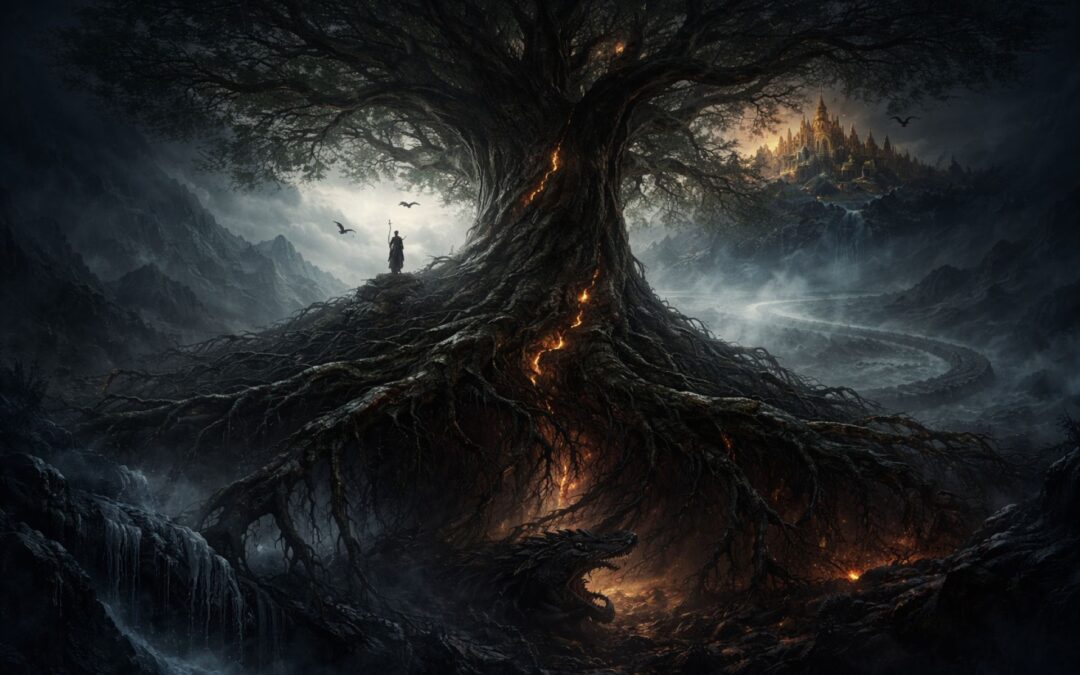
Norse mythology does not begin with creation. It begins with tension.
A void stretched between extremes. Ice pressing against fire. Stillness waiting to break. And from that collision, not harmony, but struggle. The Norse universe is not designed—it is carved out of conflict, shaped by sacrifice, and sustained by a fragile balance that is always on the brink of collapse.
This is what makes it fundamentally different from many other mythologies. The gods are not all-powerful architects. They are participants. They build the world from the body of a slain giant. They negotiate with forces they cannot fully control. They accumulate knowledge not out of curiosity, but out of necessity. Because they know something most divine systems do not admit so openly: the end is coming.
At the center of this mythology is not immortality, but inevitability.
The stories preserved in texts like the Poetic Edda and the Prose Edda are not random tales of gods and monsters. They form a cohesive worldview—one where order is temporary, chaos is constant, and fate is not something to be avoided, but something to be faced with clarity and courage. Odin does not seek wisdom to rule better. He seeks it to understand how everything will fall apart. Thor does not fight because he enjoys battle. He fights because something must hold the line, even if only for a while.
Even the structure of the universe reflects this tension. Worlds are not isolated—they are connected, dependent, and vulnerable. Gods, giants, humans, and creatures exist in a network where alliances shift, boundaries blur, and nothing remains stable for long. Enemies become in-laws. Tricksters become destroyers. Protectors become doomed warriors.
And yet, despite this constant instability, Norse mythology is not nihilistic. It does not suggest that nothing matters. On the contrary, it insists that everything matters more precisely because it will end. Courage is meaningful because defeat is certain. Honor matters because survival is not guaranteed. The greatest gods in this system are not those who avoid fate, but those who walk toward it fully aware of what awaits them.
This is a mythology built on clarity rather than comfort.
To understand it, you cannot approach it as a collection of disconnected legends. You have to see it as a system—a living cosmology where creation, conflict, and destruction are not separate phases, but parts of the same continuous cycle. Every story, from the birth of the first giant to the final flames of Ragnarok, is connected by a single underlying idea: that order must be created, defended, and ultimately surrendered.
What follows is not just a retelling of myths. It is a reconstruction of an entire worldview.
A world where gods bleed, monsters have purpose, and the end of everything is not a failure of the system—but its completion.
The Origins of the Norse Cosmos
Before there were gods, worlds, or even the concept of time as we understand it, there existed a vast, undefined expanse known as Ginnungagap. It was not emptiness in the modern sense, but a charged void—an unstable space defined by two opposing forces pressing against it from either side.
Ginnungagap, Niflheim, and Muspelheim
To the north lay Niflheim, a realm of freezing mist, endless cold, and primordial ice. It was a place of stagnation, where movement slowed and solidified, where even breath would crystallize into frost. From it flowed icy rivers that crept steadily toward the center of existence.
To the south burned Muspelheim, a realm of fire, heat, and violent energy. Unlike the stillness of Niflheim, Muspelheim was dynamic—alive with flame, sparks, and molten force. It was ruled by the fire giant Surtr, a being whose very existence was tied to destruction.
Between these two extremes stretched Ginnungagap.
Creation did not begin with a divine command. It began when these opposing forces collided. The creeping frost met the advancing heat. Ice melted under pressure. And within that unstable interaction, the first forms of life began to emerge.
The Birth of Ymir and Audhumla
From the melting ice arose Ymir, the first being in Norse mythology. He was not simply a giant; he was the origin of all giants, a primordial entity whose body contained the raw potential of life itself. Ymir existed before structure, before order—he was chaotic existence made flesh.
Alongside him emerged Audhumla, a great cosmic cow whose role was essential to sustaining this early world. She nourished Ymir with her milk, allowing him to grow and expand. From Ymir, life did not evolve in a controlled way—it erupted.
The first race of giants, the Jotnar, came into existence spontaneously from Ymir’s body, formed through processes that were less creation and more overflow. Life, at this stage, was uncontrolled and abundant, spreading without direction.
But while Ymir generated life through excess, Audhumla revealed something different—something hidden.
As she licked the salty ice around her, she gradually uncovered a new being trapped within it. What emerged was Buri, the first of the gods. Unlike Ymir, Buri did not arise from chaos, but from uncovering—suggesting that order was always present, waiting to be revealed.
Buri, Borr, and the First Gods
Buri gave rise to Borr, and from Borr came three sons: Odin, Vili, and Ve. These figures marked a turning point in the structure of the cosmos.
Where Ymir represented uncontrolled creation, Odin and his brothers represented intention.
They inherited a world dominated by giants—vast, powerful, but fundamentally unstructured. It was a universe without boundaries, without hierarchy, without stability. And rather than coexist within that chaos, they chose to reshape it entirely.
The Slaying of Ymir and the Making of the World
The decision to kill Ymir is one of the most defining moments in Norse mythology. It is not just a mythic event—it is the foundation of how this universe works.
Order, in this system, is not natural. It is imposed.
Odin, Vili, and Ve attacked Ymir and eventually brought him down. When he fell, his blood flooded the void, wiping out much of the giant race. But the true significance of his death lay in what followed.
The gods did not discard Ymir’s body. They used it.
From his flesh, they formed the earth—Midgard, the realm that would later belong to humanity. From his blood came the seas, rivers, and lakes. His bones became mountains, his teeth turned into rocks, and his skull was raised high to form the sky itself.
To stabilize this new structure, the gods placed four dwarves at the corners of the heavens—Nordri, Sudri, Austri, and Vestri—establishing direction and order where none had existed before.
This is not creation from nothing. It is transformation through destruction.
The world, in Norse thought, is built on the remains of something older, something more chaotic that was never fully erased—only repurposed.
Ask and Embla: The Creation of Humanity
With the physical world established, the gods turned their attention to life that could inhabit it meaningfully.
They found two pieces of driftwood along the shores of their newly formed world. These were not special objects. They had no inherent significance. But in the hands of the gods, they became something far more important.
From these pieces, the gods created the first humans: Ask and Embla.
Each of the three brothers contributed something essential. Odin gave them breath—the force of life itself. Vili granted them consciousness and emotion. Ve gave them senses, speech, and the ability to perceive and interact with the world.
Humanity, in this framework, is not accidental. It is deliberately constructed.
But it is also fragile.
Unlike the giants, who emerged from raw power, or the gods, who descended from a lineage of order, humans are shaped from inert matter and given life through intervention. They exist between forces far greater than themselves—protected at times, but never fully in control.
The foundations of the Norse cosmos were now in place.
A world carved from a slain giant. A divine order imposed over chaos. And a human race placed within that structure, destined to live in a universe that was never truly stable to begin with.
Because even at the moment of creation, the tension had not disappeared.
It had only been contained.
Yggdrasil and the Structure of the Universe
With the physical world formed and humanity placed within Midgard, the Norse cosmos required more than creation—it required cohesion. A universe made from the body of a slain giant could not sustain itself without a system to bind its parts together.
That system took the form of something living, something vast, and something perpetually under strain.
Yggdrasil, the World Tree
At the center of all existence stands Yggdrasil, the immense world tree that connects every realm in the Norse universe.
It is not a passive structure. It is the framework of reality itself.
Its branches stretch across the heavens, reaching into the domains of the gods, while its roots burrow deep into hidden realms filled with mystery, decay, and ancient forces. Everything that exists—gods, humans, giants, and the dead—exists in relation to this tree.
But Yggdrasil is not stable in a comforting sense.
It is constantly under pressure. At its highest point sits a great eagle, watching the worlds below. Along its trunk runs Ratatoskr, the restless messenger who carries words—often insults—between creatures above and below, ensuring that tension is never truly resolved. And at its roots, the serpent Nidhogg gnaws relentlessly, feeding on the very foundation of existence.
This is not a universe held together by harmony.
It is held together by a balance that is actively being tested at all times.
The Nine Realms and Their Meanings
Yggdrasil does not merely connect locations—it organizes existence into nine distinct realms, each representing a different dimension of reality.
These realms are not isolated worlds. They are interdependent, constantly influencing one another through movement, conflict, and exchange.
At one end, you find realms defined by order, structure, and divine authority. At the other, realms shaped by chaos, raw force, and ancient power. Between them lie worlds of life, death, craft, and transformation.
The Nine Realms are less like separate territories and more like components of a single system—each necessary, each incomplete on its own.
Understanding Norse mythology requires understanding this:
no realm exists independently. Every world is part of a larger tension that Yggdrasil is barely holding together.
Asgard, Midgard, and Jotunheim
At the highest level of divine order sits Asgard, the realm of the Aesir gods.
It is a place of intention—golden halls, structured rule, and a clear hierarchy under Odin. Here, decisions are made that affect all realms. It represents control, authority, and the ongoing effort to maintain order in an unstable universe.
Connected to Asgard is Midgard, the human world.
Midgard is not protected by strength alone, but by proximity to the gods. It is a realm of vulnerability—of growth, struggle, and survival. Humans exist in a space shaped by forces far greater than themselves, often protected, but never fully secure.
Beyond Midgard lies Jotunheim, the domain of the giants.
This is not merely enemy territory—it is the embodiment of untamed existence. The giants represent nature without restraint, power without structure. And yet, they are not entirely separate from the gods. They intermarry, interact, and influence one another, blurring the line between order and chaos.
Vanaheim, Alfheim, and Svartalfheim
While Asgard and Jotunheim represent opposing forces, other realms reflect more specialized aspects of existence.
Vanaheim, home of the Vanir gods, represents fertility, prosperity, and natural cycles. Unlike the Aesir, who emphasize power and conquest, the Vanir embody growth, harmony, and the sustaining forces of life.
Alfheim, the realm of the light elves, is associated with beauty, refinement, and subtle magic. It stands apart from the harsher realms, representing a quieter, more harmonious dimension of existence.
Beneath the surface lies Svartalfheim, also known as Nidavellir—the realm of the dwarves.
This is a world defined by craft and transformation. The dwarves are master creators, forging weapons and artifacts of immense power. Many of the most important tools used by the gods—Mjolnir, Gungnir, and others—originate here. It is a realm where raw materials are shaped into instruments that alter the balance of power across the cosmos.
Helheim, Niflheim, and Muspelheim
At the deeper and more extreme ends of the Norse universe lie realms that define the boundaries of existence.
Helheim is the realm of the dead, ruled by Hel, daughter of Loki. It is not a place of torment, but of quiet continuation. Those who do not die in battle come here, existing in a subdued, shadowed afterlife removed from the glory of Valhalla.
Further outward lies Niflheim, the primordial realm of ice, mist, and stillness. It represents the same cold force that played a role in creation, but here it exists in its pure, unchanging form.
Opposite it stands Muspelheim, the realm of fire and destruction.
This is not just a source of heat—it is a force of inevitable collapse. Ruled by Surtr, Muspelheim is destined to play a central role in Ragnarok, when its flames will consume the world entirely.
These two realms are not distant—they are foundational. They represent the extremes that define the limits of existence itself.
Cosmic Creatures and Forces Bound to the Tree
Yggdrasil is not an empty structure—it is inhabited, influenced, and constantly affected by powerful beings.
Creatures like Nidhogg at its roots, the eagle at its peak, and Ratatoskr along its trunk ensure that the tree is never at rest. They are not incidental—they are part of the system’s design, embodying decay, observation, and communication.
Elsewhere, creatures like the Midgard Serpent lie coiled around the human world, while wolves chase the sun and moon across the sky. These are not random mythological elements. They are expressions of forces that shape and destabilize the cosmos.
Every level of existence is alive with pressure.
A Cosmos Defined by Balance, Not Stability
What emerges from this structure is not a stable universe, but a functional one.
The Nine Realms exist in a state of constant interaction—sometimes cooperative, often hostile, always interconnected. The gods attempt to maintain order, the giants push against it, and the underlying forces of creation continue to exert pressure from all sides.
Yggdrasil holds everything together.
But it is not unbreakable.
From the very beginning, the Norse cosmos is built with the understanding that this structure will not last forever. The forces that created it still exist. The tensions that define it are never resolved.
The universe functions—but only temporarily.
And every root, every branch, and every realm carries within it the quiet certainty that one day, it will all come apart.
The Two Divine Clans: Aesir and Vanir
With the cosmos structured and the realms connected through Yggdrasil, the Norse universe did not settle into harmony. Instead, power concentrated into two distinct divine groups—each representing a different way of understanding and controlling the world.
Their coexistence was never going to be peaceful.
Who the Aesir Were
The Aesir were the gods of structure, authority, and force.
Centered in Asgard and led by Odin, they represented a worldview built on control—of territory, of knowledge, and of destiny itself. These were not passive deities. They were rulers, strategists, and warriors, constantly preparing for threats both visible and foretold.
Figures like Thor and Tyr embodied their values clearly. Strength, courage, and direct confrontation defined their approach. Problems were to be faced, enemies to be defeated, and order to be maintained through action.
But beneath that strength lay something more calculated.
The Aesir were not just warriors—they were planners. Odin, in particular, represents a kind of power rooted in foresight. His relentless pursuit of knowledge is not driven by curiosity alone, but by a need to understand what is coming and how to prepare for it.
The Aesir do not assume permanence.
They rule with the awareness that their power must constantly be defended.
Who the Vanir Were
In contrast, the Vanir represent a completely different form of power.
They are associated with fertility, prosperity, nature, and cycles of life. Their realm, Vanaheim, is not built on dominance, but on balance. Where the Aesir impose order, the Vanir cultivate it.
Gods like Freyr, Freyja, and Njord embody these principles. Their influence is tied to growth, abundance, and the unseen forces that sustain life over time. They possess a different kind of strength—one rooted in magic, foresight, and subtle influence rather than direct confrontation.
To the Aesir, this kind of power appears unpredictable, even dangerous.
Magic that can alter outcomes without force challenges a system built on control. The Vanir do not fight to dominate—they influence to transform. And that difference creates tension that cannot easily be resolved.
Gullveig and the War Between the Gods
The conflict between these two groups did not begin with armies.
It began with suspicion.
When a Vanir-associated figure named Gullveig arrived in Asgard, she brought with her a form of magic that the Aesir did not fully understand. She practiced seidr, a type of sorcery tied to prophecy and manipulation of fate—something the Aesir found deeply unsettling.
At first, she was observed. Then she was feared.
Eventually, the Aesir attempted to destroy her.
They burned Gullveig, but she did not die. She rose again. They burned her a second time—she returned. A third time, the same result. Each attempt only reinforced what they had feared from the beginning: this was a power they could not control.
This act was not just violence—it was a declaration.
The Vanir saw it as an unforgivable offense. An attack not just on one figure, but on their entire way of life.
And with that, war became inevitable.
The Peace Settlement and Exchange of Hostages
The war between the Aesir and the Vanir was not brief or decisive.
It was prolonged, destructive, and ultimately inconclusive. Both sides possessed strengths the other could not easily overcome. The Aesir had physical dominance and military structure. The Vanir had magic, foresight, and control over natural forces.
Neither could secure victory.
This is a critical moment in Norse mythology.
It reveals that power, in this universe, is not absolute. Strength alone is insufficient. Magic alone is insufficient. The system requires both.
Eventually, both sides recognized that continued conflict would lead to mutual destruction. And so they chose something rare in mythological systems: compromise.
Peace was established not through victory, but through exchange.
Hostages were traded between the two groups to ensure balance and trust. Njord and his children, Freyr and Freyja, came to live among the Aesir, bringing with them their knowledge of fertility, prosperity, and magic.
In return, figures like Hoenir and Mimir were sent to the Vanir, symbolizing a sharing of wisdom and governance.
The result was not assimilation, but integration.
How the War Reshaped the Norse Pantheon
After the war, the Norse pantheon was no longer divided in the same way.
The Aesir and Vanir did not merge completely, but they began to function as a unified system. Their differences remained, but those differences became complementary rather than oppositional.
This reshaped the entire structure of divine power.
Asgard became more than a stronghold of warriors—it became a center of combined knowledge. Magic that was once feared became a tool. Fertility and prosperity were no longer separate from authority—they became part of it.
Even Odin, who once stood firmly within the Aesir worldview, adopted practices associated with the Vanir, particularly seidr. This shift is significant. It shows that even the most powerful figure in the Norse cosmos is willing to adapt when faced with a more complex reality.
The war did not resolve tension.
It redefined it.
From this point forward, the Norse universe is shaped not by a single type of power, but by the interaction between multiple forms—force and foresight, control and growth, structure and transformation.
And while this balance strengthens the gods in the short term, it also makes one thing increasingly clear:
Even unity does not eliminate instability.
It only delays what is coming.
Odin and the Relentless Pursuit of Wisdom
If the Norse cosmos is defined by tension and inevitability, then Odin is the figure who understands it most clearly.
He is not the strongest god—that role belongs to Thor. He is not the most beloved—that distinction often goes to figures like Baldr. What sets Odin apart is something far more unsettling.
He knows more than the others.
And more importantly, he is willing to pay for that knowledge in ways no one else would.
Odin as Ruler, Wanderer, and Seeker
Odin rules Asgard, but he does not rule from comfort.
Unlike many divine kings in other mythologies, Odin is not static. He does not remain confined to his throne, issuing commands from a place of security. Instead, he moves—constantly.
He travels across realms in disguise, often appearing as an old wanderer cloaked in mystery. He speaks to giants, observes humans, listens to stories, and tests those he encounters. This is not curiosity—it is surveillance.
Odin understands that knowledge is not centralized. It is scattered, hidden in places that are often hostile or dangerous. To rule effectively in a universe like this, he cannot rely on authority alone.
He must gather insight from everywhere.
Even within Asgard, Odin’s position is not one of ease. He is surrounded by powerful beings, but none of them share his burden. While others fight, celebrate, or protect, Odin calculates.
Because he knows something they cannot fully ignore.
The end is coming.
Mimir’s Well and the Sacrifice of the Eye
Odin’s first great act of sacrifice reveals the extent of his commitment.
Deep within the roots of Yggdrasil lies Mimir’s Well, a source of profound wisdom. Its waters do not grant simple knowledge—they provide understanding of deeper truths, the kind that reshape how one sees reality itself.
But that knowledge is not freely given.
When Odin approaches Mimir and asks to drink from the well, he is met with a price. Not a symbolic offering. Not a ritual. Something real.
He must give up his eye.
Odin does not hesitate.
He removes it and casts it into the well, trading physical sight for something far more valuable—perception beyond the visible.
This moment defines him.
Other gods seek power. Odin seeks understanding. And he is willing to diminish himself physically to achieve it. What he loses in one dimension, he gains in another.
From this point forward, Odin is no longer simply a ruler.
He is a being who sees the world differently than everyone else.
The Runes and the Ordeal on Yggdrasil
If the sacrifice at Mimir’s Well shows Odin’s willingness to pay for knowledge, his next act shows how far he is willing to go.
Because even that was not enough.
The deepest secrets of the Norse cosmos are encoded in the runes—symbols that are not merely letters, but carriers of power. They can influence fate, shape outcomes, and alter the structure of reality itself.
But no one possesses them fully.
To gain access to this knowledge, Odin performs one of the most extreme acts in mythology.
He sacrifices himself to himself.
He climbs Yggdrasil, pierces his own body with a spear, and hangs suspended from the tree for nine days and nine nights. No food. No water. No relief. Only pain, isolation, and the slow erosion of physical strength.
This is not symbolic suffering.
It is deliberate self-destruction in pursuit of revelation.
And at the edge of death, the runes reveal themselves to him.
Odin does not discover them—he earns them.
When he falls from the tree, he is transformed. Not stronger in the conventional sense, but more dangerous. He now possesses knowledge that allows him to influence events in ways others cannot even perceive.
Huginn, Muninn, and Odin’s Expanding Vision
Odin’s pursuit of knowledge does not end with sacrifice.
He builds systems to sustain it.
Two ravens, Huginn (thought) and Muninn (memory), serve as extensions of his awareness. Each day, they travel across the Nine Realms, observing, gathering information, and returning to whisper what they have seen.
Through them, Odin’s vision expands beyond his physical limitations.
He is not omniscient—but he is closer to it than anyone else.
He also keeps wolves at his side, creatures that represent both loyalty and underlying violence. Even in his companions, there is a balance between intelligence and threat.
Everything around Odin serves a purpose.
Nothing is ornamental.
Valhalla, the Einherjar, and Odin’s Preparation for the End
Odin’s knowledge does not lead him to peace.
It leads him to preparation.
He knows that Ragnarok is inevitable—the final collapse of the cosmos. And rather than attempting to escape it, he prepares for it with relentless focus.
Valhalla, his great hall, is not merely a reward for fallen warriors. It is a training ground.
The Einherjar, warriors who died in battle, are brought there not just to feast and celebrate, but to prepare. Every day, they fight. Every night, they rise again, healed, only to repeat the cycle.
This is not indulgence.
It is conditioning.
Odin is building an army—not to win, necessarily, but to stand against what is coming.
This distinction matters.
Odin does not operate under the illusion that he can prevent Ragnarok entirely. His actions suggest something more complex. He seeks to understand it, to delay it, and perhaps to influence how it unfolds.
But he does not deny it.
The Burden of Knowing
Odin is often portrayed as wise, but that word alone is insufficient.
He is burdened.
He carries knowledge that isolates him from the other gods. While they act in the present, he is always aware of the future. While they fight for victory, he prepares for defeat.
And yet, he continues.
He does not withdraw. He does not surrender. He does not abandon his role.
Instead, he moves forward with clarity.
In Norse mythology, Odin represents a particular kind of power—not dominance, not strength, but awareness in the face of inevitability.
He is not the god who will survive.
He is the god who will understand what is happening when everything ends.
And in this system, that may be the most significant role of all.
Thor, Protector of Gods and Men
If Odin represents foresight, calculation, and the burden of knowledge, then Thor represents something far more immediate.
Force.
But reducing Thor to strength alone misses the point. In the Norse system, strength is not decorative—it is functional. Thor exists not as a symbol of power, but as the mechanism that actively holds chaos at bay.
Where Odin prepares, Thor acts.
Thor’s Place in the Norse World
Thor is the defender.
He protects Asgard from external threats, but more importantly, he protects Midgard, the human world. This is not a secondary responsibility—it is central to his identity. Humans exist in a fragile space, constantly exposed to forces they cannot control. Thor is the barrier between them and annihilation.
Unlike Odin, Thor does not seek knowledge to navigate the future. He responds to what is directly in front of him. When giants threaten, he confronts them. When imbalance emerges, he corrects it.
This makes him predictable—but also reliable.
In a cosmos built on instability, Thor represents consistency. He does not hesitate, does not overanalyze, and does not withdraw. His role is simple, but indispensable.
He ensures that the system continues to function—for as long as it can.
Mjolnir and the Dwarven Gifts
Thor’s power is inseparable from his weapon—Mjolnir, the hammer forged by dwarves.
But Mjolnir is not just a weapon. It is a tool of stabilization.
It can shatter mountains, summon lightning, and destroy enemies with overwhelming force. Yet its most important property is not its destructive capability—it is its reliability. No matter how far it is thrown, it returns to Thor’s hand.
This detail matters.
In a universe where much is uncertain, Mjolnir represents something that always comes back, something that can be depended on. It is force that can be deployed without losing control.
The hammer itself was created in a context that reflects the complexity of Norse mythology—through trickery, competition, and interference. Loki’s involvement in its forging nearly resulted in imperfection, leaving the handle shorter than intended.
Even the most powerful tools in this world are shaped by instability.
Yet despite that flaw, Mjolnir becomes one of the most important artifacts in the entire mythological system.
Thor’s Strength, Temperament, and Sacred Role
Thor’s strength is unmatched among the gods.
But it is paired with a temperament that is both an asset and a limitation. He is quick to anger, direct in action, and not particularly subtle. He does not rely on deception or long-term strategy. When confronted with a problem, he resolves it through confrontation.
This makes him effective in battle—but also vulnerable to manipulation.
Thor’s personality reflects his role. He is not meant to outthink the system. He is meant to enforce it.
His presence alone is often enough to deter threats. And when deterrence fails, he becomes the response.
There is a reason humans looked to Thor for protection.
He is not distant. He is not abstract. He is immediate.
Thor and the Giants
The giants, or Jotnar, are Thor’s primary adversaries.
But this conflict is not simply good versus evil. The giants represent forces that exist outside of divine order—wild, unpredictable, and often destructive. Thor’s role is to keep those forces from overwhelming the structured world.
This leads to constant confrontation.
Thor does not negotiate with giants in the way Odin sometimes does. He fights them. Repeatedly. Relentlessly. His battles are not isolated events—they are part of an ongoing effort to maintain balance.
Yet, despite this hostility, the relationship between gods and giants is not absolute separation. There are overlaps—alliances, interactions, even shared ancestry.
This makes Thor’s role more complex than simple opposition.
He is not eliminating chaos.
He is containing it.
Thor’s Journey to Utgard-Loki
One of the most revealing episodes in Thor’s mythology is his encounter with Utgard-Loki.
In this story, Thor enters a realm where strength alone is insufficient. He is challenged not through direct combat, but through tests designed to expose the limits of his power.
He attempts to drink from a horn he cannot empty. He tries to lift a cat he cannot fully raise. He wrestles an old woman and is brought to his knees.
At first, these appear to be failures.
But later, the illusion is revealed.
The horn was connected to the ocean—Thor had lowered its level. The cat was the Midgard Serpent—he had lifted part of it. The old woman was old age itself—something no being can defeat.
This story reframes Thor entirely.
He is not weak—he is operating within a system where even his strength has limits. And yet, even within those limits, his impact is extraordinary.
Thor does not break the system.
He pushes against it as far as it will allow.
Thor’s Disguised Wedding and the Recovery of Mjolnir
Not all of Thor’s stories are defined by brute force.
Some reveal a different dimension—one shaped by necessity and compromise.
When the giant Thrym steals Mjolnir and demands Freyja as his bride in exchange, the gods are faced with a problem Thor cannot solve through direct confrontation. Without his hammer, his power is incomplete.
The solution is unexpected.
Thor must disguise himself as Freyja.
Reluctantly, he agrees. Dressed as a bride, he enters the giant’s domain, relying not on strength, but on deception. The situation is absurd on the surface—Thor’s appetite and demeanor nearly expose him—but the plan succeeds.
When Mjolnir is placed in his hands as part of the wedding ritual, Thor reveals himself and destroys the giants.
This story matters because it shows that even Thor, the embodiment of direct force, must occasionally operate outside his natural role.
Strength alone is not always enough.
Thor and Jormungandr: A Rivalry Destined for Ragnarok
Among all of Thor’s enemies, none are more significant than Jormungandr, the Midgard Serpent.
This creature is not just another adversary—it is a cosmic force. It encircles the entire world, existing as both a physical threat and a symbol of containment. As long as it remains in place, the system holds.
But its existence is tied to eventual conflict.
Thor encounters Jormungandr multiple times, each encounter reinforcing the inevitability of their final confrontation. In one story, he nearly pulls the serpent from the ocean while fishing, only for the line to be cut before the fight can conclude.
The outcome is delayed—but not avoided.
Their conflict is not personal. It is structural.
Thor represents the force that protects the world. Jormungandr represents a force that surrounds and threatens it. Their existence is inherently opposed, and their final meeting is not a possibility—it is a certainty.
At Ragnarok, they will face each other one last time.
And neither will survive.
The Function of Strength in a Doomed World
Thor’s role in Norse mythology is not to win.
It is to hold the line.
He delays what cannot ultimately be prevented. He protects what cannot ultimately be saved. And he does so without hesitation, without retreat, and without illusion.
This is what makes him essential.
In a universe where knowledge reveals inevitability, and strategy cannot guarantee survival, there is still a need for action. There is still a need for resistance.
Thor embodies that need.
He is not the god who understands the end.
He is the god who fights it anyway.
Loki, Trickster, Transgressor, and Agent of Collapse
If Odin represents awareness and Thor represents force, then Loki represents something far more disruptive.
Instability.
He does not simply oppose the system—he exists within it, benefits from it, and gradually undermines it from the inside. Unlike the giants, who stand outside divine order, Loki operates at its core, moving between roles with unsettling ease.
He is not a straightforward villain.
He is a catalyst.
Loki’s Place Among the Gods
Loki’s presence in Asgard is, at first glance, contradictory.
He is not fully Aesir. He is not fully giant. He exists between categories, belonging to neither side completely. And yet, he is accepted among the gods, even forming a bond with Odin that elevates his status beyond what his origins would suggest.
This ambiguity defines him.
Loki is neither fully trusted nor entirely rejected. He participates in the life of the gods—joining their journeys, contributing to their victories, and solving problems that others cannot. But he also disrupts, deceives, and creates complications that would not exist without him.
His intelligence is not aligned with stability.
It is aligned with possibility.
The Ambiguity of Loki’s Character
In his early appearances, Loki is not malicious in a conventional sense.
He is mischievous, unpredictable, and often irresponsible—but also useful. Many of the gods’ greatest advantages come as a direct result of Loki’s actions, even when those actions begin as problems.
This duality is essential.
Loki creates issues that only he can resolve. He disrupts the system, then restores it—often in a slightly altered form. Each intervention introduces change, sometimes beneficial, sometimes dangerous.
He is not committed to order or chaos.
He is committed to movement.
Loki’s Tricks, Gifts, and Dangerous Cleverness
One of the clearest examples of Loki’s role comes from the forging of the gods’ most powerful artifacts.
After cutting off the hair of Sif, Thor’s wife, Loki is forced to compensate for his actions. This leads him to the dwarves, where he sets in motion a chain of events that results in the creation of several legendary items—Odin’s spear Gungnir, Freyr’s ship, and most importantly, Thor’s hammer Mjolnir.
But even here, Loki cannot resist interference.
In an attempt to sabotage the process, he disrupts the forging of Mjolnir, causing its handle to be shorter than intended.
The result is paradoxical.
Loki creates the conditions for the gods to gain their greatest tools—but ensures that those tools are never perfect.
This pattern repeats throughout his actions.
He improves the system while simultaneously destabilizing it.
Loki’s Children: Fenrir, Jormungandr, and Hel
If Loki’s behavior introduces instability, his offspring embody it.
With the giantess Angrboda, Loki fathers three beings that will come to define the end of the Norse cosmos: Fenrir, the wolf; Jormungandr, the serpent; and Hel, ruler of the dead.
These are not ordinary beings.
They are existential threats.
Fenrir grows at an uncontrollable rate, eventually becoming so powerful that the gods themselves fear him. Jormungandr expands until it encircles the entire world, a presence that is both stabilizing and dangerous. Hel governs a realm that exists outside the heroic ideals of the gods, quietly collecting those who do not die in battle.
The gods respond not by eliminating these beings, but by containing them.
Fenrir is bound. Jormungandr is cast into the sea. Hel is given dominion over the underworld.
But containment is not resolution.
It is delay.
Loki’s children are not removed from the system—they are embedded within it, waiting.
The Shift from Mischief to Malice
Over time, Loki’s role changes.
What begins as disruption evolves into something more deliberate. His actions become less about cleverness and more about consequence. The balance he once destabilized and restored begins to tilt in a single direction.
This shift is gradual—but irreversible.
Loki moves from being a necessary complication to becoming a genuine threat. His relationship with the gods deteriorates, not because of a single act, but because of a pattern that can no longer be contained within acceptable limits.
He stops being manageable.
Loki’s Punishment and the Gathering of Vengeance
The turning point comes when Loki’s actions cross a boundary that cannot be undone.
In response, the gods capture him and impose a punishment that reflects both their anger and their understanding of what he has become.
He is bound to a rock in a cavern. Above him, a serpent drips venom onto his face. The pain is constant, broken only when his wife Sigyn collects the poison in a bowl—until it fills and she must empty it, allowing the venom to strike him again.
This is not execution.
It is containment through suffering.
But like all attempts to contain instability in Norse mythology, it is temporary.
Loki does not disappear. He does not repent. He endures.
And as he endures, something builds.
Resentment. Anger. A desire not just to disrupt, but to destroy.
The Function of Loki in the Norse System
Loki is not an external enemy.
He is a product of the system’s own contradictions.
He exists because boundaries are not absolute. Because gods interact with giants. Because order is built on unstable foundations. Because intelligence can be used in ways that cannot always be controlled.
He exposes the weaknesses of the structure from within.
And ultimately, he becomes the force that ensures those weaknesses are no longer survivable.
At Ragnarok, Loki does not simply participate.
He leads.
The same figure who once solved problems for the gods becomes the one who brings their world to an end.
This is not a transformation that happens suddenly.
It is the logical conclusion of everything he represents.
In Norse mythology, Loki is not just the trickster.
He is the moment when instability stops being manageable—and becomes inevitable.
The Gods Beyond Odin, Thor, and Loki
While Odin, Thor, and Loki dominate much of the narrative, the Norse cosmos is not held together by a few central figures alone. It is sustained—and ultimately destabilized—by a wider network of gods, each embodying specific forces that shape existence in quieter but equally significant ways.
These figures do not always command attention, but they define the system’s deeper mechanics: fate, fertility, justice, vigilance, and the fragile presence of hope.
Frigg and the Knowledge of Fate
Frigg, Odin’s wife, occupies a position that is often misunderstood.
She is not a warrior, nor a seeker like Odin. Her power lies in knowing—specifically, in her ability to perceive fate. She understands what is coming, but unlike Odin, she rarely acts openly on that knowledge.
This restraint is not weakness.
It reflects a fundamental truth in Norse mythology: knowing the future does not mean you can change it.
Frigg operates subtly, influencing events where she can, protecting what she values within the limits imposed by fate. Her actions are often preventative rather than confrontational, an attempt to preserve balance without disrupting the structure of inevitability.
She represents a quieter form of power—one that understands the boundaries of intervention.
Freyja, Desire, Magic, and Sovereignty
Freyja is one of the most complex figures in the Norse pantheon.
A member of the Vanir, she embodies fertility, beauty, and desire—but these aspects only scratch the surface. Freyja is also a master of seidr, the same form of magic that once unsettled the Aesir.
Through her, magic becomes integrated into the divine system.
She does not simply represent attraction or abundance—she represents influence. Her ability to shape outcomes through unseen means places her in a unique position among the gods. She moves between roles with ease: a figure of love, a practitioner of powerful magic, and a chooser of the slain.
Half of those who die in battle do not go to Odin’s Valhalla.
They go to Freyja.
This alone makes her indispensable.
She shares in the preparation for Ragnarok, not through force, but through selection—deciding who will matter when the final moment arrives.
Freyr, Fertility, Peace, and Kingship
Freyr, Freyja’s brother, represents another dimension of Vanir power—sustained prosperity.
He governs fertility, harvests, and the stability of life itself. Where Thor defends against destruction, Freyr ensures that something worth protecting continues to exist.
His influence is quieter, but no less critical.
Fields grow. Seasons cycle. Life continues. These are not passive processes—they are maintained through forces Freyr embodies.
And yet, his story carries a crucial detail that reflects the underlying tension of Norse mythology.
Freyr gives away his sword.
In exchange for love, he sacrifices a weapon that would have been essential in the final battle. This decision is not framed as foolish—it is human. It reflects desire, attachment, and the prioritization of immediate fulfillment over future necessity.
But in a system where Ragnarok is inevitable, such choices carry consequences.
Freyr’s role reminds us that even gods are subject to trade-offs.
Tyr and the Binding of Fenrir
Tyr represents justice, law, and the willingness to uphold order even at personal cost.
His defining moment comes with the binding of Fenrir.
The wolf, already recognized as a future threat, cannot be restrained by force alone. The gods resort to deception, presenting the binding as a test of strength rather than an act of containment. Fenrir, suspicious, demands assurance.
Someone must place their hand in his mouth as a guarantee.
Only Tyr agrees.
He understands the risk. He understands the outcome. And he proceeds anyway.
When Fenrir realizes the deception and bites down, Tyr loses his hand.
This act is not about victory.
It is about responsibility.
Tyr embodies a principle that runs deep in Norse thought: maintaining order often requires sacrifice, and those sacrifices are not abstract—they are personal, irreversible, and costly.
Heimdall as Watchman of the Gods
Heimdall stands at the boundary.
As the guardian of the Bifrost—the bridge connecting Asgard to other realms—he represents vigilance in its purest form. His senses are unmatched. He sees further, hears more, and sleeps less than any other god.
He does not seek power. He does not pursue knowledge in the way Odin does.
He watches.
This role is deceptively simple, but critically important. Heimdall is the early warning system of the Norse cosmos. When Ragnarok begins, it is his horn that signals the final moment.
He is not the one who prevents the end.
He is the one who announces it.
Baldr as the Embodiment of Light and Hope
Among all the gods, Baldr stands apart.
He is not defined by strength, strategy, or even influence. He is defined by what he represents: light, joy, and the possibility of a harmonious existence.
Baldr’s presence brings stability not through force, but through absence of conflict. He is loved by all, trusted by all, and associated with everything the Norse world rarely sustains—peace without tension.
This is precisely why he matters.
In a system built on instability, Baldr represents an alternative that cannot last.
His existence introduces a contradiction. A world where everything is moving toward conflict suddenly contains something that does not fit that trajectory.
And as with all contradictions in Norse mythology, it does not remain unresolved.
The Balance Beneath the Surface
These gods do not dominate the narrative in the way Odin, Thor, or Loki do, but they define its structure.
Frigg understands fate.
Freyja shapes it.
Freyr sustains life within it.
Tyr enforces order despite it.
Heimdall watches for its collapse.
Baldr embodies what could exist if it did not.
Together, they form a system beneath the system.
A network of forces that maintain, influence, and occasionally challenge the trajectory of the Norse cosmos.
But even here, the pattern holds.
Each of these figures, in their own way, is connected to what is coming.
Their roles are not isolated from Ragnarok.
They are part of the process that leads to it.
Dwarves, Elves, Giants, and Other Beings of the Norse World
The Norse cosmos is not populated by gods alone.
It is a layered system of beings—each occupying a role that extends beyond simple categorization. These entities are not background elements or decorative additions to myth. They are structural components of the universe itself, shaping events, influencing outcomes, and embodying forces that the gods cannot fully control.
To understand Norse mythology, you have to look beyond the gods.
Because much of what defines this world comes from those who exist alongside them.
The Jotnar as More Than Simple Villains
The Jotnar, or giants, are often positioned as enemies of the gods.
But this is an oversimplification.
They are older than the divine order. They originate from Ymir, the primordial being whose body was used to create the world. In that sense, they are not intruders in the cosmos—they are remnants of what existed before structure was imposed.
They represent raw existence.
Nature without boundaries. Power without hierarchy. Forces that do not conform to divine rules because they predate them.
This is why their relationship with the gods is so complex.
They fight the gods. They challenge them. But they also interact, exchange knowledge, and even form familial ties. Loki himself is connected to them. Odin seeks wisdom from them. The boundary between god and giant is not fixed—it is permeable.
The Jotnar are not evil.
They are necessary opposition.
Dwarves as Makers of Power
If giants represent raw force, dwarves represent transformation.
They inhabit the hidden spaces of the cosmos—underground realms where raw materials are reshaped into objects of immense significance. Their importance cannot be overstated.
They do not rule. They do not fight in the same way gods and giants do.
They create.
And what they create defines the balance of power.
Thor’s hammer, Odin’s spear, Freyr’s artifacts—these are not divine creations. They are forged by dwarves. Without them, the gods would be significantly less capable of maintaining order.
But dwarves are not simply craftsmen.
They are precise, calculated, and transactional. Their creations are never given freely. They negotiate. They demand. They operate within a logic that is neither divine nor chaotic—it is practical.
They represent a crucial idea in Norse mythology:
Power is not just inherent. It can be constructed.
Elves and the Luminous Side of the Cosmos
The elves, particularly the light elves of Alfheim, occupy a different space entirely.
They are not defined by conflict or creation in the same way as giants or dwarves. Instead, they represent refinement—beauty, harmony, and a quieter form of influence.
Their presence introduces contrast.
In a world dominated by tension and instability, the elves embody something closer to balance. They are associated with growth, healing, and subtle magic. Their actions are not loud, but they are not insignificant.
They shape the atmosphere of the cosmos rather than its structure.
And yet, even this refinement exists within the same system.
Elves do not escape the broader tensions of the Norse world—they exist within them, offering a different expression of what life in that system can look like.
Valkyries, Norns, and the Hidden Shapers of Destiny
Beyond the more visible beings are figures who operate at a deeper level—those who do not just participate in events, but influence their outcomes in ways that are not always immediately visible.
The Valkyries serve Odin, selecting which warriors will die in battle and which will be brought to Valhalla. They do not simply observe death—they direct it. Their choices determine who will matter in the final confrontation of Ragnarok.
Then there are the Norns.
If Odin seeks to understand fate, the Norns are those who embody it.
They exist at the roots of Yggdrasil, shaping the destinies of gods and men alike. Past, present, and future are not separate concepts to them—they are elements of a single structure they continuously weave.
The gods cannot overrule them.
This is one of the most important dynamics in Norse mythology.
Even the most powerful beings operate within limits defined by forces they cannot control.
Monsters, Serpents, Wolves, and the Embodiment of Chaos
Some beings in the Norse cosmos are not aligned with order, creation, or refinement.
They are aligned with inevitability.
Creatures like Jormungandr, the Midgard Serpent, and Fenrir, the great wolf, are not simply threats to be eliminated. They are manifestations of forces that cannot be removed from the system.
Jormungandr encircles the world, holding a position that is both stabilizing and dangerous. Fenrir grows beyond control, representing strength that cannot be contained indefinitely.
These creatures are tied directly to Ragnarok.
Their existence is not accidental. It is directional.
They move the system toward its conclusion.
A World Defined by Interdependence
What becomes clear when examining these beings is that the Norse cosmos is not hierarchical in a simple sense.
Gods do not exist above everything else.
They exist within a network.
Giants challenge them.
Dwarves empower them.
Elves contrast them.
Valkyries and Norns shape the conditions around them.
Monsters embody the forces they cannot escape.
No single group defines the system.
It is the interaction between them that creates the world as it is.
And within that interaction lies a consistent pattern:
Every force, no matter how beneficial or destructive, contributes to the same trajectory.
A trajectory that does not lead to equilibrium.
But to culmination.
Fate, Honor, Death, and the Viking Moral Imagination
Norse mythology is not just a collection of stories—it is a framework for understanding how to live in a world that is inherently unstable.
Everything established so far—the creation of the cosmos, the tension between realms, the inevitability of Ragnarok—points toward a single underlying truth: outcomes cannot always be controlled.
What can be controlled is how one responds.
Wyrd and the Inescapability of Fate
At the core of Norse thought lies the concept of wyrd—a term often translated as fate, but closer in meaning to an unfolding pattern.
Wyrd is not a fixed script written in advance. It is a structure shaped by past actions, present choices, and forces beyond individual control. It does not eliminate agency, but it defines the boundaries within which that agency operates.
This distinction is critical.
In many mythological systems, fate can be avoided, outwitted, or negotiated. In Norse mythology, it cannot. Even the gods—particularly Odin—seek to understand fate not because they expect to escape it, but because they want to face it with clarity.
The Norns, who shape destiny at the roots of Yggdrasil, do not answer to the gods. They do not adjust outcomes based on preference or power. They operate at a level that cannot be overridden.
This creates a worldview where uncertainty is not the problem—inevitability is.
And yet, inevitability does not lead to passivity.
It produces a different kind of response.
Glory, Courage, and the Warrior Ideal
If fate cannot be changed, then value shifts from outcome to conduct.
This is where the Norse emphasis on courage and honor emerges.
Bravery is not important because it guarantees victory. It is important because it defines the individual in the face of defeat. A warrior who fights knowing the odds are against him is not acting irrationally—he is aligning himself with the highest possible standard within that system.
This is why cowardice carries such weight.
It is not simply a failure of action. It is a failure of identity.
In a world where death is inevitable and often unpredictable, the manner in which one meets it becomes the primary measure of worth. Reputation, legacy, and the memory of one’s actions matter more than survival itself.
This is not romanticization.
It is adaptation to a worldview where survival is never guaranteed.
Valhalla, Folkvangr, and Hel
The Norse understanding of the afterlife reflects this same structure.
There is no single destination for the dead—only different outcomes based on how one lived and, more importantly, how one died.
Valhalla, Odin’s hall, is reserved for warriors who fall in battle. But it is not a place of rest. It is a place of preparation. Those who arrive there become part of Odin’s force, training continuously for Ragnarok.
This reinforces a key idea: even in death, purpose continues.
Folkvangr, ruled by Freyja, receives another portion of the slain. While less militarized than Valhalla, it still represents honor and recognition for those who faced death with courage.
These two destinations are not opposites—they are parallel expressions of the same principle.
Then there is Hel.
Helheim is not a realm of punishment in the traditional sense. It is a place of quiet continuation for those who die outside of battle—through illness, age, or circumstance. It is neither celebrated nor feared in the same way as Valhalla.
But it carries a different weight.
It represents a life that did not culminate in a moment of recognized courage.
This is not framed as moral failure—but it is clearly positioned as a lesser outcome within the cultural hierarchy.
Why Death in Norse Mythology Is Never Just an Ending
Death, in this system, is not a conclusion.
It is a transition into a different form of participation.
Warriors continue to fight. Gods continue to act. Even those in Helheim continue to exist within the broader structure of the cosmos. Nothing simply disappears.
This continuity reflects a deeper philosophical position.
The Norse world does not revolve around avoiding death—it revolves around integrating it into the meaning of life.
Death is expected. It is anticipated. And in many cases, it is actively prepared for.
This is why Ragnarok does not undermine the system.
It completes it.
The same principles that govern individual lives—fate, courage, consequence—scale upward to govern the entire cosmos. The gods themselves operate under the same conditions as humans, only on a larger stage.
They know they will fall.
They prepare anyway.
A Moral System Built on Acceptance, Not Illusion
What emerges from all of this is a moral framework that is both stark and precise.
There is no promise of ultimate victory.
There is no guarantee of justice in the conventional sense.
There is no escape from the structural limits imposed by fate.
And yet, meaning is not diminished.
It is intensified.
Because when outcomes are uncertain—or even predetermined—the significance of action increases. Every decision, every act of courage, every refusal to retreat carries weight precisely because it exists within a system that does not reward it automatically.
This is what defines the Viking moral imagination.
It is not built on the expectation of success.
It is built on the insistence that how you stand matters, even when you know you will fall.
The Great Tragedy of Baldr
Up to this point, the Norse cosmos has been defined by tension, conflict, and preparation. The gods fight, negotiate, and adapt, always aware—at least at the highest level—that something larger is approaching.
But there is still balance.
There is still a sense that the system, however strained, is functioning.
That changes with Baldr.
His story is not just another mythic episode. It is the moment where instability becomes irreversible—where the system stops holding and begins, quietly but decisively, to break.
Why Baldr Mattered
Baldr is not powerful in the way Thor is, nor is he strategic like Odin.
What defines him is something far more unusual within the Norse framework: he represents harmony.
He is associated with light, fairness, and a kind of presence that reduces tension rather than amplifies it. Among the gods, he is universally admired—not feared, not merely respected, but genuinely loved.
This is not a small detail.
In a world where conflict is constant and instability is the norm, Baldr represents the closest thing to equilibrium. His existence suggests that the system might sustain something beyond struggle.
That is precisely why his loss matters so much.
Frigg’s Oaths and the One Thing Left Unbound
Baldr begins to dream of his own death.
These are not ordinary dreams. In Norse mythology, such visions carry weight. They are not dismissed—they are recognized as signals. Frigg, his mother, understands the implication immediately.
If Baldr is destined to die, then something in the structure of fate has already shifted.
Her response is decisive.
She travels across the realms, extracting oaths from everything that exists—fire, water, metal, stone, disease, animals, plants—ensuring that nothing will harm her son. One by one, each element of the world agrees.
The result is unprecedented.
Baldr becomes effectively invulnerable.
Weapons cannot cut him. Fire cannot burn him. Nothing in existence will act against him. This is not strength—it is protection enforced at a systemic level.
And yet, there is a flaw.
Frigg overlooks one thing.
Mistletoe—a small, seemingly insignificant plant—is dismissed as harmless and left outside the network of oaths.
In a mythology built on overlooked details and unintended consequences, that omission is not minor.
It is decisive.
Loki’s Plot and Hodr’s Fatal Role
Loki sees what others do not.
Where the gods celebrate Baldr’s invulnerability—turning it into a game, throwing objects at him for amusement—Loki identifies the gap. Not because he is stronger or wiser, but because he operates differently.
He looks for instability.
Disguised, he learns of the mistletoe. He retrieves it, shapes it into a weapon, and sets the final act into motion.
But Loki does not strike the blow himself.
He turns to Hodr, Baldr’s blind brother.
Hodr is not malicious. He is excluded from the gods’ game because he cannot see. Loki offers him participation—guides his hand, gives him the mistletoe weapon, and directs his aim.
Hodr throws.
The projectile strikes Baldr.
And unlike every other attempt, this one does not fail.
Baldr dies.
The moment is abrupt, but its consequences are not.
This is not just the death of a god.
It is the collapse of a condition that should not have existed in the first place.
The Failed Attempt to Bring Baldr Back
The reaction is immediate.
The gods do not accept the outcome—they attempt to reverse it.
A messenger is sent to Helheim to negotiate Baldr’s return. The condition set by Hel is precise: every being in existence must mourn Baldr.
On the surface, this seems achievable.
Baldr was loved by all.
And indeed, across the realms, everything weeps. Gods, giants, creatures, even elements of the natural world express grief.
But once again, the system fails at a single point.
One figure refuses.
A giantess named Thokk declines to mourn.
That is enough.
The condition is not met. The process fails. Baldr remains in Helheim.
And as with the mistletoe, the identity behind this refusal is not random.
It is Loki.
Why Baldr’s Death Changes Everything
Baldr’s death is not just tragic—it is structural.
Until this point, the gods operate under the assumption that while threats exist, the system itself can be maintained. They fight giants, contain monsters, gather knowledge, and prepare for the future.
But Baldr’s death reveals something deeper.
The system is not secure.
It can be disrupted from within, not through overwhelming force, but through precision—through identifying a single overlooked element and exploiting it.
More importantly, it confirms something Odin has already suspected.
Fate is not just approaching.
It is active.
The death of Baldr is widely understood within Norse mythology as the beginning of the final phase leading to Ragnarok. Not because it causes the end directly, but because it proves that the conditions for collapse are already in place.
From this point forward, the tone shifts.
The gods do not simply prepare—they anticipate.
Trust erodes. Certainty disappears. The balance that once held the system together no longer feels stable.
From Loss to Inevitability
After Baldr’s death, Loki is no longer tolerated.
He is captured and punished, bound beneath the earth, subjected to continuous suffering. But even this does not resolve the problem.
It delays it.
Baldr’s absence remains.
And with it, the realization that what was lost cannot be restored.
This is what transforms the narrative.
Before Baldr, Ragnarok is a distant certainty—something to prepare for.
After Baldr, it becomes a trajectory already in motion.
The gods do not yet fall.
But the conditions that will lead to their fall are now irreversible.
And for the first time, the Norse cosmos is not just under tension.
It is moving toward its end.
Heroes, Sagas, and the Human Dimension of Norse Myth
Up to this point, the focus has been on gods, cosmic structures, and the forces shaping the Norse universe. But the mythology does not operate solely at that level.
It extends into the human world.
Not as passive storytelling, but as a way of defining how individuals are expected to act within a system governed by fate, conflict, and inevitable decline.
The heroic tradition in Norse mythology is not separate from its cosmology—it is a direct reflection of it.
Sigurd and the Slaying of Fafnir
The story of Sigurd illustrates how Norse mythology translates its larger themes into human experience.
Sigurd is not divine. He does not possess inherent cosmic authority. What defines him is capability—skill, determination, and the willingness to confront danger directly.
His most defining act is the slaying of Fafnir, a dragon who was once a dwarf transformed by greed. The transformation itself is important. It shows how internal corruption—specifically the pursuit of wealth—can distort identity.
Sigurd’s victory is not framed as simple heroism.
It is tied to consequence.
By killing Fafnir and taking the treasure, Sigurd inherits the same curse that created the dragon. His success introduces instability into his own trajectory. The achievement does not resolve the problem—it transfers it.
This pattern aligns with the broader structure of Norse mythology.
Actions produce outcomes, but those outcomes often carry forward new complications.
Brynhild, Treachery, and the Curse of Gold
Sigurd’s later story reinforces this dynamic.
His relationship with Brynhild—a valkyrie associated with strength, independence, and honor—introduces a different kind of conflict. This is no longer about external threats, but internal contradictions: loyalty versus obligation, truth versus deception.
The curse attached to the treasure continues to operate.
Decisions influenced by that curse lead to betrayal, broken alliances, and ultimately Sigurd’s death. The narrative does not present these events as random misfortune. They are the logical extension of earlier actions.
This is consistent with the concept of wyrd.
What unfolds is not disconnected from what came before. It is shaped by it.
Ragnar Lodbrok and the Border Between Legend and History
The figure of Ragnar Lodbrok represents a different dimension of the heroic tradition.
Unlike Sigurd, whose story is fully mythological, Ragnar exists at the boundary between legend and historical memory. His narratives blend real-world elements with mythic exaggeration, making him a useful example of how Norse culture integrates storytelling with identity.
Ragnar’s defining traits—ambition, adaptability, and willingness to confront overwhelming odds—align with the values established in earlier sections.
His actions are not driven by the expectation of guaranteed success.
They are driven by the pursuit of reputation and legacy.
This reflects a consistent principle: significance is not measured by outcome alone, but by the willingness to act within uncertain conditions.
What Norse Heroic Tradition Reveals About the Culture That Produced It
When viewed collectively, these stories clarify how Norse mythology functions at the human level.
They do not offer reassurance.
They do not suggest that good actions lead to stable outcomes or that success can be maintained indefinitely. Instead, they emphasize a different set of priorities:
- Competence in the face of difficulty
- Commitment to action despite uncertainty
- Acceptance of consequence as part of any meaningful decision
Heroes in this system are not defined by victory.
They are defined by alignment with the structure of the world they inhabit.
Sigurd does not escape the consequences of his actions. Ragnar does not operate with certainty of success. Their stories do not resolve into stability—they move toward outcomes shaped by earlier choices and external forces.
This is not presented as failure.
It is presented as consistency.
The Human Role in a Larger System
The presence of heroic narratives reinforces a key idea.
Humans are not separate from the cosmic system described in Norse mythology—they operate within it under the same constraints.
They do not control fate.
They do not eliminate instability.
They do not achieve permanent resolution.
What they can do is act.
And through action, they define how they are remembered.
This is why the heroic tradition matters.
It translates abstract concepts—fate, inevitability, consequence—into decisions made by individuals. It shows how the larger structure of the Norse cosmos applies at every level, from gods to humans.
The scale changes.
The principles do not.
Ragnarok: The Twilight of the Gods
Everything in Norse mythology points toward Ragnarok.
Not as an unexpected catastrophe, but as a built-in conclusion. The creation of the world, the tension between realms, the containment of unstable forces, and even the behavior of the gods—all of it moves in this direction.
Ragnarok is not a disruption of the system.
It is the system reaching its limit.
The Signs Before the End
Ragnarok does not begin suddenly.
It is preceded by a series of developments that signal the breakdown of order. These signs are not random—they reflect the same patterns already visible throughout the mythology, now accelerating beyond control.
The most immediate indicator is moral and social collapse within the human world. Bonds weaken. Trust erodes. Conflict becomes constant and unrestrained.
This is followed by environmental disruption.
Seasons lose their structure. The world enters Fimbulwinter, an extended period of extreme cold without relief. Growth halts. Stability disappears. The natural cycles that sustain life begin to fail.
At this stage, the system is still functioning—but only partially.
The conditions that once maintained balance no longer operate as intended.
Fimbulwinter and the Breakdown of the Human World
Fimbulwinter is not simply a harsh winter.
It represents the failure of continuity.
In earlier sections, figures like Freyr embodied the stability of cycles—growth, harvest, renewal. Fimbulwinter reverses that. It introduces a state where those cycles no longer reset.
Without transition between seasons, there is no recovery.
This has direct consequences for human society.
Resource scarcity intensifies conflict. Alliances collapse under pressure. The values associated with honor and cooperation give way to survival-driven behavior. The structure of society begins to mirror the instability already present at the cosmic level.
The human world does not initiate Ragnarok.
But it reflects its approach.
The Release of Fenrir and the Rising of Jormungandr
As conditions deteriorate, the forces previously contained begin to re-emerge.
Fenrir, once bound by the gods, breaks free.
This is not a reversal of a past action—it is the failure of containment. The same system that temporarily restrained him can no longer hold. His release represents the collapse of a controlled threat into an active one.
At the same time, Jormungandr rises from the ocean.
The serpent that once encircled the world, maintaining a form of boundary, now disrupts it. The act of rising destabilizes the environment itself, causing upheaval across the seas and land.
These events are not isolated.
They reflect a broader pattern: forces that were integrated into the system are now operating beyond it.
Loki’s Return and the March of the Forces of Chaos
Loki, previously bound as punishment for his actions, also breaks free.
His role at this stage is no longer ambiguous.
He moves from internal disruptor to external leader, aligning with the giants and other forces opposed to the gods. The same intelligence that once destabilized the system from within now directs a coordinated opposition against it.
This shift is significant.
Ragnarok is not just the release of chaotic forces—it is their organization.
The giants mobilize. The boundaries between realms weaken. What was once contained begins to move toward a central confrontation.
Heimdall’s Horn and the Final Mustering of the Gods
As these forces advance, Heimdall fulfills his role.
He sounds his horn, signaling that the final phase has begun.
This is not a warning in the sense of prevention. It is an announcement. The point at which preparation ends and confrontation begins.
The gods respond by assembling.
Odin gathers the Einherjar from Valhalla. Thor prepares for battle. The other gods take their positions. There is no attempt to negotiate or delay further.
At this stage, the structure of the system has fully transitioned from maintenance to engagement.
The Great Duels of Ragnarok
Ragnarok unfolds through a series of direct confrontations between opposing forces.
These are not chaotic clashes—they are structured outcomes, reflecting relationships established throughout the mythology.
Odin faces Fenrir.
Thor confronts Jormungandr.
Freyr encounters Surtr.
Tyr battles Garm.
Heimdall and Loki face each other.
Each encounter is a culmination of earlier tensions.
These are not new conflicts—they are resolved ones.
The Death of Odin
Odin’s confrontation with Fenrir represents the limit of foresight.
Despite all his knowledge, preparation, and strategic planning, he cannot avoid the outcome. Fenrir kills him.
This does not invalidate Odin’s actions.
It confirms the structure he understood all along.
Knowledge does not eliminate inevitability.
Thor’s Final Victory and Final Death
Thor’s battle with Jormungandr follows a similar pattern.
He succeeds in killing the serpent—a direct victory. But the victory is not sustainable. After taking nine steps, he succumbs to the serpent’s venom.
This sequence reinforces a key principle.
Success and survival are not always aligned.
Thor fulfills his role completely. But fulfillment does not prevent his death.
Freyr, Tyr, Loki, and Heimdall at the End
Other confrontations follow the same structure.
Freyr, lacking the sword he gave away earlier, is killed by Surtr. His earlier decision carries forward into this moment.
Tyr and Garm kill each other.
Heimdall and Loki do the same.
These outcomes are not random.
They are consistent with earlier actions, relationships, and limitations.
Surtr’s Fire and the Destruction of the Cosmos
With the major forces engaged and the gods fallen, the final stage begins.
Surtr, the fire giant from Muspelheim, advances and sets the world ablaze.
This act is not symbolic—it is structural.
Fire, one of the original forces present at creation, now completes the cycle by destroying what was formed. The world that emerged from the interaction of fire and ice returns to a state where those forces dominate once again.
The cosmos collapses.
The structure held together by Yggdrasil fails.
A System That Ends as It Was Designed To
Ragnarok does not contradict the earlier parts of Norse mythology.
It completes them.
The same elements present at creation—conflict, imbalance, transformation—reappear at the end, not as anomalies, but as conclusions. The system does not fail unexpectedly.
It reaches a point where it can no longer sustain itself.
The gods do not avoid this outcome.
They engage with it.
And in doing so, they reinforce the central idea that has been present from the beginning:
The value of the system does not lie in its permanence.
It lies in how it functions before it ends.
What Comes After Ragnarok
Ragnarok concludes with destruction, but not with absence.
The Norse system does not treat the end of the cosmos as a final state. Instead, it presents it as a transition—one that removes the existing structure but does not eliminate the conditions for existence itself.
This distinction matters.
The collapse is total, but it is not absolute.
The World Reborn
After the fires of Surtr subside, the world does not remain in ruin.
It re-emerges.
The land rises again from the sea, renewed and largely untouched by the corruption and instability that defined the previous age. This is not a continuation of the old world—it is a reset of the conditions under which that world operated.
The emphasis here is not on restoration.
It is on renewal without inherited structure.
The conflicts, tensions, and accumulated consequences of the previous cycle are not carried forward in the same form. What emerges is a cleaner system, one not yet shaped by the same pressures that led to collapse.
But the absence of those pressures is temporary.
The underlying dynamics remain.
The Surviving Gods
Not all of the gods are lost.
A number of figures survive Ragnarok, and their presence ensures continuity between the old world and the new one. Among them are Vidar and Vali, sons of Odin, as well as Magni and Modi, sons of Thor.
These figures are not the dominant forces of the previous system.
They are secondary figures—less central, less burdened by the decisions and conflicts that defined the earlier age. Their survival reflects a shift in emphasis.
The new world is not led by those who shaped the old one.
It is led by those who come after.
Even more significant is the return of Baldr.
His presence in the renewed world signals something important. The figure who represented harmony, whose loss marked the beginning of collapse, now reappears in a system that is no longer under the same strain.
This is not a reversal of his death.
It is a reintroduction of what he represents—under different conditions.
Lif and Lifthrasir and the Return of Humanity
Humanity also continues.
Two figures, Lif and Lifthrasir, survive the destruction by sheltering within Yggdrasil. Their survival is not tied to strength or status, but to endurance.
They represent continuity at the most basic level.
From them, the human world begins again.
This detail reinforces a consistent pattern.
The Norse system does not preserve entire structures—it preserves minimal viable continuity. Enough remains to allow existence to resume, but not enough to recreate the previous system exactly as it was.
The Meaning of Destruction and Renewal in Norse Thought
The post-Ragnarok world is often interpreted as hopeful, but that interpretation requires precision.
It is not hopeful in the sense of permanent stability.
It is hopeful in the sense of possibility.
The destruction of the old world removes accumulated instability. It clears the consequences of prior actions, allowing a new system to form without the same constraints.
But the forces that shaped the original cosmos—conflict, imbalance, transformation—are still present.
The new world is not immune to them.
It is simply earlier in the cycle.
Continuity Without Illusion
What emerges after Ragnarok reflects the broader philosophy of Norse mythology.
Endings are not final in the sense of complete erasure. They are transitions that preserve certain elements while discarding others.
The system does not promise permanence.
It allows for recurrence.
Gods return, but not all of them.
Humans continue, but not unchanged.
The world exists again, but not identical to what came before.
This is not a cycle that guarantees improvement.
It is a cycle that guarantees continuation.
A Reset, Not a Resolution
Ragnarok does not resolve the tensions of the Norse cosmos.
It removes them temporarily.
The new world begins without the accumulated weight of the old, but it is still subject to the same underlying principles. Over time, those principles will produce new structures, new conflicts, and eventually, new outcomes.
The mythology does not extend beyond this point.
It does not describe another Ragnarok.
But the logic of the system makes one thing clear.
What happened once is not unique.
It is inherent.
The Enduring Legacy of Norse Mythology
Norse mythology does not remain confined to its original cultural context.
Unlike systems that fade into abstraction, it persists—reinterpreted, adapted, and embedded into new forms of storytelling, identity, and thought. Its endurance is not accidental. It reflects the structure of the mythology itself.
The ideas it presents are not tied to a single time period.
They remain applicable because they address conditions that do not disappear.
Norse Myth as Religion, Story, and Cultural Memory
Originally, Norse mythology functioned as a religious and cultural framework.
It provided explanations for natural phenomena, established moral expectations, and structured social values. The gods were not distant figures—they were integrated into daily life, invoked in ritual, and reflected in the worldview of the societies that carried these traditions.
But Norse mythology was not preserved through a continuous religious tradition.
It was recorded.
Texts such as the Poetic Edda and the Prose Edda, compiled in medieval Iceland, transformed an oral tradition into written form. This transition is significant.
It preserved the material—but it also reframed it.
The mythology we have access to today is already an interpretation, shaped by the perspectives and limitations of those who recorded it. It is not a direct transmission of belief—it is a structured version of it.
This does not reduce its value.
It defines how it continues to exist.
Medieval Preservation and the Eddas
The survival of Norse mythology depends heavily on a small number of sources.
The Poetic Edda contains earlier mythological and heroic poems, preserving narrative elements in a form closer to their original expression. The Prose Edda, attributed to Snorri Sturluson, organizes and explains these myths, providing coherence and context.
Without these texts, much of the mythology would have been lost.
But their role is not neutral.
They impose structure on material that was originally fluid. They select, organize, and interpret. This means that what is preserved is not everything—but what was considered worth preserving.
Understanding Norse mythology requires recognizing this layer.
The system we analyze today is both ancient and mediated.
Norse Mythology in Modern Literature, Film, and Games
Norse mythology continues to evolve through modern reinterpretation.
It appears in literature, film, and interactive media—not as static reference, but as a source of adaptable structures. Characters like Odin, Thor, and Loki are reimagined across contexts, often simplified or altered, but still recognizable.
This adaptability reflects a key strength of the mythology.
Its core elements—conflict, inevitability, transformation—translate across formats.
Modern depictions may shift emphasis, tone, or detail, but they tend to retain the underlying dynamics. The tension between order and chaos, the presence of fate, and the inevitability of large-scale change remain intact.
This is why Norse mythology integrates so easily into contemporary narratives.
It does not require complete reinvention.
It requires reinterpretation.
Why These Stories Still Matter
The continued relevance of Norse mythology is not based on nostalgia.
It is based on structure.
The system it presents does not rely on permanent stability, guaranteed outcomes, or absolute control. It assumes limitation. It assumes tension. It assumes that systems—whether cosmic or social—operate under conditions that cannot always be resolved.
These assumptions remain applicable.
Modern contexts differ in scale and form, but not in underlying complexity. Uncertainty, instability, and the need to act without guaranteed outcomes are not unique to the Norse world.
They are ongoing conditions.
Norse mythology provides a framework for engaging with those conditions without relying on idealized resolutions.
It does not promise control.
It emphasizes response.
A System That Persists Through Interpretation
What allows Norse mythology to endure is not just its content, but its flexibility.
It can be approached as religion, literature, philosophy, or cultural artifact. Each perspective reveals a different aspect of the same system. None of them exhaust it.
This multiplicity ensures continuity.
The mythology does not depend on a single form of engagement. It can be studied, retold, adapted, or analyzed—each approach extending its presence rather than replacing it.
Continuation Without Final Form
Norse mythology does not end with Ragnarok, and it does not end with the Eddas.
It continues through interpretation.
Each retelling introduces variation, but the core structure remains recognizable. The system adapts without losing its identity.
This is consistent with its internal logic.
Just as the cosmos is destroyed and renewed, the mythology itself undergoes cycles of reinterpretation. It changes form, but not function.
It remains a framework for understanding a world where stability is temporary and action still matters.
Conclusion
Norse mythology does not offer comfort in the traditional sense.
It does not promise a stable world, a just outcome, or a permanent resolution to conflict. From its very beginning—with a universe born out of tension between fire and ice—to its end in Ragnarok, where even the gods fall, it presents a system defined by limitation.
And yet, it does not collapse into meaninglessness.
What it offers instead is clarity.
The cosmos it describes is structured, but not secure. Order exists, but only because it is actively maintained. Knowledge can be pursued, but not used to escape fate. Strength can be applied, but not preserved indefinitely. Every force within the system—gods, giants, humans, and the structures that connect them—operates under conditions that cannot be fully controlled.
This is not a flaw in the system.
It is the system.
Within that framework, value shifts away from outcomes and toward action. The significance of a decision is not measured by whether it guarantees success, but by how it aligns with the reality in which it is made.
Odin continues to seek knowledge, even when he understands its limits.
Thor continues to defend the world, even when he cannot save it.
The gods prepare for Ragnarok, not because they believe they will win, but because they understand what it means to stand against it.
At the human level, the same principles apply.
Heroes do not achieve permanent victory. They act within constraints, accept consequences, and define themselves through their responses. Fate is not avoided—it is confronted.
This is what gives Norse mythology its enduring structure.
It does not rely on illusion.
It acknowledges instability without surrendering to it. It accepts inevitability without removing the importance of choice. It presents a world where endings are certain, but actions still carry weight.
And that is why it persists.
Not because it resolves the tensions it describes—but because it articulates them with precision, and leaves space for individuals—gods or otherwise—to decide how they will respond within them.