
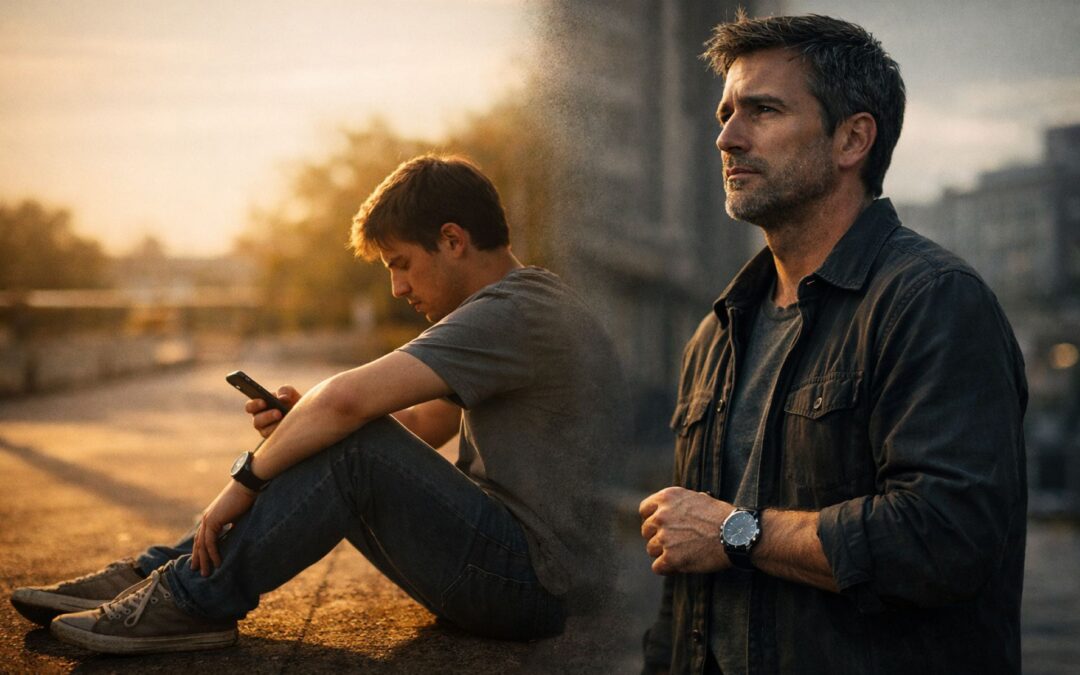
The Quiet Panic That Comes With Looking Back
Every so often, a certain kind of confession starts circulating online. It doesn’t shout. It doesn’t rage. It simply admits something quietly unsettling.
“I wasted my twenties.”
“I didn’t know what I was doing until it was too late.”
“I thought life would start later.”
These aren’t dramatic failures. They’re ordinary lives, lived in a way that, in hindsight, feels misaligned. Years pass. Opportunities slip by. And only then does the realization arrive—with an uncomfortable clarity that wasn’t available before.
What makes these reflections striking is not their rarity, but their familiarity. Different people, different paths, yet the same underlying feeling: that time was lost somewhere along the way, not in a single catastrophic decision, but in something slower, almost invisible.
Pink Floyd’s Time captures this sensation with unsettling precision. Not by explaining it outright, but by pointing to a pattern most people recognize only after they’ve already lived through it. A phase of drifting. A sudden awakening. And the quiet shock of discovering how much has already passed.
So the question is not simply why people make bad choices, or miss opportunities.
It’s deeper than that.
Why does life so often feel abundant when we’re living it—and scarce only when we look back?
When Time Feels Endless
In the early phases of life, time does not feel like something that can run out.
It stretches. It lingers. It expands in ways that are difficult to fully grasp later on. A single summer can feel vast. A year feels substantial. There is no urgency attached to it, no sense that something is quietly slipping away in the background.
This isn’t just a matter of age. It’s a matter of experience.
The philosopher Henri Bergson made a distinction between what we might call clock time—the objective, measurable sequence of seconds and hours—and what he described as lived time. We don’t actually experience life in neat, divisible units. We experience it as a continuous flow, shaped by attention, emotion, and novelty.
And in youth, everything is new.
First experiences dominate. First friendships. First failures. First discoveries. The world hasn’t settled into patterns yet, so every moment carries a kind of weight, a density that makes it feel longer than it is. Time, in this phase, doesn’t just pass—it unfolds.
Because of this, there’s no real pressure to manage it. There’s no instinct to conserve it. It doesn’t feel like a resource that needs to be used carefully, because it doesn’t feel limited in the first place.
Jean-Jacques Rousseau once described childhood as a state of being “animated, free from anxiety or corroding care, living wholly in the present.” And that presence matters. When you are fully absorbed in the moment—even in something trivial—time doesn’t feel like something external to you. It doesn’t stand apart as something to measure or worry about.
It simply is.
From the outside, this phase can look like aimlessness. Days spent doing nothing in particular. Time that could have been used more “productively.” But from within, it rarely feels wasted. It feels full. Immediate. Sufficient in itself.
And that’s where the illusion begins.
Because when time feels endless, there is no reason to think about how it’s being spent.
The Illusion That Life Hasn’t Started Yet
Alongside this sense of abundance, another belief quietly takes shape.
That real life hasn’t begun.
There’s a subtle expectation that the present is only a prelude. A preparation phase. Something you move through before things truly matter. You go to school, you explore, you drift a little—but somewhere ahead, there’s a moment when everything will become clear. A direction will reveal itself. A purpose will announce itself. Life, in its “real” form, will finally start.
Until then, there’s no urgency.
Pink Floyd’s lyrics capture this passivity with a single line: waiting for someone or something to show you the way. It reflects a deeply ingrained assumption—that meaning comes from outside, and that at some point, it will arrive fully formed.
This belief is rarely questioned because it feels intuitive. After all, much of early life is structured that way. Guidance comes from parents, teachers, institutions. Decisions are often made for you. So it’s easy to assume that the pattern continues—that eventually, something or someone will point you toward the path you’re meant to follow.
And so, you wait.
Not actively, but implicitly. You move through days without a clear sense of ownership over them. Time becomes something to pass through rather than something to shape. You try things, you drop them, you circle back. There’s always the quiet reassurance that the important part hasn’t started yet.
The future, in this phase, feels self-organizing. As if it will take care of itself.
But this assumption carries a cost.
Because while you’re waiting for life to begin, it’s already unfolding.
Drifting Without Noticing
There is no single moment where things go wrong.
No clear turning point. No obvious mistake. Just a gradual shift from presence to habit, from intention to repetition.
You wake up. You check your phone. You move through the same set of actions, often without thinking about them. Days begin to resemble each other. What once felt expansive now feels compressed—not because time has changed, but because your experience of it has.
This is where drifting begins.
Not in chaos, but in structure. Routine gives the impression of stability, even progress. You’re doing things. You’re moving. But direction becomes secondary to momentum. You don’t stop to question whether the path itself was chosen—or simply inherited.
Distraction plays its role here. Not in a dramatic sense, but in small, persistent ways. Moments that could have been used to reflect, to decide, to redirect, are instead filled. Scrolling, consuming, reacting. Time is no longer something to inhabit; it becomes something to get through.
And gradually, it turns into something to kill.
This is what makes drifting so difficult to detect while it’s happening. It doesn’t feel like neglect. It feels like normal life. There’s always something to do, something to respond to, something just urgent enough to keep you from stepping back.
So you don’t.
You keep moving, not because you’ve chosen a direction, but because stopping would require confronting the absence of one.
And the longer this continues, the more seamless it becomes. Days fold into weeks. Weeks into years. Not marked by decisions, but by continuity.
From the inside, it feels like life is ongoing.
From the outside, it looks like nothing has really changed.
The Moment You Realize Time Has Passed
The shift doesn’t announce itself.
It arrives quietly, almost casually—often in a moment that, on the surface, doesn’t seem significant. A birthday. A reunion. Running into someone you haven’t seen in years. Or simply a passing thought that lingers longer than usual.
And then it lands.
Time has passed. Not just days or months, but years. Entire stretches of life that, when you try to recall them, feel compressed, almost indistinct. You know they happened. You were there. But they don’t feel as substantial as they should.
“And then one day you find ten years have got behind you.”
The line feels abrupt because the realization itself is abrupt. There’s no gradual awareness leading up to it. One moment, time feels manageable. The next, it feels like something that has been moving without your full awareness.
What’s unsettling isn’t just that time has passed—it’s how unnoticed it was while it was happening.
You start asking questions that didn’t seem urgent before. What have I actually been doing? How did I end up here? When did things become so fixed?
There’s a subtle disorientation in this moment. The version of yourself you once imagined—the one who would eventually take control, make decisive moves, become something more defined—feels strangely distant. Not because it was impossible, but because it was never fully acted on.
And with that realization comes a new awareness of time itself.
It no longer feels endless. It feels directional.
Moving forward, yes—but also carrying with it everything that was left unchosen.
The Gap Between Expectation And Reality
Before this realization, life tends to exist in two versions at once.
There’s the life you’re living—and the life you assume is still possible.
The second one is often more vivid. It’s shaped by early ambitions, vague but compelling ideas about who you might become. A different career. A different lifestyle. A version of yourself that feels more aligned, more intentional, more complete.
And for a long time, these two versions coexist without much tension. The imagined future doesn’t disappear just because you’re not actively moving toward it. It lingers in the background, quietly reassuring you that there’s still time to pivot, to change, to become.
But after that moment of realization, the distance between them becomes harder to ignore.
You begin to see not just where you are, but how far it is from where you thought you’d be. The gap isn’t always dramatic. Sometimes it’s subtle—a series of small compromises, postponed decisions, paths taken out of convenience rather than conviction.
Life, as it turns out, doesn’t unfold according to early expectations.
It accumulates.
Responsibilities appear. Financial pressures settle in. Opportunities come, but not always the right ones. And over time, the flexibility you once assumed you had begins to narrow. Not suddenly, but gradually—until the idea of starting over feels heavier than continuing as you are.
This is where the question becomes sharper.
Not just what happened, but how did this become the default?
Because at no point did you consciously decide to abandon the life you once imagined. You didn’t wake up one morning and choose something lesser.
You just moved forward, step by step, without fully interrogating where those steps were leading.
And eventually, the path became the destination.
The Absence Of A “Starting Gun”
For a long time, it feels as if life is waiting for a signal.
A moment when things become clear. When the direction is obvious. When you finally know enough, feel ready enough, or are given some form of permission to begin in earnest.
Until then, there’s a quiet hesitation. Not inactivity, but a kind of partial engagement. You prepare, you consider, you wait. You assume that at some point, something external will mark the transition—from uncertainty to clarity, from potential to action.
But that moment never arrives.
There is no starting gun.
No clear boundary between preparation and life itself. No point where the training ends and the real thing begins. What you thought was leading up to life was, in fact, life all along.
This is the core of the existential realization.
The responsibility was never deferred. It was always yours. Every day that felt like a placeholder was already a decision. Every moment of waiting was already a direction, even if it didn’t feel like one at the time.
Jean-Paul Sartre described this condition as being “thrown” into the world—placed into existence without a predefined essence, and left to define it through action. There is no script to follow, no inherent path to discover. Only the one you create, deliberately or otherwise.
And this is where the earlier assumption begins to collapse.
That “someone” or “something” you were waiting for—the guide, the sign, the certainty—was never coming. Not because you missed it, but because it doesn’t exist.
Which means the absence of action was never neutral.
It was itself a choice.
Why Time Starts Moving Faster
After that realization, something else begins to shift.
Time no longer feels expansive. It begins to contract.
The days are still twenty-four hours long. Weeks still follow the same rhythm. Nothing about time, in an objective sense, has changed. But your experience of it has altered in a way that feels undeniable.
It speeds up.
Years that once felt substantial now pass almost unnoticed. What used to feel like a long stretch—a month, a season—collapses into something brief, barely distinguishable from what came before it.
Henri Bergson’s idea of lived time helps explain this shift.
When life is filled with novelty, attention deepens. Moments expand because they are rich, unfamiliar, and fully engaged with. But as repetition increases, that depth fades. Experiences blur together. Days become harder to distinguish from one another, and without those internal markers, time feels like it’s slipping by faster.
It’s not that time is accelerating.
It’s that you’re no longer fully inside it.
Routine, once a source of stability, now contributes to compression. The more predictable life becomes, the less you register its passage. And so, entire stretches of time seem to vanish, not because they didn’t happen, but because they left little impression.
There’s also another, quieter factor at play.
Comparison.
When you’re ten years old, a single year is a significant portion of your life. It feels large because it is large relative to everything you’ve experienced so far. But as you age, each additional year becomes a smaller fraction of your total life lived.
It occupies less psychological space.
And so, without realizing it, you begin to feel like time is accelerating—not because it has changed, but because your relationship to it has.
What once felt abundant now feels scarce.
And once that shift happens, it doesn’t reverse.
Running Against A Clock You Can’t Beat
Once time begins to feel scarce, it doesn’t just move faster—it starts to feel adversarial.
There’s a growing sense that you’re no longer moving with time, but against it.
The ambitions that once felt open-ended now come with an implicit deadline. Things you assumed you would eventually do begin to feel less certain, not because they’ve become impossible, but because the window for them no longer feels infinite. There’s a subtle pressure in the background, a sense that whatever you’re going to make of your life has to happen within limits that are becoming more visible.
And alongside this pressure comes a different kind of friction.
Energy changes. Focus changes. The ease with which you could once start something new—without overthinking, without hesitation—begins to fade. What used to feel like possibility now feels like effort. Not insurmountable effort, but enough to slow you down.
At the same time, the world doesn’t pause to accommodate this shift.
You look around and see others moving forward—sometimes faster, sometimes more decisively. Younger, more adaptable, less encumbered. And it creates a quiet comparison, one that isn’t always explicit, but is difficult to ignore.
You’re still capable. You still want things. But the conditions have changed.
And so, there’s this strange tension. The desire to catch up, to reclaim lost ground, to move faster than you did before—paired with the growing awareness that time doesn’t work that way.
You can’t rewind it. You can’t slow it down. And you can’t negotiate with it.
You can only move within it.
Which makes the feeling of being behind all the more difficult to resolve.
The Weight Of Regret And Quiet Desperation
At some point, the focus shifts from what’s ahead to what’s behind.
You begin to look back—not casually, but with a kind of scrutiny that wasn’t there before. Decisions are revisited. Opportunities are re-examined. Moments that once seemed insignificant take on new meaning, simply because you can now see what they led to.
And with that clarity comes regret.
Not always dramatic. Often quiet. Persistent. The sense that things could have been different, if only you had acted sooner, chosen differently, paid closer attention. It’s not just about what you did, but what you didn’t do—the paths left unexplored, the risks not taken, the versions of your life that never materialized.
Arthur Schopenhauer described this stage as one where life, when viewed in retrospect, feels like it promised more than it delivered. Not necessarily because life itself is lacking, but because expectation and reality rarely align as neatly as we once imagined.
And this mismatch doesn’t always produce visible dissatisfaction.
Sometimes, it settles into something quieter.
Henry David Thoreau called it “quiet desperation”—a state where life continues outwardly as normal, but inwardly feels constrained, unexamined, or misaligned. You meet your responsibilities. You fulfill your roles. But beneath that, there’s a lingering question that never quite goes away.
Is this it?
The difficulty with this kind of realization is that it doesn’t disrupt your life in an obvious way. There’s no clear breaking point, no external event forcing change. Everything can remain exactly as it is.
Which makes it easier to endure.
And harder to confront.
So the feeling stays contained. Not ignored, but not fully acted on either. It becomes part of the background—a low, constant awareness that something didn’t unfold the way it could have.
Not dramatically wrong.
Just not quite right.
The Tragedy Of Awareness Arriving Too Late
At the center of all this sits a quiet asymmetry.
Awareness and opportunity do not arrive at the same time.
When possibilities are at their widest—when paths are still open, when change is easier, when the cost of risk is lower—clarity is at its weakest. You don’t yet see the long-term consequences of inaction. You don’t fully grasp how quickly time can collapse. You don’t feel the weight of decisions that haven’t been made.
So you move loosely. You delay. You assume there’s room.
But by the time awareness sharpens—by the time you can clearly see what matters, what doesn’t, and what should have been done differently—the landscape has already changed.
Some doors have closed. Others are harder to open. The same decisions now carry heavier consequences. The margin for error has narrowed.
And this is where the feeling of “wasted time” truly takes hold.
Not simply because time has passed, but because you can now see what that time was. You can trace the patterns. You can identify the moments where things could have shifted. The connections that were invisible before are now obvious.
Which creates a difficult kind of tension.
You understand more than you did—but you can no longer act with the same freedom.
It’s not that everything is lost. But it’s no longer the same.
And that difference is enough to feel like a loss.
A structural one.
Built into the way we experience life itself.
Are We Being Too Harsh On Ourselves?
There’s something deceptively unfair about the way we judge our past.
We evaluate earlier decisions with a clarity that didn’t exist at the time. We look back with the benefit of experience, perspective, and accumulated understanding—and then measure those earlier versions of ourselves against it.
I should have known better.
I should have acted sooner.
I should have seen where this was going.
But should based on what?
At the time, the future wasn’t visible in the way it is now. The consequences weren’t fully formed. The significance of certain moments wasn’t obvious. What now appears as a missed opportunity often looked, in the moment, like one option among many—or sometimes not even an option at all.
This is what Søren Kierkegaard meant when he said that life can only be understood backwards, but must be lived forwards.
Understanding arrives late by design.
Which means that much of what we now interpret as failure is, in reality, the natural result of navigating without full information. You made decisions based on what you knew, what you felt, and what seemed reasonable within that limited frame.
And that frame matters.
Because without acknowledging it, regret becomes distorted. It turns into a form of self-criticism that assumes you had access to knowledge you didn’t yet possess.
That doesn’t mean all regret is misplaced. Some of it points to real misalignment, real hesitation, real avoidance. But not all of it deserves the same weight.
Some of it is simply the cost of becoming aware.
The moment you finally see clearly is also the moment you realize how unclear everything once was.
And that realization can either harden into self-blame—or soften into something closer to understanding.
Why “Wasting Time” Might Be Inevitable
If you follow this pattern closely enough, a difficult conclusion begins to emerge.
What we call “wasting time” may not be an exception.
It may be the default.
Not because people are careless or incapable, but because of how human life is structured. We move through it without full awareness, shaped by changing perceptions of time, incomplete information, and assumptions that only reveal themselves as flawed in hindsight.
When time feels abundant, we don’t treat it as valuable.
When it starts to feel valuable, it’s no longer abundant.
That gap isn’t accidental. It’s built into the way we experience life.
We begin without urgency because we don’t yet feel limitation. We wait for clarity because we assume it will arrive. We drift because there is no immediate pressure not to. And by the time pressure appears, we’re already embedded in patterns that are harder to break.
From this perspective, “wasted time” isn’t always the result of bad decisions.
It’s often the result of ordinary ones.
Choices made without full foresight. Days spent without deliberate intention. Periods of life that felt neutral while they were happening, but acquire meaning only in retrospect.
And this reframing matters.
Because it shifts the question from “Why did I waste my time?” to something more precise:
How could I have experienced it differently, given who I was at the time?
In many cases, the answer is simple.
You couldn’t have.
Not completely. Not consistently. Not without becoming someone you weren’t yet.
Which suggests that what we call “waste” is, at least in part, inseparable from the process of becoming aware in the first place.
Conclusion
There’s a quiet cruelty in the way life reveals itself.
Not in what it takes from us, but in when it allows us to see clearly.
We move through our early years without urgency because nothing in our experience demands it. Time feels wide, forgiving, almost infinite. And so we treat it that way—loosely, casually, without the weight it will later carry.
Then, gradually, that weight arrives.
Not as a warning, but as a realization.
You begin to see patterns. You begin to understand consequences. You begin to recognize what matters, and what doesn’t. But by then, time has already been spent. Not incorrectly, necessarily—but irreversibly.
And that’s where the feeling comes from.
Not that life was lived wrongly, but that it was lived without full awareness. That the clarity you have now would have changed things, if only it had come sooner.
But it couldn’t have.
Because that clarity is the result of the very time you think you wasted.
Which leaves you with something difficult to accept, but hard to deny:
The life you wish you had lived required an understanding you could only gain by living the one you did.