
Why “Happiness” Is the Wrong Starting Point
“Happiness” is one of the most overused and least understood words in modern life. Everyone wants it, everyone talks about it, and yet the more directly people chase it, the more elusive it seems to become.
Part of the problem lies in the vagueness of the term itself. Happiness can mean pleasure, comfort, excitement, contentment, or even momentary relief from stress. It shifts depending on mood, circumstance, and expectation. What feels like happiness today may feel empty tomorrow. As a result, people end up pursuing something unstable—something that constantly moves the moment they think they’ve reached it.
This is where Greek philosophy offers a sharper lens.
Instead of asking, “How can I feel good?”, ancient thinkers asked a different question: “What does it mean to live well?” That shift may seem subtle, but it changes everything. It moves the focus away from fleeting emotional states and toward a deeper, more stable way of being.
Within this framework, three concepts stand out: apatheia, ataraxia, and eudaimonia.
At first glance, they can look similar. All three are associated with calmness, clarity, and a kind of inner stability. But treating them as interchangeable misses the structure behind them. These are not three versions of the same idea—they represent different layers of a philosophical system.
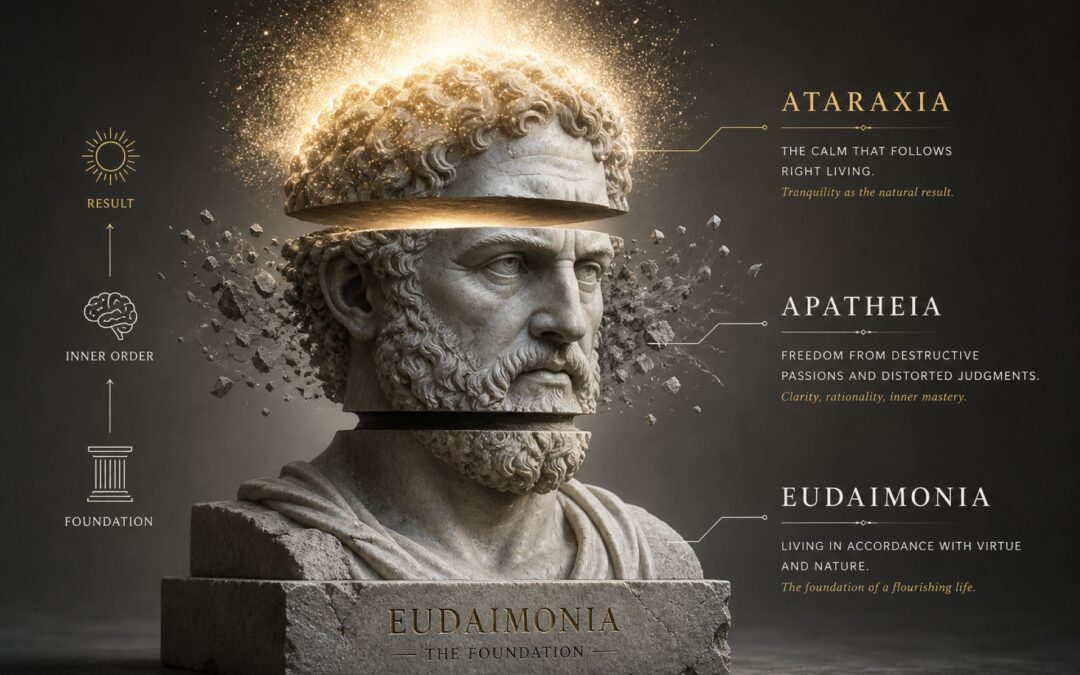
Eudaimonia sits at the top. It is the ultimate aim: a flourishing life, lived in accordance with nature and guided by virtue. It is not a feeling, but a way of living that remains steady regardless of external conditions.
Apatheia and ataraxia, on the other hand, are not goals in themselves. They are consequences. They emerge naturally when one’s life is aligned with reason and virtue.
This is where most modern interpretations go wrong.
People try to engineer calm directly. They try to eliminate anxiety, suppress discomfort, and design a life that minimizes disturbance. But in doing so, they reverse the order. Instead of living well and becoming calm as a result, they try to become calm first—and hope that a good life follows.
The Stoics rejected this approach entirely.
For them, inner peace was never something to be chased. It was something that appeared when the deeper work was done correctly. And that deeper work had nothing to do with manipulating emotions and everything to do with understanding them, questioning them, and ultimately aligning one’s life with virtue.
To understand how this works, we need to look more closely at the structure itself—starting with the most misunderstood of the three: apatheia.
Apatheia: Freedom from the Tyranny of Passion
Few Stoic concepts are more misunderstood than apatheia. At a glance, it looks like the English word “apathy,” which suggests emotional numbness, indifference, or a lack of care. But this is a misleading translation—and one that distorts the entire idea.
Apatheia does not mean the absence of emotion. It means freedom from unhelpful or irrational emotional disturbances—what the Stoics called passions.
To understand this, we need to look at how the Stoics viewed emotions in the first place.
They did not see emotions as random or purely instinctive reactions. Instead, they believed that emotions are tied to judgments. In other words, it’s not events themselves that disturb us, but the meanings we assign to them.
Lose your job, for example, and distress follows—not simply because the job is gone, but because of the belief that this loss is inherently bad, that it will lead to worse outcomes, and that it threatens your identity or future. The emotional reaction grows from the story attached to the event.
From this perspective, the problem is not the situation—it’s the judgment.
The Stoics identified four primary passions that arise from these flawed judgments.
Distress appears when we believe something bad has happened. Fear arises when we anticipate something bad might happen. Craving emerges when we believe something external is necessary for our well-being. And irrational pleasure occurs when we take excessive or misguided delight in things that are not truly good.
Each of these pulls us outward. Each makes us dependent on things we cannot fully control. And once that dependency is in place, our inner state becomes unstable.
Fear leads to avoidance. A person afraid of rejection withdraws from social situations, shrinking their life to protect themselves from discomfort. Craving leads to attachment. When we believe we need something external—whether it’s a person, status, or possession—we give it power over our decisions. Distress traps us in resistance to reality, replaying what has already happened as if it could be undone. And irrational pleasure can quietly distort our sense of what is worth pursuing, leading us to find satisfaction in things that ultimately weaken us.
Apatheia is the state in which these forces no longer dominate.
But this does not mean becoming cold or detached. It means becoming clear.
Instead of reacting automatically, the individual begins to see the judgments behind their emotions. They learn to question them. Is this truly bad? Is this truly necessary for my well-being? Is this worth fearing?
Over time, this process weakens the grip of destructive passions.
And something interesting happens here. The Stoics did not believe that all emotions should disappear. Rather, they believed that unhealthy passions could be transformed into healthier, more rational counterparts.
Fear, when refined, becomes caution—a grounded awareness that helps guide action without overwhelming it. Craving becomes a more measured form of desire, aligned with what is actually good. And irrational pleasure gives way to a quieter, more stable sense of joy—one that is rooted in virtue rather than external stimulation.
This transformation is crucial.
Because apatheia is not achieved by suppression. Suppression only pushes emotions beneath the surface, where they continue to influence behavior in less visible ways. Instead, apatheia is achieved through understanding—through gradually correcting the judgments that give rise to emotional disturbance in the first place.
What remains is not emptiness, but equilibrium.
A person in a state of apatheia still feels. They still engage with life. But their inner state is no longer dictated by every shift in circumstance. They are not easily thrown off balance by loss, fear, or desire, because they no longer grant these things the same authority over their well-being.
This is why apatheia is better understood as equanimity.
It is the quiet stability that comes from no longer being ruled by what you cannot control. And it sets the foundation for the next state—one that often looks similar on the surface, but emerges in a very different way: ataraxia.
Ataraxia: The Calm That Follows Right Living
Ataraxia is often described in a way that sounds very similar to apatheia. It refers to tranquility, a kind of inner stillness untouched by worry, anxiety, or disturbance. On the surface, it seems like the same destination—calm, balanced, undisturbed.
But the similarity is exactly what creates confusion.
Because while apatheia and ataraxia may look alike from the outside, they don’t occupy the same place in the philosophical structure. More importantly, they are not reached in the same way.
Ataraxia, in its simplest form, is the absence of mental disturbance. It is what remains when agitation subsides—when the mind is no longer constantly pulled into fear, regret, or restless desire. There is a sense of ease to it, a quiet steadiness that doesn’t depend on things going well.
For the Epicureans, this state was the ultimate goal.
Their philosophy centered around the careful management of pleasure and pain. Not indulgence in excess, but moderation—choosing pleasures wisely and avoiding unnecessary suffering. If something caused distress, the logical move was to distance oneself from it. This often meant stepping away from areas of life that were unpredictable or conflict-driven, such as politics or public affairs.
From this perspective, ataraxia makes perfect sense as an endpoint. If you can minimize disturbance and cultivate stable, moderate pleasure, you arrive at a peaceful life.
The Stoics, however, saw a problem with this approach.
If your peace depends on avoiding certain parts of life, then your peace is still dependent on external conditions. It becomes fragile. It can only exist within carefully controlled boundaries. The moment life demands something difficult—responsibility, confrontation, loss—that tranquility is at risk.
So instead of treating ataraxia as something to pursue directly, the Stoics treated it as something that emerges indirectly.
They didn’t ask, “How can I stay undisturbed?” They asked, “How should I live?”
This is a crucial shift.
A Stoic does not withdraw from life to preserve calm. They step into it fully, guided by virtue. They accept that discomfort, challenge, and uncertainty are part of existence—and rather than avoiding them, they learn to engage with them correctly.
And when this engagement is done well—when actions are aligned with reason and virtue—something unexpected happens.
Disturbance begins to fade.
Not because it was suppressed or avoided, but because the conditions that produce it have been addressed at their root. The same process that leads to apatheia—the correction of faulty judgments—also removes the mental friction that creates worry and agitation.
Ataraxia, then, is not constructed. It is revealed.
It is what remains when the mind is no longer constantly reacting to imagined threats or misplaced values. It is the natural quiet that follows clarity.
This is why, in Stoicism, ataraxia is considered a byproduct.
You don’t aim for it. You don’t organize your life around preserving it. If you try to hold onto tranquility itself, you turn it into something external—something that can be lost—and the cycle of disturbance begins again.
Instead, you focus on living well. You focus on making the right judgments, taking the right actions, and fulfilling your role within the larger whole.
And as a consequence of that orientation, tranquility appears—not as something fragile and protected, but as something stable and self-sustaining.
This distinction may seem subtle, but it carries a deeper implication.
It suggests that peace is not something you build by controlling your environment. It is something that arises when you no longer need to.
Which brings us to the final and most important concept—the one that gives structure to everything else: eudaimonia.
Eudaimonia: The State of Flourishing
If apatheia is clarity and ataraxia is calm, then eudaimonia is something deeper than both. It is not a mood, not a passing state, and not something that comes and goes with circumstances. It is the condition of a life lived well.
This is why translating eudaimonia as “happiness” falls short.
Happiness, in the modern sense, is unstable. It rises and falls with events, achievements, relationships, and internal states. It is something we feel. Eudaimonia, on the other hand, is something we are—or more precisely, something we become through the way we live.
The Stoics defined eudaimonia as living in accordance with nature. At first glance, this phrase can feel abstract, even vague. But within Stoic philosophy, it has a very specific meaning.
To live in accordance with nature is to live in alignment with both human nature and the larger order of reality.
Human nature, according to the Stoics, is rational and social. We are capable of reason—we can evaluate, judge, and choose. And we are naturally oriented toward others—we exist within a network of relationships and responsibilities. A life that ignores these aspects is a life out of alignment.
This is where virtue enters the picture.
Virtue, for the Stoics, is not a moral decoration. It is the practical expression of living in accordance with nature. It is how alignment is enacted in daily life.
They identified four core virtues: wisdom, courage, justice, and moderation.
Wisdom allows us to see things clearly—to distinguish between what is within our control and what is not, and to judge situations accurately. Courage enables us to act rightly even in the presence of fear or difficulty. Justice governs how we relate to others, ensuring fairness, responsibility, and contribution to the common good. Moderation keeps our desires and impulses in balance, preventing excess and distortion.
Together, these virtues form a kind of internal compass.
And unlike external conditions—wealth, status, health, reputation—virtue is always available. It does not depend on circumstances. A person can act with wisdom in poverty, with courage in illness, with justice in obscurity, and with moderation in abundance.
This independence is what makes eudaimonia stable.
Because if your well-being depends on things outside your control, it will always be vulnerable. It will rise when conditions are favorable and collapse when they are not. But if your well-being is rooted in how you act—how you judge, how you respond—then it becomes resilient.
This does not mean that external things are irrelevant. The Stoics acknowledged that things like friendship, health, and material comfort are naturally preferred. But they are not what determine whether a life is good. They are secondary, not foundational.
What determines the quality of a life is whether it is lived in accordance with virtue.
This is where the relationship between the three concepts becomes clear.
Apatheia and ataraxia are not separate achievements that sit alongside eudaimonia. They are expressions of it.
When a person lives virtuously, their judgments become more accurate. As a result, destructive passions lose their grip—this is apatheia. And when those disturbances fade, the mind becomes calm and undisturbed—this is ataraxia.
But neither of these is the goal.
The goal is the life that produces them.
Eudaimonia is not about feeling good. It is about functioning well—as a rational, social being—regardless of what life brings. It is about engaging with the world fully, not withdrawing from it. It is about acting rightly, not just feeling peacefully.
And because of that, it has a different kind of weight.
It is not something you stumble into. It is something you build—through choices, through habits, through the continuous effort to align your life with what is true and right.
When that alignment is in place, calm follows. Clarity follows.
But more importantly, a different kind of life emerges—one that is not defined by what happens, but by how it is lived.
How These Three States Fit Together
Seen in isolation, apatheia, ataraxia, and eudaimonia can feel like three separate ideals—three different destinations one might try to reach. But the Stoics did not think in terms of separate pursuits. They saw a structure, a kind of internal order that determines how these states arise.
At the center of that structure is eudaimonia.
It is the only true goal. Everything else either supports it or emerges from it. The mistake most people make is treating apatheia or ataraxia as independent targets—something to achieve directly, as if calmness or emotional control were ends in themselves.
But from a Stoic perspective, that approach is backwards.
Apatheia is not something you can force into existence. You cannot simply decide to be free from fear, distress, or craving and expect those reactions to disappear. These responses are tied to how you interpret the world. As long as the underlying judgments remain unchanged, the emotional patterns will persist—no matter how much you try to suppress them.
The same is true for ataraxia.
If you try to engineer a life that guarantees peace of mind, you quickly run into a problem. You begin to organize your life around avoiding discomfort. You withdraw from situations that might challenge you. You become selective, cautious, and increasingly dependent on stable conditions.
And the more you try to preserve calm, the more fragile it becomes.
Both of these approaches share the same flaw: they treat outcomes as causes.
They assume that if you can just feel the right way—calm, detached, undisturbed—then everything else will fall into place. But in Stoicism, the direction runs the other way.
You don’t start with the state. You start with how you live.
When your actions are aligned with virtue—when your judgments are grounded in reason, when you respond to events without exaggeration or distortion—the internal landscape begins to change on its own.
Disturbance loses its intensity because it is no longer being fueled by faulty assumptions. Fear weakens because it is no longer attached to imagined catastrophes. Craving softens because external things are no longer seen as necessary for your well-being.
This is where apatheia emerges.
Not as something imposed, but as something uncovered. It is the natural result of seeing clearly.
And when that clarity stabilizes, the mind no longer oscillates between agitation and relief. It settles. It stops reacting to every shift in circumstance. That quiet steadiness is what we call ataraxia.
Again, not something constructed—but something that follows.
This relationship is crucial.
Because it reveals that both apatheia and ataraxia are dependent states. They depend on the presence of something deeper: a life lived in accordance with nature and guided by virtue. Without that foundation, any attempt to achieve them directly becomes superficial.
You might be able to imitate calm for a while. You might be able to avoid certain triggers. But the underlying instability remains, waiting for the right conditions to surface again.
The Stoics were not interested in temporary states.
They were interested in permanence—not in the sense that life stops changing, but in the sense that your way of engaging with it remains steady regardless of what changes.
That steadiness is eudaimonia.
And once that is understood, the hierarchy becomes clear. Eudaimonia is the cause. Apatheia and ataraxia are the effects. Trying to reverse that order only leads to frustration.
But aligning with it transforms the entire pursuit.
It shifts the question from “How do I feel better?” to “How do I live better?” And in that shift, the path becomes both more demanding—and far more reliable.
Why Most People Get This Wrong Today
Despite how clear this structure is within Stoic philosophy, most modern interpretations miss it entirely. Not because the ideas are too complex, but because they are filtered through a completely different set of assumptions.
Today, the dominant approach to well-being is centered around emotional management.
People are taught to reduce stress, eliminate anxiety, and maintain a sense of balance. There is an ongoing effort to feel better—to stay calm, positive, and in control of one’s internal state. On the surface, this seems reasonable. But beneath it lies a subtle shift that changes everything.
The focus moves from how we live to how we feel.
And once that happens, apatheia and ataraxia are easily misunderstood.
Apatheia becomes emotional suppression. It is interpreted as “not caring,” as shutting down reactions or distancing oneself from difficult experiences. But suppression does not remove disturbance—it only hides it. The underlying judgments remain untouched, and over time, they continue to shape behavior in less obvious ways.
Ataraxia, meanwhile, becomes a lifestyle goal. It is seen as a kind of protected calm—a peaceful state that must be maintained by carefully managing one’s environment. This often leads to avoidance. People begin to structure their lives around minimizing discomfort, stepping away from conflict, responsibility, or uncertainty in order to preserve their sense of balance.
But this creates a fragile kind of peace.
Because life does not cooperate with these boundaries. It introduces loss, pressure, unpredictability, and difficulty. And when calm depends on the absence of these things, it becomes unstable. The very situations that cannot be avoided become the ones that disrupt us the most.
What emerges from this is a subtle dependency.
Inner stability becomes tied to external conditions. If things go well, we feel composed. If they don’t, we lose that composure. The result is a constant negotiation with reality—trying to shape it in ways that support our internal state.
This is precisely what the Stoics warned against.
They saw that as long as well-being depends on circumstances, it cannot be secure. No amount of optimization can guarantee stability, because the world itself is not stable.
And yet, much of modern self-help continues to move in this direction.
There is an emphasis on controlling outcomes, curating environments, and managing emotions directly. While some of these practices can offer short-term relief, they rarely address the deeper issue—the way we interpret events and assign value to them.
Without that shift, the cycle continues.
We feel disturbed, we try to manage the feeling, the disturbance returns in a different form, and we repeat the process. It becomes a loop of temporary fixes rather than a lasting transformation.
The Stoic approach breaks this loop at its root.
Instead of asking how to feel less anxiety, it asks why anxiety arises in the first place. Instead of trying to eliminate discomfort, it examines the judgments that turn events into sources of distress. Instead of avoiding difficulty, it engages with it in a way that strengthens clarity and resilience.
This is why Stoicism can appear demanding.
It does not offer quick emotional relief. It does not promise a life free from discomfort. What it offers instead is something far more stable: a way of living that does not depend on the absence of difficulty.
And because of that, it challenges a deeply ingrained habit.
The habit of measuring the quality of life by how comfortable it feels.
But once that habit is questioned, something opens up. The pursuit shifts. The goal is no longer to maintain a certain emotional state, but to develop a way of being that remains steady across all states.
And from that foundation, the very things people were chasing—calm, clarity, stability—begin to appear, not as fragile achievements, but as natural consequences.
Practicing the Stoic Path in Everyday Life
Understanding these ideas intellectually is one thing. Living them is something else entirely.
The Stoics were not interested in theory for its own sake. Their philosophy was meant to be practiced—tested against real situations, real reactions, and real decisions. Without that application, concepts like apatheia, ataraxia, and eudaimonia remain abstract.
So the question becomes: how do you actually move in this direction?
The first shift is subtle but foundational. It involves redirecting attention away from outcomes and toward actions.
Most people evaluate their day based on what happened—whether things went their way, whether they felt good, whether they avoided stress. But from a Stoic perspective, the only meaningful measure is how you responded. Did you act with clarity? Did you make judgments grounded in reason? Did your actions align with virtue?
This shift changes the entire frame.
Instead of trying to control results, you begin to take responsibility for your role within them. Success and failure lose some of their emotional charge, because they are no longer the primary reference point. What matters is whether you acted well.
From here, the next step is observation.
Not in a detached, passive sense, but in an attentive and honest way. When a strong emotional reaction arises—fear, frustration, craving—the instinct is usually to react immediately. But the Stoic approach introduces a pause.
What exactly am I reacting to?
What judgment is behind this reaction?
What am I assuming about this situation?
This line of questioning is where the work begins.
Because once you start examining your reactions, patterns become visible. You begin to notice how often distress comes not from events themselves, but from the meaning attached to them. You see how fear amplifies possibilities that have not yet happened. You recognize how desire creates a sense of dependency on things that are not essential.
And with that recognition, a degree of separation emerges.
You are no longer completely absorbed in the reaction. You can see it, evaluate it, and, over time, reshape it.
This is how apatheia develops—not through force, but through repeated correction.
Alongside this internal work, there is an external dimension that cannot be ignored.
Stoicism does not advocate withdrawal from life. It requires engagement. Acting with justice, contributing to others, fulfilling responsibilities—even when it is uncomfortable—is part of the path. Avoidance may preserve short-term calm, but it undermines the development of a stable character.
So the practice is not about creating a controlled environment.
It is about maintaining alignment within an uncontrolled one.
This often means doing the opposite of what feels immediately comfortable. Speaking when silence would be easier. Taking responsibility when deflection is possible. Acting fairly even when it costs something. These moments are not interruptions to the path—they are the path.
And over time, something begins to shift.
Reactions lose their intensity. Situations that once felt overwhelming become manageable. The need to control outcomes weakens. There is less urgency to cling to what is pleasant or resist what is not.
This is where ataraxia starts to appear.
Not because you aimed for it, but because the conditions that created disturbance have changed. The mind settles, not through avoidance, but through clarity.
And beneath all of this, a deeper transformation takes place.
The focus moves away from trying to shape life into something comfortable, and toward becoming someone capable of engaging with it fully—without being thrown off course by every change.
This is the practical side of eudaimonia.
It is not built in isolation or in ideal conditions. It is built in the middle of ordinary life, through repeated decisions that align with reason and virtue. It is gradual, often subtle, but over time it creates a kind of stability that does not depend on how things unfold.
And once that stability is in place, the pursuit itself changes.
You are no longer trying to feel a certain way. You are trying to live a certain way.
And everything else begins to follow.
Conclusion
Apatheia, ataraxia, and eudaimonia are often treated as ideas to understand. But in Stoicism, they are not concepts to collect—they are outcomes of a life lived in a certain way.
Eudaimonia stands at the center. It is the aim—not a fleeting sense of happiness, but a stable form of flourishing grounded in virtue. It does not depend on how life unfolds, but on how one engages with it.
Apatheia and ataraxia follow from this.
When judgments become clearer and no longer distort reality, the grip of destructive passions weakens—that is apatheia. And when that internal conflict fades, the mind settles into a quiet steadiness—that is ataraxia.
Neither can be forced. Neither can be pursued directly without undermining the very thing they depend on.
This is the central insight.
The more directly you chase calm, the more it slips away. The more you try to eliminate discomfort, the more sensitive you become to it. But when you shift your focus toward living well—toward aligning your actions with reason and virtue—something changes at a deeper level.
You stop negotiating with every emotional fluctuation. You stop depending on circumstances to feel stable. You stop organizing your life around comfort.
And in that shift, a different kind of life emerges.
One where clarity replaces confusion. Where engagement replaces avoidance. Where stability is no longer something fragile, but something built from within.
This is what the Stoics were pointing toward.
Not a life free from difficulty, but a life that is no longer disrupted by it in the same way. Not a constant feeling of happiness, but a consistent way of being that makes such feelings secondary.
A life that is not just experienced—but lived well.