
The Weight We Refuse to Carry
Some experiences don’t pass through us. They stay.
They settle somewhere beneath the surface, heavy and unresolved—like something we’re constantly carrying but rarely willing to look at directly. Guilt lingers long after the moment has passed. Shame reshapes how we see ourselves. Pain, when left unprocessed, doesn’t fade—it hardens.
And over time, this weight begins to dictate the way we live.
Not always in obvious ways. Sometimes it shows up as hesitation. A quiet reluctance to fully engage with life. Other times, it manifests as restlessness—an inability to sit still, because stillness brings us too close to what we’ve been avoiding. In more extreme cases, it becomes paralysis. A feeling of being stuck, unable to move forward, even when we desperately want to.
When confronted with these internal burdens, most people instinctively move in one of two directions.
They fight.
They resist what happened, replay it endlessly, argue with it, try to rewrite it in their minds. They hold onto the belief that things should have been different, that reality made a mistake. And so they remain locked in a quiet battle against something that has already taken place.
Or they avoid.
They distract themselves. They bury the experience under layers of noise—work, entertainment, substances, endless thinking. Anything to keep distance from the discomfort. Anything to avoid sitting face-to-face with what’s actually there.
But both paths lead to the same place.
Stagnation.
Because whether we fight reality or run from it, we are still orbiting around it. Still defined by it. Still controlled by something we refuse to fully acknowledge.
There’s a simple but uncomfortable truth at the center of all this:
We don’t get stuck because of what happened to us.
We get stuck because we never come to terms with the fact that it happened.
And until that shift occurs—until we stop resisting or avoiding and instead allow ourselves to see things clearly—the weight doesn’t lift.
It stays exactly where it is.
Why We Resist Reality
If acceptance is the way forward, then the obvious question is: why do we resist it so strongly?
Because seeing things as they are is rarely comfortable.
Reality, when stripped of interpretation, can be brutally simple. Something happened. Something was lost. Something cannot be undone. And the mind doesn’t take kindly to this kind of finality. It searches for alternatives, for loopholes, for ways to soften the edges of what feels too sharp to hold.
So we begin to negotiate with truth.
We tell ourselves partial stories. We reshape events in subtle ways. Not always consciously—but enough to create distance. Enough to avoid the full emotional impact of what really took place. It’s not that we don’t know the truth. It’s that we don’t allow ourselves to fully experience it.
This is where our defense mechanisms quietly take over.
Denial is the most obvious one. A refusal to acknowledge reality, even when it’s clearly in front of us. But more often, resistance takes more sophisticated forms. We rationalize. We minimize. We compare our pain to others and convince ourselves it’s not “bad enough” to face. Or we exaggerate control, telling ourselves we can fix something that, in truth, is already over.
And then there’s distraction.
We fill our time, our thoughts, our environment with noise. Not necessarily because we enjoy it—but because silence becomes dangerous. Silence creates space. And space allows reality to surface.
So we stay busy. Constantly engaged. Always moving. Because stopping would mean confronting something we’ve been carefully avoiding.
At the core of all this resistance is a simple psychological instinct: protection.
The mind is trying to shield us from pain. It believes that if we don’t fully acknowledge something, we won’t have to feel it completely. And in the short term, this works. Avoidance can feel like relief. Denial can feel like control.
But it comes at a cost.
Because while we’re protecting ourselves from the truth, we’re also cutting ourselves off from resolution. From clarity. From any real form of healing.
We end up living in a distorted version of reality—one that’s easier to tolerate, but impossible to grow within.
And the longer we stay there, the harder it becomes to leave.
Not because reality gets worse.
But because we become more invested in avoiding it.
The Cost of Living in Denial
Denial doesn’t just delay pain. It reshapes the entire structure of a person’s inner world.
At first, it feels like a form of protection. A necessary buffer between us and something we’re not ready to face. But over time, that buffer becomes a barrier—one that separates us not only from the truth, but from ourselves.
Because when reality is denied, it doesn’t disappear. It fragments.
Part of us knows what happened. Another part refuses to acknowledge it. And these two forces begin to pull in opposite directions. This is what creates that quiet, persistent tension beneath the surface—the feeling that something isn’t quite aligned, even when everything appears fine on the outside.
This internal split is what psychologists describe as cognitive dissonance.
It’s the strain of holding two conflicting realities at once. Knowing something is true, while simultaneously trying to live as if it isn’t. And the mind, unable to sustain this contradiction indefinitely, starts looking for ways to resolve it.
Not by confronting the truth.
But by distorting it further.
We adjust our beliefs. We rewrite memories. We justify behavior that doesn’t sit right. Or we project—pushing discomfort outward, blaming others, reacting disproportionately to situations that seem minor but carry deeper, unresolved weight.
In some cases, this tension stays quiet. It shows up as low-grade anxiety. A constant hum in the background. In others, it becomes volatile—erupting as anger, defensiveness, or emotional withdrawal that seems disconnected from the moment.
But it’s never random.
It’s the pressure of something unacknowledged trying to surface.
And the longer denial persists, the more it begins to shape behavior. Decisions are made not based on reality, but on avoidance. Relationships are influenced by unresolved patterns. Entire life paths can be built around not having to confront a single, painful truth.
This is how people stay stuck for years.
Not because they lack strength or awareness—but because they’ve built a system that depends on not seeing clearly. A system that protects them from pain, but also locks them inside it.
There’s a quiet irony here.
The very thing we avoid to escape discomfort becomes the source of ongoing suffering.
And the cost isn’t always dramatic. It doesn’t have to be.
Sometimes, it’s just a life that feels slightly off. Slightly disconnected. Slightly unfulfilled—without a clear reason why.
But beneath that subtle misalignment is something very precise:
A truth that was never fully faced.
What Radical Acceptance Really Means
If denial distorts reality, then acceptance restores it.
But this is where the idea is often misunderstood.
Acceptance is not approval.
It is not agreement.
And it is definitely not passivity.
To accept something does not mean we justify it, excuse it, or become indifferent to it. It simply means we stop arguing with the fact that it exists.
This distinction is crucial.
Because many people resist acceptance not because they don’t understand it—but because they confuse it with surrender. They assume that if they accept something painful, they are somehow endorsing it. That by acknowledging it fully, they are giving up their right to feel anger, to seek justice, or to want something different.
But in reality, the opposite is true.
As long as we are resisting what is, we are not engaging with it clearly. We are reacting to a version of reality filtered through denial, distortion, or emotional avoidance. And any action taken from that place is unstable—because it’s not grounded in truth.
Acceptance changes that.
It brings us back to what is actually there.
Think of it in the simplest terms.
Imagine someone sticks you with a knife.
You can ignore it. Pretend it didn’t happen. Act as if everything is fine. But the wound is still there. And left untreated, it will only get worse.
You can also fight it—rage against the fact that it happened. Replay the moment over and over, wishing it had gone differently. But no amount of resistance will undo what’s already been done.
Or you can acknowledge it.
Not because it’s fair. Not because it’s acceptable. But because it’s real.
Only then does the possibility of healing even enter the picture.
This is what acceptance does.
It aligns us with reality—not the version we wish existed, but the one we’re actually in. And from that alignment, clarity emerges. We can see what needs to be done. We can respond instead of react. We can move, instead of remaining stuck in mental loops that lead nowhere.
Radical acceptance, then, is simply this:
The willingness to face reality completely—without distortion, without avoidance, and without adding unnecessary resistance.
It’s not a passive act.
It’s a deliberate one.
And it requires more strength than denial ever will.
When Acceptance Becomes Radical
There are moments when acceptance feels straightforward. Minor disappointments, small setbacks—things we can eventually make peace with, even if it takes time.
And then there are situations where acceptance feels almost impossible.
Not difficult. Not uncomfortable.
Impossible.
These are the moments that define what radical acceptance really means.
When the reality in front of us collides violently with the reality we believed in. When what happened contradicts our sense of fairness, identity, or control. When the truth isn’t just unpleasant—but unbearable.
This is where resistance intensifies.
Because the mind doesn’t just reject the event. It rejects what the event implies.
That something irreversible has occurred.
That something we depended on is gone.
That something about ourselves may not be what we thought it was.
And so we push back harder.
We cling to alternative versions of reality. We revisit the past, searching for a different outcome. We hold onto anger, not just because of what happened—but because letting go feels like losing the last thread connecting us to how things were supposed to be.
In these moments, acceptance doesn’t feel like strength.
It feels like collapse.
Like admitting defeat. Like giving up the fight. Like stepping into something that might consume us if we get too close.
This is why it becomes radical.
Because what we are being asked to accept isn’t neutral—it’s deeply personal, deeply painful, and often in direct conflict with how we think life should work.
Things like:
Abuse that should never have happened.
A part of ourselves we struggle to face.
An illness that changes everything.
A mistake we can’t undo.
These are not abstract ideas. They carry weight. They challenge identity. They force us to confront realities we never agreed to.
And yet, the alternative remains the same.
Resistance.
And resistance, in these cases, doesn’t protect us—it traps us. It keeps us suspended between what is and what we wish were true. It delays the moment of impact, but it never removes it.
Radical acceptance is the point where we stop delaying.
Not because we’re ready.
Not because it feels right.
But because we recognize that there is no way around it.
Only through.
And something important happens in that shift.
The moment we fully allow reality in—even if it’s overwhelming—the internal struggle begins to change. The energy that was spent resisting starts to settle. The mind, no longer fighting itself, becomes quieter.
Not peaceful, not yet.
But clearer.
And in that clarity, something new becomes possible:
The ability to face what’s in front of us without turning away.
The Stoic Divide: What We Can and Cannot Control
At the heart of radical acceptance lies a simple distinction—one that has been emphasized for centuries in Stoic philosophy.
There are things that are within our control.
And there are things that are not.
Most of our suffering comes from confusing the two.
We try to control outcomes that have already been decided. We replay the past as if it’s still open to negotiation. We worry about the future as if certainty were something we could manufacture through enough thinking. And in doing so, we exhaust ourselves chasing influence where none exists.
Reality doesn’t bend to preference.
The past cannot be rewritten. The external world will always move in ways we don’t fully command. Other people will act according to their own nature, not ours. And the future—no matter how carefully we plan—remains fundamentally uncertain.
This is not pessimism.
It’s clarity.
Because once we see this distinction clearly, something shifts.
We stop investing energy where it has no return.
And we begin to notice what actually is within our control.
Not events. Not outcomes.
But our response to them.
Our interpretation. Our actions in the present. The position we take toward what happens. This is where agency exists—not in changing reality itself, but in deciding how we engage with it.
This is where radical acceptance and Stoicism converge.
Acceptance handles what is.
Agency handles what we do next.
Without acceptance, our actions are distorted—driven by resistance, denial, or emotional reactivity. But once we accept reality as it stands, we can respond with precision. We can act in alignment with what’s actually there, rather than what we wish were there.
And this is what makes acceptance powerful.
It doesn’t make us passive.
It makes us effective.
As Søren Kierkegaard observed, life can only be understood by looking backward—but it must be lived moving forward.
That forward movement depends on clarity.
And clarity begins the moment we stop arguing with what we cannot change.
From Resistance to Transformation
There’s a quiet turning point that happens the moment acceptance takes hold.
Not externally—nothing about the situation necessarily changes.
But internally, everything begins to shift.
Because resistance, no matter how justified it feels, keeps us locked in a loop. It ties our attention to the past. It keeps us reacting to something that has already happened. And over time, that reaction becomes identity—we don’t just experience the pain, we begin to live through it.
This is why the idea holds true:
What we resist, persists.
Not because the event itself continues—but because our relationship to it never evolves. We keep feeding it attention, energy, and meaning. We keep it active, even when time has already moved on.
Acceptance interrupts that cycle.
It doesn’t erase what happened. It doesn’t magically dissolve pain. But it changes the way we hold it.
Instead of gripping tightly, we begin to loosen our hold. Instead of circling the same thoughts, we start to see them for what they are—reactions, not reality itself. And slowly, the experience begins to take its proper place in our lives.
Not at the center.
But as something that happened, something that mattered, and something we’ve begun to move beyond.
This is where transformation starts.
Not in forcing change, but in creating the conditions where change becomes possible.
Because once we’re no longer resisting reality, we can finally work with it.
We can learn from what happened instead of being defined by it. We can adjust our direction instead of staying frozen in place. We can rebuild—deliberately, consciously—rather than reacting from a place of unresolved tension.
And perhaps most importantly, we regain movement.
Forward movement.
The kind that isn’t driven by avoidance or desperation, but by clarity. The kind that allows us to integrate the past without being trapped inside it.
Transformation, in this sense, isn’t dramatic.
It’s subtle.
It’s the shift from being stuck in something… to moving through it.
Facing the Abyss Without Flinching
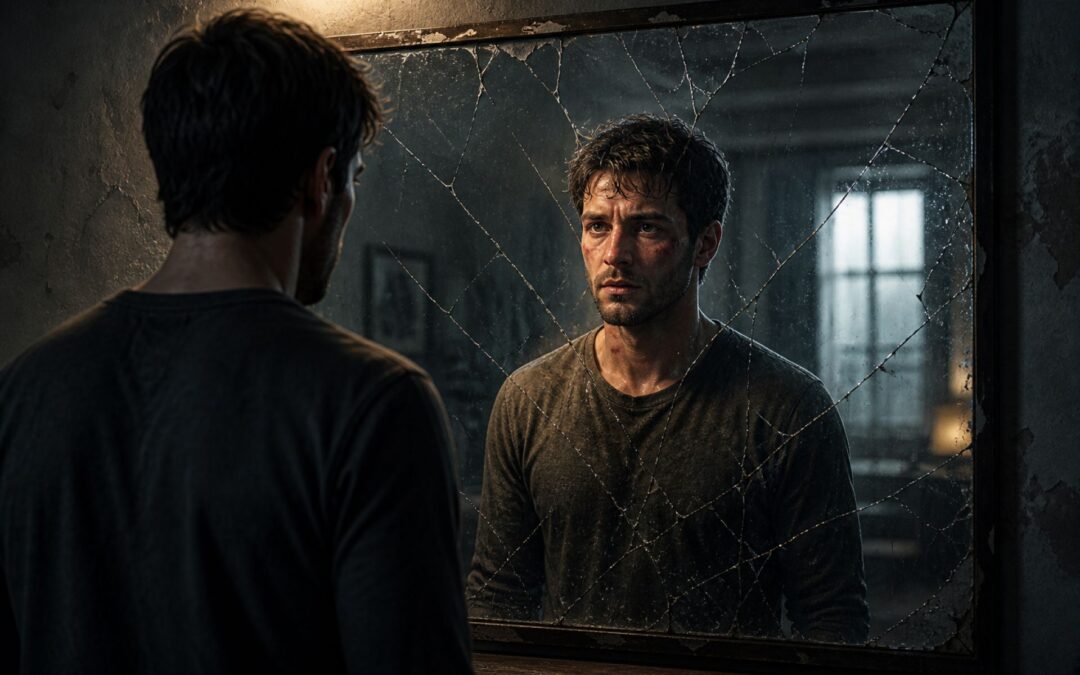
There’s a certain image that captures what radical acceptance really looks like.
Not retreating.
Not collapsing.
Not pretending everything is fine.
But standing still—fully present—and looking directly at what we would rather avoid.
This is the moment most people spend their lives postponing.
Because to face reality without distortion means giving up every layer of protection we’ve built around ourselves. No more softened narratives. No more selective memory. No more distance between us and what is actually there.
Just clarity.
And clarity can feel like standing at the edge of something vast and unsettling. An abyss, not because reality is always catastrophic, but because it strips away illusion. It leaves us with nothing to hide behind.
This is why acceptance is so often mistaken for weakness.
From the outside, it can look like someone has stopped fighting. Like they’ve given in. Like they’ve surrendered to circumstances.
But what’s actually happening is the opposite.
They’ve stopped wasting energy on resistance.
They’ve stepped out of the endless loop of avoidance and reaction. And instead of turning away, they’ve chosen to remain—steady, aware, and willing to see things as they are.
That requires a different kind of strength.
Not the loud, forceful kind.
But the quiet kind that doesn’t need to prove anything.
The kind that allows a person to hold difficult truths without immediately trying to escape them. The kind that doesn’t collapse under pressure, but also doesn’t pretend the pressure isn’t there.
It’s a posture.
A way of being.
To stand upright, internally and externally. To take a breath, even when it’s heavy. To meet reality without flinching—not because it’s easy, but because turning away would only prolong the struggle.
And something shifts in that stance.
When we stop bracing against reality, we stop fragmenting ourselves in the process. The inner conflict begins to settle. The mind, no longer divided between truth and avoidance, starts to align.
Again—not instantly, not completely.
But enough.
Enough to create stability. Enough to hold what needs to be held. Enough to move forward without constantly looking over our shoulder at what we’ve been trying to outrun.
This is what radical acceptance looks like in practice.
Not dramatic.
Not performative.
Just a quiet refusal to look away.
Conclusion
Radical acceptance doesn’t change what happened.
It changes what happens next.
As long as we refuse to acknowledge reality, we remain tied to it—arguing with it, avoiding it, trying to reshape it into something more tolerable. And in doing so, we stay stuck. Not because life has stopped moving, but because we have.
Acceptance breaks that pattern.
It brings us back into alignment with what is actually there. It removes distortion. It strips away illusion. And while that clarity can feel uncomfortable at first, it’s the only place from which real change can begin.
Because we cannot improve what we refuse to see.
We cannot heal what we deny exists.
There’s a kind of madness in trying to fix a reality that isn’t real. In acting on assumptions, narratives, or half-truths that only exist to protect us from discomfort. It leads to wasted effort, misdirected action, and a life built on unstable ground.
Radical acceptance replaces that instability with something solid.
Not certainty. Not control.
But honesty.
And from that honesty comes a different kind of strength—the ability to face life as it unfolds, without constantly needing it to be something else. The ability to take responsibility where it’s ours, and to let go where it isn’t.
It doesn’t make life easier.
But it makes it real.
And in that reality, we find something we can actually work with. Something we can shape. Something we can move forward from—not by denying the past, but by no longer being trapped inside it.
So the question isn’t whether reality is fair.
It isn’t.
The question is whether we’re willing to face it anyway.
Because the moment we do, we stop running.
And that’s where everything begins to change.