
The Quiet Avoidance of Death
“What did it matter if he existed for two or for twenty years? Happiness was the fact that he had existed.”
— Albert Camus
It’s striking how carefully we keep death at a distance.
Not consciously, of course. We don’t wake up in the morning and decide to avoid thinking about it. But if you look closely at how we live, the pattern is unmistakable. We fill our time. We distract ourselves. We chase stimulation—through entertainment, substances, work, or endless movement—anything that keeps us from slowing down long enough to face what quietly waits in the background.
Death has become a kind of cultural taboo. It sits just outside the frame of our daily awareness, acknowledged only in passing and quickly pushed aside. We talk about growth, progress, success, and becoming—but rarely about decay, endings, and disappearance. Yet both are inseparable parts of the same process.
Life is not just expansion. It is also contraction.
All around us, this duality unfolds constantly. Things grow, and things fall apart. People are born, and people die. Relationships begin, and relationships end. But we tend to emphasize only one side of this equation, as if ignoring the other might somehow make it less real.
It doesn’t.
Beneath the surface of our routines, we all carry an unspoken awareness of death. It’s subtle, often drowned out by noise, but it’s there—persistent and unavoidable. And occasionally, something breaks through. A loss. A moment. A realization that disrupts the illusion of distance we’ve carefully constructed.
When that happens, death is no longer abstract.
It becomes real.
When Death Becomes Personal
There is a moment when death stops being an idea and becomes an experience.
It no longer belongs to philosophy, religion, or distant headlines. It enters your life quietly, but with a weight that is impossible to ignore. And when it does, everything changes—not all at once, but deeply enough that you can’t return to how things felt before.
On a personal level, confronting death is unlike anything else. It doesn’t arrive with clarity or preparation. It comes with a strange mixture of disbelief and certainty. You know what is happening, yet part of you resists accepting it fully.
I remember a moment like that—standing at the edge of something final.
There were words left to say. There are always words left to say. But time doesn’t wait for clarity, and life doesn’t pause to give us the perfect moment. At some point, you realize that this is it. This is the last chance. Not in a dramatic sense, but in a quiet, irreversible way.
You say what you can.
And then you leave.
Not knowing that those were the final words you would ever exchange, but feeling it somewhere beneath the surface. A subtle, unsettling awareness that this moment carries a kind of weight that cannot be undone.
There is something profoundly unsettling about walking away like that. Knowing that the next time you think of that person, it won’t be in the present anymore. Only in memory.
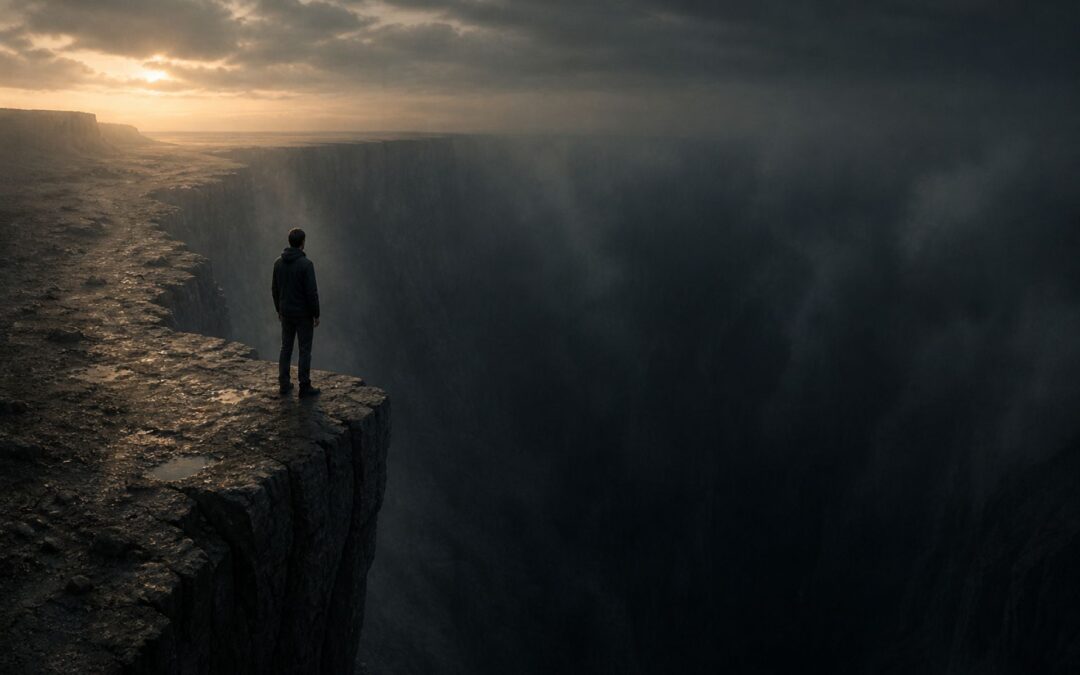
It’s almost like standing at the edge of a cliff, watching someone disappear into a space you cannot follow. There is no control. No intervention. No way to reach out and change what is happening.
Only acceptance.
And in that moment, something shifts.
The idea of death becomes real—not as a concept, but as a force. A force that takes, separates, and closes doors without asking whether you are ready.
You realize, perhaps for the first time in a visceral way, that life doesn’t stretch endlessly forward. That there are moments you cannot return to. Conversations you cannot continue. People you cannot see again.
And beneath all of that, a quieter realization begins to take shape:
One day, it will be your turn too.
Standing at the Edge of the Unknown
When death becomes real, the mind instinctively reaches for answers.
What is this, exactly? What happens next? Is there something beyond this moment of disappearance, or is it simply the end?
These questions are as old as humanity itself, and yet they remain unanswered. Not partially answered. Not incompletely answered. Truly unanswered.
And that is where the fear begins.
It’s not just death that unsettles us—it’s the uncertainty surrounding it. The complete absence of clarity. We can imagine pain, we can imagine loss, but it is far more difficult to imagine nothing. The idea of not being—of awareness dissolving into an eternal absence—is something the human mind struggles to grasp.
So we search for explanations.
Across cultures and centuries, belief systems have tried to fill this void. Religions offer structure where there is none, narratives where there is silence. In many traditions, death is not an end but a transition—into judgment, into rebirth, into another realm of existence.
In Christianity and Islam, for example, there is the idea of heaven and hell—destinations shaped by how one has lived. A moral framework that extends beyond life itself. In other traditions, like Buddhism, existence continues through cycles of rebirth, shaped by actions and consequences that stretch across lifetimes.
These perspectives do more than explain death. They soften it. They transform it from a void into a passage.
But not everyone finds comfort in these explanations.
For those without a firm belief in an afterlife, death remains what it has always been: a mystery. And perhaps an even more intimidating one. Without a narrative to hold onto, there is nothing to stand on—only the vast, undefined unknown.
And that unknown can feel like an abyss.
A kind of darkness that doesn’t threaten in a physical sense, but in a conceptual one. It challenges the very foundation of how we understand existence. Because everything we know is rooted in being. In awareness. In experience.
Death, in contrast, may be the absence of all three.
And that is what makes it so difficult to face.
Not just because we don’t know what comes after—but because we may never know.
The Permanence of Death and the Shock of Reality
At some point, beyond the questions and speculation, a more grounded realization begins to take hold.
Not about what death is, but about what it does.
From our limited human perspective, death is permanent. When someone dies, they are gone. Not temporarily absent, not waiting somewhere we can reach them—simply gone from the world we know. Their voice disappears. Their presence dissolves. Everything that once felt immediate becomes memory.
And memory is not the same thing.
This is where the true weight of death reveals itself. Not in abstract fear, but in the quiet, undeniable finality of separation. The understanding that there is no return, no continuation of unfinished conversations, no chance to revisit what was left unsaid.
It disrupts something fundamental in us.
We spend most of our lives operating under the illusion of continuity. We assume there will be more time. More opportunities. More moments to say what we mean, to fix what is broken, to show what we feel. Even when we know, intellectually, that life is finite, we don’t live as if that finiteness is immediate.
Death shatters that illusion.
Suddenly, time is no longer an open horizon. It becomes something fragile, something that can close without warning. And with that realization comes a kind of shock—not loud or chaotic, but deeply unsettling.
Because it forces us to confront a truth we’ve been avoiding:
There are moments that will never come back.
The person you lost will not return to fill the space they once occupied. The version of reality in which they existed is gone with them. What remains is a kind of silence—a presence defined by absence.
And within that silence, something else begins to emerge.
Clarity.
A clarity that doesn’t come from theory or belief, but from direct confrontation. You begin to see things differently—not because you’ve chosen to, but because you can no longer look at them the same way.
The trivial starts to feel trivial.
The things that once seemed urgent lose their intensity. Petty concerns, minor conflicts, the endless mental noise that fills our days—it all begins to fade in significance when placed next to something as absolute as death.
And in its place, a more honest perspective starts to form.
One that is harder to ignore.
The Power of Truth in Final Moments
When death draws near, something begins to surface that we usually keep buried.
Truth.
Not the kind we casually express in everyday conversations, filtered through social expectations and self-image—but a deeper, more urgent form of truth. The kind that carries emotion, weight, and a sense of finality.
It doesn’t ask for permission.
It arrives quietly at first, then insistently, as if it knows that this is the moment. The only moment. The last opportunity to be revealed. And whether we like it or not, we feel it pressing against us—everything we’ve held back, everything we’ve avoided saying, everything we’ve postponed for a “better time.”
But there is no better time.
There is only now.
In the presence of death, the illusion of infinite chances disappears. We are confronted with the reality that this may be the final exchange, the last window to express what has remained unspoken. And in that realization, something shifts within us.
The barriers begin to weaken.
Pride becomes less convincing. Fear of vulnerability loses its grip. The narratives we’ve built to justify our silence start to feel fragile, almost irrelevant. What remains is something much simpler, and much more honest: the desire to speak, to connect, to release.
For many, this release becomes a moment of profound clarity.
Words that were once difficult to say come forward with surprising ease. Emotions that were suppressed for years rise to the surface, not as chaos, but as something clean and direct. There is no longer a need to perform, to impress, or to protect an image.
Only a need to be real.
And while this moment can be intensely emotional—sometimes overwhelming—it often carries a sense of completion. Not because everything is resolved perfectly, but because something essential has been expressed.
From everyone who has experienced this kind of closure, one pattern stands out:
No one regrets it.
They may regret the time they waited. The years spent holding back. But not the act of finally speaking. Not the decision to let the truth come through when it mattered most.
Because in the face of death, truth is not just honesty.
It is release.
Why We Wait Too Long to Be Honest
If truth feels so natural in the presence of death, why does it feel so difficult in everyday life?
The answer, more often than not, is the ego.
Not in the exaggerated sense of arrogance, but in the quieter, more persistent form—the identity we construct and protect. The stories we tell ourselves about who we are, what we deserve, how others have wronged us, and why we are justified in holding back.
These stories become frameworks through which we interpret everything.
They give us a sense of control. A sense of coherence. But they also create distance—between what we feel and what we express. Between what we know is true and what we allow ourselves to say.
So we hesitate.
We wait for the right moment. The right words. The right conditions. We convince ourselves that there will be time later, that things will eventually resolve themselves, that silence is easier than confrontation.
And sometimes, it is.
But that ease comes at a cost.
Unspoken words don’t disappear. They linger. They accumulate. They shape the way we relate to others, often without us realizing it. Resentment builds quietly. Regret takes form slowly. And over time, what could have been expressed simply becomes heavier, more complicated, more difficult to release.
All because we waited.
Death, however, doesn’t negotiate with hesitation.
It doesn’t pause to accommodate our internal conflicts or our need for certainty. When it arrives, it strips away the illusion that we have endless opportunities to say what matters. And in doing so, it exposes something uncomfortable:
Much of what we hold onto isn’t as important as we think.
The pride. The need to be right. The emotional defenses we’ve built over time—they begin to lose their meaning when placed next to something as absolute as loss. What once felt justified now feels unnecessary.
And this is where the shift happens.
Because when the ego loses its grip, even momentarily, something else takes its place. Something simpler. More direct. A willingness to speak without overthinking, to act without endless hesitation.
Not because we’ve solved ourselves, but because we’ve been humbled.
In that sense, death becomes more than an ending.
It becomes a force that reveals how much we’ve been holding back—and how unnecessary that restraint often is.
Death as the Great Equalizer
When death enters a space, it has a way of rearranging everything.
Conflicts that once felt significant begin to dissolve. Long-standing resentment loses its sharpness. The emotional distance we’ve carefully maintained over time suddenly feels fragile, even unnecessary. It’s not that our reasons disappear—but their weight changes.
What once felt important no longer holds the same authority.
You see this most clearly in moments of loss. Families that haven’t spoken in years find themselves standing side by side. Old disagreements are set aside, not because they’ve been resolved intellectually, but because something deeper has taken priority.
The relationship.
Not the story built around it. Not the accumulated judgments or justifications—but the simple, undeniable fact that a connection existed. That two people shared something real, regardless of how complicated it became over time.
Death brings that into focus with brutal clarity.
It reminds us that beneath all the layers—ego, identity, pride, history—there is something more fundamental that binds us. A shared human experience. A connection that exists whether we acknowledge it or not.
And in the face of death, that connection becomes impossible to ignore.
We might spend years building walls between ourselves and others. Creating distance through narratives that feel justified in the moment. But when someone dies, those walls often collapse almost instantly. Not because we chose to dismantle them, but because they no longer make sense.
They were never as solid as we believed.
What remains is something much simpler, and much more honest:
We are human beings, connected in ways that go beyond our individual stories.
Death doesn’t create this connection—it reveals it.
And in doing so, it exposes the fragility of the divisions we place so much importance on. Differences in status, identity, background, or belief begin to fade when placed next to something as universal as mortality.
Because no matter who we are, or how we live, we all move toward the same end.
In that sense, death becomes the great equalizer.
Not as an abstract idea, but as a lived reality that strips everything down to what truly matters.
A Shared Destination
There is something unsettling, but also strangely unifying, about the fact that death is inevitable for all of us.
Not just in theory, but in absolute certainty.
No matter where we come from, what we believe, how we live, or what we achieve—every one of us is moving toward the same end. Different paths, different timelines, different circumstances, but the same destination.
And yet, we rarely live as if this is true.
We divide ourselves endlessly. Through identity, status, intelligence, beliefs, culture, success. We build entire hierarchies based on these distinctions, as if they define something essential about us. As if they determine our place in the world in any lasting sense.
But in the face of death, these distinctions begin to lose their meaning.
Not because they don’t exist, but because they don’t endure.
The distance between people—so carefully constructed in life—collapses when viewed from the perspective of mortality. What once seemed like vast differences begin to look superficial, almost arbitrary, when placed next to the one thing we all share.
We are all passing through.
There is something almost absurd about it. We arrive without understanding where we came from. We move through life constructing meaning, identity, and direction. And then, at some point, we leave—again, without knowing exactly where we are going.
It’s a journey framed by uncertainty on both ends.
And yet, within that uncertainty, there is a kind of equality that is difficult to ignore. Not imposed by society or ideology, but by the structure of existence itself.
We are on the same trajectory.
You could imagine it as a kind of shared passage—each of us moving forward, aware to different degrees, but ultimately heading toward the same unknown horizon. Some resist the thought. Others contemplate it often. But no one steps outside of it.
This realization can feel heavy at first.
But it also carries a quiet implication:
If we are all heading toward the same end, then perhaps what separates us matters less than we think. And what connects us matters more.
Living With the Awareness of Death
To truly confront death is not just to think about it—but to let it change how you live.
Not in a dramatic, life-altering way overnight, but in quieter, more subtle shifts. A recalibration of what matters. A soft but persistent awareness that time is not as abundant as it once felt.
When you carry that awareness with you, something begins to loosen.
The constant overthinking starts to lose its grip. The endless hesitation—waiting for the perfect moment, the perfect words, the perfect conditions—begins to feel unnecessary. Because you’ve seen, even briefly, that there is no guarantee those moments will ever come.
And that realization simplifies things.
You start to speak more directly. Not carelessly, but honestly. You express what you feel while there is still time for it to be heard. You act on what matters before it becomes something you wish you had done.
Not out of urgency, but out of clarity.
There is also a shift in how you relate to others. The small irritations, the minor disagreements, the things that once occupied so much mental space—they begin to fade in importance. Not because you’ve become indifferent, but because you’ve gained perspective.
You see more clearly what is worth holding onto, and what is not.
And perhaps most importantly, you begin to recognize the value of presence.
Not as an abstract idea, but as something tangible. Being with someone, fully, without distraction. Listening without preparing a response. Sharing moments without constantly thinking ahead. These things, which often seem ordinary, begin to take on a different weight when you realize they are not infinite.
They are limited.
And because they are limited, they matter.
This doesn’t mean living in constant awareness of death. That would be overwhelming, even paralyzing. But allowing it to exist somewhere in the background—quiet, steady—can bring a kind of grounding that is difficult to find elsewhere.
It reminds you, gently but consistently, that life is happening now.
And that now doesn’t repeat.
Conclusion
In the end, death doesn’t just take—it reveals.
It reveals how much we postpone, how much we suppress, how tightly we cling to things that lose their meaning the moment we are faced with something final. It strips away the illusion of endless time and replaces it with something far more honest: the reality that what we have is limited, uncertain, and fragile.
And yet, within that fragility, there is something profound.
Life does not derive its value from how long it lasts, but from the simple fact that it happens at all. Whether it spans decades or only a brief moment, existence itself carries a kind of completeness that doesn’t need to be extended to be meaningful.
We often search for guarantees—about what comes after, about whether anything endures, about whether our lives ultimately “matter” in some larger sense. But perhaps the more grounded realization is this:
It mattered that we were here.
That we experienced. That we connected. That we felt, even if imperfectly. That we existed, however briefly, within this vast and uncertain process.
We may never fully understand where we come from or where we are going. The beginning is unclear, and the end remains a mystery. But in between those two unknowns, there is something undeniable.
We live.
And no matter whether it is two years or twenty, that fact alone carries a quiet, unshakable significance.