
Why Being Physically Free Doesn’t Make You Free
When our movement is restricted, something inside us immediately reacts.
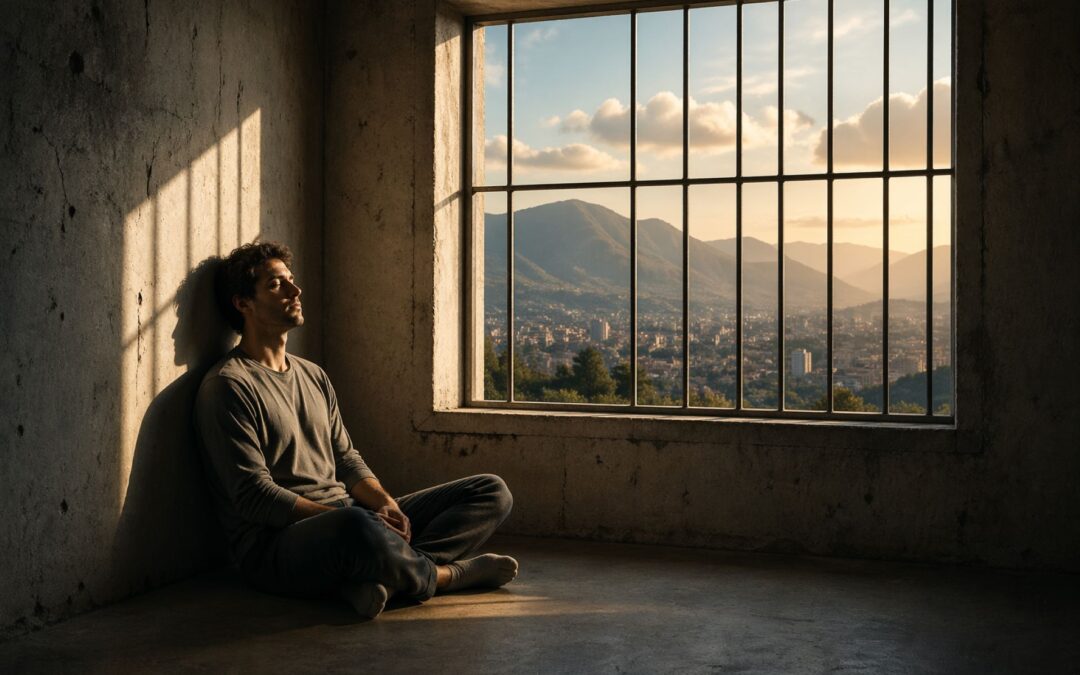
It doesn’t matter whether we are confined in a prison cell, a hospital room, or simply within the four walls of our home. The moment we realize that we cannot leave, a subtle psychological shift occurs. What was once ordinary space becomes a cage. What was once neutral time becomes something to endure. And almost instinctively, the mind begins to wander—backward into nostalgia, or forward into imagined freedom.
We start longing for things we barely appreciated before. A walk outside. A casual conversation. The ability to go somewhere without thinking about it. The restriction itself transforms the meaning of everything.
But this reaction reveals something deeper—and more uncomfortable.
If freedom were purely physical, then the absence of restriction should automatically make us feel free. Yet, that’s not how we actually live. Even when nothing is stopping us, we often feel restless, dissatisfied, or trapped in ways we can’t quite explain. We may have the ability to go anywhere, do anything within reason—and still feel confined.
So the question begins to shift.
Maybe the problem isn’t just that we are physically restricted. Maybe the real issue is that we equate freedom with movement, with options, with external conditions—without questioning whether these things ever truly guaranteed freedom in the first place.
Because if losing the ability to leave a room can disturb us this deeply, it suggests that our sense of freedom was never as stable as we thought. It was conditional. Dependent. Fragile.
And perhaps, what we call “freedom” is not something we possess—but something we are constantly negotiating with our circumstances.
Which raises a more unsettling question:
If physical freedom can be taken away so easily… was it ever real to begin with?
The Two Realms of Human Experience
To understand why physical freedom feels so unstable, we have to look at where our experience actually takes place.
At first glance, it seems obvious: life happens “out there”—in the world we see, hear, and move through. But this is only half the story. Every sight, every sound, every situation is filtered through something far more decisive: the mind.
We can think of human experience as unfolding in two distinct realms. The external world, which consists of events, circumstances, and conditions beyond our direct control. And the internal world, where these events are interpreted, judged, and given meaning.
What matters is not just what happens, but how it is processed.
Two people can be placed in the exact same situation and experience it in completely different ways. One may feel trapped, suffocated, and desperate to escape. The other may feel calm, reflective, even content. The external conditions are identical. The internal responses are not.
This is where the idea of freedom begins to fracture.
If freedom were purely external, then identical conditions should produce identical experiences. But they don’t. This means that what we call “freedom” is not simply a property of the world—it is, at least in part, a function of the mind.
Our judgments, beliefs, expectations, and desires all shape how we perceive our situation. A person who strongly desires to be elsewhere will feel imprisoned, even in a comfortable environment. Another who has little resistance to the present moment may feel a sense of ease, even in limitation.
In other words, the feeling of being trapped is not just imposed from the outside—it is constructed from the inside.
This doesn’t mean that external conditions are irrelevant. Clearly, they matter. But it does mean that they are not the whole story. The mind does not passively receive reality; it actively participates in creating the experience of it.
And if that’s true, then freedom cannot be located entirely in the outside world.
Part of it—perhaps the most important part—exists within.
Were We Ever Truly Free?
It’s tempting to imagine that, at some point in the past, human beings were truly free.
We picture early hunter-gatherers moving through vast, untouched landscapes. No governments, no borders, no laws restricting their movement. They could sleep under the open sky, wander wherever they wished, and live without the constraints of modern society. Compared to our structured lives, this image feels like pure freedom.
But look a little closer, and the illusion begins to crack.
These early humans were not free in the way we imagine. Their lives were dominated by a constant, unavoidable pressure: survival. Finding food, avoiding predators, enduring harsh climates—these were not occasional challenges, but daily realities. There was little room for rest, reflection, or self-realization. Freedom of movement existed, but it came at the cost of relentless uncertainty.
And their world, despite appearing vast, was actually quite small.
Without advanced transportation, their range was limited. Traveling too far meant entering unknown territories filled with danger—hostile tribes, unfamiliar terrain, unpredictable threats. In many ways, they were confined not by laws or walls, but by the very conditions of nature itself.
Then there is time—the ultimate constraint.
Life expectancy was short. Illness, injury, and environmental hazards could end a life abruptly. In that sense, they were not only bound by space, but also by a severe limitation of time. Their existence was compressed, fragile, and constantly at risk.
Now compare that to us.
Modern humans have achieved an unprecedented level of physical freedom. We can travel across continents in hours, communicate instantly across the globe, and even leave the planet itself. Our lives are longer, more stable, and less dominated by immediate survival concerns.
And yet, despite all of this, the feeling of being unfree persists.
Which suggests something important.
Freedom has never been absolute. It has always been shaped—and limited—by the conditions of existence. The form of the constraints may change, but the constraints themselves never disappear.
So perhaps the idea that we “lost” our freedom over time is misleading.
Maybe we were never truly free to begin with.
The Invisible Chains of Existence
Even if we set aside history and look only at our present condition, a deeper limitation becomes impossible to ignore.
There are aspects of our existence that we never chose—and never could.
We did not choose to be born. We did not choose where we were born, into which family, under what conditions. Wealth or poverty, health or illness, stability or chaos—these are not decisions we made. They were given to us, imposed before we had any say in the matter.
This is what Jean-Paul Sartre meant when he said that we are “thrown” into the world.
We arrive without consent, already entangled in a situation we did not design. And from that point onward, we remain bound to certain fundamental realities. We cannot escape time. We cannot avoid death. We cannot fully control the events that shape our lives.
Albert Camus takes this even further.
In his view, the universe is indifferent—completely unconcerned with our desires, our hopes, or our search for meaning. Life unfolds according to forces beyond our control, often in ways that feel arbitrary or even unjust. We can make plans, set goals, and strive for outcomes, but the final result is never entirely ours to decide.
Something can always intervene. Something always does.
From this perspective, the idea of total freedom begins to look like an illusion. We are constrained not only by society or circumstance, but by existence itself. There are boundaries we cannot cross, no matter how advanced or capable we become.
And this leads to a disturbing conclusion.
If we have no control over the most fundamental aspects of our lives—our origin, our limitations, our inevitable end—then in what sense can we call ourselves free?
At best, our freedom appears partial. Conditional. Circumscribed by forces that operate far beyond our reach.
Which means that even in a world where nothing seems to be physically restricting us, we are still, in a very real sense, confined.
Sisyphus and the Human Condition
To make sense of this strange mix of effort and limitation, Albert Camus turns to a figure from Greek mythology: Sisyphus.
Sisyphus was condemned by the gods to an eternal punishment. His task was simple, yet merciless: push a massive boulder up a hill. Each time he neared the top, the rock would slip from his grasp and roll all the way back down. And he would have to start again. Forever.
No progress. No completion. No escape.
At first glance, this seems like a story about futility. A cruel, meaningless repetition designed to break the spirit. But Camus saw something deeper in it—something unsettlingly familiar.
Because in many ways, Sisyphus resembles us.
We wake up, work, strive, pursue goals, solve problems—only to wake up the next day and begin again. We build routines, chase achievements, and attempt to impose order on our lives, yet nothing we do is ever truly final. Tasks return. Problems reappear. Even our greatest accomplishments eventually fade or lose their significance.
There is always another hill. Another push. Another cycle.
In this sense, we are not imprisoned by walls, but by repetition. By the structure of existence itself.
And just like Sisyphus, we cannot step outside of it.
We don’t get to opt out of the human condition. We cannot pause life indefinitely or escape its demands. Even in moments of rest, the cycle waits. Time continues. The boulder remains.
This is where the feeling of being “trapped” takes on a deeper meaning.
It is no longer about being confined to a place, but about being bound to a pattern. A structure that continues regardless of our preferences. A task that never fully resolves.
So the question becomes unavoidable:
If our condition resembles that of Sisyphus—endless effort within fixed limits—then what would it even mean to be free?
Determinism and the Paradox of Acceptance
One way people have tried to make sense of this condition is through the idea of determinism.
Across various religious and philosophical traditions, there is a recurring claim: everything that happens is already set in motion. Whether by divine will, cosmic order, or an unbroken chain of cause and effect, the course of our lives is not something we freely create—it is something that unfolds.
In its strongest form, determinism leaves no room for free will at all.
Every choice we make, every thought we have, every action we take—these too are part of the same unfolding. We may feel like we are choosing, but even that feeling is just another piece of the system.
At first, this seems like the ultimate loss of freedom.
If everything is predetermined, then what is left for us? No control over outcomes, no authorship over our lives, no real agency. It reduces the human being to something like a participant in a script already written.
But here’s where the paradox emerges.
The very acceptance of this idea can create a surprising sense of freedom.
When we stop resisting what happens—when we no longer insist that reality should be different from what it is—something shifts internally. The tension between expectation and reality begins to dissolve. The constant friction, the quiet frustration of wanting things to be otherwise, starts to fade.
Nothing external has changed.
And yet, the experience feels lighter.
This doesn’t mean that we suddenly gain control over our circumstances. It means that we loosen our grip on the illusion of control. Instead of fighting reality, we align with it. Instead of demanding certainty, we allow things to unfold.
In a strange way, this surrender becomes liberating.
Because much of what makes us feel trapped is not the situation itself, but our resistance to it. The insistence that things should be different. The refusal to accept what is already here.
Of course, a strict determinist would argue that even this “acceptance” is predetermined—that we don’t actually choose to let go. And maybe that’s true.
But from the perspective of lived experience, it doesn’t matter.
What matters is that when resistance fades, the feeling of confinement often fades with it. And in that space, something that resembles freedom begins to appear—not as control over the world, but as a release from the need to control it.
The Last Domain of Freedom: The Mind
If so much of life lies outside our control, then whatever freedom we have must exist somewhere else.
This is precisely where Epictetus directs our attention.
According to him, there is a fundamental distinction we fail to recognize: some things are within our control, and others are not. We do not control our body entirely, our reputation, our possessions, or the events that happen to us. These are all subject to forces beyond us.
But there is one domain that remains, at least in principle, ours.
Our judgments. Our desires. Our aversions.
In other words, the way we relate to what happens.
This might seem like a small concession. After all, what good is control over your inner life if the outer world can still impose anything upon you?
But look closely at how we actually suffer.
We rarely suffer simply because of what is happening. We suffer because we want something else. Because we believe things should be different. Because we cling to an image of how life ought to be—and feel frustrated when reality refuses to match it.
Desire pulls us toward what is absent. Aversion pushes us away from what is present. Between the two, the mind is constantly somewhere else—either chasing the future or resisting the now.
And in that movement, we create our own sense of imprisonment.
Even in a physically open world, a mind filled with restless desire can feel confined. Always lacking, always unsatisfied, always waiting for something better.
But if desire and aversion are within our sphere of influence, then something changes.
We may not be able to leave the room. But we can stop insisting that we must leave. We may not control the situation, but we can question the demand that the situation be different.
This is where a different kind of freedom begins to emerge.
Not the freedom to do whatever we want, but the freedom to not be psychologically dominated by what we cannot have.
It’s a subtle shift, but a powerful one.
Because when the mind no longer depends on external conditions to feel at ease, the grip of those conditions weakens. And what once felt like confinement begins to lose its psychological force.
What Buddhism Gets Right About Freedom
If Stoicism points us toward control over our inner responses, Buddhism goes a step further and questions the very structure of desire itself.
Instead of asking how we can better manage our cravings, it asks a more radical question: what if craving is the root of the problem?
In many Buddhist traditions, suffering is not primarily caused by external conditions, but by attachment—our persistent tendency to want things to be other than they are. We cling to pleasure, resist discomfort, and constantly project ourselves into a different reality than the one we inhabit.
And in doing so, we trap ourselves.
What’s interesting is how this insight is lived out.
Buddhist monks don’t accidentally find themselves in isolation—they choose it. They withdraw from the noise, the stimulation, and the endless pursuit of external satisfaction. In some cases, they even confine themselves to small spaces for long periods of time, not as punishment, but as practice.
From the outside, this looks like restriction.
From the inside, it can feel like expansion.
Because when the constant pull of desire begins to quiet down, something unexpected happens. The need to be elsewhere fades. The urgency to change the moment dissolves. What remains is a kind of stillness that is not dependent on circumstances.
This is a very different kind of freedom.
Not the freedom to move endlessly through the world, but the freedom from needing to. Not the freedom to acquire more, but the freedom from feeling incomplete without it.
In this sense, the Buddhist approach does not try to escape limitation—it transforms the relationship to it.
Solitude is no longer loneliness. Stillness is no longer boredom. Confinement is no longer a problem to solve, but a condition to understand.
And when the mind stops demanding that reality be different, the experience of being trapped begins to dissolve—not because the walls disappear, but because the need to escape them does.
Camus’ Radical Idea of Freedom
If Stoicism teaches control and Buddhism teaches release, Albert Camus offers something far more defiant.
He doesn’t ask us to transcend the human condition. He doesn’t promise peace through acceptance alone. Instead, he confronts the absurdity of existence head-on—and then asks us to rebel against it.
For Camus, life has no inherent meaning. The universe is indifferent, and our search for purpose meets only silence. This clash between our desire for meaning and the world’s indifference is what he calls the absurd.
And yet, he rejects both despair and escape.
He dismisses the idea of suicide as a solution. Not because life is secretly meaningful, but because ending it avoids the confrontation. It refuses to fully face the absurd condition we are in.
So what remains?
Revolt.
Not a physical rebellion against the world, but a psychological one. A refusal to be crushed by the meaninglessness of it all. A decision to live despite the absurd, not in denial of it.
This is where his idea of freedom emerges.
Freedom is not found in changing our circumstances, nor in escaping them. It is found in how we stand in relation to them. In our attitude toward the very condition that limits us.
Camus pushes this to a radical conclusion.
Instead of hoping for a better future, we let go of hope altogether. Instead of seeking ultimate answers, we accept that none are coming. Instead of trying to resolve the tension, we live within it—fully, consciously, and without illusion.
This doesn’t make life easier.
But it makes it ours.
Because when we stop waiting for meaning, stop relying on outcomes, and stop expecting life to conform to our desires, something shifts. We are no longer passively shaped by circumstances. We actively engage with them, even when they are indifferent or hostile.
This is not resignation.
It is defiance.
To live intensely in the present moment, without appeal, without escape, without illusion—that is Camus’ version of freedom.
A freedom that doesn’t depend on what happens, but on how we respond to the fact that it happens at all.
The Ultimate Act of Rebellion
If we follow this line of thought to its natural conclusion, something unexpected begins to emerge.
Freedom is not about escaping the conditions that confine us. It is not about waiting for better circumstances, or hoping that one day we will finally be able to live the way we want.
It is about something far more unsettling—and far more powerful.
It is about refusing to let those conditions dictate our inner state.
When we are locked in a situation we don’t like, there is an unspoken script we are expected to follow. We are supposed to feel frustrated. We are supposed to resist. We are supposed to count the days until it ends.
And most of the time, we do.
But what if we didn’t?
What if, instead of resisting the situation, we disrupted the pattern entirely? What if we stopped treating the condition as a problem to endure—and began engaging with it as something to experience?
This is where rebellion takes on a completely different meaning.
Not rebellion as outward resistance, but as inward independence.
To enjoy what is supposed to be a punishment is to break the logic of the system. It removes the power that the situation has over us. Because the situation only feels like a prison as long as we are psychologically opposed to it.
The moment that opposition fades, the structure begins to collapse—not externally, but internally.
This doesn’t mean that the walls disappear. It means that they stop defining the experience.
And that is deeply subversive.
Because systems of control—whether physical or social—often rely not just on restriction, but on predictable reactions. They assume that confinement will produce frustration, that limitation will produce suffering.
When that expectation is broken, something shifts.
If a person can find moments of contentment, curiosity, or even joy within restriction, then the restriction loses its psychological authority. It no longer fully determines the experience.
This is not passive acceptance.
It is a form of quiet defiance.
A refusal to be internally shaped by external conditions. A refusal to let the situation dictate the meaning of the experience.
And in that refusal, a different kind of freedom reveals itself.
Not the freedom to leave—but the freedom to remain, without feeling trapped.
Not the freedom to change the world—but the freedom to not be reduced by it.
Which raises a final, almost provocative thought:
If you can genuinely enjoy what is meant to confine you… isn’t that the ultimate act of rebellion?
Freedom Is a Matter of Perspective
At this point, it’s important to make a distinction—because this idea can easily be misunderstood.
To say that freedom is internal is not to say that external conditions don’t matter. It’s not a justification for injustice, nor an argument for passive acceptance of everything that happens. Physical freedom, autonomy, and the ability to act in the world are deeply important—and often worth fighting for.
But that is a different dimension of the problem.
What we are dealing with here is not political freedom, but experienced freedom. The way a situation feels from the inside. And in that domain, perspective plays a decisive role.
Two people can be placed under the same restriction—one feels imprisoned, the other finds a strange sense of peace. One counts the days, the other explores the moment. One resists, the other adapts.
The difference is not in the walls around them, but in the way those walls are interpreted.
This doesn’t mean that perspective is easy to change. It isn’t. Our reactions are often deeply ingrained, shaped by habit, culture, and instinct. The impulse to resist discomfort, to seek escape, to want things to be different—it runs deep.
But the fact that it can be changed, even slightly, opens up a space of possibility.
It means that we are not entirely at the mercy of our circumstances.
Even within limitation, there is room for variation in how we respond. A narrow space, perhaps—but a real one. And within that space lies the kind of freedom that no external force can completely remove.
The freedom to reinterpret.
The freedom to disengage from resistance.
The freedom to meet the present moment without demanding that it be something else.
This doesn’t make confinement pleasant.
But it makes it different.
And sometimes, that difference is enough to transform the experience entirely.
Conclusion
Freedom, as we usually imagine it, is fragile.
It depends on circumstances lining up in our favor. It relies on access, movement, choice, and the absence of restriction. And as we’ve seen, all of these can be taken away—or were never fully ours to begin with.
But there is another kind of freedom. Quieter. Less obvious. And far more resilient.
A freedom that does not come from controlling the world, but from no longer being psychologically controlled by it.
From Epictetus, we learn that our judgments and desires shape our experience. From Buddhist thought, we see how craving creates the very suffering we try to escape. And from Albert Camus, we encounter the bold idea that even in an indifferent, absurd world, we can choose to stand in defiance—not by escaping it, but by fully inhabiting it.
The walls may remain. The conditions may not change. Life may continue to impose limits we cannot control.
And yet, something within us can shift.
When we stop demanding that reality be different, when we loosen our grip on what we cannot have, and when we engage with the present moment without resistance, the experience of being trapped begins to dissolve.
Not completely. Not permanently. But enough to matter.
Because in that shift, we reclaim a part of ourselves that circumstances cannot fully take away.
And perhaps that is what Camus meant when he said that the only way to deal with an unfree world is to become so absolutely free that your very existence becomes an act of rebellion.
Not by breaking the walls.
But by no longer needing them to disappear.