
The Philosopher Who Refused to Comfort You
There are philosophers who try to make life easier to bear. They soften reality, reinterpret suffering, or offer frameworks that make the chaos of existence feel meaningful, even beautiful.
Epictetus did none of that.
He didn’t comfort. He confronted.
If you came to him broken—betrayed, humiliated, stripped of everything you thought was yours—he wouldn’t reassure you that life was unfair or that your pain was justified. He would tell you, bluntly, that your suffering was rooted in a mistake. Not the mistake of others, but your own: you had mistaken what was never truly yours for something you could keep.
This is what makes Epictetus both powerful and dangerous.
Powerful, because his philosophy offers something rare—freedom that cannot be taken away. A kind of inner stability that survives loss, betrayal, and even injustice. If you truly understand his message, no person, no event, no twist of fate can fundamentally disturb you.
Dangerous, because the price of that freedom is far steeper than it first appears.
Epictetus asks you to give up more than your illusions. He asks you to give up your claims. Your sense of ownership over the things you love. Your belief that life should unfold in a way that feels fair. Your instinct to protest when something deeply personal is taken from you.
Most people don’t realize how radical this is until they try to apply it.
It’s easy to nod along with Stoic ideas in the abstract. Yes, of course, we shouldn’t get attached to things beyond our control. Yes, of course, external events don’t define us. These ideas feel reasonable—almost obvious—when life is stable.
But philosophy only reveals its true nature when it collides with reality.
When your life falls apart.
When someone you trusted betrays you.
When everything you built slips out of your hands—and there is nothing you can do to stop it.
That’s where Epictetus stops sounding wise and starts sounding unsettling.
Because in those moments, he doesn’t change his message. He sharpens it.
He doesn’t say, “This is tragic.”
He says, “This was never yours.”
And suddenly, Stoicism is no longer just a philosophy of resilience.
It becomes a question:
What does it actually mean to be free, if freedom requires you to let go of everything you thought made life worth holding onto?
The Core of Stoicism: What Is and Isn’t in Your Control
At the heart of Epictetus’ philosophy lies a distinction so simple that it almost feels trivial—and yet, it changes everything.
Some things are within your control.
Some things are not.
That’s it. That’s the foundation.
But the simplicity is deceptive. Because once you begin to take this idea seriously, it starts cutting through your life with surgical precision.
According to Epictetus, what’s truly within your control is surprisingly limited. Your judgments, your choices, your responses—these belong to you. Your ability to interpret events, to decide how to act, to shape your inner world—this is your domain.
Everything else? Not yours.
Not your reputation.
Not your wealth.
Not your relationships.
Not your body.
Not even how others treat you.
These things may feel deeply personal, but from the Stoic perspective, they are external. They exist outside your control, which means they are fundamentally unstable. They can change, disappear, or be taken from you at any moment.
And if your sense of happiness depends on them, then your happiness is fragile by design.
This is where Epictetus becomes uncompromising.
Most people draw the line somewhere. They might accept that money is uncertain, that status comes and goes. But relationships? Family? Love? Surely these must count as “ours” in some meaningful sense.
Epictetus refuses that exception.
To him, treating anything external as truly yours is the root of suffering. Not because those things are bad—but because you are placing your emotional stability in something you cannot control. You are, in effect, building your life on borrowed ground.
And sooner or later, the ground shifts.
This is why Stoicism doesn’t just advise detachment—it demands it. Not a cold indifference, but a clear understanding: everything external is temporary, conditional, and ultimately not up to you.
If you accept this fully, something remarkable happens.
You become untouchable.
Insults lose their sting. Losses lose their power to destroy you. Even major upheavals—financial ruin, betrayal, exile—cannot fundamentally shake you, because you no longer rely on external conditions for your sense of self.
This is Stoic freedom.
But there’s a catch.
The same insight that protects you from suffering also forces you to reinterpret everything you care about. Love becomes something you experience without ownership. Success becomes something you engage with without attachment. Even justice—something we instinctively cling to—becomes uncertain, because its outcomes are not within your control.
And this is where the theory begins to strain.
Because while the Stoic distinction is logically consistent, applying it to real life raises uncomfortable questions. If nothing external is truly yours, then what does it mean to lose something? What does it mean to be wronged? What does it mean to fight for anything at all?
These questions don’t remain abstract for long.
Sooner or later, they become personal.
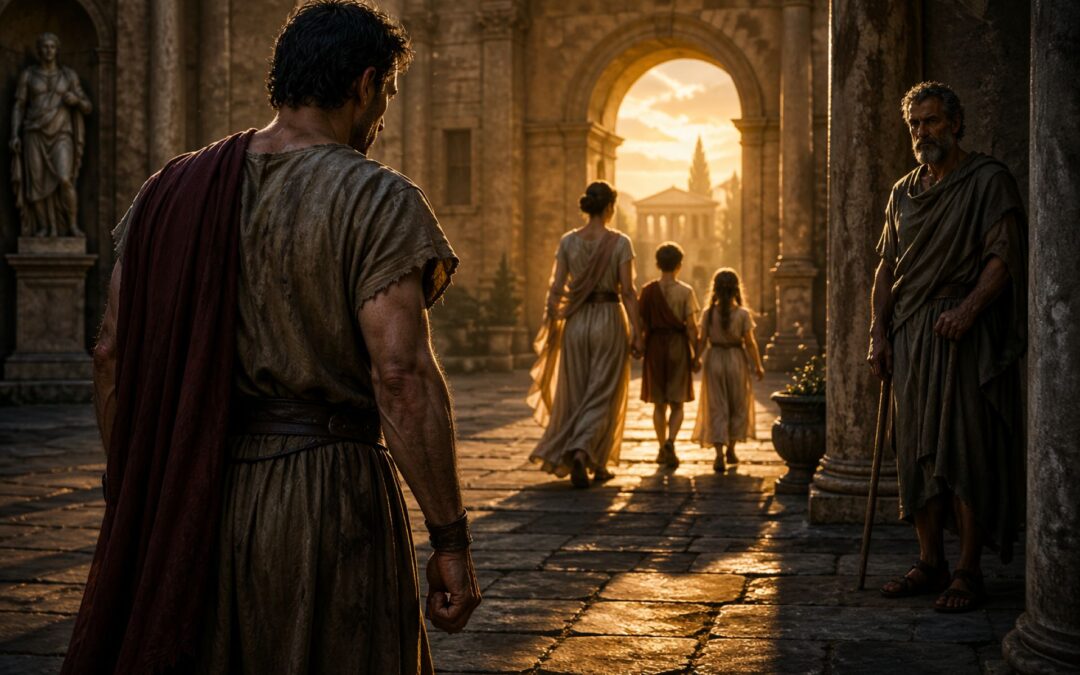
When Philosophy Meets Reality: The Case of Titus
It’s one thing to understand Stoicism as an idea. It’s another to live it when your life begins to unravel.
Titus is not a philosopher. He is not searching for truth or inner peace. He is simply trying to survive what feels like the collapse of everything that once gave his life structure.
Once, his life made sense. He had status, stability, a family. A wife he loved, children who carried his name, and a future that seemed predictable in the way people quietly assume it will be.
Then, piece by piece, it disappeared.
His father dies, and with him, the foundation of the family’s wealth. The estate begins to fracture, capital vanishes, and the security Titus once took for granted slips out of his hands. What remains is just enough to get by—a shadow of what used to be.
Before he can adjust, something far worse happens.
His wife leaves him.
Not quietly, not ambiguously—but decisively. She aligns herself with a man who represents everything Titus now lacks: power, influence, and money. And because that man possesses all three, he doesn’t just take her—he takes Titus’ children as well.
Legally. Publicly. Irreversibly.
Titus fights back in the only way he knows how. He seeks justice. He consults advisors. He tries to use the system to reclaim what he has lost.
But the system is already bought.
Every path leads to the same conclusion: unless he can outspend corruption itself, he has no chance. His opponent has insulated himself with influence and bribery. The outcome is decided before the fight even begins.
This is the moment where philosophy becomes unavoidable.
Not because Titus seeks wisdom, but because he runs out of options.
When action fails, when justice is inaccessible, when resistance becomes futile—what remains? What do you do when there is nothing left to do?
This is when he turns, reluctantly, to Epictetus.
Not out of admiration, but out of desperation.
He doesn’t go to learn about virtue or the nature of reality. He goes because he has been stripped of everything that once anchored him, and he needs some way—any way—to move forward.
And this is precisely the kind of person Epictetus speaks to.
Not the comfortable thinker.
Not the curious observer.
But the one who has lost control—and knows it.
Because Stoicism is not truly tested in moments of calm.
It is tested when life corners you, when every external solution disappears, and the only remaining question is internal:
If you can’t change what’s happening… how are you going to live with it?
Epictetus’ Answer: You Never Owned Anything
When Titus finally stands before Epictetus, he doesn’t expect kindness. But he does expect something resembling understanding.
What he gets instead is something far more unsettling.
He tells his story—haltingly, emotionally, trying to make sense of it even as he speaks. The loss of wealth. The betrayal. The humiliation. The quiet, unbearable reality of his children being taken from him.
And before he can even finish, Epictetus interrupts.
Not to clarify. Not to sympathize.
To correct.
Why are you upset over things that were never yours?
It’s a question that sounds almost absurd on the surface. Of course they were his. His wife, his children, his home, his reputation—these weren’t abstract possessions. They were his life.
But Epictetus dismantles that assumption without hesitation.
Nothing external belongs to you, he insists. Not in any permanent or reliable sense. Everything you hold dear—people, status, even your physical body—is given to you temporarily. On loan. And like all loans, it can be taken back without warning.
This is not a tragedy. This is the nature of reality.
To Epictetus, Titus’ suffering doesn’t come from loss itself. It comes from a false belief: that what he had was ever truly his to begin with.
If you believe something is yours, you cling to it. You depend on it. You build your sense of self around it. And when it disappears, it feels like something has been ripped out of you.
But if you understand that it was never yours—only entrusted to you for a time—then its loss doesn’t destroy you. It becomes something else.
An event.
This is the core of Stoic detachment, pushed to its most radical conclusion.
Your wife leaves? That’s not your loss—because she was never your possession.
Your children are taken? Painful, yes—but not a violation of ownership.
Your reputation is destroyed? That belongs to others anyway.
Even your body, Epictetus reminds his listeners, is not fully within your control. It can fail, weaken, or be taken from you entirely.
So what is yours?
Only your response.
Only your judgment about what happens.
Only the way you choose to interpret and endure the unfolding of events.
This is where Stoicism draws its line with absolute clarity: everything external is unstable, unreliable, and ultimately not yours. The only thing that cannot be taken from you is your inner faculty—your ability to choose how you engage with reality.
On paper, this is liberating.
If nothing external defines you, then nothing external can truly harm you. Loss becomes survivable. Injustice becomes tolerable. Even suffering becomes something you can step back from, rather than something that consumes you.
But standing there, in that crowded hall, Titus doesn’t feel liberated.
He feels something else entirely.
Because what Epictetus is offering him is not comfort—it’s a complete redefinition of his pain.
And not everyone is ready to accept that what hurts the most… was never theirs at all.
The Breaking Point: When Acceptance Feels Like Injustice
There is a moment when philosophy stops feeling like guidance and starts feeling like accusation.
Titus reaches that moment quickly.
Up until now, he has listened. Even if reluctantly, even if with confusion, he has tried to follow the logic. Maybe Epictetus is right. Maybe attachment is the problem. Maybe suffering comes from expecting permanence in a world that offers none.
But then something shifts.
Because what Epictetus is really saying begins to settle in—not just intellectually, but emotionally.
You are not a victim.
You are suffering because you are mistaken.
And that is where the tension becomes unbearable.
Titus doesn’t see a philosophical truth in this. He sees a reversal of responsibility. His wife betrayed him. Another man used wealth and influence to take his children. Lies were spread. His reputation was ruined. These are not abstract events. They are actions, taken by people, with consequences.
And yet, none of that seems to matter within the Stoic framework.
Because from Epictetus’ perspective, the external causes are irrelevant. What matters is Titus’ response. His distress is not proof that something unjust happened—it is proof that he is attached to things he should not depend on.
This is the breaking point.
Because it feels like something essential is being denied.
The instinct to call something wrong.
The human reaction to injustice is not neutral. It is not detached. It rises up as anger, as resistance, as a refusal to accept what feels deeply unacceptable. And this reaction is not just emotional—it is moral. It carries the sense that something should not have happened the way it did.
But Stoicism strips that away.
It doesn’t deny that events occur. It doesn’t deny that people act poorly. But it refuses to grant those events the power to disturb you. It refuses to let injustice define your inner state.
And in doing so, it creates a disturbing implication:
If you are suffering, the problem is not what happened. The problem is how you are interpreting it.
For someone like Titus, this doesn’t feel like empowerment. It feels like isolation.
Because if his pain is his own fault, then there is no one left to hold accountable. No one left to blame. No external wrong to fight against—only an internal error to correct.
The world becomes something you endure, not something you confront.
And this is where Stoicism begins to feel less like a philosophy of strength and more like a philosophy of surrender.
Not surrender to events—that part is clear. But surrender of protest. Surrender of outrage. Surrender of the deeply human need to say: this should not have happened.
Titus doesn’t articulate all of this in neat philosophical terms.
But he feels it.
In the tightening of his chest.
In the resistance rising against Epictetus’ words.
In the quiet but persistent thought that refuses to go away:
If this is freedom… why does it feel so much like giving up?
The Hidden Cost of Stoic Freedom
If Epictetus is right, then the promise of Stoicism is extraordinary.
A life where nothing can truly disturb you.
A mind that remains steady regardless of loss, betrayal, or chaos.
A kind of inner independence so complete that even fate loses its grip on you.
It is, in many ways, the ultimate form of freedom.
But like all radical ideas, it carries a cost that isn’t immediately visible.
Because to reach that level of freedom, you don’t just remove pain—you also begin to remove the very conditions that make certain experiences meaningful in the first place.
Take love.
In the Stoic framework, you are allowed to love—but not to cling. You can care deeply for another person, but you must always hold a quiet awareness that they are not yours, that they can leave, change, or be taken at any moment. Your emotional stability cannot depend on them.
This sounds wise. Even healthy.
But taken seriously, it transforms the nature of love itself.
Because part of what makes love feel intense, irreplaceable, and alive is precisely the vulnerability it creates. The risk. The sense that losing this person would matter in a way nothing else could. If you remove that vulnerability—if you train yourself to remain undisturbed no matter what happens—what exactly remains of that depth?
The same tension appears everywhere.
Ambition becomes something you pursue without needing success.
Friendship becomes something you value without depending on it.
Even joy becomes something you experience lightly, without attachment.
In theory, this protects you.
In practice, it raises an uncomfortable question:
Are you still fully participating in life, or are you observing it from a distance?
Because Stoicism doesn’t just reduce suffering—it changes your relationship to everything that creates emotional intensity. It asks you to step back, to see events as temporary, to loosen your grip on outcomes.
And over time, that distance can begin to feel like a kind of separation.
You are no longer at the mercy of the world—but you are also no longer fully immersed in it.
This is the paradox at the center of Stoic freedom.
The more you free yourself from dependence on external things, the less those things can define or destabilize you. But at the same time, the less power they have to move you deeply at all.
Life becomes calmer.
But also quieter.
Less painful.
But perhaps less vivid.
For someone like Titus, this isn’t an abstract trade-off. It’s immediate.
Because what he has lost is not just comfort—it’s meaning. His family, his role, his identity. These weren’t just external attachments; they were the structure of his life.
And now he is being told to see them as things that were never truly his.
To let go.
To remain undisturbed.
To find peace not by reclaiming what he lost, but by redefining its importance entirely.
It’s a powerful idea.
But it leaves behind a lingering doubt:
If nothing external is allowed to matter too much… what exactly is left that matters enough?
The Voice of Doubt: Should We Accept Everything?
Just when Stoicism begins to feel airtight—logically consistent, internally stable, almost unassailable—another voice enters the picture.
Not louder. Not more authoritative.
But more unsettling.
It doesn’t reject Stoicism outright. It doesn’t mock Epictetus or dismiss his ideas. Instead, it asks a quieter, more dangerous question:
What if he’s right… but not completely?
This voice doesn’t argue against the fact that many things are beyond our control. That much is undeniable. Wealth can disappear. People can leave. Circumstances can shift without warning. On that level, Stoicism feels grounded in reality.
But it pushes further.
Are the things beyond our control merely obstacles to endure—or are they the very substance of life itself?
Because when you look closely, the moments people cherish most rarely come from what they control. They come from what happens to them.
A walk with someone you love.
A shared laugh that wasn’t planned.
A sudden feeling of belonging, meaning, or beauty.
None of these are fully within your control. They arise, unpredictably, from the world outside you.
And yet, they are precisely what make life feel worth living.
This is where the critique begins to take shape.
If you train yourself to detach from everything external—to treat it as temporary, conditional, not truly yours—are you protecting yourself from suffering… or are you quietly stepping away from the very things that give life its richness?
The Stoic answer is clear: you can still enjoy these things, but without depending on them.
But the voice of doubt isn’t satisfied with that.
Because enjoyment without dependence is not the same as full engagement.
There is a difference between appreciating something and being deeply invested in it. Between experiencing something and being changed by it. Between observing life and being caught up in it.
And that difference matters.
The more you internalize Stoic detachment, the more you begin to filter your experiences. You remind yourself not to get too attached. Not to expect too much. Not to let external events shape your inner state too deeply.
Over time, this creates a subtle shift.
You are no longer just living—you are managing your reactions to living.
And while this brings stability, it can also create a sense of distance. A layer between you and the world, where everything is slightly muted, slightly less immediate.
This is the tension the unknown man in the courtyard hints at.
He doesn’t deny that Stoicism leads to peace. But he questions whether peace, in this form, comes at the expense of something equally important: intensity, spontaneity, and the willingness to be affected by life.
Because to fully live might require something Stoicism tries to eliminate—
The willingness to risk being shaken.
To care about things you cannot control.
To feel anger when something is unjust.
To grieve deeply when something is lost.
Not as a failure of reason, but as an expression of being human.
And so the question remains, hanging quietly beneath everything Epictetus teaches:
Is the goal of life to remain undisturbed… or to be fully alive, even if that means being vulnerable to disturbance?
Between Control and Chaos: Is There a Middle Path?
By now, the tension is clear.
On one side stands Epictetus, offering a form of freedom that is clean, stable, and unbreakable. A life where nothing external has the power to disturb you, because you have withdrawn your dependence from everything you cannot control.
On the other side stands something far less defined, but deeply familiar—the instinct to care, to resist, to be affected. The part of us that refuses to treat love, loss, and injustice as mere events to be interpreted correctly.
It would be easy to choose one over the other.
To fully embrace Stoicism and detach from everything unstable.
Or to reject it entirely and surrender to the full intensity of human experience, with all its chaos and vulnerability.
But both extremes carry their own limitations.
Complete detachment risks turning life into something distant—controlled, but muted. You are safe from devastation, but also removed from the very forces that make life feel vivid and meaningful.
Complete immersion, on the other hand, leaves you exposed. You care deeply, you engage fully, but you also become vulnerable to everything you cannot control. Loss doesn’t just hurt—it can break you.
So the question becomes less about choosing a side, and more about whether a balance is possible.
A way of living that acknowledges the truth of Stoicism without surrendering entirely to it.
This middle path wouldn’t reject Epictetus—it would refine him.
You recognize that many things are beyond your control. You accept that attachment creates vulnerability. You understand that building your entire sense of self on external conditions is unstable.
But you don’t go as far as stripping those things of their significance.
You allow yourself to care—fully—but consciously.
You love, knowing that loss is possible.
You pursue, knowing that failure is likely.
You stand against injustice, even if the outcome is uncertain.
Not because you believe you can control the result, but because the act itself matters.
In this sense, control is no longer the sole measure of what deserves your attention.
Meaning becomes equally important.
You may not control whether your relationships last, but that doesn’t make them disposable. You may not control how others treat you, but that doesn’t make injustice irrelevant. You may not control the outcome of your efforts, but that doesn’t make striving pointless.
This approach doesn’t eliminate suffering.
But it changes your relationship to it.
Instead of trying to avoid all disturbance, you become more selective about what you allow to disturb you. You accept that some things are worth the risk. That some forms of pain are not failures of philosophy, but consequences of living a life that is engaged rather than withdrawn.
For Titus, this possibility lingers quietly in the background.
He has seen what Stoicism offers: clarity, structure, a way to survive loss without collapsing under it.
But he has also felt its limits.
The idea that everything he lost was never truly his may protect him from despair—but it also threatens to erase the very meaning those things held.
And somewhere between those two realizations, a different question begins to form.
Not how to avoid suffering entirely.
But how to live in a way where both freedom and meaning can coexist—without one canceling out the other.
Conclusion
Epictetus offers something few philosophies dare to promise: a form of freedom that cannot be taken away.
Not because life becomes easier, fairer, or more predictable—but because you stop depending on it to be any of those things.
If you accept his teaching fully, you become unshakable. Loss no longer defines you. Injustice no longer consumes you. The world can change in any direction, and you remain intact, grounded in something that cannot be touched.
It is a powerful vision.
But it is not without consequence.
Because the same detachment that protects you from suffering also changes your relationship to everything that once mattered. Love becomes lighter. Loss becomes less devastating—but also less significant. The sharp edges of life are smoothed out, but so are its extremes.
And that leaves us with an uncomfortable truth.
Freedom, in the Stoic sense, is not just about gaining control over your inner world. It is also about letting go of your claim over the outer one.
For some, that trade-off is worth it.
For others, it feels like too high a price.
The story of Titus doesn’t resolve this tension. It exposes it. It forces us to confront what Stoicism actually demands when applied to real life—not as an idea, but as a way of being.
And perhaps that is where the real value lies.
Not in choosing between Stoicism and its rejection, but in understanding the cost of both.
Because the question Epictetus leaves us with is not simply how to avoid suffering.
It is far more difficult than that:
How much of life are you willing to let go of… in order to remain free?