
Freedom Is Not a Gift—It’s a Burden
We tend to talk about freedom as if it’s the ultimate prize. Something to chase. Something to protect. Something that, once obtained, will finally allow us to live the life we want.
But what if freedom isn’t something we gain?
What if it’s something we’re stuck with?
This is where Simone de Beauvoir breaks from comforting narratives. For her, freedom is not optional. It’s not a political condition or a lifestyle upgrade. It is an inescapable feature of being human. You cannot opt out of it. You cannot hand it back. Even the attempt to escape freedom is itself a choice—and therefore an expression of freedom.
And that’s precisely the problem.
Because once you accept that you are free, you also inherit everything that comes with it. Responsibility. Uncertainty. The burden of having to decide what your life means, without any universal script to guide you. No predefined role. No guaranteed path. No external authority that can fully justify your choices.
Freedom doesn’t just open possibilities. It removes excuses.
You can no longer say, “This is just the way things are.” Or “I had no choice.” Or “This is what I was meant to be.” Those statements collapse under scrutiny. Because even within constraints—even within limits—you are still choosing how to respond, what to value, and who to become.
That space between what is given and what you do with it—that’s where freedom lives.
And it’s uncomfortable.
Most people don’t experience this as liberation. They experience it as exposure. A kind of existential vertigo. The ground beneath them is no longer solid. The rules they thought were fixed begin to dissolve. What once felt certain now appears arbitrary.
So what do people do?
They try to escape.
Not by removing freedom—that’s impossible—but by hiding from it. By pretending it isn’t there. By surrendering it to something else. Or by refusing to engage with it altogether.
According to Beauvoir, these evasions aren’t harmless. They shape how people live, how they think, and ultimately, how they affect the world around them.
And most importantly, they follow patterns.
The Ambiguity of Freedom
If freedom were absolute—if we could simply will anything into existence—there would be no tension. Life would be a blank canvas in the purest sense.
But that’s not the world we inhabit.
Beauvoir’s central insight in The Ethics of Ambiguity is that human freedom is fundamentally ambiguous. We are free, but not entirely. We are constrained, but not completely. We exist in a constant overlap between these two conditions.
On one side, we are subjects. We choose, act, interpret, and create meaning. On the other, we are objects—shaped by circumstances we did not choose. Our upbringing, our biology, our social environment, historical events—these are all facts of our situation.
Beauvoir calls this dimension of reality facticity.
Facticity is everything that is given. The conditions into which we are thrown. You don’t choose your time of birth, your family, your early environment, or many of the forces that will shape your life. These are constraints. They limit what is immediately possible.
But they do not eliminate freedom.
To understand this tension, imagine someone with a strong desire to become a painter. She has talent, access to materials, and enough financial stability to pursue her craft. In that sense, she is free to create, to express, to build a life around art.
And yet, she is not operating in a vacuum.
She faces a world that may not value her work. Financial pressures may creep in. Cultural trends may favor entertainment over art. And then, something entirely outside her control—say, a war—interrupts her life completely, forcing her into a situation where painting becomes irrelevant.
Her freedom is real. But so are her limits.
This is the ambiguity Beauvoir is pointing to: we are always navigating between what we can choose and what we must accept. Between transcendence (our ability to go beyond what is given) and facticity (the conditions that define our starting point).
The mistake would be to collapse into either side.
If you see yourself as purely determined by circumstances, you reduce yourself to an object—something shaped entirely by external forces. But if you imagine yourself as completely unconstrained, you ignore reality and drift into illusion.
To live authentically, according to Beauvoir, is to hold both truths at once.
You are shaped by your situation. And you are responsible for what you do within it.
That tension never disappears. It cannot be resolved through a formula or a set of rules. It must be lived—again and again, through choices that have no guaranteed outcome.
And that’s exactly what makes freedom so difficult to face.
Why Freedom Terrifies Us
No one is born struggling with freedom.
In fact, early life feels like the opposite. As children, the world appears structured, stable, and already explained. Authority figures—parents, teachers, institutions—seem to possess answers. Values feel fixed. Rules feel justified. Reality appears solid.
You don’t question it. You inherit it.
From a child’s perspective, the world is already decided. What is right, what is wrong, what matters, what doesn’t—these things come pre-packaged. There is no burden of interpretation, no demand to create meaning. You simply exist within a system that feels complete.
And that’s comforting.
Because it removes responsibility.
You don’t have to decide who to be. You don’t have to question whether the system makes sense. You don’t have to confront uncertainty. The structure is there, and you fit into it.
But that stability doesn’t last.
At some point—gradually or suddenly—the cracks appear. You start noticing contradictions. The rules you were taught begin to feel arbitrary. Authority figures no longer seem all-knowing. What once felt absolute now looks constructed.
You begin to ask uncomfortable questions.
Why should things be this way?
Who decided this?
What if none of this is necessary?
And with that realization, something shifts.
The world is no longer fixed. It opens up.
But instead of feeling empowered, most people feel disoriented.
Because once the illusion of certainty collapses, you are left with something far more difficult: the realization that there are no final answers waiting for you. No predefined role you are obligated to fulfill. No universal script that tells you how to live.
You have to choose.
And not just once. Repeatedly.
This is where freedom becomes unsettling. Not because it restricts you, but because it doesn’t. It exposes you to possibility without guarantee. Every decision becomes yours. Every outcome traces back, in part, to what you chose—or refused to choose.
That level of responsibility is not easy to carry.
So people look for ways out.
Not by rejecting freedom outright—that’s impossible—but by avoiding its implications. By finding ways to restore certainty. To reduce ambiguity. To escape the anxiety of having to define their own path.
And according to Beauvoir, these escape strategies tend to follow recognizable patterns.
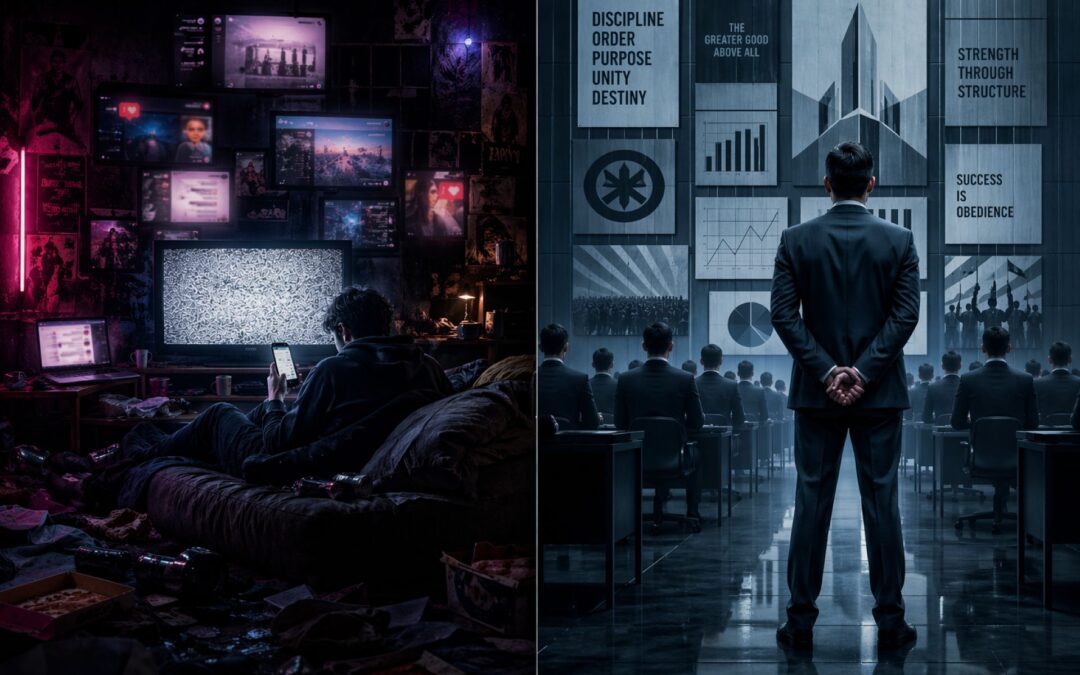
The Serious Person: Hiding Inside Systems
One of the most common ways people escape freedom is not by rejecting it outright, but by outsourcing it.
This is what Beauvoir calls the serious person.
The serious person doesn’t see themselves as avoiding freedom. In fact, they often appear disciplined, committed, even admirable. They dedicate themselves to something larger—a role, an institution, an ideology, a moral system. On the surface, it looks like purpose.
But beneath it, something else is happening.
Instead of choosing their values, the serious person treats values as given. Fixed. Absolute. Beyond question. They no longer ask, “Is this meaningful?” but rather assume, “This is meaningful.” And by aligning themselves with it, they inherit that meaning.
It’s a subtle shift, but a decisive one.
Because once values are treated as external and unquestionable, the burden of freedom disappears. There is no longer a need to think independently, to evaluate, to doubt. The system provides the answers. The individual simply follows.
In this way, the serious person recreates something very close to childhood.
Back then, authority figures defined reality. Now, it’s a different authority—an ideology, a profession, a social identity—but the psychological structure remains the same. Meaning comes from outside. Responsibility is reduced.
And it feels safe.
You see this in countless forms. The corporate employee who becomes indistinguishable from the company’s mission. The ideologue who cannot tolerate ambiguity because their belief system must remain intact. The person who defines themselves entirely through a role—parent, professional, patriot—until there is nothing left outside of it.
These identities are not inherently false. The problem is not that people take on roles. The problem is how completely they disappear into them.
Because once you surrender your freedom to a system, you also surrender your ability to question it.
Critical thinking becomes a threat. Doubt becomes dangerous. Anything that destabilizes the structure must be ignored, dismissed, or attacked—not because it is wrong, but because it reintroduces the very thing the serious person is trying to escape: uncertainty.
At that point, the system is no longer something you use. It’s something that uses you.
And the more invested you become, the harder it is to step back. Not because you can’t—but because doing so would mean confronting the possibility that the certainty you relied on was never absolute to begin with.
That’s a difficult realization to face.
So instead, the serious person doubles down.
When Belief Becomes Dangerous
At first glance, the serious person seems like a stabilizing force. They are committed, principled, and willing to sacrifice for something larger than themselves. In a chaotic world, that kind of certainty can even appear necessary.
But the danger reveals itself in what they’re willing to ignore.
Once a person treats their chosen system—whether it’s an ideology, institution, or moral code—as absolute, everything else becomes secondary. Reality is no longer evaluated on its own terms. It is filtered, interpreted, and reshaped to fit the system.
And when something doesn’t fit, it’s not the system that gets questioned.
It’s reality.
This is where seriousness crosses a line. Because at that point, the individual is no longer engaging with the world—they’re defending a structure. Truth becomes negotiable. Complexity becomes inconvenient. Human nuance becomes an obstacle.
What matters is preserving the illusion of certainty.
That shift has consequences.
If a belief system is treated as unquestionably good, then anything done in its name can be justified. Harm can be reframed as necessity. Oppression can be recast as order. Individuals can be reduced to roles—supporters, enemies, obstacles—rather than seen as human beings with their own freedom.
The system becomes more important than the people within it.
And because the serious person has already surrendered their own freedom to this structure, they are less likely to recognize the same freedom in others. If they did, the system would lose its authority. It would become one interpretation among many, rather than the truth.
So they resist that realization.
Not always consciously. Often, it feels like conviction. Like loyalty. Like moral clarity. But beneath it lies something more fragile—the need to avoid ambiguity at all costs.
Beauvoir’s warning is not abstract. It’s grounded in observation.
History repeatedly shows how ordinary individuals, when fully absorbed into rigid systems of belief, can participate in actions they might otherwise question. Not because they are inherently malicious, but because they’ve stopped evaluating their actions independently. The system does the thinking for them.
And once that happens, responsibility becomes diffuse.
“It’s just the way things are.”
“This is what must be done.”
“I’m following the rules.”
These phrases don’t eliminate responsibility. They conceal it.
The serious person, in trying to escape the burden of freedom, ends up amplifying its consequences—because their actions are no longer guided by conscious choice, but by unexamined allegiance.
And when the system they rely on begins to crack, something else takes its place.
The Subhuman: Drifting Without Direction
If the serious person escapes freedom by clinging to something, the subhuman escapes it by letting go of everything.
This is the second archetype Beauvoir describes in The Ethics of Ambiguity—and in some ways, it’s even more unsettling.
Because unlike the serious person, the subhuman doesn’t pretend to have certainty.
They abandon the entire project of meaning.
At first, this can look like detachment. A refusal to take things too seriously. A kind of quiet resignation. But underneath it lies something more definitive: a withdrawal from responsibility itself.
Where the serious person says, “The system decides,” the subhuman says, “Nothing matters enough to decide.”
And so they drift.
They don’t actively shape their lives. They don’t commit to values. They don’t meaningfully engage with the tension between freedom and constraint. Instead, they allow circumstances to carry them forward—habits, impulses, distractions, whatever happens to fill the time.
Life becomes something that happens to them, not something they participate in.
This is not the same as humility or acceptance. It’s not a thoughtful recognition of limits. It’s a quiet refusal to act within those limits at all.
Beauvoir’s point is important here: the subhuman is not defined by external traits. It has nothing to do with intelligence, appearance, or status. It’s not about failing in the world—it’s about refusing to engage with it.
The defining feature is passivity.
You can see modern versions of this mindset everywhere. The person who convinces themselves that effort is pointless. That outcomes are predetermined. That there’s no real agency, so why bother trying. They retreat into distraction—not because distraction is meaningful, but because it fills the space where responsibility would otherwise exist.
Endless scrolling. Passive consumption. Cynical detachment disguised as insight.
“It doesn’t matter anyway.”
That phrase captures the entire posture.
Unlike the serious person, who hides inside structure, the subhuman dissolves into formlessness. They don’t adopt a system—they avoid all systems. But the result is the same: freedom is denied.
Not through obedience, but through neglect.
And because they never take ownership of their choices, they never fully experience the weight of them either. Their life becomes a series of reactions rather than decisions.
Which might seem harmless at first.
But it isn’t.
Why Passivity Is Not Harmless
It’s easy to assume that the subhuman, in their detachment, poses no real threat.
After all, they aren’t imposing beliefs on others. They aren’t defending rigid systems. They’re not actively trying to control anything. Compared to the serious person, they seem almost neutral.
But that neutrality is an illusion.
Because in a world shaped by action, inaction still has consequences.
The subhuman doesn’t stand outside the system—they simply fail to resist it. And in doing so, they become exactly what Beauvoir warns about: available. Available to be influenced, redirected, absorbed into forces that do have direction.
They don’t choose ideologies. They fall into them.
One day, they may echo one set of beliefs. The next day, another. Not out of conviction, but because they lack the grounding to evaluate what they’re adopting. Their passivity makes them receptive to whatever is loudest, most convenient, or most emotionally compelling in the moment.
They don’t build positions. They inherit them—temporarily.
This is where the danger becomes clear.
Because large-scale harm rarely requires everyone to be convinced. It only requires enough people to act, and enough others to not resist. The subhuman supplies that second group. Not through malice, but through absence.
They go along.
They look away.
They don’t intervene.
And that’s enough.
Beauvoir’s insight cuts deeper than a simple moral warning. She’s not saying the subhuman is evil in the traditional sense. She’s pointing out that refusing to choose does not remove you from the world—it simply removes your control over your role in it.
You are still participating. You’re just not directing your participation.
And that makes you usable.
The subhuman becomes, in Beauvoir’s words, a kind of raw material—something that can be shaped by more forceful agents. In moments of collective movement—whether political, social, or cultural—these are often the people who carry out actions without fully understanding or questioning them.
Not because they believe strongly.
But because they never learned how to believe at all.
In trying to avoid the burden of freedom, they end up surrendering something far more significant: their capacity to act with intention.
And once that’s gone, it doesn’t take much for someone else to step in and decide for them.
The Collapse Between the Two
At first, the serious person and the subhuman seem like opposites.
One is rigid, committed, and absorbed in structure. The other is passive, detached, and drifting without direction. One clings to certainty. The other dissolves into indifference.
But beneath the surface, they are far closer than they appear.
They are both responses to the same problem: the discomfort of being free.
The serious person escapes that discomfort by locking themselves into a system. The subhuman escapes it by withdrawing from engagement altogether. Different strategies, same goal—to avoid the responsibility that freedom demands.
And because they share this foundation, one can easily collapse into the other.
Consider what happens when the serious person loses their system.
The ideology they trusted begins to unravel. The institution they built their identity around weakens. The role that once gave them purpose no longer holds. What once felt absolute starts to look contingent, even arbitrary.
At that moment, they are forced to confront what they’ve been avoiding all along.
Freedom.
But instead of embracing it, many fall into the opposite extreme. Without the structure to anchor them, they don’t suddenly become self-directed. They lose direction entirely.
Conviction turns into cynicism.
Purpose dissolves into apathy.
Certainty collapses into indifference.
The serious person becomes the subhuman.
This transition can be abrupt or gradual, but the underlying mechanism is the same. When meaning is borrowed rather than built, it remains fragile. It depends on the stability of whatever external structure is providing it.
And when that structure fails, nothing is left to replace it.
The individual has never developed the capacity to choose independently, to navigate ambiguity, to create meaning without relying on something fixed. So when the illusion breaks, they don’t step into freedom—they retreat from it.
This is why both archetypes are unstable.
The serious person appears grounded, but their stability is conditional. The subhuman appears detached, but their detachment is not neutral—it’s a form of avoidance. Neither has actually confronted the core challenge of freedom.
They’ve only found different ways to delay it.
And eventually, that delay runs out.
What It Means to Accept Freedom
If both the serious person and the subhuman are avoiding freedom, then the obvious question is:
What does it actually mean to accept it?
The first thing Beauvoir makes clear is what it does not mean.
It does not mean doing whatever you feel like.
It does not mean rejecting all structure or living without limits.
And it certainly does not mean following a predefined formula for “living freely.”
In fact, the moment you try to reduce freedom to a set of instructions, you’ve already stepped away from it.
Because real freedom cannot be outsourced.
To accept freedom is to recognize that you are always operating within a tension. You are shaped by circumstances you did not choose, and yet you are responsible for what you do within them. You cannot eliminate either side of that equation.
You have to live inside it.
This means making choices without certainty. Acting without guarantees. Committing to paths that could fail, knowing that there is no external authority that can fully justify them in advance.
It’s uncomfortable, but it’s unavoidable.
At the same time, accepting freedom is not just about choosing—it’s about owning the consequences of those choices. Not deflecting them onto systems, not dissolving them into passivity, but recognizing that your actions have weight.
They shape your life, and they shape the world around you.
This is where responsibility enters the picture.
For Beauvoir, freedom is never isolated. It exists in a shared world, among other people who are also free. Your choices don’t happen in a vacuum. They influence others, just as theirs influence you.
So to act freely is not just to choose for yourself, but to choose in a way that acknowledges this interconnectedness.
That doesn’t mean following universal moral laws—Beauvoir rejects the idea that there is a fixed ethical blueprint for everyone. What it means is that you cannot pretend your choices are without impact.
You are always participating in something larger.
And this is where many people hesitate.
Because accepting freedom requires letting go of two comforts at once: the comfort of certainty and the comfort of disengagement. You can no longer hide inside a system, and you can no longer drift outside of one.
You have to stand in between.
To decide, even when it’s difficult.
To act, even when outcomes are unclear.
To take responsibility, even when it would be easier not to.
There is no final state where this becomes effortless.
Freedom is not something you achieve once and then possess. It’s something you continually enact—through choices that could always have been different.
And that’s exactly what makes it real.
The Hard Truth About Living Freely
There is no way around it.
You are free.
Not in the sense that you can do anything you want, but in the sense that you are always involved in choosing what your life becomes. Even when you hesitate. Even when you follow. Even when you do nothing.
Those are choices too.
And that is the part most people try to avoid.
Because once you accept it, certain comforts disappear. You can no longer fully blame your circumstances, even though they are real. You can no longer hide behind roles, even though they are necessary. You can no longer dissolve into passivity, even though it feels easier.
You remain responsible for how you respond.
This is not an uplifting message in the conventional sense. It doesn’t promise clarity, or certainty, or a clear path forward. It doesn’t tell you who to become or what to value.
It does something more demanding.
It leaves the question open—and places it in your hands.
Beauvoir’s philosophy does not offer a way to escape ambiguity. It insists that ambiguity is the condition of your existence. You are neither fully determined nor fully free. You are both, at the same time. And every meaningful life is built within that tension.
There is no final resolution to this.
No point where the burden lifts completely. No stage where responsibility disappears. The only real alternative is avoidance—and as we’ve seen, that comes at a cost.
The serious person loses themselves in systems.
The subhuman loses themselves in passivity.
Both, in different ways, step away from the task of living deliberately.
And yet, that task remains.
To choose without certainty.
To act without guarantees.
To take responsibility without escape routes.
Not once, but repeatedly.
That is what it means to live freely.
And whether you embrace it or not, you’re already doing it.