
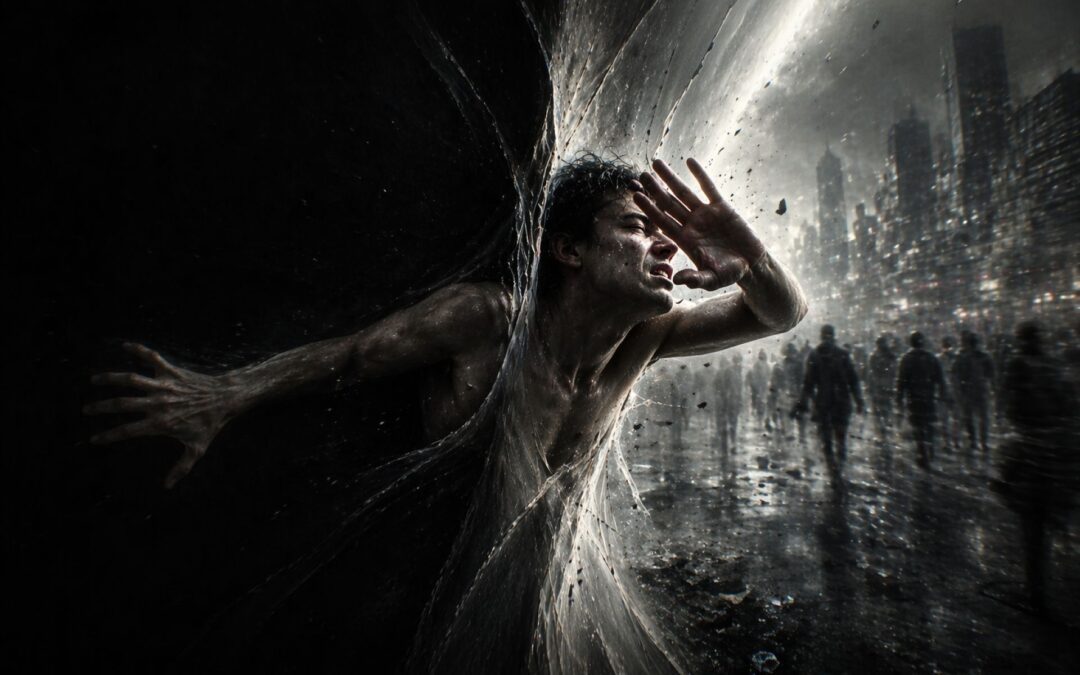
There are philosophies that comfort, philosophies that guide, and philosophies that try to make sense of the chaos of existence. And then there is the philosophy of Emil Cioran—a philosophy that does none of these things.
Cioran does not attempt to reassure. He does not offer a path to happiness, fulfillment, or redemption. Instead, he begins with a premise so stark, so unsettling, that it overturns almost everything we instinctively believe about life: that being born is not a gift, but a catastrophe.
We tend to think of life as something inherently valuable. Even when it is difficult, we justify it. We speak of meaning, growth, resilience. We frame suffering as something that leads somewhere. But Cioran rejects this entire narrative. For him, suffering is not a phase or a lesson—it is the foundation. It begins the moment consciousness emerges, and it never truly leaves.
In his later work, The Trouble with Being Born, he distills this worldview into sharp, fragmented insights. Not arguments in the traditional sense, but flashes of clarity—uncomfortable, often contradictory, yet impossible to ignore. Through these aphorisms, he explores a single, relentless idea: that existence itself is the problem.
This article does not aim to soften that idea. It follows Cioran into his bleakest conclusions—not to agree, not to disagree, but to understand what it means to see life not as an opportunity, but as an accident one never asked for.
Because once that question is taken seriously, it becomes difficult to return to the comforting illusions we usually rely on.
A Philosopher Who Regretted Being Born
To understand the force of Cioran’s ideas, it helps to see that they weren’t constructed from a distance. His philosophy was not an intellectual exercise—it was an extension of how he experienced life itself.
Emil Cioran was born in a small Romanian village to a deeply religious family. His father was an Orthodox priest, and his mother was actively involved in the church. On paper, it was an environment steeped in meaning, structure, and spiritual certainty. But Cioran moved in the opposite direction. He rejected theology early on, turning instead to philosophy—not as a system of answers, but as a language for his unrest.
From a young age, he struggled with insomnia, a condition that would shape much of his thinking. Nights stretched endlessly, stripping away distraction and forcing him into prolonged confrontation with his own thoughts. While others slept, he remained awake—hyper-aware, restless, unable to escape the weight of consciousness. It was during these sleepless periods that his pessimism deepened, not as a theory, but as a lived reality.
In his early twenties, he wrote On the Heights of Despair, a work already saturated with themes that would define his later philosophy: suffering, futility, and the unbearable intensity of being alive. Even then, he wasn’t searching for solutions. He was documenting a condition.
What makes Cioran unusual is that he didn’t just think like a pessimist—he chose to live like one. After moving to France, he deliberately avoided the markers of success that many of his contemporaries pursued. While figures like Jean-Paul Sartre and Albert Camus became prominent public intellectuals, Cioran rejected ambition altogether.
He refused to complete his doctoral thesis, even though it would have secured him a stable academic career. Instead, he prolonged his student status to access cheap meals and lived modestly, often on the margins. He avoided steady work, dismissed recognition, and even declined literary prizes later in life.
At one point, he described himself not as a thinker striving for greatness, but as someone aspiring to be a “parasite”—someone who exists without contributing, without participating in the conventional structures of society.
There’s a paradox here. Cioran criticized what he saw as the inertia and failure of Romanian culture, yet he eventually embodied the very traits he once despised. But this wasn’t accidental. It was deliberate. By rejecting success, he removed himself from the illusions that typically sustain people—the belief in progress, achievement, and purpose.
His life became an extension of his philosophy: a quiet refusal to play a game he never believed in to begin with.
This is what gives his ideas their unsettling weight. Cioran wasn’t theorizing about the emptiness of existence while secretly clinging to its rewards. He lived as if those rewards were meaningless—because, to him, they were.
From Nationalism to Disillusionment
Cioran’s pessimism did not emerge in a vacuum. It evolved—and, in some ways, intensified—through disillusionment.
In his early years, Emil Cioran was not the detached observer he later became. Like many young intellectuals of his time, he was drawn to the idea of national revival. Romania, in his eyes, was stagnant—lacking vitality, direction, and historical significance. He saw it as a culture trapped in inertia, a place where time was not used but wasted.
This dissatisfaction turned into fascination with strength—specifically, the kind of force embodied by authoritarian movements in Europe. He admired energy, discipline, and the illusion of purpose that such regimes projected. For a time, he believed that only something radical—something extreme—could pull a nation out of decay.
But this phase did not last.
As the political climate darkened and movements like the Iron Guard revealed their true nature—marked by violence, fanaticism, and antisemitism—Cioran’s admiration gave way to disgust. What once seemed like vitality now appeared as brutality. What felt like direction revealed itself as destruction.
The turning point was not merely political; it was existential. The very forces that promised meaning exposed the depth of human irrationality. Instead of elevating humanity, they stripped away any remaining illusion that humanity could be elevated at all.
When Cioran left Romania for France in 1937, it wasn’t just a geographical move—it was a rupture. He distanced himself from his past, abandoning not only his homeland but also the beliefs that once animated him. He would later express deep shame for his earlier sympathies, recognizing them as a form of blindness.
In France, he encountered a different intellectual world—one populated by figures like Jean-Paul Sartre and Simone de Beauvoir. Yet even here, he remained an outsider. While existentialists grappled with meaning and freedom, often trying to construct purpose in an indifferent universe, Cioran moved in the opposite direction.
He stopped looking for meaning altogether.
War, ideology, nationalism—these were not solutions. They were symptoms. Expressions of a deeper problem rooted in existence itself. If anything, they confirmed his growing suspicion: that human beings, when given the chance to create meaning, often create suffering instead.
This disillusionment didn’t lead him to a new belief system. It led him to abandon belief entirely.
From that point on, Cioran’s philosophy became less about fixing the world and more about exposing it—stripped of illusion, stripped of hope, reduced to what he saw as its fundamental condition: a mistake that began with birth and continues with every attempt to justify it.
Birth, Not Death, Is the Real Tragedy
We are taught, almost instinctively, to fear death. It is framed as the ultimate loss—the end of everything meaningful, the great unknown waiting at the edge of life. Entire cultures, religions, and philosophies are built around coming to terms with it.
Cioran rejects this completely.
For Emil Cioran, death is not the problem. It never was. The real catastrophe—the moment where everything goes wrong—is birth.
In The Trouble with Being Born, he returns to this idea again and again, not as a metaphor, but as a literal claim. To be born is to be thrown into a condition you never asked for, burdened with consciousness, exposed to suffering, and condemned to experience time.
Before birth, there is nothing—no pain, no anxiety, no desire, no awareness of lack. It is not happiness, but it is also not suffering. It is, in Cioran’s terms, a kind of perfect neutrality. The moment birth occurs, that neutrality is shattered.
Suddenly, there is awareness. And with awareness comes everything else: fear, longing, regret, anticipation, disappointment. Life does not gradually become difficult—it begins that way. The tragedy is not what happens later, but the fact that anything happens at all.
This inversion—placing tragedy at the beginning rather than the end—changes how everything else is interpreted. If birth is the disaster, then death is no longer something to dread. It becomes, if anything, a return. A release from the condition that was imposed in the first place.
Cioran pushes this even further by questioning the language we use around death. Why do we say someone has “rested in peace”? Why do we describe death as “eternal rest” or “going to a better place”? Even those who fear death seem to instinctively associate it with calmness, with an end to struggle.
If death is so terrible, why do we speak of it as relief?
For Cioran, this contradiction reveals something deeper. We are not truly afraid of death—we are attached to life, despite everything it contains. Our fear is not rooted in the nature of death itself, but in our inability to let go of the condition we were forced into.
He even suggests that what we call the fear of death might actually be something else entirely: a displaced memory of the shock of being born. A trauma so fundamental that it echoes throughout our lives, disguised as anxiety about the future.
“We do not rush toward death,” he writes, “we flee the catastrophe of birth.”
In this framework, everything shifts. Death is no longer the enemy. It is the quiet endpoint of a process that began unwillingly. The real question, then, is not why we die—but why we are here at all.
Consciousness: The Source of All Suffering
If birth is the beginning of the problem, consciousness is what sustains it.
For Emil Cioran, the issue is not merely that we exist, but that we are aware that we exist. Consciousness does not just allow us to experience the world—it forces us to experience it in a way that makes suffering unavoidable.
In The Trouble with Being Born, he describes consciousness not as a gift, but as an affliction. A “dagger in the flesh.” Something that pierces through every moment of life, making even neutral experiences feel heavy, even fleeting discomforts feel permanent.
Without consciousness, there is no problem.
A stone does not suffer. A plant does not anticipate its own decay. Even animals, though capable of pain, are largely free from the kind of prolonged psychological torment that defines human life. They do not obsess over the past, dread the future, or question the meaning of their existence.
Humans do all of this—constantly.
Consciousness stretches suffering across time. It takes a single moment of discomfort and extends it into memory and anticipation. What hurts once can hurt again, and again, simply by being remembered. What has not yet happened can already cause anxiety simply by being imagined.
In this way, suffering becomes less about events and more about awareness itself.
Cioran points to a deeper paradox. Consciousness is born out of discomfort—it arises because something is wrong, because something disturbs us. And yet, once it exists, it becomes the very thing that amplifies and perpetuates that disturbance.
It feeds on what created it.
We become aware because we suffer, and then we suffer because we are aware.
This loop has no clear exit. Consciousness cannot simply turn itself off. It can desire escape, fantasize about silence, even long for non-existence—but it remains active, continuing to generate the very discomfort it wishes to eliminate.
This is why Cioran finds a strange kind of appeal in diminished states of awareness. Sleep, ignorance, unconsciousness—these are not flaws in his view, but temporary reprieves. Moments where the pressure of existence loosens, even if only slightly.
The less we are aware, the less we suffer.
Taken to its extreme, this logic leads to a conclusion that defines his philosophy: that the best state would have been not to become conscious at all. Not to exist in a way that allows suffering to arise in the first place.
It is a conclusion that feels unsettling because it challenges something deeply ingrained—the belief that awareness is inherently valuable.
For Cioran, it is precisely the opposite. Awareness is the problem that makes every other problem possible.
The Antinatalist Argument: Is Procreation a Crime?
If birth is the origin of suffering and consciousness is what sustains it, then a difficult question follows naturally: what does it mean to bring someone into existence?
For Emil Cioran, the answer is blunt. Procreation is not a neutral act. It is not simply part of life’s cycle or a continuation of humanity. It is the deliberate decision to expose another being to the very condition we struggle to endure.
In The Trouble with Being Born, this idea takes a radical form. Cioran goes so far as to describe having children as a “crime.” Not in a legal sense, but in a moral one. A crime committed not out of malice, but out of blindness—an inability or refusal to confront what existence actually entails.
The reasoning is simple, but unsettling.
No one consents to being born. There is no agreement, no choice, no moment of acceptance. Yet the consequences are total. To exist is to suffer, to fear, to lose, to deteriorate, and eventually to die. Even in the best circumstances, life contains discomfort, uncertainty, and inevitable endings.
Happiness, on the other hand, is conditional. It depends on circumstances, temperament, luck. It can be interrupted, diminished, or taken away. It is never guaranteed in the same way that suffering is.
So the imbalance becomes clear.
To bring someone into existence is to guarantee the possibility of suffering while offering no certainty of fulfillment. It is to impose a burden without asking whether it should be imposed at all.
This is where Cioran’s thinking overlaps with a broader philosophical position known as antinatalism—the belief that creating new life is morally problematic because it inevitably exposes that life to harm. Like Arthur Schopenhauer before him, Cioran sees existence not as a gift, but as a liability passed from one generation to the next.
What makes this perspective particularly uncomfortable is how it collides with everyday assumptions.
People often acknowledge that the world is filled with suffering. They worry about war, environmental collapse, instability, and personal hardship. They speak of a future that seems uncertain, even bleak. And yet, many still choose to have children.
Cioran sees this as a contradiction.
If we truly believe the world is as troubled as we claim, why would we willingly introduce someone into it? Why repeat the process that we ourselves struggle with?
From his perspective, the answer lies in instinct. The drive to reproduce is powerful, deeply embedded, and largely unquestioned. It operates independently of philosophical reflection. People continue to have children not because they have resolved these questions, but because they rarely confront them in the first place.
This is what makes his argument feel so disruptive. It does not rely on complex reasoning or abstract systems. It takes a familiar act—having children—and reframes it in the starkest possible terms.
Not as creation, but as continuation of a problem.
And once that framing is seen clearly, it becomes difficult to look at the act of procreation in the same way again.
Why Suicide Isn’t the Solution
At first glance, Cioran’s philosophy seems to lead to an obvious conclusion. If existence is suffering, if consciousness is a burden, and if birth is the original mistake, then ending one’s life would appear to be the logical escape.
But Emil Cioran refuses this conclusion.
Despite everything he says about the futility of existence, he does not advocate suicide as a solution. In fact, he dismisses it with a kind of cold practicality. His reasoning is as unsettling as the rest of his thought: suicide comes too late.
By the time someone considers ending their life, the suffering that led them there has already occurred. The damage is done. The pain has been experienced, absorbed, and lived through. Ending one’s life does not undo that—it only stops what comes after.
So why bother?
This is where his philosophy takes a turn that feels almost contradictory, but remains consistent within his framework. If birth is the true disaster, then suicide cannot erase it. It cannot return us to the state before existence. It does not undo the fundamental mistake—it merely concludes it.
In The Trouble with Being Born, Cioran even expresses a strange ambivalence toward death itself. At times, he envies those who have died, seeing them as having escaped the burden of consciousness. At other times, he speaks of being just as weary of death as he is of life.
There is no clean resolution.
What emerges instead is a kind of suspended state—neither fully rejecting life nor fully embracing its end. Suicide, in this context, becomes unnecessary rather than forbidden. It is not a moral stance, but a recognition that the act does not solve the underlying problem.
There is also something else at play.
Ending one’s life is not a neutral act. It involves its own form of suffering—fear, struggle, uncertainty. It is not an immediate return to peace, but a process that still unfolds within the very condition one is trying to escape. And for Cioran, who sees suffering as already unavoidable, adding more of it for the sake of an uncertain outcome holds little appeal.
So instead of resolution, there is continuation.
Not because life is worth living in any traditional sense, but because the alternative does not offer the kind of escape one might imagine. The problem of existence cannot be neatly solved from within existence itself.
This leaves us in an uncomfortable position—aware of the burden, yet unable to discard it in any meaningful way.
And that, perhaps, is exactly where Cioran believed we already were.
Enduring Existence Without Illusions
If neither life nor death offers a solution, what remains?
For Emil Cioran, the answer is not redemption, transformation, or escape. It is endurance.
There is no system to follow, no discipline to master, no philosophy that can dissolve suffering at its root. Cioran had little patience for structured approaches like Stoicism or religious frameworks that promise peace through belief or practice. To him, these were attempts to soften reality—to impose order on something fundamentally chaotic and indifferent.
Instead, he chose to face existence without illusions.
In The Trouble with Being Born, there are no step-by-step instructions for living. What we find instead are glimpses—small, indirect ways in which he made existence bearable, even if never meaningful.
One of these was writing.
Cioran described his books as “postponed suicide.” Not because writing solved anything, but because it allowed him to externalize his thoughts, to release pressure without resolving it. Each sentence became a temporary outlet—a way to endure another moment without collapsing under it.
His style reflects this function. He did not build systems or arguments. He wrote in fragments, aphorisms, contradictions. Each line stood on its own, capturing a fleeting state of mind. Truth, for him, was not stable or universal—it was momentary, shifting with experience.
Another element of his endurance was acceptance—but not in the comforting sense the word usually carries.
To accept, in Cioran’s terms, is to recognize defeat. To see clearly that existence is not something to be conquered or justified, but something imposed. This realization does not bring joy, but it brings a strange kind of relief. When the struggle to find meaning disappears, so does the frustration of failing to find it.
There is nothing left to prove.
He also adopted an unusual relationship with misfortune. Rather than avoiding it, he leaned into it. Not out of masochism in the conventional sense, but as a strategy to eliminate surprise. If you expect failure, loss, and disappointment—and even invite them—then they lose their ability to shock or destabilize you.
Attachment, in his view, is what amplifies suffering. The more we cling to success, recognition, or stability, the more vulnerable we become when these things inevitably shift or disappear.
So he chose the opposite path.
He avoided ambition, rejected praise, and lived modestly. He spent time with those who had “failed” by society’s standards—not because he admired failure itself, but because it stripped away illusion. Among people who no longer chased success, there was nothing left to lose.
This is not a philosophy of improvement. It does not promise growth or fulfillment.
It is a philosophy of reduction—of stripping life down to what remains when hope, ambition, and meaning are no longer taken for granted.
And what remains is simple, if not comforting: the act of continuing.
Not because life is good. Not because it leads somewhere.
But because, despite everything, it persists.
Conclusion
Cioran’s philosophy does not leave us with answers. It leaves us with a disturbance.
To follow Emil Cioran to his conclusions is to stand in a place where most philosophical systems refuse to go. There is no redemption waiting at the end, no hidden meaning beneath suffering, no reassurance that things, somehow, justify themselves.
There is only the recognition that existence begins without consent, unfolds through awareness, and carries with it an inescapable burden.
And yet, Cioran does not collapse under this recognition. He does not resolve it either. He inhabits it.
In The Trouble with Being Born, we do not find a system to follow, but a perspective to confront—one that strips away the narratives we rely on to make life bearable. It does not ask us to adopt his conclusions, but it forces us to examine the assumptions we rarely question.
Why do we value existence?
Why do we continue it?
Why do we defend it?
Cioran offers no comfort in response. Only clarity—sharp, unsettling, and difficult to ignore.
And perhaps that is the point.
Not to convince, but to unsettle. Not to guide, but to expose.
Because once the idea takes hold—that being born might not be a blessing, but a problem—it becomes something you cannot entirely unthink.