
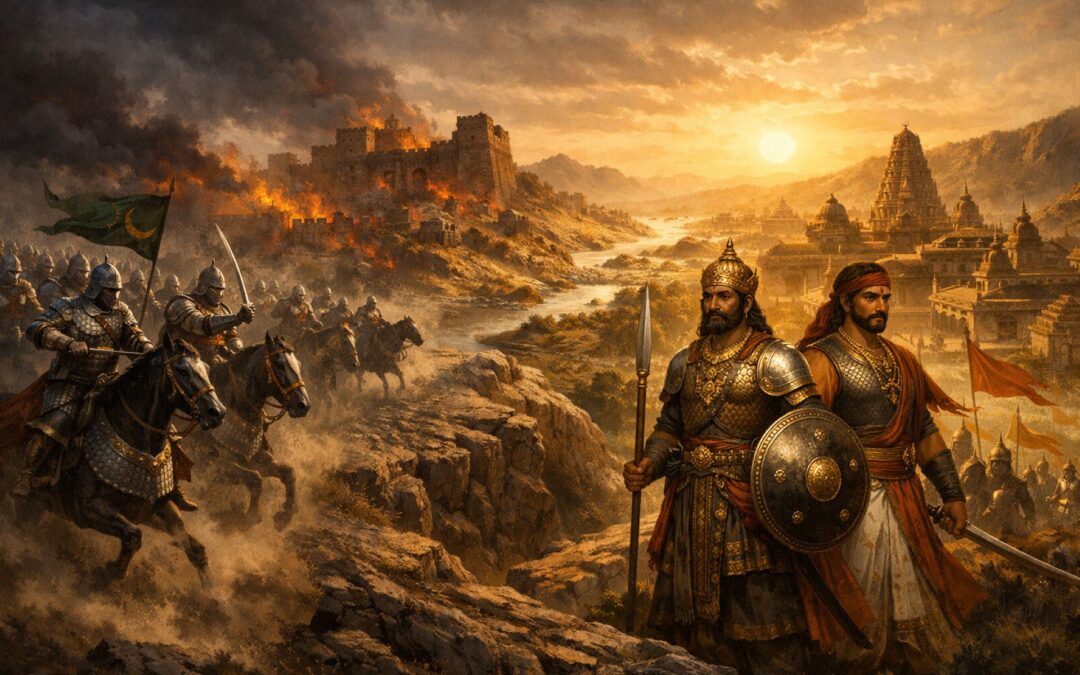
For centuries, the political landscape of the Indian subcontinent was shaped by powerful regional kingdoms that competed for wealth, territory, and influence. In the north, successive dynasties ruled from Delhi, while the Deccan and South India were dominated by established native powers such as the Yadavas, Kakatiyas, Hoysalas, and Pandyas. These kingdoms had their own long traditions of governance, military organization, and trade networks that connected the Indian interior to the wider Indian Ocean world.
This balance of power began to shift dramatically at the end of the thirteenth century with the aggressive expansion of the Delhi Sultanate. Unlike earlier northern rulers who often limited their influence to tribute relationships, the Delhi Sultanate pursued repeated military campaigns deep into the Deccan plateau. These expeditions were driven by both political ambition and the immense wealth of the southern kingdoms, whose territories were known for their rich mineral resources, fertile lands, and thriving ports.
The invasions that followed were relentless. Powerful Deccan dynasties were forced into submission, their treasuries emptied, and their rulers reduced to tributaries of Delhi. Over time, the Sultanate moved beyond tribute and began to annex entire regions, imposing direct control through governors and military garrisons. What had once been a patchwork of independent kingdoms gradually became part of a vast imperial system stretching across much of the subcontinent.
Yet the Delhi Sultanate’s expansion came with enormous costs. The strain of governing distant territories, combined with harsh administrative policies and constant rebellions, destabilized the empire’s authority in the south. As central control weakened, new political forces began to emerge across the Deccan. Some were rebellious governors, others were regional elites reclaiming autonomy, and still others were ambitious leaders seeking to build entirely new states.
Out of this turbulent period of conquest, rebellion, and imperial collapse emerged one of the most powerful and culturally influential states in Indian history: the Vijayanagara Empire. Founded in the fourteenth century by a group of ambitious leaders in the southern Deccan, Vijayanagara would grow into a formidable power that dominated South India for centuries. Its rise was not an isolated event but a direct consequence of the upheavals unleashed by the Delhi Sultanate’s expansion.
In a striking twist of history, the very campaigns that allowed the Delhi Sultanate to briefly dominate the Deccan also destroyed the older political order that had long governed the region. In the vacuum that followed, new states rose to prominence, none more successful than Vijayanagara. The story of its emergence is therefore inseparable from the violent transformations that reshaped the Deccan during the medieval era.
The rise of the Vijayanagara Empire was not merely the founding of another kingdom. It represented the birth of a new political order in South India, forged in response to conquest, rebellion, and the collapse of imperial authority.
The Political Landscape of the Deccan Before the Delhi Sultanate
Before the armies of the Delhi Sultanate marched south, the Deccan plateau was home to a complex political landscape dominated by powerful regional kingdoms. These states had developed over centuries, each rooted in local traditions, administrative systems, and networks of military alliances. Though they often competed with one another for territory and influence, they collectively formed a stable balance of power that defined the region during the late medieval period.
Among the most prominent of these kingdoms were the Yadavas of Devagiri, the Kakatiyas of Warangal, and the Hoysalas of Dwarasamudra. Further south, the Pandya kingdom controlled large parts of Tamil country and maintained extensive trade connections through ports along the Indian Ocean. Each of these powers commanded substantial resources and maintained fortified capitals that served as centers of administration, culture, and economic activity.
The Yadava kingdom, with its capital at Devagiri in present-day Maharashtra, occupied a strategic position along important trade routes connecting northern India with the southern peninsula. The region was rich in agricultural production and mineral resources, making it an attractive target for ambitious rulers seeking wealth and tribute. Devagiri itself was heavily fortified and widely regarded as one of the strongest fortresses in the Deccan.
To the east lay the Kakatiya kingdom, whose capital at Warangal had grown into a thriving political and economic center. The Kakatiyas had built a reputation as formidable defenders of their territory. Their armies were experienced in warfare across the difficult terrain of the Deccan plateau, and their rulers maintained a strong administrative system supported by regional chiefs and military commanders. Warangal’s impressive fortifications and strategic planning made it a challenging objective for any invading force.
South of the Yadavas and Kakatiyas stood the Hoysala kingdom, centered around the capital of Dwarasamudra in modern Karnataka. The Hoysalas were known not only for their military strength but also for their patronage of temple architecture and art, which flourished during their rule. Their influence extended deep into southern India, where they often clashed with the Pandyas and other regional powers for control of valuable territories.
Despite the strength of these kingdoms, the Deccan was not entirely free from conflict. Rivalries between these states were common, and wars were fought over borders, trade routes, and regional influence. These conflicts, however, were generally limited in scale and rarely resulted in the complete destruction of a kingdom. Instead, they typically produced shifting alliances and temporary changes in territorial control.
This political environment created both opportunity and vulnerability. While the Deccan kingdoms were powerful, their rivalries often prevented them from forming lasting coalitions against external threats. When the Delhi Sultanate began to look southward in search of wealth and prestige, it encountered a region rich in resources but divided among competing rulers.
The arrival of northern armies would therefore introduce a new and disruptive force into this delicate balance. The campaigns that followed would not merely alter the fortunes of individual kingdoms but would fundamentally transform the political order of the Deccan.
Alauddin Khalji and the First Northern Incursions into the Deccan
The Delhi Sultanate’s serious involvement in the Deccan began during the reign of Alauddin Khalji, one of the most ambitious and formidable rulers of medieval India. Before becoming sultan, Alauddin had already demonstrated both political cunning and military boldness, and it was his early campaign into the Deccan that helped propel him toward power.
In 1296, while still a noble serving under the ruling sultan in Delhi, Alauddin set out on an expedition that would dramatically alter the political trajectory of both the north and the south. Officially, his departure from Delhi appeared routine, but his ambitions extended far beyond a simple military raid. Rumors had already begun to circulate that he intended to challenge the throne itself. To make such a move viable, however, he needed wealth, prestige, and a victory impressive enough to win the loyalty of soldiers and nobles alike.
At the head of a force of roughly eight thousand cavalry, Alauddin marched south toward the Deccan plateau. News had long reached Delhi of the immense riches held by the southern kingdoms. The Deccan was known for its mineral wealth, including iron, gold, and diamonds, as well as for its prosperous cities and trade routes. For an ambitious commander seeking glory and resources, the region presented a tempting opportunity.
The Raid on Devagiri
Alauddin’s target was Devagiri, the capital of the Yadava kingdom. The city occupied a strategically important position and was defended by a formidable hill fort. However, circumstances within the Yadava kingdom worked in the invader’s favor. The ruling king, Ramachandra, had not anticipated a major northern invasion, and much of his army was absent at the time, engaged in conflicts further south.
When Alauddin’s forces arrived near Devagiri, they encountered far less resistance than expected. The sudden appearance of a well-organized cavalry force created panic among the defenders, who were unprepared for a prolonged siege. With the kingdom’s main army away and provisions inside the fortress limited, the Yadava ruler found himself in a precarious situation.
Alauddin further strengthened his position through clever psychological tactics. Fearing that reinforcements might soon arrive to relieve the fort, he spread rumors that a massive army from Delhi—tens of thousands of additional cavalry—was on its way to join him. To reinforce the illusion, his men deliberately created enormous dust clouds on the horizon, making it appear as though large reinforcements were approaching.
The deception worked. Believing that resistance would only lead to disaster, Ramachandra agreed to negotiate. The resulting settlement forced the Yadavas to pay an enormous indemnity and promise regular tribute to the Delhi Sultanate.
Tribute Instead of Annexation
For Alauddin Khalji, the campaign achieved exactly what he needed. The wealth extracted from Devagiri was immense, and the victory greatly enhanced his reputation in Delhi. When he returned north with the spoils of war, his newfound prestige helped him gather support among influential nobles and soldiers.
Shortly afterward, Alauddin seized the throne by assassinating his uncle, the reigning sultan. With the throne now firmly in his grasp, the Deccan would become a recurring focus of his imperial ambitions.
Despite his success, Alauddin initially avoided outright annexation of the southern kingdoms. Instead, he preferred a system of tribute in which local rulers remained in power but acknowledged the authority of the Delhi Sultanate. This approach allowed him to extract enormous wealth while avoiding the logistical challenges of directly governing distant territories.
At the same time, the strategy reflected the broader realities facing the Sultanate. The empire still had to contend with powerful Mongol forces along its northwestern frontier, and overextending resources in the Deccan could prove dangerous. Tribute therefore provided a practical compromise: the Sultanate could enjoy the riches of the south without becoming entangled in the complex politics of the region.
However, this arrangement would not last forever. As the Delhi Sultanate grew more confident and ambitious, its rulers would begin to push deeper into the Deccan. The man who would carry out these campaigns and reshape the political map of southern India was one of Alauddin Khalji’s most trusted commanders—Malik Kafur.
The Rise of Malik Kafur and the Sultanate’s Southern Campaigns
The Delhi Sultanate’s early successes in the Deccan demonstrated the immense wealth of the southern kingdoms, but they also revealed the difficulties of campaigning in the region. Initial invasions had met with mixed results, and the Sultanate needed a commander capable of conducting large-scale operations far from the imperial capital. That commander emerged in the form of Malik Kafur, one of the most capable and influential generals of Alauddin Khalji’s reign.
Malik Kafur’s rise to prominence was unusual. He had originally been captured during one of Alauddin’s earlier raids and brought to Delhi as a slave. Despite his humble beginnings, he quickly demonstrated exceptional ability in military leadership and administration. Alauddin recognized his talents and elevated him rapidly through the ranks, eventually making him one of the most trusted figures in the Sultanate’s court.
By the early fourteenth century, Malik Kafur had already proven himself in campaigns against Mongol incursions into northern India. These victories secured the Sultanate’s borders and gave Alauddin the confidence to pursue his ambitions in the Deccan once more. With the northern frontier temporarily stabilized, the Sultanate could now devote its attention to the rich kingdoms of southern India.
In 1307, Malik Kafur was entrusted with command of a large army and ordered to march south to enforce Delhi’s authority over the Deccan. What followed was one of the most sweeping military campaigns in medieval Indian history. Over the course of several years, Malik Kafur systematically defeated the major powers of the region, forcing them into submission and transforming the political balance of southern India.
Subjugation of the Yadavas
The first objective of the campaign was Devagiri, whose ruler had previously accepted tributary status after Alauddin’s earlier raid. Over time, however, the Yadavas had begun to distance themselves from the authority of Delhi and had stopped sending tribute payments.
Malik Kafur’s invasion quickly brought them back into line. The Sultanate’s forces advanced rapidly through the Deccan, overwhelming local resistance and capturing the Yadava king Ramachandra. Instead of executing him, Malik Kafur sent the defeated ruler to Delhi, where he formally acknowledged Alauddin Khalji as his sovereign.
This decision reflected the Sultanate’s continuing preference for tribute rather than outright annexation. Ramachandra was eventually allowed to return to Devagiri as a subordinate ruler, and the Yadava kingdom became a reliable ally of the Sultanate. Yadava forces even assisted Malik Kafur in his subsequent campaigns deeper into the Deccan.
The Siege of Warangal
With Devagiri secured, Malik Kafur turned east toward the powerful Kakatiya kingdom. Warangal, the Kakatiya capital, was heavily fortified and commanded by King Prataparudra, a ruler known for both his military ability and administrative strength.
Unlike the earlier failed invasion by Delhi’s forces, Malik Kafur approached Warangal through safer routes provided by Yadava allies. This allowed the Sultanate army to maintain its supply lines and arrive at the city in full strength.
The siege that followed was intense. The Sultanate army greatly outnumbered the Kakatiya defenders and applied sustained pressure on the city’s defenses. Eventually, Prataparudra recognized that continued resistance would lead to catastrophic destruction. He agreed to negotiate, offering a vast tribute that included enormous quantities of wealth, precious stones, and even the legendary Koh-i-Noor diamond.
Warangal’s submission marked one of the greatest victories of Malik Kafur’s campaign. The Kakatiya kingdom retained its ruler but became a tributary state, acknowledging the supremacy of the Delhi Sultanate.
Campaigns Against the Hoysalas and Pandyas
Malik Kafur did not stop with the submission of the Yadavas and Kakatiyas. His armies continued southward toward the Hoysala kingdom, whose capital at Dwarasamudra had long been one of the major political centers of southern India.
At the time of the invasion, the Hoysalas were heavily engaged in conflicts further south and were unable to assemble their full military strength. Recognizing the overwhelming power of the Sultanate army, they agreed to pay tribute rather than risk the destruction of their kingdom.
Malik Kafur then pushed even further south into the Pandya territories of Tamil country. These lands were known for their immense wealth and thriving trade networks, making them a tempting target for plunder. The Sultanate forces raided the region extensively, seizing large quantities of treasure before returning north.
By the early 1310s, Malik Kafur’s campaigns had reshaped the political map of southern India. Nearly every major kingdom in the Deccan and the far south had been forced into submission or tributary status. The Delhi Sultanate now stood as the dominant power across much of the Indian subcontinent.
Yet these victories carried the seeds of future instability. The Sultanate’s authority in the Deccan rested on fragile foundations: tribute agreements, military intimidation, and distant governors overseeing restless territories. Once the strong leadership that had orchestrated these campaigns disappeared, maintaining control over such a vast and diverse region would prove increasingly difficult.
The Collapse of the Old Deccan Kingdoms
The campaigns of Malik Kafur had brought the major kingdoms of the Deccan under the influence of the Delhi Sultanate, but the political order that emerged was unstable. While many rulers initially accepted tributary status in order to preserve their thrones, the relationship between Delhi and the southern kingdoms remained fragile. Tribute arrangements depended heavily on the authority and military strength of the Sultanate, and once that strength weakened, resistance quickly resurfaced.
In the years following Malik Kafur’s campaigns, several Deccan kingdoms attempted to reassert their independence. The Sultanate responded with increasingly aggressive policies, gradually abandoning the earlier strategy of tribute in favor of direct annexation. This shift would prove disastrous for many of the established dynasties of the region.
The Fall of the Yadavas
The first kingdom to suffer this fate was the Yadava dynasty of Devagiri. After Ramachandra’s submission to Delhi, the Yadavas had briefly remained in power as tributary rulers. However, the arrangement depended on the continued loyalty of the dynasty and the Sultanate’s willingness to tolerate local autonomy.
When Ramachandra died, his successor attempted to break away from Delhi’s authority and restore full independence. The Sultanate reacted swiftly. Malik Kafur led another expedition into the Deccan, this time with the intention of eliminating the Yadava kingdom altogether.
The campaign ended the dynasty that had ruled Devagiri for generations. The kingdom was annexed directly into the Delhi Sultanate, and its territories were placed under imperial administration. Devagiri itself became an important strategic base for further operations in the south.
This marked a turning point in the Sultanate’s Deccan policy. No longer satisfied with tribute payments, the rulers of Delhi began to pursue direct political control over southern territories. What had once been a system of subordinate kingdoms gradually transformed into an imperial province governed by northern officials and military garrisons.
The Destruction of the Kakatiya Kingdom
The Kakatiya kingdom of Warangal, which had earlier submitted to Malik Kafur and paid tribute to Delhi, would meet a similar fate in the following decades. Although the Kakatiyas had regained a measure of autonomy during periods of instability in Delhi, their independence proved short-lived.
The situation changed dramatically under the rule of Muhammad bin Tughluq, who emerged as one of the most controversial and forceful rulers of the Delhi Sultanate. Determined to reassert imperial authority over the Deccan, he launched a massive campaign against Warangal.
The invasion was brutal and costly. Tens of thousands of soldiers participated in the siege, and the fighting inflicted heavy casualties on both sides. Ultimately, the overwhelming numbers and relentless pressure of the Sultanate army forced the Kakatiya defenses to collapse.
Warangal was sacked, and its ruler, King Prataparudra, was captured and taken prisoner. According to later accounts, he chose to end his life during the journey to Delhi rather than face humiliation or execution at the hands of his captors.
With the fall of Warangal in 1323, one of the most powerful and culturally vibrant kingdoms of the Deccan came to an end. Its territories were absorbed into the expanding domain of the Delhi Sultanate.
The destruction of the Yadava and Kakatiya dynasties had profound consequences for the region. For centuries, these kingdoms had served as major centers of political authority, economic activity, and military power. Their collapse created a massive power vacuum across the Deccan.
At first glance, it appeared that the Delhi Sultanate had successfully extended its empire across much of southern India. In reality, however, these conquests had removed the very political structures that had previously maintained stability in the region. Without these established dynasties to govern the land, the Sultanate now faced the enormous challenge of administering vast territories far from its capital.
In the years that followed, this challenge would prove nearly impossible to overcome.
Muhammad bin Tughluq and the Age of Imperial Overreach
The expansion of the Delhi Sultanate into the Deccan reached its peak during the reign of Muhammad bin Tughluq, a ruler whose ambition was matched only by the chaos his policies unleashed. When he ascended the throne in 1325, the Sultanate had already destroyed or subjugated many of the powerful kingdoms of the Deccan. What remained was the difficult task of governing these distant territories and integrating them into the imperial system.
Muhammad bin Tughluq sought to transform the Sultanate into a tightly controlled empire that stretched across most of the Indian subcontinent. Unlike earlier rulers who had relied on tribute arrangements with local kings, he preferred direct annexation and centralized administration. Governors loyal to Delhi were installed in newly conquered regions, taxes were imposed more aggressively, and military garrisons were established to enforce imperial authority.
However, maintaining control over such vast territories proved extraordinarily difficult. The Deccan lay hundreds of kilometers from Delhi, separated by difficult terrain and slow communication routes. Local populations often resented the presence of northern officials and soldiers, while many former elites who had lost their positions under the old kingdoms quietly began to organize resistance.
Muhammad bin Tughluq attempted to suppress dissent through harsh measures. His rule quickly became associated with brutality and suspicion. Rebellions were frequent, and conspiracies against the throne were constantly rumored. Contemporary accounts describe dozens of plots against the sultan, reflecting the deep dissatisfaction that had spread across the empire.
Brutal Centralization and Rebellion
The policies of Muhammad bin Tughluq placed enormous strain on the Sultanate. Heavy taxation, strict administrative control, and the widespread use of force alienated both local rulers and ordinary subjects. Many regions that had previously accepted tributary status under Delhi now openly revolted.
The Deccan proved especially difficult to control. The destruction of the old regional dynasties had removed traditional centers of authority, but the Sultanate lacked the administrative infrastructure to replace them effectively. As a result, governors and military commanders often ruled with little oversight, while local chiefs and warlords began to reassert their influence.
These conditions created an environment in which rebellion was almost inevitable. Throughout Muhammad bin Tughluq’s reign, revolts erupted across the empire—from the northwestern frontier to the distant provinces of the south. Each uprising weakened the Sultanate’s ability to maintain order and stretched its military resources even further.
The Catastrophic Capital Move to Daulatabad
Perhaps the most famous—and disastrous—decision of Muhammad bin Tughluq’s reign was his attempt to shift the empire’s capital from Delhi to Devagiri, which he renamed Daulatabad. The move was intended to solve several strategic problems at once. By relocating the capital to the Deccan, the sultan hoped to bring the southern territories under closer supervision while also placing the government at a more central position within the empire.
In theory, the idea had strategic logic. In practice, it became one of the most infamous administrative blunders in medieval Indian history.
The relocation was not limited to the royal court. Muhammad bin Tughluq ordered the migration of large segments of Delhi’s population—including scholars, merchants, artisans, and officials—to Daulatabad. Entire families were forced to undertake the long and difficult journey south across hundreds of kilometers.
The consequences were devastating. Many people died during the journey from exhaustion, starvation, and disease. Those who survived often arrived in unfamiliar surroundings where infrastructure and resources were insufficient to support the sudden influx of people. Economic activity in Delhi collapsed, while Daulatabad struggled to accommodate its new population.
The policy created widespread resentment throughout the empire. Eventually, Muhammad bin Tughluq abandoned the experiment and allowed many inhabitants to return to Delhi. But the damage had already been done. The forced migration had disrupted trade, weakened administrative institutions, and fueled further rebellions.
In the Deccan, the withdrawal of central authority created an enormous political vacuum. Governors and local elites who had once served the Sultanate now saw an opportunity to pursue independence. Over the next two decades, this instability would lead to the emergence of entirely new political powers across the region.
Among these rising forces were two states that would dominate the history of the Deccan for centuries: the Bahmani Sultanate in the north and the Vijayanagara Empire in the south.
Rebellion and Fragmentation Across the Deccan
By the 1330s, the authority of the Delhi Sultanate in the Deccan had begun to unravel rapidly. The destruction of the region’s older kingdoms had created a political vacuum, but the Sultanate lacked the administrative strength and local legitimacy required to govern such vast territories effectively. Muhammad bin Tughluq’s policies—particularly heavy taxation, harsh rule, and the disastrous capital relocation to Daulatabad—had alienated both local elites and ordinary people.
As central authority weakened, rebellions erupted across the Deccan. Governors, military commanders, and regional chiefs who had once served the Sultanate began to assert independence. In many cases these uprisings were not coordinated, but they collectively undermined Delhi’s ability to maintain control over the region.
The situation was further complicated by the ethnic and political diversity of the Deccan. The Sultanate’s ruling class was largely composed of Turkic, Afghan, and Persian elites from the north, while the population of the Deccan consisted of a wide range of local communities with their own traditions of governance and warfare. Once the central power weakened, these regional groups quickly moved to reclaim autonomy.
Several independent movements emerged almost simultaneously. In the south, local leaders in Tamil country broke away from Delhi’s authority and formed their own states. In the eastern Deccan, Telugu warlords united to reclaim territories that had once belonged to the Kakatiya kingdom. These rebellions gradually restored local control over large parts of the region.
The speed with which these revolts spread revealed how fragile the Sultanate’s authority had been. What had seemed like a vast and powerful empire was in reality a loosely held network of conquered territories held together primarily by military force.
Regional Uprisings and the Collapse of Delhi’s Authority
Among the earliest major revolts were those led by Telugu chiefs in the former territories of the Kakatiya kingdom. After the fall of Warangal, many local leaders had been forced into subordinate roles under Delhi’s governors. When the Sultanate’s grip weakened, these chiefs quickly organized resistance.
Confederacies of local warlords and military leaders drove out the remaining Sultanate forces and reclaimed strategic fortresses such as Warangal and Golconda. These victories restored native rule to significant portions of the eastern Deccan and demonstrated that Delhi no longer possessed the power to enforce its authority in the region.
Elsewhere in the Deccan, similar movements were underway. Regional elites and former administrators who had served the Sultanate began to pursue their own ambitions, often forming new political entities from the fragments of the collapsing imperial system.
The Emergence of the Bahmani Sultanate
The most significant of these new powers emerged in the western Deccan. There, a group of Muslim nobles and military commanders who had once served the Delhi Sultanate rebelled against Muhammad bin Tughluq’s rule. After several years of conflict, they successfully secured independence from Delhi.
In 1347, the rebels formally established the Bahmani Sultanate, one of the first major independent Muslim states in the Deccan. Its founder, Hasan Gangu—later known as Ala-ud-Din Bahman Shah—was chosen as ruler by the rebel armies.
The origins of Hasan Gangu remain somewhat uncertain, and various traditions surround his early life. Some accounts claim he once served a Brahmin household, while others suggest mixed cultural origins. Regardless of these stories, he quickly proved himself capable of uniting diverse factions within the newly formed state.
The Bahmani rulers attempted to position their kingdom as a legitimate Deccan power rather than merely a continuation of northern domination. They cultivated alliances with local groups and made efforts to integrate themselves into the cultural landscape of the region.
By the mid-fourteenth century, the Bahmani Sultanate had become firmly established as a major force in the Deccan. Yet it would soon encounter a powerful rival rising to the south.
At nearly the same moment that the Bahmani state was emerging in the western Deccan, a new Hindu kingdom was forming in the south—one that would soon grow into one of the most powerful empires in Indian history: the Vijayanagara Empire.
The Origins of the Vijayanagara Founders
While rebellion was spreading across the Deccan and new states were emerging from the collapse of Delhi’s authority, the origins of another major power were already taking shape. The founders of the Vijayanagara Empire—two brothers named Harihara and Bukka—had themselves experienced the dramatic political upheavals that had transformed the region.
Most historical traditions place the brothers within the administrative circles of the Kakatiya kingdom of Warangal before its fall. The Kakatiya court had been known for incorporating capable military leaders and administrators from various regions, and the brothers appear to have risen within this environment. When the Delhi Sultanate conquered Warangal in 1323, the collapse of the kingdom dramatically altered their lives.
Harihara and Bukka Under the Kakatiyas
Under the Kakatiya rulers, the Deccan had maintained a relatively stable system of governance supported by local military elites and regional chiefs. Administrators like Harihara and Bukka would have been responsible for managing territories, collecting revenue, and organizing military forces on behalf of the state.
The fall of Warangal destroyed this system almost overnight. As the Delhi Sultanate absorbed the former Kakatiya territories, many members of the old administration were captured or displaced. The brothers were among those taken north toward Delhi after the defeat of their kingdom.
For the Delhi Sultanate, the capture of experienced administrators and military leaders from conquered territories was often useful. Rather than eliminating all local elites, the Sultanate sometimes chose to incorporate them into its own political structure. This approach helped maintain order in newly annexed provinces and allowed the empire to govern regions far from the capital.
Capture, Conversion, and Service Under Delhi
Historical accounts suggest that Harihara and Bukka were eventually brought into the service of Muhammad bin Tughluq. During this period they reportedly converted to Islam and pledged their loyalty to the Sultanate. The reasons for their conversion remain debated by historians, but it likely reflected the political realities of the time.
Muhammad bin Tughluq was known for his suspicion of potential rebels, and it is unlikely that he would have entrusted important administrative responsibilities to individuals whose loyalty he doubted. By accepting service under the Sultanate, the brothers secured both their survival and their position within the imperial system.
The Sultan appointed them as administrators in the Deccan, allowing them to govern territories on behalf of Delhi. In effect, the same men who had once served the Kakatiya kingdom were now responsible for maintaining the authority of the Delhi Sultanate in the south.
However, the political situation in the Deccan was rapidly deteriorating. Rebellions were spreading, governors were asserting independence, and Delhi’s ability to enforce its will in distant provinces was steadily declining.
For men like Harihara and Bukka—who understood both the region and the weaknesses of the Sultanate—the situation presented an extraordinary opportunity. If they could successfully break away from Delhi’s authority, they might establish a new power in the south.
Within a few years, that is exactly what they would attempt to do.
The Founding of the Vijayanagara Empire
By the early fourteenth century, the Deccan was in a state of profound upheaval. The once-powerful kingdoms that had dominated the region—such as the Yadavas and Kakatiyas—had been destroyed by the Delhi Sultanate, while Muhammad bin Tughluq’s disastrous policies had weakened the empire’s ability to maintain control over its distant territories. Rebellions were erupting across the Deccan, and the authority of Delhi was rapidly collapsing.
It was within this environment of political fragmentation that Harihara and Bukka made their decisive move.
Return to the Deccan and Rebellion Against Delhi
After serving the Delhi Sultanate as provincial administrators in the Deccan, the brothers gradually began to distance themselves from the authority of Delhi. The widespread revolts across the region demonstrated that the Sultanate was no longer capable of maintaining firm control over its southern provinces.
Recognizing the opportunity, the brothers abandoned their allegiance to the Sultanate and reestablished themselves as independent rulers in the Carnatic region of southern India. According to traditional accounts, they renounced their earlier conversion and returned to Hinduism, an act that helped secure support among local elites and religious leaders.
Their rebellion was not simply a personal power grab but part of a broader movement across the Deccan in which regional leaders were reclaiming authority from the collapsing imperial administration. By positioning themselves as defenders of local autonomy and stability, the brothers gained the loyalty of many communities that had grown resentful of Delhi’s rule.
The Role of Religion, Legitimacy, and the Sangama Brothers
Harihara and Bukka were not alone in this effort. They were joined by their brothers from the Sangama family, forming a leadership group that would become known as the Sangama dynasty. Together, they began constructing the foundations of a new state.
One of their most important decisions was the establishment of a new capital city along the Tungabhadra River. This city, which came to be known as Vijayanagara, occupied a strategically advantageous location protected by rugged terrain and natural defenses. The surrounding landscape of hills and river valleys made it an ideal center for a growing kingdom.
The founders also carefully cultivated religious and cultural legitimacy. According to later traditions, the influential sage Vidyaranya played a role in supporting the brothers and encouraging their reconversion to Hinduism. Whether or not the details of these stories are entirely accurate, they reflect the broader effort by the new rulers to present themselves as rightful protectors of the region’s traditions and institutions.
By the mid-1330s, the Sangama brothers had begun expanding their authority across the southern Deccan. Through a combination of military campaigns, alliances with local chiefs, and control of strategic fortresses, they gradually assembled a multi-ethnic kingdom that incorporated diverse communities and territories.
In 1336, the foundations of the Vijayanagara state were firmly established. Within a decade, the brothers had consolidated their position and formally proclaimed the creation of the Vijayanagara Empire.
What began as a rebellion against the weakening authority of the Delhi Sultanate had quickly evolved into the rise of a new imperial power in South India.
Vijayanagara as the Successor Power of the Deccan
The emergence of the Vijayanagara state was not merely the creation of another regional kingdom. It represented the beginning of a new political order in South India, one that filled the vacuum left behind by the destruction of the older Deccan dynasties and the retreat of the Delhi Sultanate. Within a relatively short period, Vijayanagara transformed itself from a rebellious provincial power into the dominant force across much of southern India.
Consolidation of Power
After establishing their capital at Vijayanagara, the Sangama brothers began the difficult task of consolidating their authority. The Deccan was still fragmented, with numerous local chiefs, warlords, and former administrators attempting to carve out their own domains. To survive and expand, the new kingdom needed to bring these groups under its influence.
Harihara, who is generally regarded as the first ruler of the new state, focused on stabilizing the territories around the Tungabhadra River and securing key fortresses that controlled trade routes and strategic passes. Control of these routes allowed the kingdom to regulate movement across the Deccan and provided a reliable flow of revenue through taxation and commerce.
At the same time, Vijayanagara’s rulers built alliances with regional elites who had once served the older Deccan kingdoms. By incorporating these leaders into their administration, they gained access to experienced military commanders and local networks of support. This strategy allowed the kingdom to expand without relying solely on conquest.
The kingdom also invested heavily in building a strong military. Cavalry units, infantry formations, and fortified strongholds became essential components of Vijayanagara’s defensive and offensive capabilities. Over time, the state developed a sophisticated military system capable of defending its territory against rival powers.
A New Southern Empire Emerges
As Vijayanagara expanded, it increasingly found itself in competition with other emerging states in the Deccan—most notably the Bahmani Sultanate to the north. The two powers quickly became rivals, competing for control over the fertile river valleys and strategic fortresses that lay between their territories.
This rivalry would shape the political history of the Deccan for centuries. The borderlands between the two states became frequent battlegrounds, and both sides invested heavily in military infrastructure to defend their frontiers.
Despite this constant conflict, Vijayanagara continued to grow in strength and influence. The kingdom’s rulers encouraged trade, supported religious institutions, and fostered the development of a vibrant urban center at their capital. Over time, the city of Vijayanagara became one of the largest and wealthiest cities in the medieval world, attracting merchants, travelers, and diplomats from across Asia and beyond.
What had begun as a regional rebellion had evolved into a powerful empire capable of shaping the destiny of South India. The rise of Vijayanagara demonstrated how the collapse of one imperial system could give birth to another—one built upon the political, cultural, and economic foundations of the region itself.
Conclusion
The rise of the Vijayanagara Empire was not the result of a sudden or isolated event. It emerged from decades of upheaval that transformed the political landscape of the Deccan. The expansion of the Delhi Sultanate into southern India had destroyed several powerful regional kingdoms, including the Yadavas and the Kakatiyas, dismantling a long-standing system of political authority that had governed the region for generations.
At first, the Sultanate’s victories appeared decisive. Through military campaigns led by commanders like Malik Kafur, the rulers of Delhi forced southern kingdoms into submission and briefly extended their influence across much of the subcontinent. Yet these conquests also created deep instability. The destruction of established dynasties left large territories without traditional centers of power, while the Sultanate struggled to administer distant regions from its northern capital.
The situation worsened under Muhammad bin Tughluq, whose ambitious but disastrous policies pushed the empire to the brink of collapse. Rebellions spread across the Deccan, and the authority of Delhi rapidly disintegrated. As imperial control weakened, ambitious leaders across the region seized the opportunity to establish their own states.
Among these emerging powers, the Vijayanagara Empire proved to be the most successful. Founded by the Sangama brothers in the midst of this political chaos, the new state quickly consolidated its power and expanded across southern India. Its rulers built a resilient political system, forged alliances with regional elites, and developed a powerful military capable of defending the kingdom against rival states.
In a historical irony, the very campaigns that allowed the Delhi Sultanate to dominate the Deccan for a brief period also created the conditions for the rise of Vijayanagara. By dismantling the old order, the Sultanate inadvertently opened the door for new political forces to emerge.
The Vijayanagara Empire would go on to shape the history of South India for centuries, becoming a center of political authority, economic prosperity, and cultural achievement. Its origins, however, lay in the turbulent era of conquest and rebellion that followed the Delhi Sultanate’s attempts to control the Deccan.