
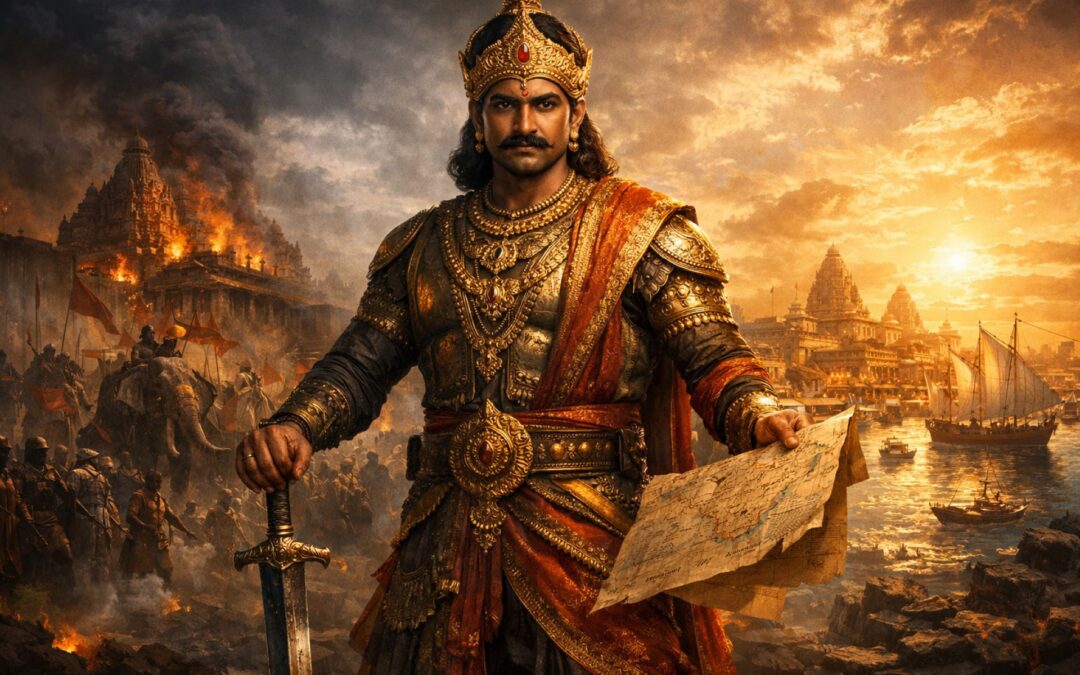
Introduction: The Empire on the Brink
In the year 1070 CE, the mighty Chola Empire stood at the edge of collapse.
For over a century, it had been one of the most powerful forces in Asia—its armies dominating South India, its fleets projecting power across the Indian Ocean, and its administrators governing a vast, complex, multi-ethnic empire with remarkable efficiency. But now, all of that seemed ready to unravel.
The emperor was dead.
The throne was contested.
And across the Deccan, an ambitious rival—Vikramaditya VI—was already moving his pieces, determined to turn the Chola Empire into a puppet state as part of a larger plan to dominate the subcontinent.
Inside the empire, things were no better. Years of constant warfare had drained its strength. Rapid successions had weakened central authority. Regional elites were restless. Old enemies sensed opportunity. New ones were already circling.
This was not just a succession crisis.
This was the kind of moment that ended empires.
And for a brief, dangerous window, it seemed inevitable that the Cholas—once masters of South India and key players in Southeast Asia—would be torn apart by internal chaos and external aggression.
But history rarely unfolds in straight lines.
Far from the imperial capital, a prince with a complicated claim and an uncertain future was watching events closely. He was not yet emperor. He did not command the full might of the Chola state. In fact, he had recently lost much of what was rightfully his.
But he had something far more important.
Strategic clarity.
And the ability to act decisively when the moment arrived.
His name was Kulotunga.
What followed was not just the survival of an empire—but its transformation.
Because Kulotunga Chola would do more than reclaim a throne in chaos. He would rebuild the Chola Empire into something new: leaner, more adaptive, and better suited to a rapidly changing world where power was no longer defined by conquest alone, but by trade, diplomacy, and intelligent governance.
This is the story of how one prince stepped into a collapsing system—and reforged it into a golden age.
The Rise of a South Indian Superpower
Long before the crisis of 1070 CE, the Chola Empire had been one of the most extraordinary success stories in Indian history.
It did not begin that way.
The early Cholas were a relatively modest regional power in Tamilakam, often overshadowed by stronger neighbors like the Pallavas and the Pandyas. For centuries, they remained one among many competing kingdoms in South India, rising and falling with the tides of regional politics.
What changed was timing—and leadership.
The turning point came in the late 10th century, when the Cholas began to expand aggressively during a moment of weakness among their rivals. Instead of simply securing their borders, they did something far more ambitious: they went on the offensive, absorbing former overlords and eliminating competing powers before they could recover.
Then came the two rulers who would define the empire’s golden age—Rajaraja I and his son Rajendra Chola.
Together, they transformed the Cholas from a regional kingdom into a full-fledged imperial power.
Rajaraja I laid the foundation. He consolidated control over Tamil Nadu, subdued the Pandyas and Cheras, and extended Chola authority deep into the southern Deccan. His campaigns were systematic and calculated, ensuring that conquered territories were not just raided—but integrated.
Rajendra Chola took this expansion even further.
Under his leadership, the empire reached its greatest territorial extent. Chola armies marched northward into Odisha and Bengal, demonstrating their reach across the subcontinent. In the south, Sri Lanka was brought firmly under Chola control. And in a move that set the Cholas apart from almost every other Indian power of the time, they turned decisively toward the sea.
The Chola navy became a formidable force.
In a coordinated maritime campaign, Rajendra launched expeditions across the Bay of Bengal, targeting the Srivijaya Empire in Southeast Asia. These operations were not random acts of piracy—they were strategic interventions aimed at controlling key trade routes and weakening rival maritime powers.
The result was profound.
The Cholas emerged not just as a dominant land empire, but as a major player in Indian Ocean trade and Southeast Asian politics. Their influence stretched from the Coromandel Coast to the Malay Archipelago, connecting them to a vast commercial network that linked the Middle East, India, Southeast Asia, and China.
But conquest alone does not sustain an empire.
What truly set the Cholas apart was what they built after victory.
They developed a sophisticated administrative system that was both centralized and data-driven. Revenue collection was organized with remarkable precision. Land surveys and taxation systems ensured a steady flow of income to the state. Instead of relying solely on local elites, the Cholas often installed royal family members as viceroys in key regions, tightening their grip over distant territories.
This was not a loose confederation of conquered lands.
It was an empire in the truest sense—structured, organized, and deeply interconnected.
At its height, the Chola state combined military strength, administrative efficiency, and economic dynamism in a way that few contemporary powers could match.
Which is precisely why its decline, when it came, was so dangerous.
Because the larger and more complex an empire becomes, the harder it is to hold together when things start to fall apart.
The Slow Decline Before the Storm
Empires rarely collapse overnight.
Even at their peak, the seeds of decline are already being sown—hidden beneath victories, masked by expansion, and ignored in moments of triumph. The Chola Empire was no exception.
After the death of Rajendra Chola in 1044 CE, the empire entered a phase of instability that, while not immediately catastrophic, gradually weakened its foundations.
The problem was not a single bad ruler.
It was succession.
In the years that followed, three of Rajendra’s sons ascended the throne in rapid succession. Each transition of power created uncertainty. Each short reign limited the ability to pursue long-term strategy. And with every change at the top, the coherence of imperial governance began to fray.
At the same time, the empire was paying the price of its own success.
Decades of nearly constant warfare had stretched resources thin. Maintaining control over a vast, multi-regional empire required enormous administrative effort and military presence. Garrisons had to be maintained. Tributaries had to be monitored. Rebellions had to be suppressed.
And perhaps most dangerously of all—the Cholas were locked in a relentless struggle with a rival that refused to go away.
The Western Chalukyas.
For decades, the Cholas and the Chalukyas had been engaged in a bitter contest for dominance in the Deccan. This was not a peripheral conflict. It was central to the balance of power in South India.
The stakes were enormous.
Control over fertile riverine deltas—especially along the Andhra coast—meant control over some of the most productive agricultural land in the subcontinent. These regions were economic powerhouses, capable of generating immense wealth. In fact, contemporary estimates suggest that land in these areas could be worth several times more than land in the drier interior regions.
And then there were the ports.
The same coastal regions were also gateways to maritime trade. Whoever controlled them could tap into the lucrative Indian Ocean trade networks that connected India to Southeast Asia, the Middle East, and China.
This made the conflict between the Cholas and the Chalukyas not just a territorial dispute—but an economic war.
And like many long-running rivalries, it became deeply personal.
Inscriptions from the period boast of massive casualties inflicted on the enemy, sometimes claiming the deaths of hundreds of thousands. While such numbers were likely exaggerated, they reflect the intensity of the hatred between the two powers.
This was not a rivalry that could be easily resolved.
It was a cycle of invasion, retaliation, and counter-invasion that drained both sides—especially the Cholas, who were already managing a larger and more complex empire.
By the mid-11th century, the signs were clear.
The empire was still powerful—but it was no longer invincible.
Its leadership was less stable.
Its resources were more stretched.
Its enemies were just as determined.
And all it would take was one well-timed crisis to push the entire system to the brink.
That crisis arrived in 1070 CE.
And when it did, it brought with it a man who understood exactly how to exploit it.
Vikramaditya VI and the Game of Thrones Begins
If the Chola Empire was weakening, there was one man who saw it clearly—and intended to take full advantage of it.
Vikramaditya VI.
He was not yet the undisputed ruler of the Western Chalukyas. In fact, he wasn’t even the emperor. He was the younger brother—technically subordinate, politically constrained, and expected to remain in the shadows.
But Vikramaditya was anything but ordinary.
He was a brilliant commander, already proven in campaigns that reached deep into North India. More importantly, he was a master of strategy—not just on the battlefield, but in the far more dangerous arena of politics.
Where others saw loyalty, he saw opportunity.
Where others followed rules, he rewrote them.
The moment came in 1068 CE, when the Cholas launched yet another invasion into Chalukya territory.
Most commanders would have responded with force.
Vikramaditya chose something far more effective—diplomacy.
He quietly undermined his own brother, the reigning Chalukya emperor, portraying him as a reckless warmonger who was dragging the kingdom into unnecessary conflict. Behind the scenes, he built alliances with powerful feudatories, creating a support base independent of the central authority.
Then, in a move that would have been unthinkable for a conventional prince, he negotiated directly with the enemy.
He brokered a peace deal with the Cholas—without his brother’s approval.
And he didn’t stop there.
As part of the agreement, Vikramaditya married a Chola princess, the daughter of the Chola emperor himself. With that single move, he embedded himself within the Chola royal network, gaining not just legitimacy—but leverage.
The consequences were immediate.
The Chalukya Empire split in two.
Vikramaditya effectively carved out control over the southern half, establishing himself as an independent power. The northern half remained under his brother—for now. Reunification could wait. Timing, as always, was everything.
Then came the opportunity he had been waiting for.
In 1070 CE, the Chola emperor—his father-in-law—died suddenly.
The throne passed to Adhirajendra, Vikramaditya’s brother-in-law.
And Vikramaditya saw exactly what this meant.
This was not just a succession.
This was an opening.
Through his familial connection, he could influence the new emperor directly. More importantly, he could turn him into a puppet—someone who would rule in name, while real power flowed through Vikramaditya himself.
If successful, the implications were enormous.
The Chola Empire—one of the most powerful states in Asia—would effectively fall under Chalukya control without the need for a full-scale conquest. It would become a stepping stone for something even greater: domination of the Deccan, and perhaps, in time, all of India.
It was a bold plan.
And for a brief moment, it looked like it might actually work.
The Chola throne was unstable.
The empire was fractured.
And its enemies were already inside the gates.
But Vikramaditya had overlooked one critical factor.
There was another claimant.
One who was not only legitimate—but far more dangerous than he realized.
Kulotunga: The Making of a King
Long before he became the man who would save an empire, Kulotunga was being shaped for power.
Not in comfort.
But in complexity.
He was born into a world where identity itself was political capital. His mother, Ammangadevi, was a Chola princess—directly tied to one of the most powerful dynasties in South India. His father, Rajaraja Narendra, was the king of Vengi, a strategically vital kingdom along the Andhra coast.
This made Kulotunga something rare.
A bridge between two worlds.
Through his father, he had a rightful claim to Vengi. Through his mother, he had a legitimate connection to the Chola throne. In a more stable time, this dual lineage might have been a complication.
In an age of crisis, it would become his greatest strength.
As a young prince, Kulotunga was brought to the Chola capital, Gangaikonda Cholapuram—the symbolic and administrative heart of the empire. This was not just a ceremonial upbringing. It was an education in empire.
Here, he would have witnessed firsthand how power was exercised at scale.
How revenue was collected across vast territories.
How officials coordinated governance across regions.
How military campaigns were planned and executed.
How diplomacy, trade, and politics intertwined.
He was not being raised merely as a regional prince.
He was being trained—consciously or not—to think like an imperial ruler.
And when the time came, he proved it.
As he grew into adulthood, Kulotunga was sent to the frontiers of the empire—where theory met reality. These were not symbolic assignments. They were real tests of capability, carried out in regions where Chola authority was contested or weakening.
In Kalinga, he led expeditions to bring rebellious territories back under control.
In the central Indian regions of present-day Chhattisgarh, he reasserted Chola influence over unstable frontier zones.
And beyond the subcontinent, he commanded a naval expedition to Kadaram in northern Malaysia—an operation that demonstrated both logistical sophistication and strategic reach. There, he overthrew a hostile ruler and installed a loyal vassal, reinforcing Chola influence in Southeast Asia.
These were not isolated successes.
They revealed a pattern.
Kulotunga was decisive—but not reckless.
He understood when to strike—and when to consolidate.
He was capable of operating across very different environments—land campaigns, frontier politics, and maritime expeditions.
In short, he was exactly the kind of leader the empire would need in a moment of crisis.
And people noticed.
In the volatile world of 11th-century politics, rising talent was never ignored. Allies saw potential. Rivals saw a threat. Opportunists saw an obstacle.
Because Kulotunga’s continued ascent meant one thing.
The Chola Empire still had a future.
And for those who stood to gain from its collapse, that future had to be stopped.
The first move against him would not come on the battlefield.
It would come through succession.
A Prince Without a Throne
For all his promise, Kulotunga’s rise was anything but smooth.
In fact, at a critical moment in his life, he lost everything that should have been his.
In 1061 CE, his father—the king of Vengi—died.
By all rights, Kulotunga was the legitimate heir. His claim was strong, his lineage unquestionable. But legitimacy, in medieval politics, was only one part of the equation.
Power had to be taken—or defended.
And Kulotunga’s rivals moved quickly.
Instead of allowing him to ascend the throne, competing factions backed his uncle as the new ruler of Vengi. This was not an accident. It was a calculated move—one designed to sideline a rising figure who was becoming too powerful, too capable, and too closely tied to the Chola imperial core.
Kulotunga was pushed out.
Stripped of his inheritance.
Reduced, at least on paper, to a prince without a kingdom.
For many, this would have been the end of the story.
But Kulotunga did not disappear.
He adapted.
Rather than launching a desperate, premature attempt to reclaim Vengi, he chose a different path—one that reveals a great deal about the kind of leader he would become.
He withdrew.
But not in defeat.
In the frontier region of Chakrakuta—located in what is now Chhattisgarh—he began to rebuild. This was not the heart of an empire. It was a rugged, contested zone, far from the polished centers of power. But it offered something far more valuable.
Time.
And space.
Here, Kulotunga gathered the forces that remained loyal to him. He built a base of power from the ground up, consolidating control over a smaller but secure territory. It was a slow, deliberate process—one that required patience, discipline, and an understanding that timing mattered more than speed.
He did not rush.
He did not overextend.
He waited.
And while he waited, he watched.
He watched as the Chola Empire, his mother’s world, began to destabilize.
He watched as succession disputes weakened central authority.
He watched as Vikramaditya maneuvered his way into influence.
He watched as the system that had once seemed unshakable began to crack.
Most importantly, he understood something that many others did not.
Moments of chaos create openings—but only for those prepared to seize them.
By the late 1060s, the political landscape of South India was shifting rapidly. Old structures were weakening. New alliances were forming. And the balance of power was becoming increasingly fluid.
Kulotunga was no longer just a displaced prince.
He was a man with a claim, an army, and a growing opportunity.
All he needed now was the right moment.
It arrived in 1070 CE—when the Chola Empire, already fragile, plunged into full-scale anarchy.
1070 CE: The Empire Falls into Anarchy
When the crisis finally came, it came fast.
In 1070 CE, the death of Emperor Veera Rajendra Chola shattered what little stability remained in the empire. The succession was not smooth. It was not orderly. It was not even uncontested.
It was chaotic.
Into this vacuum stepped Adhirajendra—the new ruler, backed not by overwhelming legitimacy, but by external influence. His ascent to the throne was deeply entangled with Vikramaditya VI, who now stood poised to control the Chola Empire from behind the scenes.
On paper, the transition was complete.
In reality, the empire was unraveling.
Across the Chola domains, uncertainty spread like wildfire. Regional elites began to question authority. Tributary states sensed weakness. Long-suppressed tensions resurfaced. What had once been a tightly governed imperial system began to fracture under pressure.
Contemporary South Indian records describe this period in stark terms.
A time of disorder.
A time of instability.
A time of fear.
And not without reason.
Because this was precisely the kind of moment that invited intervention.
External powers were watching closely. Rivals who had spent decades fighting the Cholas now saw their chance. Rebellions simmered. Alliances shifted. The possibility of the empire being carved up—piece by piece—no longer seemed remote.
Inside the empire, the situation was even more volatile.
Adhirajendra struggled to command loyalty.
There were whispers—then open accusations—that he was little more than a puppet of the Chalukyas. For a proud imperial state like the Cholas, this was unacceptable. Legitimacy was everything, and once it was questioned, authority could collapse quickly.
To make matters worse, his rule appears to have alienated segments of his own population.
Religious tensions flared. Records suggest that he took a hardline stance against certain religious groups, including followers of the influential philosopher Ramanuja. Whether exaggerated or not, such actions would have eroded whatever goodwill he might have had among his subjects.
By this point, the Chola Empire was facing a perfect storm.
A weak and contested ruler.
A powerful external manipulator.
Internal unrest across multiple regions.
And a growing sense that the center could no longer hold.
It was, in every sense, an imperial breakdown.
And yet, within this chaos, there was also an opportunity.
Because when systems collapse, they create space—not just for destruction, but for transformation.
Kulotunga understood this.
While others saw instability, he saw a narrow window—a moment where decisive action could reshape the entire political landscape.
But he would have to move quickly.
Because if he hesitated, someone else would seize control.
And this time, it wouldn’t just be a throne at stake.
It would be the future of the Chola Empire itself.
The Lightning Campaign for Power
Kulotunga did not wait.
When the Chola Empire descended into chaos in 1070 CE, he moved with a speed and clarity that would define his legacy. This was not a gradual rise. It was a calculated strike—executed at precisely the moment when the existing order was weakest.
His first objective was clear.
Vengi.
Before he could claim the Chola throne, he needed to secure his paternal inheritance. Without Vengi, he would lack the resources, legitimacy, and strategic depth required to challenge for imperial power.
So he acted—fast.
In a matter of months, Kulotunga launched a rapid campaign into Vengi. His forces moved decisively, overwhelming resistance and reestablishing his claim over the kingdom. But what stands out is not just the speed of the conquest—it is what he did next.
He showed restraint.
Instead of eliminating his uncle, the very man who had been placed on the throne in his place, Kulotunga chose to spare him. More than that, he allowed him to continue ruling—now as a subordinate.
This was not mercy.
It was strategy.
By keeping his uncle in place, Kulotunga avoided unnecessary disruption while gaining immediate access to Vengi’s administrative machinery, military manpower, and logistical networks. He transformed a rival into a resource—and in doing so, strengthened his own position without wasting time.
Now he was ready for the real prize.
The Chola heartland.
With Vengi secured, Kulotunga turned south. Backed by fresh troops and a solid logistical base, he advanced toward the core of the empire—where Adhirajendra still held the throne, but not the loyalty of his people.
The confrontation was inevitable.
We do not know the exact details of what followed. The historical record is fragmentary, shaped by later narratives and incomplete inscriptions. But the outcome is clear.
Adhirajendra died.
Whether in battle, in a palace revolt, or in the chaos of collapsing authority, his reign came to a sudden and violent end. With the puppet removed, the final obstacle to Kulotunga’s rise disappeared.
And Kulotunga stepped in.
He was crowned as the new emperor of the Chola Empire.
But this was not just a change of ruler.
It was the beginning of a new dynasty.
For the first time, the Chola throne passed into a line that combined both Chola and Vengi royal blood in a direct and unified way. This was more than symbolic—it reflected a broader shift in the structure of power.
Kulotunga had not simply seized control.
He had reconfigured the system.
In a matter of months, he had gone from a displaced prince with no kingdom…
to the ruler of one of the most powerful empires in Asia.
But taking the throne was only the beginning.
Because what he inherited was not a stable empire.
It was a fractured, volatile system—on the verge of breaking apart.
And holding it together would require far more than speed.
It would require vision.
Rebuilding a Broken Empire
Kulotunga had won the throne.
But the empire he inherited was barely holding together.
The crisis of 1070 CE had not just been a political event—it had triggered a chain reaction across the Chola world. Authority had weakened. Control had slipped. And in region after region, local powers had begun testing the limits of imperial rule.
Rebellions were already underway.
In Sri Lanka, resistance to Chola authority was intensifying.
In the Deccan, old fault lines were reopening.
In Kerala and the Pandya country, local rulers were asserting autonomy.
This was the real test.
Not conquest—but control.
And Kulotunga understood that restoring order would not be a single campaign. It would be a sustained effort, requiring both force and judgment.
To make matters worse, the instability was not entirely organic.
Vikramaditya VI was still in play.
From the outside, he actively supported rebellions across the Chola Empire, turning local unrest into a coordinated pressure campaign. This was classic indirect warfare—destabilize the empire from within, force it to overextend, and then move in when it weakens further.
Kulotunga was now facing threats on multiple fronts.
And yet, he did not panic.
He responded methodically.
Where rebellion threatened core regions, he acted with force—moving quickly to reassert authority and send a clear message that the empire was still capable of defending itself. Campaigns were launched. Territories were retaken. Loyalists were restored to positions of power.
But what’s striking is what he did not do.
He did not attempt to crush every rebellion at any cost.
He did not overcommit to distant territories simply to preserve the illusion of total control.
Instead, he made distinctions.
Some regions were essential. Others were expendable.
Some threats required immediate military action. Others could be managed, contained, or even tolerated—at least temporarily.
This was a shift in mindset.
Earlier Chola rulers, at the height of imperial expansion, had pursued dominance across all fronts. Kulotunga, inheriting a weakened system, recognized that survival required prioritization.
He was no longer fighting to expand the empire.
He was fighting to stabilize it.
And that meant making difficult choices—decisions that might have seemed unthinkable to his predecessors.
The first of those decisions would define his approach to leadership.
Because in one of the most surprising moves of his reign, Kulotunga chose not to fight a war he could have won.
He chose to let go.
The Strategic Masterstroke: Letting Sri Lanka Go
For over half a century, Sri Lanka had been under Chola control.
It was not just another territory. It was a symbol of imperial reach—a demonstration that the Cholas were not confined to the mainland, but were capable of projecting power across the sea. Holding Lanka had once made strategic sense.
But by 1070 CE, the situation had changed.
The island was in revolt.
A rebellion had broken out, fueled not just by local resistance, but by betrayal from within. A Chola governor had turned against the empire, and external forces—most notably Vikramaditya—were more than willing to support the uprising.
Kulotunga now faced a choice.
He could launch a full-scale campaign to reconquer Sri Lanka, reassert control, and restore imperial prestige.
Or he could walk away.
For a traditional imperial ruler, the answer would have been obvious.
Fight.
Reclaim.
Punish.
But Kulotunga was not thinking like a traditional ruler.
He was thinking like a strategist.
He understood that Sri Lanka, while valuable, was not essential. Holding it required constant military presence, logistical effort, and administrative attention—all of which were in short supply at a time when the empire was already stretched thin.
More importantly, he recognized something deeper.
The real strength of the Chola Empire did not come from holding distant territories.
It came from controlling trade.
And in that regard, Sri Lanka was not indispensable.
The Cholas still dominated key ports along the Malabar and Coromandel coasts. They were still deeply embedded in the Indian Ocean trade networks that connected the Middle East, India, Southeast Asia, and China. Losing Sri Lanka did not mean losing access to wealth.
It meant shedding a costly commitment.
So Kulotunga made a decision that would have seemed shocking to many of his contemporaries.
He let Sri Lanka go.
He did not launch a massive reconquest campaign.
He did not drain his resources in a prolonged war.
He accepted the loss—and moved on.
This was not weakness.
It was clarity.
By giving up Sri Lanka, Kulotunga freed up troops, resources, and attention—allowing him to focus on what truly mattered: securing the core of the empire and preparing for the far more dangerous threats that lay ahead.
And those threats were already gathering.
Because even as Kulotunga stabilized his empire, his greatest rival was preparing to strike again.
This time, the target was not a distant island.
It was the heart of his power—Vengi itself.
The Battle for Vengi and the Clash of Empires
If Sri Lanka was a calculated loss, Vengi was non-negotiable.
It was the keystone of Kulotunga’s power.
Geographically, it sat between the Tamil heartland and the Deccan—a strategic buffer and a gateway. Economically, it was one of the richest regions in South India, with fertile lands and access to critical trade routes. Politically, it was the foundation of Kulotunga’s legitimacy through his paternal line.
Losing Vengi was not an option.
And soon enough, that reality was tested.
In 1075 CE, Kulotunga’s uncle—the same man he had allowed to rule Vengi as a subordinate—died. For the first time, Kulotunga was in a position to fully integrate the kingdom into the Chola Empire under his direct rule.
If successful, this would create something formidable.
A unified Chola–Vengi state, combining the administrative strength of the Cholas with the economic and strategic advantages of Vengi. It would not just restore the empire—it would elevate it to a new level.
Naturally, his enemies could not allow this to happen.
Vikramaditya VI moved quickly.
Determined to prevent the consolidation of power, he launched an invasion aimed directly at Vengi. But he did not act alone. He secured the support of Rajaraja Deva, the king of Kalinga—another regional power with its own ambitions over Vengi’s rich lands.
This was no longer a localized conflict.
It was a multi-front war.
From the Deccan, Vikramaditya advanced.
From the east, Kalinga forces pressed in.
The objective was clear: overwhelm Kulotunga before he could consolidate.
But Kulotunga was ready.
He had anticipated this.
Unlike the chaos of 1070 CE, he now commanded a more stable base of power. His forces were organized. His supply lines were secured. And perhaps most importantly, he was fighting on terrain he understood—both politically and geographically.
The response was swift and effective.
Kulotunga’s forces engaged the invading armies across multiple fronts, preventing them from coordinating effectively. Instead of allowing himself to be surrounded, he broke the momentum of each attack—turning a potential disaster into a series of contained conflicts.
And then he did something characteristic.
He counterattacked.
The Chola response was not limited to defense. Once the immediate threat was neutralized, Kulotunga pushed outward, carrying the fight into enemy territory. His forces advanced deep enough to secure regions as far as Mysore, demonstrating that the Cholas were still capable of projecting power beyond their borders.
The message was unmistakable.
The empire was not collapsing.
It was fighting back.
Vikramaditya understood the situation.
He had taken his shot—and failed.
Continuing the conflict risked overextension, especially with his own ambitions within the Chalukya realm still unresolved. So, for the moment, he chose pragmatism.
A deal was struck.
Hostilities eased.
And an uneasy peace settled over the region.
But this was not the end of the story.
Because while the western front stabilized, the eastern front was still in motion.
Kalinga had not been fully dealt with.
And Kulotunga was not the kind of ruler who left unfinished business behind.
Securing the Frontiers: Kalinga and the Pandyas
With the immediate threat from Vikramaditya contained, Kulotunga turned his attention to unfinished business.
Kalinga.
The eastern kingdom had not just supported the invasion of Vengi—it had actively tried to take advantage of Chola instability. That could not go unanswered.
Kulotunga responded the way he often did: decisively, and with long-term intent.
Chola forces pushed into Kalinga in a counter-invasion, reasserting authority and breaking the momentum of resistance. But more importantly, Kulotunga did not treat Kalinga as just another conquered territory.
He integrated it into his system.
Instead of relying on distant oversight, he placed members of his own family in positions of power. His sons were appointed as viceroys, ensuring that Kalinga would remain firmly within the Chola sphere of influence. This was a familiar strategy—one that the earlier Cholas had used effectively—but Kulotunga applied it with renewed precision.
And the effects were lasting.
Over time, the connection between the Cholas and Kalinga became deeply embedded. Local rulers began to adopt Chola-linked identities, even incorporating Chola lineage into their own claims to legitimacy. It was not just political control.
It was cultural influence.
But while Kalinga could be integrated, the situation in the south required a different approach.
The Pandya country was a constant challenge.
Unlike distant regions, the Pandyas were not just subjects—they were long-standing rivals, deeply rooted in the Tamil political landscape. They had their own identity, their own ambitions, and a long history of resisting Chola dominance.
Direct control had always been difficult.
The earlier Chola system—placing viceroys over the region—had worked to an extent, but it was increasingly clear that it was not a permanent solution. The more pressure was applied, the more resistance it generated.
Kulotunga recognized the pattern.
And instead of forcing control, he adjusted it.
He allowed the Pandyas a degree of autonomy, treating them as semi-independent feudatories rather than tightly controlled provinces. They were still under Chola authority—but they were given space to govern themselves.
At the same time, he ensured that this autonomy did not turn into rebellion.
Strategically placed military cantonments were established across the region. These were not just defensive outposts—they were instruments of control, allowing the Cholas to respond quickly to any sign of unrest.
It was a hybrid system.
Local autonomy—backed by imperial force.
This approach achieved something that brute force alone could not.
Stability.
For the first time in years, the southern front quieted down. The Pandyas remained within the Chola sphere, but without the constant cycle of rebellion and suppression that had defined earlier periods.
By the late 1070s, the picture had changed dramatically.
The western front had stabilized.
The eastern front had been secured.
The southern front had been managed.
The empire was no longer on the brink.
It was under control.
And for the first time since his rise, Kulotunga could begin to shift his focus.
From survival… to governance.
From Conqueror to Statesman
By the late 1070s, Kulotunga had achieved something remarkable.
He had inherited a collapsing empire, fought off multiple threats, stabilized its frontiers, and reasserted central authority. The immediate crises had been contained. The system, though battered, was no longer breaking apart.
Now came the harder part.
Ruling it.
Because conquest and control are not the same thing.
Many rulers excel at expansion. Fewer know how to govern what they have won. Kulotunga understood that the future of the Chola Empire would not be decided on the battlefield—but in administration, policy, and long-term stability.
And so, he shifted.
From commander…
to statesman.
One of the defining features of his rule was his approach to leadership. Kulotunga did not try to micromanage a vast empire stretching across multiple regions and cultures. Instead, he built a system that relied on capable individuals—ministers, administrators, and local officials who could execute policy effectively.
The historical record makes this clear.
Inscriptions from his reign frequently praise not just the king—but his ministers and close allies. This was not accidental. Kulotunga understood that a complex empire required a network of competent actors, not just a powerful ruler at the top.
He delegated.
But he did so carefully.
Power was distributed—but within a framework that ensured loyalty and accountability. Trusted individuals were placed in key roles. Regional governance was structured in a way that balanced local realities with imperial priorities.
This was governance as design.
Not just control—but coordination.
At the same time, Kulotunga demonstrated a keen awareness of changing realities.
The world of the late 11th century was not the same as that of Rajaraja or Rajendra. The dynamics of power were shifting. Military strength still mattered—but economic strength was becoming just as important, if not more so.
Trade was expanding.
Merchant networks were growing.
Wealth was flowing through ports, not just through land revenue.
Kulotunga recognized this shift—and adapted to it.
He did not abandon the military. When necessary, he could still act with speed and brutality, as seen in his handling of rebellions. But he no longer treated conquest as the primary tool of statecraft.
Instead, he began to focus on something far more sustainable.
Prosperity.
A stable, prosperous empire was harder to destabilize. It generated its own momentum. It aligned the interests of rulers, elites, and common people in ways that constant warfare never could.
And to build that kind of system, Kulotunga would need to rethink how the empire interacted with its most powerful emerging force.
The merchant guilds.
Because in the Chola world of the late 11th century, wealth was becoming power.
And those who controlled trade were becoming impossible to ignore.
The Economic Revolution of the Chola Empire
If Kulotunga’s military campaigns saved the empire, his economic policies transformed it.
By the late 11th century, the Indian Ocean was no longer just a collection of regional trade routes. It had evolved into a vast, interconnected commercial system—linking the Middle East, India, Southeast Asia, and China in a continuous flow of goods, capital, and influence.
And at the center of this system sat the Chola Empire.
Its ports along the Coromandel and Malabar coasts were some of the busiest in the region. Merchants moved textiles, spices, precious metals, and luxury goods across thousands of miles. Ships sailed regularly between South India and Southeast Asia, carrying not just commodities—but ideas, culture, and political influence.
This was not a peripheral economy.
This was the bloodstream of the empire.
Kulotunga understood this better than most.
Where earlier rulers had focused heavily on land revenue and territorial expansion, Kulotunga recognized that the future of power lay in trade. And instead of trying to control it through heavy taxation or rigid oversight, he made a decision that was both radical and deeply strategic.
He removed barriers.
Tolls.
Duties.
Trade restrictions.
He abolished them.
At a time when most states saw commerce as something to be taxed and extracted from, Kulotunga treated it as something to be enabled. By eliminating costs and friction, he made Chola ports more attractive than ever.
The result was predictable—and powerful.
Trade surged.
Merchants flocked to Chola-controlled ports. Commercial activity intensified. The volume of goods moving through the empire increased dramatically, generating wealth not through direct extraction—but through scale.
It was a shift in mindset.
From taxing trade…
to growing it.
But Kulotunga did not stop there.
He recognized that the real drivers of this system were not the ports themselves—but the merchant guilds that operated across them.
These guilds were not small, local organizations.
They were massive, transregional networks.
They maintained their own ships.
They organized long-distance trade expeditions.
They negotiated directly with foreign rulers.
And, perhaps most strikingly…
They had their own armies.
By the late 11th century, merchant guilds had accumulated enough wealth and influence to fund military campaigns, protect trade routes, and even shape political outcomes. They were not just economic actors.
They were power centers.
Kulotunga had two options.
He could try to control them.
Or he could work with them.
He chose the latter.
Instead of clashing with merchant interests, he aligned the state with them. His pro-trade policies ensured that guilds thrived under Chola rule. In return, the guilds contributed to the stability and prosperity of the empire—financing projects, supporting trade networks, and reinforcing Chola influence abroad.
It was a symbiotic relationship.
The state enabled trade.
Trade enriched the state.
And together, they created a system that was far more resilient than one based purely on conquest.
Kulotunga’s approach was, in many ways, ahead of its time.
He understood that economic power could achieve what military force often could not—that influence could be projected through commerce just as effectively as through armies.
And as trade expanded, so did the reach of the Chola world.
Because the empire was no longer defined only by the lands it controlled.
It was defined by the networks it dominated.
The Chola World System
By the time Kulotunga’s economic policies began to take full effect, the Chola Empire was no longer just a territorial state.
It had become a network.
A system of influence that extended far beyond its formal borders—reaching across the Indian Ocean into Southeast Asia and China. Power was no longer measured only in land held or armies fielded, but in connections maintained and flows controlled.
The Cholas were at the center of this system.
Across Southeast Asia, their presence was felt not just through past conquests, but through ongoing diplomacy and trade. Kingdoms from regions like Pegu and Angkor sent embassies to the Chola court, carrying gifts, tribute, and recognition of Chola prestige.
These were not acts of submission in the traditional sense.
They were acknowledgments of influence.
At the same time, the Cholas were not passive recipients. Kulotunga continued the long-standing tradition of sending embassies abroad, most notably to Song China—one of the most powerful and economically advanced states of the time.
These diplomatic missions served multiple purposes.
They strengthened commercial ties.
They enhanced prestige.
They embedded the Cholas within a wider international order.
This was diplomacy as strategy.
Not for territorial gain—but for systemic influence.
And at the heart of this system were the merchant guilds.
Operating across ports from South India to Southeast Asia, these guilds functioned as both economic and diplomatic agents. They negotiated trade agreements, established commercial enclaves, and maintained long-distance networks that tied distant regions together.
In many cases, they acted almost like extensions of the state.
Not formally controlled—but aligned.
Through them, Chola influence reached places where armies did not. Markets became points of contact. Trade routes became channels of power. And the boundaries of the empire became more fluid—defined less by borders and more by participation in a shared system.
This was a different kind of dominance.
Not imposed…
but integrated.
Kulotunga’s genius lay in recognizing that this system could be more valuable than territorial expansion. By strengthening the networks rather than stretching the borders, he ensured that the Chola Empire remained relevant in a rapidly changing world.
Because while empires built purely on conquest often collapse when expansion stops…
Systems built on exchange can endure.
Under Kulotunga, the Chola Empire was no longer just a kingdom that ruled land.
It was a power that connected worlds.
Justice, Power, and Authority
For all his pragmatism and economic vision, Kulotunga never forgot a fundamental truth of empire:
Authority must be enforced.
Stability, prosperity, and trade could strengthen the system—but they could not replace power. And when that power was challenged, Kulotunga responded without hesitation.
His rule was not soft.
It was balanced.
He could be flexible where flexibility made sense—allowing autonomy in the Pandya country, tolerating the loss of Sri Lanka, working with merchant guilds. But when a subordinate openly defied him, especially in ways that threatened the structure of the empire, the response was swift and uncompromising.
The clearest example of this came from Kalinga.
Despite earlier integration into the Chola system, the region did not remain quiet indefinitely. At some point in the early 12th century, its ruler—Anantavarman, a prince with Chola blood ties—began to challenge imperial authority.
He stopped paying tribute.
Not once.
But repeatedly.
This was more than a minor act of defiance.
Tribute was not just about revenue—it was a symbol of hierarchy. Refusing it was a statement: a rejection of Chola supremacy.
Kulotunga understood the implications immediately.
If left unanswered, it would set a precedent. Other regions might follow. The carefully rebuilt structure of the empire could begin to unravel once again.
So he acted.
He dispatched one of his most trusted generals—Karunakara—to deal with the situation. The campaign that followed was not a limited intervention. It was a full demonstration of imperial force.
Chola armies advanced into Kalinga.
They did not just defeat resistance—they dismantled it.
The region was devastated. Anantavarman was overthrown, and according to historical accounts, he disappeared from the record entirely. The message was unmistakable.
Defiance would not be negotiated.
It would be crushed.
And yet, this was not mindless brutality.
It was calculated.
Kulotunga did not rely on violence as a default tool. But when he used it, he used it decisively—ensuring that the cost of rebellion was so high that it discouraged future challenges.
This balance—between restraint and force—was central to his success.
Too much leniency, and the empire would fragment.
Too much brutality, and it would destabilize itself.
Kulotunga walked that line carefully.
He allowed autonomy where it strengthened the system.
He enforced authority where it protected the system.
And in doing so, he maintained something that had nearly been lost in 1070 CE.
Legitimacy.
Because in the end, an empire does not survive on power alone.
It survives when its power is recognized, accepted, and—when necessary—feared.
A Golden Age Reforged
By the time Kulotunga’s reign matured, the transformation was undeniable.
The Chola Empire—once on the brink of collapse—had entered a new phase of stability and prosperity. Not the explosive, conquest-driven expansion of Rajaraja or Rajendra, but something more enduring.
A system that worked.
The constant cycle of large-scale wars slowed. Major external threats were contained. Internal rebellions became less frequent—and when they did occur, they were handled swiftly, without destabilizing the entire structure.
For the first time in decades, the empire could breathe.
And that breathing space translated into prosperity.
Trade flourished across the Indian Ocean. Chola ports remained among the most active in Asia, attracting merchants from across the known world. Wealth flowed not just into royal coffers, but into towns, markets, and communities.
This mattered.
Because an empire is not sustained by its rulers alone—it is sustained by the lives of its people.
Under Kulotunga, the relative peace allowed agriculture to stabilize, commerce to expand, and local economies to recover from the strain of decades of warfare. The benefits were not uniform, and not every region experienced the same level of prosperity, but the overall trend was clear.
The system was functioning again.
And this time, it was better adapted to its environment.
Kulotunga’s Chola Empire was different from the one he had inherited.
It was less obsessed with territorial expansion.
More focused on consolidation.
More integrated with trade networks.
More flexible in its governance.
In many ways, it was a more modern state.
He had taken an empire built on conquest—and reshaped it into one sustained by balance.
Military strength remained important, but it was no longer the only pillar. Economic vitality, administrative competence, and strategic restraint became equally central to the empire’s survival.
And perhaps most importantly…
The empire endured.
For decades after the crisis of 1070 CE, the Chola state remained a major force in South India and the wider Indian Ocean world. It did not vanish in chaos. It did not fragment beyond repair.
It adapted.
And that adaptation was Kulotunga’s greatest achievement.
Because saving an empire in a moment of crisis is one thing.
Rebuilding it in a way that allows it to survive long after you are gone…
That is something else entirely.
Legacy of Kulotunga Chola
Kulotunga Chola did not inherit a golden age.
He created one.
When he stepped onto the stage of history, the Chola Empire was fractured, unstable, and dangerously exposed to both internal collapse and external takeover. The system that had once made it powerful was no longer holding.
And yet, by the end of his reign, that same empire stood stable, prosperous, and deeply integrated into one of the most dynamic economic networks in the world.
That transformation is his legacy.
He was not the greatest conqueror in Chola history.
He did not lead the most dramatic expansions.
But he may have been the most important ruler the empire ever had.
Because he understood something that many great conquerors do not:
What to do after the victories are over.
Kulotunga’s leadership was defined by adaptation.
He recognized that the age of relentless territorial expansion had limits. That the costs of holding distant lands could outweigh their benefits. That economic power could rival—and sometimes surpass—military power.
And he acted on that understanding.
He made difficult choices—like abandoning Sri Lanka—not out of weakness, but out of strategic clarity. He restructured governance to balance central authority with local autonomy. He embraced the rise of merchant guilds instead of resisting them. And he maintained a careful equilibrium between flexibility and force.
This was not traditional kingship.
This was statecraft.
In many ways, Kulotunga represents a different model of imperial success—one that is less about dramatic conquest and more about intelligent consolidation. Less about expansion at any cost, and more about sustainability.
And that model worked.
The Chola Empire did not collapse after him. It continued—shaped by the systems he refined, strengthened by the stability he created.
His influence extended beyond his own reign.
It could be seen in the continued importance of trade networks, in the administrative structures that endured, and even in the cultural and political connections between regions like Tamil Nadu and Kalinga.
But perhaps the most important part of his legacy is this:
At a moment when collapse seemed inevitable…
He changed the trajectory of an entire empire.
Not by force alone.
But by understanding the world he ruled—and reshaping his empire to fit it.
That is why Kulotunga Chola deserves to be remembered not just as a ruler who saved an empire—
But as one who reinvented it.
Conclusion
In 1070 CE, the Chola Empire stood on the edge of collapse.
A weak succession.
A powerful external rival.
Internal unrest spreading across regions.
All the ingredients of imperial downfall were in place.
And yet, the empire did not fall.
Because at that exact moment, a different kind of leader stepped forward.
Kulotunga Chola did not simply seize power—he understood the nature of the crisis he was inheriting. He recognized that the old model of empire—endless conquest, rigid control, expansion at any cost—was no longer sustainable in a changing world.
And instead of clinging to it, he evolved.
He chose strategy over pride.
Pragmatism over tradition.
Adaptation over rigidity.
He let go of territories that drained resources.
He strengthened regions that mattered.
He aligned the state with emerging economic forces.
He balanced authority with flexibility.
In doing so, he did something far more difficult than winning battles.
He rebuilt a system.
A system that could endure.
Because the true measure of a ruler is not just what they conquer—but what they leave behind. And Kulotunga left behind an empire that was stronger, more resilient, and better suited to its time than the one he had inherited.
His story is not just about saving the Chola Empire.
It is about understanding when to change—and having the courage to do it.
And that is why, centuries later, his reign still stands as one of the most remarkable examples of leadership in Indian history.