
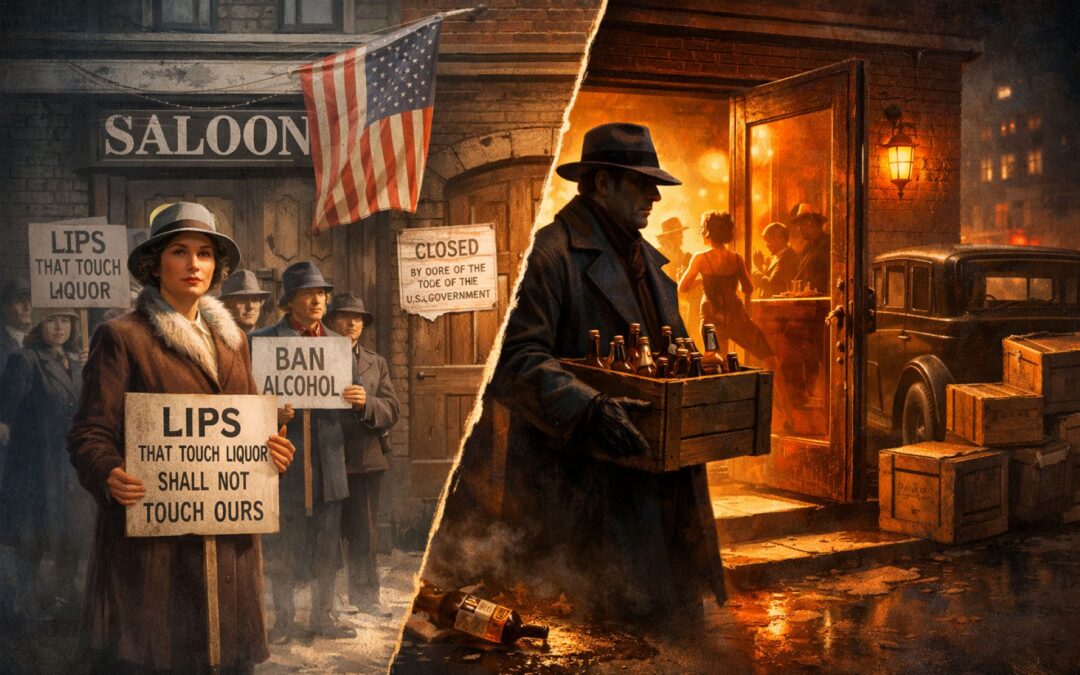
Few social experiments in modern history have been as ambitious—or as controversial—as America’s attempt to ban alcohol. Known as Prohibition, this national policy lasted from 1920 to 1933 and represented one of the most sweeping efforts ever made by a government to regulate personal behavior. Supporters believed it would eliminate social problems associated with drinking, strengthen families, improve worker productivity, and usher in a new era of moral discipline. Instead, it produced a complicated legacy filled with unintended consequences.
Prohibition did not emerge suddenly. It was the result of decades of activism, political organization, and social reform movements that sought to curb what many Americans saw as a destructive drinking culture. For reformers, alcohol was not merely a beverage—it was a threat to public health, family stability, and social order. Their campaigns eventually culminated in the passage of the Eighteenth Amendment, which made the manufacture, sale, and transportation of alcoholic beverages illegal across the United States.
At first, the change appeared revolutionary. A country famous for its drinking habits had voluntarily outlawed alcohol through its own constitutional system. But the reality of enforcing such a sweeping ban quickly proved far more complicated than its supporters anticipated. Loopholes in the law, limited enforcement resources, widespread corruption, and the persistence of public demand turned Prohibition into a massive challenge for the American legal system.
Rather than eliminating alcohol entirely, the ban pushed it underground. Illegal distilleries flourished, smuggling networks stretched across borders and coastlines, and secret drinking establishments known as speakeasies appeared in cities across the country. Organized crime groups seized the opportunity to supply the demand, transforming bootlegging into one of the most profitable criminal enterprises in American history.
By the late 1920s, Prohibition had become a deeply divisive national issue. Critics argued that the policy had weakened respect for the law, empowered criminal networks, and fostered corruption in government institutions. When the Great Depression struck and the nation faced economic catastrophe, support for repeal grew rapidly. In 1933, the Twenty-First Amendment officially ended Prohibition, bringing the experiment to a close.
The story of Prohibition is therefore not just about alcohol. It is about the limits of government power, the unpredictability of social reform, and the complex relationship between law and public behavior. What began as a moral crusade ultimately reshaped American politics, culture, and crime in ways that few had anticipated.
America’s Deep-Rooted Drinking Culture
To understand why Prohibition became such a dramatic national experiment, it is important to first understand how deeply alcohol was woven into American life. Long before the temperance movement emerged, drinking was not simply tolerated in the United States—it was widely accepted as a normal and even expected part of everyday culture.
From the earliest days of European settlement, alcohol played a central role in daily routines. The Puritans who arrived in North America in the seventeenth century carried beer with them on their ships, and alcoholic beverages were commonly consumed at meals. In an era when clean drinking water could be unreliable, fermented drinks such as beer and cider were often viewed as safer alternatives. Alcohol therefore entered American society not as a vice but as a practical and ordinary part of life.
By the eighteenth century, alcohol consumption had become firmly embedded in both social and political traditions. Revolutionary War soldiers, including those under the command of George Washington, were frequently issued daily rations of spirits. Drinking was common at public gatherings, political meetings, celebrations, and community events. Even presidential inaugurations could resemble enormous drinking parties, reflecting a broader culture in which alcohol was closely tied to social interaction and public life.
During the nineteenth century, Americans consumed alcohol at extraordinary levels compared with later generations. Historians estimate that the average adult in the early 1800s drank several times more alcohol annually than modern Americans. Whiskey, in particular, became a dominant drink across much of the country because it was easy to produce from surplus grain and simple to transport or store.
Saloons soon emerged as important social centers, especially in growing towns and cities. These establishments were more than just places to drink. They served as informal meeting spaces where workers gathered after long days, immigrants formed communities, and local politics were discussed. In many working-class neighborhoods, the saloon functioned as a hub of social life.
Alcohol also appeared in contexts that modern readers might find surprising. Drinking could accompany barn raisings, baptisms, elections, and even public executions. In some professions, alcohol consumption during the workday was not uncommon. Doctors sometimes prescribed liquor as a remedy for various ailments, reflecting the widespread belief that alcohol had medicinal value.
Because drinking was so widely accepted, it rarely carried the stigma that would develop later. Heavy consumption might raise eyebrows, but it was often viewed as an unfortunate habit rather than a major social crisis. The idea that the entire nation might one day ban alcohol altogether would have seemed unimaginable to many Americans.
Yet beneath this culture of widespread drinking, serious concerns were growing. Excessive alcohol consumption contributed to domestic violence, workplace accidents, and financial instability in many households. For families affected by alcoholism, the consequences were devastating. Over time, these social problems began to attract the attention of reformers who believed the nation needed to change its relationship with alcohol.
The stage was therefore set for one of the most powerful reform movements in American history. As the nineteenth century progressed, growing numbers of activists—particularly women—began organizing campaigns aimed at curbing alcohol consumption and challenging the social institutions that sustained it.
The Temperance Movement and the Women Who Drove It Forward
As concerns about alcohol’s social consequences grew during the nineteenth century, a powerful reform movement began to take shape. Known as the temperance movement, it aimed to reduce or eliminate alcohol consumption in American society. At first, the movement focused on moderation—encouraging people to drink less. Over time, however, many activists concluded that moderation was not enough and began advocating for complete abstinence.
One of the most important forces behind the temperance movement was women. Although women had limited political rights and little formal power in public life, they were often the ones most directly affected by alcohol abuse within the home. Heavy drinking by husbands frequently meant lost wages, financial instability, and domestic violence. For many families, alcohol was not just a personal habit but a destructive force that threatened their safety and well-being.
Because women had few legal protections or political avenues to address these problems, temperance activism became one of the earliest ways for them to participate in public reform. Through church groups, community organizations, and grassroots campaigns, women began organizing efforts to confront what they saw as a national crisis.
One of the most influential organizations to emerge from this movement was the Woman’s Christian Temperance Union (WCTU), founded in 1874. The WCTU quickly grew into one of the largest and most organized reform groups in the United States. Its members believed that alcohol was responsible for a wide range of social problems, including poverty, crime, and family breakdown. Their mission was not only to discourage drinking but also to promote a broader vision of moral and social improvement.
Women involved in the temperance movement organized marches, prayer meetings, and demonstrations outside saloons. In many towns, groups of women would gather outside drinking establishments, singing hymns and praying in an effort to persuade saloon owners to close their businesses. These public displays were striking in an era when women were generally expected to remain quiet and confined to domestic life.
The movement also focused heavily on education and moral persuasion. Temperance advocates produced pamphlets, lectures, and school materials warning about the dangers of alcohol. Some of these educational campaigns exaggerated the effects of drinking, portraying alcohol as an almost immediate path to physical destruction or social ruin. While these claims were not always scientifically accurate, they reflected the urgency reformers felt about the issue.
Beyond campaigning against alcohol, temperance organizations often engaged in broader social reform. The WCTU, for example, supported improvements in public health, prison reform, and women’s suffrage. Many activists believed that political rights for women would strengthen the fight against alcohol by allowing women to vote for laws that protected families and communities.
The temperance movement gradually reshaped public opinion. By the late nineteenth century, the idea that alcohol was a major social problem had gained significant traction in American society. Local and state governments began passing laws that restricted the sale of alcohol, creating “dry” regions where drinking establishments were banned.
Although the movement had not yet achieved its ultimate goal of national prohibition, it had succeeded in transforming alcohol from a routine part of everyday life into a subject of intense political debate. What had begun as a moral campaign led largely by women was slowly evolving into a nationwide political movement that would eventually reshape the American Constitution itself.
Carrie Nation and the Radical Edge of Temperance
While many temperance activists relied on persuasion, education, and organized protest, some individuals believed that more direct action was necessary. Among the most famous—and controversial—figures of the movement was Carrie Nation, a woman whose dramatic attacks on saloons made her one of the most recognizable symbols of anti-alcohol activism in America.
Carrie Nation lived in Kansas, a state that had technically outlawed alcohol in 1881. In theory, the law meant that saloons should have disappeared. In practice, many establishments continued operating openly, and local authorities often did little to enforce the ban. For Nation, this failure of enforcement represented not only hypocrisy but a moral crisis.
Frustrated by what she saw as widespread indifference toward illegal drinking establishments, Nation decided to act on her own. Armed with a hatchet and a sack of rocks she referred to as her “smashers,” she began traveling across Kansas and other parts of the country targeting saloons. Her method was simple and dramatic: she would enter the establishment and begin smashing bottles, mirrors, and furniture, declaring that she was destroying instruments of moral corruption.
These incidents quickly drew national attention. Newspaper reporters eagerly covered her raids, describing scenes in which startled saloon patrons watched as the small, determined woman tore apart the bar’s interior. In many cases, the men inside were too stunned to respond before authorities arrived.
Nation was arrested numerous times for destruction of property, but the arrests did little to slow her campaign. Instead, they helped turn her into a national celebrity. Supporters admired her determination and saw her actions as a righteous defense of families harmed by alcoholism. Critics, on the other hand, viewed her as an extremist whose tactics damaged the credibility of the broader temperance movement.
Even within the Woman’s Christian Temperance Union, her methods caused discomfort. Many leaders worried that violent demonstrations undermined the movement’s message of moral reform and peaceful persuasion. Nation, however, remained unapologetic. She famously insisted that those who had never smashed a saloon could not understand the satisfaction of confronting what she believed to be a destructive institution.
Despite the controversy surrounding her tactics, Carrie Nation succeeded in bringing enormous public attention to the temperance cause. Her dramatic protests forced Americans to confront the growing conflict between alcohol culture and reform movements seeking to eliminate it. She also demonstrated that frustration with alcohol’s social consequences had reached a point where some activists were willing to abandon traditional protest methods entirely.
Although her direct attacks on saloons did not spread widely across the country, they symbolized the increasingly intense atmosphere surrounding the debate over alcohol. By the early twentieth century, the temperance movement was no longer merely a moral campaign—it was becoming a powerful national crusade determined to change the law itself.
The Anti-Saloon League and the Politics of Pressure
While early temperance activism relied heavily on grassroots organizing and moral persuasion, the movement entered a new and far more effective phase when professional political strategists became involved. The organization that transformed temperance into a powerful national political force was the Anti-Saloon League.
Founded in the late nineteenth century, the Anti-Saloon League had a simple but extremely focused mission: eliminate the saloon and ultimately ban alcohol entirely. Unlike many reform groups of the era, the League concentrated on only one issue. It did not attempt to solve a broad range of social problems. Instead, it devoted all of its resources to achieving prohibition through political pressure.
The man who made the organization especially formidable was Wayne Wheeler, a highly disciplined strategist who understood how to manipulate the American political system. Wheeler believed that success did not require persuading everyone in the country to support prohibition. Instead, he focused on controlling elections by mobilizing dedicated voters around a single issue.
The League became extremely effective at identifying political candidates who either supported or opposed prohibition. Candidates who aligned with the movement could expect strong backing from temperance voters. Those who opposed it often found themselves facing organized campaigns designed to defeat them at the polls.
This strategy gave the Anti-Saloon League an influence that far exceeded its size. Politicians quickly realized that crossing the League could cost them their careers. Even those who privately enjoyed alcohol often began publicly supporting prohibition in order to avoid becoming targets of the organization’s campaigns.
Wheeler and his allies also became masters of propaganda. They tailored their arguments to different audiences, presenting prohibition as a solution to whatever concerns a particular group already had. Workers were told that alcohol allowed wealthy elites to keep them poor and distracted. Industrialists were warned that drinking made workers unproductive and dangerous. Religious conservatives were encouraged to see alcohol as a moral evil that threatened the nation’s character.
In some cases, the League even exploited existing racial and ethnic tensions. Certain campaigns warned that immigrant communities were spreading alcohol culture and undermining American values. Other arguments claimed that alcohol was preventing marginalized communities from advancing socially and economically. By framing the issue in different ways for different audiences, the League built an unusually broad coalition of supporters.
This highly strategic approach made the Anti-Saloon League one of the most effective political pressure groups in American history. By the early twentieth century, its influence had reached state legislatures and Congress itself. Dry laws restricting alcohol were spreading across many states, and the idea of a nationwide ban was beginning to look increasingly possible.
What had begun as a moral reform movement driven by churches and women’s organizations had now become a disciplined political campaign capable of reshaping national policy. Under Wheeler’s leadership, the temperance movement was no longer simply trying to persuade Americans to drink less—it was preparing to change the Constitution of the United States.
War, Nationalism, and the Road to the Eighteenth Amendment
By the early twentieth century, the temperance movement had already gained significant political momentum. Several states had enacted their own restrictions on alcohol, and the Anti-Saloon League had demonstrated its ability to influence elections. Yet the final push toward national prohibition came from an unexpected source: the political and cultural upheaval surrounding the First World War.
When the United States entered the war in 1917, the country experienced a surge of intense nationalism. Public opinion quickly turned against anything associated with Germany, which had become America’s enemy on the battlefield. German language newspapers disappeared, German cultural traditions were discouraged, and even foods with German names were rebranded with more patriotic alternatives.
This wave of anti-German sentiment had a direct impact on the alcohol industry. Many of the largest breweries in the United States were owned or founded by German immigrants. Companies that produced beer were suddenly viewed with suspicion by some Americans, who began associating the brewing industry with the enemy nation. Prohibition advocates quickly seized on this opportunity.
Temperance leaders argued that drinking beer supported businesses linked to Germany and therefore undermined the national war effort. These claims helped transform prohibition from a moral reform campaign into a patriotic duty. In the charged atmosphere of wartime America, arguments that might once have seemed exaggerated suddenly carried far greater emotional force.
At the same time, wartime policies also strengthened the economic case for banning alcohol. Grain supplies were urgently needed to feed both American troops and the civilian population, and some reformers argued that using grain to produce alcohol was wasteful during a national emergency. The federal government responded by introducing temporary wartime restrictions on alcohol production.
Another crucial development involved government finances. For decades, taxes on alcohol had provided a major source of federal revenue. Eliminating alcohol production would therefore create a significant budget gap. To address this issue, the United States introduced a federal income tax following the ratification of the Sixteenth Amendment in 1913. Once income taxes began generating substantial revenue, the government no longer depended as heavily on alcohol taxes.
With these political and economic obstacles removed, prohibition advocates moved quickly. In 1917, Congress approved a proposal for a constitutional amendment banning the manufacture, sale, and transportation of intoxicating beverages. Because constitutional amendments require ratification by the states, the proposal then moved to state legislatures across the country.
The response was swift. By 1919, enough states had ratified the amendment for it to become part of the Constitution. The Eighteenth Amendment was officially adopted, and the federal government soon passed the Volstead Act to define and enforce the new prohibition laws.
For the leaders of the temperance movement, the moment represented the culmination of decades of activism. What had begun as a moral crusade led by reformers and community activists had now reshaped the Constitution itself. To many supporters, the nation had taken a historic step toward a healthier, more disciplined society.
Few, however, fully understood how difficult it would be to enforce such a sweeping ban—or how dramatically the policy would reshape American society in the years that followed.
The Promise of Prohibition and the Reality of the Volstead Act
When national Prohibition finally became law, many reformers believed they had achieved a historic victory. The Eighteenth Amendment, ratified in 1919, banned the manufacture, sale, and transportation of intoxicating liquors throughout the United States. For temperance activists who had spent decades campaigning against alcohol, the amendment represented the culmination of a long moral struggle.
Supporters imagined that Prohibition would quickly transform American society. Without easy access to alcohol, they expected families to become more stable, workers to become more productive, and crime to decline. In the eyes of its advocates, the law would eliminate one of the most destructive social forces in the country.
However, the amendment itself was only a broad constitutional statement. To implement it, Congress passed a piece of legislation known as the Volstead Act, officially called the National Prohibition Act. This law defined what counted as an intoxicating beverage and established the mechanisms for enforcing the ban.
The details of the Volstead Act surprised even some supporters of Prohibition. Many Americans had assumed that the law would mainly target hard liquor such as whiskey and spirits while allowing weaker beverages like beer or wine to remain legal. Instead, the act defined intoxicating liquor as any beverage containing more than 0.5 percent alcohol by volume. This threshold effectively outlawed almost every alcoholic drink.
The law therefore proved far stricter than many people had expected. Beer, which had long been one of the most widely consumed beverages in the country, suddenly became illegal alongside stronger spirits. Even drinks that modern audiences would consider extremely mild fell under the prohibition rules.
The Volstead Act also created the enforcement structure responsible for policing the ban. Federal agents were tasked with investigating illegal production and distribution, while courts were expected to prosecute offenders. On paper, the law appeared comprehensive.
In practice, however, the act introduced a number of contradictions that would soon become obvious. One of the most significant was that the law banned the manufacture and sale of alcohol but did not make the act of drinking itself illegal. Individuals who had already purchased alcohol before the ban could legally store and consume it in their homes.
This detail created an immediate loophole. Wealthy individuals and private clubs began stockpiling large quantities of alcohol before Prohibition officially took effect. These reserves allowed some drinkers to continue enjoying alcohol legally for years.
Other exceptions also existed. Alcohol could still be prescribed for medicinal purposes, and religious institutions were permitted to use wine for sacramental ceremonies. These allowances were originally intended to accommodate legitimate medical and religious needs, but they soon became pathways for widespread abuse.
Even before Prohibition fully began, it was clear that the law would be difficult to enforce and easy to circumvent. While reformers celebrated their victory, the gap between the idealistic vision of Prohibition and the practical reality of implementing it was already beginning to emerge.
Loopholes, Weak Enforcement, and Everyday Lawbreaking
Once Prohibition officially went into effect in 1920, it quickly became clear that the Volstead Act contained numerous weaknesses. Although the law appeared strict on paper, its many exceptions and the difficulty of enforcing it across an enormous country created opportunities that Americans were quick to exploit.
One of the most obvious loopholes involved alcohol that already existed before Prohibition began. Because the law did not forbid possession or consumption, anyone who had purchased alcohol legally beforehand was free to keep it and drink it. Wealthy individuals and private clubs took advantage of this rule by stockpiling massive quantities of liquor before the ban came into force. Some establishments accumulated enough alcohol to last throughout the entire Prohibition period.
Medicinal alcohol became another widely exploited exception. Doctors were permitted to prescribe whiskey for certain medical conditions, and pharmacies were allowed to dispense it. Almost immediately, prescriptions for medicinal whiskey surged across the country. Pharmacies that had once sold modest amounts of alcohol suddenly found themselves distributing large quantities to eager patients.
Religious institutions also received exemptions. Wine used for sacramental purposes in churches and synagogues remained legal. As a result, the demand for religious wine rose dramatically. In some areas, individuals attempted to obtain special status as clergy or religious officials in order to gain access to legal supplies.
Businesses also found creative ways to stay technically within the law while encouraging customers to produce alcohol themselves. Products such as concentrated grape juice bricks appeared on store shelves. These items were perfectly legal, but their packaging sometimes included strangely specific warnings advising consumers not to leave the mixture in a container for several weeks—because doing so might accidentally cause fermentation and produce wine.
Even more importantly, enforcement resources were extremely limited. The federal government created the Bureau of Prohibition to oversee enforcement, but the agency was dramatically understaffed. Only a small number of agents were responsible for policing a vast nation that included thousands of miles of coastline and an enormous land border with Canada.
This shortage made it nearly impossible to stop illegal alcohol production and distribution. Millions of Americans continued drinking despite the law, and the number of enforcement agents was far too small to investigate every violation. In many communities, authorities simply lacked the capacity to pursue widespread offenses.
Local attitudes also complicated enforcement efforts. Many police officers and officials came from the same communities where drinking remained common. Arresting neighbors, friends, or family members for possessing alcohol was often unpopular. In some cases, local authorities quietly ignored violations rather than provoke community resentment.
As a result, a culture of everyday lawbreaking began to develop. Ordinary citizens who had previously respected the law found themselves casually violating Prohibition rules by purchasing or consuming alcohol. Over time, the widespread disregard for the law eroded public respect for the entire legal system.
Rather than creating a disciplined and law-abiding society, Prohibition had begun to normalize illegal behavior on a massive scale. The combination of loopholes, weak enforcement, and widespread public demand ensured that alcohol did not disappear from American life—it simply moved into the shadows.
Bootlegging, Moonshine, and the Economics of Illicit Alcohol
As Prohibition pushed alcohol out of the legal marketplace, it did not eliminate demand. Millions of Americans still wanted to drink, and wherever strong demand exists, someone will inevitably find a way to supply it. The nationwide ban therefore created an enormous black market, turning alcohol into one of the most profitable illegal commodities in the country.
One of the simplest responses to Prohibition was home production. Across the United States, individuals began producing their own alcohol using small stills. Moonshine—strong, illegally distilled liquor—became particularly common in rural areas. Hidden distilleries appeared in forests, hills, caves, and barns, especially in regions such as the Appalachian Mountains where traditions of home distilling already existed.
These illegal stills could be remarkably creative in their concealment. Some were hidden in remote wilderness areas far from law enforcement, while others operated in basements, garages, and even apartment buildings in major cities. The equipment required to produce alcohol was relatively simple, making it difficult for authorities to eliminate the practice completely.
At the same time, large-scale smuggling operations developed to bring alcohol into the country. Along the Atlantic coast, ships carrying liquor from overseas anchored just beyond American territorial waters. This floating marketplace became known as “Rum Row.” Smugglers using fast boats would travel out to these ships, purchase alcohol, and then transport it back to shore under cover of darkness.
Smuggling also flourished along the long northern border with Canada. Alcohol that was legal to produce in Canada could easily be transported across the border into the United States, where it fetched far higher prices. Similar routes developed along the Mexican border and through the Caribbean, creating complex international smuggling networks.
The profits available in this underground economy were enormous. Because alcohol had become illegal, its price rose dramatically. A shipment of liquor that cost relatively little to produce could be sold for many times its original value once it reached American consumers. Bootleggers—people who produced or distributed illegal alcohol—quickly realized they could earn fortunes.
Some individuals who entered the bootlegging business built vast criminal enterprises. One notable example was Roy Olmsted, a former police officer in Seattle who became one of the most successful alcohol smugglers on the West Coast. His operation imported large quantities of liquor from Canada and distributed it throughout the region, employing hundreds of workers.
Bootlegging operations often relied on bribery and corruption to survive. Police officers, customs officials, and local politicians were frequently offered payments to ignore smuggling activities. With so much money at stake, many officials found it difficult to resist these incentives.
The illegal alcohol trade soon grew into a sophisticated underground economy involving transportation networks, distribution systems, and organized supply chains. What had once been a legitimate industry producing beer, wine, and spirits was replaced by a shadow market that operated entirely outside the law.
Instead of eliminating alcohol production, Prohibition had merely changed who controlled it. Where legitimate breweries and distilleries had once operated openly, criminals now dominated the market. This shift not only undermined the original goals of Prohibition but also set the stage for an even more troubling development: the rapid expansion of organized crime.
Corruption, Speakeasies, and the Collapse of Legal Authority
As illegal alcohol production and smuggling expanded, Prohibition began to erode the credibility of the institutions meant to enforce it. The enormous profits available in the black market created powerful incentives for corruption, and many public officials found themselves drawn into the underground economy.
Bootleggers quickly learned that bribery could be more effective than secrecy. Rather than constantly hiding from the authorities, many criminals simply paid police officers, local politicians, and government officials to ignore their activities. In some cities, bribes became so routine that they were treated as a normal cost of doing business. A well-funded bootlegging operation could ensure that enforcement agents looked the other way when shipments arrived or when illegal bars opened their doors.
Corruption extended through multiple levels of government. Police officers might accept small payments to overlook violations, while higher-ranking officials could receive larger sums to influence enforcement policies. In some cases, entire local administrations were compromised, allowing illegal alcohol networks to operate openly with little fear of punishment.
At the same time, secret drinking establishments known as speakeasies began appearing across the country. These venues were essentially illegal bars that served alcohol to paying customers. From the outside, they often looked like ordinary businesses or private residences, but inside they functioned much like the saloons that Prohibition had intended to eliminate.
Entry to a speakeasy sometimes required a password or personal connection, although in many cities their locations quickly became widely known. Despite being technically illegal, these establishments flourished, particularly in major urban centers such as New York and Chicago. In fact, the number of speakeasies in some cities eventually surpassed the number of legal saloons that had existed before Prohibition.
Speakeasies also contributed to significant cultural changes. Unlike many traditional saloons, which were often male-dominated spaces, these new venues frequently attracted mixed crowds. Men and women socialized together, jazz music filled the rooms, and nightlife became more vibrant and experimental than it had been in previous decades.
Because these establishments operated outside the law, many of the regulations that once governed alcohol consumption disappeared. There were no official closing hours, no age restrictions, and few safety standards. As long as owners continued paying bribes or avoiding attention from authorities, their businesses could continue operating.
For many Americans, the existence of speakeasies revealed a troubling contradiction. A law intended to eliminate drinking had instead produced a situation in which illegal drinking establishments operated openly and enforcement appeared inconsistent or ineffective. Ordinary citizens could see that the law was widely ignored, and this realization gradually weakened respect for legal authority.
Prohibition had therefore created a paradox. By attempting to impose strict control over alcohol, the government had inadvertently encouraged a system where illegal behavior became normalized and corruption flourished. In many cities, the line between law enforcement and criminal enterprise grew increasingly blurred, setting the stage for even greater instability in the years ahead.
Gangsters, Al Capone, and the Violent Logic of Prohibition
While bootlegging and speakeasies were visible signs of Prohibition’s failure, the most dramatic consequence of the alcohol ban was the rise of organized crime. By turning alcohol into an illegal but highly profitable commodity, Prohibition created a massive opportunity for criminal organizations. Gangs that once engaged in relatively small-scale illegal activities suddenly found themselves competing for control of an enormously valuable market.
Cities across the United States saw the growth of powerful criminal groups that specialized in supplying alcohol. These organizations managed smuggling routes, controlled speakeasies, and distributed liquor through extensive underground networks. Because the trade was illegal, disputes between rival groups could not be settled in courts. Instead, they were often resolved through violence.
As gangs fought for territory and market dominance, urban crime rates rose sharply. Hijackings of alcohol shipments became common, and rival groups frequently attacked each other’s operations. Machine guns, bombings, and assassinations became increasingly associated with the bootlegging wars of the 1920s.
Every major city developed its own criminal leaders who controlled local alcohol distribution networks. Detroit saw the rise of groups such as the Purple Gang, which dominated smuggling operations across the Canadian border. Other cities had their own influential crime figures managing similar enterprises.
No city, however, became more closely associated with Prohibition-era gang violence than Chicago. The city’s rapidly growing population and strategic location made it a central hub for bootlegging operations. Multiple criminal factions competed for control of the lucrative alcohol trade, and conflicts between these groups frequently turned violent.
The most famous figure to emerge from this environment was Al Capone. Originally part of the South Side gang in Chicago, Capone rose to power after the departure of his predecessor and quickly established himself as one of the most powerful crime bosses in the country. His organization controlled a vast network of breweries, distilleries, speakeasies, and distribution routes that generated enormous profits.
Capone became notorious not only for the scale of his operations but also for his public persona. Unlike many criminals who tried to remain hidden, he embraced publicity. Newspapers eagerly reported on his activities, and Capone often portrayed himself as a businessman who simply provided a service that the public clearly wanted.
Behind this image, however, his organization used violence to eliminate competitors and maintain control. Gang rivalries in Chicago produced a series of deadly confrontations throughout the 1920s. The most infamous of these incidents was the St. Valentine’s Day Massacre in 1929, when several members of a rival gang were lined up against a wall and shot by attackers posing as police officers.
The massacre shocked the nation and intensified public concerns about the consequences of Prohibition. Many Americans began to question whether the alcohol ban had unintentionally created an environment in which organized crime could flourish.
Despite widespread suspicion of Capone’s involvement in violent crimes, authorities struggled to gather enough evidence to convict him directly for murder or bootlegging. Ultimately, the federal government succeeded in prosecuting him on a different charge: tax evasion. In 1931, Capone was convicted and sentenced to eleven years in prison, one of the harshest penalties ever imposed for that offense.
Capone’s downfall did little to eliminate organized crime, however. By the early 1930s, criminal networks that had grown rich from the illegal alcohol trade were already deeply entrenched in American cities. Prohibition had not only failed to eliminate alcohol—it had helped create powerful criminal organizations that would continue to shape American crime for decades.
Public Disillusionment, Pauline Sabin, and the Movement for Repeal
By the late 1920s, it was becoming increasingly difficult for Americans to ignore the failures of Prohibition. Although supporters could point to some reductions in alcohol consumption, the broader consequences of the policy were becoming impossible to overlook. Organized crime had grown dramatically, corruption had spread through many levels of government, and millions of ordinary citizens were routinely violating the law.
As these problems became more visible, public opinion began to shift. Many Americans who had once supported Prohibition—or at least tolerated it—started to question whether the policy was doing more harm than good. Among the most influential voices in this growing opposition was Pauline Sabin.
Sabin was a prominent political figure and a committed Republican who had spent years supporting conservative political causes. She had initially backed Prohibition, believing that it would help improve American society. However, after nearly a decade of observing its consequences, she became convinced that the policy was deeply flawed.
Rather than strengthening moral standards, Sabin argued, Prohibition had encouraged widespread lawbreaking. Ordinary citizens who might otherwise have respected the law were now casually violating it by purchasing illegal alcohol. At the same time, criminal organizations were growing richer and more powerful by supplying the demand that the government had failed to eliminate.
In response, Sabin founded a new organization dedicated to ending Prohibition: the Women’s Organization for National Prohibition Reform. The movement represented a striking reversal of earlier temperance activism. Women had played a crucial role in pushing for the alcohol ban, and now many were becoming leaders in the effort to repeal it.
Sabin proved to be an exceptionally effective organizer. Within just a few years, her organization attracted more than a million members, far surpassing the size of some traditional temperance groups. The movement argued that Prohibition had not solved the social problems it promised to address and that regulated, legal alcohol would be far less harmful than an uncontrolled criminal market.
Public debates over Prohibition became increasingly intense. Newspapers, politicians, and civic organizations across the country began openly discussing whether the policy should be abandoned. Critics emphasized the corruption surrounding enforcement, the rise of organized crime, and the enormous cost of attempting to police an unpopular law.
Despite the growing pressure, President Herbert Hoover remained reluctant to abandon Prohibition. A long-time supporter of the policy, he resisted calls for repeal and instead ordered studies to evaluate whether the system could be improved through stricter enforcement.
But by this point, the momentum of public opinion was shifting rapidly. Many Americans had come to believe that Prohibition had created more problems than it had solved. The stage was being set for a dramatic political change—one that would soon be accelerated by an even greater crisis facing the nation.
The Great Depression and the End of Prohibition
The final collapse of Prohibition came not only from growing public frustration but also from a far greater national crisis: the Great Depression. When the American economy crashed in 1929, the country entered one of the most devastating economic downturns in its history. Millions of people lost their jobs, businesses closed, banks failed, and poverty spread across the nation.
In this new environment, the debate over alcohol took on a different tone. For years, critics of Prohibition had argued that the policy encouraged crime and corruption. Now they began emphasizing another powerful argument: the country could no longer afford it.
Enforcing Prohibition required large amounts of government resources. Investigations, prosecutions, and enforcement agencies all demanded funding at a time when government revenues were shrinking. Many Americans began questioning why the country was spending money trying to enforce a law that so many people openly ignored.
At the same time, legalizing alcohol offered potential economic benefits. Reopening breweries, distilleries, and bars would create jobs in industries that had been shut down for more than a decade. It would also restore tax revenue from alcohol sales, providing the government with a valuable source of income during an economic emergency.
As unemployment rose and economic hardship spread, these arguments gained increasing support. The idea that legal alcohol could help stimulate economic recovery became politically attractive to many voters and policymakers.
The political turning point came during the presidential election of 1932. President Herbert Hoover, who continued to support Prohibition, faced Democratic challenger Franklin D. Roosevelt. Roosevelt campaigned on a platform that included modifying or ending the Prohibition system, promising to address the widespread dissatisfaction with the law.
The election results were decisive. Roosevelt won a landslide victory, reflecting the public’s desire for change in both economic policy and the nation’s approach to alcohol. Even before Roosevelt officially took office, Congress began moving toward repeal.
One of Roosevelt’s early actions as president was the passage of the Beer Permit Act, which allowed the production and sale of low-alcohol beer while the constitutional process of repeal continued. The measure was widely celebrated, with breweries reopening and Americans lining up to legally purchase beer for the first time in more than a decade.
Later that same year, the Twenty-First Amendment was ratified, officially repealing the Eighteenth Amendment and ending national Prohibition. The United States had reversed one of the most sweeping constitutional experiments in its history.
When the repeal took effect in 1933, celebrations erupted across the country. Bars reopened, breweries resumed production, and Americans marked the end of an era that had lasted thirteen years. What had once been hailed as a moral victory had ultimately become a cautionary example of how difficult it can be to regulate personal behavior through national prohibition laws.
The Legacy of Prohibition
Although Prohibition officially ended in 1933, its effects continued to shape American society long afterward. The thirteen-year experiment had transformed drinking culture, altered the structure of organized crime, and left a lasting impression on how Americans viewed the relationship between law, morality, and personal behavior.
One of the most immediate changes was the transformation of drinking culture itself. Before Prohibition, saloons had largely been male-dominated spaces where men gathered after work. During the Prohibition era, however, speakeasies created a different social environment. Men and women often drank together in these hidden clubs, and when alcohol became legal again, many bars and taverns continued operating in this more socially mixed style. In this way, Prohibition indirectly helped reshape American nightlife.
The era also permanently strengthened organized crime networks. Criminal groups that had grown wealthy through bootlegging did not disappear when alcohol became legal again. Instead, many of them shifted their operations to other illegal activities such as gambling, narcotics trafficking, and racketeering. The infrastructure and influence they had developed during Prohibition allowed them to remain powerful forces in American cities for decades.
Prohibition also left behind a complicated legal landscape. Although national prohibition ended, the Twenty-First Amendment gave individual states significant authority to regulate alcohol. As a result, some states and counties chose to remain “dry,” continuing to restrict alcohol sales long after repeal. Even today, certain areas of the United States maintain local alcohol restrictions that trace their origins back to the Prohibition era.
Perhaps the most important legacy of Prohibition, however, lies in the lessons it offered about public policy. Reformers had hoped that banning alcohol would solve a wide range of social problems, but the policy revealed how difficult it can be to legislate personal behavior on a national scale—especially when large segments of the population do not support the law.
Instead of eliminating drinking, Prohibition often encouraged people to break the law, weakened respect for legal authority, and created new opportunities for criminal enterprises. It demonstrated that when a widely demanded product is banned, the market for it rarely disappears. Instead, that demand tends to move into illegal channels where regulation and oversight are far more difficult.
For historians and policymakers alike, Prohibition remains one of the clearest examples of the unintended consequences that can arise from well-intentioned reform. The movement began with genuine concerns about the destructive effects of alcohol, but its implementation revealed the complexities of trying to reshape society through sweeping legal restrictions.
The experiment ultimately changed how Americans approached regulation and social reform. While debates over alcohol policy continued, the experience of Prohibition left a lasting caution in the national memory about the limits of prohibition as a tool for solving deeply rooted social problems.
Conclusion
Prohibition stands as one of the most ambitious and revealing social experiments in American history. What began as a moral reform movement grew into a national constitutional policy aimed at reshaping everyday life. Reformers hoped that eliminating alcohol would strengthen families, improve public health, and reduce crime. Instead, the attempt exposed the limits of law when it collides with widespread social habits and public demand.
The Prohibition era demonstrated that banning a deeply embedded product does not necessarily eliminate it. Rather than disappearing, alcohol moved into illegal markets where criminals, smugglers, and organized gangs quickly took control. Speakeasies flourished, corruption spread through public institutions, and millions of ordinary citizens found themselves routinely violating the law. In the process, respect for legal authority weakened across much of the country.
At the same time, Prohibition produced lasting cultural changes. It altered the structure of nightlife, helped reshape gender norms in social spaces, and contributed to the rise of powerful organized crime networks that would influence American society for decades. Even after repeal, the experience left behind new systems of alcohol regulation and a lingering awareness of the complexities involved in legislating personal behavior.
Ultimately, the story of Prohibition is not simply about alcohol. It is about the tension between moral reform and practical governance. The movement that brought about the Eighteenth Amendment emerged from genuine concerns about the social harms of excessive drinking. Yet the national ban revealed how difficult it can be to solve complex cultural problems through sweeping legal restrictions.
More than a century later, the Prohibition era continues to serve as a reminder that laws are most effective when they reflect the values and behavior of the society they govern. When legislation moves too far ahead of public consensus—or proves impossible to enforce—the results can be unpredictable, and sometimes the cure may create problems as serious as the ones it was meant to solve.