
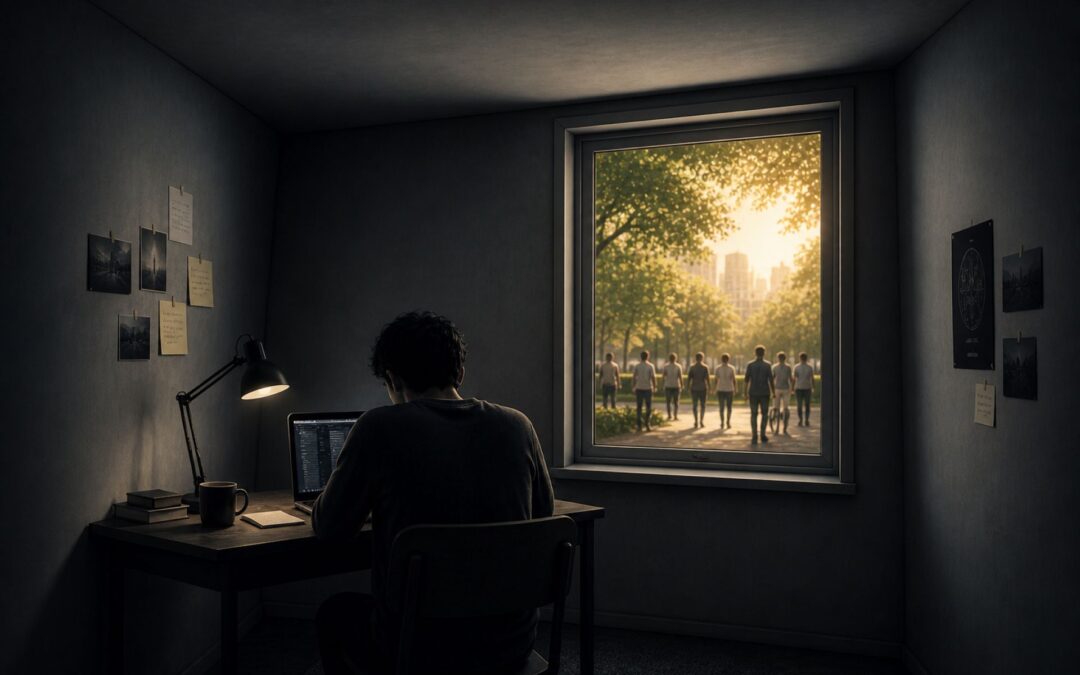
The Man Who Stood Apart From the World
In The Stranger, Albert Camus introduces us to a man who doesn’t quite belong. Meursault moves through life with a kind of quiet detachment that unsettles everyone around him. He doesn’t perform grief the way others expect. He doesn’t respond to events with the “appropriate” emotional cues. When his mother dies, he feels no need to pretend sorrow. When he later commits a violent act, he shows no remorse.
To the world, this makes him monstrous.
But the deeper we look, the more ambiguous things become. Meursault isn’t driven by cruelty or malice. He isn’t plotting harm. If anything, he’s simply disconnected—out of sync with the invisible rules that govern how people are supposed to feel, behave, and react. He stands apart, not because he wants to rebel, but because he cannot convincingly participate.
There’s something quietly unsettling about that. Not because Meursault is extreme, but because he reflects a possibility that exists, in smaller ways, within many of us.
Most people don’t go as far as he does. But many know what it feels like to drift slightly out of alignment with the world around them. To feel like conversations are mechanical. To sense that the rituals of everyday life—small talk, social expectations, shared enthusiasms—don’t quite resonate. There’s a subtle distance that begins to form, almost imperceptibly at first.
And over time, that distance can grow.
Sometimes it begins with something concrete—a betrayal, a string of bad experiences, or the slow erosion of meaningful connection. Other times, it’s harder to pinpoint. A vague sense that you don’t quite fit. That your way of seeing things doesn’t match the rhythm of everyone else. That you’re participating, but not truly belonging.
So you start to withdraw, just a little.
You engage less. You speak less. You stop explaining yourself. And gradually, without making a dramatic decision, you find yourself standing slightly outside the world you once inhabited.
At first, this distance can feel liberating. There’s relief in no longer forcing yourself to conform. No longer playing roles that feel unnatural. No longer adjusting your thoughts to match the expectations of others.
But beneath that relief, something else begins to take shape—a quieter, less obvious shift.
Because stepping away from the world doesn’t just change how others see you.
It changes how you see the world itself.
Why We Drift Away From People
Drifting away from people rarely happens in a single moment. It’s usually a slow, almost invisible process—like a tide pulling back from the shore. At first, nothing seems unusual. You’re still present, still connected in some sense. But something has shifted beneath the surface.
Conversations begin to feel thinner. Interactions that once carried weight now feel repetitive, even performative. You notice yourself responding out of habit rather than genuine interest. The familiar question—“How are you?”—starts to sound hollow, not because it is, but because you no longer feel compelled to answer it honestly.
So you begin to disengage.
Sometimes, this withdrawal comes from a place of clarity rather than pain. You may discover that solitude offers something rare—space to think, to reflect, to exist without interruption. Away from the constant presence of others, there’s no need to adjust yourself, no need to filter your thoughts through the expectations of those around you. There’s a certain purity in that.
Philosophers have long recognized this. Arthur Schopenhauer argued that we are most ourselves when we are alone, free from the influence of others. In solitude, there is no audience—only the raw experience of being.
But not all withdrawal comes from a place of quiet strength.
For many, drifting away is a response to discomfort. The presence of others can feel like exposure, as if you are constantly being evaluated. Jean-Paul Sartre captured this unease with his famous line: “Hell is other people.” Not because people are inherently terrible, but because their gaze forces us to see ourselves from the outside.
In their presence, something changes.
You become aware of how you appear. You adjust your behavior, sometimes subtly, sometimes significantly. You perform versions of yourself that are acceptable, likable, or at least unremarkable. Even when you’re not consciously trying, the shift is there.
And over time, that can become exhausting.
So you retreat—not necessarily because you hate people, but because being around them feels like work. Solitude, in contrast, feels effortless. It offers relief from judgment, from performance, from the constant negotiation of identity.
There are also those who drift away because of disappointment.
Relationships can leave scars. Trust can erode. After enough negative experiences, it becomes tempting to generalize—to see people not as individuals, but as patterns. If enough interactions lead to frustration, rejection, or betrayal, the conclusion begins to form: it’s safer to keep your distance.
In some cases, this disappointment expands beyond personal relationships and turns outward, toward society itself. The world begins to feel chaotic, superficial, or even hostile. News cycles amplify this perception, painting reality in extremes. Over time, it can feel as though disengagement is not just a preference, but a form of self-preservation.
And then there are those who simply don’t resonate with the conventional path.
The predictable rhythms of modern life—the routines, the expectations, the unspoken rules—can feel strangely artificial. Some people find themselves unable to fully invest in them, not out of rebellion, but out of a quiet sense that something doesn’t quite align.
So they step back.
Not dramatically, not with a declaration, but gradually—until they are no longer fully part of the flow.
Whatever the reason, the result is often the same: a growing distance between oneself and others. At first, it may feel like a choice. A preference. Even a form of liberation.
But as that distance increases, something subtle begins to change.
What started as stepping away can slowly turn into drifting apart.
The Allure of Being Alone
There’s a reason solitude has always held a certain mystique. Across cultures and philosophies, the image of the lone figure—sitting by a river, walking through mountains, living quietly apart from the world—carries a sense of depth, even wisdom.
To be alone is to be unobserved. And to be unobserved is, in many ways, to be free.
In the presence of others, even in the most subtle ways, we are shaped. We adjust our tone, our expressions, our posture. We anticipate reactions, interpret signals, and respond accordingly. Much of this happens unconsciously. It’s simply part of being human.
But in solitude, that entire layer disappears.
There is no one to impress, no one to disappoint, no one to mirror. The constant background noise of social awareness fades, and what remains is something quieter—your own thoughts, your own rhythms, your own way of being. This is what makes solitude feel so liberating. It strips away the performance and leaves behind something more authentic.
It’s not surprising that many philosophical traditions celebrate this state. The idea of withdrawing from the world to find clarity, truth, or inner peace appears again and again. In Taoist thought, the sage often steps away from society, not out of rejection, but out of alignment—seeking harmony with something deeper than social convention.
There’s also a more immediate, almost physical pleasure to being alone.
Think of those moments when everything slows down. Sitting in nature without interruption. Reading without distraction. Letting your mind wander without being pulled in different directions. These experiences are simple, but they carry a kind of richness that is often missing in social environments filled with noise, obligation, and constant stimulation.
In solitude, time feels different.
It stretches. It softens. It becomes less about productivity and more about presence. Without the pressure to respond, to react, or to engage, there’s space to notice things you would otherwise overlook—subtle thoughts, quiet emotions, small details of the world around you.
For many, this becomes a source of growth.
Removed from the influence of others, you can examine your beliefs more honestly. You can question assumptions, confront internal contradictions, and explore ideas without immediate resistance. In this sense, solitude becomes a kind of workshop for the self—a place where transformation is possible.
And perhaps most importantly, solitude offers relief.
Relief from social tension. Relief from comparison. Relief from the endless stream of expectations that come with being part of a group. In a world that often demands constant interaction, constant visibility, and constant validation, stepping away can feel like reclaiming something that was quietly taken.
So it’s easy to see why people are drawn to it.
Solitude doesn’t present itself as a danger. It presents itself as a refuge. A place of peace, clarity, and freedom. A place where you can finally just be.
But that’s precisely what makes it so deceptive.
Because the same conditions that make solitude feel liberating can, under the surface, begin to shift in ways that are much harder to notice.
When Solitude Becomes Estrangement
The transition is rarely dramatic.
No one wakes up one day and decides to detach from the world entirely. Instead, the shift happens quietly, through small, almost reasonable choices. You decline a few invitations. You stop initiating conversations. You take longer to reply, until eventually, you don’t reply at all.
Nothing feels wrong at first.
In fact, it often feels right. There’s a sense of control in choosing when and how to engage. You’re no longer pulled into interactions you don’t enjoy. You conserve your energy. You protect your peace.
But something subtle begins to change.
What started as intentional solitude slowly loses its intentionality. You’re no longer choosing to be alone—you simply are. The distinction matters more than it seems. Chosen solitude is active; estrangement is passive. One is rooted in awareness, the other in drift.
And drift is difficult to notice from the inside.
Connections weaken, not through conflict, but through absence. Relationships don’t end—they fade. The people who once anchored you to a shared reality become distant figures, then occasional thoughts, and eventually, almost abstractions.
At the same time, your tolerance for social interaction begins to shrink.
Situations that were once neutral start to feel draining. Conversations feel forced. Being around others requires effort you’re no longer willing to expend. So you retreat further, reinforcing the very distance that made interaction feel difficult in the first place.
It becomes a loop.
The less you engage, the more unfamiliar social interaction feels. The more unfamiliar it feels, the less you want to engage. Over time, even simple interactions can begin to carry a subtle tension, as if you’re slightly out of sync with the rhythm of others.
And then there’s the emotional shift.
Estrangement doesn’t always feel like loneliness—at least not immediately. Often, it feels like indifference. A quiet numbness toward people, toward connection, toward the idea of belonging. You may not miss others in any obvious way. You may even feel that you’re better off without them.
But indifference has a way of deepening.
Without regular contact, without the friction and warmth that come from interacting with others, your emotional world can begin to flatten. Not dramatically, but gradually. Highs become less intense. Lows become more internal. The range narrows.
And perhaps most importantly, your reference point begins to shift.
When you’re connected to others, your understanding of the world is constantly being updated. You encounter different perspectives, different experiences, different ways of thinking. These interactions act as a kind of calibration, keeping your perception grounded.
But in estrangement, that calibration weakens.
Your world becomes smaller—not necessarily in physical terms, but in terms of input. Fewer perspectives enter. Fewer contradictions challenge your thinking. What remains is a more contained, more self-reinforcing environment.
At that point, solitude is no longer just a space you inhabit.
It becomes the lens through which you see everything.
And that’s where things begin to change in ways that are much harder to reverse.
Alone With Your Thoughts
When you’re around others, your mind is constantly interrupted.
Conversations pull your attention outward. Reactions from others reshape your thinking in real time. Even disagreement serves a purpose—it forces you to clarify, to reconsider, to adjust. In a subtle way, other people keep your inner world moving.
But in solitude, that movement slows down.
There are no interruptions. No external friction. No one to challenge your assumptions or shift your perspective. What remains is a closed loop—your thoughts, feeding into themselves.
At first, this can feel like clarity.
Without distraction, you can think more deeply. Ideas unfold more fully. You can follow a line of reasoning without being pulled away midway. For a while, this creates a sense of control, even mastery over your inner world.
But that same condition has another side.
Because when there is no external input, the quality of your experience becomes entirely dependent on the quality of your thoughts. And thoughts, left unchecked, don’t always move in healthy directions.
They tend to repeat.
A passing irritation becomes a recurring theme. A small disappointment grows into a broader narrative. A moment of self-doubt quietly expands into a more persistent sense of inadequacy. Without interruption, these patterns deepen, not because they are true, but because they are unchallenged.
Over time, repetition creates conviction.
What begins as a fleeting thought starts to feel like an insight. What feels like an insight becomes a belief. And because there is no external perspective to contrast it, that belief settles in without resistance.
This is where solitude begins to change in character.
Instead of being a space for exploration, it becomes a space for reinforcement. The mind circles familiar territory, digging deeper each time. If those patterns are constructive—curiosity, reflection, creativity—solitude can be a powerful ally.
But if they are rooted in cynicism, resentment, or fear, the experience becomes very different.
You don’t just think those thoughts—you begin to inhabit them.
The world, as it exists in your mind, starts to take on a certain tone. People seem more predictable, more disappointing, more distant. Interactions, even imagined ones, feel less appealing. The idea of reconnecting begins to lose its appeal, not because connection is inherently lacking, but because your perception of it has shifted.
And this shift is subtle enough that it often goes unnoticed.
From the inside, it feels like you’re simply seeing things more clearly. That you’ve stripped away illusions and arrived at a more honest view of reality. But without external friction, without perspectives that challenge your conclusions, it becomes difficult to tell the difference between clarity and distortion.
This is the quiet risk of being alone with your thoughts.
Not that thinking itself is dangerous—but that thinking, when left entirely to itself, has a tendency to harden into something unquestioned.
The Echo Chamber Effect
When solitude deepens into isolation, something else often takes its place.
Silence rarely stays empty for long.
Even when we withdraw from people in our immediate surroundings, we don’t stop seeking input altogether. Instead, the source of that input shifts. Conversations are replaced by content. Real-world interactions are replaced by curated streams of information—articles, videos, forums, comment sections.
And unlike real-life interactions, these environments are rarely balanced.
They are selective. Algorithmic. Reinforcing.
Over time, we begin to gravitate toward voices that resonate with what we already think or feel. Not necessarily because we are trying to avoid disagreement, but because familiarity feels like clarity. Agreement feels like truth.
And slowly, almost imperceptibly, a kind of filter forms.
You see more of what confirms your perspective and less of what challenges it. The world begins to look more consistent, more predictable, more aligned with your internal narrative. At first, this can feel like progress—as if you’re finally cutting through confusion and seeing things as they are.
But what’s actually happening is narrowing.
The range of perspectives shrinks. Complexity gives way to certainty. Nuance is replaced by sharper, more definitive conclusions. And because these conclusions are echoed back to you again and again, they begin to feel increasingly solid.
This is what makes echo chambers so powerful.
They don’t just present ideas—they amplify them. They strip away contradiction and replace it with reinforcement. In these environments, even the most extreme views can start to feel reasonable, simply because they are no longer being challenged.
Research into online communities has shown how this process unfolds. In morally homogeneous spaces—where people share the same core beliefs and values—there’s a tendency for positions to become more extreme over time. Without opposing viewpoints, there’s nothing to slow that movement, nothing to pull it back toward balance.
So the edges expand.
Ideas that once felt fringe begin to feel central. Language becomes more absolute. Opposing groups are no longer seen as individuals with different perspectives, but as unified entities—simplified, generalized, and often dehumanized.
And all of this can happen while sitting alone in a room.
Isolation doesn’t eliminate influence—it reshapes it. Instead of being influenced by a diverse range of real-world interactions, you become influenced by a narrow set of voices that are often disconnected from the complexity of everyday life.
The result is a kind of distorted reality.
Not necessarily false in every detail, but skewed. Certain aspects are exaggerated. Others are ignored entirely. The world becomes less textured, less contradictory, less human.
And because this version of reality is continuously reinforced, it becomes harder to question.
From the inside, it feels like conviction. Like seeing what others refuse to see. Like having access to a deeper truth.
But without friction, without disagreement, without exposure to perspectives that don’t fit neatly into the narrative, that sense of truth can drift further and further away from reality itself.
At that point, solitude is no longer just a personal space.
It becomes an environment that shapes what you believe—and how far you’re willing to go to defend it.
Losing Touch With Reality
When you spend enough time removed from people, something subtle but important begins to erode—your sense of proportion.
In everyday life, other people act as a kind of grounding force. Not because they are always right, but because they introduce friction. They disagree. They react in unexpected ways. They bring perspectives that don’t neatly align with your own. Even casual interactions—small talk, shared routines, ordinary conversations—serve as a constant recalibration of how the world actually is.
Without that, your perception begins to drift.
It doesn’t happen all at once. There’s no clear moment where reality suddenly breaks. Instead, the shift is gradual. You begin to rely more on your internal interpretations and less on lived, shared experience. The outside world becomes something you observe from a distance rather than something you actively participate in.
And distance changes perception.
When you’re not regularly engaging with people, it becomes easier to generalize. Individuals blur into categories. Complex social dynamics simplify into clean, overarching narratives. What was once messy and nuanced starts to feel obvious, even predictable.
This is where isolation quietly reshapes reality.
Because the fewer real interactions you have, the more your understanding of the world is shaped by indirect sources—media, online discussions, secondhand accounts. And these sources, by their nature, tend to emphasize the extreme. Conflict is more visible than cooperation. Outrage is more engaging than normalcy. The unusual stands out more than the ordinary.
So your picture of the world becomes skewed.
It starts to feel more hostile, more divided, more dysfunctional than it actually is. Not because those elements don’t exist, but because they are no longer balanced by everyday, lived experiences that would normally keep them in perspective.
This is why stepping outside—literally and figuratively—can feel disorienting after long periods of isolation.
The people you encounter don’t quite match the image you’ve built in your mind. They’re more ordinary, more varied, less extreme. The world feels less like a battleground of rigid ideologies and more like a collection of individuals navigating their own lives, often with far less intensity than you expected.
But if you remain disconnected, that corrective experience never fully takes hold.
Instead, your internal model of reality continues to evolve on its own, shaped by limited input and reinforced by repetition. Over time, it can become increasingly difficult to distinguish between what is broadly true and what is selectively perceived.
And the more confident you become in that perception, the less likely you are to question it.
This is one of the quiet dangers of estrangement.
Not just that you are alone, but that your understanding of the world is no longer being tested against the world itself.
The Double-Edged Nature of Solitude
By this point, it might be tempting to draw a simple conclusion—that solitude is dangerous, that drifting away from people inevitably leads to distortion, isolation, and decline.
But that wouldn’t be accurate.
Solitude itself is neutral. It doesn’t carry a fixed outcome. It’s a condition, not a verdict. And like most conditions, its effects depend entirely on how it’s inhabited.
The same space that allows one person to grow can cause another to unravel.
There are those who enter solitude and become clearer. Without the noise of constant interaction, they begin to understand themselves more deeply. Their thoughts sharpen. Their values become more intentional. They develop a kind of independence that isn’t reactive, but grounded.
These are the individuals who use solitude as a tool.
They step away, but not completely. They return when needed. They maintain some connection to the world, even if it’s limited. Their solitude is porous—it allows reflection without cutting off reality entirely.
But then there are those for whom solitude becomes something else.
Instead of clarity, it breeds rigidity. Instead of independence, it fosters detachment. The mind doesn’t open—it narrows. Thoughts don’t evolve—they repeat. What could have been a space for exploration turns into a closed system, feeding on itself.
The difference isn’t always obvious from the outside.
Both individuals may appear the same—quiet, withdrawn, self-contained. Both may claim to prefer being alone. But internally, their experiences are worlds apart. One is expanding, the other contracting.
And the dividing line is often subtle.
It has less to do with how much time you spend alone and more to do with what happens during that time. Are your thoughts flexible, or are they hardening? Are you exploring ideas, or reinforcing them? Are you stepping away to gain perspective, or to avoid it?
Solitude can amplify whatever is already there.
If there is curiosity, it deepens. If there is resentment, it intensifies. If there is peace, it stabilizes. If there is unrest, it echoes. The environment itself doesn’t decide—it reflects.
This is why solitude can feel like both a sanctuary and a trap.
On one hand, it offers freedom—freedom from expectation, from noise, from the constant pull of others. On the other, it removes the very elements that keep us balanced—interaction, contradiction, shared reality.
And without that balance, it’s easy to drift.
Not necessarily into something dramatic or destructive, but into something quieter—a version of yourself that is increasingly shaped by internal patterns rather than external reality.
So the question isn’t whether solitude is good or bad.
The question is what direction it’s taking you in.
Drifting Too Far—and Finding Your Way Back
There’s no clear boundary where solitude becomes too much.
No signal that tells you you’ve crossed a line.
If anything, the shift is only visible in hindsight—when you notice that your thoughts have grown heavier, your world narrower, your reactions sharper or more indifferent than they used to be. Not dramatically, but enough to feel like something has changed.
And by then, solitude is no longer just a preference.
It has become a direction.
The difficulty is that stepping away always feels justified while you’re doing it. There’s always a reason—fatigue, disappointment, clarity, even growth. And often, those reasons are valid. The problem isn’t the initial withdrawal. It’s the quiet continuation of it, long after its purpose has been served.
Because what begins as protection can turn into avoidance.
You avoid conversations that feel unnecessary. Then you avoid ones that feel slightly uncomfortable. Then ones that might challenge you. Eventually, what remains is a version of life that is smooth, controlled, and increasingly insulated.
And insulation comes at a cost.
Without contact, without friction, without the unpredictable presence of others, something essential is missing—not just socially, but psychologically. You lose opportunities to recalibrate, to see yourself from the outside, to encounter perspectives that disrupt your internal patterns.
The world becomes easier to manage, but harder to understand.
Finding your way back doesn’t require abandoning solitude.
It requires reintroducing contact.
Not in a forced or overwhelming way, but in small, deliberate moments. A conversation you don’t entirely feel like having. Time spent observing people without filtering them through assumptions. Engaging with perspectives that don’t immediately align with your own.
These moments act as interruptions.
They break the closed loop. They introduce just enough unpredictability to loosen rigid patterns. Not to replace your perspective, but to test it—to see where it holds, and where it might need adjustment.
And that’s often enough.
Because the goal isn’t to dissolve into the crowd or lose the independence that solitude can offer. It’s to prevent that independence from turning into isolation.
To remain connected enough that your understanding of the world is still shaped by the world itself.
In the end, drifting away from people isn’t inherently a mistake.
Sometimes, it’s necessary. Sometimes, it’s even transformative.
But like any drift, it has a direction.
And if left unchecked, it can carry you further than you ever intended to go.