
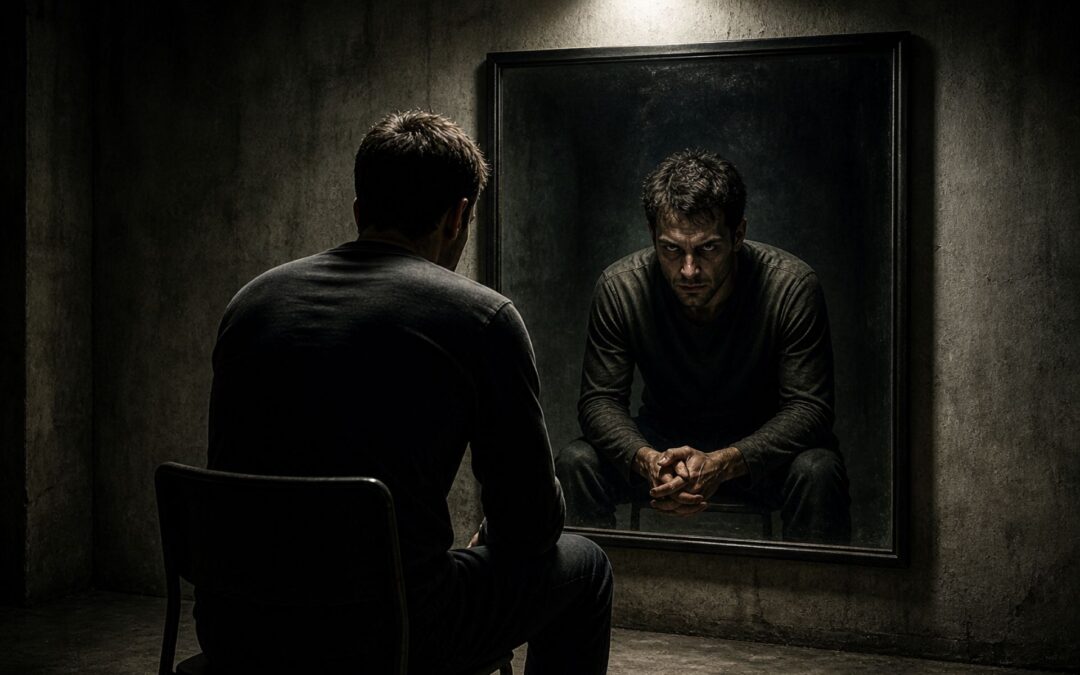
The Fear of Your Own Darkness
What do you do when your inner world doesn’t just feel flawed—but dangerous?
Not in a poetic sense. Not in a “we all have our bad days” kind of way. But in a way that feels genuinely unsettling. As if something inside you is capable of cruelty, chaos, or even destruction—and not just theoretically, but viscerally. Close. Personal. Real.
For many people, this realization doesn’t arrive gently. It comes through intrusive thoughts, disturbing dreams, sudden emotional reactions, or an uncomfortable recognition: there’s something in me I don’t trust.
And the natural response is rejection.
You want distance from it. You want to label it as something foreign—something external, something that doesn’t truly belong to you. Because if it does belong to you, then what does that say about who you are?
This is where the fear deepens.
Because the question is no longer just what is this darkness?
It becomes: why would I ever want to integrate it?
Why bring something “evil” closer? Why not cut it off entirely? Why not suppress it, bury it, or sever it from your identity altogether?
At first glance, that seems like the most reasonable path. After all, if something feels destructive, the instinct is to eliminate it. But the problem is this: what you try to reject doesn’t disappear—it retreats.
And what retreats into the unconscious doesn’t weaken. It grows.
This is the paradox at the heart of psychological development. The very thing you refuse to acknowledge may be the thing shaping your behavior the most. Quietly. Indirectly. Without your consent.
So the real danger may not be that your shadow feels “evil.”
The real danger is that it remains unseen.
Because what you cannot see, you cannot control.
And what you cannot control… eventually expresses itself anyway.
What Carl Jung Meant by the Shadow
To understand why this inner darkness exists—and why it feels so powerful—you have to start with what Carl Jung actually meant by the shadow.
The shadow is not a separate entity living inside you. It’s not a demon, and it’s not something that attaches itself to your personality from the outside. It is, quite simply, you—but not the version of you that you consciously identify with.
More specifically, the shadow is the collection of traits, impulses, desires, and tendencies that you have rejected, suppressed, or disowned over time.
Some of these traits are clearly negative—aggression, envy, selfishness, cruelty. But others are surprisingly positive—creativity, assertiveness, confidence, even ambition. The common thread is not morality. It’s rejection.
If something within you was judged as unacceptable—by your family, your environment, or even by your own standards—it didn’t disappear. It got pushed out of conscious awareness and into the unconscious. That’s where it becomes part of the shadow.
This is why the shadow can feel foreign. You don’t experience it as “me,” because you’ve spent years building an identity around not being that.
You might see yourself as kind, so your capacity for cruelty becomes shadow.
You might see yourself as rational, so your emotional volatility becomes shadow.
You might see yourself as moral, so your darker fantasies become shadow.
But the psyche doesn’t erase what it rejects. It stores it.
And over time, this hidden material accumulates. It gathers intensity. It becomes charged, precisely because it is not allowed expression or acknowledgment.
This is also why the shadow often appears more extreme than it actually is. When something is suppressed for long enough, it doesn’t return in a mild, manageable form. It returns amplified—distorted by years of denial.
So when someone says, “my shadow feels evil,” they’re often encountering not just the trait itself, but the pressure that has built around it.
Jung’s insight was simple but unsettling: the shadow is not optional. You don’t get to choose whether you have one. If you have a personality, you have a shadow.
And the more strongly you identify with being “good,” “pure,” or “in control,” the more likely it is that your shadow contains everything that contradicts that image.
In other words, the darker it feels, the more it may reflect what you’ve spent your life trying not to be.
Why the Shadow Feels So Dark and Overwhelming
If the shadow is simply made up of rejected parts of yourself, then why does it sometimes feel so extreme—so alien, even “hellish”?
The answer lies in what happens when something is pushed away for too long.
Repression doesn’t neutralize an impulse. It compresses it.
Every time you deny a thought, suppress a desire, or distance yourself from an uncomfortable emotion, you’re not removing it—you’re forcing it out of conscious awareness. And what remains unconscious doesn’t disappear. It accumulates.
Over time, this creates pressure.
Think of it like a sealed container. The more you push into it without release or acknowledgment, the more intense the contents become. Eventually, when something leaks through—whether in dreams, intrusive thoughts, or sudden emotional reactions—it doesn’t appear in a mild or recognizable form. It emerges distorted, exaggerated, and often overwhelming.
This is why the shadow can feel disproportionate to your conscious identity.
You might live your life as a calm, controlled, and morally grounded person. But underneath that surface, years of suppressed anger, aggression, or forbidden desires may have built up without ever being processed. When they finally surface, they don’t feel like “a part of you.” They feel like something entirely different—something you don’t recognize, and therefore don’t trust.
That sense of unfamiliarity is what creates the illusion that the shadow is external.
It’s not that the shadow is separate from you. It’s that you’ve spent so long identifying with the opposite of it that, when it appears, it feels like an intrusion rather than an expression.
There’s another factor that intensifies this experience: moral judgment.
When you label certain inner experiences as unacceptable—especially in absolute terms like “evil” or “wrong”—you don’t just reject them. You load them with fear and resistance. This makes any encounter with them more emotionally charged.
So when a dark thought arises, it’s not just the thought itself that disturbs you. It’s the meaning you attach to it.
“What does this say about me?”
“Am I capable of something terrible?”
“Should I be worried about myself?”
These questions amplify the experience, turning a moment of awareness into a crisis of identity.
And the more you react with fear, the more you reinforce the cycle.
Because now, not only is the trait repressed—it’s also feared.
This combination—repression and fear—is what gives the shadow its overwhelming quality. It’s not just hidden. It’s avoided, judged, and emotionally charged. Which means when it surfaces, it does so with intensity.
But here’s the crucial shift: the intensity doesn’t necessarily reflect the true nature of what’s being repressed.
It reflects how long it’s been denied.
How the Shadow Reveals Itself
The shadow doesn’t stay hidden forever. Even when it’s pushed deep into the unconscious, it finds ways to express itself—indirectly, symbolically, and often without your awareness.
The difficulty is that it rarely shows up in a form you immediately recognize.
Instead of appearing as a clear, conscious trait—“I feel anger,” “I want power,” “I am envious”—the shadow communicates through distortion. It slips into your experience in ways that feel confusing, irrational, or disproportionate to the situation at hand.
One of the most common ways this happens is through dreams.
In dreams, the mind is less constrained by your conscious identity. The parts of you that are usually suppressed are given a kind of symbolic language. They appear as characters, scenarios, or emotionally charged events that don’t always make logical sense—but carry a certain intensity.
You might dream of being chased, attacked, humiliated, or behaving in ways that feel completely out of character. These are not random. They are expressions—metaphorical representations of aspects of yourself that haven’t been fully acknowledged.
Another major pathway is projection.
Projection is the tendency to see in others what you cannot accept in yourself. When a particular trait is deeply repressed, you become highly sensitive to it in the outside world. It stands out. It irritates you. Sometimes it even disgusts you.
But the emotional intensity is the clue.
If your reaction to someone feels unusually strong—far beyond what the situation objectively calls for—it may not be just about them. It may be pointing toward something within you that you’ve disowned.
For example, someone who strongly condemns a certain behavior may be unconsciously struggling with that same impulse. The judgment becomes a defense—a way to maintain distance from what feels unacceptable internally.
This doesn’t mean that every criticism is projection. But when the reaction is charged, repetitive, and emotionally loaded, it’s worth looking inward.
Then there are emotional overreactions.
Moments where your response feels disproportionate—sudden anger, intense jealousy, irrational fear, or deep resentment. These are often situations where something in the present has triggered something unresolved beneath the surface.
The shadow doesn’t always speak loudly, but when it does, it often does so through these spikes in emotion.
What makes all of this difficult is that, in each case, the shadow is disguised.
It doesn’t announce itself as “this is your repressed anger” or “this is your hidden desire.” It appears as a dream, a judgment, a reaction, or a situation involving someone else.
Which is why most of it goes unnoticed.
But once you begin to recognize these patterns—once you start asking “why does this affect me so much?” instead of just reacting—you begin to see the shadow not as something mysterious, but as something communicating.
And that changes everything.
Because what was once unconscious starts becoming visible.
And what becomes visible… becomes workable.
The Illusion of Good and Evil Within Human Nature
When people describe their shadow as “evil,” they’re not just reacting to what they feel—they’re reacting to what they believe those feelings mean.
At the core of this is a rigid division: good versus evil. Acceptable versus unacceptable. Human versus inhuman.
But when you look closely, this division becomes less clear than it first appears.
From a psychological perspective, what we call “evil” is often a cluster of impulses—aggression, dominance, desire for control, even destruction—that exist in some form within all human beings. These are not foreign elements. They are part of the same system that produces ambition, self-preservation, competitiveness, and strength.
The difference is context and control.
In nature, these impulses are not labeled as moral failures. They are simply expressions of instinct. A predator hunts. An animal defends its territory. There is violence, but there is no moral narrative attached to it.
A cat can be gentle and affectionate one moment, and relentlessly cruel to its prey the next. It toys with it, prolongs its suffering, and eventually kills it. Yet we don’t see the cat as “evil.” We see it as behaving according to its nature.
Now compare that to how we judge similar impulses in ourselves.
The moment we recognize something aggressive, destructive, or socially unacceptable within us, we don’t just observe it—we condemn it. We distance ourselves from it as quickly as possible. Not because it isn’t there, but because we’ve learned that it shouldn’t be there.
This is where the illusion begins.
Because the standard we apply to ourselves is not based purely on what is natural—it’s based on what is socially acceptable.
Society requires order. It depends on cooperation, predictability, and restraint. So we develop systems—moral codes, cultural norms, religious frameworks—that define what is “good” and what is “bad.”
And in order to function within these systems, we suppress what doesn’t fit.
This suppression is necessary to a degree. Without it, there would be chaos. But it comes at a cost.
The cost is that parts of our natural psychological makeup are pushed out of awareness—not because they don’t exist, but because they are inconvenient, disruptive, or unacceptable.
Over time, this creates a distorted perception of the self.
You begin to identify only with the traits that are rewarded—kindness, patience, control, rationality. And everything that contradicts that identity gets labeled as something other than you.
So when those disowned traits surface, they feel like violations.
Not just of behavior—but of identity.
This is why the shadow can feel “evil.” Not necessarily because it is fundamentally malevolent, but because it contains everything you’ve been conditioned to reject.
The more rigid your idea of “good” is, the darker everything outside of it becomes.
But the psyche doesn’t operate on moral binaries. It operates on wholeness.
And from that perspective, what you call “evil” may not be something separate from you—it may simply be something you’ve never allowed yourself to understand.
The Persona: Why We Hide Our Dark Side
If the shadow represents everything you’ve rejected, then the question becomes: what exactly are you protecting?
The answer is the persona—the version of yourself that you present to the world.
The persona is not fake in the sense of being a complete lie. It’s selective. It’s a carefully constructed identity built around traits that are acceptable, desirable, and rewarded in your environment. It’s how you learn to function socially—how you gain approval, avoid conflict, and maintain a sense of belonging.
From a very early age, you start shaping this persona.
You notice which behaviors are praised and which are punished. You learn what makes you likable, respectable, or “good.” And gradually, you begin to identify with those traits.
At the same time, anything that threatens this image gets pushed aside.
If anger is discouraged, you learn to suppress it.
If vulnerability is seen as weakness, you hide it.
If assertiveness is labeled as aggression, you tone it down.
Over time, this becomes automatic.
You don’t just act a certain way—you start to believe that this is who you are. The persona becomes your identity.
But this creates a split.
Because everything that doesn’t fit into that identity doesn’t disappear—it becomes shadow.
The more invested you are in maintaining a particular image, the more pressure there is to keep anything contradictory out of awareness. And the stronger that pressure, the more forcefully those rejected parts are pushed into the unconscious.
This is why people who appear extremely composed, moral, or controlled on the surface sometimes experience intense inner conflict.
Not because they are “worse” than others—but because the gap between their persona and their shadow is wider.
And the wider that gap, the more energy it takes to maintain it.
The persona, in this sense, is both necessary and limiting.
It allows you to navigate the world. But it also defines the boundaries of what you’re allowed to acknowledge within yourself. It tells you, implicitly: this is who you are—and this is who you must never be.
The problem is that the psyche doesn’t respect those boundaries.
What is excluded doesn’t stay outside forever. It accumulates, waiting for moments where the persona weakens—under stress, in solitude, in dreams, or in emotionally charged situations.
And when it does emerge, it doesn’t ask for permission.
This is why integration becomes important.
Not because the persona is wrong, but because it is incomplete.
If you only identify with one side of yourself, the other side doesn’t vanish. It simply operates without your awareness.
And that is where the real loss of control begins.
What It Really Means to Integrate an “Evil” Shadow
When people hear the word integration, they often misunderstand it in the worst possible way.
They assume it means expression. Acting out. Letting dark impulses run freely as a form of “authenticity.” And if your shadow feels aggressive, destructive, or even cruel, that idea is understandably terrifying.
But that’s not what integration means.
Integration is not about becoming your shadow.
It’s about becoming aware of it without being ruled by it.
At its core, integration is a shift in relationship.
Instead of rejecting certain thoughts, impulses, or tendencies, you begin to acknowledge them. You allow them into conscious awareness—not to justify them, not to indulge them, but to understand them.
Because once something is conscious, it changes.
It’s no longer operating behind the scenes, influencing your behavior indirectly. It becomes something you can observe, question, and—most importantly—choose how to respond to.
This is where control actually begins.
Paradoxically, the more you try to suppress an impulse, the less control you have over it. It slips through in unintended ways—passive aggression, sudden outbursts, self-sabotage, or internal conflict.
But when you bring that same impulse into awareness, you create distance between you and it.
You can recognize: this is anger.
Not: I am anger.
You can notice: this is a desire for control.
Not: this defines who I am.
That distinction is subtle, but it’s everything.
Because integration doesn’t collapse your identity into your darkest tendencies. It expands your identity to include the fact that those tendencies exist—without letting them take over.
It also requires a certain level of honesty that most people avoid.
You have to be willing to admit what you’re capable of—not just in theory, but in reality. You have to confront the parts of yourself that don’t fit your self-image. The parts you would rather deny.
And this is uncomfortable.
Because it challenges the idea that you are purely “good,” or entirely in control, or fundamentally different from the traits you judge in others.
But this honesty is what makes integration possible.
Without it, the shadow remains hidden—and anything hidden has the potential to act without your consent.
So integration is not a moral decision. It’s a practical one.
It’s the recognition that awareness gives you a choice.
You can feel anger without acting on it.
You can acknowledge destructive impulses without becoming destructive.
You can understand the darker aspects of your nature without being consumed by them.
In that sense, integration is not about letting the shadow loose.
It’s about bringing it into the light—so it no longer needs to force its way out.
Facing the Shadow Without Becoming It
One of the deepest fears people have when approaching their shadow is this: what if I lose control?
What if, by acknowledging these impulses, you somehow give them more power? What if looking too closely at your darkness pulls you into it?
This fear is understandable. When something feels intense or disturbing, the instinct is to keep your distance. But avoidance doesn’t create safety—it creates blindness.
And blindness is where real danger lies.
Facing the shadow doesn’t mean merging with it. It doesn’t mean identifying with every impulse or letting it dictate your actions. In fact, it’s the opposite.
It’s about learning to observe without becoming.
This requires a shift in how you relate to your inner experience. Instead of immediately reacting—judging, suppressing, or acting—you pause. You notice what’s there without rushing to define yourself by it.
An aggressive thought arises. Instead of panicking or pushing it away, you recognize it: this exists in me. You don’t glorify it. You don’t follow it. But you also don’t pretend it isn’t there.
That moment of recognition creates space.
And within that space, something important happens: you are no longer fused with the impulse. You are aware of it, which means you have a choice in how to respond.
This is the key distinction.
People don’t lose control because they are aware of their darker tendencies. They lose control because those tendencies operate unconsciously, building pressure until they erupt.
When something is unconscious, it acts through you.
When it is conscious, it stands in front of you.
That difference is what allows restraint.
It’s also what allows responsibility.
Because once you see what you’re capable of, you can no longer hide behind ignorance. You become accountable—not in a moralizing sense, but in a practical one. You know what’s there, and that knowledge gives you the ability to navigate it.
There’s also a stabilizing effect that comes from this process.
When you stop resisting your inner experience so aggressively, it often becomes less chaotic. The intensity begins to settle. Not because the impulse disappears, but because it’s no longer being amplified by fear and suppression.
You start to realize that having a dark thought doesn’t mean you will act on it. That experiencing aggression doesn’t make you violent. That acknowledging something disturbing doesn’t define your character.
It simply means you’re aware.
And awareness, when grounded, doesn’t pull you into the shadow.
It keeps you from being pulled by it.
Transforming Dark Energy Into Strength
Once you stop treating the shadow as something to eliminate, a different possibility opens up.
What if, instead of being purely destructive, it’s also a source of energy?
Because beneath many of the traits we label as “dark”—anger, aggression, obsession, even hatred—there is intensity. There is force. There is drive. And when that force is left unconscious, it tends to leak out in chaotic or harmful ways.
But when it’s recognized and redirected, it can become something else entirely.
This is where transformation begins.
Take anger, for example. In its raw form, it can be explosive, irrational, and damaging. But at its core, anger is also a signal of boundaries, injustice, or unmet needs. It carries a kind of clarity and urgency that, when channeled, can become assertiveness, discipline, or the refusal to tolerate what weakens you.
The same applies to more extreme forms of inner tension.
What feels like destructive impulse on the surface can often be reduced to more fundamental drives—power, control, survival, expression. These are not inherently negative. They become problematic when they are unconscious and unmanaged.
But when brought into awareness, they can be directed.
A powerful real-world example of this is David Goggins.
His early life was marked by abuse, fear, and deep emotional pain. Beneath the surface, there was anger—intense, unresolved, and potentially destructive. But instead of denying it, he eventually confronted it.
And more importantly, he used it.
He redirected that energy into physical discipline, extreme endurance, and relentless self-improvement. The same force that could have manifested as self-destruction became the fuel for extraordinary achievement.
This doesn’t mean that everyone needs to become an ultra-endurance athlete.
But it illustrates a principle: energy doesn’t disappear. It transforms.
If you repress it, it distorts.
If you express it blindly, it harms.
But if you channel it consciously, it strengthens.
For some, this might mean physical outlets—training, martial arts, pushing the body to its limits. For others, it might mean creative expression—writing, art, building something meaningful out of inner tension.
The form doesn’t matter as much as the direction.
What matters is that the energy is not left to operate unconsciously.
Because the shadow is not just a collection of problems. It’s also a reservoir.
And when approached with awareness, that reservoir can become one of the most powerful sources of growth you have.
Practical Ways to Begin Shadow Integration
Understanding the shadow intellectually is one thing. Working with it in your own life is something else entirely.
Because the shadow doesn’t reveal itself all at once. It shows up in fragments—through moments, reactions, patterns. And the process of integration is less about dramatic breakthroughs and more about sustained attention.
It begins with a willingness to look.
Not in a vague, abstract sense, but in a very direct way: what in me do I avoid seeing?
One of the simplest entry points is honest self-reflection.
Pay attention to your reactions throughout the day. Not just what you do, but how you feel—especially when the response seems disproportionate. Sudden irritation, strong judgment, unexpected jealousy, or emotional spikes often point toward something deeper.
Instead of dismissing them, pause and ask: why does this affect me this much?
You’re not looking for a perfect answer. You’re creating a habit of inquiry.
Journaling can deepen this process.
Writing forces you to articulate what you might otherwise keep vague. It allows patterns to emerge over time. You might begin to notice recurring themes—certain situations that trigger you, certain types of people that provoke strong reactions, certain thoughts you repeatedly avoid.
These patterns are not random. They are entry points into the shadow.
Dreams offer another layer.
Even if they seem strange or disconnected, they often carry emotional residue. Instead of trying to interpret them immediately, start by observing what stands out. What felt intense? What lingered after you woke up? Over time, you may begin to see symbolic patterns that reflect unresolved aspects of yourself.
Then there is the practice of active imagination.
This involves consciously engaging with the images, emotions, or inner figures that arise from the unconscious. Instead of pushing them away, you allow them to unfold—mentally exploring what they represent, what they want, what they express.
It may feel unusual at first, but it creates a bridge between conscious awareness and unconscious material.
Throughout all of this, one principle remains constant: observation without immediate judgment.
The goal is not to fix, eliminate, or justify what you find. It’s to see it clearly.
Because clarity is what allows choice.
If you immediately label everything as “bad” or “unacceptable,” you reinforce the very mechanism that created the shadow in the first place. But if you can hold what you observe with a certain level of neutrality—even briefly—you create space for understanding.
And understanding is what gradually reduces fear.
This process is not about becoming perfect. It’s about becoming more aware of what is already there.
And that awareness, over time, changes how you relate to yourself—and how much control you actually have.
Why Denial Is More Dangerous Than Darkness
At first glance, denial feels safe.
If you don’t acknowledge something, it can’t affect you—at least, that’s how it seems. You maintain your sense of identity. You preserve the image you have of yourself. You avoid the discomfort of confronting what you’d rather not see.
But this sense of safety is deceptive.
Because denial doesn’t remove the shadow—it removes your awareness of it.
And when you lose awareness, you lose influence.
What remains hidden doesn’t stay inactive. It continues to operate beneath the surface, shaping your thoughts, reactions, and decisions in ways you don’t fully understand. It leaks into behavior indirectly—through impulsive actions, emotional volatility, or patterns you can’t quite explain.
You might find yourself acting in ways that contradict your values, and not fully knowing why. Or reacting more intensely than the situation calls for. Or repeating the same mistakes, even when you’re consciously trying to change.
This is what unconscious shadow looks like.
Not dramatic evil, but subtle misalignment. A gap between who you think you are and how you actually behave under pressure.
And the more you deny certain aspects of yourself, the less prepared you are when they surface.
Because without awareness, there’s no anticipation. No recognition. No pause.
Things simply happen—and you deal with the consequences afterward.
This is why repression often leads to sudden outbursts.
The anger you never allowed yourself to feel builds quietly over time. Then, under the right conditions, it emerges all at once—disproportionate, uncontrolled, and often directed at the wrong target.
The same applies to other shadow elements.
Unacknowledged desires may lead to compulsive behavior.
Unrecognized insecurity may lead to defensiveness or projection.
Unseen resentment may turn into passive aggression or withdrawal.
In each case, the problem is not the existence of the trait—it’s the lack of awareness around it.
Denial also prevents growth.
If you refuse to see certain patterns, you can’t work with them. You remain stuck, repeating the same cycles, because the underlying cause is never addressed. It stays outside your conscious field, which means it stays unchanged.
There’s also a deeper consequence.
When you deny parts of yourself, you fragment your identity. You create a version of yourself that is incomplete—selective, curated, and disconnected from the full range of your experience.
And maintaining that fragmentation takes effort.
It requires constant filtering, constant suppression, constant avoidance. Over time, this creates internal tension—a sense that something isn’t fully aligned, even if you can’t articulate what it is.
So while denial may feel like control, it’s actually a loss of it.
Because real control doesn’t come from avoiding what’s there.
It comes from knowing it—clearly enough that it no longer needs to act without your permission.
Accepting Your Imperfection as Wholeness
At the end of this process, something subtle but profound begins to shift.
You stop chasing a version of yourself that is flawless.
Not because you’ve given up on growth, but because you begin to see that the idea of being purely “good,” entirely rational, or completely in control was never realistic to begin with. It was an ideal—useful in some ways, but incomplete.
Because wholeness does not come from perfection.
It comes from integration.
When you start acknowledging the full range of what exists within you—the admirable and the uncomfortable, the light and the dark—you no longer need to maintain a rigid divide. You don’t have to constantly prove that you are one thing and not another.
You begin to experience yourself as more complex, but also more stable.
There’s less internal conflict, because fewer parts of you are being pushed away. Less fear, because there’s less that feels unknown or threatening. And more clarity, because what was once hidden is now visible.
This doesn’t mean the shadow disappears.
It remains a part of you, just as it always has been. But it changes in how it relates to you. It’s no longer something lurking in the background, waiting for moments of weakness. It becomes something you are aware of—something you can monitor, understand, and respond to consciously.
And that awareness creates a different kind of confidence.
Not the confidence that comes from believing you are always right or always in control, but the confidence that comes from knowing yourself more completely.
You know what you’re capable of—both the constructive and the destructive. And because of that, you’re less likely to be surprised by your own reactions. Less likely to act blindly. More likely to pause, to choose, to respond rather than react.
There’s also a kind of relief in this.
Because maintaining the illusion of perfection is exhausting. It requires constant effort—constant filtering of thoughts, emotions, and impulses to fit a certain image.
When that pressure eases, something opens up.
You don’t have to be one-dimensional anymore. You don’t have to deny parts of yourself just to feel acceptable. You can hold contradictions without feeling fragmented.
And in that space, growth becomes more genuine.
Not driven by avoidance or fear, but by understanding.
You’re no longer trying to eliminate your darkness.
You’re learning how to live with it—without being defined by it.
And that is what makes a personality feel whole.
Conclusion
The fear that your shadow might be “evil” is not a sign that something has gone wrong.
It’s a sign that you’ve started to see more of yourself than you did before.
And that can be unsettling. Because once you become aware of what lies beneath the surface—impulses, thoughts, or tendencies that don’t fit your self-image—you can’t easily go back to ignorance. You’re faced with a choice: reject it, or understand it.
Rejection feels safer in the moment. But it comes at the cost of awareness—and without awareness, there is no real control.
Understanding, on the other hand, requires discomfort. It asks you to look directly at what you’d rather avoid. To admit that your nature is not as simple or as clean as you once believed.
But it also gives you something far more valuable.
It gives you the ability to respond consciously.
Because once the shadow is seen, it no longer needs to force its way into your behavior. It no longer operates entirely on its own. It becomes part of your awareness—and anything within awareness can be observed, questioned, and guided.
This is the essence of integration.
Not the removal of darkness, but the recognition of it. Not the denial of imperfection, but the acceptance of it as part of a larger whole.
You don’t become dangerous by acknowledging what exists within you.
You become more responsible.
And perhaps that’s the real shift.
Instead of asking, “why would I want to integrate something this dark?”
The question becomes: “what happens if I don’t?”