
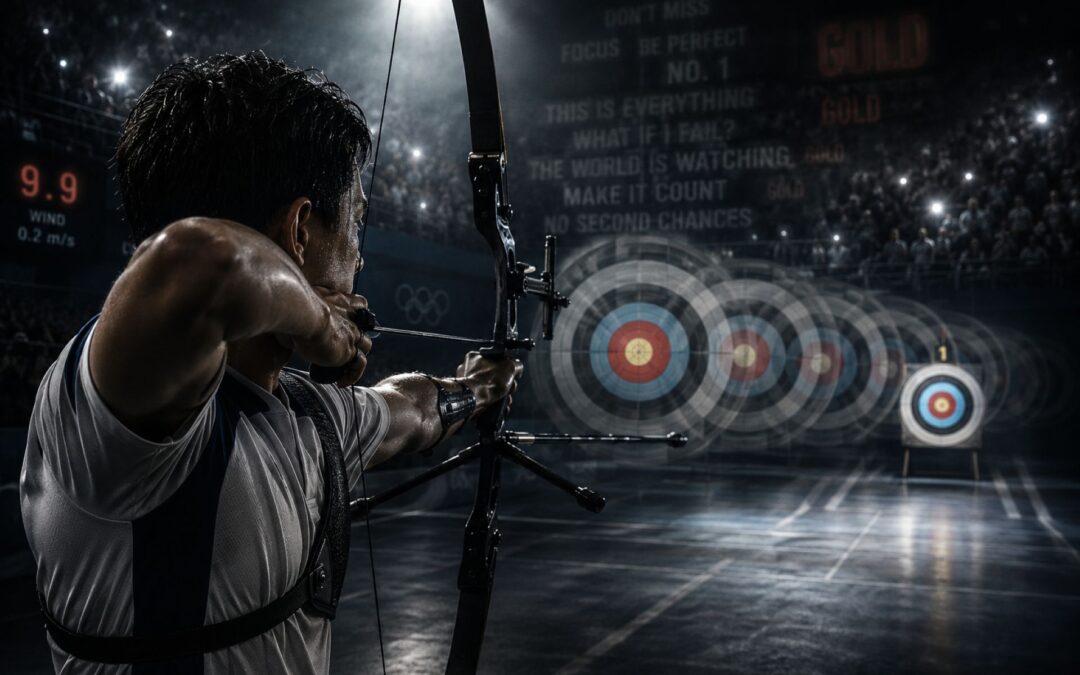
There is a strange irony at the heart of human performance: the more important something becomes, the harder it often is to do well.
A student who can speak confidently in front of a mirror suddenly forgets their words on stage. A basketball player who dominates during practice misses an easy shot during the final seconds of a real game. A musician who can play flawlessly alone in a room becomes stiff and anxious under the spotlight. The skill is still there. The preparation has already been done. Yet something changes the moment the stakes become real.
Most people assume that pressure sharpens performance. We are taught that success belongs to those who want it badly enough, who obsess over winning, who refuse to accept failure as an option. Modern culture glorifies intensity. We admire people who sacrifice everything for victory and push themselves beyond their limits in pursuit of greatness.
And to some extent, this mindset works. Desire creates discipline. Ambition fuels effort. The fear of losing can force people to train harder than they otherwise would. But there is also a hidden cost to this obsession with outcomes. The more psychologically attached we become to success, the more fragile our performance often becomes in the very moment it matters most.
This paradox was observed centuries ago by the Taoist philosopher Zhuangzi.
Through a simple story about an archer, Zhuangzi explored a problem that athletes, artists, performers, creators, and ordinary people still struggle with today: why do we perform worse when we care too much about the result? Why does anxiety appear the moment something important is on the line? And why do our best performances often emerge when we stop trying so hard to control them?
At the center of Taoist philosophy lies the idea that forcing things too aggressively often produces the opposite of what we want. The harder we cling to outcomes, the more tension enters the mind. And tension disrupts the natural flow through which skill expresses itself.
This does not mean effort is useless. Nor does it mean we should stop caring altogether. Zhuangzi’s insight is subtler than that. The problem is not action itself, but the psychological burden we attach to action. It is the mind’s obsession with future consequences that interferes with our ability to fully inhabit the present moment.
When this interference disappears, something remarkable happens.
The swimmer no longer thinks about winning medals. The musician no longer thinks about judgment. The writer no longer thinks about views, praise, or failure. Instead, there is only the act itself. Movement becomes fluid. Attention becomes complete. The separation between the person and the performance begins to dissolve.
Modern psychology would later describe this state as “flow.” Taoism described it long before the term existed.
And perhaps that is the deeper lesson hidden within Zhuangzi’s story: that excellence does not always emerge from force, strain, and obsession. Sometimes, our greatest performances appear only after the mind stops clutching so tightly to the future and finally allows itself to disappear into the present.
The Strange Paradox of Performance
Human beings are remarkably inconsistent creatures. The same person who performs brilliantly in private can completely collapse in public. Someone can demonstrate extraordinary skill during practice, then suddenly become clumsy, hesitant, and overwhelmed the moment the situation carries consequences.
This contradiction appears everywhere.
A comedian effortlessly makes friends laugh during casual conversation but freezes during a live performance. A tennis player executes impossible shots during training but plays cautiously during an important match. A writer produces beautiful ideas freely in a journal yet becomes mentally paralyzed when trying to write something that “must succeed.”
What makes this paradox so frustrating is that the ability itself has not vanished. The athlete did not suddenly forget how to move. The musician did not lose years of training overnight. The speaker did not become unintelligent. In many cases, the person is just as competent as they were before the pressure appeared.
And yet pressure changes the entire psychological atmosphere in which skill operates.
Why We Often Perform Best When Nothing Is at Stake
Think about moments when you have felt completely natural while doing something.
Perhaps it was a conversation where words flowed effortlessly. A football game played casually with friends. Drawing for no reason other than enjoyment. Singing alone. Dancing without worrying about being watched. Writing without thinking about how people would react.
In these moments, action often feels fluid and alive. There is little hesitation. Little self-monitoring. The mind is not constantly interrupting the activity with judgment.
This is partly because there is no psychological threat attached to the outcome.
When nothing important is at stake, failure loses its power. Missing a shot during a casual game means almost nothing. Forgetting a lyric while alone in your room carries no social consequences. A bad sketch drawn for fun does not become evidence that you are talentless. The ego remains relatively unthreatened.
And because there is less fear, there is less internal resistance.
The mind is not split between action and self-evaluation. Attention remains connected to the activity itself rather than drifting toward imagined futures. You are not thinking about reputation, humiliation, money, rankings, judgment, or success. You are simply immersed in doing.
Children often display this naturally. They can become completely absorbed in building sandcastles, chasing balls, drawing pictures, or inventing imaginary worlds. Their engagement is total because their actions are not yet dominated by self-conscious calculation.
This is why some of the purest forms of creativity emerge during play.
Play has a unique psychological quality: it liberates action from excessive attachment to results. The act becomes valuable in itself rather than merely a vehicle for obtaining something else. And paradoxically, this freedom often produces higher levels of spontaneity, creativity, and skill.
Many great discoveries and artistic breakthroughs emerge indirectly through experimentation, curiosity, and exploration rather than rigid forcing. When people stop obsessing over whether every action succeeds or fails, their minds often become more flexible and responsive.
The body relaxes. Attention sharpens. Reactions become quicker and more intuitive.
Performance stops feeling like survival.
The Moment Pressure Enters the Picture
Everything changes once consequences become psychologically significant.
Suddenly, the activity is no longer just an activity. It becomes a test.
The speech is no longer simply about speaking; it becomes about avoiding embarrassment. The competition becomes tied to status and identity. The exam becomes connected to the future. The creative project becomes linked to money, validation, or self-worth.
At that moment, the mind begins projecting itself forward.
“What if I fail?”
“What if I disappoint everyone?”
“What if this ruins my chances?”
“What if I’m not good enough?”
These thoughts create division within the self. Part of the mind remains engaged in the present task, while another part becomes trapped in imagined futures and hypothetical disasters. Attention fragments.
This fragmentation is one of the main reasons pressure sabotages performance.
Under normal conditions, many skills operate fluidly and automatically. Years of practice become embodied. A pianist does not consciously calculate every finger movement. A basketball player does not verbally analyze every motion before shooting. Skill functions through deep familiarity and instinctive coordination.
But anxiety interferes with this natural process.
The moment we become excessively self-conscious, we begin trying to consciously control what previously flowed on its own. We monitor ourselves too intensely. We overcorrect. We hesitate. We think too much.
Psychologists sometimes refer to this as “paralysis by analysis.” The mind becomes so preoccupied with avoiding mistakes that it disrupts the very mechanisms responsible for good performance.
Fear transforms action into calculation.
This is why high-pressure moments can feel strangely unreal. People often describe experiences where time feels distorted, their body becomes tense, their thoughts race uncontrollably, or simple tasks suddenly feel difficult. The natural rhythm that existed during relaxed performance disappears.
The person has not necessarily become less skilled.
They have simply become divided against themselves.
And this is precisely the problem Zhuangzi explores through his story of the archer: the moment desire, fear, and attachment enter the mind, human beings stop acting freely. Instead of flowing with the act itself, they become trapped inside their own thoughts about winning and losing.
Zhuangzi’s Archer and the Psychology of Pressure
To explain the destructive effect of pressure, Zhuangzi tells a deceptively simple story:
When an archer shoots for fun, he uses all his skill.
When he shoots for a brass buckle, he becomes nervous.
When he shoots for gold, he goes blind.
At first glance, this seems irrational.
Why should the possibility of winning a prize make someone worse at what they already know how to do? The archer’s eyes still function. His muscles still work. His training has not disappeared. The target remains exactly where it was before.
Objectively speaking, nothing essential has changed except one thing: the meaning attached to the outcome.
This is what makes the story psychologically profound. Zhuangzi understood that human beings rarely respond to situations directly. We respond to the mental significance we attach to them.
A target is just a target until the mind transforms it into something larger. Suddenly, hitting the target becomes connected to pride, status, money, identity, validation, or fear. The act itself becomes burdened by psychological weight.
The archer is no longer simply shooting.
He is trying to avoid failure.
This distinction matters enormously.
When action becomes contaminated by excessive concern over results, attention shifts away from the present moment and toward imagined consequences. The mind starts splitting reality into categories of success and failure, victory and humiliation, gain and loss.
And with this division comes tension.
The body tightens. Movements lose fluidity. Thought becomes intrusive. Instead of responding naturally to the situation, the person becomes trapped in self-consciousness. The act no longer unfolds spontaneously because the mind keeps interfering with it.
This is why Zhuangzi says the archer “goes blind” when shooting for gold.
The blindness is psychological.
The archer is no longer seeing the target clearly because he is overwhelmed by what the target represents. His perception becomes distorted by desire and fear. Instead of acting directly, he becomes consumed by internal noise.
This idea appears repeatedly throughout Taoist philosophy.
Taoism often warns against excessive striving because striving creates friction within the mind. The more desperately we try to force outcomes, the more unnatural our actions become. We stop moving with circumstances and begin fighting against them internally.
This does not mean Taoism rejects ambition, discipline, or skill. Zhuangzi is not suggesting that the archer should stop practicing or stop caring about excellence altogether. The story is not anti-effort.
Rather, it highlights the difference between skillful engagement and psychological attachment.
The archer performs well when his attention remains fully connected to the act of shooting itself. But when his mind becomes possessed by thoughts of reward and failure, the simplicity of action disappears. His awareness becomes fragmented.
In modern terms, we might say that anxiety overloads cognition.
The mind begins multitasking in the worst possible way. Instead of focusing entirely on execution, part of consciousness becomes occupied with hypothetical futures, imagined judgments, and emotional consequences. The present moment becomes crowded with abstraction.
And abstraction weakens direct experience.
This is why people under pressure often feel strangely disconnected from themselves. Athletes describe “choking.” Performers suddenly feel mechanical. Public speakers lose their train of thought. Creators stare at blank screens despite having ideas moments earlier.
Their abilities have not vanished.
Their minds have simply become noisy.
Zhuangzi recognized that the human mind has a tendency to sabotage itself precisely when it becomes too attached to outcomes. The greater the emotional investment in succeeding, the more intensely people fear failure. And the more intensely they fear failure, the more difficult it becomes to act naturally.
This creates a cruel psychological loop.
The desire to perform well produces anxiety. Anxiety disrupts performance. Poor performance then increases anxiety even further. Eventually, the person may start believing they are fundamentally incapable, when in reality their skill is merely being obstructed by mental interference.
What makes this insight timeless is that modern life constantly amplifies the conditions described in Zhuangzi’s story.
Today, performances are not merely performances. They are recorded, shared, monetized, ranked, and publicly judged. Careers, identities, and self-worth become entangled with outcomes. People are encouraged to constantly compare themselves to others and measure their value through visible success.
As a result, many people rarely experience action without pressure.
Even hobbies become competitions. Creativity becomes content production. Exercise becomes optimization. Relationships become performance. Rest becomes productivity recovery. Everything starts feeling like it must lead somewhere.
And when life becomes dominated by outcome-oriented thinking, the mind loses its ability to simply inhabit the present activity itself.
The archer is no longer shooting arrows.
He is trying to secure his future, protect his identity, and prove his worth through every shot.
No wonder he goes blind.
The Mind’s Obsession With Winning and Losing
One of the mind’s most exhausting habits is its inability to simply let an experience remain what it is. Almost everything becomes transformed into a psychological evaluation. Every action gets measured against imagined outcomes, future consequences, or personal meaning.
A conversation becomes an opportunity to impress.
A project becomes proof of intelligence.
A competition becomes a judgment of worth.
A performance becomes a referendum on identity.
And once this transformation occurs, the mind becomes obsessed with winning and terrified of losing.
This obsession is not always obvious. Sometimes it appears as ambition. Sometimes as perfectionism. Sometimes as “wanting to reach one’s potential.” But beneath these different forms often lies the same underlying fear: the fear that failure will diminish us in the eyes of others or ourselves.
This fear changes the way we experience action.
Instead of participating fully in the present moment, we begin mentally negotiating with possible futures. We calculate consequences. We rehearse disasters. We imagine praise. We anticipate humiliation. The mind drifts constantly between fantasies of success and nightmares of failure.
The actual task becomes secondary.
How Future Consequences Hijack the Present Moment
The human mind possesses an extraordinary ability to project itself into the future. This ability is useful in many ways. It allows us to plan, strategize, and prepare for danger. Civilization itself depends partly on this capacity for foresight.
But the same ability that helps us survive can also trap us psychologically.
During moments of pressure, the mind begins treating imagined futures as if they are already real. A presentation has not even started, yet the body reacts as though humiliation is already happening. A competition has not been lost, yet the nervous system behaves as if defeat is inevitable. Someone has not rejected us, yet anxiety floods the body anyway.
The future invades the present.
And when this happens, attention becomes fragmented. Part of the mind remains engaged with reality, while another part disappears into hypothetical scenarios. This division weakens concentration and drains energy.
A tennis player starts thinking about the championship point instead of the next shot. A musician imagines the audience’s judgment while still performing. A writer becomes preoccupied with how an article will be received before it is even finished.
The mind keeps abandoning the present moment in order to control a future that does not yet exist.
Ironically, this attempt at control often produces the exact outcome we fear.
Anxiety narrows awareness. Muscles tense up. Breathing changes. Reactions become less fluid. Thought becomes rigid and repetitive. Instead of responding naturally to the situation unfolding in front of us, we become trapped in mental simulations.
The body may remain physically present, but psychologically we are elsewhere.
This is one reason why pressure feels so exhausting. The mind is trying to occupy two realities at once: the actual present and the imagined future. The greater the emotional stakes, the more difficult it becomes to remain grounded in immediate experience.
And without presence, performance deteriorates.
Why Fear Clouds Skill Instead of Improving It
Many people assume fear is necessary for excellence.
Fear of failure pushes students to study. Fear of losing motivates athletes to train harder. Fear of poverty drives people to work relentlessly. To some extent, this is true. Fear can create urgency. It can force discipline and preparation.
But fear becomes destructive once the moment of execution arrives.
Preparation and performance are not psychologically identical states. During preparation, analysis and evaluation are useful. During execution, excessive self-consciousness becomes interference.
An experienced boxer cannot stop mid-fight to consciously analyze every punch. A pianist cannot verbally think through every movement during a difficult performance. High-level skill depends on embodied familiarity, intuition, rhythm, and responsiveness.
Fear disrupts these qualities.
When people become consumed by the possibility of failure, they often shift from fluid engagement to defensive control. Instead of acting freely, they begin acting cautiously. They hesitate. They second-guess themselves. Their awareness contracts around the avoidance of mistakes.
This is why fear rarely produces peak performance in the moment itself.
At best, fear can motivate preparation. But during action, fear tends to pull attention away from the task and toward self-protection. The person stops flowing with the activity and starts monitoring themselves from the outside.
In many cases, this self-monitoring becomes so intense that people temporarily lose access to abilities they normally perform with ease.
This explains why someone can practice perfectly alone but struggle under observation. The presence of judgment activates self-consciousness. The mind becomes divided between doing and evaluating.
And divided attention weakens action.
Zhuangzi understood this long before modern psychology gave it scientific language. The archer does not lose skill because the target changed. He loses clarity because his mind became attached to the meaning of the result.
The moment winning and losing dominate awareness, the act itself becomes obscured.
This is why some of humanity’s greatest performances emerge from states where self-consciousness temporarily disappears. Athletes call it “being in the zone.” Artists describe moments where the work seems to create itself. Musicians speak of losing awareness of the audience entirely.
These moments feel powerful because action becomes undivided.
The mind stops interrupting itself.
And perhaps this is the deeper tragedy of excessive attachment to outcomes: people become so obsessed with succeeding that they destroy the mental state required for success itself.
The Burden of Necessity
Human beings can endure astonishing amounts of hardship when they believe something is necessary.
Athletes wake before sunrise to train until their bodies ache. Entrepreneurs sacrifice sleep, stability, and relationships to build something meaningful. Students isolate themselves for months preparing for exams that may determine their future. Artists spend years refining skills with no guarantee of recognition.
Necessity creates momentum.
When something feels important enough, people become capable of extraordinary discipline and resilience. In many cases, greatness is impossible without this sense of urgency. Few people reach high levels of mastery through casual interest alone. Deep commitment often requires sacrifice, repetition, and sustained effort over long periods of time.
This is why ambition can be such a powerful force.
The desire to achieve something meaningful gives structure to action. It helps people tolerate boredom, frustration, uncertainty, and discomfort. Without some degree of attachment to goals, many human achievements would never exist.
But there is a hidden danger embedded within necessity.
The more psychologically necessary success becomes, the more emotionally catastrophic failure begins to feel.
And this is where motivation slowly transforms into burden.
How Desire Creates Motivation
Desire itself is not inherently destructive.
In fact, desire is deeply woven into human life. People desire love, security, recognition, mastery, purpose, freedom, beauty, achievement, and meaning. Desire drives exploration, creativity, and civilization itself. Even spiritual pursuits are often fueled by the desire for peace or understanding.
The problem begins when desire hardens into psychological dependence.
At first, a person may enjoy an activity for its own sake. A child plays football because playing is exciting. A musician learns an instrument because sound itself feels magical. A writer writes because expressing ideas feels alive and rewarding.
But gradually, external rewards enter the picture.
Praise appears. Expectations develop. Comparisons emerge. The activity becomes associated with reputation, money, status, or identity. Success starts promising emotional security, while failure starts threatening emotional pain.
Without realizing it, the person’s relationship to the activity changes.
The athlete no longer simply loves the sport. They need to win.
The creator no longer simply enjoys creating. They need recognition.
The student no longer simply wants to learn. They need validation.
What once felt playful and immersive slowly becomes psychologically loaded.
This shift is subtle but profound because necessity changes the emotional atmosphere surrounding action. The mind begins treating outcomes not as preferences, but as conditions for self-worth, stability, or future happiness.
And once this happens, fear intensifies.
Every setback feels larger than it actually is because it threatens something beyond the immediate situation. A bad performance no longer means “I performed badly today.” Instead, it becomes “What if I’m not good enough?” or “What if everything falls apart?”
The activity becomes entangled with identity itself.
When Motivation Turns Into Psychological Weight
There is a major difference between caring deeply about something and becoming psychologically imprisoned by it.
Healthy motivation energizes action. Psychological attachment constricts it.
When people become excessively attached to outcomes, they carry an invisible emotional weight into every performance. Their mind becomes crowded with pressure, expectation, and fear. Instead of engaging freely with the present moment, they become burdened by everything riding on the result.
This burden often manifests physically.
The body tightens. Breathing becomes shallow. Movements lose spontaneity. Fatigue increases. Even enjoyable activities begin feeling emotionally exhausting because the person can no longer separate the act from the pressure surrounding it.
Eventually, the activity itself may stop feeling alive.
This is especially common in creative work.
Someone may begin creating videos, music, art, or writing out of curiosity and enjoyment. But once audience numbers, algorithms, income, and public reception dominate the experience, creativity can become deeply stressful. Every project begins carrying emotional consequences.
Will people like it?
Will it perform well?
Will this damage my reputation?
Am I falling behind others?
The mind becomes obsessed with metrics and comparison instead of immersion in the creative process itself.
Ironically, this obsession often weakens creativity.
The creator becomes hesitant and overcontrolled. They stop experimenting freely because failure feels too dangerous. Spontaneity disappears. What once emerged naturally now feels forced and mechanical.
This pattern exists far beyond art.
Many people lose joy in activities they once loved because the activity becomes overloaded with necessity. Exercise becomes punishment. Work becomes identity. Relationships become emotional dependency. Even relaxation becomes something people feel pressured to optimize.
Modern culture intensifies this problem by constantly encouraging people to turn every passion into productivity and every talent into personal branding. Hobbies become side hustles. Creativity becomes monetization. Self-worth becomes measurable through visible achievement.
As a result, many people rarely experience action free from psychological burden.
They are always carrying something extra into the moment: fear of falling behind, fear of irrelevance, fear of wasting potential, fear of not succeeding enough.
And this burden directly interferes with presence.
Zhuangzi’s insight becomes relevant here again. The archer becomes a nervous wreck not because his skill disappeared, but because the meaning attached to success became too heavy. His desire for victory created internal tension that obstructed natural action.
The more desperately we need something psychologically, the more fragile we often become in relation to it.
This is the paradox of necessity: the same force that pushes people toward excellence can eventually suffocate the very qualities that made excellence possible in the first place.
Why We Lose Ourselves Under Pressure
One of the strangest aspects of pressure is that it can make people feel disconnected from abilities they clearly possess.
A skilled speaker suddenly struggles to form sentences. An experienced athlete makes beginner-level mistakes. A talented musician forgets notes they have practiced hundreds of times. In severe moments of anxiety, people may even feel as if they are watching themselves fail from a distance, unable to stop it.
This experience often creates confusion and self-doubt.
People start wondering whether they were ever truly capable at all. They assume they have lost talent, discipline, confidence, or intelligence. But in many cases, the real problem is not lack of ability. The problem is interference.
Pressure introduces psychological noise into processes that function best when they remain fluid and undivided.
The Difference Between Skill and Mental Interference
Human skill is deeply tied to rhythm, familiarity, and embodied repetition.
When someone practices a skill long enough, many aspects of performance stop requiring conscious thought. An experienced driver does not consciously analyze every turn of the wheel. A skilled typist does not think about every key. A basketball player reacting during a fast break does not verbally calculate each movement before acting.
The body learns.
Over time, complex actions become integrated into instinctive patterns that operate faster and more efficiently than conscious analysis ever could. This is one reason why highly trained individuals can react with extraordinary precision under normal conditions.
But pressure disrupts this natural integration.
The moment anxiety enters the picture, people often become hyper-aware of themselves. Instead of trusting embodied skill, they begin consciously monitoring actions that normally happen automatically. They start trying to manually control processes that function best without excessive interference.
This creates friction within the mind.
A golfer overthinks the swing.
A singer becomes painfully aware of their voice.
A public speaker monitors every word while speaking.
A dancer starts thinking about each movement individually instead of flowing through the choreography.
The person becomes split between action and observation.
This division weakens performance because conscious attention is far too slow and rigid to manage every aspect of skilled behavior in real time. Many abilities rely on responsiveness, intuition, timing, and unconscious coordination. Excessive self-monitoring interrupts these qualities.
This is why people often say things like:
“I don’t know what happened.”
“I got inside my own head.”
“I started thinking too much.”
These phrases point toward the same phenomenon: the mind interfering with itself.
Under pressure, people stop trusting the intelligence of practiced action. Instead of participating directly in the moment, they become spectators of themselves, constantly evaluating, correcting, and anticipating mistakes.
And the more they try to force control, the more unnatural performance becomes.
The Illusion of “Losing Your Mojo”
Periods of poor performance often create the frightening feeling that something essential has disappeared.
Athletes call it losing confidence. Artists call it creative block. Performers call it stage fright. But beneath these labels is often the same experience: the sudden inability to access abilities that once felt natural.
This can feel deeply personal because humans tend to identify strongly with competence. When performance declines, people frequently interpret it as evidence of personal inadequacy rather than temporary psychological interference.
But skill rarely vanishes overnight.
What often disappears is ease.
The person becomes trapped in cycles of self-consciousness and emotional tension. Every mistake increases anxiety. Anxiety increases hesitation. Hesitation creates more mistakes. Eventually, the individual begins expecting failure before action even begins.
This expectation alone can become destabilizing.
A tennis player who starts doubting their serve may approach each serve with fear instead of fluid confidence. A writer who fears producing bad work may become unable to write naturally at all. A speaker who once stumbled during a presentation may begin anticipating humiliation every time they stand before an audience.
The mind develops anticipatory tension.
And this tension becomes self-fulfilling.
What makes this especially painful is that people often respond by trying even harder. They force themselves mentally. They become more controlling, more perfectionistic, more obsessed with fixing themselves. But this excessive effort usually deepens the problem because it increases internal pressure rather than reducing it.
The person starts fighting their own mind.
This is one reason why some of the best performances happen after people temporarily stop obsessing over results. When pressure relaxes, natural responsiveness begins returning on its own. The individual stops trying to manufacture spontaneity and instead allows skill to unfold organically again.
Zhuangzi’s philosophy repeatedly points toward this principle.
Taoism emphasizes harmony over force, responsiveness over rigid control. Water becomes one of its central symbols precisely because water does not strain to be what it is. It moves naturally according to circumstance, adapting without internal conflict.
Human beings, however, constantly create internal resistance through excessive self-consciousness.
We try to force confidence instead of allowing it to emerge. We try to force creativity instead of creating conditions for it. We try to force perfect performance while simultaneously fearing failure.
This internal contradiction produces tension.
And tension separates us from ourselves.
The tragedy is that many people spend years believing they are fundamentally broken when, in reality, they are simply trapped in patterns of mental interference. Their abilities remain intact beneath the noise. But because the mind has become crowded with fear, evaluation, and self-monitoring, those abilities can no longer express themselves freely.
The archer still knows how to shoot.
He just cannot stop thinking about the gold.
Flow State and the Disappearance of the Self
There are moments in human life when action feels almost effortless.
An athlete moves with perfect timing without consciously thinking about each movement. A musician becomes so absorbed in playing that awareness of the audience disappears entirely. A writer looks up from the page and realizes that hours have passed unnoticed. A climber reacts instinctively to every surface and shift in balance without deliberate calculation.
In these moments, people often describe a strange sensation: it no longer feels like they are forcing themselves to perform.
Everything simply flows.
Modern psychology refers to this experience as the “flow state,” a condition of deep immersion in which attention becomes completely absorbed in the present activity. During flow, self-consciousness temporarily weakens. The inner voice that constantly evaluates, compares, worries, and anticipates begins to fade into the background.
And when that happens, performance often reaches extraordinary levels.
What It Means to Become One With the Act
Ordinarily, human consciousness feels divided.
There is the part of us acting, and the part observing ourselves act. We constantly monitor our appearance, evaluate our progress, compare ourselves to others, and think about consequences. Even during simple activities, the mind often remains partially detached from the experience itself.
But flow changes this structure entirely.
Instead of standing outside the activity mentally, the person becomes fully integrated with it. Attention no longer jumps between action and self-evaluation. Awareness becomes unified.
This is why athletes sometimes describe feeling “at one” with their movement or environment.
The swimmer no longer feels separate from the water.
The basketball player no longer consciously calculates each motion.
The painter no longer thinks about the brush as an object being controlled.
The musician no longer experiences a gap between intention and sound.
Action becomes immediate.
There is no psychological distance between thought and movement because thought itself quiets down. The compulsive need to analyze, predict, and judge temporarily dissolves.
This state can feel almost mystical because it removes the heavy self-consciousness that dominates so much of ordinary life. People often report feelings of timelessness, clarity, effortlessness, and heightened presence during flow states.
And importantly, flow cannot be fully forced.
The harder someone tries to mechanically manufacture flow, the more self-aware they often become, which directly interferes with immersion. Flow emerges more naturally when attention becomes deeply engaged with the activity itself rather than obsessed with results.
This is where Taoist philosophy strongly overlaps with modern psychological insight.
The Taoist principle of wu wei, often translated as “effortless action” or “non-forcing,” does not mean passivity or laziness. It refers to action that occurs without excessive internal resistance. The person acts fluidly and harmoniously rather than through rigid strain and self-conscious control.
In wu wei, action unfolds naturally because the individual stops interfering with themselves.
Zhuangzi’s archer fails precisely because he cannot enter this state. His awareness becomes fragmented by fear and attachment. Instead of merging with the act of shooting, he becomes trapped in thoughts about victory and defeat.
The flow state disappears the moment the self becomes too heavy.
Why Immersion Produces Our Best Performances
The human mind performs remarkably well when attention is concentrated fully on the present task.
This is partly because immersion eliminates many of the inefficiencies created by self-consciousness. Energy is no longer wasted on anxiety, comparison, anticipation, or internal commentary. The body and mind coordinate more smoothly because awareness is no longer divided.
Flow also enhances responsiveness.
When people are deeply immersed, they react directly to reality rather than to mental abstractions about reality. A soccer player responds instinctively to the movement of the game instead of overthinking every possibility. A jazz musician improvises naturally because they are listening completely rather than trying to intellectually calculate every note.
This immediacy creates fluidity.
Under normal self-conscious conditions, action often becomes delayed by internal dialogue. The mind interrupts itself constantly:
“What if this goes wrong?”
“What will people think?”
“Am I doing this correctly?”
“What happens if I fail?”
These thoughts create hesitation and fragmentation.
Flow removes much of this interference.
That is why some people produce their best work only after they stop obsessing over quality. Writers often discover this while free-writing. Athletes experience it when they stop overthinking technique. Artists encounter it when they become absorbed in experimentation instead of evaluation.
The mind becomes quieter, and skill expresses itself more freely.
Ironically, many people spend their lives chasing external rewards without realizing that the deepest satisfaction often comes from the state of immersion itself. Winning a medal produces only temporary pleasure. Praise fades quickly. Public validation rarely provides lasting fulfillment.
But complete absorption in meaningful action feels intrinsically alive.
This may explain why many highly successful people still feel empty after achieving what they thought would satisfy them. They become addicted to outcomes while neglecting the quality of consciousness through which life is actually experienced.
Taoism repeatedly points attention back toward this forgotten truth.
Life is not merely about accumulating victories. It is also about learning how to participate fully in the unfolding of each moment without constantly dragging the weight of past and future into it.
The archer shoots best not when he becomes indifferent to life, but when his mind stops clinging so desperately to the result.
Because in the end, the moments when human beings perform most beautifully are often the moments when they temporarily disappear into the act itself.
The Dog Catching the Ball
Zhuangzi’s philosophy often returns to nature because nature acts without psychological conflict.
Animals do not sit awake at night questioning whether they are fulfilling their potential. Trees do not compare their growth to other trees. Rivers do not hesitate before flowing downhill. There is a kind of immediacy and directness in nature that human beings, with all their self-consciousness, frequently lose.
One of the simplest examples of this can be seen in a dog catching a ball.
The moment the ball leaves your hand, the dog becomes completely absorbed in the movement unfolding before it. It runs, adjusts its body instinctively, tracks the ball with astonishing precision, leaps at the right moment, and catches it midair without pausing to mentally calculate the mechanics involved.
The dog does not stop to think:
“What if I miss?”
“What if everyone judges me?”
“What if this ruins my reputation as a ball-catching dog?”
It simply acts.
And because its attention remains fully connected to the activity itself, its movements often appear graceful and precise.
This does not mean the dog lacks intelligence. Quite the opposite. The dog’s responsiveness emerges from complete engagement with the present moment rather than abstraction about future consequences.
Humans, however, rarely experience action this directly.
Action Without Self-Consciousness
Much of human suffering originates from excessive psychological distance between ourselves and our actions.
Instead of living experiences directly, we constantly interpret them through layers of thought, memory, expectation, comparison, and self-evaluation. We are rarely just doing something. We are thinking about ourselves doing it.
This self-awareness can be useful. It allows reflection, planning, moral reasoning, and complex cooperation. Human civilization depends on these abilities. But self-consciousness also comes with a cost: it can sever us from immediacy.
The dog chasing the ball does not divide itself psychologically. There is no observer standing outside the action, criticizing or anticipating outcomes. There is only movement responding to movement.
Humans, by contrast, often carry an internal audience everywhere they go.
Even while speaking, working, creating, or competing, many people remain partially occupied with imagined judgment. They monitor themselves constantly:
“How do I appear?”
“Am I succeeding?”
“What if I fail?”
“What does this say about me?”
This creates chronic tension because attention becomes split between action and self-image.
And once self-image dominates awareness, spontaneous engagement becomes difficult.
This is especially visible in social situations. Many people behave naturally when alone or with close friends but become stiff and unnatural around strangers or authority figures. Their awareness shifts away from direct interaction and toward monitoring how they are perceived.
The result is often awkwardness, hesitation, and anxiety.
Children frequently lose their natural spontaneity this way as they grow older. A child may sing, dance, draw, or play freely without worrying whether they are impressive. But over time, social evaluation enters consciousness. Gradually, many people stop acting freely and begin performing versions of themselves for others.
This is one reason why adults often envy the ease and vitality of childhood. Children have not yet fully internalized the burden of constant self-monitoring.
The dog catching the ball symbolizes something humans long for psychologically: undivided action.
What Humans Can Learn From Effortless Action
Of course, human beings cannot and should not become animals.
Unlike dogs, humans possess abstract thought, long-term planning, symbolic language, and highly sophisticated goals. We cannot simply abandon concern for the future altogether. A civilization built entirely on immediate instinct would quickly collapse.
But Taoism does not ask people to stop thinking entirely.
Instead, it questions whether thought has become excessive and tyrannical.
Modern people often live almost entirely inside mental projections. They replay the past endlessly, anticipate future scenarios obsessively, compare themselves constantly, and analyze every aspect of their lives until simple experiences become psychologically exhausting.
The mind becomes crowded.
And when the mind is crowded, direct experience weakens.
The lesson of effortless action is not that humans should stop caring about outcomes, but that they should stop allowing outcomes to dominate consciousness completely. There is a difference between having goals and being possessed by them.
A skilled athlete still wants to win. A creator still wants their work to succeed. A student still hopes to perform well. But when attention remains rooted primarily in the activity itself rather than trapped in fear and desire, performance becomes far more fluid.
This is why experienced performers often develop rituals designed to quiet self-consciousness before important moments. Athletes focus on breathing. Musicians lose themselves in rhythm. Martial artists train movements until they become instinctive. Actors immerse themselves so deeply in a role that self-awareness temporarily dissolves.
All of these practices point toward the same principle: reducing psychological interference.
The dog catches the ball because it is fully there.
Human beings, however, are often only partially present. One part of the mind remains trapped elsewhere — in future consequences, past mistakes, imagined judgments, or internal narratives about success and failure.
Zhuangzi recognized that this divided consciousness weakens life itself.
To act freely, a person must sometimes loosen their obsessive attachment to self-image and outcomes. They must allow themselves to participate directly in reality again rather than constantly standing outside of it mentally.
This does not guarantee victory.
But it restores something far more fundamental: the ability to move through life without constantly fighting oneself.
Creativity, Ambition, and the Anxiety of Results
Creative work often begins in a state of freedom.
A person starts writing because they enjoy expressing ideas. They make videos because the process feels exciting. They paint, compose music, design, or photograph things out of curiosity and fascination. There is experimentation, playfulness, and exploration. The activity itself feels rewarding regardless of whether anyone notices.
In the beginning, creativity is usually alive because it is not yet burdened by excessive expectation.
But over time, something changes.
An audience appears. Metrics become visible. Comparisons become unavoidable. Suddenly, the work is no longer just work. It becomes tied to reputation, income, validation, and identity. The creator begins thinking not only about making something meaningful, but also about performance.
How many people will watch this?
Will this outperform previous work?
What if people dislike it?
What if I’m falling behind others?
And gradually, the anxiety of results enters the creative process.
When Passion Becomes Performance
One of the great paradoxes of modern life is that many people destroy the joy of their passions by turning them into psychological obligations.
A person who once loved photography may eventually become obsessed with engagement numbers. Someone who enjoyed writing casually may become paralyzed once their work starts defining their career. A musician who once played for pleasure may begin feeling intense dread before every release or performance.
The activity remains the same externally, but internally the experience changes completely.
This happens because creativity becomes entangled with self-worth.
The work is no longer simply an expression. It becomes evidence. Evidence of talent, intelligence, originality, relevance, or success. And once this happens, every creative act starts carrying emotional risk.
The creator becomes afraid.
Afraid of irrelevance.
Afraid of criticism.
Afraid of producing something mediocre.
Afraid of no longer being “good enough.”
This fear quietly reshapes the creative process itself.
Instead of exploring ideas openly, creators may begin calculating what is safest or most likely to succeed. They become more self-conscious. More perfectionistic. More hesitant. The mind starts filtering every impulse through anticipation of judgment.
And this filtering weakens spontaneity.
Many artists describe periods where they become unable to create naturally after gaining success. The pressure to maintain standards becomes overwhelming. The joy that originally fueled creativity gets replaced by obligation and fear.
What once felt playful now feels heavy.
This is not limited to artists in the traditional sense. The same dynamic affects entrepreneurs, students, athletes, academics, professionals, and content creators. Modern life increasingly encourages people to transform every ability into measurable performance.
Even hobbies are often approached through optimization.
People are told to monetize their passions, build personal brands, outperform competitors, maximize productivity, and constantly improve themselves. As a result, many individuals struggle to experience activities without mentally converting them into systems of achievement and evaluation.
The problem is not ambition itself.
The problem is that ambition easily mutates into chronic psychological pressure.
How Obsession With Success Drains Creative Energy
Creativity requires a certain degree of openness and uncertainty.
To create something original, a person must be willing to experiment, fail, improvise, and temporarily move without guarantees. Genuine creativity is not entirely controllable because it emerges partly through discovery. Many ideas only reveal themselves during the process itself.
But obsession with success makes uncertainty feel dangerous.
When people become overly attached to outcomes, they often lose the willingness to take creative risks. Failure feels too threatening. Criticism feels too personal. The mind becomes rigid because it is trying to avoid emotional pain rather than engage deeply with the work itself.
This rigidity suffocates creative energy.
A writer may endlessly edit instead of writing freely. A filmmaker may imitate successful formulas rather than experiment honestly. A musician may obsess over reception instead of immersion in sound. The creator becomes trapped between expression and self-protection.
And eventually, exhaustion appears.
Not merely physical exhaustion, but psychological exhaustion — the fatigue that comes from constantly carrying the burden of evaluation. Every project begins feeling emotionally loaded. The creator no longer enters the work with curiosity, but with tension.
Ironically, this state often produces worse results.
The mind becomes too crowded for deep immersion. Attention fragments between creation and anticipation of response. Instead of entering flow, the creator remains partially trapped in imagined futures:
Will this succeed?
Will people care?
What if this fails?
The work loses vitality because the person is no longer fully inside it.
This is why many creators eventually rediscover the importance of play. Some intentionally create private projects with no audience. Others disconnect from metrics temporarily. Some return to older forms of experimentation simply to recover the feeling of making something without pressure.
What they are often searching for is not laziness or indifference.
They are searching for presence.
Zhuangzi’s insight becomes deeply relevant here. The archer loses clarity the moment gold enters his mind. Likewise, creators often lose their natural rhythm when success becomes psychologically overwhelming. The more desperately they cling to outcomes, the more difficult it becomes to access the state from which meaningful work actually emerges.
The paradox is uncomfortable but profound:
Many of our best creations appear when we are immersed in the process itself rather than anxiously grasping for results.
This does not mean external success is meaningless. Recognition, money, and achievement matter in practical ways. Human beings cannot simply pretend otherwise. But when these things dominate consciousness completely, they begin interfering with the very conditions that allow creativity to flourish.
The creator becomes divided against their own work.
And divided attention rarely produces living art.
The Taoist Idea of Winning Without Forcing
At first glance, the Taoist approach to performance can seem contradictory.
How can someone succeed without aggressively pursuing success?
How can a person perform at their highest level while caring less about the outcome?
Doesn’t achievement require intense effort, ambition, and control?
Modern culture usually answers yes.
People are taught to constantly push harder, optimize themselves, compete relentlessly, and force results into existence through sheer willpower. Life becomes framed as an endless struggle against limitation. The individual is expected to dominate circumstances through discipline and determination alone.
Taoism approaches the problem differently.
Rather than emphasizing force above all else, Taoism emphasizes alignment. Instead of asking how to control everything, it asks how to move harmoniously with reality without unnecessary resistance.
This is where the principle of wu wei becomes important.
Often translated as “effortless action” or “non-forcing,” wu wei does not mean doing nothing. It does not mean laziness, passivity, or lack of ambition. A master archer still practices. A skilled musician still trains. A swimmer still spends years refining technique.
The difference lies in the quality of action.
Forced action emerges from tension, fear, and excessive psychological struggle. Effortless action emerges from immersion, responsiveness, and harmony between the individual and the activity itself.
In wu wei, action flows naturally because the person is no longer constantly interrupting themselves through anxiety and self-conscious control.
This is difficult for modern minds to understand because people often associate tension with seriousness. If someone looks relaxed, observers assume they are not trying hard enough. Yet many elite performers describe their greatest moments not as experiences of strain, but as experiences of extraordinary fluidity.
Everything clicks into place.
The athlete stops overthinking.
The performer stops monitoring themselves.
The creator stops forcing ideas.
The speaker stops fighting the audience internally.
There is still effort, but the effort no longer feels psychologically heavy.
This distinction matters enormously.
A river exerts immense force, yet it does not strain. It moves according to its nature. Taoist philosophy repeatedly uses water as a metaphor because water adapts without internal conflict. It flows around obstacles rather than becoming rigid against them.
Human beings, however, often become mentally rigid under pressure.
The moment success becomes emotionally overloaded, people begin forcing outcomes through tension and control. They grip too tightly. They overcorrect. They resist uncertainty. They become psychologically contracted.
And this contraction weakens responsiveness.
The Taoist solution is not to abandon goals altogether, but to loosen one’s compulsive attachment to them. A person can still prepare seriously, work diligently, and pursue excellence while reducing the internal desperation surrounding results.
This creates a fundamentally different state of mind.
Instead of obsessively asking:
“What if I fail?”
Attention returns to:
“What is required of me right now?”
The focus shifts away from hypothetical futures and back toward present engagement.
This is why Taoist philosophy places such importance on simplicity and presence. The mind performs best when it is not overcrowded by unnecessary psychological noise. Excessive fear, ego, comparison, and craving fragment awareness. They pull attention away from direct participation in reality.
The archer shoots poorly not because he lacks skill, but because his awareness becomes divided by attachment.
Winning without forcing means recovering undivided action.
It means preparing fully while understanding that complete control over outcomes is impossible. It means acting wholeheartedly without turning success or failure into measures of personal worth. It means allowing skill to unfold rather than suffocating it beneath anxiety.
Paradoxically, this mindset often improves performance precisely because it removes many of the mental obstacles that interfere with performance.
The athlete reacts faster because they are fully present.
The creator becomes more original because fear loosens its grip.
The speaker communicates more naturally because self-consciousness fades.
The musician performs more beautifully because they stop fighting the moment internally.
The person stops wasting energy trying to control what cannot be fully controlled.
This does not guarantee victory every time. Taoism is not a hidden formula for always winning. Loss, failure, unpredictability, and disappointment remain part of life. But Taoism suggests that psychological suffering intensifies when people demand certainty from an uncertain world.
The obsession with controlling results becomes its own form of imprisonment.
And perhaps that is why so many people feel exhausted today.
Not simply because they work hard, but because they carry constant psychological tension into everything they do. Every action becomes loaded with identity, comparison, fear, and pressure. Even rest becomes instrumentalized toward future productivity.
The mind rarely relaxes its grip.
Zhuangzi’s archer offers a radically different possibility: that clarity emerges not through greater force, but through freedom from compulsive attachment. That the highest form of skill may involve trusting deeply practiced action rather than constantly interfering with it.
And that sometimes, the more desperately we chase victory, the further we move from the mental state required to achieve it.
Conclusion: The Art of Letting the Moment Take Over
Human beings spend much of their lives trying to secure the future.
We chase success, stability, recognition, achievement, and certainty because we believe these things will finally quiet our anxiety. We train harder, think harder, optimize harder, and push ourselves relentlessly in the hope that enough effort will protect us from failure and disappointment.
But somewhere along the way, many people lose the ability to simply act.
They become trapped inside their own minds, burdened by pressure and self-consciousness. Every performance carries emotional weight. Every mistake feels threatening. Every opportunity becomes loaded with fear of losing, falling behind, or not being enough.
And in this state, life begins to feel heavy.
Zhuangzi’s story about the archer points toward a different understanding of performance and, perhaps, a different way of living altogether. The archer loses his clarity not because his skill disappears, but because his mind becomes entangled with outcomes. His awareness fragments under the burden of desire and fear.
The target remains the same.
The skill remains the same.
But the mind no longer remains simple.
This insight extends far beyond competitions and performances. It touches nearly every aspect of modern existence. People often suffer not because they are incapable, but because they are psychologically divided against themselves. They become consumed by imagined futures and internal evaluations until direct experience itself becomes obscured.
The irony is that many of our best moments occur when this division temporarily disappears.
When the athlete stops thinking and simply moves.
When the artist becomes absorbed in creation.
When the speaker forgets themselves in the act of speaking.
When attention becomes so complete that the self briefly falls silent.
These moments feel powerful because they restore wholeness.
The mind is no longer fighting itself.
Taoism does not ask us to abandon ambition or stop caring about life. Rather, it asks whether our attachment to outcomes has become so excessive that it interferes with life itself. It questions whether constant striving has made us psychologically rigid, anxious, and disconnected from the present moment.
Winning without forcing does not mean becoming passive.
It means learning how to act without turning every action into a desperate attempt to secure identity, worth, or emotional certainty. It means preparing seriously while understanding that obsession and fear rarely improve performance. It means allowing practiced skill, attention, and presence to unfold naturally instead of suffocating them beneath pressure.
Perhaps this is why the flow state feels so liberating.
For a brief moment, the endless noise of the self quiets down. The future loses its grip. The burden of evaluation fades. And action becomes direct again.
The swimmer becomes the movement through water.
The musician becomes sound.
The writer becomes language.
The archer becomes the arrow in flight.
And maybe that is the deeper wisdom hidden inside Zhuangzi’s simple story: that excellence is not always born from force, tension, and relentless striving. Sometimes, it emerges only after the mind loosens its grip and allows the moment to take over.