
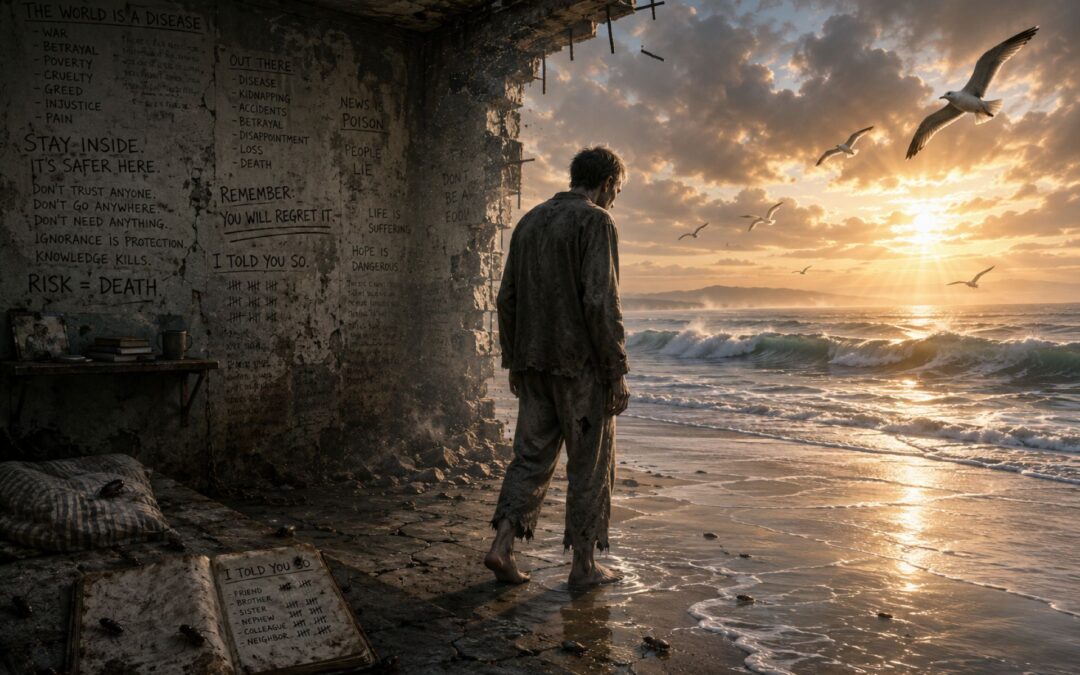
A man voluntarily locks himself inside a prison cell because he believes the world outside is too dangerous to live in. He avoids love because betrayal exists. He avoids travel because accidents happen. He avoids ambition because failure is possible. And over the years, he convinces himself that this withdrawal is not cowardice, but wisdom.
At first glance, the story reads like an extreme psychological case. But beneath its dark imagery lies something far more uncomfortable: a reflection of tendencies that exist in many of us. The prison cell is not merely a physical location. It is a mental structure built from fear, pessimism, resentment, and the desperate desire for certainty in an unpredictable world.
The man believes he has discovered “the truth” about life. He sees danger everywhere and calls his avoidance intelligence. He builds an entire philosophy around safety, turning isolation into virtue and risk into foolishness. Yet the story slowly reveals the hidden cost of this worldview. In trying to avoid suffering altogether, he abandons life itself.
What makes the allegory powerful is that the prisoner is not entirely irrational. The world is dangerous. People do get cheated, abandoned, infected, humiliated, and destroyed. Businesses fail. Relationships collapse. Accidents happen. Every fear he has is rooted in something real. This is precisely why his prison becomes so convincing. Fear does not need fantasy to imprison us. Reality alone is enough.
And this is where the story becomes deeply psychological. Human beings have an extraordinary ability to transform isolated dangers into entire worldviews. Once fear becomes the lens through which we interpret reality, everything begins to reinforce it. The mind selectively gathers evidence that confirms its anxieties, slowly constructing an internal architecture of self-protection. Eventually, retreat no longer feels like surrender. It feels like intelligence.
The prisoner’s tragedy is not simply that he is afraid. It is that he mistakes the avoidance of pain for the achievement of wisdom. He confuses survival with living. He believes that if he minimizes enough risks, he can finally become untouchable. But in doing so, he unknowingly creates a different kind of suffering: a life emptied of movement, spontaneity, beauty, intimacy, and wonder.
The prison cell therefore becomes symbolic of something profoundly human. Many people never physically isolate themselves from society, yet psychologically they inhabit similar structures. Some avoid relationships because they fear heartbreak. Some never pursue meaningful work because failure would wound their identity. Others constantly consume news, statistics, and cautionary stories until life itself starts to feel like a catastrophe waiting to happen. They may still walk through cities, go to work, and interact with others, but inwardly they have already withdrawn from existence.
At the center of the story lies a difficult existential question: what if the attempt to eliminate suffering is itself the greatest source of suffering? What if absolute safety is impossible, and the pursuit of it slowly transforms life into a sterile prison of fear?
The allegory ultimately forces us to confront an unsettling possibility: that many of the walls we believe protect us are the very things preventing us from experiencing the world fully.
The Prison Cell as a Psychological State
The prison cell in the story is not merely a setting. It is a manifestation of a worldview. Every rotten detail of the environment — the cockroaches, the foul stench, the decaying mattress, the silence of the hallway — reflects the internal condition of the man who lives there. The cell is filthy, claustrophobic, and lifeless, yet he chooses it willingly because to him, safety matters more than vitality.
This distinction is crucial. The prisoner does not remain inside because he enjoys solitude in the traditional sense. Genuine solitude can be creative, restorative, even spiritually enriching. Many philosophers, artists, monks, and writers deliberately withdrew from society to deepen their understanding of themselves and the world. But their solitude was still connected to life. It was expansive rather than defensive.
The prisoner’s isolation is something entirely different.
He retreats not because he loves peace, but because he fears uncertainty. His withdrawal is not rooted in contemplation but in aversion. The world has become intolerable to him because he perceives danger in nearly everything. Crowds are threatening. Vehicles are deadly. Travel is reckless. Human relationships are unstable. Even the sea — the one thing he genuinely loves — becomes inaccessible because he has convinced himself that contamination and disaster await him there.
Fear gradually reshapes his perception of reality until the outside world appears almost apocalyptic. What is tragic is that this transformation happens slowly and rationally. He does not descend into madness overnight. Instead, he accumulates reasons, statistics, examples, and cautionary tales until his prison begins to feel justified.
This is how psychological prisons are often built in real life.
People rarely wake up one morning and consciously decide to abandon life. More commonly, they suffer disappointment, betrayal, humiliation, rejection, or anxiety, and then slowly begin constructing protective mechanisms around themselves. After enough painful experiences, caution hardens into habit. Habit hardens into identity. Eventually, avoidance starts masquerading as maturity.
Someone gets heartbroken and decides relationships are not worth the risk. Someone fails publicly and never attempts anything ambitious again. Someone experiences social rejection and begins avoiding vulnerability altogether. Over time, their world shrinks. But because this shrinking protects them from immediate pain, it feels sensible.
The human mind has a remarkable ability to normalize confinement when confinement reduces anxiety.
This is why the prisoner constantly repeats the phrase: “At least I’m safe here.” The statement functions almost like a religious mantra. It allows him to reinterpret deprivation as security. Even the unbearable conditions of the cell become acceptable because they serve a psychological purpose. Misery becomes tolerable if it promises protection from greater misery.
And yet the story subtly reveals the contradiction at the center of his existence: although he claims to hate the world, part of him still longs for it. The sea remains emotionally alive inside him. The annoying voice continues speaking. His frustration toward others who continue taking risks reveals an unresolved tension within himself. Deep down, he has not extinguished the desire to live. He has merely buried it beneath layers of fear and rationalization.
This makes the prison cell especially symbolic. It is not simply a place of confinement imposed from the outside. It is self-created limitation. The door is never truly locked. He could leave whenever he wants. But psychologically, he no longer believes he can.
That is what makes fear so powerful. The most effective prisons are often the ones that convince people they are free for choosing them.
Fear Disguised as Wisdom
One of the most unsettling aspects of the story is that the prisoner does not see himself as weak. On the contrary, he believes he has achieved a level of understanding that others lack. In his mind, he is not hiding from life; he is seeing through it. Everyone else appears naïve, reckless, and delusional, while he alone possesses the courage to face reality honestly.
This psychological transformation is essential to understanding how fear can become an identity.
If the prisoner simply admitted that he was terrified of the world, his worldview would collapse under its own weight. Fear alone is difficult to sustain because human beings naturally crave movement, novelty, intimacy, and meaning. To permanently withdraw from life, he must reinterpret his fear as intelligence. He must convince himself that avoidance is not cowardice, but clarity.
And so he begins constructing a philosophy.
He studies disasters, betrayals, diseases, accidents, and failures. He collects evidence obsessively. Every tragedy becomes proof that his withdrawal is justified. Every painful event reinforces the idea that life is fundamentally dangerous and that those who participate in it are fools gambling with suffering.
This mentality resembles what psychologists sometimes call defensive pessimism, though in the prisoner’s case it has evolved into something far darker and more absolute. Defensive pessimism can occasionally serve a practical purpose, helping people prepare for difficulties realistically. But when fear completely dominates perception, realism mutates into paranoia. The mind stops assessing probabilities and starts scanning constantly for threats.
At that point, intelligence itself becomes corrupted by fear.
The prisoner’s worldview feels rational because it is built from real events. Plane crashes happen. Businesses fail. Marriages collapse. Diseases spread. Nothing he believes is entirely fabricated. But wisdom is not merely the accumulation of negative evidence. Wisdom also requires proportion, perspective, and the ability to tolerate uncertainty without surrendering to it.
The prisoner cannot do this. He interprets danger not as a dimension of life, but as its defining essence.
This is why pessimistic worldviews can feel strangely seductive. They often create the illusion of intellectual superiority. Optimistic people are dismissed as naïve. Adventurous people are called reckless. Hopeful people appear irrational. Meanwhile, the fearful person feels grounded, realistic, and emotionally prepared for catastrophe.
There is a certain ego hidden inside this posture.
To believe that one alone truly understands reality can become psychologically intoxicating. It transforms suffering into evidence of depth. Cynicism begins to resemble intelligence. Suspicion feels more mature than trust. Gradually, the fearful person stops seeing themselves as wounded and starts seeing themselves as enlightened.
The prisoner embodies this perfectly. He believes he has discovered “the truth” about existence while others remain trapped in illusion. His contempt for the outside world is inseparable from his sense of intellectual superiority. This is why he constantly lectures others about risk. He genuinely believes he is protecting them from their own ignorance.
But beneath this apparent wisdom lies something deeply fragile.
People who are genuinely at peace with their understanding of life rarely need constant validation. The prisoner, however, desperately needs the world to confirm his beliefs. Every failed business, every betrayal, every accident becomes emotionally gratifying because it reassures him that his fear was justified all along.
This reveals the hidden paradox of fear-based worldviews: they often depend on catastrophe for psychological survival.
Without evidence of disaster, the prisoner would be forced to confront a terrifying possibility — that he sacrificed his entire life not for wisdom, but for fear. And so his mind continuously searches for confirmation that the world is as terrible as he believes it to be.
Over time, this creates a tragic inversion. Instead of seeking truth, he seeks reassurance. Instead of understanding reality, he selectively interprets it through the lens of anxiety. His intelligence no longer expands his world. It imprisons him within it.
The story therefore exposes a painful human tendency: the ability to transform fear into philosophy so convincingly that we no longer recognize it as fear at all.
The Wall of Knowledge and the Need for Certainty
At the center of the prisoner’s existence stands his most sacred creation: the wall of knowledge.
Over the years, he covers the wall of his cell with everything he has learned about life. Every danger, every warning, every painful lesson becomes another inscription reinforcing his worldview. To him, the wall is not merely a collection of thoughts. It is an authority. A doctrine. A final answer to the uncertainty of existence.
Most importantly, it gives him something psychologically irresistible: certainty.
Human beings can tolerate pain more easily than uncertainty. We often imagine fear as a reaction to danger itself, but many times what truly terrifies us is unpredictability. The unknown leaves room for possibilities we cannot control. It forces us to live without guarantees. And for some people, this ambiguity becomes unbearable.
The prisoner solves this problem by constructing a complete explanatory system. His wall organizes reality into something fixed and understandable. The world outside may be chaotic, but inside the cell everything makes sense. Every risk has already been categorized. Every decision has already been made. He no longer has to wrestle with ambiguity because the wall interprets existence for him.
This is why the words “YOU ARE SAFE HERE” become so important.
The sentence is written in blood, which gives it an almost religious intensity. It is not merely a reminder; it is a creed. A sacred truth around which he organizes his entire identity. By repeating it daily, he transforms self-protection into a ritual of psychological reassurance.
The wall therefore symbolizes more than knowledge. It symbolizes the human tendency to use knowledge defensively.
Information can illuminate reality, but it can also become armor against it. People often gather facts not to understand the world more openly, but to reduce anxiety. Statistics, articles, theories, and endless analysis can become emotional shields that create the illusion of control.
This is particularly visible in modern life.
Many people consume a constant stream of alarming information about economics, politics, disease, crime, climate collapse, technological disruption, and social instability. Some become trapped in endless cycles of research and caution, believing that if they can just understand every possible danger, they can finally feel safe. But instead of becoming wiser, they become increasingly paralyzed.
The mind mistakes preparation for control.
The prisoner embodies this dynamic completely. He believes his wall has “saved” him because it has allowed him to avoid risks. Yet the wall has not actually made him safe. It has only narrowed his existence to the point where life itself becomes inaccessible.
And this narrowing happens subtly.
The more certainty he accumulates, the less capable he becomes of engaging with spontaneity. He can no longer tolerate unpredictability because unpredictability threatens the entire structure of his worldview. The outside world becomes intolerable precisely because it refuses to obey the neat conclusions written on his wall.
Real life is messy. Contradictory. Uncontrollable.
People succeed unexpectedly. Relationships survive hardship. Risks sometimes lead to joy instead of catastrophe. None of this fits comfortably into the prisoner’s system. His wall requires the world to remain dangerous because its authority depends on that assumption.
This explains why the “annoying voice” disturbs him so deeply. The voice does not merely challenge his behavior; it threatens the foundation of certainty upon which his identity rests. If he were to leave the cell and experience beauty, freedom, or meaning despite the risks, then the wall would lose its sacred power.
And so he clings to it desperately.
There is something profoundly human in this attachment. People often prefer painful certainty over uncertain possibility. A miserable but familiar existence can feel safer than venturing into unknown territory where failure, rejection, or loss might occur. The known prison becomes psychologically preferable to the unpredictable horizon beyond it.
But the story gradually reveals the fatal flaw in the prisoner’s pursuit of certainty: life itself cannot be mastered through knowledge alone.
No amount of information can eliminate vulnerability. No worldview can fully protect us from suffering, illness, betrayal, or death. The prisoner mistakes understanding risk for escaping risk. And because of this confusion, he spends his life worshipping an illusion of safety that was never truly real.
The Voice Inside Him
Throughout the story, the prisoner treats the “annoying voice” as his enemy. He tries to silence it, argues with it, curses at it, and interprets it as a corrupting influence trying to lure him toward danger. But the more the voice speaks, the clearer it becomes that it is not an external demon at all. It is the part of him that still wants to live.
This inner dialogue is one of the most psychologically revealing elements of the allegory because it captures a conflict that exists within many people: the battle between fear and vitality.
On one side stands the frightened self that seeks protection, certainty, and control. On the other stands a quieter but more persistent impulse pushing toward experience, movement, risk, curiosity, and participation in life. The prisoner experiences this second impulse as torment because it threatens the stability of the defensive world he has built around himself.
The voice continually asks the question he cannot answer honestly: “Are you scared?”
And eventually, under pressure, he explodes: “Of course I’m scared!”
This moment is crucial because it briefly tears apart the intellectual mask he has constructed around his fear. Up until then, he frames his isolation as rationality. But the voice strips away the philosophy and exposes the emotional reality underneath it. His behavior is not fundamentally driven by wisdom. It is driven by terror.
Yet the voice does not ridicule him for this fear. Instead, it challenges the conclusions he has drawn from it.
The voice proposes something remarkably simple: go to the sea. Test your assumptions. See whether the world is truly as catastrophic as you believe it to be. In other words, it asks him to confront reality directly instead of endlessly interpreting it through anxiety.
This is psychologically significant because fear often thrives in abstraction.
The less directly people engage with life, the more monstrous their fears can become. Imagination fills the gaps left by experience. Someone who never risks vulnerability may convince themselves that relationships always end in devastation. Someone who never pursues ambition may imagine failure as unsurvivable humiliation. Someone who avoids the world entirely can slowly transform existence itself into a nightmare within their own mind.
The prisoner’s fears remain so powerful partly because they are untested.
He has not seen the sea in years, yet he speaks about it with absolute certainty. He has not traveled, started a business, or embraced family life, yet he confidently predicts disaster in all these pursuits. His knowledge is disconnected from lived experience. The voice therefore represents something profoundly important: direct engagement with reality instead of fearful speculation about it.
But the voice also symbolizes desire.
Despite everything, the prisoner still longs for the world. The sea continues to haunt his imagination because it represents something emotionally alive within him. It symbolizes freedom, beauty, unpredictability, and transcendence — everything his prison lacks.
This explains why he cannot fully silence the voice no matter how much knowledge he accumulates. Human beings are not built merely to survive. We are also driven by longing. Beneath fear, there often remains a buried hunger for meaning, wonder, intimacy, adventure, and transformation.
The tragedy is that the prisoner interprets this longing as weakness.
Rather than seeing the voice as a healthy instinct pushing him toward life, he frames it as temptation. He treats his own desire for freedom as something dangerous that must be suppressed. This inversion is psychologically devastating because it turns the self against itself. The very impulse capable of rescuing him becomes identified as the enemy.
Many people experience a similar internal conflict.
There is often a voice urging movement: apply for the opportunity, express the feeling, leave the unhealthy environment, create something meaningful, take the journey, risk failure, risk embarrassment, risk change. But fear responds immediately with reasons to remain still. Over time, people may become so identified with caution that the life-seeking part of themselves starts feeling irrational or irresponsible.
The prisoner’s hostility toward the voice therefore reflects a broader existential tension. To truly live requires confronting uncertainty, and uncertainty inevitably awakens fear. The voice keeps pushing him toward the sea because it understands something he does not yet grasp: safety alone cannot satisfy the human spirit.
Something inside him still knows that there is a difference between being alive and merely remaining unharmed.
Resentment Toward Those Who Participate in Life
The prisoner does not simply withdraw from the world. He gradually becomes hostile toward those who continue participating in it.
This transformation is important because fear rarely remains passive forever. When people build their entire identity around avoidance, they often become emotionally threatened by those who embrace the very risks they themselves are unwilling to take. The existence of courageous, hopeful, or adventurous people quietly challenges the logic of retreat.
The prisoner’s conversations with his family reveal this dynamic clearly.
His sister wants to travel abroad. He immediately warns her about diseases, kidnapping, and plane crashes. His friend wants to start a business. He predicts financial ruin. His brother wants children. He focuses on betrayal, divorce, and suffering. His nephew wants a driver’s license. He imagines fatal accidents.
Every possibility is filtered through catastrophe.
At first glance, this behavior appears protective. The prisoner likely believes he is helping others avoid pain. But beneath his warnings lies something more complicated: resentment. He cannot tolerate watching others move toward life because their willingness to risk uncertainty exposes the limitations of his own existence.
This is why he reacts so intensely whenever people ignore his advice.
If others continue taking risks despite his warnings and still find meaning, joy, or fulfillment, then his entire worldview becomes unstable. Their lives become evidence against his philosophy of avoidance. But if they fail, suffer, or collapse, then he feels vindicated. Their pain reassures him that his fear was justified all along.
The “I told you so” notebook symbolizes this need for vindication perfectly.
It is one of the darkest details in the story because it reveals how deeply his identity depends on being proven right. The notebook is not simply a record of predictions. It is an emotional survival mechanism. Every tragedy he documents strengthens the walls of his prison psychologically. Every disaster becomes proof that life outside the cell is unbearable.
Notice how he reacts when misfortune strikes others.
When his friend goes bankrupt, he feels satisfaction. When his brother’s marriage collapses, he chuckles. When his nephew crashes his car, he experiences emotional triumph. These are not the reactions of someone at peace. They are the reactions of someone desperately seeking confirmation that his sacrifices were worthwhile.
This is one of the most corrosive effects of fear-based living: suffering becomes emotionally useful.
If the world is not as terrible as the prisoner believes, then he must confront the horrifying possibility that he wasted his life hiding from experiences that could have brought him meaning. That realization would shatter him psychologically. And so catastrophe becomes comforting because it protects him from regret.
The story therefore reveals how resentment can emerge from unfulfilled longing.
Deep down, the prisoner once wanted many of the same things he condemns in others. He wanted adventure. He wanted intimacy. He wanted ambition. He wanted movement. But instead of confronting the pain of abandoning these desires, he converts his disappointment into superiority. He mocks people as “fools” for continuing to pursue what he secretly envies.
This psychological mechanism appears frequently in real life.
People who fear vulnerability may ridicule romance as naïve. Those afraid of failure may dismiss ambition as ego-driven. Those who abandoned their dreams may mock idealism itself. Over time, cynicism becomes a defense against grief. It is often easier to condemn what we cannot bring ourselves to pursue.
The prisoner’s resentment also reveals something deeper about human beings: we often seek social confirmation for our deepest fears.
Fear becomes easier to sustain when others share it. But people who continue embracing uncertainty despite pain become threatening reminders that another way of living is possible. Their courage silently asks a difficult question: what if suffering is not sufficient reason to stop participating in life?
The prisoner cannot bear this question.
And so he retreats further into bitterness, surrounding himself with evidence that the world is horrifying while dismissing anything that contradicts his conclusions. His prison is no longer merely built from fear. It is now reinforced by resentment, envy, and the desperate need to be proven correct.
By this point in the story, he has become psychologically dependent on pessimism itself.
The Fantasy of a Risk-Free Existence
At the core of the prisoner’s worldview lies a dream that many people secretly share: the fantasy that suffering can be avoided through enough caution, enough knowledge, enough control, and enough withdrawal from danger.
The prisoner believes he has solved the problem of life.
By refusing to participate in the world, he imagines he has escaped its chaos. No heartbreak can wound him if he never opens himself to love. No financial ruin can destroy him if he never pursues ambition. No accident can harm him if he never travels. His strategy appears airtight because every avoided risk feels like a victory.
But hidden inside this logic is a devastating contradiction.
In trying to eliminate suffering, he also eliminates the conditions that make life meaningful. Safety gradually becomes his highest value, replacing joy, intimacy, growth, beauty, spontaneity, and freedom. The avoidance of pain becomes more important than the experience of being alive.
This is why his prison cell is so symbolically important.
The environment itself is miserable. He sleeps beside rot, filth, disease, and decay. The cell offers no beauty, no connection, no vitality, and no genuine peace. Yet he continues convincing himself that he is better off there because at least he has minimized uncertainty.
The irony is brutal: he sacrifices his life in order to preserve it.
This paradox reflects a deeply human temptation. Many people unconsciously organize their lives around minimizing emotional exposure rather than maximizing meaningful experience. They choose predictability over possibility. Familiar misery over uncertain transformation. Emotional numbness over vulnerability.
At first, this approach can feel intelligent because it genuinely reduces certain forms of pain. Avoidance often works in the short term. If you never risk rejection, you avoid humiliation. If you never pursue difficult goals, you avoid failure. If you never trust deeply, you reduce the possibility of betrayal.
But avoidance extracts its payment slowly.
What begins as protection eventually becomes stagnation. Life loses texture. Curiosity fades. Emotional energy shrinks. Days become repetitive and psychologically airless. The person may remain physically safe, yet inwardly they experience a quiet form of spiritual starvation.
The prisoner embodies this starvation completely.
Notice how little life actually exists inside the cell. There are no meaningful experiences, no beauty, no movement, no transformation. Even time itself feels stagnant. The hallway remains silent. The walls never change. His routines repeat endlessly. He has constructed a world designed to prevent disaster, but also incapable of producing vitality.
And yet he continues clinging to it because uncertainty feels more frightening than emptiness.
This reveals something profound about human psychology: people can adapt to unhappiness more easily than unpredictability. A painful but familiar existence often feels psychologically safer than stepping into an unknown future where outcomes cannot be controlled.
The prisoner therefore mistakes the absence of risk for the presence of safety.
But these are not the same thing.
Absolute safety does not exist because vulnerability is built into existence itself. Human beings can reduce certain dangers, but they cannot eliminate uncertainty altogether. Illness, loss, aging, betrayal, death, and chaos remain unavoidable dimensions of life. The attempt to escape them entirely inevitably leads to withdrawal from reality itself.
The story gradually exposes this truth through the prisoner’s increasing desperation. The more he tries controlling life, the more fragile he becomes emotionally. His worldview depends on constant vigilance. His sense of security depends on maintaining rigid psychological boundaries against the outside world. This is not peace. It is chronic defensive tension disguised as wisdom.
And beneath all of it lies a haunting existential tragedy.
The prisoner never truly lives the life he claims to protect.
He never returns to the sea he loves. He never travels. He never builds anything meaningful. He never embraces uncertainty long enough to discover whether life contains beauty alongside suffering. His fear protects him from catastrophe, but it also protects him from wonder.
This is what makes the fantasy of a risk-free existence so destructive. It promises protection while quietly eroding the very experiences that give existence depth and meaning. The pursuit of total safety eventually becomes incompatible with life itself.
Because to live fully is to accept exposure.
There is no meaningful love without the possibility of heartbreak. No freedom without uncertainty. No adventure without danger. No transformation without risk. The prisoner spends his life trying to negotiate an impossible deal with existence: to receive the rewards of life without accepting its vulnerability.
The story’s answer is mercilessly clear.
Such a bargain cannot be made.
The Pestilence and the Collapse of Illusion
The turning point of the story arrives with devastating irony.
After spending years isolating himself from the dangers of the outside world, the prisoner discovers that the very thing he feared has already entered his sanctuary. The pestilence spreads through the cockroaches living inside his own cell — the same creatures crawling above his head every night while he reassured himself that he was safe.
In a single moment, his entire worldview begins to collapse.
This is what makes the scene so psychologically powerful. The story does not merely show the prisoner becoming ill. It shows the destruction of the illusion that his prison ever truly protected him. The wall of knowledge, the rituals of caution, the years of withdrawal — all of it suddenly appears fragile and absurd in the face of reality.
For perhaps the first time, he is forced to confront something he spent his entire life denying: vulnerability cannot be eliminated.
No amount of fear prevented suffering from reaching him. No amount of avoidance stopped chaos from entering his world. The danger he spent years trying to escape was already living inside the walls he trusted most.
The symbolism here is profound.
The cockroaches are not random details added for atmosphere. They represent the ignored contradictions within his system. He tolerated them because they existed inside the boundaries of what he considered “safe.” Even though the cell was objectively filthy and unhealthy, he psychologically reinterpreted it as protection because it aligned with his worldview.
Human beings do this constantly.
We often ignore dangers that feel familiar while obsessing over dangers associated with uncertainty. Someone may fear traveling abroad while neglecting their deteriorating mental health at home. Another may avoid emotional vulnerability while remaining trapped in lonely routines that slowly erode their spirit. Familiar suffering becomes normalized because it feels controllable.
The prisoner normalized his prison so thoroughly that he stopped seeing its decay clearly.
This is why his rage toward the wall becomes so significant. When he yells, “You lied to me!” he is not merely speaking to the words written before him. He is confronting the collapse of the entire psychological structure that gave his life meaning.
The wall promised certainty. Reality shattered it effortlessly.
There is something almost existentially terrifying about this moment because it reveals how fragile human systems of control truly are. People often construct elaborate identities around the belief that they can outthink suffering, outmaneuver uncertainty, or organize life into something predictable. But existence repeatedly refuses to cooperate with these fantasies.
Illness appears unexpectedly. Relationships end suddenly. Accidents happen randomly. Economic collapse arrives without warning. Mortality remains undefeated.
The prisoner’s breakdown therefore represents more than personal despair. It symbolizes the collapse of the illusion that life can be mastered through defensive living.
And yet, paradoxically, this collapse also becomes the beginning of transformation.
As long as the prisoner believed completely in his wall, he remained psychologically trapped. His certainty prevented growth because it closed him off from experience. Only when the illusion fails does something new become possible.
This pattern appears frequently in human life.
Many people do not begin changing until their systems of control stop working. A crisis, heartbreak, illness, failure, or existential collapse forces them to confront truths they previously avoided. The identities they carefully constructed begin cracking apart, revealing unresolved fears beneath them.
Painful as these moments are, they can also become liberating.
The prisoner’s suffering strips away the intellectual defenses that once insulated him from reality. His wall no longer comforts him. His rituals no longer reassure him. His philosophy no longer explains the world. He is left exposed before existence itself, without the psychological armor he spent years building.
And strangely, it is only at this point — when certainty finally disintegrates — that he becomes capable of seeing the world differently.
The pestilence destroys him physically, but it also destroys the illusion that kept him spiritually imprisoned.
The Sea as a Symbol of Life Itself
Throughout the story, one image quietly lingers beneath the prisoner’s fear and resentment: the sea.
It is the only thing in the outside world that he genuinely loves.
This detail matters enormously because it reveals that despite all his cynicism, something inside him still responds to beauty. The sea represents a part of existence that continues calling to him even after years of withdrawal. It remains emotionally alive within him long after his connection to the rest of the world has withered.
And yet he never returns to it.
Not because the sea harmed him, but because fear gradually contaminated even his love for it. He convinces himself that the ocean is polluted, dangerous, diseased, and inaccessible. The journey itself becomes terrifying. Traffic accidents, contamination, unpredictability — every possible danger expands in his imagination until the sea transforms from a source of wonder into another forbidden territory.
This is what fear often does to beauty.
It does not always destroy our longing directly. Instead, it surrounds longing with so many warnings, anxieties, and calculations that pursuing what we love starts feeling irresponsible. Over time, people stop moving toward the things that make them feel alive because the risks associated with those things begin outweighing the emotional reward.
The prisoner therefore lives in a painful contradiction: he loves the sea, but he fears life more than he loves what life offers.
Symbolically, the sea represents everything his prison lacks.
The cell is rigid, enclosed, stagnant, and controlled. The ocean is open, moving, uncontrollable, and alive. The prison walls create separation and predictability. The sea dissolves boundaries. It stretches endlessly beyond certainty, beyond fixed structures, beyond the illusion of control.
This contrast gives the ocean an almost existential significance.
The sea embodies life in its rawest form: beautiful yet dangerous, peaceful yet chaotic, magnificent yet indifferent. One cannot experience it fully while remaining obsessed with safety. To stand before the ocean requires surrendering, at least temporarily, to uncertainty itself.
That is why the “annoying voice” keeps urging him toward it.
The voice understands something the prisoner does not: the sea is not merely a destination. It is a confrontation. A confrontation with openness, unpredictability, vulnerability, and awe. Returning to the sea would mean stepping beyond the defensive identity he spent years constructing.
And so he resists it desperately.
But after the pestilence destroys his illusion of safety, something extraordinary happens. The prison itself begins transforming into the shoreline. The walls crumble. The ceiling disappears into the sky. The stench gives way to ocean air. Cockroaches are replaced by seagulls. The rotting mattress becomes soft sand beneath his feet.
This transformation is deeply symbolic.
The story is no longer operating purely on literal reality. Instead, it enters a psychological and existential dimension where the prisoner’s inner world dissolves alongside his physical surroundings. The collapse of the prison represents the collapse of the rigid mental structures that once confined him.
And what waits beyond them is not certainty, but reality itself.
The sea appears precisely at the moment when his need for control begins disintegrating. As his old worldview dies, he finally encounters the thing he spent his entire life avoiding: direct contact with existence.
Importantly, the sea does not suddenly become “safe.” His lungs are still failing. He is still vulnerable. Death still surrounds him. The story never suggests that life becomes risk-free once fear is abandoned. Instead, it reveals something far more profound: beauty and danger coexist inseparably.
This realization changes everything.
The prisoner spent his life believing that suffering invalidated existence. But standing before the ocean, he begins understanding that vulnerability is not the opposite of beauty — it is part of it. The sea moves him precisely because it cannot be controlled. Its vastness overwhelms the defensive structures of his mind.
For the first time, he is no longer analyzing life from behind walls. He is experiencing it directly.
This is why the ocean feels almost sacred in the final scenes. It represents a state of being that exists beyond obsessive fear and defensive certainty. A reality where meaning emerges not from eliminating danger, but from participating in life despite it.
The sea therefore becomes the ultimate counterpoint to the prison.
The prison says: avoid vulnerability at all costs.
The sea says: vulnerability is the price of aliveness.
A Heaven Unfolding in Hell
The final moments of the story contain a paradox that lies at the heart of the entire allegory.
The prisoner reaches peace not when the world becomes safe, but when he finally stops demanding that it be safe in the first place.
This distinction changes everything.
Throughout his life, he believed happiness depended on eliminating danger, uncertainty, suffering, and vulnerability. He treated fear as a problem to solve intellectually. Every warning on his wall, every argument against risk, every withdrawal from life reflected the same underlying assumption: if he could just avoid enough pain, he would finally achieve peace.
But peace never arrived.
Instead, his obsession with safety transformed existence into something sterile, claustrophobic, and joyless. The more desperately he tried controlling life, the smaller his world became. His prison was not merely built from fear of suffering. It was built from refusal — refusal to accept the conditions under which life actually exists.
And then, in the final scene, something shifts.
Standing before the sea with failing lungs, he experiences a moment of radical surrender. The danger has not disappeared. His body remains weak. The world remains uncertain. Mortality still surrounds him. Yet suddenly, the sounds of the ocean and the cries of seagulls become more vivid than his fear.
For the first time, he stops resisting reality.
This is why the line “a heaven unfolding in hell” is so powerful. The phrase does not describe escape from suffering. It describes a transformation in perception. Hell remains present — illness, vulnerability, death, uncertainty — but within that same reality, beauty also emerges with overwhelming intensity.
The prisoner spent his life assuming that suffering cancels out beauty. The ending reveals the opposite: beauty often becomes most visible when we stop trying to dominate existence and simply experience it fully.
This idea appears across many philosophical and spiritual traditions.
Existentialist thinkers argued that meaning emerges precisely because life is finite and uncertain. Buddhist philosophy teaches that suffering intensifies when people cling desperately to permanence and control. Stoic thinkers emphasized accepting what cannot be controlled rather than exhausting oneself resisting reality.
The prisoner arrives at a similar realization, though tragically late.
As the wall disappears, so does his compulsive need to interpret, categorize, predict, and defend against life. There is “nothing left to solve, nothing to comprehend.” This line is crucial because it marks the end of his obsessive relationship with certainty.
For years, he believed understanding life intellectually would save him from suffering. But standing before the sea, understanding suddenly becomes irrelevant. What matters is presence.
He no longer needs to win arguments. He no longer needs to convince others. He no longer needs records of being right. The entire psychological machinery of resentment and fear falls away. What remains is immediate experience: the horizon, the wind, the sound of waves, the warmth of sunlight, the softness of sand.
Reality itself becomes enough.
There is something deeply liberating about this transformation because the prisoner finally experiences the world directly instead of filtering it through fear. He spent years trying to reduce existence into manageable conclusions written on a wall. But life cannot be compressed into doctrines without losing its vitality.
The sea destroys abstraction.
Before it, all his defensive philosophies collapse into silence.
And then comes the final line: “I told you so.”
Earlier in the story, those words symbolized bitterness, vindication, and resentment. The prisoner used them to celebrate tragedy because tragedy validated his worldview. But in the ending, the phrase returns transformed. The voice says “I told you so” not to humiliate him, but almost tenderly — as if gently reminding him that life still contained beauty beyond the walls of fear he constructed around himself.
This reversal gives the ending extraordinary emotional weight.
The prisoner’s greatest enemy was never the world outside. It was the fearful part of himself that mistook control for wisdom and safety for life. The voice represented the neglected instinct urging him toward existence all along.
And in the end, the voice was right.
Not because the world became safe, but because life remained beautiful despite never being safe at all.
Conclusion
The prisoner’s tragedy is not that he feared the world. Fear is natural. Every human being recognizes the reality of suffering, loss, betrayal, illness, and death. The tragedy is that he allowed fear to become the organizing principle of his existence.
He tried to solve life instead of living it.
What makes the story so unsettling is that the prisoner is never portrayed as entirely irrational. Much of what he believes is true. The world is dangerous. Human beings do fail each other. Chaos can arrive suddenly and without warning. But the allegory reveals a profound existential mistake: recognizing danger is not the same thing as understanding life.
The prisoner mistakes caution for wisdom and certainty for peace. He believes that if he withdraws far enough from uncertainty, he can finally escape suffering. Instead, he creates a different kind of suffering altogether — one rooted in stagnation, resentment, emotional starvation, and the slow abandonment of everything that makes existence meaningful.
In the end, the story exposes the impossibility of the bargain he tried to make with reality.
There is no life without vulnerability.
To love is to risk heartbreak. To pursue meaning is to risk failure. To trust people is to risk disappointment. To embrace freedom is to accept uncertainty. The very experiences that give life depth are inseparable from the possibility of pain. Anyone seeking absolute safety will eventually have to retreat not only from suffering, but from life itself.
And yet the story is not nihilistic.
Its final revelation is strangely hopeful. The prisoner discovers that peace does not emerge from controlling existence, but from participating in it fully despite its uncertainty. The sea does not become less dangerous. Death does not disappear. The world remains imperfect and unpredictable. But once he stops demanding guarantees from life, he becomes capable of experiencing beauty again.
This may be the deepest insight hidden within the allegory.
Human beings often spend enormous amounts of energy trying to construct psychological prisons that protect them from disappointment, humiliation, grief, rejection, or uncertainty. But walls built to keep pain out eventually keep life out as well. Over time, many people become experts at survival while forgetting how to feel alive.
The prisoner realizes this too late.
But the story leaves the reader with a question that remains deeply relevant: how many of the walls we defend so passionately are actually prisons we have mistaken for safety?
Perhaps the most dangerous thing about fear is not that it makes people suffer, but that it can convince them they are wise for refusing to live.