
On August 8, 2023, the island of Maui was engulfed in flames unlike anything Hawai’i has ever witnessed. Hurricane-force winds whipped a wall of fire that tore through Lahina—the historic capital of the Kingdom of Hawai’i—leaving devastation in its wake and marking the deadliest natural disaster in the state’s history. This was no random catastrophe. The wildfire was the latest chapter in a saga spanning over a century: a relentless theft of land, culture, and identity that has pushed Hawai’i to a breaking point.
More than 15,000 Native Hawaiians flee the islands every year. They escape soaring costs, climate disasters, and a tsunami of tourists and wealthy investors who uproot indigenous families. The American military silently poisons the water, while powerful outsiders convert paradise into an exclusive playground. Behind postcard-perfect beaches and the veneer of aloha hospitality lies a painful truth: a kingdom stolen, a culture erased, a fertile land transformed into ashes and riches for outsiders.
To truly grasp Hawai’i’s current crisis, we must journey back to its fiery origins, tracing the transformation from a thriving indigenous nation to a colonized, exploited territory.
Born of Fire: Hawai’i’s Volcanic Genesis and Unique Ecosystem
The Hawaiian Islands stand as monuments to the earth’s most primal creative force: fire. Their existence owes entirely to the relentless volcanic activity beneath the vast Pacific Ocean. Unlike continental landmasses that slowly drifted apart over eons, Hawai’i was born abruptly and violently. Molten rock from deep within the Earth’s mantle forced its way through the ocean floor, erupting in torrents of lava that cooled upon contact with seawater, slowly but inexorably building new landforms.
This fiery genesis was not a singular event but a continuous process. Over millions of years, successive eruptions built up volcanic mountains, layer upon layer, rising from the abyss until they breached the ocean’s surface. Each island represents a different stage in this volcanic lifecycle—from the youngest, like Hawai’i’s Big Island with its still-active volcanoes, to the older, more eroded islands like Kaua’i.
In the beginning, these islands were barren, a stark landscape of jagged black rock devoid of life. Without soil, water, or vegetation, survival seemed impossible. Yet nature is relentless. Winds, ocean currents, and migratory birds became unwitting agents of colonization, transporting seeds, spores, and small animals from distant lands. Over millennia, this slow natural immigration seeded Hawai’i with an astonishing biodiversity.
The result was an isolated ecological laboratory, home to thousands of unique species that evolved in splendid isolation. From the endemic honeycreepers—birds with specialized beaks—to rare plants found nowhere else on Earth, Hawai’i’s ecosystem developed intricate webs of life finely tuned to its environment.
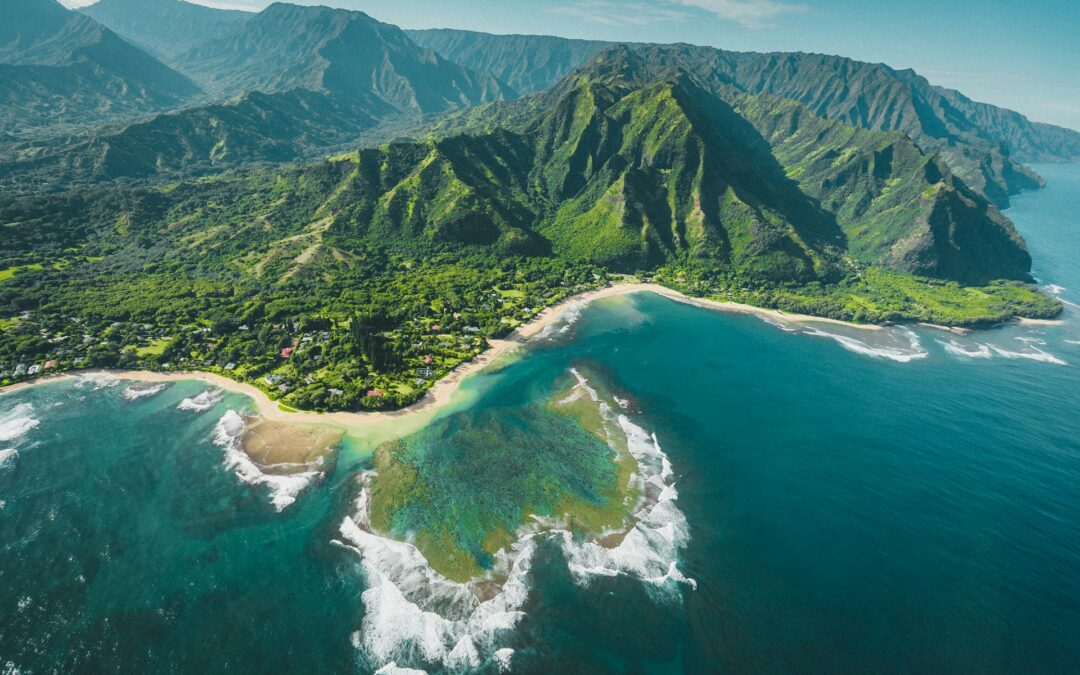
The islands’ topography played a critical role in shaping their climate and ecology. Towering volcanic peaks forced moist trade winds upwards, causing condensation and rainfall on the windward slopes. These areas became lush, green rainforests, cloaked in mist and teeming with life. In stark contrast, the leeward sides lay in a rain shadow, baking under the sun in dry, sometimes desert-like conditions. This created a patchwork of diverse habitats: dense jungles, arid grasslands, rugged lava fields, tranquil beaches, and turbulent seas.
The isolation of these islands, combined with their varied environments, forged a land both breathtakingly beautiful and inherently fragile. It was a place of contradictions—gentle and harsh, fertile and barren, nurturing yet unforgiving—a crucible where life had to adapt or perish.
The Polynesian Navigators: Architects of a Thriving Society
Long before Western explorers set eyes on Hawai’i, the islands were discovered, settled, and transformed by remarkable seafaring peoples—the Polynesians. Between 2,000 and 1,000 years ago, these master navigators embarked on epic voyages across the open ocean, guided not by instruments but by a profound understanding of the natural world. They read the stars, felt the ocean’s swell beneath their canoes, tracked the flight of birds, and interpreted the subtle signs of wind and cloud.
Their vessels were double-hulled canoes, sturdy and capacious enough to carry entire families along with vital livestock and crops necessary for survival. These canoes were floating microcosms of civilization, carrying pigs, dogs, chickens, and rats, as well as plants like taro, bananas, breadfruit, sweet potatoes, sugarcane, and paper mulberry. This cargo represented the building blocks of a sustainable society—food, fiber, and animals.
Unlike accidental drift voyagers, the Polynesians intentionally sought out Hawai’i, navigating thousands of kilometers across one of the planet’s most unforgiving ocean expanses. Their arrival was a calculated colonization, bringing the cultural and ecological foundations that would flourish on the islands.
Once ashore, the Kanaka Maoli—the true original people—began a profound transformation of the landscape. Harnessing their deep knowledge of agriculture and aquaculture, they engineered extensive systems to make the harsh volcanic terrain productive. They carved terraces into steep hillsides to retain soil and moisture, channeled mountain streams into intricate irrigation networks, and constructed massive stone-walled fishponds that leveraged tidal flows to trap and farm fish sustainably.
These fishponds alone covered areas equivalent to dozens of football fields, producing an estimated one million kilograms of fish annually by the 1700s—an astounding feat of pre-industrial aquaculture. Alongside these aquatic farms, sprawling taro patches, breadfruit groves, and sweet potato fields formed a mosaic of cultivated land.
Their relationship with the land was more than utilitarian; it was spiritual and familial. The concept of ‘āina—literally “that which feeds”—embodied the intimate bond between people and place. To nurture the land was to nurture one’s own family; to harm it was a violation of sacred duty. The gods were present in every rock, rain, and wave, and stewardship was a religious obligation passed from generation to generation.
In this carefully balanced system, Kanaka Maoli society thrived. They adapted to Hawai’i’s environmental extremes not by conquering nature but by harmonizing with it—engineering resilience into the landscape and building a culture inseparable from the islands themselves.
A Complex Society Governed by Kapu
The Kanaka Maoli established a society that was both deeply spiritual and remarkably organized, governed by a system of sacred laws known as kapu. Far from being arbitrary or oppressive, kapu was an intricate framework designed to regulate social conduct, resource management, and religious observance, ensuring the survival and prosperity of both the people and the environment on these isolated islands.
At its core, kapu functioned as a form of ecological stewardship encoded in cultural law. It dictated when and how natural resources could be harvested—protecting fragile species and habitats from overexploitation. For example, certain fish species were off-limits during spawning seasons, and specific hunting and gathering activities were restricted to maintain population balance. Breaking these taboos could carry severe consequences, including death, underscoring the seriousness with which the community regarded environmental equilibrium.
Kapu also regulated social order, prescribing behavior and interactions among individuals and classes. It enforced gender-specific rules, such as prohibiting men and women from eating together or consuming certain foods. These restrictions, while strict, were thought to maintain spiritual purity and social harmony.
Hawaiian society was hierarchical yet interdependent. The Ali‘i, or nobility, held authority over governance, religion, and land management. The land was divided into ‘ahupua‘a, long wedges extending from mountain to sea, each designed as a self-sustaining unit. Within these divisions, extended families (‘ohana) worked communal plots, sharing resources and labor to support their community.
This system fostered a remarkable sense of balance and cooperation. Mountain dwellers sent down wood and fresh water to the coast, while fishermen supplied fish and salt upstream. The elites received food and goods to sustain their leadership role but were also held accountable; if they failed to maintain the land’s fertility or social order, the people had the power to remove them.
The communal nature of resource management extended to water, which was regarded as the source of all wealth—so vital that the Hawaiian word for wealth, waiwai, literally means “water water.” Irrigation canals (‘auwai) were built and maintained by the community, distributing precious water to taro fields and fishponds. This collective effort ensured that everyone shared in the land’s bounty, binding society through mutual dependence.
Religious life intertwined with kapu, centered around temples (heiau) built from volcanic stone. These sacred places anchored spiritual practice, oral traditions, music, dance (notably hula), and specialized crafts. The rhythm of life was also governed by seasonal and ecological cycles, with kapu laws adapting to protect resources during vulnerable times.
Though far from a utopia—wars and class inequalities existed—this society created one of the fastest growing populations of the era. By the 1700s, Hawai’i supported around half a million people, with nutrition and leisure time surpassing many contemporary societies, a testament to the sophistication and sustainability embedded in kapu governance.
The Arrival of Europeans: The Beginning of Catastrophe
The arrival of Europeans in the late 18th century marked the beginning of profound upheaval for the Hawaiian Islands, initiating a cascade of cultural, demographic, and political transformations that would irrevocably alter the fate of Kanaka Maoli society.
Captain James Cook’s landing in 1778 represented the first documented contact. Initially welcomed with ceremonies, gifts, and the warmth of aloha, these encounters soon soured. A year later, Cook was killed during a confrontation born from misunderstandings and conflict—a violent episode that presaged more profound disturbances to come.
Beyond these clashes, the most catastrophic impact came in the form of diseases unknown to the isolated islands. Europeans unwittingly brought smallpox, influenza, tuberculosis, measles, and other deadly pathogens to which Native Hawaiians had no immunity. These diseases spread swiftly and mercilessly, ravaging the population in waves that were apocalyptic in scale.
Within a century, approximately 90% of Hawai’i’s population perished. Entire communities vanished, severing ancestral ties and eroding the social fabric that had sustained the islands for centuries.
Meanwhile, the islands became a vital resupply point for European and American merchants, sailors, and whalers, who introduced not only new goods and technologies but also Western economic and political systems alien to Kanaka traditions. This influx included firearms and ships, which local leaders like King Kamehameha I leveraged to consolidate power and unify the islands into a kingdom.
However, these military and political gains could not halt the relentless demographic collapse. The Hawaiian people faced an existential crisis as their population dwindled and cultural continuity frayed.
The arrival of outsiders also introduced new ideologies and religions, setting the stage for cultural transformation. This initial contact was not just a meeting of peoples but the opening chapter in a prolonged encounter that would challenge the very identity and sovereignty of Hawai’i.
Missionaries and Monarchy: Cultural Erasure Under a Christian Veil
The arrival of Christian missionaries in the early 19th century marked a seismic cultural shift for Native Hawaiians. These missionaries arrived shortly after the abolition of the kapu system—a radical social reform that dismantled centuries-old religious and social laws—and saw a society they deemed “savage” in need of salvation and civilization. Armed with Bibles and zeal, they set out not only to convert Hawaiians but to fundamentally reshape their way of life.
Education became a primary tool of this transformation. Missionaries established schools across the islands, rapidly increasing literacy rates among Native Hawaiians to some of the highest in the world at the time. They introduced Western languages, reading, and writing, which opened new possibilities but also served as a conduit for cultural replacement. Within a few decades, Hawai’i had adopted many trappings of Western modernity, including a constitutional monarchy, a Supreme Court, and declarations of human rights inspired by European and American models.
Yet this progress came at a steep cost. The missionaries and their descendants actively suppressed native Hawaiian culture, deeming traditional practices immoral or pagan. Hula dancing, once a vital expression of history, spirituality, and identity, was banned. Ancient religious temples (heiau) were destroyed or repurposed, and sacred chants and oral histories were discouraged or forgotten.
Social norms were rigidly altered. The missionaries imposed strict codes of modesty, outlawed pre-marital cohabitation, and criminalized many aspects of Hawaiian social life that emphasized community and sensuality. One 1825 observer lamented that the once lively Hawaiian streets had become desolate, with games, singing, and celebrations forbidden under missionary influence.
This cultural erasure was compounded by political interference. The sons of missionaries, educated in New England, returned to Hawai’i not as equals but as a dominant elite. They gained advisory roles in the monarchy, wielding power to reshape governance according to their Calvinist values and Western ideologies. Despite their professed benevolence, these advisors actively undermined traditional Hawaiian structures, fostering dependency on foreign trade and transforming the islands’ economy to serve global markets rather than local needs.
In essence, the missionaries cloaked their colonial ambitions in religious righteousness. While they contributed to Hawai’i’s modernization, they simultaneously dismantled its cultural foundations, severing Native Hawaiians from the traditions that had sustained their identity and connection to the land for centuries.
Privatization and Displacement: The Mahele and the Sugar Empire
One of the most consequential changes to Hawaiian society came in 1848 with the enactment of the Mahele—a land division act that privatized land ownership in a society where land had traditionally been held communally. This shift, urged by missionary advisors and Western legal concepts, shattered the deep-rooted Hawaiian relationship with the ‘āina, transforming land from a shared, sacred resource into commodified private property subject to sale and speculation.
Before the Mahele, Hawaiians managed land collectively within ‘ahupua‘a divisions, ensuring each community’s self-sufficiency. After the Mahele, vast tracts of land were sold or granted to foreigners who had no ancestral or cultural ties to the islands. Missionaries, plantation owners, and investors quickly amassed large estates, setting the stage for the explosive growth of the sugar and pineapple industries.
Sugar, a water-intensive monoculture, became the linchpin of Hawai’i’s economy. To sustain its cultivation, plantation owners diverted staggering volumes of water—nearly 4 billion liters daily by the early 20th century—from the wet, windward regions to the arid leeward plains. This massive ecological engineering destroyed ancient fishponds, wetlands, and breadfruit groves that had once cooled the land, maintained soil moisture, and acted as natural firebreaks.
The environmental transformation had devastating social consequences. Native Hawaiians, once deeply connected to and sustained by the land, found themselves dispossessed, reduced to tenant farmers or low-wage laborers on plantations that supplanted their homes and food sources. With their traditional agriculture undermined, many faced starvation, displacement, and poverty.
Moreover, the new landowners imposed rents and laws that made it impossible for many Hawaiians to remain. The cultural fabric that tied people to their ancestral lands unraveled as plantation capitalism imposed a cash economy alien to indigenous values.
Sugar exports soared—from 120 million kilograms in 1890 to over 900 million kilograms by 1932—generating enormous wealth for plantation owners and corporations. Yet, this prosperity was built on the dispossession, exploitation, and marginalization of the Kanaka Maoli.
In short, the Mahele and sugar plantation economy rewrote Hawai’i’s landscape and society, turning a communal, sustainable system into one driven by private profit and ecological depletion—setting a pattern of displacement and environmental degradation whose effects resonate to this day.
The Big Five and the Struggle for Sovereignty
By the late 19th century, Hawai’i’s economic and political landscape was dominated by a powerful oligarchy known colloquially as the “Big Five.” These five corporations—Alexander & Baldwin, C. Brewer, Castle & Cooke, Amfac, and Theo H. Davies—were largely founded and controlled by descendants of American missionaries and foreign entrepreneurs who had leveraged the Mahele to amass vast landholdings and control key industries. Together, they commanded not only the sugar plantations but also the banks, railroads, shipping lines, and utilities, effectively owning Hawai’i’s economic infrastructure.
This concentration of power translated into overwhelming political influence. The Big Five exerted control over the Hawaiian government and its policies, aligning them with their business interests. Native Hawaiians, increasingly marginalized economically and politically, found themselves disenfranchised and powerless.
The Hawaiian League, an elite group dominated by these economic interests, orchestrated the infamous 1887 “Bayonet Constitution.” So named because King Kalākaua was forced to sign it under threat of armed rebellion, this constitution stripped the Hawaiian monarchy of most of its power and shifted authority to the legislature and cabinet—bodies now controlled largely by the Big Five and their allies. It also imposed racially and economically discriminatory voting qualifications, disenfranchising the majority of Native Hawaiians and Asian residents while granting voting rights to non-citizen American and European residents who met property requirements.
This political coup destabilized the monarchy and set the stage for further erosion of Hawaiian sovereignty. The sugar barons sought to solidify their economic dominance by securing a treaty with the United States to allow Hawaiian sugar tariff-free entry into the American market. To make this viable, the U.S. demanded a military foothold, leading to the establishment of the Pearl Harbor naval base.
Despite formal recognition of Hawaiian independence by Britain, France, and the U.S., the islands’ strategic importance and economic value made them a target for annexation. The tension culminated in the 1893 illegal overthrow of Queen Liliʻuokalani, orchestrated with the support of U.S. Minister John L. Stevens and American Marines. The queen surrendered to avoid bloodshed, under protest, expecting the U.S. government to reverse the coup. Instead, a provisional government led by Sanford B. Dole—another missionary descendant—was installed, declaring the monarchy abolished without a popular vote or consent from Hawaiians.
This overthrow marked a critical point where Hawai’i’s sovereignty was effectively dismantled by foreign interests backed by imperial power, plunging Native Hawaiians further into political and economic marginalization.
Annexation and Americanization: Cultural Suppression and Militarization
The years following the overthrow saw Hawai’i’s complete political absorption into the expanding American empire. Although President Grover Cleveland initially opposed annexation and recognized the illegality of the coup, geopolitical imperatives soon overrode these objections. The outbreak of the Spanish-American War in 1898 heightened the strategic value of Hawai’i as a military base and staging ground for American forces in the Pacific.
Under President William McKinley, Hawai’i was formally annexed without the consent of its native population. This act made the islands a U.S. territory and paved the way for further military expansion. Pearl Harbor evolved into the centerpiece of American naval power in the Pacific, symbolizing the transformation of Hawai’i from an independent kingdom into an imperial outpost.
Annexation accelerated the cultural suppression initiated by missionary influence. Hawaiian language, once the soul of the nation, was banned from schools, and speaking it became shameful. Children were forcibly removed from their families and placed in boarding schools where their native identity was systematically erased—a practice that continued well into the 1960s. By the 1970s, fluent Hawaiian speakers dwindled to fewer than 2,000, and much of the cultural heritage was relegated to obscurity.
Simultaneously, large tracts of land were seized for military use and commercial development. The U.S. military controlled nearly 6% of Hawaiian land, establishing bases that often polluted the environment, including jet fuel leaks into aquifers causing widespread health problems. The island of Kahoʻolawe was used as a bombing range for decades, leaving unexploded ordnance scattered and the landscape scarred—a potent symbol of militarization’s toll.
The militarization of Hawai’i had profound effects on the indigenous population. Native Hawaiians were increasingly displaced, their cultural practices criminalized or marginalized, and their political rights ignored. Hawai’i’s identity was recast through the prism of American imperialism and capitalism, its people relegated to the status of subjects rather than sovereign citizens.
Yet, amid these forces, the seeds of resistance were sown—movements to reclaim language, land, and dignity would later emerge, but for decades Hawai’i was defined by loss, erasure, and subjugation under the shadow of empire.
Environmental Devastation and the Rise of Tourism
The transformation of Hawai’i’s landscape under colonial and industrial pressures has been catastrophic and continues to reverberate today. Once a mosaic of thriving native ecosystems—lush forests, vast wetlands, intricately engineered fishponds, and fertile taro terraces—the islands have been stripped, drained, and paved over to accommodate commercial agriculture and later, tourism.
The sugar plantations were perhaps the most significant agents of ecological change. To cultivate sugarcane, plantation owners diverted staggering volumes of water from windward mountains and streams to irrigate dry leeward plains. This massive redirection—amounting to nearly 4 billion liters of water per day by the 1920s—decimated native wetlands and fishponds that had served as natural reservoirs, flood controls, and buffers against wildfire.
Wetlands that once retained moisture, moderated temperatures, and sustained biodiversity were drained and replaced with monocultures that depleted the soil and created vast expanses of flammable grasslands. Native trees and plants were cut down, and invasive species, introduced unintentionally or otherwise, outcompeted endemic flora.
When the sugar industry declined mid-20th century, many plantations were abandoned, leaving behind barren fields overtaken by invasive, dry grasses. These dried-out expanses became tinderboxes, vulnerable to wildfires—a sharp contrast to the original wetlands and groves that acted as natural firebreaks.
Parallel to agricultural decline, tourism emerged as the new economic driver, reshaping Hawai’i’s environment and society. Resorts, golf courses, and luxury developments sprawled across coastlines and hillsides, consuming millions of liters of water daily—far more than local residents could access or afford. For instance, the Grand Wailea Hotel uses nearly two million liters of water per day, and golf courses collectively consume millions more. Meanwhile, locals face steep fines for watering their own gardens.
The intense water demand of tourism developments often exacerbates drought conditions, stressing already fragile ecosystems. Furthermore, coastal construction disrupts beaches and coral reefs, while traffic congestion and pollution further degrade natural resources.
The environmental toll is starkly visible. Hawai’i is now considered the endangered species capital of the world, with over 90% of its dry forests destroyed and more than 100 native plant species extinct. The islands’ natural resilience has been undermined by human intervention, making them more vulnerable to disasters like the wildfires that ravaged Maui in 2023.
Displacement and Economic Inequality: The New Plantation Economy
As sugar plantations gave way to resorts and tourism, Hawai’i’s social landscape shifted but retained troubling continuities. The native Hawaiian population, once dispossessed by plantation capitalism, now confronts new forms of displacement and economic marginalization within a tourism-driven economy that profits from their homeland while offering them little security.
After the devastating wildfires of August 2023, survivors faced skyrocketing rents and pressure from landlords eager to capitalize on the opportunity to redevelop land for luxury tourism. In affected areas, rents surged by 40%, pricing many Native Hawaiians out of neighborhoods where multigenerational families once lived in close-knit communities.
Tourism accounts for roughly 25% of Hawai’i’s economy and draws nearly 10 million visitors annually. However, the jobs it creates—maids, line cooks, drivers, entertainers—are often among the lowest-paid in the nation. Wages have stagnated even as housing costs have soared. The average rent has increased by over 57% between 2012 and 2025, while wages rose only 19%. The cost of living in Hawai’i is now about 86% higher than the U.S. average.
Native Hawaiians, with a per capita income significantly below the state average, face the highest rates of homelessness in the nation. On Oahu, for instance, they comprise only 10% of the population but account for half of the homeless population. Many families live in tents, cars, or on beaches, with parents working multiple full-time jobs just to survive. Children often do homework by torchlight in cars, highlighting the extreme hardships faced by indigenous communities.
Meanwhile, billionaire investors and corporations continue to acquire vast swaths of land. Mark Zuckerberg owns 1,500 acres on Kaua’i, purchasing it for $300 million, and has used legal tactics to force locals to sell or pay exorbitant fees. Jeff Bezos’s $80 million Maui estate sits atop sacred archaeological sites, and Larry Ellison owns the entire island of Lānaʻi, where workers risk losing their homes if they lose employment.
This stark juxtaposition of immense wealth and profound poverty illustrates a modern plantation economy where land and resources are controlled by a wealthy few, and native Hawaiians struggle to maintain their place in their own homeland.
A Cultural and Political Resistance
Despite centuries of colonization, cultural suppression, and economic marginalization, Native Hawaiians have persistently resisted and sought to reclaim their identity, sovereignty, and connection to the land.
The 1970s marked a pivotal resurgence of Hawaiian cultural pride and activism. Grassroots movements emerged demanding the return of native language, land rights, and recognition of sovereignty. The Hawaiian language, which had been banned from schools and driven to near extinction, was revived through immersion programs and educational initiatives. Today, Hawaiian is taught in schools and embraced by new generations, including through digital platforms like TikTok, where young Hawaiians share language and culture globally.
Political activism has targeted issues such as land reclamation, environmental protection, and opposition to military use of sacred sites. The occupation of Kahoʻolawe island in the 1970s, protesting its use as a bombing range, was a landmark moment symbolizing the reclaiming of Hawaiian agency. The broader Hawaiian sovereignty movement continues to challenge state and federal policies, advocating for reparations and self-determination.
Culturally, Hawaiians have revitalized traditional arts—hula, chanting, navigation, and craftsmanship—reaffirming their heritage against decades of erasure. Community-led efforts focus on restoring native ecosystems, revitalizing traditional agriculture, and rebuilding social structures aligned with indigenous values.
Yet Hawai’i remains a land of contrasts. Immense wealth and deep inequality coexist. The fight to preserve culture, language, and land rights persists amidst ongoing pressures from development, tourism, and political marginalization.
The endurance and resilience of Native Hawaiians testify to a spirit that refuses to be extinguished—a living culture rooted in the ‘āina, demanding recognition and respect. Their struggle underscores that erasure is not sudden but a slow, deliberate process—acre by acre, law by law, word by word—but that resistance can reclaim and revitalize what was thought lost.
Conclusion
Hawai’i is dying not because of a single wildfire or disaster, but because of a long history of colonization, environmental exploitation, and cultural erasure. Understanding this tragic arc is crucial to honoring Native Hawaiians’ resilience and to imagining a future where the islands can be restored—not as a playground for outsiders, but as a living homeland for its original people.
The story of Hawai’i is a cautionary tale of how paradise can be lost, but also a testament to the enduring power of culture, connection, and resistance in the face of relentless adversity.