
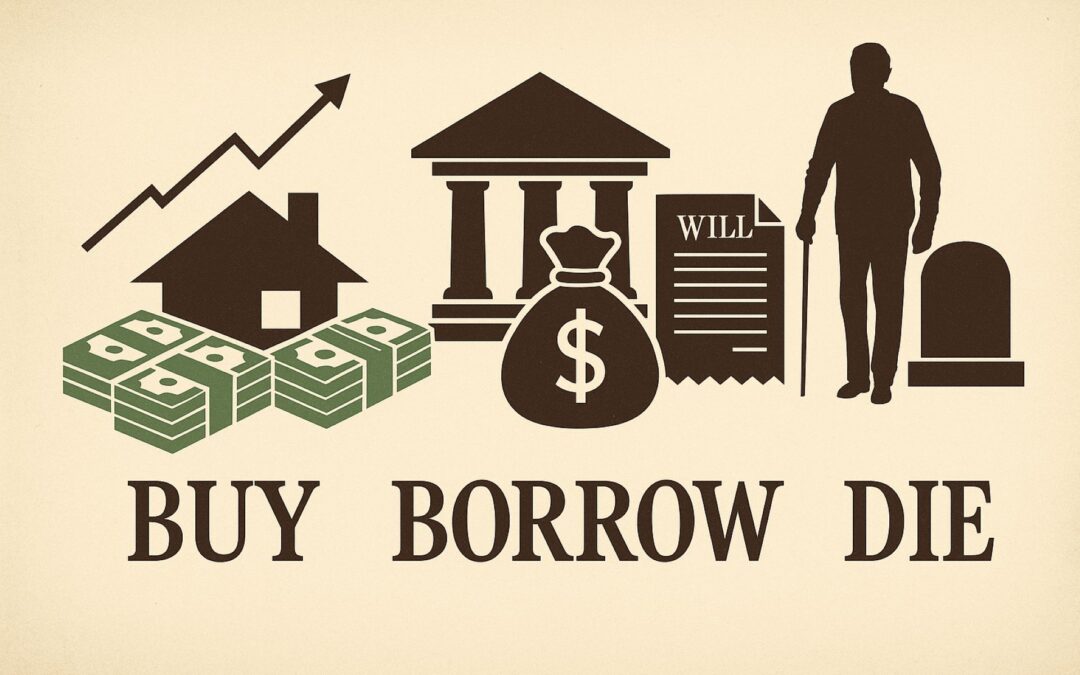
There’s a pervasive myth about wealth: that billionaires amass their fortunes through piles of cash flowing directly into their bank accounts. In reality, the ultra-rich play a financial game few truly understand — one that hinges not on cash income but on asset ownership, clever borrowing, and the artful timing of death. This system, known as Buy Borrow Die, creates an invisible wealth loop that almost exclusively benefits those who already hold significant assets.
The Illusion of Income: Why Cash Isn’t King for the Ultra-Rich
For most people, income is synonymous with wealth. You work a job, get a paycheck, maybe earn bonuses or commissions, and that money funds your daily life. It’s a tangible, liquid measure of success and security. But this traditional notion of income—money earned from labor or services—is fundamentally misunderstood when it comes to how billionaires and ultra-wealthy individuals actually accumulate and preserve their fortunes.
At first glance, it might seem like CEOs and tech moguls rake in enormous salaries. Headlines boast tens or hundreds of millions earned in a year. But dig deeper, and you find that their actual take-home cash is minimal or even zero. Elon Musk, for example, famously took no salary from Tesla for many years. Warren Buffett has held a $100,000 annual salary for decades, a pittance compared to his net worth. Jeff Bezos’ CEO salary at Amazon was under $100,000. Mark Zuckerberg takes a symbolic $1 salary.
Why do they do this? The answer lies in the nature of taxation and wealth structure. Income from labor or salary is subject to some of the highest tax rates—federal income tax alone can exceed 37% for top earners, and when combined with state taxes, Medicare, and Social Security, the effective tax rate often approaches or surpasses 50%. These taxes are immediate and unavoidable on any cash salary received.
The ultra-rich circumvent this by eschewing cash income and instead building wealth through equity—ownership stakes in companies, investments, real estate, and other appreciating assets. Equity grows silently in value over time, and this growth isn’t taxed until it is “realized,” meaning when the asset is sold or converted into cash.
This system hinges on the realization principle of taxation, a cornerstone of capital gains tax law. Unlike income tax, which hits immediately on wages, capital gains tax applies only when you dispose of an asset. If you hold onto shares as their price appreciates, you accumulate unrealized gains—paper wealth that inflates your net worth but doesn’t trigger tax bills.
Imagine you bought stock at $10 per share, and over the years it rises to $100 per share. Your paper profit is $90 per share, but you owe no taxes as long as you hold onto it. This deferral allows capital to compound exponentially because your entire gain stays invested and working for you.
Similarly, real estate and private businesses appreciate in value but do not generate taxable income until sold. This allows billionaires to amass staggering fortunes “on paper” without ever liquidating and triggering tax events. Their net worth swells, but cash income remains minimal, often just enough to cover expenses.
This creates a paradox: the wealthiest people appear cash-poor but asset-rich. Their fortunes are locked in illiquid holdings—shares in companies, stakes in real estate, or private equity funds. They are infinitely wealthy on paper but draw little to no taxable salary.
From a tax perspective, this is brilliant. The government taxes earned income aggressively, but deferred gains on held assets are effectively tax-free until realized. This creates an enormous advantage for capital owners over wage earners.
It also explains why billionaires don’t “work for money” in the traditional sense. Their primary goal isn’t to generate income but to grow the value of their assets. Cash flow is secondary. When they need liquidity, they don’t sell assets and pay capital gains taxes. Instead, they borrow against those assets, using them as collateral to access low-interest credit lines, preserving the value of their holdings while enjoying spending power.
In essence, the illusion of income is a smokescreen that conceals the real engine of wealth accumulation: ownership of appreciating assets combined with sophisticated tax and borrowing strategies. This mechanism is invisible to most and inaccessible without substantial capital, reinforcing the divide between the ultra-wealthy and everyone else.
Understanding this distinction is crucial because it reframes how we think about money and wealth. For the rich, money isn’t about the paycheck; it’s about the growth, control, and leveraging of assets—a concept fundamentally different from living paycheck to paycheck or chasing raises.
The ultra-rich have mastered the art of making money work silently and efficiently in the background, while the average person remains trapped in the visible but highly taxed cycle of earning and spending income. This gap between cash income and true wealth lies at the heart of persistent economic inequality.
The Consumer Debt Trap: Why Most Borrowing Keeps You Poor
For the vast majority of people, borrowing is not a tool for wealth creation—it’s a financial trap that slowly siphons away hard-earned money. Mortgages, credit cards, auto loans, and student debts create a web of obligations that can take decades to escape. Understanding this trap requires examining the real cost of debt and how it compounds over time, especially when combined with the crushing burden of taxes.
Take mortgages, for instance. They are often marketed as the cornerstone of building wealth through homeownership, but the reality is far more complex and less rosy. The average American household carries roughly $148,000 in mortgage debt. When you scale this to the national level, total mortgage debt exceeds $13 trillion—a staggering figure that highlights how entrenched this form of debt is.
Interest rates have been climbing steadily, recently hovering near 7%. This means that on a $250,000 mortgage at 6.85% interest over 30 years, your monthly payment is about $1,600. Over three decades, you will have paid nearly $576,000 in total—more than double the original loan amount. Early payments are mostly interest, meaning the actual equity you build in your home accumulates painfully slowly.
While owning a home can be a source of stability, this heavy interest load and slow equity build-up mean many homeowners are effectively paying a premium for the privilege of living there, without immediate wealth accumulation.
Credit cards and other consumer loans are an even more insidious form of debt. Typical credit card interest rates range from 18% to 25% or more. With such high rates, making only minimum payments barely chips away at the principal, allowing balances to balloon as interest accrues. Auto loans and student loans frequently carry similar or slightly lower rates but still add to the mountain of debt many carry.
What compounds the burden is that all these loan payments must be made from after-tax income. If your mortgage payment is $19,200 per year, and you fall into a 35% tax bracket, you need to earn roughly $29,500 before taxes just to cover that expense. This means you are paying income tax on money that immediately goes toward servicing debt, effectively taxing the same money twice—once as income, then as interest.
This “double squeeze” severely limits the capacity for saving or investing, trapping many households in a cycle where they work harder just to stay afloat.
On top of these personal burdens, banks wield enormous power. When you take out a mortgage, you don’t truly own the home until the loan is fully paid off. The bank holds the deed as collateral and can repossess and resell the property if you default. This creates a situation where homeowners are, in effect, renting from the bank until decades of payments clear the debt.
The system is rigged to extract maximum value from the working and middle classes by keeping them locked into long-term debt obligations, often with little flexibility or reprieve.
But it’s not just the amount owed that matters—the perception of risk heavily influences lending terms. Banks evaluate borrowers based on credit scores, debt-to-income ratios, employment stability, and available collateral. If you earn $150,000 but have no savings, little collateral, and a volatile job, the bank views you as a high-risk borrower. This results in higher interest rates and less favorable loan terms.
Conversely, someone earning a modest income but with strong collateral and a stable financial profile is deemed low risk and can access cheaper credit. This dynamic disproportionately favors those who already own assets.
Consequently, many working- and middle-class borrowers are burdened with high interest rates on loans they can barely afford, perpetuating financial instability. Meanwhile, their wealth is eroded by the combination of taxation on income, steep loan interest payments, and limited opportunities to build real equity.
This creates a vicious cycle: debt payments consume after-tax earnings, limiting savings; limited savings restrict asset accumulation; without assets, borrowing costs remain high; and high borrowing costs deepen financial strain.
In short, for most people, borrowing is a treadmill of expense and risk that slows or prevents wealth creation. It contrasts sharply with how the wealthy use debt—as a low-cost tool secured by assets they already own—to amplify wealth rather than diminish it.
Understanding this consumer debt trap is critical to recognizing why traditional paths to homeownership, education, and consumer purchases often fail to generate long-term financial security for the average person. Without access to assets and favorable borrowing conditions, debt becomes a slow drain rather than a stepping stone.
Buy Borrow Die: How the Wealthy Use Debt to Get Richer
The financial universe of the ultra-wealthy operates on fundamentally different principles than those governing most people’s money lives. The Buy Borrow Die strategy is a sophisticated cycle that turns ownership of appreciating assets into a perpetual engine of wealth growth and liquidity—without triggering the tax liabilities and cash flow constraints that typically ensnare average borrowers.
The strategy hinges on three distinct phases: buying assets that grow in value, borrowing cheaply against those assets to generate liquidity without selling, and leveraging the tax advantages that come with passing assets on after death. Together, these steps create a seamless financial machine that allows the wealthy to live affluent lives, invest aggressively, and transfer fortunes across generations with minimal tax friction.
Phase One: Buy — Acquire Appreciating Assets
Wealth accumulation begins with ownership. Unlike most people who focus on earning a paycheck or holding cash, the wealthy prioritize acquiring assets that appreciate over time. This is not merely a preference but a fundamental mindset shift—from viewing money as something to spend or save, to viewing it as a tool for acquiring income-generating or value-appreciating holdings.
These assets are varied and often complex. Stocks in publicly traded companies allow ownership in enterprises whose value can multiply over decades. Real estate—commercial properties, residential rentals, farmland—serves as a tangible, income-producing asset class that typically appreciates with inflation and economic growth. Private businesses, intellectual property, and alternative investments like art or rare collectibles also feature in this diversified portfolio.
The key is holding these assets for the long term rather than flipping them for short-term gains. Selling an asset crystallizes gains and triggers capital gains taxes, which can be substantial. Instead, the wealthy let their holdings compound silently, growing in value without tax consequences as long as the assets remain unsold. This “unrealized gain” grows wealth invisibly but powerfully.
Compensation structures in corporations often reflect this approach: CEOs receive stock options or equity grants rather than large cash salaries. Their real wealth lies in the rising value of their shares, aligning their financial incentives with the long-term success of the company and protecting them from heavy income taxation.
Phase Two: Borrow — Unlock Liquidity Without Selling
A paradox emerges when assets grow tremendously in value but remain illiquid. How does one fund an extravagant lifestyle, new investments, or philanthropy without selling assets and incurring taxes?
The answer is borrowing against those assets. Private banks and wealth management firms offer lines of credit secured by the client’s portfolio. Loan-to-value (LTV) ratios vary depending on asset class and stability—commonly 50% for volatile stocks, 60–70% or higher for real estate.
For example, if an individual holds $100 million in real estate, a bank might extend a $60–70 million loan at low interest rates. This loan provides ready cash flow without triggering capital gains taxes or requiring asset liquidation.
Interest rates for such loans are far lower than typical consumer debt, often between 2% and 4%, reflecting the bank’s low risk given the high collateralization. Furthermore, with appropriate structuring, interest payments may be tax-deductible, reducing the effective cost of borrowing.
This strategy allows the wealthy to enjoy tremendous liquidity while maintaining full ownership of their assets, which continue to appreciate. Over time, as the portfolio grows—say from $100 million to $150 million—the borrower’s capacity to refinance or increase borrowing grows in tandem.
Borrowing against assets also funds further investment ventures, lifestyle expenses (such as luxury homes, jets, art collections), and philanthropic efforts. Because the borrower’s net worth remains high and well-collateralized, banks are eager to maintain long-term lending relationships, creating a mutually beneficial cycle.
Contrast this with average borrowers who rely on after-tax income to service high-interest debt, have little collateral, and face onerous repayment schedules. The wealthy convert paper wealth into usable cash without losing the underlying asset or triggering taxes, a privilege unavailable to most.
Phase Three: Die — The Wealth Reset Through Estate Planning
The final piece of the puzzle, and arguably the most potent, involves passing assets to heirs.
U.S. tax law provides a critical benefit called the step-up in basis: when an asset owner dies, the cost basis of their assets resets to the market value at the date of death. This eliminates the capital gains accumulated during the deceased’s lifetime for the heirs.
Imagine a scenario where an individual bought $1 million worth of Apple stock decades ago, now worth $10 million. If sold while alive, the $9 million gain would be taxed at capital gains rates, potentially 20% or more. But upon inheritance, the cost basis jumps to $10 million, so heirs can sell immediately without paying capital gains taxes on any gain accrued during the original owner’s lifetime.
Estate planning tools like trusts and irrevocable life insurance policies often complement this process. Life insurance proceeds can cover outstanding loans the deceased had taken against assets, ensuring the estate can pay off debts without forcing asset sales.
This phase allows the wealthy to borrow against appreciating assets for decades, enjoy liquidity and tax advantages, then hand over clean, unencumbered assets to the next generation. This perpetuates wealth without triggering heavy tax burdens that would otherwise erode fortunes.
The combination of unrealized gains, low-cost borrowing, and the step-up in basis creates a nearly frictionless wealth cycle available only to those with sufficient assets and access to specialized financial services.
Why the System Favors the Asset Owner
The Buy Borrow Die strategy exposes a deep structural imbalance embedded within modern financial, tax, and lending systems—a system explicitly designed to reward asset ownership and penalize reliance on wages. Understanding why the system favors asset owners requires unpacking the interplay between taxation policies, credit markets, and legal frameworks that together create a disproportionate advantage for those who hold appreciating assets.
At its core, the system distinguishes sharply between capital and labor. Labor—the income earned through working—is taxed heavily and immediately. Capital—the wealth held in assets like stocks, real estate, or businesses—is subject to taxes primarily when gains are realized, not accrued. This fundamental tax distinction incentivizes asset ownership and penalizes earned income, setting the stage for wealth accumulation among capital holders while restricting wealth mobility for wage earners.
When ordinary workers receive their paychecks, they are hit by income tax rates that can exceed 30-40% at the federal level, with additional state taxes layered on. This means nearly half of what they earn can be siphoned away before they even begin to cover living expenses or pay down debt. In contrast, owners of assets enjoy the luxury of deferring taxes on appreciation until they sell—often decades later or never—allowing wealth to compound uninterrupted by taxation.
Credit markets further reinforce this divide. Banks and lenders view asset-backed borrowers as low risk because the loans are secured by tangible, appreciating collateral. This security translates into lower interest rates, longer repayment terms, and larger loan amounts. Asset owners can therefore borrow cheaply and on favorable terms, leveraging their holdings to access liquidity without sacrificing ownership or triggering tax events.
On the other hand, wage earners and those without substantial collateral are categorized as high risk. Their loans come with higher interest rates, stringent terms, and often ballooning monthly payments. The disparity means that while asset owners enjoy near “free money” through low-cost borrowing, most people pay exorbitant prices to access capital.
This credit advantage enables asset owners to use debt strategically: to acquire more appreciating assets, invest in new ventures, fund lifestyles, and engage in philanthropic activities. Each use of cheap credit further expands their net worth and financial flexibility, reinforcing a self-sustaining cycle of wealth growth.
Legal structures amplify these advantages through estate and trust planning. The step-up in basis rule, for instance, effectively erases capital gains taxes on inherited assets, allowing fortunes to transfer between generations intact. Moreover, sophisticated estate planning vehicles—like irrevocable trusts and family offices—enable the wealthy to shield assets from estate taxes, creditor claims, and even divorce settlements.
These tools are unavailable or inaccessible to the majority, further entrenching wealth concentration within established capital holders.
The combined effect is a system where ownership of the right assets grants access to preferential tax treatment, low-cost capital, and estate protections—resources that multiply wealth efficiently and protect it from erosion.
Meanwhile, those dependent on wages face a far steeper climb. Their earnings are immediately taxed, their borrowing is costly and risky, and their ability to build wealth is constrained by both high taxes and limited access to appreciating assets.
This systemic disparity explains why wage growth alone has failed to close the wealth gap. Without access to asset ownership and the financial tools that accompany it, rising incomes offer only limited upward mobility.
The takeaway is clear: to engage effectively with the financial system and build enduring wealth, one must shift focus from earning income to acquiring and controlling appreciating assets. This transition changes the game from surviving paycheck-to-paycheck to participating in a cycle that the system is built to reward.
The Buy Borrow Die strategy is a masterclass in leveraging this system—a blueprint that transforms paper wealth into liquidity, minimizes taxation, and perpetuates financial power. It is the engine behind multigenerational wealth and the financial moat that separates the ultra-rich from the rest.
Understanding and navigating this structure is essential not only for those seeking personal wealth but also for anyone grappling with the realities of economic inequality and the rules that govern modern capitalism.
Conclusion
Understanding these mechanics reveals why wealth inequality persists and why financial literacy alone won’t bridge the gap without access to assets and structural advantages. The ultra-rich don’t just earn money—they orchestrate its flow, multiplying it through ownership, strategic borrowing, and legacy planning.
If you want to transcend the rat race, start by thinking beyond income. Build assets. Learn to borrow intelligently. And plan your financial legacy carefully. That’s the roadmap the wealthy have been following for generations.