
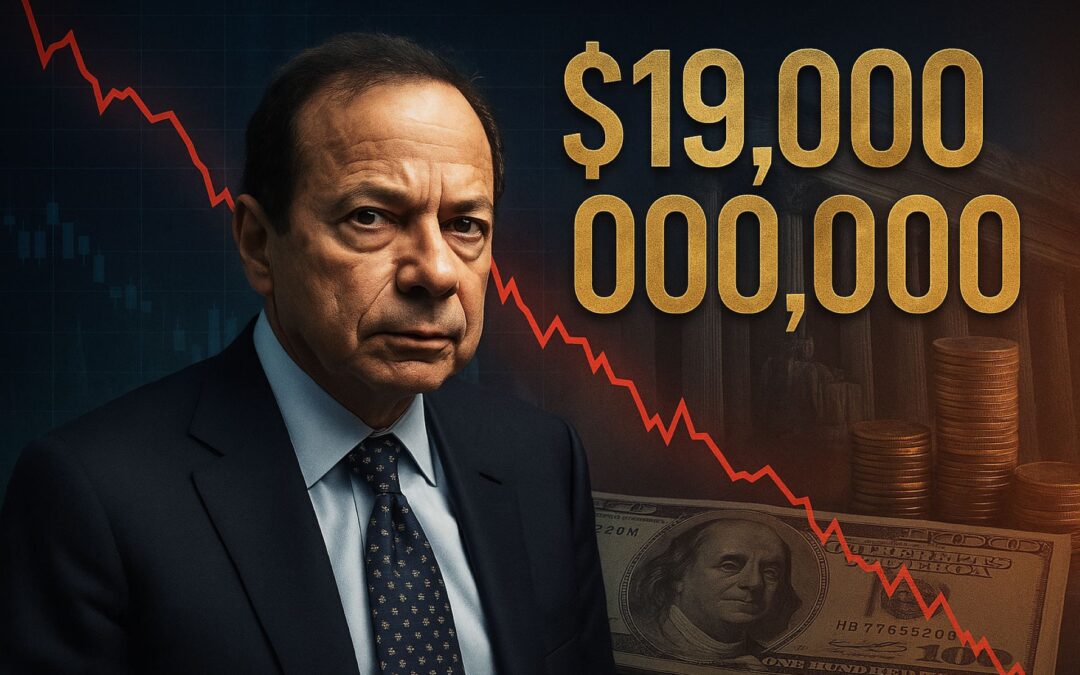
There are trades that make money, and then there are trades that redefine what’s even possible.
In a span of just two years, an obscure hedge fund manager turned a deeply unpopular idea into nearly $20 billion in profit. Not by following the market, but by betting against it at a time when doing so looked almost irrational. While legends like George Soros and David Tepper built their reputations on bold moves, what John Paulson pulled off during the mid-2000s housing bubble stands in a category of its own.
Because this wasn’t just a big bet. It was a bet against a system that appeared unbreakable.
At the time, the U.S. housing market was widely considered one of the safest corners of the global economy. Prices had been rising steadily, credit was flowing freely, and institutions across Wall Street were reinforcing the same narrative: real estate doesn’t collapse on a national scale. It never had. And in a system built on historical precedent, that was enough to convince almost everyone.
Almost.
Paulson didn’t come from a real estate background. He wasn’t a mortgage expert, nor did he have insider access to the housing market. What he had instead was something far rarer: the ability to step back, question the consensus, and investigate what others were too comfortable to challenge.
What he discovered wasn’t just a flaw—it was a structural vulnerability hiding in plain sight. A system fueled by easy money, distorted incentives, and blind trust in institutions that were supposed to manage risk but had quietly abandoned it.
And once he saw it clearly, the question wasn’t whether the system would fail.
It was when.
The Trade That Shouldn’t Have Been Possible
A $20 Billion Outlier in Financial History
In the world of high finance, billion-dollar trades are rare. Multi-billion-dollar trades are legendary. But a single strategy generating nearly $20 billion in profit within two years? That’s something else entirely.
To put it into perspective, even the most celebrated trades in modern financial history don’t quite match the scale and precision of what John Paulson achieved. George Soros’s famous bet against the British pound during the 1992 currency crisis netted around $1 billion in a single day. David Tepper made billions during the 2008 recovery by betting on distressed financial institutions. These were bold, high-conviction moves that required timing, insight, and nerve.
But Paulson’s trade was different.
It wasn’t a reaction to a crisis. It was a prediction of one.
He positioned himself before the collapse, at a time when the overwhelming majority of investors, institutions, and regulators believed the system was stable. There was no panic yet. No visible cracks that the broader market acknowledged. Just a quiet, growing imbalance that most people either didn’t see or chose to ignore.
And that’s what makes this trade so extraordinary. It wasn’t just profitable—it was asymmetrical. Paulson risked relatively small, controlled amounts of capital in exchange for a payoff that could only materialize if a highly improbable event occurred: the widespread failure of the U.S. housing market.
Why This Trade Stands Above Soros and Others
Most historic trades are built on identifying mispriced assets or macroeconomic shifts that the market hasn’t fully accounted for yet. Soros saw that the British pound couldn’t maintain its peg within the European Exchange Rate Mechanism. Tepper recognized that the market had become overly pessimistic about financial institutions during the crisis.
Paulson, however, identified something deeper.
He saw that the entire foundation of a major asset class was built on faulty assumptions. That the risk wasn’t just mispriced—it was misunderstood. Entire financial products were being labeled safe when, in reality, they were anything but.
And instead of shorting housing directly or waiting for visible signs of distress, he found a way to profit from the failure of the system itself.
That required more than just analysis. It required conviction.
Because making a bet like this means accepting a simple, uncomfortable truth: if you’re right, almost everyone else has to be wrong.
The Illusion of a Perfect Market
The Housing Boom That Defied Logic
From the early 2000s to around 2006, the U.S. housing market entered what looked like a golden age. Home prices weren’t just rising—they were accelerating. Historically, real estate appreciated at a steady 3 to 5% per year. But during this period, prices were climbing closer to 10% annually, and in some regions, even faster.
At first glance, it looked like prosperity. More homeowners, rising equity, booming construction, and expanding wealth. But beneath the surface, something didn’t add up.
Markets don’t grow exponentially forever—especially not ones tied to something as grounded as income and affordability. When asset prices begin to outpace the financial reality of the people buying them, it’s usually a signal that something artificial is sustaining the growth.
In this case, it wasn’t organic demand driving the boom.
It was access to credit.
Cheap Money and Easy Credit After 9/11
In the aftermath of 9/11, the Federal Reserve lowered interest rates to stabilize the economy and encourage spending. Borrowing became cheaper, and suddenly, mortgages were more accessible than ever before.
Lower interest rates meant lower monthly payments, at least initially. That brought a wave of new buyers into the market—people who previously couldn’t afford homes now found themselves eligible for loans.
But cheap money doesn’t just increase demand. It distorts it.
Banks, flush with liquidity and incentivized to lend, began expanding their criteria. The goal was no longer just to lend responsibly—it was to lend as much as possible. The more loans issued, the more money flowed through the system.
And that’s where the real shift began.
The Rise of Subprime Lending
Traditionally, mortgages were reserved for borrowers with stable income, solid credit histories, and a high likelihood of repayment. These were known as prime borrowers.
But during the housing boom, a new category began to dominate: subprime borrowers.
These were individuals with low credit scores, inconsistent income, or financial histories that made them high-risk candidates. Under normal circumstances, they wouldn’t qualify for large loans. But now, they were being approved in massive numbers.
Between 2000 and 2006, subprime lending didn’t just grow—it exploded. The total value of mortgage debt nearly doubled, rising from around $4.8 trillion to $9.8 trillion. A significant portion of that growth came from loans issued to borrowers who had little capacity to repay them under normal conditions.
To compensate for the risk, these loans often came with higher interest rates, adjustable terms, and hidden penalties. They looked manageable at the beginning, but over time, the financial burden would increase—sometimes dramatically.
And yet, despite the rising risk, the system kept expanding.
Because as long as housing prices continued to rise, defaults could be delayed, hidden, or ignored.
As long as the illusion held, the market looked perfectly healthy.
But the moment it broke, everything tied to it would unravel with it.
The System That Incentivized Recklessness
How Banks Stopped Caring About Risk
At the core of the housing bubble wasn’t just bad judgment—it was a system designed in a way that made bad judgment profitable.
Traditionally, banks followed a simple model: they issued loans and held them for decades, collecting monthly payments along the way. This structure forced discipline. If a borrower defaulted, the bank absorbed the loss. So naturally, they were careful about who they approved.
But by the early 2000s, that model had fundamentally changed.
Banks no longer needed to hold onto the loans they issued. Instead, they could originate a mortgage, bundle it together with thousands of others, and sell it to Wall Street almost immediately. This process allowed them to recover their money upfront and move on to issuing more loans.
The incentive shifted from loan quality to loan quantity.
Once the risk was passed on to someone else, there was little reason to scrutinize borrowers carefully. As long as loans kept flowing, profits kept growing. And so, standards eroded. Approval processes loosened. Risk became someone else’s problem.
The Securitization Machine Explained Simply
To understand how this system scaled, you have to understand securitization—the mechanism that turned individual mortgages into tradable financial products.
At its core, it was deceptively simple.
Thousands of mortgages were pooled together into a single financial structure. That pool was then sliced into different layers, known as tranches, each with varying levels of risk and return. These slices were sold to investors as mortgage-backed securities or more complex instruments like collateralized debt obligations (CDOs).
The idea was that by combining many loans, the overall risk would be diluted. Some borrowers might default, but others would continue paying, creating a steady stream of income.
In theory, it made sense.
In practice, it masked reality.
Because inside these pools were increasing numbers of subprime loans—high-risk borrowers who were far more likely to default. But once blended together with better-quality loans, the true level of risk became harder to see.
It was financial alchemy: turning questionable assets into something that appeared safe.
Why AAA Ratings Meant Nothing
The final layer of the system—and perhaps the most dangerous—was the role of credit rating agencies.
These institutions were supposed to act as gatekeepers, evaluating the risk of financial products and assigning ratings to guide investors. A AAA rating signaled the highest level of safety, reserved for investments considered almost risk-free.
And yet, many of these mortgage-backed securities filled with subprime loans were receiving exactly that rating.
Why?
Because the models used to assess them assumed that housing prices would continue rising. As long as that assumption held, defaults would remain low, and the structure would appear stable.
But that assumption was never truly questioned.
And there was another conflict hiding in plain sight: rating agencies were paid by the very institutions creating these securities. The more deals that got approved, the more money flowed through the system.
So instead of acting as a barrier, the ratings became a rubber stamp.
To the outside world, everything looked secure. Pension funds, insurance companies, and large institutional investors poured money into these products, trusting the ratings that labeled them safe.
But underneath the surface, the risk wasn’t just growing.
It was being systematically ignored.
Seeing What Others Ignored
Paulson’s Unlikely Background
John Paulson wasn’t the obvious candidate to uncover one of the biggest financial vulnerabilities in modern history.
He didn’t come from a real estate background. He wasn’t deeply embedded in mortgage markets. In fact, for much of his early career, he struggled to stand out. Despite graduating near the top of his class from New York University and earning a place at Harvard Business School, his initial years in finance were far from remarkable.
When he launched his hedge fund, Paulson & Co., in 1994, it barely gained traction. Clients were slow to come in. Performance was modest at best, often trailing industry averages. For years, he operated on the margins of the hedge fund world—competent, but not exceptional.
And that’s exactly what makes what happened next so important.
Because Paulson wasn’t anchored by deep experience in the housing market, he wasn’t conditioned to accept its assumptions. He wasn’t emotionally invested in the belief that real estate was inherently stable. He approached it with distance—and that distance allowed him to see what others overlooked.
Bringing in Expertise to Understand the Market
Recognizing his limitations, Paulson didn’t try to force expertise he didn’t have. Instead, he did something far more valuable—he brought in someone who did.
He hired Paolo Pellegrini, an analyst with a strong background in credit markets, to help him dig deeper into what was actually happening beneath the surface of the housing boom. Together, they began dissecting the structure of mortgage-backed securities and the growing prevalence of subprime loans.
What they found wasn’t just concerning—it was systemic.
Banks were issuing loans to increasingly risky borrowers, but they weren’t holding onto those loans. They were packaging them, selling them, and moving on. Investors buying these securities believed they were diversified and safe, largely because of the ratings attached to them.
But when Paulson and Pellegrini looked closer, they realized that many of these securities were heavily exposed to the same underlying risk: borrowers who were unlikely to repay their loans if conditions changed.
It wasn’t diversification.
It was concentration disguised as complexity.
The Realization: It Was a Matter of When, Not If
At a certain point, the analysis stopped being about probabilities and started becoming about inevitability.
If housing prices slowed or stopped rising, subprime borrowers would begin to default. If enough of them defaulted, the mortgage-backed securities built on those loans would start to lose value. And because these securities were spread across the entire financial system, the effects wouldn’t be isolated—they would cascade.
The system wasn’t fragile because of one bad decision. It was fragile because every layer of it depended on the same assumption continuing indefinitely.
And that assumption was already starting to crack.
For Paulson, this shifted the question entirely. It was no longer about whether the market might correct.
It was about how to position himself for when it did.
The Bet: Credit Default Swaps Explained
What a CDS Really Is
Once Paulson understood the fragility of the system, the next challenge was execution.
Seeing a problem is one thing. Profiting from it is another entirely.
The instrument he chose to express his conviction was something most investors at the time barely understood: the credit default swap, or CDS.
At its core, a CDS functions like insurance on a bond. If a borrower fails to repay their debt, the CDS pays out to the holder. In exchange for that protection, the buyer pays a periodic premium—much like an insurance policy.
In traditional use, this made sense. If you owned a bond and were worried about default risk, you could buy a CDS to hedge against potential losses.
But Paulson wasn’t interested in protection.
He was interested in positioning.
Betting on Failure Without Owning the Asset
What made credit default swaps so powerful—and so unusual—was that you didn’t need to own the underlying bond to buy one.
That meant Paulson could effectively bet on the failure of mortgage-backed securities without ever purchasing them.
It’s a counterintuitive idea. Imagine buying fire insurance on a house you don’t own—not because you want to protect it, but because you’re convinced it’s going to burn down. If it does, you collect the payout.
That’s essentially what Paulson did.
He identified specific mortgage bonds heavily exposed to subprime loans and purchased CDS contracts tied to them. He paid relatively small premiums to financial institutions like AIG and major investment banks, which agreed to compensate him if those bonds lost value or defaulted.
At the time, this seemed like easy money for the sellers. After all, the prevailing belief was that housing prices would continue rising, and widespread defaults were highly unlikely.
Which meant the insurance looked cheap.
Why the Opportunity Was So Cheap
The pricing of those CDS contracts reflected the market’s confidence.
Because almost no one believed that a large-scale housing collapse was possible, the perceived risk of default was extremely low. And when perceived risk is low, the cost of insuring against it drops accordingly.
That created an asymmetry.
Paulson was risking relatively small, ongoing payments in exchange for a potential payout that could be exponentially larger if his thesis proved correct. He didn’t need the entire housing market to collapse. He just needed enough subprime borrowers to default for those specific bonds to start unraveling.
And because these contracts were traded privately—over-the-counter rather than on public exchanges—there was little transparency. Even the institutions selling the CDS often didn’t fully grasp the scale of exposure they were taking on.
They saw steady premium income.
Paulson saw a ticking clock.
And the moment those underlying loans began to fail, the entire structure would flip—from a slow bleed of premiums into a sudden surge of payouts.
Timing the Collapse Perfectly
Why Paulson Got Paid Before Everyone Else
Identifying the flaw in the system was only half the equation. What turned Paulson’s trade into something historic was timing.
Many investors eventually realized that the housing market was unstable. But most of them positioned themselves too late—or in ways that delayed their profits until the crisis was already unfolding in full view.
Paulson’s approach was different.
Because he wasn’t betting on housing prices directly, he didn’t need to wait for the broader market to visibly collapse. His position was tied to the performance of specific mortgage bonds—particularly those loaded with subprime loans.
And those were the first to break.
As soon as borrowers began missing payments, the value of those bonds started to deteriorate. That triggered payouts on the credit default swaps Paulson had accumulated. While the rest of the market was still debating whether a downturn was even happening, his position was already moving into profit.
He wasn’t reacting to the crash.
He was positioned at the exact point where it would begin.
The Advantage of Targeting Subprime Bonds
Not all parts of the housing market were equally fragile.
Prime borrowers—those with stable income and strong credit—were less likely to default, even under pressure. But subprime borrowers operated on far thinner margins. Many of them were already stretched financially, relying on rising home prices or favorable loan terms to stay afloat.
That made them the weakest link in the chain.
Paulson didn’t need a nationwide collapse in housing prices. He focused on mortgage bonds heavily concentrated with these high-risk loans. As soon as conditions tightened—whether through rising interest rates or slowing price growth—defaults would begin cascading through that segment first.
And once they did, the structure built on top of them would follow.
This precision gave him a critical advantage. While others made broader, less targeted bets, Paulson positioned himself exactly where the system was most vulnerable.
Locking in Profits Before the Crowd Arrived
Perhaps the most overlooked part of the trade wasn’t the entry—it was the exit.
As the housing market began to crack in 2007, awareness spread quickly. What had once seemed impossible was now undeniable. Investors rushed to take similar positions, driving up the cost of credit default swaps and flooding the trade with new participants.
But by then, Paulson was already ahead.
He had accumulated his positions when CDS contracts were cheap and largely ignored. As demand surged, those same contracts became expensive, reducing the potential upside for latecomers.
More importantly, the institutions responsible for paying out those contracts were beginning to feel the strain. The longer one stayed in the trade, the greater the risk that counterparties might fail before honoring their obligations.
Paulson recognized this.
He began closing out positions and securing profits while the system was still functioning—before the full extent of the crisis overwhelmed the very entities that owed him money.
In 2007 alone, his fund generated approximately $15 billion in profit, with Paulson personally earning around $4 billion—the largest individual payout in hedge fund history at the time.
He didn’t just get the direction right.
He got the timing right—on both ends of the trade.
The Psychology Behind the Greatest Trade
Why Markets Follow Crowd Behavior
At first glance, markets appear rational—driven by data, analysis, and informed decision-making. But beneath that surface lies something far more human.
Markets are, at their core, collective behavior.
Investors don’t operate in isolation. They observe each other, react to each other, and often take cues from what the majority seems to believe. Even when decisions are framed as data-driven, they’re frequently influenced by consensus.
And consensus has momentum.
When prices rise, it reinforces the belief that they should keep rising. More people buy in, pushing prices even higher. Confidence builds, risk perception drops, and skepticism fades. Over time, what started as a trend transforms into a shared assumption.
That assumption becomes the market’s reality—until it doesn’t.
The Danger of Widely Accepted Beliefs
The most dangerous ideas in markets are the ones that feel unquestionably true.
During the housing boom, one belief dominated: real estate prices don’t fall on a national level. It had historical backing, institutional support, and widespread acceptance. Banks believed it. Investors believed it. Rating agencies built models around it.
And because everyone believed it, no one felt the need to challenge it.
This is how systemic risk builds—not through obvious mistakes, but through unquestioned assumptions. When an idea becomes universal, it stops being tested. It becomes embedded in pricing, embedded in behavior, embedded in decision-making.
At that point, the market is no longer evaluating reality.
It’s reinforcing a narrative.
How Mispricing Is Created
When everyone aligns around the same belief, markets lose balance.
In a functioning market, there are always opposing views—buyers and sellers, optimists and skeptics. That tension is what keeps prices anchored to reality. But when one side dominates completely, that balance disappears.
There’s no one left to question valuations. No one left to push back against excessive optimism. Prices drift further away from underlying fundamentals, not because new information justifies it, but because belief itself is driving behavior.
That’s mispricing.
And mispricing doesn’t correct gradually. It builds quietly and then resolves violently.
Because when the underlying assumption finally breaks—when reality contradicts the belief—everyone tries to move at once. Sellers overwhelm buyers. Confidence collapses. And prices adjust far more aggressively than they rose.
This is the environment Paulson stepped into.
He wasn’t just betting against housing.
He was betting against a belief system that had gone unchallenged for too long.
Contrarian Investing: Strategy vs Mindset
Why It’s Not Just a System You Follow
Contrarian investing is often misunderstood as a simple rule: do the opposite of what everyone else is doing.
But that’s an oversimplification—and a dangerous one.
If it were that easy, everyone would do it successfully. The reality is that going against the crowd only works when the crowd is wrong. And identifying when that’s the case requires far more than blind opposition.
It requires judgment.
A true contrarian doesn’t reject consensus for the sake of being different. They question it. They test it. And only when they find that the underlying assumptions don’t hold up do they position themselves against it.
In that sense, contrarian investing isn’t a fixed strategy with clear signals and triggers.
It’s a way of thinking.
Emotional Discipline and Independent Thinking
The hardest part of being a contrarian isn’t intellectual—it’s emotional.
Standing apart from the crowd means operating without validation. There are no reassuring signals when you’re early. No widespread agreement to confirm that you’re on the right track. In fact, most of the feedback you receive suggests the opposite.
You look wrong.
And often, for a while, you are.
Markets can stay irrational longer than expected. Prices can continue rising even when fundamentals deteriorate. Narratives can persist long after they stop making sense. And during that time, the pressure to conform builds.
Doubt creeps in. Fear intensifies. The temptation to abandon your position becomes overwhelming.
This is where most contrarian ideas fail—not because they were incorrect, but because they were abandoned too early.
The Cost of Being Early and Alone
There’s a hidden cost to being right before everyone else.
When you enter a position early, you absorb uncertainty without immediate reward. You watch the market move against you. You endure skepticism from others and second-guessing from yourself. And all of that happens before the payoff, if it comes at all.
That’s the gap most people can’t tolerate.
They want confirmation. They want alignment. They want the comfort of knowing others see what they see. But by the time that comfort arrives, the opportunity is often gone—or significantly diminished.
Paulson understood this.
He didn’t just identify a flaw in the system—he committed to it long before it became obvious. He absorbed the discomfort of being early, knowing that if his analysis was correct, timing would eventually catch up to him.
Contrarian investing, at its highest level, isn’t about doing the opposite.
It’s about holding your ground when everything around you suggests you shouldn’t.
Why Almost Nobody Could Have Done This
The Fear of Going Against Consensus
On paper, Paulson’s trade looks logical. Identify a flawed system, find a way to profit from its failure, and execute.
In reality, almost no one could have done it.
Because going against the consensus at that scale isn’t just a financial decision—it’s a social and psychological one. When the entire market agrees on something, that agreement creates a powerful form of pressure. Not explicit, but ambient. It shapes how you think, what you question, and what you’re willing to act on.
Every institution, every expert, every signal around you reinforces the same idea: this is safe.
To challenge that isn’t just to question a trade.
It’s to question the collective judgment of an entire system.
And most people aren’t wired for that.
The Pain of Being Wrong Before Being Right
Even if you manage to step outside the consensus, there’s another hurdle waiting: the timeline.
Being early in a contrarian position often feels identical to being wrong.
Prices don’t immediately validate your thesis. In fact, they often move in the opposite direction first. Losses accumulate. Confidence erodes. And with each passing day, the gap between your belief and the market’s behavior becomes harder to ignore.
This is where conviction gets tested.
Because it’s one thing to believe something intellectually. It’s another to watch that belief get challenged in real time, with capital on the line, and still hold your position.
Most investors can’t.
They exit too soon, not because their idea was flawed, but because the discomfort became unbearable.
The Role of Conviction and Timing
Paulson’s edge wasn’t just insight—it was alignment between insight, conviction, and timing.
He saw the weakness early. He built his position when it was still cheap. And he held it long enough for the thesis to play out—but not so long that he got caught in the aftermath.
That balance is incredibly difficult to achieve.
Too early, and you risk running out of capital or patience. Too late, and the opportunity shrinks as others pile in. Stay too long, and you expose yourself to second-order risks, like counterparties failing or the trade becoming overcrowded.
Precision matters.
And it’s that combination—seeing clearly, acting early, holding steady, and exiting decisively—that separates rare trades from ordinary ones.
It’s also why, even with the same information, very few people would have been able to replicate what Paulson did.
The Real Lesson Behind the $20 Billion Trade
Humility, Curiosity, and Adaptability
John Paulson’s trade didn’t begin with certainty—it began with doubt.
He didn’t assume he understood the housing market. In fact, he knew he didn’t. Instead of forcing a conclusion, he leaned into that gap. He brought in expertise, questioned what he was seeing, and stayed open long enough to understand the system properly.
That’s where most people fail.
They either assume they already know enough, or they rely too heavily on existing narratives. Paulson did neither. He approached the situation with curiosity, not ego—and that allowed him to see the cracks forming beneath what looked like a stable system.
Adaptability followed naturally. As new information emerged, he refined his thesis instead of defending it. He wasn’t trying to be right—he was trying to understand what was actually happening.
And in a market driven by overconfidence, that mindset created an edge.
Recognizing Patterns Before They Break
Nothing Paulson identified was hidden.
The rise in subprime lending was visible. The surge in housing prices was obvious. The increasing complexity of financial products was widely known. Even the misaligned incentives across banks, investors, and rating agencies were not a secret.
But most people looked at these signals in isolation.
Paulson connected them.
He recognized that all of these trends pointed to the same underlying issue: a system dependent on conditions that couldn’t sustain themselves indefinitely. Rising prices were masking weak borrowers. Complex structures were disguising concentrated risk. Confidence was replacing scrutiny.
That’s how systemic risk builds—not through a single failure, but through a pattern that only becomes clear when you step back and look at the whole picture.
And once you see that pattern, the outcome becomes much easier to anticipate.
Knowing When to Exit
Getting in early is only part of the equation.
Knowing when to get out is just as critical—and often far more difficult.
As the housing market began to crack, Paulson’s position started paying off. The thesis was validated. The profits were real. But that’s exactly when a new set of risks emerged.
More investors entered the same trade. CDS contracts became more expensive. And the institutions responsible for paying out those contracts were starting to weaken under pressure.
The dynamics had changed.
What was once a clean, asymmetric opportunity was becoming crowded and unstable. Staying too long meant risking exposure to factors beyond the original thesis—like counterparty failure or diminishing returns.
Paulson recognized this shift.
He didn’t wait for the collapse to fully play out. He exited while the system was still functioning, locking in gains before the environment turned chaotic.
Because the final discipline of any great trade isn’t just being right.
It’s knowing when the opportunity no longer is.
Conclusion
John Paulson’s $20 billion trade wasn’t just about spotting a market inefficiency.
It was about seeing through a system built on assumptions that no one was questioning anymore.
He didn’t rely on superior information. He relied on better interpretation. While the world saw rising prices and stability, he saw leverage, fragility, and misaligned incentives stacked on top of each other. And more importantly, he acted on that understanding before the market was forced to confront it.
That’s what made the difference.
Because markets don’t collapse when problems exist—they collapse when those problems can no longer be ignored. By the time the shift becomes obvious, the opportunity has already passed or become crowded.
Paulson moved before that moment.
But what truly separates this trade isn’t just the outcome—it’s the mindset behind it. The willingness to question consensus. The discipline to stay with an idea before it’s validated. And the clarity to exit before the environment changes.
Most people wait for confirmation.
The few who don’t are the ones who define moments like this.
And that’s why trades of this magnitude are so rare.
Not because the opportunities don’t exist—but because almost nobody is willing to act when they do.